REVIEW 3 major objections 4 minor 43 references
GauCho: Gaussian Distributions with Cholesky Decomposition for Oriented Object Detection
T0 review · 3 major / 4 minor · reviewed 2026-08-09 · deepseek-v4-flash
Pith's one-line read Oriented object detection can sidestep angle discontinuities by regressing Gaussian Cholesky parameters directly instead of oriented bounding boxes.
desk verdict GauCho is a genuinely new regression head with correct math and broad experiments, but the boundary-discontinuity claim is a labeled hypothesis, not a proven theorem, so the paper needs revision and reproducibility artifacts before acceptance. read the letter →
The pith
A machine-rendered reading of the paper's core claim, the machinery that carries it, and where it could break.
The reading
What carries the argument
The Cholesky decomposition of the 2D covariance matrix, C = LL^T with L = [[α, 0], [γ, β]] and α, β > 0, γ ∈ R. This gives a unique, continuous parameterization of a Gaussian distribution: unlike the covariance entries (a, b, c), the parameters (α, β, γ) are unconstrained except for positivity of α and β, and unlike OBB parameters (w, h, θ) they are 180-degree periodic and continuous in rotation. The paper uses it as the regression target of detection heads, with multiplicative offsets relative to anchors or strides, and proves bounds relating α, β, γ to object dimensions so the head can be initialized from anchor geometry.
What would settle it
Train an otherwise identical detector to regress the Cholesky parameters (α, β, γ) directly from a Gaussian ground truth, using a Gaussian loss, and plot the loss as a function of predicted orientation for a fixed anisotropic object. If a second local minimum persists near the boundary (e.g., near -90 degrees for a target at 89 degrees) that is almost as deep as the global minimum, the causal claim that the mapping is the culprit would be refuted; if the landscape becomes single-minimum, the claim survives.
Extended reading notes
Core claim
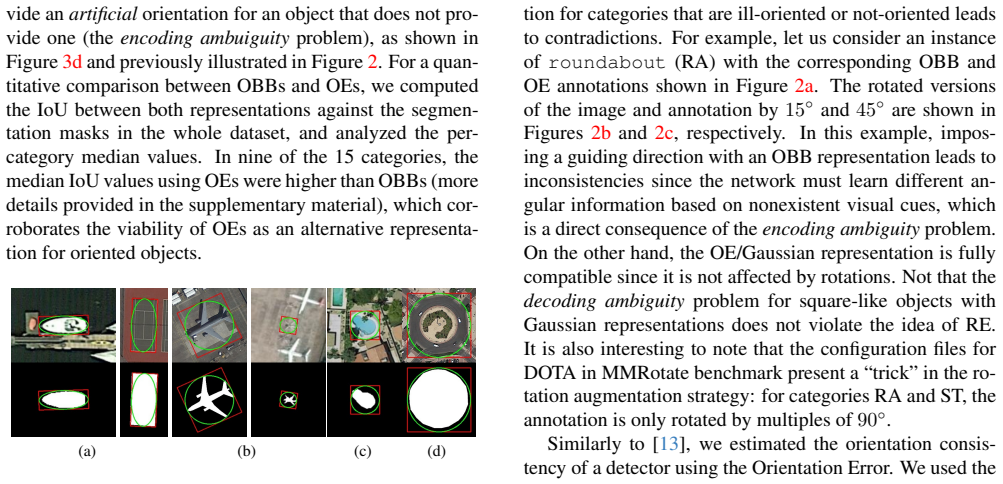
The paper claims that the angular boundary problem in oriented object detection is caused by the mapping from oriented bounding boxes to Gaussians, not by Gaussian loss functions themselves, and that regressing Gaussian Cholesky parameters directly should therefore mitigate it. GauCho parameterizes a 2D Gaussian by its mean (x,y) and a covariance matrix C, whose positive-definiteness is enforced by writing C = LL^T with lower-triangular L, whose entries α, β, γ the network outputs. The paper proves bounds relating α, β, γ to the OBB dimensions w and h and shows a bijective continuous relation between the Cholesky parameters and the Gaussian, so any Gaussian-based regression loss can be applied without angle discontinuity. It also introduces oriented ellipses as a decoding target and shows that they are a natural output for Gaussian-based detectors, especially for near-circular objects.
Load-bearing premise
The advantage of GauCho rests on the hypothesis that the angular boundary problem observed with Gaussian losses is caused by the OBB-to-Gaussian mapping, not by the Gaussian loss function itself; the paper illustrates but does not prove this causal chain.
Editorial extensions
If this is right
- Any Gaussian-based regression loss — GWD, KLD, or ProbIoU — can be trained with the GauCho head without modifying the loss, since the head outputs the same Gaussian parameters the loss consumes.
- Anchor-free and anchor-based, one-stage and two-stage detectors can switch to GauCho by changing only the regression head, keeping the rest of the architecture intact.
- GauCho reduces orientation errors: on HRSC the average orientation error drops from 1.36 degrees with the OBB head to 1.11 degrees, with smaller errors in every orientation bin.
- On DOTA v1.0 with multiscale training, GauCho paired with RoI-Transformer reaches 80.61 AP50, better than the OBB-head methods compared.
- Decoding detections as oriented ellipses raises AP75 on UCAS-AOD and gives a representation that is well defined for circular objects.
Reading between the lines
- A testable extension: if the causal claim is right, then any future improvement to Gaussian loss functions will inherit the boundary-discontinuity fix without extra machinery; one way to test this is to inject perfect Cholesky ground truth and check whether the two local minima in the loss landscape disappear.
- A natural extension beyond 2D is to regress Cholesky factors of 3D covariance ellipsoids for oriented 3D detection, where the same continuity argument should hold.
- The OE representation could become a practical output format for detectors on datasets with many circular instances, replacing arbitrary OBB angles with a representable circle; measuring IoU against masks would quantify the gain.
- GauCho's bound equations suggest that anchor boxes could be designed directly in (α, β, γ) space; testing whether such anchors give better recall than OBB-space anchors would isolate the benefit of the parameterization.
Editorial analysis
A structured set of objections, weighed in public.
Referee Report
Summary. The paper proposes GauCho, a regression head for oriented object detection that directly outputs the lower-triangular Cholesky factors (α, β, γ) of a 2D Gaussian covariance matrix, instead of the usual oriented-bounding-box (OBB) parameters (x, y, w, h, θ). The authors derive bounds relating the Cholesky parameters to OBB dimensions, instantiate the head in anchor-free and anchor-based detectors, advocate oriented ellipses (OEs) as an alternative output representation, and evaluate the head with GWD, KLD, and ProbIoU losses on FCOS, RetinaNet, R3Det, and RoI-Transformer over HRSC, UCAS-AOD, and DOTA v1.0/v1.5. The paper's central theoretical claim is that this parameterization is continuous in orientation and therefore mitigates the angular boundary discontinuity problem.
Significance. If the continuity argument were sufficient to guarantee the mitigation claim, GauCho would be a simple, loss-agnostic representation change applicable to a broad family of existing detectors and Gaussian-based losses. The experimental breadth is a genuine strength: four detectors, three losses, and three datasets using standard MMRotate configurations, with competitive DOTA results when multiscale training is used. The OE analysis is also a useful contribution for thinking about circular and ill-oriented objects. However, the central 'theoretically mitigates' claim is weaker than stated: continuity of the target mapping does not by itself ensure the loss landscape has no problematic near-boundary local minima, and the paper's own appendix frames the causal mechanism as a hypothesis. The practical value of the head as an alternative representation is supported by the experiments, but the deeper theoretical claim needs either additional analysis or a more modest framing.
major comments (3)
- [Section 3.1 and Appendix 7.1] The central claim that directly regressing Cholesky parameters 'theoretically mitigates' the boundary discontinuity problem is not established. The argument shows only that the covariance elements a, b, c in Eq. (15) are continuous and 180°-periodic in θ; this does not imply that GWD, KLD, or ProbIoU, viewed as functions of the predicted Cholesky parameters (α, β, γ), have no problematic local minima near the angle boundary. Appendix 7.1 itself labels the mechanism as a hypothesis, and Figure 5 plots the loss only along the one-dimensional OBB angle curve, not over the full Cholesky output space. Please either provide a proof or a numerical optimization-landscape study for the relevant losses in (α, β, γ) coordinates, or weaken the claim to 'empirically improves orientation consistency'.
- [Section 3.3.1 and Appendix 7.2] Proposition 3.2 as stated is incorrect: the text claims |γ| < √λmax − √λmin, but the proof's Eq. (27) yields f(x*) = (√λw − √λh)^2, so the inequality is attained and should be ≤. This matters because Eq. (13) uses the bound as the default scale for γ; the construction remains valid with ≤, but the proposition must be corrected.
- [Table 1 and Section 4] The experimental evidence for the central mechanism is mixed and underpowered. On DOTA v1.0, GauCho improves FCOS across all losses, but for R3Det it decreases AP50 under KLD (38.90 → 37.65) and ProbIoU (38.91 → 37.89), and for RoI-Transformer all three losses give lower AP50 (e.g., KLD 45.96 → 44.32). Since all results appear to be single runs, seed variability cannot be assessed. To support the claim that GauCho mitigates the boundary problem rather than merely serving as an alternative parameterization, the key comparisons should include multiple seeds or error bars, and the head change should be isolated from the anchor/stride scaling and OBB-to-OE decoding changes.
minor comments (4)
- [Throughout] There are several typos: 'ambuiguity' in Sections 1 and 2, 'Choleky' in Proposition 3.2, and 'Not that' in Section 5, which should be 'Note that'.
- [Section 5 and Appendix 7.3] The number of DOTA categories is inconsistent: Section 5 says 'nine of the 15 categories', while Appendix 7.3 says 'nine of the sixteen categories' and Figure 6 says 'sixteen'; DOTA v1.0 has 15 categories.
- [Section 3.1 and 3.3.1] Equation cross-references are inconsistent: Section 3.1 refers to Eq. (15) for the covariance matrix, but the equation appears as Eq. (3), and Section 3.3.1 refers to 'Eq. (1) to Eq. (17)', which does not match the displayed equation numbers.
- [Table 1] The column header 'HRSC (OBB)' is potentially confusing because the table also reports OE-based metrics for UCAS-AOD; a clearer caption or sub-headers would help.
Circularity Check
No significant circularity: GauCho's head parameterization is derived from standard linear algebra and the experimental claims are tested against external baselines; the few self-citations are not load-bearing.
full rationale
The paper's central derivation—representing a 2D Gaussian by its Cholesky factor and regressing (alpha, beta, gamma) directly—does not reduce to a fitted parameter or to a prior result from the same authors. Cholesky decomposition is a standard, externally established linear-algebra fact, and the bounds in Propositions 3.1 and 3.2 are proven from the covariance formulas in Eqs. (15)-(17), not assumed. The claim that the covariance elements are continuous and 180-degree periodic in theta is a direct mathematical consequence of Eq. (15), and the decoding to OBB or OE uses the eigenvalue decomposition of the covariance, so no target quantity is encoded into the representation by construction. Although Appendix 7.1 labels the cause of the angular local minimum as a hypothesis and Figure 5 only plots a 1D loss curve, that is an under-supported causal/convexity claim (a correctness risk), not a circular step. The paper's use of ProbIoU [20], which shares an author, is one of three loss baselines, and GWD and KLD come from other groups; the GauCho head is not defined through ProbIoU, so the self-citation is not load-bearing. Experimental comparisons are against MMRotate baselines and published SOTA numbers, with no parameter fitted to the test data; the hand-set quantities s and delta are fixed before training and are not tuned to the reported AP values. Thus no circularity is present.
Assumptions & free parameters
free parameters (2)
- Gaussian scaling factor s =
1/4 for GWD/KLD; 1/12 for ProbIoU
- Anchor-based gamma slack delta =
delta = sqrt(lambda_min)
assumptions (5)
- standard math Cholesky decomposition gives a unique lower-triangular matrix for every positive-definite covariance matrix.
- standard math Sylvester's criterion for positive-definiteness motivates the Cholesky parameterization.
- domain assumption The fixed scaling s in Eq. (2) maps OBB dimensions to Gaussian eigenvalues and supports all Gaussian losses.
- ad hoc to paper The angular boundary problem with Gaussian losses is caused by the OBB-to-Gaussian mapping.
- domain assumption Oriented ellipses decoded from Gaussians are a valid output representation comparable to oriented bounding boxes.
Cite this review
Pith. "Pith review of GauCho: Gaussian Distributions with Cholesky Decomposition for Oriented Object Detection." pith.science (2026). https://pith.science/paper/4RVSWN6V
@misc{pith2026250201565,
  author       = {Pith},
  title        = {Pith review of: GauCho: Gaussian Distributions with Cholesky Decomposition for Oriented Object Detection},
  year         = {2026},
  howpublished = {\url{https://pith.science/paper/4RVSWN6V}},
  note         = {Machine review of arXiv:2502.01565}
}
read the original abstract
Oriented Object Detection (OOD) has received increased attention in the past years, being a suitable solution for detecting elongated objects in remote sensing analysis. In particular, using regression loss functions based on Gaussian distributions has become attractive since they yield simple and differentiable terms. However, existing solutions are still based on regression heads that produce Oriented Bounding Boxes (OBBs), and the known problem of angular boundary discontinuity persists. In this work, we propose a regression head for OOD that directly produces Gaussian distributions based on the Cholesky matrix decomposition. The proposed head, named GauCho, theoretically mitigates the boundary discontinuity problem and is fully compatible with recent Gaussian-based regression loss functions. Furthermore, we advocate using Oriented Ellipses (OEs) to represent oriented objects, which relates to GauCho through a bijective function and alleviates the encoding ambiguity problem for circular objects. Our experimental results show that GauCho can be a viable alternative to the traditional OBB head, achieving results comparable to or better than state-of-the-art detectors for the challenging dataset DOTA
Figures


Figures from the paper (6 more)


Reference graph
Works this paper leans on
-
[1]
PIoU loss: Towards accurate ori- ented object detection in complex environments
Zhiming Chen, Kean Chen, Weiyao Lin, John See, Hui Yu, Yan Ke, and Cong Yang. PIoU loss: Towards accurate ori- ented object detection in complex environments. In ECCV, pages 195–211, 2020. 3
work page 2020
-
[2]
Learning roi transformer for oriented object detection in aerial images
Jian Ding, Nan Xue, Yang Long, Gui-Song Xia, and Qikai Lu. Learning roi transformer for oriented object detection in aerial images. In 2019 IEEE/CVF Conference on Computer Vision and Pattern Recognition (CVPR) , pages 2844–2853,
work page 2019
-
[3]
Object detection in aerial images: A large-scale benchmark and challenges
Jian Ding, Nan Xue, Gui-Song Xia, Xiang Bai, Wen Yang, Michael Yang, Serge Belongie, Jiebo Luo, Mihai Datcu, Marcello Pelillo, and Liangpei Zhang. Object detection in aerial images: A large-scale benchmark and challenges. IEEE Transactions on Pattern Analysis and Machine Intelli- gence, pages 1–1, 2021. 6
work page 2021
-
[4]
Positive definite matrices and sylvester’s (a) (b) Figure 9
George T Gilbert. Positive definite matrices and sylvester’s (a) (b) Figure 9. Detection outputs (blue) for FCOS-GauCho on the UCAS-AOD dataset and GT annotations (green), using (a) OBB and (b) OE representations. criterion. The American Mathematical Monthly , 98(1):44– 46, 1991. 4
work page 1991
-
[5]
Zonghao Guo, Chang Liu, Xiaosong Zhang, Jianbin Jiao, Xi- angyang Ji, and Qixiang Ye. Beyond bounding-box: Convex- hull feature adaptation for oriented and densely packed ob- ject detection. In CVPR, pages 8792–8801, 2021. 3
work page 2021
-
[6]
Re- Det: A rotation-equivariant detector for aerial object de- tection
Jiaming Han, Jian Ding, Nan Xue, and Gui-Song Xia. Re- Det: A rotation-equivariant detector for aerial object de- tection. In Proceedings of the IEEE/CVF conference on computer vision and pattern recognition, pages 2786–2795,
-
[7]
Align deep features for oriented object detection
Jiaming Han, Jian Ding, Jie Li, and Gui-Song Xia. Align deep features for oriented object detection. IEEE Transac- tions on Geoscience and Remote Sensing, 60:1–11, 2022. 2
work page 2022
-
[8]
Deep residual learning for image recognition
Kaiming He, Xiangyu Zhang, Shaoqing Ren, and Jian Sun. Deep residual learning for image recognition. In Proceed- ings of the IEEE conference on computer vision and pattern recognition, pages 770–778, 2016. 5
2016
Show all 43 references
-
[9]
Matrix analysis
Charles R Johnson and Roger A Horn. Matrix analysis . Cambridge university press Cambridge, 1985. 4
1985
-
[10]
DAFNe: A one-stage anchor-free approach for oriented ob- ject detection
Steven Lang, Fabrizio Ventola, and Kristian Kersting. DAFNe: A one-stage anchor-free approach for oriented ob- ject detection. arXiv preprint arXiv:2109.06148 , 2021. 2, 7
2021 arXiv
-
[11]
FRED: Towards a full rotation-equivariance 11 (a) (b) (c) (d) (e) (f) (g) (h) Figure 10
Chanho Lee, Jinsu Son, Hyounguk Shon, Yunho Jeon, and Junmo Kim. FRED: Towards a full rotation-equivariance 11 (a) (b) (c) (d) (e) (f) (g) (h) Figure 10. Qualitative comparison of FCOS-Gaucho using OBBs (top) and OEs (bottom) from some images from the DOTA dataset. Better seen...
-
[12]
Recent advances for aerial object detection: A survey
Jiaxu Leng, Yongming Ye, Mengjingcheng Mo, Chenqiang Gao, Ji Gan, Bin Xiao, and Xinbo Gao. Recent advances for aerial object detection: A survey. ACM Computing Surveys, 56(12):1–36, 2024. 1
2024
-
[13]
Oriented reppoints for aerial object detection
Wentong Li, Yijie Chen, Kaixuan Hu, and Jianke Zhu. Oriented reppoints for aerial object detection. In 2022 IEEE/CVF Conference on Computer Vision and Pattern Recognition (CVPR), pages 1819–1828, 2022. 8
2022
-
[14]
Focal loss for dense object detection
Tsung-Yi Lin, Priya Goyal, Ross Girshick, Kaiming He, and Piotr Doll´ar. Focal loss for dense object detection. In 2017 IEEE International Conference on Computer Vision (ICCV), pages 2999–3007, 2017. 2, 5
2017
-
[15]
A high resolution optical satellite image dataset for ship recognition and some new baselines
Zikun Liu, Liu Yuan, Lubin Weng, and Yiping Yang. A high resolution optical satellite image dataset for ship recognition and some new baselines. In International conference on pat- tern recognition applications and methods , pages 324–331. SciTePress, 2017. 5, 6
2017
-
[16]
Cfc-net: A critical feature capturing network for arbitrary-oriented object detection in remote-sensing images
Qi Ming, Lingjuan Miao, Zhiqiang Zhou, and Yunpeng Dong. Cfc-net: A critical feature capturing network for arbitrary-oriented object detection in remote-sensing images. IEEE Transactions on Geoscience and Remote Sensing , 60: 1–14, 2021. 2, 7
2021
-
[17]
Optimization for arbitrary-oriented object detection via representation invariance loss
Qi Ming, Lingjuan Miao, Zhiqiang Zhou, Xue Yang, and Yunpeng Dong. Optimization for arbitrary-oriented object detection via representation invariance loss. IEEE Geo- science and Remote Sensing Letters, 19:1–5, 2021. 7
2021
-
[18]
Dynamic anchor learning for arbitrary- oriented object detection
Qi Ming, Zhiqiang Zhou, Lingjuan Miao, Hongwei Zhang, and Linhao Li. Dynamic anchor learning for arbitrary- oriented object detection. In Proceedings of the AAAI con- ference on artificial intelligence, pages 2355–2363, 2021. 7
2021
-
[19]
Task interleaving and orienta- tion estimation for high-precision oriented object detection in aerial images
Qi Ming, Lingjuan Miao, Zhiqiang Zhou, Junjie Song, Yun- peng Dong, and Xue Yang. Task interleaving and orienta- tion estimation for high-precision oriented object detection in aerial images. ISPRS Journal of Photogrammetry and Re- mote Sensing, 196:241–255, 2023. 2
2023
-
[20]
Probabilistic intersection-over- union for training and evaluation of oriented object detectors
Jeffri Murrugarra-Llerena, Lucas N Kirsten, Luis Felipe Zeni, and Claudio R Jung. Probabilistic intersection-over- union for training and evaluation of oriented object detectors. IEEE Transactions on Image Processing, 2024. 2, 3, 5
2024
-
[21]
A novel object detector based on high-quality rotation proposal generation and adaptive angle optimization
Yajun Qiao, Lingjuan Miao, Zhiqiang Zhou, and Qi Ming. A novel object detector based on high-quality rotation proposal generation and adaptive angle optimization. IEEE Transac- tions on Geoscience and Remote Sensing, 61:1–15, 2023. 2
2023
-
[22]
Fcos: Fully convolutional one-stage object detection
Zhi Tian, Chunhua Shen, Hao Chen, and Tong He. Fcos: Fully convolutional one-stage object detection. In 2019 IEEE/CVF International Conference on Computer Vision (ICCV), pages 9626–9635, 2019. 2, 4, 5
2019
-
[23]
iSAID: A large- scale dataset for instance segmentation in aerial images
Syed Waqas Zamir, Aditya Arora, Akshita Gupta, Salman Khan, Guolei Sun, Fahad Shahbaz Khan, Fan Zhu, Ling Shao, Gui-Song Xia, and Xiang Bai. iSAID: A large- scale dataset for instance segmentation in aerial images. In CVPRW, pages 28–37, 2019. 7, 10
2019
-
[24]
DOTA: A large-scale dataset for object detection in aerial images
Gui-Song Xia, Xiang Bai, Jian Ding, Zhen Zhu, Serge Be- longie, Jiebo Luo, Mihai Datcu, Marcello Pelillo, and Liang- pei Zhang. DOTA: A large-scale dataset for object detection in aerial images. In CVPR, 2018. 2, 5, 6, 7, 10 12
2018
-
[25]
Theoretically achieving continuous representation of oriented bounding boxes
Zikai Xiao, Guoye Yang, Xue Yang, Taijiang Mu, Junchi Yan, and Shimin Hu. Theoretically achieving continuous representation of oriented bounding boxes. InProceedings of the IEEE/CVF Conference on Computer Vision and Pattern Recognition, pages 16912–16922, 2024. 1, 2, 3, 5
2024
-
[26]
Oriented R-CNN and beyond
Xingxing Xie, Gong Cheng, Jiabao Wang, Ke Li, and Junwei Han. Oriented R-CNN and beyond. International Journal of Computer Vision, pages 1–23, 2024. 2, 5
2024
-
[27]
Rethinking boundary discon- tinuity problem for oriented object detection
Hang Xu, Xinyuan Liu, Haonan Xu, Yike Ma, Zunjie Zhu, Chenggang Yan, and Feng Dai. Rethinking boundary discon- tinuity problem for oriented object detection. InProceedings of the IEEE/CVF Conference on Computer Vision and Pat- tern Recognition, pages 17406–17415, 2024. 2, 3, 5...
2024
-
[28]
Arbitrary-oriented object de- tection with circular smooth label
Xue Yang and Junchi Yan. Arbitrary-oriented object de- tection with circular smooth label. In Computer Vision– ECCV 2020: 16th European Conference, Glasgow, UK, Au- gust 23–28, 2020, Proceedings, Part VIII 16, pages 677–694. Springer, 2020. 3, 7
2020
-
[29]
Scrdet: Towards more robust detection for small, cluttered and rotated objects
Xue Yang, Jirui Yang, Junchi Yan, Yue Zhang, Tengfei Zhang, Zhi Guo, Xian Sun, and Kun Fu. Scrdet: Towards more robust detection for small, cluttered and rotated objects. In 2019 IEEE/CVF International Conference on Computer Vision (ICCV), pages 8231–8240, 2019. 3
2019
-
[30]
Dense label encoding for boundary discontinuity free rotation detection
Xue Yang, Liping Hou, Yue Zhou, Wentao Wang, and Junchi Yan. Dense label encoding for boundary discontinuity free rotation detection. In Proceedings of the IEEE/CVF con- ference on computer vision and pattern recognition , pages 15819–15829, 2021. 3, 7
2021
-
[31]
R 3det: Refined single-stage detector with feature refinement for ro- tating object
Xue Yang, Junchi Yan, Ziming Feng, and Tao He. R 3det: Refined single-stage detector with feature refinement for ro- tating object. 35(4):3163–3171, 2021. 2, 5, 7
2021
-
[32]
Rethinking rotated object detection with gaussian wasserstein distance loss
Xue Yang, Junchi Yan, Ming Qi, Wentao Wang, Zhang Xi- aopeng, and Tian Qi. Rethinking rotated object detection with gaussian wasserstein distance loss. In ICML, 2021. 2, 3, 5, 7
2021
-
[33]
Learning high-precision bounding box for rotated object detection via kullback- leibler divergence
Xue Yang, Xiaojiang Yang, Jirui Yang, Qi Ming, Wentao Wang, Qi Tian, and Junchi Yan. Learning high-precision bounding box for rotated object detection via kullback- leibler divergence. In NeurIPS, pages 18381–18394, 2021. 2, 3, 5, 7, 9
2021
-
[34]
SCRDet++: Detecting small, cluttered and rotated objects via instance-level feature denoising and rotation loss smoothing
Xue Yang, Junchi Yan, Wenlong Liao, Xiaokang Yang, Jin Tang, and Tao He. SCRDet++: Detecting small, cluttered and rotated objects via instance-level feature denoising and rotation loss smoothing. IEEE Transactions on Pattern Anal- ysis and Machine Intelligence, 45(2):2384–2399...
2022
-
[35]
Detecting rotated objects as gaussian distributions and its 3-D generalization
Xue Yang, Gefan Zhang, Xiaojiang Yang, Yue Zhou, Wentao Wang, Jin Tang, Tao He, and Junchi Yan. Detecting rotated objects as gaussian distributions and its 3-D generalization. IEEE Transactions on Pattern Analysis and Machine Intelli- gence, 45(04):4335–4354, 2023. 1, 2, 3, 4, 5, 7, 8
2023
-
[36]
The KFIou loss for rotated object detection
Xue Yang, Yue Zhou, Gefan Zhang, Jirui Yang, Wentao Wang, Junchi Yan, Xiaopeng Zhang, and Qi Tian. The KFIou loss for rotated object detection. In The Eleventh Interna- tional Conference on Learning Representations, 2023. 2, 3, 5, 7
2023
-
[37]
Phase-shifting coder: Predicting ac- curate orientation in oriented object detection
Yi Yu and Feipeng Da. Phase-shifting coder: Predicting ac- curate orientation in oriented object detection. In Proceed- ings of the IEEE/CVF Conference on Computer Vision and Pattern Recognition, pages 13354–13363, 2023. 3, 4, 7, 8
2023
-
[38]
On boundary discontinuity in angle regression based arbitrary oriented object detection
Yi Yu and Feipeng Da. On boundary discontinuity in angle regression based arbitrary oriented object detection. IEEE Transactions on Pattern Analysis and Machine Intelligence,
-
[39]
Bridging the gap between anchor-based and anchor-free detection via adaptive training sample selection
Shifeng Zhang, Cheng Chi, Yongqiang Yao, Zhen Lei, and Stan Z Li. Bridging the gap between anchor-based and anchor-free detection via adaptive training sample selection. In Proceedings of the IEEE/CVF conference on computer vi- sion and pattern recognition, pages 9759–9768, 2020. 5
2020
-
[40]
IoU loss for 2D/3D object detection
Dingfu Zhou, Jin Fang, Xibin Song, Chenye Guan, Junbo Yin, Yuchao Dai, and Ruigang Yang. IoU loss for 2D/3D object detection. In International Conference on 3D Vision, pages 85–94, 2019. 3
2019
-
[41]
Ob- jects as points
Xingyi Zhou, Dequan Wang, and Philipp Kr ¨ahenb¨uhl. Ob- jects as points. arXiv preprint arXiv:1904.07850, 2019. 2
1904 arXiv
-
[42]
MMRotate: a rotated object detection benchmark using PyTorch
Yue Zhou, Xue Yang, Gefan Zhang, Jiabao Wang, Yanyi Liu, Liping Hou, Xue Jiang, Xingzhao Liu, Junchi Yan, Chengqi Lyu, Wenwei Zhang, and Kai Chen. MMRotate: a rotated object detection benchmark using PyTorch. In Proceedings of the 30th ACM International Conference on Multimedia ,
-
[43]
Orientation robust object detection in aerial images using deep convolutional neural network
Haigang Zhu, Xiaogang Chen, Weiqun Dai, Kun Fu, Qixi- ang Ye, and Jianbin Jiao. Orientation robust object detection in aerial images using deep convolutional neural network. In 2015 IEEE international conference on image processing (ICIP), pages 3735–3739. IEEE, 2015. 5, 6 13
2015
Reviewed August 9, 2026 · model on record in the stance chip above.
Discussion (0). Continue with ORCID to comment.