REVIEW 3 major objections 5 minor 1 cited by
MFP-VTON: Enhancing Mask-Free Person-to-Person Virtual Try-On via Diffusion Transformer
T0 review · 3 major / 5 minor · reviewed 2026-08-09 · deepseek-v4-flash
Pith's one-line read MFP-VTON claims that one mask-free diffusion-transformer model can handle both person-to-person and garment-to-person virtual try-on at high fidelity, without needing a clean garment image or a garment mask at inference.
desk verdict A practical mask-free person-to-person try-on framework built on FLUX-Fill-dev, but its headline performance claim rests on a circular IDM-generated evaluation and its Focus Attention loss equation contradicts its own text. read the letter →
The pith
A machine-rendered reading of the paper's core claim, the machinery that carries it, and where it could break.
The reading
What carries the argument
The mechanism is a mask-free conditioning scheme combined with a Focus Attention loss. The condition image is built by concatenating the reference person, the target person, and a blank patch along the width dimension, and the corresponding mask is all ones except for the blank patch, so the diffusion transformer only inpaints the final region. The Focus Attention loss operates on the attention sub-matrices from the fitting output tokens to the reference and target image tokens: it penalizes attention to the non-garment area of the reference person and to the garment area of the target person, thereby steering the model to borrow the garment from the reference and preserve the exterior of the target. This loss is what makes the mask-free setup trainable without explicit spatial guidance at inference.
What would settle it
Collect genuine person-to-person swap images where the same garment is worn by two people in matched poses, then compare MFP-VTON against baselines with human preference judgments and pixel-level fidelity metrics; if human raters prefer the baselines or the generated images reproduce artifacts that appear in the teacher model's synthetic swaps, the central claim of high-fidelity person-to-person try-on would be weakened.
Extended reading notes
Core claim
The paper's central claim is that person-to-person virtual try-on can be done without a garment mask and without first restoring a clean garment from the reference person. The input to the model is a horizontal concatenation of the reference person, the target person, and a blank region, with a full-mask image so that inpainting happens only in the blank region. Because the target person's garment area is never masked, the model preserves foreground details such as hands and handheld objects. A Focus Attention loss supervises the transformer's cross-attention maps: queries from the fitting region are pushed to attend to garment pixels of the reference person and to non-garment pixels of the target person. The authors report that on paired and unpaired person-to-person benchmarks the method outperforms adapted garment-to-person baselines, while remaining comparable on the standard garment-to-person task.
Load-bearing premise
The person-to-person ground-truth images used for both training and evaluation are generated by another virtual try-on model, so the whole pipeline assumes those synthetic swaps are accurate enough to serve as correct targets.
Editorial extensions
If this is right
- Person-to-person try-on can be run directly from two photos, without first segmenting or restoring a clean garment from the reference photo.
- Because no target-person garment mask is needed at inference, the method can preserve pose and foreground objects such as phones better than mask-based inpainting, according to the paper.
- The same fine-tuned checkpoint handles both person-to-person and garment-to-person try-on, so a single model can serve both workflows.
- Pseudo-pair generation from an off-the-shelf garment-to-person model is a viable route to build training data for tasks that lack paired person-to-person examples.
Reading between the lines
- The paired metrics in the paper measure agreement with the synthetic ground truths produced by the off-the-shelf model, so a real-world deployment would likely need validation against genuinely captured try-on photos; any systematic artifacts in the teacher model would be inherited by MFP-VTON.
- The Focus Attention loss is a general mechanism that could be transferred to other diffusion inpainting tasks where one region must borrow content from another region while preserving the rest, such as face swapping or object replacement.
- Because the current training pairs come from VITON-HD, a dataset with limited pose variation, an extension worth testing is whether the method retains its pose preservation when the reference and target persons have large pose differences.
Editorial analysis
A structured set of objections, weighed in public.
Referee Report
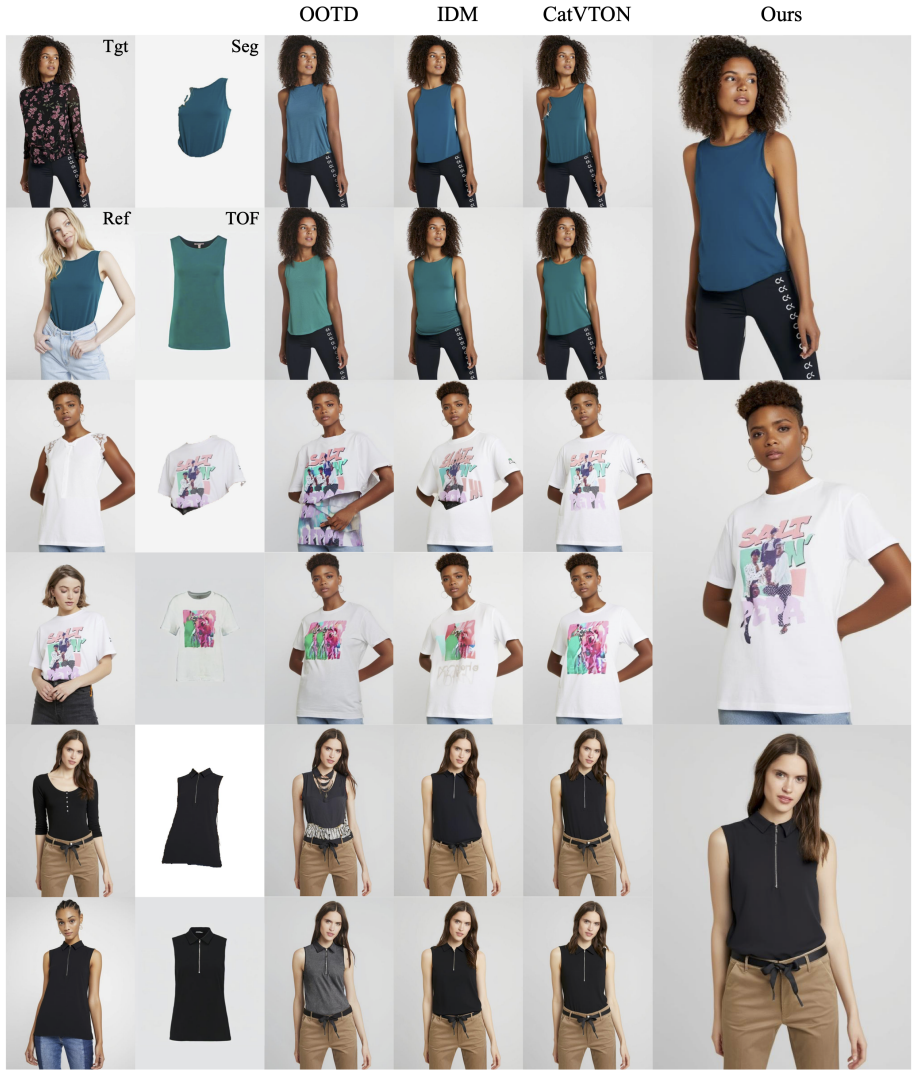
Summary. The paper proposes MFP-VTON, a mask-free person-to-person virtual try-on framework built on the FLUX.1-Fill-dev diffusion transformer. Because no large person-to-person paired dataset exists, the authors use the off-the-shelf garment-to-person model IDM to swap garments between pairs from VITON-HD, creating pseudo triplets of the form (reference person, target person, target person wearing the reference garment). The model concatenates the reference person and target person images with a blank inpainting region, and is fine-tuned with a proposed Focus Attention loss. Experiments compare the method against garment-to-person baselines OOTD, IDM, and CatVTON-FLUX after adapting them with segmentation or try-off methods, reporting both paired and unpaired metrics on the person-to-person task as well as garment-to-person metrics.
Significance. The ease-of-use motivation is clear: a mask-free framework that can transfer a garment directly from a worn reference image would remove the need for standard garment product images and garment masks. The recipe is simple and reproducible in spirit, relying on public models (FLUX.1-Fill-dev, IDM) and the standard VITON-HD dataset. The paper also reports a standard set of quantitative metrics, which is a useful starting point. However, the empirical evidence for the central claim is not convincing: the paired person-to-person evaluation is circular, and the Focus Attention loss as written contradicts its stated objective. These issues prevent the current version from establishing the claimed performance.
major comments (3)
- [Sec. 3.3, Eq. (1)] The paired person-to-person evaluation is not independent of the training signal. The ground-truth images in Table 1 are generated by IDM using the same procedure described in Sec. 3.1 that created the pseudo training triplets. Since MFP-VTON is fine-tuned to reproduce those IDM-generated swaps, the SSIM, LPIPS, and DISTS columns largely measure agreement with IDM's characteristic artifacts (garment warping, texture smoothing, identity drift) rather than real try-on fidelity. The adapted baselines are not trained against this same generator, so the comparison is asymmetric. No human study or independent real paired person-to-person dataset is provided. The paired columns therefore cannot support the abstract's claim that the method 'excels in person-to-person VTON'; at best, they show that the model reproduces IDM-style outputs. The unpaired FID/CLIP-FID/KID columns remain distributional evidence, but they do not directly measure garment or identity preservation.
- [Sec. 3.3, Eq. (1)] The Focus Attention loss is written in the opposite direction of the text. The text says the loss should emphasize the garment of the reference person and the details outside the garment of the target person. However, Eq. (1) weights the attention from the fitting output to the reference person by (1 - M_r), i.e., the non-garment part of the reference image, and the attention to the target person by M_t, i.e., the garment part of the target image. This is exactly the reverse of the stated objective. Because the loss is a claimed contribution and is used during training, this inconsistency must be fixed and the correct form should be verified with an ablation. The equation also contains an unbalanced parenthesis, further obscuring the intended expression.
- [Sec. 4.2, Table 1 (Ours row)] The paper's wording that the method 'outperforms existing methods across multiple metrics' is stronger than the table shows. In the paired person-to-person columns, 'Ours' has SSIM 0.8688, which is lower than Seg+IDM (0.8727) and TROF+IDM (0.8761). The text should state the exact set of metrics on which improvements are claimed, rather than implying a uniform improvement.
minor comments (5)
- [Table 2] The caption of Table 2 says 'person-to-person task', but the table reports garment-to-person results; this should be corrected.
- [Sec. 4.1] The authors state that they 'manually filter out a subset' of the pseudo person-to-person data, but no filtering criteria, statistics, or examples are given. This makes the dataset construction non-reproducible.
- [Sec. 4.2] The 'unpaired testing datasets' used for FID/CLIP-FID/KID are not described precisely; the paper should specify which real image distribution is used as the reference for computing these metrics.
- [Sec. 3.3, Eq. (1)] Aside from the mask-direction issue, Eq. (1) has a formatting and parenthesis problem: the first 'mean' is not closed before the second term, and the overall expression is ambiguous.
- [Sec. 4.1] The authors say the model is fine-tuned on 'both garment-to-person and person-to-person datasets', but Sec. 3.1 only describes construction of the person-to-person pseudo dataset; the garment-to-person fine-tuning data and any associated loss are not described.
Circularity Check
Person-to-person evaluation is circular: both training pseudo-targets and paired test ground truth are IDM outputs (Sec. 3.1, 4.1, 4.2), so Table 1 measures agreement with IDM rather than real try-on fidelity.
-
fitted input called prediction
[Sec. 4.2, Quantitative Comparison; Sec. 3.1, Data preparation; Sec. 4.1, Implementation Details]
""we process the testing dataset using the data preparation method outlined in Sec. 3.1 and extract paired datasets such as (Pmn, Pnm, Pmm) and (Pnm, Pmn, Pnn). On this dataset, we evaluate the aforementioned metrics and additionally compute SSIM [23], LPIPS [30] and DISTS [6] to evaluate the reconstruction quality between the generated fitting image and corresponding ground truth.""
The 'data preparation method outlined in Sec. 3.1' is the IDM-based swap: 'we use an off-the-shelf VTON model [4] to virtually swap garments between these two persons, generating new data pairs,' and the same IDM outputs are used as training pseudo-targets in Sec. 4.1 ('we use IDM [4] to prepare the custom datasets for person-to-person task'). Thus the paired test ground truth is produced by the same procedure that generated the training labels. A model fine-tuned to reproduce IDM's synthetic swaps will score high SSIM/LPIPS/DISTS by imitating IDM's characteristic artifacts, while the adapted baselines are not trained on pseudo-data and enter at an asymmetry. Table 1 therefore demonstrates imitation of IDM, not independent person-to-person try-on fidelity.
full rationale
The garment-to-person results (Tab. 2) are evaluated against real VITON-HD test pairs and are self-contained. However, the paper's central novelty is the person-to-person task, and there the paired evaluation is partially circular: the test ground truth is generated by the same off-the-shelf IDM model whose outputs define the training targets, so the reported 'excels in person-to-person' claim reduces to how well MFP-VTON imitates IDM's artifacts. No independent real paired person-to-person dataset or human study is provided. The Focus Attention loss (Eq. 1) also appears to weight the opposite of its stated objective, but that is a correctness issue rather than a circularity. The only self-citation ([19]) appears in related work and is not load-bearing. Overall, one central prediction reduces by construction, while the garment-to-person component retains independent content, hence a score of 6.
Assumptions & free parameters
free parameters (2)
- Focus Attention loss weight =
not reported
- Manual dataset filtering criteria =
undefined
assumptions (3)
- domain assumption IDM generates accurate enough swapped-garment images (Pmn, Pnm) to serve as ground truth for both training and evaluation.
- domain assumption FLUX-Fill-dev's pretrained inpainting capabilities transfer to the mask-free VTON fine-tuning setting.
- domain assumption The attention sub-matrices FqGk and FqPk are the only image-condition components relevant to fitting output.
Cite this review
Pith. "Pith review of MFP-VTON: Enhancing Mask-Free Person-to-Person Virtual Try-On via Diffusion Transformer." pith.science (2026). https://pith.science/paper/N2N5YO3Z
@misc{pith2026250201626,
  author       = {Pith},
  title        = {Pith review of: MFP-VTON: Enhancing Mask-Free Person-to-Person Virtual Try-On via Diffusion Transformer},
  year         = {2026},
  howpublished = {\url{https://pith.science/paper/N2N5YO3Z}},
  note         = {Machine review of arXiv:2502.01626}
}
read the original abstract
The garment-to-person virtual try-on (VTON) task, which aims to generate fitting images of a person wearing a reference garment, has made significant strides. However, obtaining a standard garment is often more challenging than using the garment already worn by the person. To improve ease of use, we propose MFP-VTON, a Mask-Free framework for Person-to-Person VTON. Recognizing the scarcity of person-to-person data, we adapt a garment-to-person model and dataset to construct a specialized dataset for this task. Our approach builds upon a pretrained diffusion transformer, leveraging its strong generative capabilities. During mask-free model fine-tuning, we introduce a Focus Attention loss to emphasize the garment of the reference person and the details outside the garment of the target person. Experimental results demonstrate that our model excels in both person-to-person and garment-to-person VTON tasks, generating high-fidelity fitting images.
Figures


Forward citations
Cited by 1 Pith paper
-
DualFit: A Two-Stage Virtual Try-On via Warping and Synthesis
DualFit combines flow-based warping with a Res-UNet synthesis module guided by a preserved-region image and an inpainting mask, reporting state-of-the-art VITON-HD numbers for detail preservation and realism.
Reference graph
Works this paper leans on
-
[1]
Mikołaj Bi´nkowski, Danica J Sutherland, Michael Arbel, and Arthur Gretton. Demystifying mmd gans. arXiv preprint arXiv:1801.01401, 2018. 4
arXiv 2018
-
[2]
black-forest labs. Flux.1-fill-dev. https : / / huggingface.co/black-forest-labs/FLUX.1- Fill-dev, 2025. Accessed: 2025-02-03. 2, 3, 4
work page 2025
-
[3]
Viton-hd: High-resolution virtual try-on via misalignment-aware normalization
Seunghwan Choi, Sunghyun Park, Minsoo Lee, and Jaegul Choo. Viton-hd: High-resolution virtual try-on via misalignment-aware normalization. In Proceedings of the IEEE/CVF conference on computer vision and pattern recog- nition, pages 14131–14140, 2021. 1, 2, 4
work page 2021
-
[4]
Improving diffusion models for vir- tual try-on
Yisol Choi, Sangkyung Kwak, Kyungmin Lee, Hyungwon Choi, and Jinwoo Shin. Improving diffusion models for vir- tual try-on. arXiv preprint arXiv:2403.05139, 2024. 1, 2, 4
arXiv 2024
-
[5]
Street tryon: Learning in-the-wild virtual try-on from unpaired person images
Aiyu Cui, Jay Mahajan, Viraj Shah, Preeti Gomathinayagam, Chang Liu, and Svetlana Lazebnik. Street tryon: Learning in-the-wild virtual try-on from unpaired person images. In Proceedings of the IEEE/CVF Conference on Computer Vi- sion and Pattern Recognition, pages 8235–8239, 2024. 2
2024
-
[6]
Image quality assessment: Unifying structure and texture similarity
Keyan Ding, Kede Ma, Shiqi Wang, and Eero P Simoncelli. Image quality assessment: Unifying structure and texture similarity. IEEE transactions on pattern analysis and machine intelligence, 44(5):2567–2581, 2020. 4
work page 2020
-
[7]
Scaling rectified flow trans- formers for high-resolution image synthesis
Patrick Esser, Sumith Kulal, Andreas Blattmann, Rahim En- tezari, Jonas M¨uller, Harry Saini, Yam Levi, Dominik Lorenz, Axel Sauer, Frederic Boesel, et al. Scaling rectified flow trans- formers for high-resolution image synthesis. In Forty-first International Conference on Machine Learning, 2024. 2
work page 2024
-
[8]
Generative adversarial nets
Ian Goodfellow, Jean Pouget-Abadie, Mehdi Mirza, Bing Xu, David Warde-Farley, Sherjil Ozair, Aaron Courville, and Yoshua Bengio. Generative adversarial nets. Advances in neural information processing systems, 27, 2014. 2
2014
Show all 31 references
-
[9]
Gans trained by a two time-scale update rule converge to a local nash equilibrium
Martin Heusel, Hubert Ramsauer, Thomas Unterthiner, Bern- hard Nessler, and Sepp Hochreiter. Gans trained by a two time-scale update rule converge to a local nash equilibrium. Advances in neural information processing systems, 30, 2017. 4
2017
-
[10]
Denoising diffu- sion probabilistic models
Jonathan Ho, Ajay Jain, and Pieter Abbeel. Denoising diffu- sion probabilistic models. Advances in neural information processing systems, 33:6840–6851, 2020. 2 4 Figure 3. Qualitative comparison. The first two columns show the inputs to different models. In the person-to-perso...
2020
-
[11]
In-context lora for diffusion transformers
Lianghua Huang, Wei Wang, Zhi-Fan Wu, Yupeng Shi, Huanzhang Dou, Chen Liang, Yutong Feng, Yu Liu, and Jin- gren Zhou. In-context lora for diffusion transformers. arXiv preprint arXiv:2410.23775, 2024. 3 5 Model Paired Person2Person Unpaired Person2Person SSIM↑ LPIPS↓ DISTS↓ FI...
2024 arXiv
-
[12]
Image-to-image translation with conditional adversarial net- works
Phillip Isola, Jun-Yan Zhu, Tinghui Zhou, and Alexei A Efros. Image-to-image translation with conditional adversarial net- works. In Proceedings of the IEEE conference on computer vision and pattern recognition, pages 1125–1134, 2017. 2
2017
-
[13]
Stableviton: Learning semantic correspondence with latent diffusion model for virtual try-on
Jeongho Kim, Guojung Gu, Minho Park, Sunghyun Park, and Jaegul Choo. Stableviton: Learning semantic correspondence with latent diffusion model for virtual try-on. In Proceedings of the IEEE/CVF Conference on Computer Vision and Pattern Recognition, pages 8176–8185, 2024. 1, 2
2024
-
[14]
The role of imagenet classes in fr´echet inception distance
Tuomas Kynk¨a¨anniemi, Tero Karras, Miika Aittala, Timo Aila, and Jaakko Lehtinen. The role of imagenet classes in fr´echet inception distance. arXiv preprint arXiv:2203.06026,
-
[15]
Dress code: High- resolution multi-category virtual try-on
Davide Morelli, Matteo Fincato, Marcella Cornia, Federico Landi, Fabio Cesari, and Rita Cucchiara. Dress code: High- resolution multi-category virtual try-on. In Proceedings of the IEEE/CVF conference on computer vision and pattern recognition, pages 2231–2235, 2022. 1, 2
2022
-
[16]
Scalable diffusion models with transformers
William Peebles and Saining Xie. Scalable diffusion models with transformers. In Proceedings of the IEEE/CVF Inter- national Conference on Computer Vision, pages 4195–4205,
-
[17]
Sam 2: Segment any- thing in images and videos
Nikhila Ravi, Valentin Gabeur, Yuan-Ting Hu, Ronghang Hu, Chaitanya Ryali, Tengyu Ma, Haitham Khedr, Roman R¨adle, Chloe Rolland, Laura Gustafson, et al. Sam 2: Segment any- thing in images and videos. arXiv preprint arXiv:2408.00714,
-
[18]
High-resolution image synthesis with latent diffusion models
Robin Rombach, Andreas Blattmann, Dominik Lorenz, Patrick Esser, and Bj ¨orn Ommer. High-resolution image synthesis with latent diffusion models. In Proceedings of the IEEE/CVF conference on computer vision and pattern recognition, pages 10684–10695, 2022. 2
2022
-
[19]
Igr: Improving diffusion model for garment restoration from person image,
Le Shen, Rong Huang, and Zhijie Wang. Igr: Improving diffusion model for garment restoration from person image,
-
[20]
Denoising diffusion implicit models
Jiaming Song, Chenlin Meng, and Stefano Ermon. Denoising diffusion implicit models. arXiv preprint arXiv:2010.02502,
2010 arXiv
-
[21]
Ragdiffusion: Faithful cloth generation via external knowl- edge assimilation
Xianfeng Tan, Yuhan Li, Wenxiang Shang, Yubo Wu, Jian Wang, Xuanhong Chen, Yi Zhang, Ran Lin, and Bingbing Ni. Ragdiffusion: Faithful cloth generation via external knowl- edge assimilation. arXiv preprint arXiv:2411.19528, 2024. 2
2024
-
[22]
Tryoffdiff: Virtual-try-off via high-fidelity gar- ment reconstruction using diffusion models
Riza Velioglu, Petra Bevandic, Robin Chan, and Barbara Hammer. Tryoffdiff: Virtual-try-off via high-fidelity gar- ment reconstruction using diffusion models. arXiv preprint arXiv:2411.18350, 2024. 2, 4
2024 arXiv
-
[23]
Image quality assessment: from error visibility to structural similarity
Zhou Wang, Alan C Bovik, Hamid R Sheikh, and Eero P Simoncelli. Image quality assessment: from error visibility to structural similarity. IEEE transactions on image processing, 13(4):600–612, 2004. 4
2004
-
[24]
Tryoffany- one: Tiled cloth generation from a dressed person, 2024
Ioannis Xarchakos and Theodoros Koukopoulos. Tryoffany- one: Tiled cloth generation from a dressed person, 2024. 2
2024
-
[25]
Catvton-flux
xiaozaa. Catvton-flux. https://huggingface.co/ xiaozaa/catvton- flux- alpha , 2025. Accessed: 2025-02-03. 2, 3, 4
2025
-
[26]
Pasta-gan++: A versatile framework for high-resolution unpaired virtual try-on
Zhenyu Xie, Zaiyu Huang, Fuwei Zhao, Haoye Dong, Michael Kampffmeyer, Xin Dong, Feida Zhu, and Xi- 6 aodan Liang. Pasta-gan++: A versatile framework for high-resolution unpaired virtual try-on. arXiv preprint arXiv:2207.13475, 2022. 2
2022 arXiv
-
[27]
Oot- diffusion: Outfitting fusion based latent diffusion for control- lable virtual try-on
Yuhao Xu, Tao Gu, Weifeng Chen, and Chengcai Chen. Oot- diffusion: Outfitting fusion based latent diffusion for control- lable virtual try-on. arXiv preprint arXiv:2403.01779, 2024. 1, 2, 4
2024 arXiv
-
[28]
Zalando enhances its virtual fitting room by enabling customers to create a 3d avatar with their body measure- ments
Zalando. Zalando enhances its virtual fitting room by enabling customers to create a 3d avatar with their body measure- ments. https://corporate.zalando.com/en/ technology/zalando-enhances-its-virtual- fitting- room- enabling- customers- create- 3d-avatar-their-body , 2025. Ac...
2025
-
[29]
Ti- legan: Category-oriented attention-based high-quality tiled clothes generation from dressed person
Wei Zeng, Mingbo Zhao, Yuan Gao, and Zhao Zhang. Ti- legan: Category-oriented attention-based high-quality tiled clothes generation from dressed person. Neural Computing and Applications, 32:17587–17600, 2020. 2
2020
-
[30]
The unreasonable effectiveness of deep features as a perceptual metric
Richard Zhang, Phillip Isola, Alexei A Efros, Eli Shechtman, and Oliver Wang. The unreasonable effectiveness of deep features as a perceptual metric. In Proceedings of the IEEE conference on computer vision and pattern recognition, pages 586–595, 2018. 4
2018
-
[31]
Boow- vton: Boosting in-the-wild virtual try-on via mask-free pseudo data training
Xuanpu Zhang, Dan Song, Pengxin Zhan, Qingguo Chen, Zhao Xu, Weihua Luo, Kaifu Zhang, and Anan Liu. Boow- vton: Boosting in-the-wild virtual try-on via mask-free pseudo data training. arXiv preprint arXiv:2408.06047, 2024. 1, 2 7
2024 arXiv
Reviewed August 9, 2026 · model on record in the stance chip above.
Discussion (0). Continue with ORCID to comment.