REVIEW 4 major objections 8 minor 36 references
Fast Direct: Query-Efficient Online Black-box Guidance for Diffusion-model Target Generation
T0 review · 4 major / 8 minor · reviewed 2026-08-09 · deepseek-v4-flash
Pith's one-line read The paper claims that nudging every diffusion noise vector toward the current output's gap to a pseudo-target cuts black-box queries by 6x-44x.
desk verdict Plausible, well-tested black-box guidance for diffusion, but the query-efficiency headline is undercut by sloppy accounting and a missing same-group baseline. read the letter →
The pith
A machine-rendered reading of the paper's core claim, the machinery that carries it, and where it could break.
The reading
What carries the argument
The load-bearing object is Guided Noise Sequence Optimization (GNSO): in each outer iteration, generate $x_K$ from the current noise sequence, then update every $\epsilon_k$ as $\epsilon_k \leftarrow (\epsilon_k + \alpha(x^* - x_K))/\|\epsilon_k + \alpha(x^* - x_K)\| \cdot \|\epsilon_k\|$. The direction $x^* - x_K$ is called the universal direction; using $x_K$ rather than intermediate latents keeps the update tied to the data manifold, and the renormalization preserves the noise norm. For the Gaussian-process variant, Proposition 1 states that with a shift-invariant kernel $k(z_1, z_2) = g(\|z_1 - z_2\|_2)$, the gradient of the GP posterior mean lies in the span of $x, x_1, \ldots, x_n$, so the pseudo-target from one gradient step stays near the data. Fast Direct plugs either that pseudo-target or the historical best sample into GNSO and repeats.
What would settle it
Run Algorithm 1 on a fixed target that is pure Gaussian noise and record $\|x_K - x^*\|$ over $T$ iterations: if the renormalized universal-direction update does not reduce this distance, or if image quality collapses as the target moves off the manifold, then the central guidance mechanism is not doing the work claimed.
Extended reading notes
Core claim
The central claim is that a universal noise update—adding $\alpha(x^* - x_K)$ to every element of the diffusion noise sequence and rescaling each vector to its original norm—turns a pre-trained diffusion sampler into a guided generator that homes in on a target $x^*$ within tens of iterations. The paper argues this works even when $x^*$ is only a noisy pseudo-target produced by a Gaussian-process surrogate or by the historical best sample, rather than the true optimum. Fast Direct wraps this update in an online loop: generate a batch, query the black-box objective, store the $(x_K, y)$ pairs, form a pseudo-target, and repeat. The reported experiments show near-full Gemini alignment ratings within 50 queries on twelve 1024x1024 prompt-alignment tasks and lower Vina scores on six 3D-molecule tasks, with query-efficiency gains of 6x-10x over DDPO, DPOK, D3PO, and DNO on images and 11x-44x on molecules.
Load-bearing premise
The load-bearing premise is empirical: adding $\alpha(x^* - x_K)$ to every noise vector and renormalizing shifts the generated sample toward $x^*$ without leaving the data manifold, and the paper offers this as an observation rather than a theorem.
Editorial extensions
If this is right
- Fast Direct never updates the diffusion model's weights, so it avoids the GPU memory and training cost of RL fine-tuning and can be used with any stochastic scheduler.
- Within a 50-batch-query budget, Fast Direct reaches near-full Gemini alignment ratings on all twelve tested image prompts, while DDPO, DPOK, and D3PO need roughly 200 queries to catch up on the first three tasks.
- The same inference-time mechanism transfers from 1024x1024 images to 3D molecular structures, where it reports 11x-44x query-efficiency gains over the fine-tuning baselines.
- The pseudo-target is a plug-in: any method that proposes an updated target from the collected dataset can be inserted into Fast Direct, so GP updates and historical-best updates are instantiations of a broader recipe.
- With the learned GP frozen, Fast Direct generalizes to unseen prompts, improving compressibility, incompressibility, and aesthetic-quality scores on new animal prompts.
Reading between the lines
- The universal-direction update is not specific to diffusion: any sampling process with a renormalizable latent or noise sequence could in principle be steered the same way, though the paper only tests diffusion samplers.
- Because the GP pseudo-target gradient lies in the span of previously queried samples, Fast Direct's search is confined to a data-defined subspace; targets outside that span may be unreachable, a ceiling the paper does not address.
- Replacing the one-step posterior-mean gradient with an acquisition function such as expected improvement could cut queries further, since the paper only explores gradient-descent and historical-best ways to set the pseudo-target.
- The reported gains assume a consistent black-box scorer (Gemini at temperature zero); with noisy human raters the pseudo-target would be noisier, and while GNSO's robustness to noisy targets suggests the method would cope, the exact efficiency multipliers would likely shrink.
Editorial analysis
A structured set of objections, weighed in public.
Referee Report
Summary. The paper proposes Fast Direct, an inference-time, black-box, query-efficient method for steering pre-trained diffusion models toward a target specified only by an online objective function. The method has two components: (1) GNSO (Algorithm 1), which updates the diffusion noise sequence along the direction from the current generated sample x_K to a target x* and renormalizes, and (2) Fast Direct (Algorithm 2), which repeatedly proposes a pseudo-target using either a GP surrogate or the historical best sample, runs GNSO, and queries the black-box objective. The paper reports that on twelve 1024x1024 image-prompt-alignment tasks with a Gemini 1.5 oracle and six 3D-molecule Vina-score tasks, Fast Direct is 6-10x and 11-44x more batch-query-efficient than DDPO, DPOK, D3PO, and DNO, reaching near-optimal scores within a 50 batch-query budget. The paper also reports ablations, a generalization study to unseen prompts, and a proof that the GP gradient for shift-invariant kernels lies in the span of the data.
Significance. If the central efficiency claim holds, Fast Direct is practically significant: it offers a simple, inference-time, black-box alternative to RL-based fine-tuning of diffusion models, with public code and no requirement of a differentiable objective. The GP-gradient-span proposition (Proposition 1) is a useful theoretical sanity check, and the empirical robustness to noisy pseudo-targets is an interesting phenomenon that supports the online black-box setting. The main caveat is that the query-efficiency multipliers, which are the headline contribution, rest on an ambiguous and apparently inconsistent accounting of what counts as a query and on efficiency numbers computed only for a subset of the tasks.
major comments (4)
- [Section 4.1, Appendix D, Algorithm 2] The unit of 'query' is never fixed. Section 4.1 says 'query refers to the input to Gemini', yet the '50 batch query budget' is implemented as N=50 outer iterations, each with B=32 instances, and each instance appears to call Gemini (or, for D3PO, perhaps two images per call, see footnote 6 and Appendix G). Appendix D then describes DNO as spending 16 x 50 = 800 'batch queries' while also stating that DNO uses 32 samples per gradient approximation, which would be 16 x 50 x 32 = 25,600 individual objective evaluations if a query means one oracle input. Because Table 1's denominators N* are computed on this ambiguous basis, the reported 6-10x and 11-44x multipliers cannot be verified from the manuscript. The authors should provide a single, unified ledger of individual oracle evaluations per method, per task, and per iteration, and recompute all efficiency ratios with that ledger.
- [Algorithm 2, lines 6-16] Algorithm 2's inner loop 'for t <- 1 to i' means that by outer iteration i each instance performs i GNSO diffusion passes and i noise updates before issuing a single objective query at line 14. After N=50 outer iterations, Fast Direct makes sum_{i=1}^{50} i = 1275 diffusion passes per instance, while each baseline is charged one update per batch query. If Fig. 4 and Table 1 count 'algorithm updates', the comparison is not apples-to-apples because Fast Direct receives quadratic unqueried compute; if they count individual objective evaluations, the paper must state the per-method per-iteration ledger explicitly. The authors should either justify that unqueried diffusion compute is negligible relative to oracle cost for both domains, or report the total compute as a separate axis.
- [Table 1 and Abstract] The abstract claims 6x-10x query-efficiency improvement on 'twelve' image tasks and 11x-44x on 'six' molecule tasks, but Table 1 reports N* only for Image Tasks 1-3 and Molecule Tasks 1-2. The text says that the extra 200-query budget was granted only for 'tasks 1 to 3' (images) and 'tasks 1 and 2' (molecules), so the quantitative efficiency multipliers in Table 1 are not computed on all twelve/six tasks. The authors should either provide per-task N* and efficiency ratios for every task, or adjust the Abstract and conclusion claims to the subset actually measured.
- [Fig. 4, Fig. 10, Table 1] No error bars, confidence intervals, or significance tests are reported for the central quantitative comparison. The image curves and molecule curves appear to be single-run averages (DNO is averaged over 16 independent trials), and the 'Fast Direct outperforms baseline with 200 queries' claims in Table 1 depend on these trajectories. The authors should report means and variances over at least a few random seeds, or otherwise justify that the observed differences are not within run-to-run variability.
minor comments (8)
- [Section 4.1] The phrase '50 batch query budget' is never defined; the paper defines 'query' but not 'batch query'. Please define it explicitly and state how many individual Gemini calls one batch query corresponds to.
- [Algorithm 2 and Appendix A] In Appendix A, the generalization procedure says 'Lines 17 and 18 are removed from Algorithm 2', but Algorithm 2 has only 16 lines. Please fix the line numbering or the reference.
- [Section 4.1] Typo: 'EularDescreteScheduler' should be 'EulerDiscreteScheduler'.
- [Appendix G] The D3PO query prompt says 'Given this two images...' while the main-text definition of a query as a single Gemini input is unclear about whether one query can contain two images; please reconcile footnote 6, Appendix G, and the main-text query definition.
- [Figure 5 caption] The caption says 'the 45 common animals that were used in DDPO (Tang et al., 2024)', but the DDPO citation should be Black et al. (2023), not Tang et al. (2024).
- [Appendix A] The LAION aesthetics predictor reference is missing ('?'). Please add the proper citation.
- [Section 4.1] The GP is said to operate on the SDXL latent space of dimension d=4x128x128, but the main text never states that x_K is the latent representation rather than the decoded image. Please clarify what input is stored in dataset D and used in Eq. (2)-(3).
- [Footnote 4 and Table 3] The prompt is called 'deer-eleplant' in the text and figures but 'deer-elephant' in Table 3; please make the label consistent.
Circularity Check
Reported 6-44x query-efficiency gains are an artifact of Algorithm 2's query-counting convention; the central claim reduces by construction to counting outer iterations rather than actual objective queries.
-
self definitional
[Algorithm 2, lines 6-16; Section 4.1 'Experiment Procedure'; Table 1]
"for t ← 1 to i do ... Query black-box objective score y ← f (xK). ... We use N = 50 iterations to utilize the 50 batch query budget, and set the batch size as B = 32. ... Table 1: batch-query-efficiency gain (200/N∗)"
Algorithm 2 places the objective query (Line 14) inside the inner loop 'for t ← 1 to i'. For N=50 outer iterations, a single instance therefore executes Σ_{i=1}^{50} i = 1275 objective evaluations, not 50. Yet Section 4.1 reports the experiment as a '50 batch query budget', and Table 1 computes Fast Direct's efficiency gain as 200/N* using N* in this same self-defined outer-iteration unit. The 6-44x query-efficiency multipliers are thus built into the query-counting convention rather than measured against a common query unit; the comparison to baselines is not a measured prediction but a construction of the accounting.
full rationale
The only load-bearing reduction I can exhibit is the query-efficiency comparison. Algorithm 2's query operation sits inside the inner loop 'for t ← 1 to i', so after 50 outer iterations a single Fast Direct instance has made 1275 objective evaluations, while Section 4.1 and Table 1 treat the 50 outer iterations as the entire batch query budget and compute gains 200/N*. The 6-44x multipliers therefore reduce by construction to the choice of query-counting convention. Apart from this accounting step, the paper does not disguise fitting as prediction: GNSO is explicitly presented as an empirical heuristic, with Section 5 deferring theory to future work; Proposition 1 is a proved linear-algebra statement; and the GP pseudo-target is a standard online surrogate rather than a fitted parameter renamed as a prediction. The only self-citation (CASBO, Lyu et al. 2024) appears in a related-work table and is not load-bearing. The remaining weakness, the lack of proof that the universal direction preserves the data manifold, is a correctness and empirical-support concern, not circularity.
Assumptions & free parameters
free parameters (4)
- Step size alpha for image tasks =
80
- Step size alpha for molecule tasks =
1e-2
- GP lengthscale lambda =
sqrt(d), d = 4*128*128 latent dim
- Batch size B and number of iterations N =
B=32, N=50 (most tasks); N=100 for aesthetic quality
assumptions (4)
- ad hoc to paper Adding alpha*(x* - xK) to each noise vector, then renormalizing, moves the generated sample toward the target on the data manifold without quality loss.
- standard math GP posterior mean formula with shift-invariant kernels and its differentiability.
- domain assumption The score landscape is smooth enough that a one-step GP gradient descent produces a pseudo-target with lower score.
- domain assumption Gemini 1.5 ratings correlate with text-image alignment, and Vina scores correlate with binding affinity.
Cite this review
Pith. "Pith review of Fast Direct: Query-Efficient Online Black-box Guidance for Diffusion-model Target Generation." pith.science (2026). https://pith.science/paper/SQCOJLOR
@misc{pith2026250201692,
  author       = {Pith},
  title        = {Pith review of: Fast Direct: Query-Efficient Online Black-box Guidance for Diffusion-model Target Generation},
  year         = {2026},
  howpublished = {\url{https://pith.science/paper/SQCOJLOR}},
  note         = {Machine review of arXiv:2502.01692}
}
abstract
Guided diffusion-model generation is a promising direction for customizing the generation process of a pre-trained diffusion model to address specific downstream tasks. Existing guided diffusion models either rely on training the guidance model with pre-collected datasets or require the objective functions to be differentiable. However, for most real-world tasks, offline datasets are often unavailable, and their objective functions are often not differentiable, such as image generation with human preferences, molecular generation for drug discovery, and material design. Thus, we need an $\textbf{online}$ algorithm capable of collecting data during runtime and supporting a $\textbf{black-box}$ objective function. Moreover, the $\textbf{query efficiency}$ of the algorithm is also critical because the objective evaluation of the query is often expensive in real-world scenarios. In this work, we propose a novel and simple algorithm, $\textbf{Fast Direct}$, for query-efficient online black-box target generation. Our Fast Direct builds a pseudo-target on the data manifold to update the noise sequence of the diffusion model with a universal direction, which is promising to perform query-efficient guided generation. Extensive experiments on twelve high-resolution ($\small {1024 \times 1024}$) image target generation tasks and six 3D-molecule target generation tasks show $\textbf{6}\times$ up to $\textbf{10}\times$ query efficiency improvement and $\textbf{11}\times$ up to $\textbf{44}\times$ query efficiency improvement, respectively. Our implementation is publicly available at: https://github.com/kimyong95/guide-stable-diffusion/tree/fast-direct
Figures


Figures from the paper (31 more)




Reference graph
Works this paper leans on
-
[2]
Minshuo Chen, Song Mei, Jianqing Fan, and Mengdi Wang. An overview of diffusion models: Ap- plications, guided generation, statistical rates and optimization.arXiv preprint arXiv:2404.07771,
-
[5]
Diffdock: Dif- fusion steps, twists, and turns for molecular docking
Gabriele Corso, Hannes St ¨ark, Bowen Jing, Regina Barzilay, and Tommi Jaakkola. Diffdock: Dif- fusion steps, twists, and turns for molecular docking. arXiv preprint arXiv:2210.01776,
-
[6]
Laurianne David, Amol Thakkar, Roc´ıo Mercado, and Ola Engkvist
doi: 10.1109/TPAMI.2023.3261988. Laurianne David, Amol Thakkar, Roc´ıo Mercado, and Ola Engkvist. Molecular representations in ai-driven drug discovery: a review and practical guide. Journal of Cheminformatics , 12(1):56,
arXiv 2023
-
[9]
3d equiv- ariant diffusion for target-aware molecule generation and affinity prediction
Jiaqi Guan, Wesley Wei Qian, Xingang Peng, Yufeng Su, Jian Peng, and Jianzhu Ma. 3d equiv- ariant diffusion for target-aware molecule generation and affinity prediction. arXiv preprint arXiv:2303.03543,
-
[10]
Manifold preserving guided diffusion
Yutong He, Naoki Murata, Chieh-Hsin Lai, Yuhta Takida, Toshimitsu Uesaka, Dongjun Kim, Wei- Hsiang Liao, Yuki Mitsufuji, J Zico Kolter, Ruslan Salakhutdinov, et al. Manifold preserving guided diffusion. arXiv preprint arXiv:2311.16424,
-
[11]
Lora: Low-rank adaptation of large language models
Edward J Hu, Yelong Shen, Phillip Wallis, Zeyuan Allen-Zhu, Yuanzhi Li, Shean Wang, Lu Wang, and Weizhu Chen. Lora: Low-rank adaptation of large language models. arXiv preprint arXiv:2106.09685,
-
[12]
Vanilla bayesian optimization performs great in high dimension
Carl Hvarfner, Erik Orm Hellsten, and Luigi Nardi. Vanilla bayesian optimization performs great in high dimension. arXiv preprint arXiv:2402.02229,
-
[13]
Diffusion models for black- box optimization
Siddarth Krishnamoorthy, Satvik Mehul Mashkaria, and Aditya Grover. Diffusion models for black- box optimization. arXiv preprint arXiv:2306.07180,
Show all 36 references
-
[14]
Derivative-free guidance in continuous and discrete diffusion models with soft value-based decoding
Xiner Li, Yulai Zhao, Chenyu Wang, Gabriele Scalia, Gokcen Eraslan, Surag Nair, Tommaso Bian- calani, Aviv Regev, Sergey Levine, and Masatoshi Uehara. Derivative-free guidance in continuous and discrete diffusion models with soft value-based decoding. arXiv preprint arXiv:2408.08252,
-
[15]
Sdxl-lightning: Progressive adversarial diffusion distillation
Shanchuan Lin, Anran Wang, and Xiao Yang. Sdxl-lightning: Progressive adversarial diffusion distillation. arXiv preprint arXiv:2402.13929,
-
[16]
Covariance-adaptive sequential black-box optimization for diffusion targeted generation.arXiv preprint arXiv:2406.00812,
Yueming Lyu, Kim Yong Tan, Yew Soon Ong, and Ivor W Tsang. Covariance-adaptive sequential black-box optimization for diffusion targeted generation.arXiv preprint arXiv:2406.00812,
-
[17]
Sdxl: Improving latent diffusion models for high-resolution image synthesis
Dustin Podell, Zion English, Kyle Lacey, Andreas Blattmann, Tim Dockhorn, Jonas M ¨uller, Joe Penna, and Robin Rombach. Sdxl: Improving latent diffusion models for high-resolution image synthesis. arXiv preprint arXiv:2307.01952,
-
[18]
Aligning text-to- image diffusion models with reward backpropagation
Mihir Prabhudesai, Anirudh Goyal, Deepak Pathak, and Katerina Fragkiadaki. Aligning text-to- image diffusion models with reward backpropagation. arXiv preprint arXiv:2310.03739,
-
[19]
Direct preference optimization: Your language model is secretly a reward model.Advances in Neural Information Processing Systems, 36,
12 Published as a conference paper at ICLR 2025 Rafael Rafailov, Archit Sharma, Eric Mitchell, Christopher D Manning, Stefano Ermon, and Chelsea Finn. Direct preference optimization: Your language model is secretly a reward model.Advances in Neural Information Processing Systems, 36,
2025
-
[20]
Gem- ini 1.5: Unlocking multimodal understanding across millions of tokens of context
Machel Reid, Nikolay Savinov, Denis Teplyashin, Dmitry Lepikhin, Timothy Lillicrap, Jean- baptiste Alayrac, Radu Soricut, Angeliki Lazaridou, Orhan Firat, Julian Schrittwieser, et al. Gem- ini 1.5: Unlocking multimodal understanding across millions of tokens of context. arXiv ...
-
[21]
Equivalence between policy gradients and soft q- learning
John Schulman, Xi Chen, and Pieter Abbeel. Equivalence between policy gradients and soft q- learning. arXiv preprint arXiv:1704.06440,
-
[23]
Tuning-free alignment of diffusion models with direct noise optimization
Zhiwei Tang, Jiangweizhi Peng, Jiasheng Tang, Mingyi Hong, Fan Wang, and Tsung-Hui Chang. Tuning-free alignment of diffusion models with direct noise optimization. arXiv preprint arXiv:2405.18881,
-
[24]
Understanding rein- forcement learning-based fine-tuning of diffusion models: A tutorial and review
Masatoshi Uehara, Yulai Zhao, Tommaso Biancalani, and Sergey Levine. Understanding rein- forcement learning-based fine-tuning of diffusion models: A tutorial and review. arXiv preprint arXiv:2407.13734,
-
[25]
We follow DDPO (Black et al.,
13 Published as a conference paper at ICLR 2025 A M ORE EXPERIMENTS : C OMPRESSIBILITY , INCOMPRESSIBILITY , AND AESTHETIC QUALITY Problem. We follow DDPO (Black et al.,
2025
-
[26]
Objective Function
to evaluate our algorithm on the three black-box optimization tasks for images: compressibility, incompressibility, and aesthetic quality. Objective Function. For compressibility, we aimed to minimize the compressed JPEG size (MB) of the generated images. For incompressibility...
2023
-
[27]
We set N = 50 batch query budget for compressibility and incompressibility, and N = 100 for aesthetic quality
The prompt for each instance within a batch is sampled randomly and independently. We set N = 50 batch query budget for compressibility and incompressibility, and N = 100 for aesthetic quality. We use the same pre-trained model, hyper-parameters, and GP settings as in Section ...
2025
-
[28]
Right column: The objective score of the images generated byunseen prompts, which demonstrates the generalization capability
as the input prompts. Right column: The objective score of the images generated byunseen prompts, which demonstrates the generalization capability. Note that DNO is not applicable to this task. 15 Published as a conference paper at ICLR 2025 (a) Compressibility (b) Incompressi...
2025
-
[30]
7For D3PO, to evaluate 64 images only requires 32 queries calls, see Appendix G
sampler. 7For D3PO, to evaluate 64 images only requires 32 queries calls, see Appendix G. 18 Published as a conference paper at ICLR 2025 For DNO, we optimize the noise sequence w.r.t the Gemini rating. Recall that the Gemini is a black- box, so we use the non-differentiable m...
2025
-
[31]
✓ ✗ DDOM (Krishnamoorthy et al., 2023), RCGDM (Yuan et al., 2024), DPO (Wallace et al.,
2023
-
[32]
✗ ✓ DDPO (Black et al., 2023), DPOK (Fan et al., 2024), D3PO (Yang et al.,
2023
-
[33]
✓ ✓ Inference-time Guidance LGD (Song et al., 2023), MPGD (He et al., 2023), DNO (2024a) (Karunratanakul et al., 2024), ReNO (Eyring et al.,
2024
-
[34]
Answer in the format: Score=(score), Reason=(reason)
✗ ✓ DNO (Tang et al., 2024), CASBO (Lyu et al., 2024), Fast Direct(ours) ✓ ✓ G E XPERIMENT DETAILS We use the following query question for the Gemini: Does the prompt $prompt accurately describe the image? Rate from 1 (inaccurate) to 5 (accurate). Answer in the format: Score=(...
2024
-
[35]
The accumulated plot displays the maximum Gemini rating achieved for each number of batch queries
20 Published as a conference paper at ICLR 2025 Figure 11: The accumulated Gemini rating (from 1 to 5, higher is better) over the number of batch queries. The accumulated plot displays the maximum Gemini rating achieved for each number of batch queries. Figure 12: The accumula...
2025
-
[36]
22 Published as a conference paper at ICLR 2025 Figure 15: The generated images over each number of batch queries on the prompt ”cyber-dog” for each algorithm
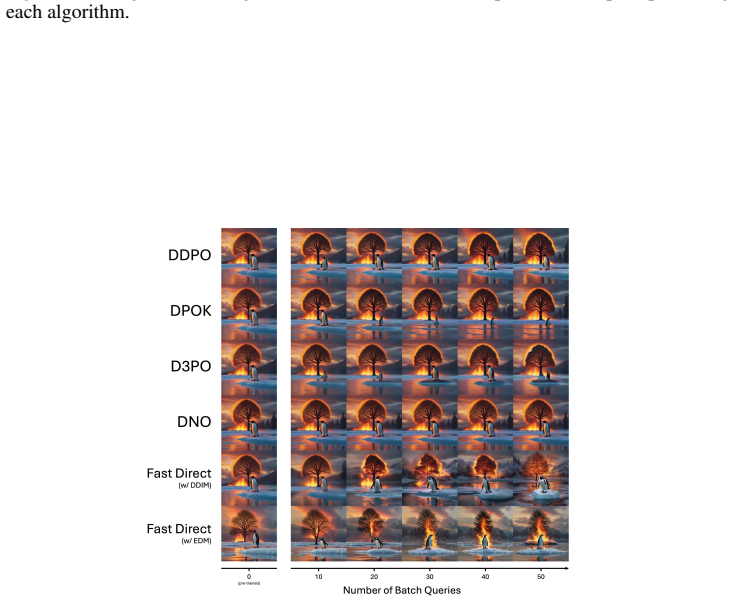
are given to the baseline methods for demonstration. 22 Published as a conference paper at ICLR 2025 Figure 15: The generated images over each number of batch queries on the prompt ”cyber-dog” for each algorithm. Figure 16: The generated images over each number of batch querie...
2025
-
[500]
are given to the baseline methods for demonstration. 16 Published as a conference paper at ICLR 2025 (a) Pre-trained (b) Compressibility (c) Incompressibility (d) Aesthetic Quality Figure 7: The generated images using the 16 unseen prompts. Top left is the image generated by t...
2025
-
[2004]
Denoising diffusion implicit models
Jiaming Song, Chenlin Meng, and Stefano Ermon. Denoising diffusion implicit models. arXiv preprint arXiv:2010.02502,
2010 arXiv
-
[2020]
Aligning optimization trajec- tories with diffusion models for constrained design generation
11 Published as a conference paper at ICLR 2025 Giorgio Giannone, Akash Srivastava, Ole Winther, and Faez Ahmed. Aligning optimization trajec- tories with diffusion models for constrained design generation. Advances in Neural Information Processing Systems, 36:51830–51861,
2025
-
[2021]
Reno: Enhancing one-step text-to-image models through reward-based noise optimization
Luca Eyring, Shyamgopal Karthik, Karsten Roth, Alexey Dosovitskiy, and Zeynep Akata. Reno: Enhancing one-step text-to-image models through reward-based noise optimization. arXiv preprint arXiv:2406.04312,
-
[2022]
Directly fine-tuning diffusion models on differentiable rewards
Kevin Clark, Paul Vicol, Kevin Swersky, and David J Fleet. Directly fine-tuning diffusion models on differentiable rewards. arXiv preprint arXiv:2309.17400,
-
[2023]
Training diffusion models with reinforcement learning
Kevin Black, Michael Janner, Yilun Du, Ilya Kostrikov, and Sergey Levine. Training diffusion models with reinforcement learning. arXiv preprint arXiv:2305.13301,
-
[2024]
Diffusion posterior sampling for general noisy inverse problems
Hyungjin Chung, Jeongsol Kim, Michael T Mccann, Marc L Klasky, and Jong Chul Ye. Diffusion posterior sampling for general noisy inverse problems. arXiv preprint arXiv:2209.14687,
Reviewed August 9, 2026 · model on record in the stance chip above.
Discussion (0). Continue with ORCID to comment.