REVIEW 3 major objections 5 minor 1 cited by
Stars as cosmic scales: measuring stellar mass with microlensed supernovae
T0 review · 3 major / 5 minor · reviewed 2026-08-09 · deepseek-v4-flash
Pith's one-line read Microlensed Type Ia supernovae can measure a lens galaxy's stellar mass-to-light ratio to about 15 percent and its typical stellar mass to about 50 percent.
desk verdict A useful, honestly-caveated forecast showing lensed SNe Ia could measure stellar mass-to-light ratio to ~15%, but the quoted precision is conditional on a perfect macromodel and should be treated as an upper bound. read the letter →
The pith
A machine-rendered reading of the paper's core claim, the machinery that carries it, and where it could break.
The reading
What carries the argument
The analysis is carried by microlensing magnification probability distributions and by the distance to the nearest microlensing caustic. The free parameter is the IMF mismatch $\alpha_{\rm IMF}$, defined as the ratio of the stellar convergence measured by microlensing to the stellar convergence expected for a Chabrier IMF; this is equivalent to the stellar mass-to-light ratio $\Upsilon_\star$ up to a fixed IMF-dependent conversion. For each image the likelihood uses the distribution of microlensing magnifications given the macromodel convergence and shear, while the caustic-crossing likelihood uses $p(d_{\rm caustic} \mid \theta_\star)$, with $\theta_\star \propto \sqrt{m_\star}$, to translate the observed time (or absence) of a caustic crossing into a constraint on the typical microlens mass. The posteriors from all images and all systems are multiplied, with a Gaussian prior on the intrinsic supernova brightness supplied by the Type Ia standard-candle nature of the sources.
What would settle it
Take the same mock catalogue and add dark-matter subhalo millilensing at a level of 20 percent of the flux-ratio anomalies; if the recovered stellar mass fraction shifts by more than the quoted statistical uncertainty, the method's core assumption that anomalies are purely stellar fails.
Extended reading notes
Core claim
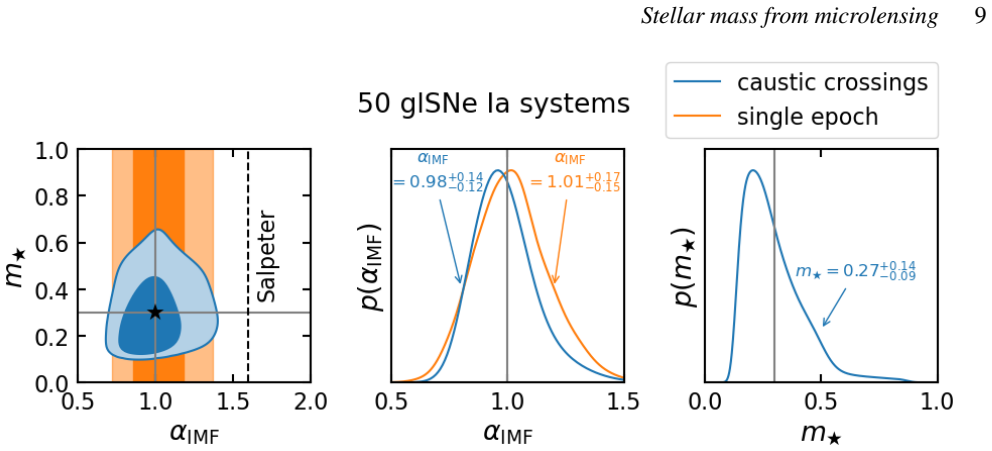
The paper's claim is that gravitational microlensing of lensed Type Ia supernovae can directly measure the stellar mass content of the lens galaxy, without assuming a stellar mass-to-light ratio or a dark-matter profile. With a mock sample of 50 well-modeled systems observed at peak intrinsic brightness, the posterior on the IMF mismatch parameter $\alpha_{\rm IMF} = \kappa_\star / \kappa_{\star,\rm Chabrier}$ recovers the input value to about 15 percent at 68% confidence. Adding light-curve information on whether and when the expanding supernova photosphere crosses a microlensing caustic yields a constraint on the mean microlens mass of order 50 percent, recovering the injected $0.3\,M_\odot$. The paper further claims these precisions would separate a Chabrier-like from a Salpeter-like IMF at roughly $4\sigma$, with the discrimination degrading to $2\sigma$ even if all errors are underestimated by a factor of two.
Load-bearing premise
The load-bearing premise is that the total mass density (the convergence) at each image position is known perfectly and that every brightness anomaly comes from stellar microlensing rather than from dark-matter clumps; if either assumption is wrong, the inferred stellar mass fraction is biased.
Editorial extensions
If this is right
- With 50 well-modeled lensed Type Ia supernovae and a 0.1 mag uncertainty on the intrinsic source brightness, the average stellar mass-to-light ratio is recovered to within roughly 15 percent.
- The same 50 systems can discriminate between Chabrier-like and Salpeter-like initial mass functions at about $4\sigma$, and still at $2\sigma$ if all uncertainties are underestimated by a factor of two.
- Increasing the sample to 200 systems tightens the stellar mass-to-light ratio constraint to about 7 percent and the mean microlens mass constraint to about 25 percent.
- If the intrinsic source brightness uncertainty is instead 0.3 mag, roughly 200 systems are needed to match the stellar mass-to-light ratio precision that 50 systems give at 0.1 mag.
- Light curves with identified or absent caustic crossings constrain the mean microlens mass to about 50 percent with 50 systems, and this mass constraint is less sensitive to source-brightness uncertainty than the stellar mass fraction constraint.
Reading between the lines
- If the method survives real lens-model systematics, it could be applied to images at different radii in the same lens, turning microlensing into a probe of radial stellar mass-to-light gradients rather than a single average.
- The same distance-to-caustic statistics could be inverted for a full mass spectrum of compact objects rather than a single characteristic mass, which would directly probe the low-mass cutoff of the initial mass function.
- A near-term extension is to apply the single-epoch likelihood to the handful of known galaxy-scale lensed Type Ia supernovae with existing light curves; even a few systems with well-measured caustic-crossing times would test whether the timescales are consistent with stellar-mass microlenses.
- Combining these gravitational stellar-mass measurements with stellar-population-synthesis masses for the same lenses would isolate mass in remnants and very low mass stars that contribute little or no light.
Editorial analysis
A structured set of objections, weighed in public.
Referee Report
Summary. The paper presents a simulated forecasting study of gravitational microlensing by stars in strong-lens galaxies, using gravitationally lensed Type Ia supernovae (glSNe Ia). The authors combine mock glSNe Ia systems from Sainz de Murieta et al. (2023) with microlensing magnification maps to infer an IMF-mismatch parameter alpha_IMF (equivalent to a stellar mass-to-light ratio) from single-epoch peak fluxes, and a mean microlens mass m_star from caustic-crossing times in the joint analysis. They report that 50 systems can constrain alpha_IMF to roughly 15% and m_star to roughly 50%, and that this would give a roughly 4 sigma Chabrier-versus-Salpeter discrimination. The analysis is an injection-recovery test with true values alpha_IMF = 1 and m_star = 0.3 solar masses; Section 6 lists important caveats, principally the assumption of a perfectly known macromodel and the possible contamination by millilensing.
Significance. If the forecast survives contact with realistic macromodel uncertainties, it is a valuable new probe: microlensing would measure stellar mass at image positions without stellar-population-synthesis priors or assumptions on the dark matter profile, and it would directly constrain the present-day mass function mean mass. Strengths of the paper are that the injection-recovery framework is internally consistent, uses a pre-existing published mock catalog, and is transparent about several limitations, including the Appendix A statement that alpha_IMF can fall slightly outside the 68% interval with a wide source-brightness prior. The principal weakness is that the headline precision is conditional on a perfect macromodel, and the paper's own Section 6 admits this will not hold in practice; that gap is the central open point for the claimed feasibility.
major comments (3)
- [§4.1, Fig. 3] Equations (7) and (8) and Figure 3 condition on the catalog values of kappa and gamma; the likelihood is evaluated at the true macromodel and never marginalizes over it. Section 6 correctly identifies the mass-sheet degeneracy and lens-model systematics as likely larger sources of error, but the proposed mitigation, that a few percent mass-sheet uncertainty changes magnifications by less than 10%, does not by itself bound the bias in alpha_IMF because the microlensing magnification distributions are strongly nonlinear functions of kappa_star/kappa. I request a direct sensitivity test: rerun the 50-system recovery with kappa or gamma shifted by the expected few percent, or sample over them, and report how the alpha_IMF posterior shifts relative to the quoted 15%. Without this, the headline '50 systems to 15%' is a conditional statistical precision rather than a forecast for real data.
- [§6, millilensing] The paper assumes all flux-ratio anomalies are stellar microlensing and acknowledges that dark-matter subhalo millilensing can also produce them; it also notes that glSNe lack the narrow-line-region diagnostic used for quasars. The suggestion of joint modeling with subhalo magnifications is not quantified, so the central claim that alpha_IMF is measured without prior assumptions on stellar mass is not robust to the known millilensing contamination. At minimum, the forecast should state how many systems or what prior on the subhalo mass function would be needed to separate the two effects, or it should present the alpha_IMF constraint as a joint constraint that includes a subhalo contribution.
- [§7 and Appendix A] Section 7 states that the input alpha_IMF and m_star values are consistently recovered within the 68% confidence intervals, but Appendix A reports that with a 0.3 mag source-brightness uncertainty alpha_IMF lies slightly outside the 68% interval of its marginalized posterior. This is an internal inconsistency in how the recovery is summarized. The paper should either report coverage statistics over many mock realizations rather than a single realization, or soften the claim to say that the true values are usually recovered within the stated intervals.
minor comments (5)
- [§4.2 and §5.2] Please specify whether the quoted precisions of roughly 15% and roughly 50% refer to 68% credible intervals or to 1 sigma errors; the distinction should be explicit in a forecasting paper.
- [§2.2 and §5.2] The demonstration in Section 2.2 uses a uniform prior on m_star between 0.01 and 2 solar masses, while Section 5.2 uses a uniform prior between 0 and 1 solar mass; the change of prior range should be justified.
- [Eq. (7)] Equation (7) uses D without a subscript inside the integrand although the product is over the images j; please make the notation consistent by writing D_j.
- [§3 and §5.1] The two references to 'Weisenbach in prep.' for the GPU microlensing codes should be replaced by a public code release or a methods reference so that the likelihood simulations are reproducible.
- [§6] The sentence describing '0.2-0.3 mag level as considered here' is ambiguous because it mixes the intrinsic source-brightness uncertainty with magnification uncertainties; please rephrase to distinguish the two quantities.
Circularity Check
No circularity: this is an injection-recovery forecast using forward-modeled mock data; the claimed precision is a Monte Carlo result, not a fitted input relabeled as a prediction.
full rationale
The paper does not claim to measure a real quantity; it simulates mock glSNe Ia systems, injects known values (alpha_IMF = 1, m_star = 0.3 M_sun), and tests whether a Bayesian pipeline recovers them. The likelihood is built from microlensing magnification and caustic-distance distributions computed with established methods, not from the injected truth values, so the recovered posterior is a self-consistency check of statistical power rather than a prediction equal to an input by construction. The definition of alpha_IMF in Eq. 2 is a convention (a ratio to a Chabrier fiducial), and the Salpeter discrimination uses external estimates of alpha_IMF ~ 1.6-1.7, so the central claim has independent content. The main self-citations (Sainz de Murieta et al. 2023 mock catalog and the in-preparation GPU codes) are inputs or tools, not logical premises that force the result; the forecast would stand or fall on external validation of the mock catalog. The most important limitations are explicitly disclosed in Section 6: the paper assumes the macromodel is known precisely and concedes that this 'will, in general, not be true', also acknowledging millilensing as a contaminant. These are honest caveats about conditional precision, not hidden circular steps. No uniqueness theorem, no ansatz smuggled via citation, and no renamed known result appear in the derivation chain.
Assumptions & free parameters
free parameters (6)
- alpha_IMF (IMF mismatch) =
0.98+0.14-0.12 (50 systems, 0.1 mag intrinsic scatter)
- microlens mass m_star =
0.3 solar masses (input); recovered 0.27+0.14-0.09 (50 systems)
- intrinsic SN brightness scatter =
0.1 mag (fiducial), 0.3 mag (pessimistic)
- supernova expansion velocity =
10^4 km/s
- light curve baseline =
50 rest-frame days
- microlens mass prior range =
0.01-2 solar masses (Section 2.2), 0-1 solar masses (Section 5)
assumptions (9)
- domain assumption The total convergence kappa and shear at each image position are known perfectly from the macromodel.
- domain assumption All microlenses have a single mass m_star (0.3 solar masses in the mocks).
- domain assumption The source half-light radius is known exactly.
- domain assumption Type Ia supernova intrinsic brightness is known to a Gaussian scatter of 0.1 or 0.3 mag after standardization.
- domain assumption The mock catalog of lensed supernovae from Sainz de Murieta et al. (2023), with cuts on image separation and observability, represents the future LSST sample.
- domain assumption The stellar mass-to-light ratio is constant across the galaxy and across the sample.
- domain assumption Millilensing by dark matter subhalos contributes negligibly to flux ratio anomalies.
- domain assumption The supernova photosphere expands as a uniform disk at 10^4 km/s.
- standard math Standard microlensing simulation methods (inverse polygon mapping, fast multipole method, Witt's critical curve method) are accurate.
Cite this review
Pith. "Pith review of Stars as cosmic scales: measuring stellar mass with microlensed supernovae." pith.science (2026). https://pith.science/paper/NYJ2AGXB
@misc{pith2026250201728,
  author       = {Pith},
  title        = {Pith review of: Stars as cosmic scales: measuring stellar mass with microlensed supernovae},
  year         = {2026},
  howpublished = {\url{https://pith.science/paper/NYJ2AGXB}},
  note         = {Machine review of arXiv:2502.01728}
}
abstract
Gravitational microlensing is a unique probe of the stellar content in strong lens galaxies. Flux ratio anomalies from gravitationally lensed supernovae (glSNe), just like lensed quasars, can be used to constrain the stellar mass fractions at the image positions. Type Ia supernovae are of particular interest as knowledge of the intrinsic source brightness helps constrain the amount of (de)magnification from the macromodel predictions that might be due to microlensing. In addition, the presence or absence of caustic crossings in the light curves of glSNe can be used to constrain the mass of the microlenses. We find that a sample of 50 well-modeled glSNe Ia systems with single epoch observations at peak intrinsic supernova luminosity should be able to constrain an average stellar mass-to-light ratio to within $\sim 15\%$. A set of systems with light curve level information providing the location (or absence) of caustic crossing events can also constrain the mass of the microlenses to within $\sim 50\%$. Much work is needed to make such a measurement in practice, but our results demonstrate the feasibility of microlensing to place constraints on astrophysical parameters related to the initial mass function of lensing galaxies without any prior assumptions on the stellar mass.
Figures


Figures from the paper (2 more)

Forward citations
Cited by 1 Pith paper
-
A GPU Code for Finding Microlensing Critical Curves and Caustics
A publicly available GPU code computes microlensing critical curves and caustics in parallel and produces maps of caustic crossing counts and distances.
Reference graph
Works this paper leans on
-
[1]
Arendse N., et al., 2024, @doi [ ] 10.1093/mnras/stae1356 , https://ui.adsabs.harvard.edu/abs/2024MNRAS.531.3509A 531, 3509
-
[2]
Arendse N., et al., 2025, @doi [arXiv e-prints] 10.48550/arXiv.2501.01578 , https://ui.adsabs.harvard.edu/abs/2025arXiv250101578A p. arXiv:2501.01578
-
[3]
Auger M. W., Treu T., Bolton A. S., Gavazzi R., Koopmans L. V. E., Marshall P. J., Moustakas L. A., Burles S., 2010, @doi [ ] 10.1088/0004-637X/724/1/511 , https://ui.adsabs.harvard.edu/abs/2010ApJ...724..511A 724, 511
-
[4]
Barnab \`e M., Spiniello C., Koopmans L. V. E., Trager S. C., Czoske O., Treu T., 2013, @doi [ ] 10.1093/mnras/stt1727 , https://ui.adsabs.harvard.edu/abs/2013MNRAS.436..253B 436, 253
-
[5]
H., Taubenberger S., Sluse D., Chan J
Bayer J., Huber S., Vogl C., Suyu S. H., Taubenberger S., Sluse D., Chan J. H. H., Kerzendorf W. E., 2021, @doi [ ] 10.1051/0004-6361/202040169 , https://ui.adsabs.harvard.edu/abs/2021A&A...653A..29B 653, A29
-
[6]
Bernardi M., et al., 2018, @doi [ ] 10.1093/mnras/stx3171 , https://ui.adsabs.harvard.edu/abs/2018MNRAS.475..757B 475, 757
-
[7]
Cappellari M., 2016, @doi [ ] 10.1146/annurev-astro-082214-122432 , https://ui.adsabs.harvard.edu/abs/2016ARA&A..54..597C 54, 597
-
[8]
Cappellari M., et al., 2012, @doi [ ] 10.1038/nature10972 , https://ui.adsabs.harvard.edu/abs/2012Natur.484..485C 484, 485
Show all 101 references
-
[9]
Chang K., Refsdal S., 1979, @doi [ ] 10.1038/282561a0 , https://ui.adsabs.harvard.edu/abs/1979Natur.282..561C 282, 561
1979 doi
-
[10]
E., et al., 2018, @doi [Science] 10.1126/science.aao2469 , https://ui.adsabs.harvard.edu/abs/2018Sci...360.1342C 360, 1342
Collett T. E., et al., 2018, @doi [Science] 10.1126/science.aao2469 , https://ui.adsabs.harvard.edu/abs/2018Sci...360.1342C 360, 1342
2018 doi
-
[11]
Conroy C., 2013, @doi [ ] 10.1146/annurev-astro-082812-141017 , https://ui.adsabs.harvard.edu/abs/2013ARA&A..51..393C 51, 393
2013 doi
-
[12]
E., White M., 2009, @doi [ ] 10.1088/0004-637X/699/1/486 , https://ui.adsabs.harvard.edu/abs/2009ApJ...699..486C 699, 486
Conroy C., Gunn J. E., White M., 2009, @doi [ ] 10.1088/0004-637X/699/1/486 , https://ui.adsabs.harvard.edu/abs/2009ApJ...699..486C 699, 486
2009 doi
-
[13]
G., Villaume A., 2017, @doi [ ] 10.3847/1538-4357/aa6190 , https://ui.adsabs.harvard.edu/abs/2017ApJ...837..166C 837, 166
Conroy C., van Dokkum P. G., Villaume A., 2017, @doi [ ] 10.3847/1538-4357/aa6190 , https://ui.adsabs.harvard.edu/abs/2017ApJ...837..166C 837, 166
2017 doi
-
[14]
J., 2005, @doi [ ] 10.1051/0004-6361:20053217 , https://ui.adsabs.harvard.edu/abs/2005A&A...439..671D 439, 671
Dessart L., Hillier D. J., 2005, @doi [ ] 10.1051/0004-6361:20053217 , https://ui.adsabs.harvard.edu/abs/2005A&A...439..671D 439, 671
2005 doi
-
[15]
M., Bernstein G., Chen W., Goobar A., Johansson J
Diego J. M., Bernstein G., Chen W., Goobar A., Johansson J. P., Kelly P. L., M \"o rtsell E., Nightingale J. W., 2022, @doi [ ] 10.1051/0004-6361/202143009 , https://ui.adsabs.harvard.edu/abs/2022A&A...662A..34D 662, A34
2022 doi
-
[16]
R., 2006, @doi [ ] 10.1086/508769 , https://ui.adsabs.harvard.edu/abs/2006ApJ...653.1391D 653, 1391
Dobler G., Keeton C. R., 2006, @doi [ ] 10.1086/508769 , https://ui.adsabs.harvard.edu/abs/2006ApJ...653.1391D 653, 1391
2006 doi
-
[17]
G., Schmidt B
Eastman R. G., Schmidt B. P., Kirshner R., 1996, @doi [ ] 10.1086/177563 , https://ui.adsabs.harvard.edu/abs/1996ApJ...466..911E 466, 911
1996 doi
-
[18]
Fabbri R., Costa L. D. F., Torelli J. C., Bruno O. M., 2008, @doi [ACM Comput. Surv.] 10.1145/1322432.1322434 , 40
2008
-
[19]
E., Gorenstein M
Falco E. E., Gorenstein M. V., Shapiro I. I., 1985, @doi [ ] 10.1086/184422 , https://ui.adsabs.harvard.edu/abs/1985ApJ...289L...1F 289, L1
1985 doi
-
[20]
E., Vernardos G., Goldstein D
Foxley-Marrable M., Collett T. E., Vernardos G., Goldstein D. A., Bacon D., 2018, @doi [ ] 10.1093/mnras/sty1346 , https://ui.adsabs.harvard.edu/abs/2018MNRAS.478.5081F 478, 5081
2018 doi
-
[21]
E., Frohmaier C., Goldstein D
Foxley-Marrable M., Collett T. E., Frohmaier C., Goldstein D. A., Kasen D., Swann E., Bacon D., 2020, @doi [ ] 10.1093/mnras/staa1289 , https://ui.adsabs.harvard.edu/abs/2020MNRAS.495.4622F 495, 4622
2020 doi
-
[22]
Gilman D., Birrer S., Nierenberg A., Treu T., Du X., Benson A., 2020, @doi [ ] 10.1093/mnras/stz3480 , https://ui.adsabs.harvard.edu/abs/2020MNRAS.491.6077G 491, 6077
2020 doi
-
[23]
A., Nugent P
Goldstein D. A., Nugent P. E., Kasen D. N., Collett T. E., 2018, @doi [ ] 10.3847/1538-4357/aaa975 , https://ui.adsabs.harvard.edu/abs/2018ApJ...855...22G 855, 22
2018 doi
-
[24]
A., Nugent P
Goldstein D. A., Nugent P. E., Goobar A., 2019, @doi [ ] 10.3847/1538-4365/ab1fe0 , https://ui.adsabs.harvard.edu/abs/2019ApJS..243....6G 243, 6
2019 doi
-
[25]
Goobar A., et al., 2017, @doi [Science] 10.1126/science.aal2729 , https://ui.adsabs.harvard.edu/abs/2017Sci...356..291G 356, 291
2017 doi
-
[26]
Goobar A., et al., 2023, @doi [Nature Astronomy] 10.1038/s41550-023-01981-3 , https://ui.adsabs.harvard.edu/abs/2023NatAs...7.1098G 7, 1098
2023 doi
-
[27]
L., Wambsganss J., 2003, @doi [ ] 10.1086/345447 , https://ui.adsabs.harvard.edu/abs/2003ApJ...583..575G 583, 575
Granot J., Schechter P. L., Wambsganss J., 2003, @doi [ ] 10.1086/345447 , https://ui.adsabs.harvard.edu/abs/2003ApJ...583..575G 583, 575
2003 doi
-
[28]
Greengard L., Rokhlin V., 1987, @doi [Journal of Computational Physics] 10.1016/0021-9991(87)90140-9 , https://ui.adsabs.harvard.edu/abs/1987JCoPh..73..325G 73, 325
1987 doi
-
[29]
Y., Conley A., Howell D
Hsiao E. Y., Conley A., Howell D. A., Sullivan M., Pritchet C. J., Carlberg R. G., Nugent P. E., Phillips M. M., 2007, @doi [ ] 10.1086/518232 , https://ui.adsabs.harvard.edu/abs/2007ApJ...663.1187H 663, 1187
2007 doi
-
[30]
Huber S., et al., 2019, @doi [ ] 10.1051/0004-6361/201935370 , https://ui.adsabs.harvard.edu/abs/2019A&A...631A.161H 631, A161
2019 doi
-
[31]
H., Noebauer U
Huber S., Suyu S. H., Noebauer U. M., Chan J. H. H., Kromer M., Sim S. A., Sluse D., Taubenberger S., 2021, @doi [ ] 10.1051/0004-6361/202039218 , https://ui.adsabs.harvard.edu/abs/2021A&A...646A.110H 646, A110
2021 doi
-
[32]
Huber S., et al., 2022, @doi [ ] 10.1051/0004-6361/202141956 , https://ui.adsabs.harvard.edu/abs/2022A&A...658A.157H 658, A157
2022 doi
-
[33]
B., Bernardi M., 2009, @doi [ ] 10.1111/j.1365-2966.2009.14445.x , https://ui.adsabs.harvard.edu/abs/2009MNRAS.394.1978H 394, 1978
Hyde J. B., Bernardi M., 2009, @doi [ ] 10.1111/j.1365-2966.2009.14445.x , https://ui.adsabs.harvard.edu/abs/2009MNRAS.394.1978H 394, 1978
2009
-
[34]
J., Webster R
Irwin M. J., Webster R. L., Hewett P. C., Corrigan R. T., Jedrzejewski R. I., 1989, @doi [ ] 10.1086/115272 , https://ui.adsabs.harvard.edu/abs/1989AJ.....98.1989I 98, 1989
1989 doi
-
[35]
Jim \'e nez-Vicente J., Mediavilla E., 2019, @doi [ ] 10.3847/1538-4357/ab46b8 , https://ui.adsabs.harvard.edu/abs/2019ApJ...885...75J 885, 75
2019 doi
-
[36]
Jim \'e nez-Vicente J., Mediavilla E., 2022, @doi [ ] 10.3847/1538-4357/ac9e59 , https://ui.adsabs.harvard.edu/abs/2022ApJ...941...80J 941, 80
2022 doi
-
[37]
D., et al., 2021, @doi [ ] 10.3847/1538-4357/ac30d8 , https://ui.adsabs.harvard.edu/abs/2021ApJ...923..265K 923, 265
Kenworthy W. D., et al., 2021, @doi [ ] 10.3847/1538-4357/ac30d8 , https://ui.adsabs.harvard.edu/abs/2021ApJ...923..265K 923, 265
2021 doi
-
[38]
P., Kwan J., 1974, @doi [ ] 10.1086/153123 , https://ui.adsabs.harvard.edu/abs/1974ApJ...193...27K 193, 27
Kirshner R. P., Kwan J., 1974, @doi [ ] 10.1086/153123 , https://ui.adsabs.harvard.edu/abs/1974ApJ...193...27K 193, 27
1974 doi
-
[39]
S., 2004, @doi [ ] 10.1086/382180 , https://ui.adsabs.harvard.edu/abs/2004ApJ...605...58K 605, 58
Kochanek C. S., 2004, @doi [ ] 10.1086/382180 , https://ui.adsabs.harvard.edu/abs/2004ApJ...605...58K 605, 58
2004 doi
-
[40]
Larison C., et al., 2025, @doi [ ] 10.3847/1538-4357/ada776 , https://ui.adsabs.harvard.edu/abs/2025ApJ...980..172L 980, 172
2025 doi
-
[41]
F., Gil-Merino R., 2006, @doi [ ] 10.1086/504579 , https://ui.adsabs.harvard.edu/abs/2006ApJ...645..835L 645, 835
Lewis G. F., Gil-Merino R., 2006, @doi [ ] 10.1086/504579 , https://ui.adsabs.harvard.edu/abs/2006ApJ...645..835L 645, 835
2006 doi
-
[42]
F., Irwin M
Lewis G. F., Irwin M. J., 1995, @doi [ ] 10.1093/mnras/276.1.103 , https://ui.adsabs.harvard.edu/abs/1995MNRAS.276..103L 276, 103
1995 doi
-
[43]
F., Irwin M
Lewis G. F., Irwin M. J., 1996, @doi [ ] 10.1093/mnras/283.1.225 , https://ui.adsabs.harvard.edu/abs/1996MNRAS.283..225L 283, 225
1996 doi
-
[44]
A., Lopez P., Mediavilla T., Abajas C., Gonzalez-Morcillo C., Gil-Merino R., 2006, @doi [ ] 10.1086/508796 , https://ui.adsabs.harvard.edu/abs/2006ApJ...653..942M 653, 942
Mediavilla E., Mu \ n oz J. A., Lopez P., Mediavilla T., Abajas C., Gonzalez-Morcillo C., Gil-Merino R., 2006, @doi [ ] 10.1086/508796 , https://ui.adsabs.harvard.edu/abs/2006ApJ...653..942M 653, 942
2006 doi
-
[45]
Mediavilla E., et al., 2009, @doi [ ] 10.1088/0004-637X/706/2/1451 , https://ui.adsabs.harvard.edu/abs/2009ApJ...706.1451M 706, 1451
2009 doi
-
[46]
A., Ariza O., Lopez P., Gonzalez-Morcillo C., Jimenez-Vicente J., 2011, @doi [ ] 10.1088/0004-637X/741/1/42 , https://ui.adsabs.harvard.edu/abs/2011ApJ...741...42M 741, 42
Mediavilla E., Mediavilla T., Mu \ n oz J. A., Ariza O., Lopez P., Gonzalez-Morcillo C., Jimenez-Vicente J., 2011, @doi [ ] 10.1088/0004-637X/741/1/42 , https://ui.adsabs.harvard.edu/abs/2011ApJ...741...42M 741, 42
2011 doi
-
[47]
A., Vives-Arias H., Calder \'o n-Infante J., 2017, @doi [ ] 10.3847/2041-8213/aa5dab , https://ui.adsabs.harvard.edu/abs/2017ApJ...836L..18M 836, L18
Mediavilla E., Jim \'e nez-Vicente J., Mu \ n oz J. A., Vives-Arias H., Calder \'o n-Infante J., 2017, @doi [ ] 10.3847/2041-8213/aa5dab , https://ui.adsabs.harvard.edu/abs/2017ApJ...836L..18M 836, L18
2017 doi
-
[48]
J., Schechter P
Mortonson M. J., Schechter P. L., Wambsganss J., 2005, @doi [ ] 10.1086/431195 , https://ui.adsabs.harvard.edu/abs/2005ApJ...628..594M 628, 594
2005 doi
-
[49]
A., 2020, @doi [ ] 10.1093/mnras/staa1600 , https://ui.adsabs.harvard.edu/abs/2020MNRAS.496.3270M 496, 3270
M \"o rtsell E., Johansson J., Dhawan S., Goobar A., Amanullah R., Goldstein D. A., 2020, @doi [ ] 10.1093/mnras/staa1600 , https://ui.adsabs.harvard.edu/abs/2020MNRAS.496.3270M 496, 3270
2020 doi
-
[50]
A., Metcalf R
Moustakas L. A., Metcalf R. B., 2003, @doi [ ] 10.1046/j.1365-8711.2003.06055.x , https://ui.adsabs.harvard.edu/abs/2003MNRAS.339..607M 339, 607
2003
-
[51]
B., Smith R
Newman A. B., Smith R. J., Conroy C., Villaume A., van Dokkum P., 2017, @doi [ ] 10.3847/1538-4357/aa816d , https://ui.adsabs.harvard.edu/abs/2017ApJ...845..157N 845, 157
2017 doi
-
[52]
M., Treu T., Wright S
Nierenberg A. M., Treu T., Wright S. A., Fassnacht C. D., Auger M. W., 2014, @doi [ ] 10.1093/mnras/stu862 , https://ui.adsabs.harvard.edu/abs/2014MNRAS.442.2434N 442, 2434
2014 doi
-
[53]
J., Auger M
Oldham L. J., Auger M. W., 2018, @doi [ ] 10.1093/mnras/sty065 , https://ui.adsabs.harvard.edu/abs/2018MNRAS.476..133O 476, 133
2018 doi
-
[54]
Paczynski B., 1986, @doi [ ] 10.1086/163919 , https://ui.adsabs.harvard.edu/abs/1986ApJ...301..503P 301, 503
1986 doi
-
[55]
F., Hollenbach D
Parravano A., McKee C. F., Hollenbach D. J., 2011, @doi [ ] 10.1088/0004-637X/726/1/27 , https://ui.adsabs.harvard.edu/abs/2011ApJ...726...27P 726, 27
2011 doi
-
[56]
M., 1993, @doi [ ] 10.1086/186970 , https://ui.adsabs.harvard.edu/abs/1993ApJ...413L.105P 413, L105
Phillips M. M., 1993, @doi [ ] 10.1086/186970 , https://ui.adsabs.harvard.edu/abs/1993ApJ...413L.105P 413, L105
1993 doi
-
[57]
Pierel J. D. R., Rodney S., 2019, @doi [ ] 10.3847/1538-4357/ab164a , https://ui.adsabs.harvard.edu/abs/2019ApJ...876..107P 876, 107
2019 doi
-
[58]
Planck Collaboration et al., 2020, @doi [ ] 10.1051/0004-6361/201833910 , https://ui.adsabs.harvard.edu/abs/2020A&A...641A...6P 641, A6
2020 doi
-
[59]
A., Rappaport S., Schechter P
Pooley D., Blackburne J. A., Rappaport S., Schechter P. L., Fong W.-f., 2006, @doi [ ] 10.1086/505860 , https://ui.adsabs.harvard.edu/abs/2006ApJ...648...67P 648, 67
2006 doi
-
[60]
A., Rappaport S., Schechter P
Pooley D., Blackburne J. A., Rappaport S., Schechter P. L., 2007, @doi [ ] 10.1086/512115 , https://ui.adsabs.harvard.edu/abs/2007ApJ...661...19P 661, 19
2007 doi
-
[61]
L., Schwab J., Wambsganss J., 2009, @doi [ ] 10.1088/0004-637X/697/2/1892 , https://ui.adsabs.harvard.edu/abs/2009ApJ...697.1892P 697, 1892
Pooley D., Rappaport S., Blackburne J., Schechter P. L., Schwab J., Wambsganss J., 2009, @doi [ ] 10.1088/0004-637X/697/2/1892 , https://ui.adsabs.harvard.edu/abs/2009ApJ...697.1892P 697, 1892
2009 doi
-
[62]
G., et al., 2022, @doi [ ] 10.3847/2041-8213/ac5c5b , https://ui.adsabs.harvard.edu/abs/2022ApJ...934L...7R 934, L7
Riess A. G., et al., 2022, @doi [ ] 10.3847/2041-8213/ac5c5b , https://ui.adsabs.harvard.edu/abs/2022ApJ...934L...7R 934, L7
2022 doi
-
[63]
E., Magee M
Sainz de Murieta A., Collett T. E., Magee M. R., Weisenbach L., Krawczyk C. M., Enzi W., 2023, @doi [ ] 10.1093/mnras/stad3031 , https://ui.adsabs.harvard.edu/abs/2023MNRAS.526.4296S 526, 4296
2023 doi
-
[64]
E., Magee M
Sainz de Murieta A., Collett T. E., Magee M. R., Pierel J. D. R., Enzi W. J. R., Lokken M., Gagliano A., Ryczanowski D., 2024, @doi [ ] 10.1093/mnras/stae2486 , https://ui.adsabs.harvard.edu/abs/2024MNRAS.535.2523S 535, 2523
2024 doi
- [65]
-
[66]
L., Wambsganss J., 2002, @doi [ ] 10.1086/343856 , https://ui.adsabs.harvard.edu/abs/2002ApJ...580..685S 580, 685
Schechter P. L., Wambsganss J., 2002, @doi [ ] 10.1086/343856 , https://ui.adsabs.harvard.edu/abs/2002ApJ...580..685S 580, 685
2002 doi
-
[67]
L., Wambsganss J., Lewis G
Schechter P. L., Wambsganss J., Lewis G. F., 2004, @doi [ ] 10.1086/422907 , https://ui.adsabs.harvard.edu/abs/2004ApJ...613...77S 613, 77
2004 doi
-
[68]
L., Pooley D., Blackburne J
Schechter P. L., Pooley D., Blackburne J. A., Wambsganss J., 2014, @doi [ ] 10.1088/0004-637X/793/2/96 , https://ui.adsabs.harvard.edu/abs/2014ApJ...793...96S 793, 96
2014 doi
-
[69]
W., Wambsganss J., 2010, @doi [General Relativity and Gravitation] 10.1007/s10714-010-0956-x , https://ui.adsabs.harvard.edu/abs/2010GReGr..42.2127S 42, 2127
Schmidt R. W., Wambsganss J., 2010, @doi [General Relativity and Gravitation] 10.1007/s10714-010-0956-x , https://ui.adsabs.harvard.edu/abs/2010GReGr..42.2127S 42, 2127
2010 doi
-
[70]
Schneider P., Sluse D., 2014, @doi [ ] 10.1051/0004-6361/201322106 , https://ui.adsabs.harvard.edu/abs/2014A&A...564A.103S 564, A103
2014 doi
-
[71]
J., Treu T., Agnello A., 2018, @doi [ ] 10.1093/mnras/stx2302 , https://ui.adsabs.harvard.edu/abs/2018MNRAS.473..210S 473, 210
Shajib A. J., Treu T., Agnello A., 2018, @doi [ ] 10.1093/mnras/stx2302 , https://ui.adsabs.harvard.edu/abs/2018MNRAS.473..210S 473, 210
2018 doi
-
[72]
J., Treu T., Birrer S., Sonnenfeld A., 2021, @doi [ ] 10.1093/mnras/stab536 , https://ui.adsabs.harvard.edu/abs/2021MNRAS.503.2380S 503, 2380
Shajib A. J., Treu T., Birrer S., Sonnenfeld A., 2021, @doi [ ] 10.1093/mnras/stab536 , https://ui.adsabs.harvard.edu/abs/2021MNRAS.503.2380S 503, 2380
2021 doi
-
[73]
J., et al., 2024, @doi [ ] 10.1007/s11214-024-01105-x , https://ui.adsabs.harvard.edu/abs/2022arXiv221010790S 220, 87
Shajib A. J., et al., 2024, @doi [ ] 10.1007/s11214-024-01105-x , https://ui.adsabs.harvard.edu/abs/2022arXiv221010790S 220, 87
2024 doi
-
[74]
J., 2020, @doi [ ] 10.1146/annurev-astro-032620-020217 , https://ui.adsabs.harvard.edu/abs/2020ARA&A..58..577S 58, 577
Smith R. J., 2020, @doi [ ] 10.1146/annurev-astro-032620-020217 , https://ui.adsabs.harvard.edu/abs/2020ARA&A..58..577S 58, 577
2020 doi
-
[75]
J., Auger M
Sonnenfeld A., Treu T., Gavazzi R., Marshall P. J., Auger M. W., Suyu S. H., Koopmans L. V. E., Bolton A. S., 2012, @doi [ ] 10.1088/0004-637X/752/2/163 , https://ui.adsabs.harvard.edu/abs/2012ApJ...752..163S 752, 163
2012 doi
-
[76]
J., Suyu S
Sonnenfeld A., Treu T., Marshall P. J., Suyu S. H., Gavazzi R., Auger M. W., Nipoti C., 2015, @doi [ ] 10.1088/0004-637X/800/2/94 , https://ui.adsabs.harvard.edu/abs/2015ApJ...800...94S 800, 94
2015 doi
-
[77]
W., Gavazzi R., Treu T., More S., Komiyama Y., 2018, @doi [ ] 10.1093/mnras/sty2262 , https://ui.adsabs.harvard.edu/abs/2018MNRAS.481..164S 481, 164
Sonnenfeld A., Leauthaud A., Auger M. W., Gavazzi R., Treu T., More S., Komiyama Y., 2018, @doi [ ] 10.1093/mnras/sty2262 , https://ui.adsabs.harvard.edu/abs/2018MNRAS.481..164S 481, 164
2018 doi
-
[78]
T., Chan J., More A., Suyu S
Sonnenfeld A., Jaelani A. T., Chan J., More A., Suyu S. H., Wong K. C., Oguri M., Lee C.-H., 2019, @doi [ ] 10.1051/0004-6361/201935743 , https://ui.adsabs.harvard.edu/abs/2019A&A...630A..71S 630, A71
2019 doi
-
[80]
C., Koopmans L
Spiniello C., Trager S. C., Koopmans L. V. E., Chen Y. P., 2012, @doi [ ] 10.1088/2041-8205/753/2/L32 , https://ui.adsabs.harvard.edu/abs/2012ApJ...753L..32S 753, L32
2012 doi
-
[81]
H., Goobar A., Collett T., More A., Vernardos G., 2024, @doi [ ] 10.1007/s11214-024-01044-7 , https://ui.adsabs.harvard.edu/abs/2024SSRv..220...13S 220, 13
Suyu S. H., Goobar A., Collett T., More A., Vernardos G., 2024, @doi [ ] 10.1007/s11214-024-01044-7 , https://ui.adsabs.harvard.edu/abs/2024SSRv..220...13S 220, 13
2024 doi
-
[82]
Tak \'a ts K., Vink \'o J., 2012, @doi [ ] 10.1111/j.1365-2966.2011.19921.x , https://ui.adsabs.harvard.edu/abs/2012MNRAS.419.2783T 419, 2783
2012
-
[83]
Treu T., Koopmans L. V. E., 2004, @doi [ ] 10.1086/422245 , https://ui.adsabs.harvard.edu/abs/2004ApJ...611..739T 611, 739
2004 doi
-
[84]
W., Koopmans L
Treu T., Auger M. W., Koopmans L. V. E., Gavazzi R., Marshall P. J., Bolton A. S., 2010, @doi [ ] 10.1088/0004-637X/709/2/1195 , https://ui.adsabs.harvard.edu/abs/2010ApJ...709.1195T 709, 1195
2010 doi
-
[85]
Vernardos G., 2019, @doi [ ] 10.1093/mnras/sty3486 , https://ui.adsabs.harvard.edu/abs/2019MNRAS.483.5583V 483, 5583
2019 doi
-
[86]
J., 2014, @doi [ ] 10.1093/mnras/stu1833 , https://ui.adsabs.harvard.edu/abs/2014MNRAS.445.1223V 445, 1223
Vernardos G., Fluke C. J., 2014, @doi [ ] 10.1093/mnras/stu1833 , https://ui.adsabs.harvard.edu/abs/2014MNRAS.445.1223V 445, 1223
2014 doi
-
[87]
Vernardos G., Tsagkatakis G., 2019, @doi [ ] 10.1093/mnras/stz868 , https://ui.adsabs.harvard.edu/abs/2019MNRAS.486.1944V 486, 1944
2019 doi
-
[88]
Vernardos G., et al., 2024, @doi [ ] 10.1007/s11214-024-01043-8 , https://ui.adsabs.harvard.edu/abs/2024SSRv..220...14V 220, 14
2024 doi
-
[89]
F., Weymann R
Walsh D., Carswell R. F., Weymann R. J., 1979, @doi [ ] 10.1038/279381a0 , https://ui.adsabs.harvard.edu/abs/1979Natur.279..381W 279, 381
1979 doi
-
[90]
Wambsganss J., 1992, @doi [ ] 10.1086/170987 , https://ui.adsabs.harvard.edu/abs/1992ApJ...386...19W 386, 19
1992 doi
-
[91]
J., Schneider P., 1992, , https://ui.adsabs.harvard.edu/abs/1992A&A...258..591W 258, 591
Wambsganss J., Witt H. J., Schneider P., 1992, , https://ui.adsabs.harvard.edu/abs/1992A&A...258..591W 258, 591
1992
-
[92]
L., Pontula S., 2021, @doi [ ] 10.3847/1538-4357/ac2228 , https://ui.adsabs.harvard.edu/abs/2021ApJ...922...70W 922, 70
Weisenbach L., Schechter P. L., Pontula S., 2021, @doi [ ] 10.3847/1538-4357/ac2228 , https://ui.adsabs.harvard.edu/abs/2021ApJ...922...70W 922, 70
2021 doi
-
[93]
S., Krawczyk C., Vernardos G., Enzi W., Lundgren A., 2024, @doi [ ] 10.1093/mnras/stae1396 , https://ui.adsabs.harvard.edu/abs/2024MNRAS.531.4349W 531, 4349
Weisenbach L., Collett T., de Murieta A. S., Krawczyk C., Vernardos G., Enzi W., Lundgren A., 2024, @doi [ ] 10.1093/mnras/stae1396 , https://ui.adsabs.harvard.edu/abs/2024MNRAS.531.4349W 531, 4349
2024 doi
-
[94]
J., 1990, , https://ui.adsabs.harvard.edu/abs/1990A&A...236..311W 236, 311
Witt H. J., 1990, , https://ui.adsabs.harvard.edu/abs/1990A&A...236..311W 236, 311
1990
-
[95]
J., Mao S., Schechter P
Witt H. J., Mao S., Schechter P. L., 1995, @doi [ ] 10.1086/175499 , https://ui.adsabs.harvard.edu/abs/1995ApJ...443...18W 443, 18
1995 doi
-
[96]
Wojtak R., Hjorth J., Gall C., 2019, @doi [ ] 10.1093/mnras/stz1516 , https://ui.adsabs.harvard.edu/abs/2019MNRAS.487.3342W 487, 3342
2019 doi
-
[97]
Wyithe J. S. B., Turner E. L., 2001, @doi [ ] 10.1046/j.1365-8711.2001.03917.x , https://ui.adsabs.harvard.edu/abs/2001MNRAS.320...21W 320, 21
2001
-
[98]
H., Chen G
Y ld r m A., Suyu S. H., Chen G. C. F., Komatsu E., 2023, @doi [ ] 10.1051/0004-6361/202142318 , https://ui.adsabs.harvard.edu/abs/2023A&A...675A..21Y 675, A21
2023 doi
-
[99]
Young P., 1981, @doi [ ] 10.1086/158752 , https://ui.adsabs.harvard.edu/abs/1981ApJ...244..756Y 244, 756
1981 doi
-
[100]
L., Filippenko A
Zheng W., Kelly P. L., Filippenko A. V., 2018, @doi [ ] 10.3847/1538-4357/aabaeb , https://ui.adsabs.harvard.edu/abs/2018ApJ...858..104Z 858, 104
2018 doi
-
[101]
van Dokkum P., Conroy C., 2024, @doi [ ] 10.3847/2041-8213/ad77b8 , https://ui.adsabs.harvard.edu/abs/2024ApJ...973L..32V 973, L32
2024 doi
-
[102]
J., 2017, @doi [ ] 10.3847/1538-4357/aa7135 , https://ui.adsabs.harvard.edu/abs/2017ApJ...841...68V 841, 68
van Dokkum P., Conroy C., Villaume A., Brodie J., Romanowsky A. J., 2017, @doi [ ] 10.3847/1538-4357/aa7135 , https://ui.adsabs.harvard.edu/abs/2017ApJ...841...68V 841, 68
2017 doi
Reviewed August 9, 2026 · model on record in the stance chip above.
Discussion (0). Continue with ORCID to comment.