REVIEW 3 major objections 5 minor 36 references
Physics-Informed Surrogates for Temperature Prediction of Multi-Tracks in Laser Powder Bed Fusion
T0 review · 3 major / 5 minor · reviewed 2026-08-09 · deepseek-v4-flash
Pith's one-line read A track-by-track PINN surrogate predicts multi-track laser powder bed fusion temperatures within 2.5% error.
desk verdict A useful application paper showing sequential per-track PINNs beat an operator network on a small multi-track LPBF benchmark, but the unvalidated FD ground truth means the absolute error numbers are only as good as that baseline. read the letter →
The pith
A machine-rendered reading of the paper's core claim, the machinery that carries it, and where it could break.
The reading
What carries the argument
The load-bearing mechanism is the sequential PINN decomposition: a scenario with n tracks is split into n time intervals, a dedicated PINN is trained for every track in every predecessor context (15 networks for n = 3), and the trained networks are stored and recalled in order to assemble any complete path. The initial condition for each track is the end-state of its predecessor, which is what keeps the stitched solution physically consistent. Accuracy near the moving laser comes from adaptive clustering of collocation points around the heat source, so the networks resolve the sharp thermal gradients that dominate melt pool dimensions.
What would settle it
Run the same six three-track paths with a grid-converged finite-difference or finite-element thermal model, or with instrumented single-bead and multi-bead experiments, and recompute the surrogate's MAPE and melt pool errors: if the errors exceed the reported 2.5% and 5% thresholds, the central claim fails.
Extended reading notes
Core claim
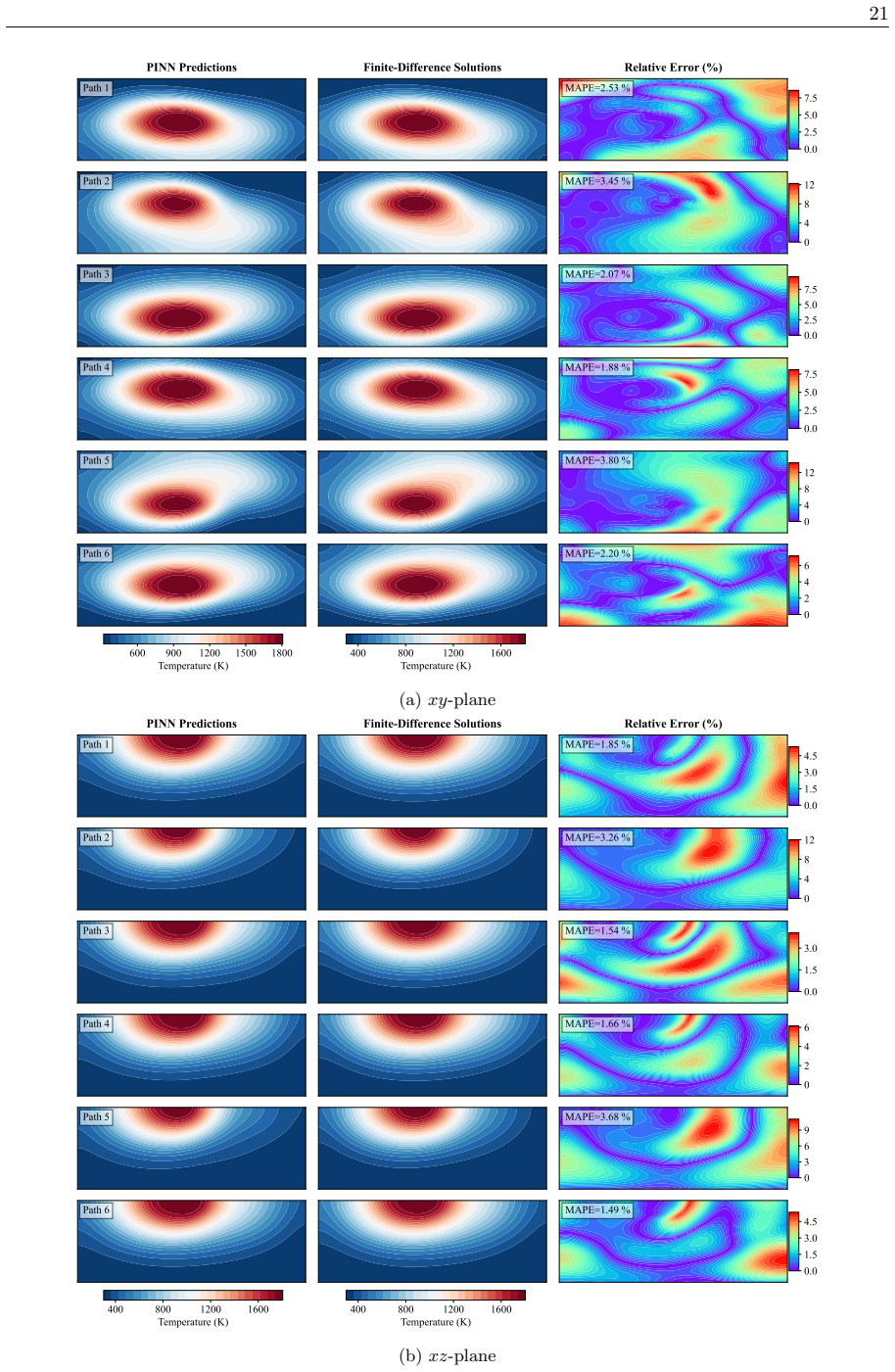
On the paper's own terms, the central discovery is that the sequential PINN is a scalable surrogate where the one-shot physics-informed operator fails: when the laser path is treated as an input function, the enriched DeepONet's error grows to a MAPE of 6.81% and melt pool errors of 8-10% on six three-track paths, whereas decomposing each path into tracks and chaining track-level PINNs brings MAPE to 2.49% and melt pool errors below 5%. The chain works because each track network takes the final temperature field of its predecessor as its initial condition, preserving continuity of the thermal history across track boundaries. The same chained model also tracks the cooling and consolidation phase with MAPE below 5% over time, which the authors identify as relevant for microstructure predictions.
Load-bearing premise
The finite-difference solver that generates the reference temperatures is an accurate and converged representation of the true physical process, yet no mesh-convergence, analytical-benchmark, or experimental validation of that solver is reported.
Editorial extensions
If this is right
- Scan-path optimization for laser powder bed fusion becomes feasible with a surrogate that holds melt pool errors below 5%, avoiding thousands of full finite-difference or finite-element solves.
- Physics-informed surrogates are no longer restricted to single tracks: the sequential formulation extends the parametric idea to path-dependent processes without the accuracy collapse seen in the one-shot DeepONet.
- Reusing stored track networks cuts training time from 17 hours to 2 hours for the six-path test case, so adding a new scan order costs only the recall of already-trained track models.
- Because the chain resolves the cooling phase, the surrogate can feed microstructure models or support process control decisions that depend on thermal history, not just peak temperature.
Reading between the lines
- A boundary the authors leave implicit: the number of stored PINNs in Eq. (20) grows factorially with the number of tracks, so for many-track parts the benefit of reuse shrinks unless tracks share common predecessors or the approach is paired with transfer learning.
- The same chaining idea applies naturally to multi-layer builds: each new layer could start from the previous layer's final temperature field, which is the direct next test of whether error accumulation stays bounded.
- A stronger validation the paper does not attempt would compare the chained surrogate's melt pool widths and depths against high-speed imaging or cross-section metallography, since the reference itself is an unvalidated finite-difference solve.
Editorial analysis
A structured set of objections, weighed in public.
Referee Report
Summary. This manuscript develops physics-informed surrogates for the three-dimensional temperature field in laser powder bed fusion, with emphasis on multi-track scanning paths. The authors solve the transient heat equation in an unsupervised manner using a PINN and a PI-EnDeepONet, and they propose a sequential PINN that trains one small network per track transition and assembles full multi-track solutions by recalling the trained networks. Single-track results show MAPE below 2% for both architectures; for six three-track paths, the sequential PINN achieves a MAPE of 2.49% and melt-pool errors below 5%, while reducing training time by a factor of 8.5 relative to PI-EnDeepONet. All accuracy claims are measured against a finite-difference solution of the heat equation.
Significance. If the reported accuracy holds, the sequential-PINN idea is a pragmatic contribution: it replaces one hard multi-track operator-learning problem with many small, Markovian track-transition problems, uses no labeled data, and cuts training time substantially for the n=3 case. The training is unsupervised, with physics-based losses, and the FD reference is independent, so there is no circular fitting of the benchmark. The paper also names the error-accumulation limitation of the sequential approach explicitly. However, the single-run nature of the experiments and the absence of any validation of the FD reference mean that the quantitative conclusions should be read as promising demonstrations rather than established accuracy guarantees.
major comments (3)
- [Section 2.1, Eq. (5); Tables 2 and 3] The finite-difference solution is the sole reference for all accuracy metrics in Tables 2 and 3, yet the scheme is never validated and its discretization parameters are not reported. Eq. (5) is an explicit Euler update with temperature-dependent conductivity and an apparent-heat-capacity treatment of latent heat; such schemes have restrictive stability limits, and under-resolution near the moving Gaussian source would directly bias the peak temperatures and melt-pool dimensions that the surrogates are compared against. Please report the grid spacings and time step actually used, add a spatial and temporal mesh-convergence study, and validate the converged FD solution against an independent benchmark (an analytical solution for a Gaussian heat source, a well-established FEM code, or experimental thermocouple/IR data). Without this, the MAPE values are errors with respect to a possibly biased numerical baseline rather than to the true thermal field.
- [Section 3.3, Tables 2 and 3] All accuracy and training-time comparisons are based on a single training run per model. Physics-informed networks are sensitive to initialization and collocation-point sampling; the differences between PINN (MAPE 1.44%) and PI-EnDeepONet (1.77%) in single-track cases, and the melt-pool errors of 2.5-5%, may be within run-to-run variance. Report results over multiple random seeds, including the mean and standard deviation of MAPE and melt-pool errors, so that the claimed superiority of the sequential PINN over PI-EnDeepONet is statistically supported.
- [Section 3.3 and Section 4] The paper attributes the PI-EnDeepONet degradation in multi-track scenarios to the 'curse of dimensionality' but provides no diagnostic evidence. The branch-net input does grow with the number of tracks, but the error increase could equally be caused by insufficient collocation points, branch/trunk capacity, the fixed weighting scheme of Eq. (14), or optimization difficulty. Please add a controlled experiment (for example, varying the input discretization for a fixed path, or keeping the number of tracks fixed while changing the input size) to isolate the cause, and soften the conclusion accordingly if the evidence is inconclusive.
minor comments (5)
- [Abstract and Section 4] The abstract and conclusion state that the surrogate analyzes the effect of 'scanning paths and laser parameters,' but only the tool path is varied in the experiments; laser power, scan speed, and spot size are fixed in Table 1. Please restrict the parametric claims to tool-path variation or add experiments that vary laser parameters.
- [Section 3.3, Figures 7 and 8] The text refers to 'Fig. 8 illustrates the temperature contours' when the contour plot is actually Figure 7; the temperature-history plot is Figure 8. Correct the cross-references.
- [Table 1 and Eq. (5)] Table 1 lists a convection heat transfer coefficient of 10 W/(m2K), but the governing equation in Eq. (1) and the FD update in Eq. (5) neglect convective losses. Please clarify how the convective boundary condition is imposed in the finite-difference solver and in the PINN loss terms, or remove the unused parameter.
- [Section 2.3, Eq. (20)] The number of required PINNs in Eq. (20) grows like the sum of falling factorials, exceeding the number of scenarios for n>2. The word 'scalable' in the conclusion should therefore be qualified as 'scalable relative to PI-EnDeepONet for the n=3 case' rather than suggesting that the approach extends to large multi-track problems without further changes.
- [General] No code or data are provided for the finite-difference reference or the trained networks. Releasing the FD solver and the training configuration would materially aid reproducibility, given that all benchmark metrics depend on the reference implementation.
Circularity Check
No circularity found: the surrogate claims rest on unsupervised physics-based training and an independent finite-difference comparison, not on fitted inputs or self-citations.
full rationale
Score 0. The central claims are not circular. The PINN and PI-EnDeepONet are trained without labeled finite-difference data: their losses (Eqs. 7-13) enforce initial conditions, boundary conditions, and PDE residuals, and the loss weights (Eq. 14) are computed from initial loss values rather than from any benchmark output. The finite-difference solver of Eq. (5) is used only as a post-training validation baseline, and the MAPE in Eq. (22) is an evaluation metric applied after training, not a training objective. The sequential PINN decomposes multi-track scenarios into per-track problems whose initial conditions are inherited from previously trained networks; this is a compositional construction, not a fit to the reference data. There is no load-bearing self-citation chain: the author-overlapping references ([1], [2], [25]) support peripheral points about POD limitations, data-assisted training, and model-calibration reviews, while the material properties and adaptive clustering are taken from the external reference [11]. The acknowledged limitations, namely the unvalidated finite-difference baseline and possible error accumulation across tracks, are validation and correctness concerns rather than circularity. No specific equation or fitted parameter was found to reduce to the paper's own inputs, so no circular step is identified.
Assumptions & free parameters
free parameters (2)
- Network architecture hyperparameters =
5 hidden layers x 64 neurons (full/trunk), branch 2x64, sine(pi*beta*x)
- Loss weighting factors lambda_IC, lambda_BC, lambda_PDE =
Set from initial loss values via Eq. (14)
assumptions (4)
- domain assumption Heat equation with temperature-dependent conductivity and a moving Gaussian volumetric heat source (Eqs. 2 and 4) models the LPBF thermal process.
- domain assumption Apparent heat capacity cp(T) in Eq. (21) accounts for latent heat of fusion.
- domain assumption Explicit Euler finite-difference solution (Eq. 5) is a converged and accurate reference.
- domain assumption Dirichlet and Neumann boundary conditions (Eq. 3) fully describe the domain boundaries.
Cite this review
Pith. "Pith review of Physics-Informed Surrogates for Temperature Prediction of Multi-Tracks in Laser Powder Bed Fusion." pith.science (2026). https://pith.science/paper/KDSXRWF4
@misc{pith2026250201820,
  author       = {Pith},
  title        = {Pith review of: Physics-Informed Surrogates for Temperature Prediction of Multi-Tracks in Laser Powder Bed Fusion},
  year         = {2026},
  howpublished = {\url{https://pith.science/paper/KDSXRWF4}},
  note         = {Machine review of arXiv:2502.01820}
}
read the original abstract
Modeling plays a critical role in additive manufacturing (AM), enabling a deeper understanding of underlying processes. Parametric solutions for such models are of great importance, enabling the optimization of production processes and considerable cost reductions. However, the complexity of the problem and diversity of spatio-temporal scales involved in the process pose significant challenges for traditional numerical methods. Surrogate models offer a powerful alternative by accelerating simulations and facilitating real-time monitoring and control. The present study presents an operator learning approach that relies on the deep operator network (DeepONet) and physics-informed neural networks (PINN) to predict the three-dimensional temperature distribution during melting and consolidation in laser powder bed fusion (LPBF). Parametric solutions for both single-track and multi-track scenarios with respect to tool path are obtained. To address the challenges in obtaining parametric solutions for multi-track scenarios using DeepONet architecture, a sequential PINN approach is proposed to efficiently manage the increased training complexity inherent in those scenarios. The accuracy and consistency of the model are verified against finite-difference computations. The developed surrogate allows us to efficiently analyze the effect of scanning paths and laser parameters on the thermal history.
Figures


Figures from the paper (5 more)



Reference graph
Works this paper leans on
-
[1]
Gopal Agarwal, Jorge-Humberto Urrea-Quintero, Henning Wessels, and Thomas Wick. Parameter identification and uncertainty propagation of hydrogel coupled diffusion-deformation using pod- based reduced-order modeling. Computational Mechanics, pages 1–31, 2024
work page 2024
-
[2]
David Anton, Jendrik-Alexander Tr¨ oger, Henning Wessels, Ulrich R¨ omer, Alexander Henkes, and Stefan Hartmann. Deterministic and statistical calibration of constitutive models from full-field data with parametric physics-informed neural networks. arXiv preprint arXiv:2405.18311, 2024
work page Pith review arXiv 2024
-
[3]
Wenbo Cao, Jiahao Song, and Weiwei Zhang. Solving high-dimensional parametric engineering problems for inviscid flow around airfoils based on physics-informed neural networks. Journal of Computational Physics, 516:113285, 2024. 18
work page 2024
-
[4]
Capturing local temperature evolution during additive manufacturing through fourier neural operators
Jiangce Chen, Wenzhuo Xu, Martha Baldwin, Bj¨ orn Nijhuis, Ton van den Boogaard, Noelia Grande Guti´ errez, Sneha Prabha Narra, and Christopher McComb. Capturing local temperature evolution during additive manufacturing through fourier neural operators. Journal of Manufacturing Science and Engineering, 146(9), 2024
work page 2024
-
[5]
A deeponet multi-fidelity approach for residual learning in reduced order modeling
Nicola Demo, Marco Tezzele, and Gianluigi Rozza. A deeponet multi-fidelity approach for residual learning in reduced order modeling. Advanced Modeling and Simulation in Engineering Sciences, 10(1):12, 2023
work page 2023
-
[6]
Reduced order modeling via pgd for highly transient thermal evolutions in additive manufacturing
B Favoretto, CA De Hillerin, O Bettinotti, V Oancea, and Andrea Barbarulo. Reduced order modeling via pgd for highly transient thermal evolutions in additive manufacturing. Computer Methods in Applied Mechanics and Engineering, 349:405–430, 2019
work page 2019
-
[7]
Jon Flores, Iker Garmendia, and Joseba Pujana. Toolpath generation for the manufacture of metallic components by means of the laser metal deposition technique. The international journal of advanced manufacturing technology, 101(5):2111–2120, 2019
work page 2019
-
[8]
On ther- mal modeling of additive manufacturing processes
Panagis Foteinopoulos, Alexios Papacharalampopoulos, and Panagiotis Stavropoulos. On ther- mal modeling of additive manufacturing processes. CIRP Journal of Manufacturing Science and Technology, 20:66–83, 2018
work page 2018
Show all 36 references
-
[9]
A comprehensive deep learning-based approach to reduced order modeling of nonlinear time-dependent parametrized pdes
Stefania Fresca, Luca Dede’, and Andrea Manzoni. A comprehensive deep learning-based approach to reduced order modeling of nonlinear time-dependent parametrized pdes. Journal of Scientific Computing, 87:1–36, 2021
2021
-
[10]
En-deeponet: An enrichment ap- proach for enhancing the expressivity of neural operators with applications to seismology
Ehsan Haghighat, Umair bin Waheed, and George Karniadakis. En-deeponet: An enrichment ap- proach for enhancing the expressivity of neural operators with applications to seismology. Computer Methods in Applied Mechanics and Engineering, 420:116681, 2024
2024
-
[11]
Single-track thermal analysis of laser powder bed fusion process: Parametric solution through physics-informed neural networks
Ehsan Hosseini, P Scheel, Oliver M¨ uller, Roberto Molinaro, and Siddhartha Mishra. Single-track thermal analysis of laser powder bed fusion process: Parametric solution through physics-informed neural networks. Computer Methods in Applied Mechanics and Engineering, 410:116019, 2023
2023
-
[12]
Enhancing pinns for solving pdes via adaptive collocation point movement and adaptive loss weighting
Jie Hou, Ying Li, and Shihui Ying. Enhancing pinns for solving pdes via adaptive collocation point movement and adaptive loss weighting. Nonlinear Dynamics, 111(16):15233–15261, 2023
2023
-
[13]
Tool path optimization of selective laser sintering processes using deep learning
DH Kim and TI Zohdi. Tool path optimization of selective laser sintering processes using deep learning. Computational Mechanics, 69(1):383–401, 2022
2022
-
[14]
An efficient and high- fidelity local multi-mesh finite volume method for heat transfer and fluid flow problems in metal additive manufacturing
Ming-Jian Li, Jiawei Chen, Yanping Lian, Feiyu Xiong, and Daining Fang. An efficient and high- fidelity local multi-mesh finite volume method for heat transfer and fluid flow problems in metal additive manufacturing. Computer Methods in Applied Mechanics and Engineering, 404:1...
2023
-
[15]
A physics- informed neural network framework to predict 3d temperature field without labeled data in process of laser metal deposition
Shilin Li, Gang Wang, Yuelan Di, Liping Wang, Haidou Wang, and Qingjun Zhou. A physics- informed neural network framework to predict 3d temperature field without labeled data in process of laser metal deposition. Engineering Applications of Artificial Intelligence, 120:105908, 2023
2023
-
[16]
Fourier neural operator for parametric partial differential equations
Zongyi Li, Nikola Kovachki, Kamyar Azizzadenesheli, Burigede Liu, Kaushik Bhattacharya, An- drew Stuart, and Anima Anandkumar. Fourier neural operator for parametric partial differential equations. arXiv preprint arXiv:2010.08895, 2020. 19
2010 arXiv
-
[17]
Hy- brid thermal modeling of additive manufacturing processes using physics-informed neural networks for temperature prediction and parameter identification
Shuheng Liao, Tianju Xue, Jihoon Jeong, Samantha Webster, Kornel Ehmann, and Jian Cao. Hy- brid thermal modeling of additive manufacturing processes using physics-informed neural networks for temperature prediction and parameter identification. Computational Mechanics, 72(3):4...
2023
-
[18]
On the limited memory bfgs method for large scale optimization
Dong C Liu and Jorge Nocedal. On the limited memory bfgs method for large scale optimization. Mathematical programming, 45(1):503–528, 1989
1989
-
[19]
Learning nonlinear operators via deeponet based on the universal approximation theorem of operators.Nature machine intelligence, 3(3):218–229, 2021
Lu Lu, Pengzhan Jin, Guofei Pang, Zhongqiang Zhang, and George Em Karniadakis. Learning nonlinear operators via deeponet based on the universal approximation theorem of operators.Nature machine intelligence, 3(3):218–229, 2021
2021
-
[20]
Physics-informed neural networks for high-speed flows
Zhiping Mao, Ameya D Jagtap, and George Em Karniadakis. Physics-informed neural networks for high-speed flows. Computer Methods in Applied Mechanics and Engineering, 360:112789, 2020
2020
-
[21]
Multiscale modeling of powder bed–based additive manufac- turing
Matthias Markl and Carolin K¨ orner. Multiscale modeling of powder bed–based additive manufac- turing. Annual Review of Materials Research, 46(1):93–123, 2016
2016
-
[22]
Modeling parametric uncertainty in pdes models via physics-informed neural networks
Milad Panahi, Giovanni Michele Porta, Monica Riva, and Alberto Guadagnini. Modeling parametric uncertainty in pdes models via physics-informed neural networks. Advances in Water Resources, 195:104870, 2025
2025
-
[23]
Physics-informed neural networks: A deep learning framework for solving forward and inverse problems involving nonlinear partial differential equations
Maziar Raissi, Paris Perdikaris, and George E Karniadakis. Physics-informed neural networks: A deep learning framework for solving forward and inverse problems involving nonlinear partial differential equations. Journal of Computational physics, 378:686–707, 2019
2019
-
[24]
Challenges in training pinns: A loss landscape perspective
Pratik Rathore, Weimu Lei, Zachary Frangella, Lu Lu, and Madeleine Udell. Challenges in training pinns: A loss landscape perspective. arXiv preprint arXiv:2402.01868, 2024
2024 arXiv
-
[25]
Reduced and all-at-once approaches for model calibration and discovery in computational solid mechanics
Ulrich R¨ omer, Stefan Hartmann, Jendrik-Alexander Tr¨ oger, David Anton, Henning Wessels, Moritz Flaschel, and Laura De Lorenzis. Reduced and all-at-once approaches for model calibration and discovery in computational solid mechanics. Applied Mechanics Reviews, pages 1–51, 2024
2024
-
[26]
Advances in computational modeling for laser powder bed fusion additive manufacturing: A comprehensive review of finite element techniques and strategies
Devashish Sarkar, Angshuman Kapil, and Abhay Sharma. Advances in computational modeling for laser powder bed fusion additive manufacturing: A comprehensive review of finite element techniques and strategies. Additive Manufacturing, page 104157, 2024
2024
-
[27]
Simulation of metallic powder bed additive manufacturing processes with the finite element method: A critical review
Babis Schoinochoritis, Dimitrios Chantzis, and Konstantinos Salonitis. Simulation of metallic powder bed additive manufacturing processes with the finite element method: A critical review. Proceedings of the Institution of Mechanical Engineers, Part B: Journal of Engineering M...
2017
-
[28]
On the distribution of points in a cube and the approximate evaluation of integrals
Il’ya Meerovich Sobol’. On the distribution of points in a cube and the approximate evaluation of integrals. Zhurnal Vychislitel’noi Matematiki i Matematicheskoi Fiziki, 7(4):784–802, 1967
1967
-
[29]
Pgd in thermal transient problems with a moving heat source: A sensitivity study on factors affecting accuracy and efficiency
Dominic Strobl, J¨ org F Unger, Chady Ghnatios, and Annika Robens-Radermacher. Pgd in thermal transient problems with a moving heat source: A sensitivity study on factors affecting accuracy and efficiency. Engineering Reports, page e12887, 2024. 20
2024
-
[30]
On the calibration of thermo-microstructural simulation models for laser powder bed fusion process: Integrating physics-informed neural networks with cellular automata
Jian Tang, Pooriya Scheel, Mohammad S Mohebbi, Christian Leinenbach, Laura De Lorenzis, and Ehsan Hosseini. On the calibration of thermo-microstructural simulation models for laser powder bed fusion process: Integrating physics-informed neural networks with cellular automata. ...
2024
-
[31]
Wavelet neural operator for solving parametric partial dif- ferential equations in computational mechanics problems
Tapas Tripura and Souvik Chakraborty. Wavelet neural operator for solving parametric partial dif- ferential equations in computational mechanics problems. Computer Methods in Applied Mechanics and Engineering, 404:115783, 2023
2023
-
[32]
3d temperature field prediction in direct energy deposition of metals using physics informed neural network
Jibing Xie, Ze Chai, Luming Xu, Xukai Ren, Sheng Liu, and Xiaoqi Chen. 3d temperature field prediction in direct energy deposition of metals using physics informed neural network. The International Journal of Advanced Manufacturing Technology, 119(5):3449–3468, 2022
2022
-
[33]
Process planning for adaptive contour parallel tool- path in additive manufacturing with variable bead width
Yi Xiong, Sang-in Park, Suhasini Padmanathan, Audelia Gumarus Dharmawan, Shaohui Foong, David William Rosen, and Gim Song Soh. Process planning for adaptive contour parallel tool- path in additive manufacturing with variable bead width. The International Journal of Advanced Ma...
2019
-
[34]
Fast and accurate reduced-order modeling of a moose-based additive manufacturing model with operator learning
Mahmoud Yaseen, Dewen Yushu, Peter German, and Xu Wu. Fast and accurate reduced-order modeling of a moose-based additive manufacturing model with operator learning. The International Journal of Advanced Manufacturing Technology, 129(7):3123–3139, 2023
2023
-
[35]
Modeling and cooling rate control in laser additive manufacturing: 1-d pde formulation
Chengjian Zheng, John T Wen, Sandipan Mishra, and Mamadou Diagne. Modeling and cooling rate control in laser additive manufacturing: 1-d pde formulation. In 2017 IEEE 56th Annual Conference on Decision and Control (CDC), pages 5020–5025. IEEE, 2017
2017
-
[36]
Q. Zhu, Z. Liu, and J. Yan. Machine learning for metal additive manufacturing: predicting tem- perature and melt pool fluid dynamics using physics-informed neural networks. Computational Mechanics, 67(2):619–635, 2021. 21 /uni00000033/uni00000044/uni00000057/uni0000004b/uni000...
2021
Reviewed August 9, 2026 · model on record in the stance chip above.
Discussion (0). Continue with ORCID to comment.