REVIEW 3 major objections 5 minor 2 cited by
ADF22-WEB: ALMA and JWST (sub)kpc-scale views of dusty star-forming galaxies in a $z\approx$3 proto-cluster
T0 review · 3 major / 5 minor · reviewed 2026-08-09 · deepseek-v4-flash
Pith's one-line read The paper argues that z≈3 dusty starbursts in a proto-cluster core are predominantly disk-like galaxies with compact cores, so the local morphology-density relation must form after that epoch.
desk verdict Solid matched-resolution ALMA+JWST morphology of z~3 protocluster DSFGs; the disk interpretation is well supported, while the morphology-density-relation narrative overreaches the small sample. read the letter →
The pith
A machine-rendered reading of the paper's core claim, the machinery that carries it, and where it could break.
The reading
What carries the argument
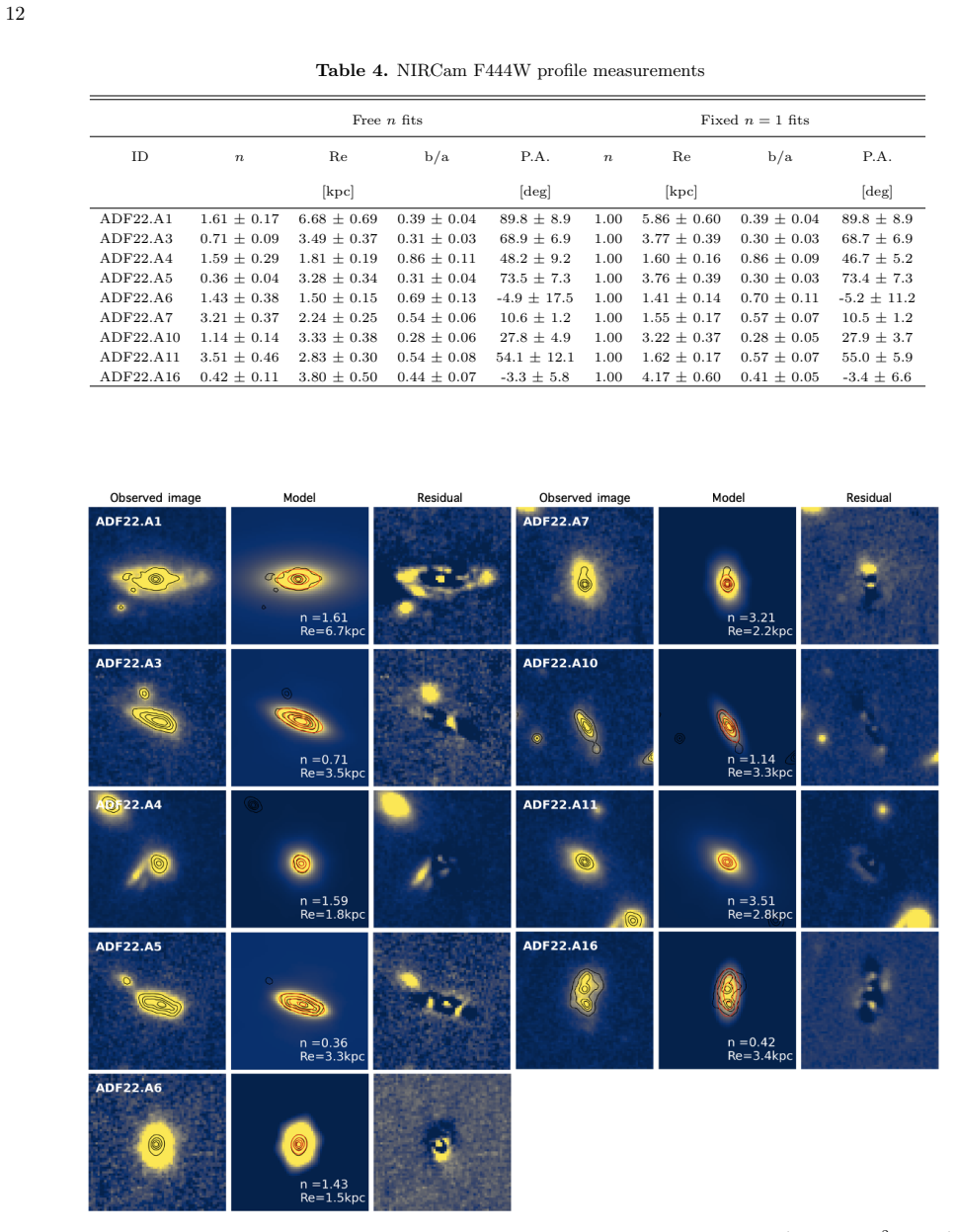
The central tool is two-dimensional Sersic profile fitting, applied to ALMA 870-micron images at about 0.15 arcseconds and to JWST F444W images at matched resolution, with iterative masking of residual pixels above 5-sigma in the ALMA fits to expose an underlying smooth disk component. The Sersic index n characterizes profile concentration: n≈1 corresponds to an exponential disk and high n to a concentrated spheroid, so comparing n, effective radius, axis ratio, and position angle between the two tracers lets the paper test whether dust and stellar emission share the same geometry. A second element is the core dust mass surface density estimated from 0.05-arcsecond 1.1-millimeter maps, combined with the F444W Sersic index and F200W–F444W color, to place the galaxies in an evolutionary diagram of dust-obscured bulge growth.
What would settle it
A single deep ALMA 870-micron observation of one of these DSFGs at about 0.05 to 0.08 arcseconds that resolves out the extended component and shows the flux concentrated in unresolved cores and clumps, with no exponential disk remaining in the residual after masking, would falsify the disk claim; alternatively, [C II] or CO kinematics showing no ordered rotation across the apparent disk would weaken the late-type interpretation.
Extended reading notes
Core claim
The central claim is that, in the core of the SSA22 proto-cluster at z≈3.09, dusty star-forming galaxies have predominantly disk-like morphologies with superimposed compact cores. For the six brightest sources, the 870-micron Sersic index measured after iteratively masking bright residual pixels is close to unity, with a mean n=0.86±0.05, indicating an exponential disk; without the masks the mean rises to n=1.37±0.08, quantifying the extra concentrated core light. The JWST F444W Sersic indices range from about 1 to 3, pointing to coexisting bulges and stellar disks, and the ALMA and F444W measurements agree well in axis ratio and position angle, supporting the interpretation that dust emission originates across the disks. The paper therefore argues that these DSFGs are late-type galaxies undergoing rapid, heavily obscured growth, and that the sharp contrast with the early-type morphology-density relation seen in local clusters means we are observing the early formation of that relation.
Load-bearing premise
The central assumption is that iteratively masking the brightest 5-sigma pixels in the ALMA images reveals a real pre-existing smooth exponential disk, rather than manufacturing one by fitting only the faint wings of unresolved compact cores.
Editorial extensions
If this is right
- The most massive galaxies in the proto-cluster core at z≈3 are predominantly late-type, so the morphology-density relation must emerge after this epoch.
- Dust continuum emission in DSFGs traces star formation across the disk rather than only in compact starburst cores, since the ALMA and F444W axis ratios and position angles agree.
- Compact red dusty cores in some DSFGs mark an ongoing, dust-obscured bulge-growth phase, often accompanied by X-ray AGNs, suggesting simultaneous bulge and black-hole growth.
- ADF22.A11 may be a transitional object where the center has already quenched, with n≈4 in F444W, while the disk still forms stars, offering evidence for inside-out quenching.
- Bars and offset ridges in dust emission in at least ADF22.A1, A3, and A5 indicate that secular bar-driven gas inflow contributes to the starbursts.
Reading between the lines
- If these disky DSFGs are truly the ancestors of local ellipticals, their transformation into spheroids must be completed between z≈3 and z≈1; counting mergers or measuring disk settling in proto-cluster cores over that redshift range would test this.
- The tight ALMA–F444W axis-ratio correlation seen here, not seen in the general field, could reflect shared gas inflow geometry along cosmic-web filaments; a larger proto-cluster sample can check whether the alignment is systematic.
- ADF22.A11's n≈4 F444W profile with faint dust may be a snapshot of inside-out quenching; near-infrared spectroscopy of its gas could confirm that the center is already passive.
- The 5-sigma masking step biases the fitted Sersic index downward by construction, so independent checks with visibility-plane modeling or deeper stacking of the extended component are needed before the disk conclusion is generalized.
Editorial analysis
A structured set of objections, weighed in public.
Referee Report
Summary. The paper analyzes ALMA 870 um and 1.1 mm images together with JWST/NIRCam (F115W–F444W) images of nine spectroscopically confirmed dusty star-forming galaxies (DSFGs) at z ~ 3.09 in the SSA22 proto-cluster core. Fluxes are measured at multiple resolutions and cross-checked, and Sersic profiles are fit to the ALMA 870 um images both with and without iterative bright-pixel masking, as well as to the NIRCam F444W images. The masked ALMA fits give Sersic indices near unity, which the authors interpret as evidence that dust emission arises from disks with superimposed compact cores; the F444W fits give n ~ 1–3.5, suggesting bulges and disks. Combining dust mass surface density, F444W Sersic index, and F200W–F444W colors, the paper argues that the proto-cluster DSFGs span different evolutionary stages, including red, dusty cores undergoing rapid bulge growth. The paper concludes that these DSFGs are predominantly disk-dominated and interprets this as the early formation stage of the local morphology-density relation.
Significance. If the central disk-dominance claim holds, the paper provides a valuable observational datum for the evolution of the morphology-density relation and for the internal structure of DSFGs in a proto-cluster environment. Strengths include the multi-resolution flux cross-checks in Section 3.2, the convolution of model profiles with the synthesized beam in the Sersic fits (Section 3.3), the explicit comparison of masked and unmasked fits, the fixed-n test in Appendix A, and the candid discussion of caveats such as flux recovery, F444W dust extinction, and the small sample size. The comparison of ALMA and F444W sizes, axis ratios, and position angles is a useful addition to the literature, and the paper's emphasis on the coexistence of disks, cores, bars, and clumps is timely.
major comments (3)
- [§3.3, Table 3] The central disk-dominance claim rests on the masked Sersic fits. Iterative masking of residual pixels above 5σ removes the bright central core and clumps before fitting, and the reported mean n drops from 1.37 ± 0.08 (unmasked) to 0.86 ± 0.05 (masked). The interpretation that this exposes an underlying exponential disk is not uniquely supported by the data: if the true profile is a compact high-n Sersic with a masked center, the remaining outer wings can be approximated by n ≈ 1. The paper does not provide a recovery simulation showing that the masking-and-fitting procedure returns the input n for single-component Sersic profiles with n spanning 1–4 in the presence of the 0.15″ beam and the measured noise, nor does it fit an explicit two-component (disk + core) model. The fixed-n = 1 test in Appendix A is not an adequate substitute because it forces n = 1 rather than testing whether the residual wings of a high-n profile masquerade as an exponential disk. I recommend adding injection-recovery simulations or explicit two-component fits before the abstract's claim that 'dust emission arises from disks' is accepted.
- [Appendix A, Table A1] The statement in §3.3 that the fixed-n = 1 unmasked fits 'broadly yielded similar parameters compared with the fit with bright emission masks' is not fully supported by the numbers. For ADF22.A1, Re changes from 4.73 ± 0.53 kpc (masked free-n) to 2.82 ± 0.31 kpc (fixed-n unmasked), and ADF22.A7 changes from 1.53 ± 0.15 to 1.30 ± 0.15 kpc. These differences are several times the quoted uncertainties and indicate that the fixed-n fit is not simply recovering the same disk component. Since the fixed-n fit is the main check on the masking procedure, this discrepancy should be discussed and ideally reconciled with a two-component model.
- [§5.3, Abstract] The concluding claim that 'we are witnessing the early formation of the morphology-density relation' goes beyond what the data directly show. The paper demonstrates that nine DSFGs in the SSA22 proto-cluster core have disk-dominated dust and stellar profiles, and it compares their Sersic indices, sizes, and axis ratios with field DSFGs from Hodge et al. (2025). However, the comparison is not quantitative in terms of environment: the field sample is not matched in stellar mass, redshift, or selection (e.g., L_IR limits), and the paper does not show that the proto-cluster DSFGs are more disk-dominated than field DSFGs at fixed mass. Without such a differential test, the claim about the origin of the morphology-density relation is an interpretation rather than a measurement. I suggest either adding a matched control comparison or softening the conclusion to state that the ancestors of local cluster ellipticals were disk-dominated at z ≈ 3 in this proto-cluster.
minor comments (5)
- [§2.3] The sentence listing 5σ limiting magnitudes gives five values for four filters ('29.74, 29.01, 29.15, 29.49, 29.00 AB mag for F115W, F200W, F356W, and F444W'); please correct the number of values or filters.
- [§2.2.1] The phrase 'The recipitable water vapor' should be 'The precipitable water vapor'.
- [§4.1] There is a typo: 'invisiblein the bluer bands' should read 'invisible in the bluer bands'.
- [Table 3] The ADF22.A4 masked fit reports b/a = 1.0 ± 0.1 with an essentially unconstrained position angle (114.1 ± 100.5 deg); it would be helpful to note that PA is meaningless for a round source and to exclude this PA from the correlation analysis in §4.3.
- [Table 2] The header 'IRCS IRCS' above the R.A. and Dec. columns appears to be an undefined or leftover coordinate-system label; please define it or remove it.
Circularity Check
No significant circularity: the morphological analysis is self-contained and the disk interpretation is supported by independent fits and external comparisons.
full rationale
The paper is an observational morphological study, not a derivation, and no load-bearing step reduces to its own inputs. The Sérsic index at 870 µm is a free parameter in the profile fit; the iterative 5σ residual masking is defined from fit residuals, not from an assumed n, so the measured ⟨n⟩=0.86 does not equal an input by construction. The unmasked fits (⟨n⟩=1.37) and the fixed-n=1 fits provide internal checks, and the disk interpretation is additionally supported by the ALMA–F444W b/a and PA correlations and by the external stacked detection of faint extended components (Gullberg et al. 2019). Self-citations (Umehata et al. 2015, 2019, 2024) supply target selection, field context, and some complementary data or interpretations, but the central morphological measurements and the comparison to local morphology-density relations are made with the new ALMA and JWST data presented here; the cited prior results are independent measurements rather than assumptions that already contain the conclusion. No fitted parameter is renamed as a prediction, no uniqueness theorem is imported, and no known result is merely relabeled. The iterative-masking concern raised by a skeptical reading is a possible systematic or measurement bias and a correctness risk, not a circularity under the definitions used here.
Assumptions & free parameters
free parameters (4)
- Dust temperature Td =
25 K
- Spectral emissivity index beta =
1.8
- Dust mass absorption coefficient kappa(nu850) =
0.04 m2/kg
- Dust temperature and emissivity for flux correction =
Td = 30 K, beta = 2.0
assumptions (4)
- ad hoc to paper Iterative masking of residual pixels above 5-sigma isolates the underlying smooth disk profile in the ALMA 870 um fits.
- domain assumption F444W (rest-frame around 1.1 um) light primarily traces stellar mass.
- domain assumption The z=3.09 SSA22 proto-cluster core is the direct ancestor of the densest regions in the local universe.
- domain assumption Standard concordance cosmology (H0=70 km/s/Mpc, Omega_m=0.30, Omega_Lambda=0.70).
Cite this review
Pith. "Pith review of ADF22-WEB: ALMA and JWST (sub)kpc-scale views of dusty star-forming galaxies in a $z\approx$3 proto-cluster." pith.science (2026). https://pith.science/paper/G3FBT7GE
@misc{pith2026250201868,
  author       = {Pith},
  title        = {Pith review of: ADF22-WEB: ALMA and JWST (sub)kpc-scale views of dusty star-forming galaxies in a $z\approx$3 proto-cluster},
  year         = {2026},
  howpublished = {\url{https://pith.science/paper/G3FBT7GE}},
  note         = {Machine review of arXiv:2502.01868}
}
read the original abstract
We present a morphological analysis of ALMA and JWST NIRCam images of nine dusty star-forming galaxies (DSFGs) at zspec=3.09, all embedded within the cosmic web filaments at the SSA22 proto-cluster core. The ALMA 870um and 1.1mm images are obtained at spatial resolutions ranging from 0.5" to 0.05" (350 pc at z=3.09). The high-resolution images enable us to resolve inner structures traced by dust continuum, identifying compact dusty cores, clumps, and offset ridges within bars. Sersic profile fit was performed for both ALMA 870um and NIRCam F444W images at comparable resolutions (0.15"). The Sersic index measured for 870um, masking bright regions, indicates values close to unity, suggesting that dust emission arises from disks with superimposed compact core components. For the JWST F444W images (restframe 1um), the Sersic indices range between nF444W = 1-3, pointing to the coexistence of bulges and stellar disks in these DSFGs. A comparison of dust mass surface density, nF444W, and F200W-F444W color (restframe 0.5-1um) reveals diversity among the DSFGs, likely reflecting different evolutionary stages including some DSFGs with red cores, indicating ongoing rapid bulge growth phases heavily obscured by dust. The predominantly disk-like morphologies observed in most DSFGs in the proto-cluster core contrast sharply with early-type morphologies that dominate the highest density environment in the local universe. This suggests that we are witnessing the early formation of the morphology-density relation, as massive galaxies undergo rapid growth as late-type galaxies fueled by cosmic web gas filaments.
Figures


Figures from the paper (7 more)




Forward citations
Cited by 2 Pith papers
-
ADF22-WEB: Detection of a molecular gas reservoir in a massive quiescent galaxy located in a $z\approx3$ proto-cluster core
ALMA's CO(3-2) detection in ADF22-QG1 provides the first direct measurement of molecular gas in a quiescent galaxy at z~3, with gas fraction and gas-to-dust ratio constraints.
-
Morphological Demographics of Galaxies at $z\sim 10-16$: Log-Normal Size Distribution and Exponential Profiles Consistent with the Disk Formation Scenario
Galaxies at z=10-16 have a log-normal size distribution with sigma 0.52, nearly uniform axis ratios, and exponential profiles, consistent with early disk formation.
Reference graph
Works this paper leans on
-
[1]
Amvrosiadis, A., Lange, S., Nightingale, J., et al. 2024, arXiv e-prints, arXiv:2404.01918, doi: 10.48550/arXiv.2404.01918 Astropy Collaboration, Robitaille, T. P., Tollerud, E. J., et al. 2013, A&A, 558, A33, doi: 10.1051/0004-6361/201322068 Astropy Collaboration, Price-Whelan, A. M., Sip˝ ocz, B. M., et al. 2018, AJ, 156, 123, doi: 10.3847/1538-3881/aabc4f
-
[2]
Bagley, M. B., Finkelstein, S. L., Koekemoer, A. M., et al. 2023, ApJL, 946, L12, doi: 10.3847/2041-8213/acbb08
-
[3]
Barger, A. J., Cowie, L. L., Sanders, D. B., et al. 1998, Nature, 394, 248, doi: 10.1038/28338
doi:10.1038/28338 1998
-
[4]
1996, A&AS, 117, 393, doi: 10.1051/aas:1996164
Bertin, E., & Arnouts, S. 1996, A&AS, 117, 393, doi: 10.1051/aas:1996164
-
[5]
Blain, A. W., Chapman, S. C., Smail, I., & Ivison, R. 2004, ApJ, 611, 725, doi: 10.1086/422353
doi:10.1086/422353 2004
-
[6]
Frayer, D. T. 2002, PhR, 369, 111, doi: 10.1016/S0370-1573(02)00134-5
-
[7]
Bond, J. R., Kofman, L., & Pogosyan, D. 1996, Nature, 380, 603, doi: 10.1038/380603a0
doi:10.1038/380603a0 1996
-
[8]
Bournaud, F., Daddi, E., Elmegreen, B. G., et al. 2008, A&A, 486, 741, doi: 10.1051/0004-6361:20079250 CASA Team, Bean, B., Bhatnagar, S., et al. 2022, PASP, 134, 114501, doi: 10.1088/1538-3873/ac9642 20
Show all 93 references
-
[9]
M., Narayanan, D., & Cooray, A
Casey, C. M., Narayanan, D., & Cooray, A. 2014, PhR, 541, 45, doi: 10.1016/j.physrep.2014.02.009
2014 doi
-
[10]
M., et al
Chen, C.-C., Smail, I., Swinbank, A. M., et al. 2015, ApJ, 799, 194, doi: 10.1088/0004-637X/799/2/194
2015 doi
-
[11]
2022, ApJL, 939, L7, doi: 10.3847/2041-8213/ac98c6
Chen, C.-C., Gao, Z.-K., Hsu, Q.-N., et al. 2022, ApJL, 939, L7, doi: 10.3847/2041-8213/ac98c6
2022 doi
-
[12]
2023, ApJL, 942, L19, doi: 10.3847/2041-8213/aca9d0
Cheng, C., Huang, J.-S., Smail, I., et al. 2023, ApJL, 942, L19, doi: 10.3847/2041-8213/aca9d0
2023 doi
-
[13]
2023, A&A, 673, L6, doi: 10.1051/0004-6361/202346535
Colina, L., Crespo G´ omez, A.,´Alvarez-M´ arquez, J., et al. 2023, A&A, 673, L6, doi: 10.1051/0004-6361/202346535
2023 doi
-
[14]
2021, CARTA: The Cube Analysis and Rendering Tool for Astronomy, 2.0.0, Zenodo, doi: 10.5281/zenodo.4905459
Comrie, A., Wang, K.-S., Hsu, S.-C., et al. 2021, CARTA: The Cube Analysis and Rendering Tool for Astronomy, 2.0.0, Zenodo, doi: 10.5281/zenodo.4905459
2021 doi
-
[15]
J., Grogin, N
Conselice, C. J., Grogin, N. A., Jogee, S., et al. 2004, ApJL, 600, L139, doi: 10.1086/378556 da Cunha, E., Groves, B., Walter, F., et al. 2013, ApJ, 766, 13, doi: 10.1088/0004-637X/766/1/13
2004 doi
-
[16]
2009, ApJ, 694, 1517, doi: 10.1088/0004-637X/694/2/1517 De Lucia, G., Springel, V., White, S
Daddi, E., Dannerbauer, H., Stern, D., et al. 2009, ApJ, 694, 1517, doi: 10.1088/0004-637X/694/2/1517 De Lucia, G., Springel, V., White, S. D. M., Croton, D., &
2009 doi
-
[18]
2006, MNRAS, 368, 2, doi: 10.1111/j.1365-2966.2006.10145.x
Dekel, A., & Birnboim, Y. 2006, MNRAS, 368, 2, doi: 10.1111/j.1365-2966.2006.10145.x
2006
-
[19]
2009, Nature, 457, 451, doi: 10.1038/nature07648
Dekel, A., Birnboim, Y., Engel, G., et al. 2009, Nature, 457, 451, doi: 10.1038/nature07648
2009 doi
-
[20]
1980, ApJ, 236, 351, doi: 10.1086/157753
Dressler, A. 1980, ApJ, 236, 351, doi: 10.1086/157753
1980 doi
-
[21]
S., McLure, R
Dunlop, J. S., McLure, R. J., Biggs, A. D., et al. 2017, MNRAS, 466, 861, doi: 10.1093/mnras/stw3088
2017 doi
-
[22]
1999, ApJ, 515, 518, doi: 10.1086/307069
Eales, S., Lilly, S., Gear, W., et al. 1999, ApJ, 515, 518, doi: 10.1086/307069
1999 doi
-
[23]
S., Smail, I., Dressler, A., et al
Ellis, R. S., Smail, I., Dressler, A., et al. 1997, ApJ, 483, 582, doi: 10.1086/304261
1997 doi
-
[24]
G., & Elmegreen, D
Elmegreen, B. G., & Elmegreen, D. M. 2005, ApJ, 627, 632, doi: 10.1086/430514
2005 doi
-
[25]
Lemonias, J. J. 2009, ApJ, 692, 12, doi: 10.1088/0004-637X/692/1/12
2009 doi
-
[26]
Coe, D. A. 2007, ApJ, 658, 763, doi: 10.1086/511667
2007 doi
-
[27]
2008, ApJ, 687, 59, doi: 10.1086/591840
Genzel, R., Burkert, A., Bouch´ e, N., et al. 2008, ApJ, 687, 59, doi: 10.1086/591840
2008 doi
-
[28]
2011, ApJ, 733, 101, doi: 10.1088/0004-637X/733/2/101
Genzel, R., Newman, S., Jones, T., et al. 2011, ApJ, 733, 101, doi: 10.1088/0004-637X/733/2/101
2011 doi
-
[29]
2023, A&A, 676, A26, doi: 10.1051/0004-6361/202346531
Gillman, S., Gullberg, B., Brammer, G., et al. 2023, A&A, 676, A26, doi: 10.1051/0004-6361/202346531
2023 doi
-
[30]
2024, A&A, 691, A299, doi: 10.1051/0004-6361/202451006
Gillman, S., Smail, I., Gullberg, B., et al. 2024, A&A, 691, A299, doi: 10.1051/0004-6361/202451006
2024 doi
-
[31]
R., Bertoldi, F., Smail, I., et al
Greve, T. R., Bertoldi, F., Smail, I., et al. 2005, MNRAS, 359, 1165, doi: 10.1111/j.1365-2966.2005.08979.x
2005
-
[32]
M., Smail, I., et al
Gullberg, B., Swinbank, A. M., Smail, I., et al. 2018, ApJ, 859, 12, doi: 10.3847/1538-4357/aabe8c
2018 doi
-
[33]
M., et al
Gullberg, B., Smail, I., Swinbank, A. M., et al. 2019, MNRAS, 490, 4956, doi: 10.1093/mnras/stz2835
2019 doi
-
[34]
J., Blain, A
Hainline, L. J., Blain, A. W., Smail, I., et al. 2011, ApJ, 740, 96, doi: 10.1088/0004-637X/740/2/96
2011 doi
-
[35]
R., Millman, K
Harris, C. R., Millman, K. J., van der Walt, S. J., et al. 2020, Nature, 585, 357, doi: 10.1038/s41586-020-2649-2
2020 doi
-
[36]
2004, AJ, 128, 2073, doi: 10.1086/424935
Hayashino, T., Matsuda, Y., Tamura, H., et al. 2004, AJ, 128, 2073, doi: 10.1086/424935
2004 doi
-
[37]
H., Matsuda, Y., Umehata, H., et al
Hayatsu, N. H., Matsuda, Y., Umehata, H., et al. 2017, PASJ, 69, 45, doi: 10.1093/pasj/psx018
2017 doi
-
[38]
A., & da Cunha, E
Hodge, J. A., & da Cunha, E. 2020, Royal Society Open Science, 7, 200556, doi: 10.1098/rsos.200556
2020 doi
-
[39]
A., Karim, A., Smail, I., et al
Hodge, J. A., Karim, A., Smail, I., et al. 2013, ApJ, 768, 91, doi: 10.1088/0004-637X/768/1/91
2013 doi
-
[40]
A., Swinbank, A
Hodge, J. A., Swinbank, A. M., Simpson, J. M., et al. 2016, ApJ, 833, 103, doi: 10.3847/1538-4357/833/1/103
2016 doi
-
[41]
A., Smail, I., Walter, F., et al
Hodge, J. A., Smail, I., Walter, F., et al. 2019, ApJ, 876, 130, doi: 10.3847/1538-4357/ab1846
2019 doi
-
[42]
A., Cunha, E
Hodge, J. A., Cunha, E. d., Kendrew, S., et al. 2025, ApJ, 978, 165, doi: 10.3847/1538-4357/ad9a52
2025 doi
-
[43]
F., Hernquist, L., Cox, T
Hopkins, P. F., Hernquist, L., Cox, T. J., et al. 2006, ApJS, 163, 1, doi: 10.1086/499298
2006 doi
-
[44]
H., Serjeant, S., Dunlop, J., et al
Hughes, D. H., Serjeant, S., Dunlop, J., et al. 1998, Nature, 394, 241, doi: 10.1038/28328
1998 doi
-
[45]
Hunter, J. D. 2007, Computing in Science and Engineering, 9, 90, doi: 10.1109/MCSE.2007.55
2007 doi
-
[46]
J., Cowley, W
Ikarashi, S., Ivison, R. J., Cowley, W. I., & Kohno, K. 2022, A&A, 659, A154, doi: 10.1051/0004-6361/202141196
2022 doi
-
[47]
J., Caputi, K
Ikarashi, S., Ivison, R. J., Caputi, K. I., et al. 2015, ApJ, 810, 133, doi: 10.1088/0004-637X/810/2/133
2015 doi
-
[48]
S., Aretxaga, I., et al
Iono, D., Yun, M. S., Aretxaga, I., et al. 2016, ApJL, 829, L10, doi: 10.3847/2041-8205/829/1/L10
2016 doi
-
[49]
J., Smail, I., Le Borgne, J
Ivison, R. J., Smail, I., Le Borgne, J. F., et al. 1998, MNRAS, 298, 583, doi: 10.1046/j.1365-8711.1998.01677.x
1998
- [50]
-
[51]
2007, MNRAS, 377, 1717, doi: 10.1111/j.1365-2966.2007.11739.x
Kodama, T., Tanaka, I., Kajisawa, M., et al. 2007, MNRAS, 377, 1717, doi: 10.1111/j.1365-2966.2007.11739.x
2007
-
[52]
J., Lintott, C
Kruk, S. J., Lintott, C. J., Bamford, S. P., et al. 2018, MNRAS, 473, 4731, doi: 10.1093/mnras/stx2605
2018 doi
-
[53]
2016, MNRAS, 455, 3333, doi: 10.1093/mnras/stv2392
Kubo, M., Yamada, T., Ichikawa, T., et al. 2016, MNRAS, 455, 3333, doi: 10.1093/mnras/stv2392
2016 doi
-
[54]
1999, MNRAS, 302, 111, doi: 10.1046/j.1365-8711.1999.02090.x 21
Lemson, G., & Kauffmann, G. 1999, MNRAS, 302, 111, doi: 10.1046/j.1365-8711.1999.02090.x 21
1999
-
[55]
Li, A., & Draine, B. T. 2001, ApJ, 554, 778, doi: 10.1086/323147
2001 doi
-
[56]
2005, ApJL, 634, L125, doi: 10.1086/499071
Matsuda, Y., Yamada, T., Hayashino, T., et al. 2005, ApJL, 634, L125, doi: 10.1086/499071
2005 doi
-
[57]
B., Chapman, S
Miller, T. B., Chapman, S. C., Aravena, M., et al. 2018, Nature, 556, 469, doi: 10.1038/s41586-018-0025-2
2018 doi
-
[58]
B., Lehmer, B
Monson, E. B., Lehmer, B. D., Doore, K., et al. 2021, ApJ, 919, 51, doi: 10.3847/1538-4357/ac0f84
2021 doi
-
[59]
B., Doore, K., Eufrasio, R
Monson, E. B., Doore, K., Eufrasio, R. T., et al. 2023, ApJ, 951, 15, doi: 10.3847/1538-4357/acd449
2023 doi
-
[60]
B., et al
Newville, M., Stensitzki, T., Allen, D. B., et al. 2016, Lmfit: Non-Linear Least-Square Minimization and Curve-Fitting for Python, Astrophysics Source Code Library, record ascl:1606.014
2016
-
[61]
J., Dunne, L., et al
Oteo, I., Ivison, R. J., Dunne, L., et al. 2018, ApJ, 856, 72, doi: 10.3847/1538-4357/aaa1f1
2018 doi
-
[62]
Y., Ho, L
Peng, C. Y., Ho, L. C., Impey, C. D., & Rix, H.-W. 2002, AJ, 124, 266, doi: 10.1086/340952 —. 2010, AJ, 139, 2097, doi: 10.1088/0004-6256/139/6/2097
2002 doi
-
[63]
D., Sivaramakrishnan, A., Lajoie, C.-P., et al
Perrin, M. D., Sivaramakrishnan, A., Lajoie, C.-P., et al. 2014, in Society of Photo-Optical Instrumentation Engineers (SPIE) Conference Series, Vol. 9143, Space Telescopes and Instrumentation 2014: Optical, Infrared, and Millimeter Wave, ed. J. Oschmann, Jacobus M., M. Clampi...
2014 doi
-
[64]
2022, MNRAS, 510, 3321, doi: 10.1093/mnras/stab3312
Popping, G., Pillepich, A., Calistro Rivera, G., et al. 2022, MNRAS, 510, 3321, doi: 10.1093/mnras/stab3312
2022 doi
-
[65]
A., Bradford, C
Riechers, D. A., Bradford, C. M., Clements, D. L., et al. 2013, Nature, 496, 329, doi: 10.1038/nature12050
2013 doi
-
[66]
2023, A&A, 679, A129, doi: 10.1051/0004-6361/202346444
Rizzo, F., Roman-Oliveira, F., Fraternali, F., et al. 2023, A&A, 679, A129, doi: 10.1051/0004-6361/202346444
2023 doi
-
[67]
2016, ApJ, 820, 83, doi: 10.3847/0004-637X/820/2/83
Scoville, N., Sheth, K., Aussel, H., et al. 2016, ApJ, 820, 83, doi: 10.3847/0004-637X/820/2/83
2016 doi
-
[68]
Sersic, J. L. 1968, Atlas de Galaxias Australes
1968
-
[69]
M., Swinbank, A
Simpson, J. M., Swinbank, A. M., Smail, I., et al. 2014, ApJ, 788, 125, doi: 10.1088/0004-637X/788/2/125
2014 doi
-
[70]
M., Smail, I., Swinbank, A
Simpson, J. M., Smail, I., Swinbank, A. M., et al. 2015, ApJ, 799, 81, doi: 10.1088/0004-637X/799/1/81 —. 2017, ApJ, 839, 58, doi: 10.3847/1538-4357/aa65d0
2015 doi
-
[71]
J., & Blain, A
Smail, I., Ivison, R. J., & Blain, A. W. 1997, ApJL, 490, L5, doi: 10.1086/311017
1997 doi
-
[72]
M., et al
Smail, I., Dudzeviˇ ci¯ ut˙ e, U., Stach, S. M., et al. 2021, MNRAS, 502, 3426, doi: 10.1093/mnras/stab283
2021 doi
-
[73]
2023, ApJ, 958, 36, doi: 10.3847/1538-4357/acf931
Smail, I., Dudzeviˇ ci¯ ut˙ e, U., Gurwell, M., et al. 2023, ApJ, 958, 36, doi: 10.3847/1538-4357/acf931
2023 doi
-
[74]
J., Lucey, J
Smith, R. J., Lucey, J. R., & Carter, D. 2012, MNRAS, 426, 2994, doi: 10.1111/j.1365-2966.2012.21922.x
2012
-
[75]
Springel, V., White, S. D. M., Jenkins, A., et al. 2005, Nature, 435, 629, doi: 10.1038/nature03597
2005 doi
-
[76]
M., Dudzeviˇ ci¯ ut˙ e, U., Smail, I., et al
Stach, S. M., Dudzeviˇ ci¯ ut˙ e, U., Smail, I., et al. 2019, MNRAS, 487, 4648, doi: 10.1093/mnras/stz1536
2019 doi
-
[77]
C., Adelberger, K
Steidel, C. C., Adelberger, K. L., Dickinson, M., et al. 1998, ApJ, 492, 428, doi: 10.1086/305073
1998 doi
-
[78]
A., Ivison, R
Stevens, J. A., Ivison, R. J., Dunlop, J. S., et al. 2003, Nature, 425, 264, doi: 10.1038/nature01976
2003 doi
-
[79]
M., Egami, E., et al
Sun, F., Helton, J. M., Egami, E., et al. 2024, ApJ, 961, 69, doi: 10.3847/1538-4357/ad07e3
2024 doi
-
[80]
M., Smail, I., Chapman, S
Swinbank, A. M., Smail, I., Chapman, S. C., et al. 2010, MNRAS, 405, 234, doi: 10.1111/j.1365-2966.2010.16485.x
2010
-
[81]
S., et al
Tadaki, K., Iono, D., Yun, M. S., et al. 2018, Nature, 560, 613, doi: 10.1038/s41586-018-0443-1
2018 doi
-
[82]
2009, Nature, 459, 61, doi: 10.1038/nature07947
Tamura, Y., Kohno, K., Nakanishi, K., et al. 2009, Nature, 459, 61, doi: 10.1038/nature07947
2009 doi
-
[83]
J., et al
Tamura, Y., Iono, D., Wilner, D. J., et al. 2010, ApJ, 724, 1270, doi: 10.1088/0004-637X/724/2/1270
2010 doi
-
[84]
2024, Nature, 636, 69, doi: 10.1038/s41586-024-08201-6
Tan, Q.-H., Daddi, E., Magnelli, B., et al. 2024, Nature, 636, 69, doi: 10.1038/s41586-024-08201-6
2024 doi
-
[85]
2014, ApJ, 782, 68, doi: 10.1088/0004-637X/782/2/68
Toft, S., Smolˇ ci´ c, V., Magnelli, B., et al. 2014, ApJ, 782, 68, doi: 10.1088/0004-637X/782/2/68
2014 doi
-
[86]
2024, MNRAS, 527, 8941, doi: 10.1093/mnras/stad3588
Tsukui, T., Wisnioski, E., Bland-Hawthorn, J., et al. 2024, MNRAS, 527, 8941, doi: 10.1093/mnras/stad3588
2024 doi
-
[87]
2014, MNRAS, 440, 3462, doi: 10.1093/mnras/stu447 —
Umehata, H., Tamura, Y., Kohno, K., et al. 2014, MNRAS, 440, 3462, doi: 10.1093/mnras/stu447 —. 2015, ApJL, 815, L8, doi: 10.1088/2041-8205/815/1/L8 —. 2017, ApJ, 835, 98, doi: 10.3847/1538-4357/835/1/98
2014 doi
-
[88]
2018, PASJ, 70, 65, doi: 10.1093/pasj/psy065
Umehata, H., Hatsukade, B., Smail, I., et al. 2018, PASJ, 70, 65, doi: 10.1093/pasj/psy065
2018 doi
-
[89]
2019, Science, 366, 97, doi: 10.1126/science.aaw5949
Umehata, H., Fumagalli, M., Smail, I., et al. 2019, Science, 366, 97, doi: 10.1126/science.aaw5949
2019 doi
-
[90]
M., et al
Umehata, H., Smail, I., Swinbank, A. M., et al. 2020, A&A, 640, L8, doi: 10.1051/0004-6361/202038146
2020 doi
- [91]
-
[92]
E., et al
Virtanen, P., Gommers, R., Oliphant, T. E., et al. 2020, Nature Methods, 17, 261, doi: 10.1038/s41592-019-0686-2
2020 doi
-
[93]
2012, Nature, 486, 233, doi: 10.1038/nature11073
Walter, F., Decarli, R., Carilli, C., et al. 2012, Nature, 486, 233, doi: 10.1038/nature11073
2012 doi
-
[94]
L., Smail, I., Coppin, K
Wardlow, J. L., Smail, I., Coppin, K. E. K., et al. 2011, MNRAS, 415, 1479, doi: 10.1111/j.1365-2966.2011.18795.x Weiß, A., De Breuck, C., Marrone, D. P., et al. 2013, ApJ, 767, 88, doi: 10.1088/0004-637X/767/1/88
2011
Reviewed August 9, 2026 · model on record in the stance chip above.
Discussion (0). Continue with ORCID to comment.