REVIEW 4 major objections 6 minor 104 references
Generative Data Mining with Longtail-Guided Diffusion
T0 review · 4 major / 6 minor · reviewed 2026-08-09 · deepseek-v4-flash
Pith's one-line read By decoding noisy latent states back to images and steering the diffusion update with the production model's longtail gradient, Longtail Guidance generates rare or hard training data without retraining either model.
desk verdict A practical Epistemic Head and a clever terminal-state guidance trick, but the benchmark gains are confounded by iterative generation scheduling; worth reviewing with a controlled comparison. read the letter →
The pith
A machine-rendered reading of the paper's core claim, the machinery that carries it, and where it could break.
The reading
What carries the argument
The load-bearing object is the decoded terminal-state estimate $\hat{x}^{(t)}_0 = D(P(z_t))$: at every DDIM step, the latent state $z_t$ is mapped to its predicted clean latent and decoded through the VAE, then scored by the production model. Because this estimate stays close to real training data much earlier in the reverse process, which the paper measures with FID, the production model's gradient is meaningful without being trained on noisy states. The second piece is the Epistemic Head: K duplicated classifier heads trained with an oracle loss that only back-propagates through the best head, with a stop-grad protecting the backbone. Their outputs give a single-forward-pass estimate of epistemic uncertainty, and LTG uses it or entropy or energy as the guiding signal.
What would settle it
Run LTG with increasing guidance weights on a fixed task, and have independent human raters or a separately trained anomaly detector label each generated image as an artifact or a semantically valid longtail example; if the artifact rate rises before correct-class probability drops, or if the FID of $\hat{x}^{(t)}_0$ is worse than the FID of the decoded noisy state at early timesteps, the terminal-estimate premise fails. A complementary check is to match LTG-selected and unguided generations for FID and test whether LTG still produces higher semantic diversity in the production model's feature space.
Extended reading notes
Core claim
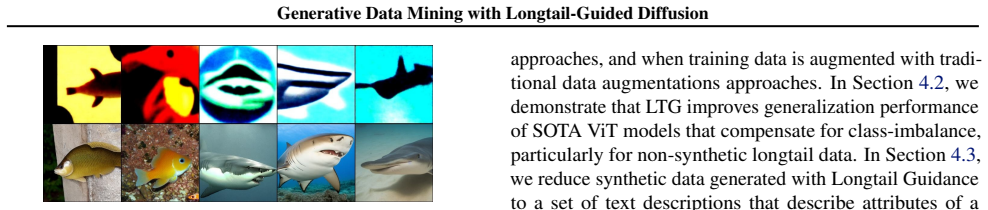
The central claim is that one can generate synthetic training data that is longtail from the perspective of a specific deployed model, not merely diverse from a foundation model's perspective. The method computes a differentiable longtail signal on the decoded terminal-state estimate $\hat{x}^{(t)}_0 = D(P(z_t))$ and biases the denoising update with a term of the form $-w \nabla_{z_t} f^{\mathrm{lt}}_\phi(D(P(z_t))) \sigma_t$. The paper reports that guided generations show lower probability of the correct class, lower accuracy, and higher longtail signal under the production model, while remaining in-distribution according to FID and precision/recall. Training on these generations improves generalization beyond CLIP-space synthetic-data baselines, and the authors attribute the gap to the fact that what is hard for CLIP differs substantially from what is hard for the production model.
Load-bearing premise
The load-bearing premise is that at early denoising steps the one-step terminal-state estimate is already close enough to real images that a classifier trained on clean data gives useful gradients; if the estimate is off-manifold in a way FID misses, guidance may select for artifacts rather than semantic longtail variation.
Editorial extensions
If this is right
- Across seven natural-image classification benchmarks, fine-tuning with LTG-generated data adds on average 5.6 points of top-1 accuracy over GIF and Dream-ID, and 15.0 points over prompt-tuned Stable Diffusion.
- On ImageNet-LT, LTG lifts accuracy on the rarest (Few) classes by 10 points over baseline diffusion, while overall accuracy rises 1.3 points, so the benefit is concentrated exactly where data scarcity bites.
- LTG-generated data are more efficient: the reported gains come with 20 to 30 percent of the synthetic data volume used by GIF, an average efficiency improvement of about 4x.
- Because neither the diffusion model nor the predictive model is retrained, LTG composes with established training recipes such as logit-adjusted BCE and MAE pretraining, and it can be run iteratively as the model's longtail evolves.
- Longtail Introspection reduces generated data to text keywords that improve downstream prompting over manual prompt tuning, so the process is inspectable rather than a black-box data factory.
Reading between the lines
- The terminal-state trick is not image-specific: any latent generative model with a differentiable decoder could in principle be steered by a clean-data model, so LTG-style mining could be tested in audio, video, medical imaging, or driving scenes.
- Because the guiding signal is an arbitrary differentiable function of the production model, one could substitute calibrated loss, safety scores, or downstream task metrics for uncertainty, mining data that are risky rather than merely uncertain.
- The paper's in-distribution evidence relies on FID and the model's own threshold on correct-class probability; a direct test with an independent density estimator or artifact detector would show whether some guidance weights trade semantic longtail variation for generated artifacts.
- The vision-language introspection step suggests a closed loop not fully explored: keywords discovered from LTG data could guide real data collection or re-prompt the generator, and the loop could then be repeated, which the paper's saturation results suggest would have diminishing but nonzero returns.
Editorial analysis
A structured set of objections, weighed in public.
Referee Report
Summary. The paper proposes model-based longtail signals, including a differentiable single-forward-pass Epistemic Head that estimates epistemic uncertainty via multiple heads with an oracle loss, and uses these signals as guidance for a latent diffusion model (Longtail Guidance, LTG). LTG decodes the predicted terminal latent state D(P(z_t)) at each denoising step, evaluates the longtail signal with an existing clean-data classifier, and backpropagates the gradient to bias the denoising estimate toward high-longtail-signal data. The authors claim training-free coupling between off-the-shelf diffusion and a deployed classifier, with large top-1 accuracy gains over GIF, Dream-ID, and prompt-tuned Stable Diffusion across seven benchmarks, and additional VLM-based introspection results. The central results are empirical; no equation reduces to a fitted value, and the main artifacts are external benchmark accuracy numbers.
Significance. If the claims hold, LTG is a practical training-free method to couple existing generative models with deployed classifiers, with potentially large gains on longtail and distribution-shift benchmarks, and the Epistemic Head is a lightweight uncertainty estimator. The paper has several strengths: it evaluates on multiple architectures (ResNet-50, ResNet-34, ViT/LiVT) and multiple datasets; it reports ablations over guidance weight and number of heads (Appendix A.8); it provides a computational-cost analysis (Appendix A.5); and the VLM introspection experiment (Section 4.3, Table 4) is a useful, falsifiable check that LTG data carry semantic value. However, the headline quantitative claim is currently confounded by the generation schedule, and the in-distribution verification is under-specified, so the significance is contingent on additional controlled experiments.
major comments (4)
- [Section 4.1, Tables 1 and 2; Supplement A.1, Table 5] The headline comparison to GIF and Dream-ID does not isolate the longtail-guidance mechanism from the iterative generation schedule. LTG generates synthetic data throughout fine-tuning (e.g., Pets at epochs 0,5,...,98; Caltech/Cars/Flowers at epochs 0,5,...,95; ImageNet-100 at 50 images/class every 5 epochs), while GIF and Dream-ID generate all synthetic data once before fine-tuning. Supplement A.1 explicitly states that iteratively generated data outperformed all-at-once generation in the authors' own experiments. Therefore the reported average +5.6 point gain over GIF and Dream-ID could be partly or wholly explained by periodically adding fresh synthetic data during training, rather than by the model-based longtail signal. To support the central claim, the paper needs a control: for example, run LTG with all data generated at epoch 0, and run GIF, Dream-ID, and plain prompt-tuned Stable Diffusion under the same iterative schedule. This concern also applies to the LiVT comparison in Section 4.2 and Table 3 if the LiVT SD baseline generates data only once.
- [Section 3.1, Figure 2] The claim that LTG-generated data remain in-distribution is not backed by quantitative evidence. The stated criterion is that P(Class) is lower than unguided generations but 'well above zero'; this uses the same model f_phi that is being guided, so it is not an independent out-of-distribution check. The accompanying statement that FID scores are lower and generative precision+recall are higher than the real-to-real baseline is made without any numbers, table, or figure. Since the central mechanism relies on D(P(z_t)) being close to the real data manifold, please report the actual FID and precision/recall values (with confidence intervals if possible) for the datasets used, and consider an independent OOD detector to verify that guided data do not drift into VAE decoding artifacts.
- [Section 3 and Supplement A.7, Figure 15] The justification that an existing clean-data classifier can guide early denoising steps rests on the claim that the decoded terminal state D(P(z_t)) is much closer to real data than the decoded intermediate state D(x_t). This is supported only by a single FID curve for ImageNet-LT, with no numerical values, no confidence intervals, and no analysis of how the FID gap depends on timestep and dataset. Because the gradient in Eq. (11) is computed through D(P(z_t)), a failure mode is that the guidance exploits decoder artifacts rather than semantic longtail variation. Please provide per-dataset quantitative support (e.g., FID/P&R over denoising timesteps, or a distributional test) for the claim that the terminal estimates are sufficiently in-distribution at the guidance timesteps actually used.
- [Section 2.1, Eq. (4)] The theoretical justification of the Epistemic Head as approximating posterior predictive samples is asserted rather than derived: head outputs are said to 'act as fixed-point samples from the posterior predictive (Eqn 3)' but no argument or reference is given for why the oracle-loss-trained heads should be interpreted as posterior samples. This is not fatal, because the empirical evaluation in Figure 5 stands on its own, but the wording overclaims a Bayesian justification. Please either provide a derivation or soften the claim to describe the head as a heuristic ensemble approximation, and report error bars or significance tests for the average-precision differences in Figure 5.
minor comments (6)
- [Figure 2] The abbreviation P(Class) is used without definition; please define it as the probability of the expected class under the production model f_phi.
- [Algorithm 1] The variable z0 is used both for the final latent returned by the algorithm and for the terminal estimate z_hat_0^t; please disambiguate for clarity.
- [Section 4.4] There is a typo in 'more than80% generalization improvement'; it should read 'more than 80%'.
- [Figure 1 caption] The caption contains a duplicated word: 'the the synthetic data'.
- [Supplement A.7] The notation in Figure 13 caption ('D(P (ˆx0 t ))') is inconsistent with the main text's D(P(z_t)); please align the notation.
- [Supplement A.5] The text and Table 9 use 'm' for million (e.g., '83.6m parameter VAE'); use 'M' for consistency.
Circularity Check
One Section 3 claim reduces to the LTG objective by construction; the central benchmark results are independent of this step.
-
self definitional
[Section 3, Equation (11) and Figure 2 caption]
"compute longtail signal f lt ϕ(ˆx 0 t ) ... and then bias the denoising estimate (in latent space) in the direction of higher production model longtail signal ... Guided generations predictably exhibit lower correct class probability, P(Class), lower accuracy, and higher longtail signals,f lt ϕ, compared to unguided generations (zero guidance weight), indicating they are more difficult and more longtail from the predictive model’s perspective."
Equation (11) defines the denoising update as ˆϵt = ϵθ(zt, t) − w∇zt f lt ϕ (D(P (zt))) σt, i.e. gradient ascent on the model-based longtail signal f lt ϕ evaluated at the decoded terminal estimate. A sample following this update has higher f lt ϕ by construction, so Figure 2's 'higher longtail signal' is the optimized objective restated as an empirical finding rather than an independent prediction. The accompanying 'lower correct class probability' and 'lower accuracy' also follow once f lt includes entropy/total uncertainty, since increasing predictive entropy reduces confidence in every class.
full rationale
The central derivation chain is otherwise self-contained. The Epistemic Head is benchmarked against entropy, energy, and an independently trained ensemble (Figure 5), and the downstream generalization comparisons (Tables 1-4) are measured on public benchmarks with fixed hyperparameters chosen by ablation, so no headline number reduces to a fitted value. I found no load-bearing self-citation: references such as Maddox et al. (2019) (which includes an author) and Hydra/LoRA are background techniques, not uniqueness constraints, and no prior-work theorem is invoked to forbid alternatives. The Supplement A.1 admission that LTG distributes data generation across fine-tuning epochs while GIF/Dream-ID generate once is a scheduling confound, not circularity: it weakens isolation of the mechanism but does not make the measured accuracy gains true by definition. Overall, the only circular ingredient is the Section 3/Figure 2 observation that guided data score higher on the very signal used for guidance; because this tautology is not what establishes the generalization improvements, the paper is only mildly self-definitional.
Assumptions & free parameters
free parameters (4)
- Longtail guidance weight w =
Energy: 10.0, Entropy: 10.0, Epistemic: 50.0
- Number of Epistemic Heads K =
5
- Use of total uncertainty vs epistemic alone for guidance =
epistemic plus aleatoric
- Synthetic data generation schedule =
every 5 epochs over 100 to 300 epochs
assumptions (5)
- domain assumption One-step DDIM terminal estimate P(z_t) approximates the fully denoised image well enough at early timesteps for a clean-data classifier to score it.
- ad hoc to paper Epistemic Head outputs can be treated as Monte Carlo samples from the posterior predictive distribution p(y|x) in Equation 3.
- domain assumption A low but nonzero predicted class probability is sufficient to keep LTG-generated data in-distribution.
- domain assumption Stable Diffusion v1.4 contains enough Internet-scale knowledge to render longtail variations of each target class.
- domain assumption Top-1 accuracy on the chosen seven datasets is a sufficient proxy for generalization.
Cite this review
Pith. "Pith review of Generative Data Mining with Longtail-Guided Diffusion." pith.science (2026). https://pith.science/paper/KDF5MD67
@misc{pith2026250201980,
  author       = {Pith},
  title        = {Pith review of: Generative Data Mining with Longtail-Guided Diffusion},
  year         = {2026},
  howpublished = {\url{https://pith.science/paper/KDF5MD67}},
  note         = {Machine review of arXiv:2502.01980}
}
read the original abstract
It is difficult to anticipate the myriad challenges that a predictive model will encounter once deployed. Common practice entails a reactive, cyclical approach: model deployment, data mining, and retraining. We instead develop a proactive longtail discovery process by imagining additional data during training. In particular, we develop general model-based longtail signals, including a differentiable, single forward pass formulation of epistemic uncertainty that does not impact model parameters or predictive performance but can flag rare or hard inputs. We leverage these signals as guidance to generate additional training data from a latent diffusion model in a process we call Longtail Guidance (LTG). Crucially, we can perform LTG without retraining the diffusion model or the predictive model, and we do not need to expose the predictive model to intermediate diffusion states. Data generated by LTG exhibit semantically meaningful variation, yield significant generalization improvements on numerous image classification benchmarks, and can be analyzed by a VLM to proactively discover, textually explain, and address conceptual gaps in a deployed predictive model.
Figures


Figures from the paper (12 more)




Reference graph
Works this paper leans on
-
[1]
write newline
" write newline "" before.all 'output.state := FUNCTION n.dashify 't := "" t empty not t #1 #1 substring "-" = t #1 #2 substring "--" = not "--" * t #2 global.max substring 't := t #1 #1 substring "-" = "-" * t #2 global.max substring 't := while if t #1 #1 substring * t #2 global.max substring 't := if while FUNCTION format.date year duplicate empty "emp...
-
[2]
Introducing the next generation of claude, 2024
Anthropic. Introducing the next generation of claude, 2024. URL https://www.anthropic.com/news/claude-3-family. Accessed: 2025-01-03
2024
-
[3]
Azizi, S., Kornblith, S., Saharia, C., Norouzi, M., and Fleet, D. J. Synthetic data from diffusion models improves imagenet classification. arXiv preprint arXiv:2304.08466, 2023
arXiv 2023
-
[4]
Universal guidance for diffusion models
Bansal, A., Chu, H.-M., Schwarzschild, A., Sengupta, S., Goldblum, M., Geiping, J., and Goldstein, T. Universal guidance for diffusion models. In Proceedings of the IEEE/CVF Conference on Computer Vision and Pattern Recognition, pp.\ 843--852, 2023
2023
-
[5]
Bansal, H. and Grover, A. Leaving reality to imagination: Robust classification via generated datasets. arXiv preprint arXiv:2302.02503, 2023
arXiv 2023
-
[6]
Beit: Bert pre-training of image transformers
Bao, H., Dong, L., Piao, S., and Wei, F. Beit: Bert pre-training of image transformers. arXiv preprint arXiv:2106.08254, 2021
arXiv 2021
-
[7]
D., Dhariwal, P., Neelakantan, A., Shyam, P., Sastry, G., Askell, A., et al
Brown, T., Mann, B., Ryder, N., Subbiah, M., Kaplan, J. D., Dhariwal, P., Neelakantan, A., Shyam, P., Sastry, G., Askell, A., et al. Language models are few-shot learners. Advances in neural information processing systems, 33: 0 1877--1901, 2020
1901
-
[8]
Ace: Ally complementary experts for solving long-tailed recognition in one-shot
Cai, J., Wang, Y., and Hwang, J.-N. Ace: Ally complementary experts for solving long-tailed recognition in one-shot. In Proceedings of the IEEE/CVF international conference on computer vision, pp.\ 112--121, 2021
2021
Show all 104 references
-
[9]
Learning imbalanced datasets with label-distribution-aware margin loss
Cao, K., Wei, C., Gaidon, A., Arechiga, N., and Ma, T. Learning imbalanced datasets with label-distribution-aware margin loss. Advances in neural information processing systems, 32, 2019
2019
-
[10]
Pixart- : Weak-to-strong training of diffusion transformer for 4k text-to-image generation
Chen, J., Ge, C., Xie, E., Wu, Y., Yao, L., Ren, X., Wang, Z., Luo, P., Lu, H., and Li, Z. Pixart- : Weak-to-strong training of diffusion transformer for 4k text-to-image generation. In European Conference on Computer Vision, pp.\ 74--91. Springer, 2025
2025
-
[11]
Gridmask data augmentation
Chen, P., Liu, S., Zhao, H., Wang, X., and Jia, J. Gridmask data augmentation. arXiv preprint arXiv:2001.04086, 2020
2001 arXiv
-
[12]
Detecting adversarial samples using influence functions and nearest neighbors
Cohen, G., Sapiro, G., and Giryes, R. Detecting adversarial samples using influence functions and nearest neighbors. In Proceedings of the IEEE/CVF conference on computer vision and pattern recognition, pp.\ 14453--14462, 2020
2020
-
[13]
A., Birch, A., Abraham, T
Crowson, K., Baumann, S. A., Birch, A., Abraham, T. M., Kaplan, D. Z., and Shippole, E. Scalable high-resolution pixel-space image synthesis with hourglass diffusion transformers. In Forty-first International Conference on Machine Learning, 2024
2024
-
[14]
D., Zoph, B., Mane, D., Vasudevan, V., and Le, Q
Cubuk, E. D., Zoph, B., Mane, D., Vasudevan, V., and Le, Q. V. Autoaugment: Learning augmentation strategies from data. In Proceedings of the IEEE/CVF conference on computer vision and pattern recognition, pp.\ 113--123, 2019
2019
-
[15]
D., Zoph, B., Shlens, J., and Le, Q
Cubuk, E. D., Zoph, B., Shlens, J., and Le, Q. V. Randaugment: Practical automated data augmentation with a reduced search space. In Proceedings of the IEEE/CVF conference on computer vision and pattern recognition workshops, pp.\ 702--703, 2020
2020
-
[16]
Parametric contrastive learning
Cui, J., Zhong, Z., Liu, S., Yu, B., and Jia, J. Parametric contrastive learning. In Proceedings of the IEEE/CVF international conference on computer vision, pp.\ 715--724, 2021
2021
-
[17]
Class-balanced loss based on effective number of samples
Cui, Y., Jia, M., Lin, T.-Y., Song, Y., and Belongie, S. Class-balanced loss based on effective number of samples. In Proceedings of the IEEE/CVF conference on computer vision and pattern recognition, pp.\ 9268--9277, 2019
2019
-
[18]
Decomposition of uncertainty in bayesian deep learning for efficient and risk-sensitive learning
Depeweg, S., Hernandez-Lobato, J.-M., Doshi-Velez, F., and Udluft, S. Decomposition of uncertainty in bayesian deep learning for efficient and risk-sensitive learning. In International conference on machine learning, pp.\ 1184--1193. PMLR, 2018
2018
-
[19]
Bert: Pre-training of deep bidirectional transformers for language understanding
Devlin, J. Bert: Pre-training of deep bidirectional transformers for language understanding. arXiv preprint arXiv:1810.04805, 2018
2018 arXiv
-
[20]
Improved regularization of convolutional neural networks with cutout
DeVries, T. Improved regularization of convolutional neural networks with cutout. arXiv preprint arXiv:1708.04552, 2017
2017 arXiv
-
[21]
and Nichol, A
Dhariwal, P. and Nichol, A. Diffusion models beat gans on image synthesis. Advances in neural information processing systems, 34: 0 8780--8794, 2021
2021
-
[22]
An image is worth 16x16 words: Transformers for image recognition at scale
Dosovitskiy, A. An image is worth 16x16 words: Transformers for image recognition at scale. arXiv preprint arXiv:2010.11929, 2020
2010 arXiv
-
[23]
and Song, Y
Dou, Z. and Song, Y. Diffusion posterior sampling for linear inverse problem solving: A filtering perspective. In The Twelfth International Conference on Learning Representations, 2024
2024
-
[24]
Dream the impossible: Outlier imagination with diffusion models
Du, X., Sun, Y., Zhu, J., and Li, Y. Dream the impossible: Outlier imagination with diffusion models. Advances in Neural Information Processing Systems, 36, 2024
2024
-
[25]
Learning generative visual models from few training examples: An incremental bayesian approach tested on 101 object categories
Fei-Fei, L., Fergus, R., and Perona, P. Learning generative visual models from few training examples: An incremental bayesian approach tested on 101 object categories. In 2004 conference on computer vision and pattern recognition workshop, pp.\ 178--178. IEEE, 2004
2004
-
[26]
and Ghahramani, Z
Gal, Y. and Ghahramani, Z. Dropout as a bayesian approximation: Representing model uncertainty in deep learning. In international conference on machine learning, pp.\ 1050--1059. PMLR, 2016
2016
-
[27]
J., and Tao, D
Gou, J., Yu, B., Maybank, S. J., and Tao, D. Knowledge distillation: A survey. International Journal of Computer Vision, 129 0 (6): 0 1789--1819, 2021
2021
-
[28]
A., and Mann, T
Gowal, S., Rebuffi, S.-A., Wiles, O., Stimberg, F., Calian, D. A., and Mann, T. A. Improving robustness using generated data. Advances in Neural Information Processing Systems, 34: 0 4218--4233, 2021
2021
-
[29]
Multiple choice learning: Learning to produce multiple structured outputs
Guzman-Rivera, A., Batra, D., and Kohli, P. Multiple choice learning: Learning to produce multiple structured outputs. Advances in neural information processing systems, 25, 2012
2012
-
[30]
Masked autoencoders are scalable vision learners
He, K., Chen, X., Xie, S., Li, Y., Doll \'a r, P., and Girshick, R. Masked autoencoders are scalable vision learners. In Proceedings of the IEEE/CVF conference on computer vision and pattern recognition, pp.\ 16000--16009, 2022
2022
-
[31]
D., Zoph, B., Gilmer, J., and Lakshminarayanan, B
Hendrycks, D., Mu, N., Cubuk, E. D., Zoph, B., Gilmer, J., and Lakshminarayanan, B. Augmix: A simple data processing method to improve robustness and uncertainty. arXiv preprint arXiv:1912.02781, 2019
1912 arXiv
-
[32]
The many faces of robustness: A critical analysis of out-of-distribution generalization
Hendrycks, D., Basart, S., Mu, N., Kadavath, S., Wang, F., Dorundo, E., Desai, R., Zhu, T., Parajuli, S., Guo, M., et al. The many faces of robustness: A critical analysis of out-of-distribution generalization. In Proceedings of the IEEE/CVF international conference on compute...
2021
-
[33]
Gans trained by a two time-scale update rule converge to a local nash equilibrium
Heusel, M., Ramsauer, H., Unterthiner, T., Nessler, B., and Hochreiter, S. Gans trained by a two time-scale update rule converge to a local nash equilibrium. Advances in neural information processing systems, 30, 2017
2017
-
[34]
and Salimans, T
Ho, J. and Salimans, T. Classifier-free diffusion guidance. arXiv preprint arXiv:2207.12598, 2022
2022 arXiv
-
[35]
Denoising diffusion probabilistic models
Ho, J., Jain, A., and Abbeel, P. Denoising diffusion probabilistic models. Advances in neural information processing systems, 33: 0 6840--6851, 2020
2020
-
[36]
Safa: Sample-adaptive feature augmentation for long-tailed image classification
Hong, Y., Zhang, J., Sun, Z., and Yan, K. Safa: Sample-adaptive feature augmentation for long-tailed image classification. In European Conference on Computer Vision, pp.\ 587--603. Springer, 2022
2022
-
[37]
Generalized odin: Detecting out-of-distribution image without learning from out-of-distribution data
Hsu, Y.-C., Shen, Y., Jin, H., and Kira, Z. Generalized odin: Detecting out-of-distribution image without learning from out-of-distribution data. In Proceedings of the IEEE/CVF conference on computer vision and pattern recognition, pp.\ 10951--10960, 2020
2020
-
[38]
J., Shen, Y., Wallis, P., Allen-Zhu, Z., Li, Y., Wang, S., Wang, L., and Chen, W
Hu, E. J., Shen, Y., Wallis, P., Allen-Zhu, Z., Li, Y., Wang, S., Wang, L., and Chen, W. Lora: Low-rank adaptation of large language models. arXiv preprint arXiv:2106.09685, 2021
2021 arXiv
-
[39]
On the importance of gradients for detecting distributional shifts in the wild
Huang, R., Geng, A., and Li, Y. On the importance of gradients for detecting distributional shifts in the wild. Advances in Neural Information Processing Systems, 34: 0 677--689, 2021
2021
-
[40]
Categorical reparameterization with gumbel-softmax
Jang, E., Gu, S., and Poole, B. Categorical reparameterization with gumbel-softmax. arXiv preprint arXiv:1611.01144, 2016
2016 arXiv
-
[41]
Motiondiffuser: Controllable multi-agent motion prediction using diffusion
Jiang, C., Cornman, A., Park, C., Sapp, B., Zhou, Y., Anguelov, D., et al. Motiondiffuser: Controllable multi-agent motion prediction using diffusion. In Proceedings of the IEEE/CVF Conference on Computer Vision and Pattern Recognition, pp.\ 9644--9653, 2023
2023
-
[42]
M., Najibi, M., Qi, C
Jiang, C. M., Najibi, M., Qi, C. R., Zhou, Y., and Anguelov, D. Improving the intra-class long-tail in 3d detection via rare example mining. In European Conference on Computer Vision, pp.\ 158--175. Springer, 2022
2022
-
[43]
Decoupling representation and classifier for long-tailed recognition
Kang, B., Xie, S., Rohrbach, M., Yan, Z., Gordo, A., Feng, J., and Kalantidis, Y. Decoupling representation and classifier for long-tailed recognition. arXiv preprint arXiv:1910.09217, 2019
1910 arXiv
-
[44]
B., Chess, B., Child, R., Gray, S., Radford, A., Wu, J., and Amodei, D
Kaplan, J., McCandlish, S., Henighan, T., Brown, T. B., Chess, B., Child, R., Gray, S., Radford, A., Wu, J., and Amodei, D. Scaling laws for neural language models. arXiv preprint arXiv:2001.08361, 2020
2001 arXiv
-
[45]
Elucidating the design space of diffusion-based generative models
Karras, T., Aittala, M., Aila, T., and Laine, S. Elucidating the design space of diffusion-based generative models. Advances in neural information processing systems, 35: 0 26565--26577, 2022
2022
-
[46]
Collecting a large-scale dataset of fine-grained cars
Krause, J., Deng, J., Stark, M., and Fei-Fei, L. Collecting a large-scale dataset of fine-grained cars. 2013
2013
-
[47]
Multi-concept customization of text-to-image diffusion
Kumari, N., Zhang, B., Zhang, R., Shechtman, E., and Zhu, J.-Y. Multi-concept customization of text-to-image diffusion. In Proceedings of the IEEE/CVF Conference on Computer Vision and Pattern Recognition, pp.\ 1931--1941, 2023
1931
-
[48]
Improved precision and recall metric for assessing generative models
Kynk \"a \"a nniemi, T., Karras, T., Laine, S., Lehtinen, J., and Aila, T. Improved precision and recall metric for assessing generative models. Advances in neural information processing systems, 32, 2019
2019
-
[49]
Simple and scalable predictive uncertainty estimation using deep ensembles
Lakshminarayanan, B., Pritzel, A., and Blundell, C. Simple and scalable predictive uncertainty estimation using deep ensembles. Advances in neural information processing systems, 30, 2017
2017
-
[50]
A simple unified framework for detecting out-of-distribution samples and adversarial attacks
Lee, K., Lee, K., Lee, H., and Shin, J. A simple unified framework for detecting out-of-distribution samples and adversarial attacks. Advances in neural information processing systems, 31, 2018
2018
-
[51]
Trustworthy long-tailed classification
Li, B., Han, Z., Li, H., Fu, H., and Zhang, C. Trustworthy long-tailed classification. In Proceedings of the IEEE/CVF Conference on Computer Vision and Pattern Recognition, pp.\ 6970--6979, 2022 a
2022
-
[52]
W., Kreis, K., Fidler, S., and Torralba, A
Li, D., Ling, H., Kim, S. W., Kreis, K., Fidler, S., and Torralba, A. Bigdatasetgan: Synthesizing imagenet with pixel-wise annotations. In Proceedings of the IEEE/CVF Conference on Computer Vision and Pattern Recognition, pp.\ 21330--21340, 2022 b
2022
-
[53]
Nested collaborative learning for long-tailed visual recognition
Li, J., Tan, Z., Wan, J., Lei, Z., and Guo, G. Nested collaborative learning for long-tailed visual recognition. In Proceedings of the IEEE/CVF Conference on Computer Vision and Pattern Recognition, pp.\ 6949--6958, 2022 c
2022
-
[54]
Long-tailed visual recognition via gaussian clouded logit adjustment
Li, M., Cheung, Y.-m., and Lu, Y. Long-tailed visual recognition via gaussian clouded logit adjustment. In Proceedings of the IEEE/CVF Conference on Computer Vision and Pattern Recognition, pp.\ 6929--6938, 2022 d
2022
-
[55]
S., Indyk, P., and Katabi, D
Li, T., Cao, P., Yuan, Y., Fan, L., Yang, Y., Feris, R. S., Indyk, P., and Katabi, D. Targeted supervised contrastive learning for long-tailed recognition. In Proceedings of the IEEE/CVF conference on computer vision and pattern recognition, pp.\ 6918--6928, 2022 e
2022
-
[56]
Liu, H., Li, C., Li, Y., Li, B., Zhang, Y., Shen, S., and Lee, Y. J. Llava-next: Improved reasoning, ocr, and world knowledge, January 2024. URL https://llava-vl.github.io/blog/2024-01-30-llava-next/
2024
-
[57]
Accurate uncertainty estimation and decomposition in ensemble learning
Liu, J., Paisley, J., Kioumourtzoglou, M.-A., and Coull, B. Accurate uncertainty estimation and decomposition in ensemble learning. Advances in neural information processing systems, 32, 2019 a
2019
-
[58]
Energy-based out-of-distribution detection
Liu, W., Wang, X., Owens, J., and Li, Y. Energy-based out-of-distribution detection. Advances in neural information processing systems, 33: 0 21464--21475, 2020
2020
-
[59]
Liu, Z., Miao, Z., Zhan, X., Wang, J., Gong, B., and Yu, S. X. Large-scale long-tailed recognition in an open world. In Proceedings of the IEEE/CVF conference on computer vision and pattern recognition, pp.\ 2537--2546, 2019 b
2019
-
[60]
Dpm-solver++: Fast solver for guided sampling of diffusion probabilistic models
Lu, C., Zhou, Y., Bao, F., Chen, J., Li, C., and Zhu, J. Dpm-solver++: Fast solver for guided sampling of diffusion probabilistic models. arXiv preprint arXiv:2211.01095, 2022
2022 arXiv
-
[61]
J., Izmailov, P., Garipov, T., Vetrov, D
Maddox, W. J., Izmailov, P., Garipov, T., Vetrov, D. P., and Wilson, A. G. A simple baseline for bayesian uncertainty in deep learning. Advances in neural information processing systems, 32, 2019
2019
-
[62]
The Emotion Machine: Commonsense Thinking, Artificial Intelligence, and the Future of the Human Mind
Minsky, M. The Emotion Machine: Commonsense Thinking, Artificial Intelligence, and the Future of the Human Mind. Simon and Schuster, 2006. ISBN 9780743276641
2006
-
[63]
and Zisserman, A
Nilsback, M.-E. and Zisserman, A. Automated flower classification over a large number of classes. In 2008 Sixth Indian conference on computer vision, graphics & image processing, pp.\ 722--729. IEEE, 2008
2008
-
[64]
Gpt-4 technical report
OpenAI. Gpt-4 technical report. Technical report, OpenAI, 2023. URL https://openai.com/research/gpt-4
2023
-
[65]
M., Vedaldi, A., Zisserman, A., and Jawahar, C
Parkhi, O. M., Vedaldi, A., Zisserman, A., and Jawahar, C. Cats and dogs. In 2012 IEEE conference on computer vision and pattern recognition, pp.\ 3498--3505. IEEE, 2012
2012
-
[66]
Sdxl: Improving latent diffusion models for high-resolution image synthesis
Podell, D., English, Z., Lacey, K., Blattmann, A., Dockhorn, T., M \"u ller, J., Penna, J., and Rombach, R. Sdxl: Improving latent diffusion models for high-resolution image synthesis. arXiv preprint arXiv:2307.01952, 2023
2023 arXiv
-
[67]
R., Hendy, N., Wang, Z., Morales, A., Wang, K., and Roy, N
Pronovost, E., Ganesina, M. R., Hendy, N., Wang, Z., Morales, A., Wang, K., and Roy, N. Scenario diffusion: Controllable driving scenario generation with diffusion. Advances in Neural Information Processing Systems, 36: 0 68873--68894, 2023
2023
-
[68]
W., Hallacy, C., Ramesh, A., Goh, G., Agarwal, S., Sastry, G., Askell, A., Mishkin, P., Clark, J., et al
Radford, A., Kim, J. W., Hallacy, C., Ramesh, A., Goh, G., Agarwal, S., Sastry, G., Askell, A., Mishkin, P., Clark, J., et al. Learning transferable visual models from natural language supervision. In International conference on machine learning, pp.\ 8748--8763. PMLR, 2021
2021
-
[69]
Towards realistic scene generation with lidar diffusion models
Ran, H., Guizilini, V., and Wang, Y. Towards realistic scene generation with lidar diffusion models. In Proceedings of the IEEE/CVF Conference on Computer Vision and Pattern Recognition, pp.\ 14738--14748, 2024
2024
-
[70]
High-resolution image synthesis with latent diffusion models
Rombach, R., Blattmann, A., Lorenz, D., Esser, P., and Ommer, B. High-resolution image synthesis with latent diffusion models. In Proceedings of the IEEE/CVF conference on computer vision and pattern recognition, pp.\ 10684--10695, 2022
2022
-
[71]
and Doll \'a r, G
Ross, T.-Y. and Doll \'a r, G. Focal loss for dense object detection. In proceedings of the IEEE conference on computer vision and pattern recognition, pp.\ 2980--2988, 2017
2017
-
[72]
Dreambooth: Fine tuning text-to-image diffusion models for subject-driven generation
Ruiz, N., Li, Y., Jampani, V., Pritch, Y., Rubinstein, M., and Aberman, K. Dreambooth: Fine tuning text-to-image diffusion models for subject-driven generation. In Proceedings of the IEEE/CVF conference on computer vision and pattern recognition, pp.\ 22500--22510, 2023
2023
-
[73]
Denoising diffusion implicit models
Song, J., Meng, C., and Ermon, S. Denoising diffusion implicit models. arXiv preprint arXiv:2010.02502, 2020 a
2010 arXiv
-
[74]
Loss-guided diffusion models for plug-and-play controllable generation
Song, J., Zhang, Q., Yin, H., Mardani, M., Liu, M.-Y., Kautz, J., Chen, Y., and Vahdat, A. Loss-guided diffusion models for plug-and-play controllable generation. In International Conference on Machine Learning, pp.\ 32483--32498. PMLR, 2023
2023
-
[75]
P., Kumar, A., Ermon, S., and Poole, B
Song, Y., Sohl-Dickstein, J., Kingma, D. P., Kumar, A., Ermon, S., and Poole, B. Score-based generative modeling through stochastic differential equations. arXiv preprint arXiv:2011.13456, 2020 b
2011 arXiv
-
[76]
Long-tailed classification by keeping the good and removing the bad momentum causal effect
Tang, K., Huang, J., and Zhang, H. Long-tailed classification by keeping the good and removing the bad momentum causal effect. Advances in neural information processing systems, 33: 0 1513--1524, 2020
2020
-
[77]
Deit iii: Revenge of the vit
Touvron, H., Cord, M., and J \'e gou, H. Deit iii: Revenge of the vit. In European conference on computer vision, pp.\ 516--533. Springer, 2022
2022
-
[78]
S., Roth, K., Swiatkowski, J., Dillon, J
Tran, L., Veeling, B. S., Roth, K., Swiatkowski, J., Dillon, J. V., Snoek, J., Mandt, S., Salimans, T., Nowozin, S., and Jenatton, R. Hydra: Preserving ensemble diversity for model distillation. arXiv preprint arXiv:2001.04694, 2020
2001 arXiv
-
[79]
and Ye, J
Um, S. and Ye, J. C. Self-guided generation of minority samples using diffusion models. In European Conference on Computer Vision, pp.\ 414--430. Springer, 2024
2024
-
[80]
W., and Gal, Y
Van Amersfoort, J., Smith, L., Teh, Y. W., and Gal, Y. Uncertainty estimation using a single deep deterministic neural network. In International conference on machine learning, pp.\ 9690--9700. PMLR, 2020
2020
-
[81]
The inaturalist species classification and detection dataset
Van Horn, G., Mac Aodha, O., Song, Y., Cui, Y., Sun, C., Shepard, A., Adam, H., Perona, P., and Belongie, S. The inaturalist species classification and detection dataset. In Proceedings of the IEEE conference on computer vision and pattern recognition, pp.\ 8769--8778, 2018
2018
-
[82]
End-to-end diffusion latent optimization improves classifier guidance
Wallace, B., Gokul, A., Ermon, S., and Naik, N. End-to-end diffusion latent optimization improves classifier guidance. In Proceedings of the IEEE/CVF International Conference on Computer Vision, pp.\ 7280--7290, 2023 a
2023
-
[83]
Edict: Exact diffusion inversion via coupled transformations
Wallace, B., Gokul, A., and Naik, N. Edict: Exact diffusion inversion via coupled transformations. In Proceedings of the IEEE/CVF Conference on Computer Vision and Pattern Recognition, pp.\ 22532--22541, 2023 b
2023
-
[84]
Towards calibrated hyper-sphere representation via distribution overlap coefficient for long-tailed learning
Wang, H., Fu, S., He, X., Fang, H., Liu, Z., and Hu, H. Towards calibrated hyper-sphere representation via distribution overlap coefficient for long-tailed learning. In European Conference on Computer Vision, pp.\ 179--196. Springer, 2022
2022
-
[85]
Wang, X., Lian, L., Miao, Z., Liu, Z., and Yu, S. X. Long-tailed recognition by routing diverse distribution-aware experts. arXiv preprint arXiv:2010.01809, 2020
2010 arXiv
-
[86]
V., Zhou, D., et al
Wei, J., Wang, X., Schuurmans, D., Bosma, M., Xia, F., Chi, E., Le, Q. V., Zhou, D., et al. Chain-of-thought prompting elicits reasoning in large language models. Advances in neural information processing systems, 35: 0 24824--24837, 2022
2022
-
[87]
Wilson, A. G. and Izmailov, P. Bayesian deep learning and a probabilistic perspective of generalization. Advances in neural information processing systems, 33: 0 4697--4708, 2020
2020
-
[88]
Learning from multiple experts: Self-paced knowledge distillation for long-tailed classification
Xiang, L., Ding, G., and Han, J. Learning from multiple experts: Self-paced knowledge distillation for long-tailed classification. In Computer Vision--ECCV 2020: 16th European Conference, Glasgow, UK, August 23--28, 2020, Proceedings, Part V 16, pp.\ 247--263. Springer, 2020
2020
-
[89]
Constructing balance from imbalance for long-tailed image recognition
Xu, Y., Li, Y.-L., Li, J., and Lu, C. Constructing balance from imbalance for long-tailed image recognition. In European Conference on Computer Vision, pp.\ 38--56. Springer, 2022
2022
-
[90]
Learning imbalanced data with vision transformers
Xu, Z., Liu, R., Yang, S., Chai, Z., and Yuan, C. Learning imbalanced data with vision transformers. In Proceedings of the IEEE/CVF conference on computer vision and pattern recognition, pp.\ 15793--15803, 2023
2023
-
[91]
Tree of thoughts: Deliberate problem solving with large language models
Yao, S., Yu, D., Zhao, J., Shafran, I., Griffiths, T., Cao, Y., and Narasimhan, K. Tree of thoughts: Deliberate problem solving with large language models. Advances in Neural Information Processing Systems, 36, 2024
2024
-
[92]
Bdd100k: A diverse driving dataset for heterogeneous multitask learning
Yu, F., Chen, H., Wang, X., Xian, W., Chen, Y., Liu, F., Madhavan, V., and Darrell, T. Bdd100k: A diverse driving dataset for heterogeneous multitask learning. In Proceedings of the IEEE/CVF conference on computer vision and pattern recognition, pp.\ 2636--2645, 2020
2020
-
[93]
Freedom: Training-free energy-guided conditional diffusion model
Yu, J., Wang, Y., Zhao, C., Ghanem, B., and Zhang, J. Freedom: Training-free energy-guided conditional diffusion model. In Proceedings of the IEEE/CVF International Conference on Computer Vision, pp.\ 23174--23184, 2023 a
2023
-
[94]
Dataset distillation: A comprehensive review
Yu, R., Liu, S., and Wang, X. Dataset distillation: A comprehensive review. IEEE Transactions on Pattern Analysis and Machine Intelligence, 2023 b
2023
-
[95]
J., Chun, S., Choe, J., and Yoo, Y
Yun, S., Han, D., Oh, S. J., Chun, S., Choe, J., and Yoo, Y. Cutmix: Regularization strategy to train strong classifiers with localizable features. In Proceedings of the IEEE/CVF international conference on computer vision, pp.\ 6023--6032, 2019
2019
-
[96]
Adding conditional control to text-to-image diffusion models
Zhang, L., Rao, A., and Agrawala, M. Adding conditional control to text-to-image diffusion models. In Proceedings of the IEEE/CVF International Conference on Computer Vision, pp.\ 3836--3847, 2023 a
2023
-
[97]
Memo: Test time robustness via adaptation and augmentation
Zhang, M., Levine, S., and Finn, C. Memo: Test time robustness via adaptation and augmentation. Advances in neural information processing systems, 35: 0 38629--38642, 2022 a
2022
-
[98]
Distribution alignment: A unified framework for long-tail visual recognition
Zhang, S., Li, Z., Yan, S., He, X., and Sun, J. Distribution alignment: A unified framework for long-tail visual recognition. In Proceedings of the IEEE/CVF conference on computer vision and pattern recognition, pp.\ 2361--2370, 2021
2021
-
[99]
Self-supervised aggregation of diverse experts for test-agnostic long-tailed recognition
Zhang, Y., Hooi, B., Hong, L., and Feng, J. Self-supervised aggregation of diverse experts for test-agnostic long-tailed recognition. Advances in Neural Information Processing Systems, 35: 0 34077--34090, 2022 b
2022
-
[100]
Expanding small-scale datasets with guided imagination
Zhang, Y., Zhou, D., Hooi, B., Wang, K., and Feng, J. Expanding small-scale datasets with guided imagination. Advances in neural information processing systems, 36: 0 76558--76618, 2023 b
2023
-
[101]
Improving calibration for long-tailed recognition
Zhong, Z., Cui, J., Liu, S., and Jia, J. Improving calibration for long-tailed recognition. In Proceedings of the IEEE/CVF conference on computer vision and pattern recognition, pp.\ 16489--16498, 2021
2021
-
[102]
Language-guided traffic simulation via scene-level diffusion
Zhong, Z., Rempe, D., Chen, Y., Ivanovic, B., Cao, Y., Xu, D., Pavone, M., and Ray, B. Language-guided traffic simulation via scene-level diffusion. In Conference on Robot Learning, pp.\ 144--177. PMLR, 2023
2023
-
[103]
Training on thin air: Improve image classification with generated data
Zhou, Y., Sahak, H., and Ba, J. Training on thin air: Improve image classification with generated data. arXiv preprint arXiv:2305.15316, 2023
2023 arXiv
-
[104]
P., and Jiang, Y.-G
Zhu, J., Wang, Z., Chen, J., Chen, Y.-P. P., and Jiang, Y.-G. Balanced contrastive learning for long-tailed visual recognition. In Proceedings of the IEEE/CVF Conference on Computer Vision and Pattern Recognition, pp.\ 6908--6917, 2022
2022
Reviewed August 9, 2026 · model on record in the stance chip above.
Discussion (0). Continue with ORCID to comment.