REVIEW 4 major objections 4 minor 1 cited by
A Periodic Bayesian Flow for Material Generation
T0 review · 4 major / 4 minor · reviewed 2026-08-09 · deepseek-v4-flash
Pith's one-line read This paper claims crystal generation can be cast as a periodic Bayesian flow on a hyper-torus, where the non-additive accuracy of von Mises updates makes entropy, not time, the right conditioning signal—yielding state-of-the-art results…
desk verdict A novel periodic Bayesian flow that mostly delivers on its empirical promises, but the headlining linear-entropy schedule is a mean-field approximation the paper doesn't acknowledge. read the letter →
The pith
A machine-rendered reading of the paper's core claim, the machinery that carries it, and where it could break.
The reading
What carries the argument
The load-bearing mechanism is the von Mises Bayesian update in polar-vector form. The belief state is $\theta=\{m,c\}$, with concentration $c$ playing the role of $1/\sigma^2$; observing a sender sample $y$ at accuracy $\alpha$ updates the belief by weighted vector addition: $\dot m_i c_i = \alpha\dot y + c_{i-1}\dot m_{i-1}$, which unpacks to $m_i = \operatorname{atan2}(\alpha\sin y + c_{i-1}\sin m_{i-1}, \alpha\cos y + c_{i-1}\cos m_{i-1})$ and $c_i = \|\alpha\dot y + c_{i-1}\dot m_{i-1}\|_2$. Two consequences follow. First, after $i$ steps the accumulated accuracy is $c_i = \|\sum_{j=1}^i \alpha_j \dot y_j\|_2$, a random variable in time, so entropy dynamics are non-monotonic and the network must be told its own confidence—hence the entropy-conditioning mechanism that distinguishes this work from time-conditioned diffusion models. Second, the same vector-sum identity makes the Bayesian flow distribution simulable in one shot from $i$ independent von Mises draws, bypassing iterative simulation (Proposition 4.1). The sender accuracies $\alpha_i$ are pre-computed numerically so that receiver entropy decreases linearly in $t$, and a periodic-translation-equivariant network head carries the per-dimension updates while the original Gaussian and categorical BFN machinery handles the lattice and atom-type parts.
What would settle it
Retrain CrysBFN on MP-20 with the sender-accuracy schedule re-solved for two very different fixed values of $x$ (for example $x=0$ and $x\approx 3$) and compare match rates: a large gap would show the reported numbers depend on the arbitrary choice. In addition, record the realized receiver entropy $H(c_i|x)$ for each test crystal at each step and compare the average trajectory with the scheduled line $H(t)=(1-t)H(0)+tH(1)$; a systematic deviation that leaves match rate unchanged would show the schedule is not performing the entropy linearization the theory claims.
Extended reading notes
Core claim
On the paper's own terms, the discovery is that a periodic Bayesian flow on the hyper-torus $T^{3\times N}$—the space of crystal fractional coordinates—can be defined from scratch, despite the fact that the von Mises distribution lacks the additive-accuracy property that makes the original Gaussian-based BFN tractable. The receiver's belief is a von Mises distribution with mean direction $m$ and concentration $c$; after observing sender samples $y_1,\dots,y_i$ at accuracies $\alpha_1,\dots,\alpha_i$, the belief update is equivalent to adding weighted unit vectors, giving $c_i = \|\sum_{j=1}^i \alpha_j \dot y_j\|_2$ and $m_i = \operatorname{atan2}(\sum_j \alpha_j \sin y_j, \sum_j \alpha_j \cos y_j)$. Because $c_i$ is a random variable over the step index rather than a bijective function, the network is fed $\log c_i$ as an entropy condition, Proposition 4.1 proves the single-shot flow distribution of Eqs. (15)–(16) equals the iterated one, and Propositions 4.2–4.3 establish periodic-translation and O(3) invariance of the generated crystal distribution. The paper reports new state-of-the-art on all four benchmarks, including 64.35% match rate on MP-20 structure prediction, 99.12% coverage-precision on Carbon-24, and 60.02% match rate with only 10 network forwards.
Load-bearing premise
The numerical schedule that sets the noise levels at each step is computed from one arbitrarily chosen coordinate value, so the theory assumes that schedule remains valid for every real crystal; if real samples' confidence dynamics stray far from that curve, the principled rationale for entropy conditioning weakens, even if the model still works in practice.
Editorial extensions
If this is right
- CrysBFN claims new state-of-the-art on Perov-5, Carbon-24, MP-20, and MPTS-52 for both ab initio generation and structure prediction, with 64.35% match rate on MP-20 and 99.12% coverage-precision on Carbon-24.
- Entropy conditioning is claimed to be decisive: replacing it with time conditioning drops MP-20 match rate from 64.35% to 52.16%, and swapping the torus flow for plain Gaussian BFN collapses it to 6.17%.
- Sampling requires about two orders of magnitude fewer network forwards, with 60.02% match rate at 10 steps surpassing DiffCSP's 51.49% at 2000 steps.
- The single-shot flow distribution removes autoregressive simulation during training, yielding roughly a 4x per-batch speed-up in the paper's measurement.
- The periodic Bayesian flow transfers to other data on the hyper-torus, which the paper explicitly offers as a route beyond crystal generation.
Reading between the lines
- I expect the entropy-conditioning fix to transfer to other non-Euclidean Bayesian flows—spherical or directional data, molecular torsions, discrete flows—wherever the same additivity failure appears; the paper gestures at this but does not test it.
- Because the accuracy schedule is solved for an arbitrarily chosen $x\in[-\pi,\pi)$, I infer the linear-entropy guarantee is approximate per sample; re-solving the schedule on the empirical distribution of coordinates, or making accuracies adaptive, is a direct sensitivity test.
- The paper states the continuous-time loss is intractable under non-additive accuracy, so training is discrete-step only; a continuous formulation would need a different theoretical handle, which currently limits export to step-count-free samplers.
- I infer that a 100x sampling speedup at matched quality could change the economics of crystal structure prediction, since candidate structures for downstream DFT or machine-learned-potential validation could be screened at far lower sampling cost—a use case the paper does not run.
Editorial analysis
A structured set of objections, weighed in public.
Referee Report
Summary. The paper introduces CrysBFN, a Bayesian Flow Network for crystal generation, by constructing a periodic Bayesian flow on the hypertorus using von Mises distributions. Because the usual additive-accuracy property of Gaussian BFNs fails for von Mises distributions, the authors introduce a non-additive accuracy formulation, a fast simulation-free equivalent Bayesian flow distribution, and an entropy-conditioning mechanism in which the receiver's concentration parameter c, rather than time alone, is fed to the network. The method is evaluated on ab initio crystal generation (Perov-5, Carbon-24, MP-20) and crystal structure prediction (Perov-5, MP-20, MPTS-52), reporting strong property statistics, competitive coverage, and a large sampling-efficiency gain over diffusion baselines. Appendices contain derivations, invariance proofs, implementation details, and additional ablations.
Significance. If the theoretical claims are fully supported after revision, this is a substantial contribution: it extends Bayesian Flow Networks to non-Euclidean circular manifolds, identifies and addresses the non-additive accuracy problem, and demonstrates that entropy conditioning improves over time conditioning. The paper also provides useful engineering contributions: a code repository, a fast non-autoregressive sampling formulation, equivariance propositions with proofs, and ablations showing the importance of the searched sender schedule. The main limitation is that the central 'linear entropy' schedule is currently a mean-field approximation rather than the exact objective stated, and there is an apparent atan2 inconsistency in the equivalent-flow formulas that affects training-time sampling. These issues are correctable but must be addressed before the method's theoretical rationale and empirical claims can be fully accepted.
major comments (4)
- [§4.1 / Appendix A.5 / Eq. (56)] The stated objective is to make the receiver-belief entropy H(t) = E_{pF(c_i|x;α_1..α_i)}[H(vM(·|c_i))] linear in t, but the numerical procedure does not implement this objective. It first solves H(c(t_i)) = (1-t_i)H(0)+t_iH(1) for a scalar c(t_i), then chooses α_i by matching the expected concentration E_{y∼vM(x,α_i)}[sqrt(α_i^2+c_{i-1}^2+2α_i c_{i-1} cos(y−m_{i-1}))] to c(t_i), using an arbitrarily selected x. Since H(c) = −c I1(c)/I0(c) + ln(2π I0(c)) is nonlinear in c, matching the expected c does not linearize the expected entropy; moreover, the recursion treats c_{i-1} and m_{i-1} as deterministic scalars, whereas in the true flow they are random variables. The resulting schedule is therefore a mean-field approximation, not the exact 'linear entropy' schedule claimed. This matters because Table 3 shows that replacing the searched schedule with the hand-designed roughly linear schedule c(t) = t c(1) drops the MP-20 match rate from 64.35% to 49.76%. The authors should either provide a Monte Carlo check that E[H(c_i)] is close to linear under the proposed schedule, or explicitly reframe the schedule as an approximate/heuristic design and support its choice empirically.
- [Eq. (15), Eq. (52), Algorithm 1 line 13] The equivalent Bayesian flow distribution and the fast training sampler use atan2(Σ α_j cos y_j, Σ α_j sin y_j). With the standard atan2(y,x) convention used in Eq. (8), these arguments are reversed; the correct mean direction of the vector [Σ α_j cos y_j, Σ α_j sin y_j] is atan2(Σ α_j sin y_j, Σ α_j cos y_j). As written, pF(m_i) is centered at π/2 − x rather than at x, so Proposition 4.1 and Algorithm 1 are inconsistent with the recursive Bayesian update in Eq. (8) and Algorithm 2. If a nonstandard atan2 convention is intended, it must be stated explicitly and reconciled with the other equations. This is load-bearing because the simulation-free training procedure relies on sampling m_i from the correct Bayesian flow distribution.
- [Abstract / §5.1 / Table 1] The abstract and introduction claim that CrysBFN 'consistently achieves new state-of-the-art on all benchmarks.' This is contradicted by Table 1: on Perov-5 the COV-R is 99.52 vs 99.74 for DiffCSP, and on MP-20 the COV-R is 99.09 vs 99.71 for DiffCSP and 99.49 for FlowMM. CrysBFN does improve several property statistics and COV-P, but it does not dominate all coverage metrics. The claims should be revised to 'competitive or state-of-the-art on most metrics' or should specify the exact metric set for which state-of-the-art is claimed.
- [§5.1 / Table 1 / Appendix D] The ab initio generation results in Table 1 are reported without error bars, number of seeds, or statistical significance tests. Appendix D provides error bars only for the crystal structure prediction task (Table 5). Given that several Table 1 comparisons are close (e.g., COV-P on Carbon-24 is 99.12 vs 97.27, and COV-R on MP-20 is 99.09 vs 99.49), the claim of consistent superiority needs at least a statement of whether the differences are stable across seeds or should be treated as single-run comparisons.
minor comments (4)
- [Algorithm 1, line 18] The assignment lists ΨF twice; the third term should presumably be ΨA (the atom-type prediction), not ΨF again.
- [§5.1, text after Table 1] The text states '+4.34% compared to DiffCSP' for compositional validity on MP-20, but Table 1 gives 87.51 vs 83.25, a difference of 4.26 percentage points. Please verify the number.
- [Table 1, FlowMM row] The FlowMM entry '0.239 - 0.083' is visually ambiguous; it should indicate which cells are dρ and delem and that dE is not reported.
- [Table 3 / §5.3] The abbreviation 'w/o approx. sch.' is not defined in the table caption; the text in §5.3 explains it, but the caption should be self-contained.
Circularity Check
No significant circularity: CrysBFN's derivation is self-contained and empirical claims are validated against external benchmarks; only minor non-load-bearing self-citations appear.
full rationale
The core derivation chain is carried out from stated distributional assumptions rather than from the paper's own conclusions. The von Mises sender/receiver setup, Bayesian update rules in Eqs. (8)-(9), the non-additive accuracy argument in Eq. (13), the equivalent flow-distribution reformulation in Eqs. (15)-(16), and the discrete-time loss in Eq. (18) are all derived mathematically from Bayes' rule and the von Mises likelihood; none of these steps is defined in terms of the benchmark metrics the paper predicts. The linear-entropy sender accuracy schedule in Section 4.1 and Appendix A.5 is a modeling choice, not a fitted predictor: it is solved numerically from H(c(t)) and a matching condition on the expected concentration c, and the ablation in Table 3 treats it as a design component. A correctness caveat exists there: because H is nonlinear in c, matching E[c_i] to a scalar c(t_i) does not by itself enforce E[H(c_i)] = H(c(t_i)), so the phrase 'linear entropy schedule' is only approximate. This is a potential approximation gap, not a circular reduction of a prediction to an input. The only self-references, principally Song et al. (2023), are used to motivate Bayesian flow networks and to point to prior evidence of their effectiveness; the present paper's own ablations and comparisons against DiffCSP, FlowMM, and other external baselines carry the central empirical claims. No fitted parameter is renamed as a prediction, no uniqueness theorem is imported from the authors' prior work, and no known empirical pattern is merely relabeled. The score of 1 reflects the presence of minor non-load-bearing self-citation, not circularity.
Assumptions & free parameters
free parameters (6)
- sigma_1^2 (lattice variance at t=1) =
0.001
- beta_1 (circular accuracy scale) =
1000
- beta_1 (discrete accuracy scale, MP-20) =
0.4
- beta_1 (discrete accuracy scale, Perov-5) =
3.0
- number of steps n =
searched in {50, 100, 500, 1000, 2000}
- alpha_i sender accuracy schedule =
computed numerically via binary search
assumptions (6)
- standard math Bayesian conjugacy of the von Mises distribution
- standard math KL divergence formula for von Mises distributions
- standard math Lemma: G-invariant prior plus equivariant transitions yields G-invariant marginal
- domain assumption Crystal representation as (A, F, L) with periodic E(3) invariance
- ad hoc to paper Receiver entropy decreases linearly with time via numerically solved schedule
- ad hoc to paper Entropy parameter c is an effective conditioning variable
Cite this review
Pith. "Pith review of A Periodic Bayesian Flow for Material Generation." pith.science (2026). https://pith.science/paper/SBU2CXEW
@misc{pith2026250202016,
  author       = {Pith},
  title        = {Pith review of: A Periodic Bayesian Flow for Material Generation},
  year         = {2026},
  howpublished = {\url{https://pith.science/paper/SBU2CXEW}},
  note         = {Machine review of arXiv:2502.02016}
}
read the original abstract
Generative modeling of crystal data distribution is an important yet challenging task due to the unique periodic physical symmetry of crystals. Diffusion-based methods have shown early promise in modeling crystal distribution. More recently, Bayesian Flow Networks were introduced to aggregate noisy latent variables, resulting in a variance-reduced parameter space that has been shown to be advantageous for modeling Euclidean data distributions with structural constraints (Song et al., 2023). Inspired by this, we seek to unlock its potential for modeling variables located in non-Euclidean manifolds e.g. those within crystal structures, by overcoming challenging theoretical issues. We introduce CrysBFN, a novel crystal generation method by proposing a periodic Bayesian flow, which essentially differs from the original Gaussian-based BFN by exhibiting non-monotonic entropy dynamics. To successfully realize the concept of periodic Bayesian flow, CrysBFN integrates a new entropy conditioning mechanism and empirically demonstrates its significance compared to time-conditioning. Extensive experiments over both crystal ab initio generation and crystal structure prediction tasks demonstrate the superiority of CrysBFN, which consistently achieves new state-of-the-art on all benchmarks. Surprisingly, we found that CrysBFN enjoys a significant improvement in sampling efficiency, e.g., ~100x speedup 10 v.s. 2000 steps network forwards) compared with previous diffusion-based methods on MP-20 dataset. Code is available at https://github.com/wu-han-lin/CrysBFN.
Figures


Figures from the paper (4 more)


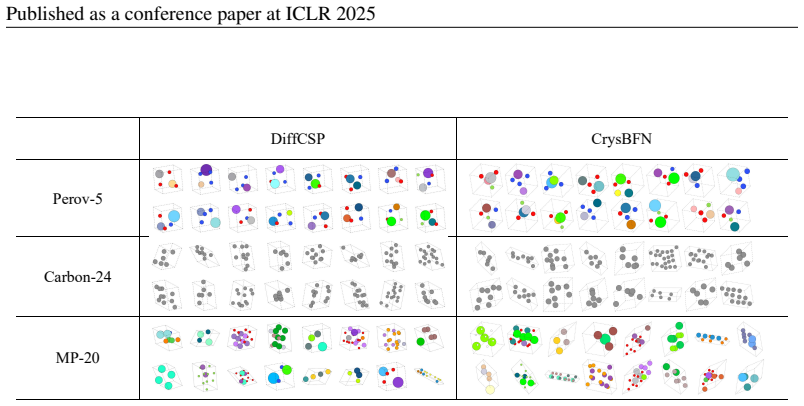

Forward citations
Cited by 1 Pith paper
-
MiAD: Mirage Atom Diffusion for De Novo Crystal Generation
Mirage infusion lets crystal diffusion models vary atom counts during generation and raises the S.U.N. rate on MP-20 to 8.2%.
Reference graph
Works this paper leans on
-
[1]
Crystal-gfn: sampling crystals with desirable properties and constraints
Mila AI4Science, Alex Hernandez-Garcia, Alexandre Duval, Alexandra Volokhova, Yoshua Bengio, Divya Sharma, Pierre Luc Carrier, Micha Koziarski, and Victor Schmidt. Crystal-gfn: sampling crystals with desirable properties and constraints. arXiv preprint arXiv:2310.04925, 2023
-
[2]
Equivariant energy-guided SDE for inverse molecular design
Fan Bao, Min Zhao, Zhongkai Hao, Peiyao Li, Chongxuan Li, and Jun Zhu. Equivariant energy-guided SDE for inverse molecular design. In The Eleventh International Conference on Learning Representations, 2023
2023
-
[3]
Making a science of model search: Hyperparameter optimization in hundreds of dimensions for vision architectures
James Bergstra, Daniel Yamins, and David Cox. Making a science of model search: Hyperparameter optimization in hundreds of dimensions for vision architectures. In International conference on machine learning, pp.\ 115--123. PMLR, 2013
2013
-
[4]
Projector augmented-wave method
Peter E Bl \"o chl. Projector augmented-wave method. Physical review B, 50 0 (24): 0 17953, 1994
1994
-
[5]
Riemannian score-based generative modelling
Valentin De Bortoli, Emile Mathieu, Michael John Hutchinson, James Thornton, Yee Whye Teh, and Arnaud Doucet. Riemannian score-based generative modelling. In Alice H. Oh, Alekh Agarwal, Danielle Belgrave, and Kyunghyun Cho (eds.), Advances in Neural Information Processing Systems, 2022
2022
-
[6]
Geometry optimization of periodic systems using internal coordinates
Tom \'a s Bu c ko, J \"u rgen Hafner, and J \'a nos G \'A ngy \'a n. Geometry optimization of periodic systems using internal coordinates. The Journal of chemical physics, 122 0 (12): 0 124508, 2005
2005
-
[7]
Machine learning for molecular and materials science
Keith T Butler, Daniel W Davies, Hugh Cartwright, Olexandr Isayev, and Aron Walsh. Machine learning for molecular and materials science. Nature, 559 0 (7715): 0 547--555, 2018
2018
-
[8]
Space group informed transformer for crystalline materials generation
Zhendong Cao, Xiaoshan Luo, Jian Lv, and Lei Wang. Space group informed transformer for crystalline materials generation. arXiv preprint arXiv:2403.15734, 2024
arXiv 2024
Show all 131 references
-
[9]
New cubic perovskites for one-and two-photon water splitting using the computational materials repository
Ivano E Castelli, David D Landis, Kristian S Thygesen, S ren Dahl, Ib Chorkendorff, Thomas F Jaramillo, and Karsten W Jacobsen. New cubic perovskites for one-and two-photon water splitting using the computational materials repository. Energy & Environmental Science, 5 0 (10): ...
2012
-
[10]
Computational screening of perovskite metal oxides for optimal solar light capture
Ivano E Castelli, Thomas Olsen, Soumendu Datta, David D Landis, S ren Dahl, Kristian S Thygesen, and Karsten W Jacobsen. Computational screening of perovskite metal oxides for optimal solar light capture. Energy & Environmental Science, 5 0 (2): 0 5814--5819, 2012 b
2012
-
[11]
Lawrence Zitnick, and Zachary Ulissi
Lowik Chanussot, Abhishek Das, Siddharth Goyal, Thibaut Lavril, Muhammed Shuaibi, Morgane Riviere, Kevin Tran, Javier Heras-Domingo, Caleb Ho, Weihua Hu, Aini Palizhati, Anuroop Sriram, Brandon Wood, Junwoong Yoon, Devi Parikh, C. Lawrence Zitnick, and Zachary Ulissi. Open cat...
2020 doi
-
[12]
A universal graph deep learning interatomic potential for the periodic table
Chi Chen and Shyue Ping Ong. A universal graph deep learning interatomic potential for the periodic table. Nature Computational Science, 2 0 (11): 0 718--728, 2022 a
2022
-
[13]
A universal graph deep learning interatomic potential for the periodic table
Chi Chen and Shyue Ping Ong. A universal graph deep learning interatomic potential for the periodic table. Nature Computational Science, 2 0 (11): 0 718--728, 2022 b
2022
-
[14]
Graph networks as a universal machine learning framework for molecules and crystals
Chi Chen, Weike Ye, Yunxing Zuo, Chen Zheng, and Shyue Ping Ong. Graph networks as a universal machine learning framework for molecules and crystals. Chemistry of Materials, 31 0 (9): 0 3564--3572, 2019
2019
-
[15]
Riemannian flow matching on general geometries
Ricky TQ Chen and Yaron Lipman. Riemannian flow matching on general geometries. arXiv preprint arXiv:2302.03660, 2023
2023 arXiv
-
[16]
Crystal structure prediction by combining graph network and optimization algorithm
Guanjian Cheng, Xin-Gao Gong, and Wan-Jian Yin. Crystal structure prediction by combining graph network and optimization algorithm. Nature communications, 13 0 (1): 0 1--8, 2022
2022
-
[17]
Jaakkola
Gabriele Corso, Hannes St \"a rk, Bowen Jing, Regina Barzilay, and Tommi S. Jaakkola. Diffdock: Diffusion steps, twists, and turns for molecular docking. In The Eleventh International Conference on Learning Representations, 2023
2023
-
[18]
3-d inorganic crystal structure generation and property prediction via representation learning
Callum J Court, Batuhan Yildirim, Apoorv Jain, and Jacqueline M Cole. 3-d inorganic crystal structure generation and property prediction via representation learning. Journal of chemical information and modeling, 60 0 (10): 0 4518--4535, 2020
2020
-
[19]
Smact: Semiconducting materials by analogy and chemical theory
Daniel W Davies, Keith T Butler, Adam J Jackson, Jonathan M Skelton, Kazuki Morita, and Aron Walsh. Smact: Semiconducting materials by analogy and chemical theory. Journal of Open Source Software, 4 0 (38): 0 1361, 2019
2019
-
[20]
Cryptic crystallography
Gautam R Desiraju. Cryptic crystallography. Nature materials, 1 0 (2): 0 77--79, 2002
2002
-
[21]
Chiral and achiral crystal structures
Howard D Flack. Chiral and achiral crystal structures. Helvetica Chimica Acta, 86 0 (4): 0 905--921, 2003
2003
-
[22]
Pyxtal: A python library for crystal structure generation and symmetry analysis
Scott Fredericks, Kevin Parrish, Dean Sayre, and Qiang Zhu. Pyxtal: A python library for crystal structure generation and symmetry analysis. Computer Physics Communications, 261: 0 107810, 2021. ISSN 0010-4655. doi:https://doi.org/10.1016/j.cpc.2020.107810. URL http://www.scie...
2021
-
[23]
Worrall, Volker Fischer, and Max Welling
Fabian Fuchs, Daniel E. Worrall, Volker Fischer, and Max Welling. Se(3)-transformers: 3d roto-translation equivariant attention networks. In Hugo Larochelle, Marc'Aurelio Ranzato, Raia Hadsell, Maria - Florina Balcan, and Hsuan - Tien Lin (eds.), Advances in Neural Information...
2020
-
[24]
Margraf, and Stephan G \"u nnemann
Johannes Gasteiger, Shankari Giri, Johannes T. Margraf, and Stephan G \"u nnemann. Fast and uncertainty-aware directional message passing for non-equilibrium molecules. In Machine Learning for Molecules Workshop, NeurIPS, 2020
2020
-
[25]
Gemnet: Universal directional graph neural networks for molecules
Johannes Gasteiger, Florian Becker, and Stephan G \"u nnemann. Gemnet: Universal directional graph neural networks for molecules. Advances in Neural Information Processing Systems, 34: 0 6790--6802, 2021 a
2021
-
[26]
Gemnet: Universal directional graph neural networks for molecules
Johannes Gasteiger, Florian Becker, and Stephan G \"u nnemann. Gemnet: Universal directional graph neural networks for molecules. In Conference on Neural Information Processing Systems (NeurIPS), 2021 b
2021
-
[27]
Symmetry-adapted generation of 3d point sets for the targeted discovery of molecules
Niklas Gebauer, Michael Gastegger, and Kristof Sch\" u tt. Symmetry-adapted generation of 3d point sets for the targeted discovery of molecules. In H. Wallach, H. Larochelle, A. Beygelzimer, F. d Alch\' e -Buc, E. Fox, and R. Garnett (eds.), Advances in Neural Information Proc...
2019
-
[28]
u ller, and Kristof T Sch \
Niklas WA Gebauer, Michael Gastegger, Stefaan SP Hessmann, Klaus-Robert M \"u ller, and Kristof T Sch \"u tt. Inverse design of 3d molecular structures with conditional generative neural networks. Nature communications, 13 0 (1): 0 1--11, 2022
2022
-
[29]
Neural message passing for quantum chemistry
Justin Gilmer, Samuel S Schoenholz, Patrick F Riley, Oriol Vinyals, and George E Dahl. Neural message passing for quantum chemistry. In International conference on machine learning, pp.\ 1263--1272. PMLR, 2017
2017
-
[30]
Uspex—evolutionary crystal structure prediction
Colin W Glass, Artem R Oganov, and Nikolaus Hansen. Uspex—evolutionary crystal structure prediction. Computer physics communications, 175 0 (11-12): 0 713--720, 2006
2006
-
[31]
Generative adversarial networks
Ian Goodfellow, Jean Pouget-Abadie, Mehdi Mirza, Bing Xu, David Warde-Farley, Sherjil Ozair, Aaron Courville, and Yoshua Bengio. Generative adversarial networks. Communications of the ACM, 63 0 (11): 0 139--144, 2020
2020
-
[32]
Bayesian flow networks
Alex Graves, Rupesh Kumar Srivastava, Timothy Atkinson, and Faustino Gomez. Bayesian flow networks. arXiv preprint arXiv:2308.07037, 2023
2023 arXiv
-
[33]
Numerically stable algorithms for the computation of reduced unit cells
Ralf W Grosse-Kunstleve, Nicholas K Sauter, and Paul D Adams. Numerically stable algorithms for the computation of reduced unit cells. Acta Crystallographica Section A: Foundations of Crystallography, 60 0 (1): 0 1--6, 2004
2004
-
[34]
Fine-tuned language models generate stable inorganic materials as text
Nate Gruver, Anuroop Sriram, Andrea Madotto, Andrew Gordon Wilson, C Lawrence Zitnick, and Zachary Ulissi. Fine-tuned language models generate stable inorganic materials as text. arXiv preprint arXiv:2402.04379, 2024
2024 arXiv
-
[35]
Finding the location of a signal: A bayesian analysis
Peter Guttorp and Richard A Lockhart. Finding the location of a signal: A bayesian analysis. Journal of the American Statistical Association, 83 0 (402): 0 322--330, 1988
1988
-
[36]
Ab-initio simulations of materials using vasp: Density-functional theory and beyond
J \"u rgen Hafner. Ab-initio simulations of materials using vasp: Density-functional theory and beyond. Journal of computational chemistry, 29 0 (13): 0 2044--2078, 2008
2008
-
[37]
Denoising diffusion probabilistic models
Jonathan Ho, Ajay Jain, and Pieter Abbeel. Denoising diffusion probabilistic models. Advances in neural information processing systems, 33: 0 6840--6851, 2020 a
2020
-
[38]
Denoising diffusion probabilistic models
Jonathan Ho, Ajay Jain, and Pieter Abbeel. Denoising diffusion probabilistic models. Advances in Neural Information Processing Systems, 33: 0 6840--6851, 2020 b
2020
-
[39]
Data-driven approach to encoding and decoding 3-d crystal structures
Jordan Hoffmann, Louis Maestrati, Yoshihide Sawada, Jian Tang, Jean Michel Sellier, and Yoshua Bengio. Data-driven approach to encoding and decoding 3-d crystal structures. arXiv preprint arXiv:1909.00949, 2019
1909 arXiv
-
[40]
Crystal structure prediction by data mining
Detlef WM Hofmann and Joannis Apostolakis. Crystal structure prediction by data mining. Journal of Molecular Structure, 647 0 (1-3): 0 17--39, 2003
2003
-
[41]
Argmax flows and multinomial diffusion: Learning categorical distributions
Emiel Hoogeboom, Didrik Nielsen, Priyank Jaini, Patrick Forr \'e , and Max Welling. Argmax flows and multinomial diffusion: Learning categorical distributions. Advances in Neural Information Processing Systems, 34: 0 12454--12465, 2021
2021
-
[42]
Equivariant diffusion for molecule generation in 3d
Emiel Hoogeboom, V ctor Garcia Satorras, Cl \'e ment Vignac, and Max Welling. Equivariant diffusion for molecule generation in 3d. In International Conference on Machine Learning, pp.\ 8867--8887. PMLR, 2022
2022
-
[43]
Distance matrix-based crystal structure prediction using evolutionary algorithms
Jianjun Hu, Wenhui Yang, and Edirisuriya M Dilanga Siriwardane. Distance matrix-based crystal structure prediction using evolutionary algorithms. The Journal of Physical Chemistry A, 124 0 (51): 0 10909--10919, 2020
2020
-
[44]
Contact map based crystal structure prediction using global optimization
Jianjun Hu, Wenhui Yang, Rongzhi Dong, Yuxin Li, Xiang Li, Shaobo Li, and Edirisuriya MD Siriwardane. Contact map based crystal structure prediction using global optimization. CrystEngComm, 23 0 (8): 0 1765--1776, 2021
2021
-
[45]
Riemannian diffusion models
Chin-Wei Huang, Milad Aghajohari, Joey Bose, Prakash Panangaden, and Aaron Courville. Riemannian diffusion models. In Alice H. Oh, Alekh Agarwal, Danielle Belgrave, and Kyunghyun Cho (eds.), Advances in Neural Information Processing Systems, 2022
2022
-
[46]
On-the-fly machine learning of atomic potential in density functional theory structure optimization
TL Jacobsen, MS J rgensen, and B Hammer. On-the-fly machine learning of atomic potential in density functional theory structure optimization. Physical review letters, 120 0 (2): 0 026102, 2018
2018
-
[47]
Commentary: The materials project: A materials genome approach to accelerating materials innovation
Anubhav Jain, Shyue Ping Ong, Geoffroy Hautier, Wei Chen, William Davidson Richards, Stephen Dacek, Shreyas Cholia, Dan Gunter, David Skinner, Gerbrand Ceder, et al. Commentary: The materials project: A materials genome approach to accelerating materials innovation. APL materi...
2013
-
[48]
Crystal structure prediction by joint equivariant diffusion on lattices and fractional coordinates
Rui Jiao, Wenbing Huang, Peijia Lin, Jiaqi Han, Pin Chen, Yutong Lu, and Yang Liu. Crystal structure prediction by joint equivariant diffusion on lattices and fractional coordinates. In Workshop on''Machine Learning for Materials''ICLR 2023, 2023
2023
-
[49]
Space group constrained crystal generation
Rui Jiao, Wenbing Huang, Yu Liu, Deli Zhao, and Yang Liu. Space group constrained crystal generation. arXiv preprint arXiv:2402.03992, 2024
2024 arXiv
-
[50]
Torsional diffusion for molecular conformer generation
Bowen Jing, Gabriele Corso, Jeffrey Chang, Regina Barzilay, and Tommi Jaakkola. Torsional diffusion for molecular conformer generation. Advances in Neural Information Processing Systems, 35: 0 24240--24253, 2022
2022
-
[51]
Highly accurate protein structure prediction with AlphaFold
John Jumper, Richard Evans, Alexander Pritzel, Tim Green, Michael Figurnov, Olaf Ronneberger, Kathryn Tunyasuvunakool, Russ Bates, Augustin Z \' dek, Anna Potapenko, Alex Bridgland, Clemens Meyer, Simon A A Kohl, Andrew J Ballard, Andrew Cowie, Bernardino Romera-Paredes, Stani...
2021
-
[52]
Generative adversarial networks for crystal structure prediction
Sungwon Kim, Juhwan Noh, Geun Ho Gu, Alan Aspuru-Guzik, and Yousung Jung. Generative adversarial networks for crystal structure prediction. ACS central science, 6 0 (8): 0 1412--1420, 2020
2020
-
[53]
Variational graph auto-encoders
Thomas N Kipf and Max Welling. Variational graph auto-encoders. arXiv preprint arXiv:1611.07308, 2016
2016 arXiv
-
[54]
von mises-fisher distributions and their statistical divergence
Toru Kitagawa and Jeff Rowley. von mises-fisher distributions and their statistical divergence. arXiv preprint arXiv:2202.05192, 2022
2022 arXiv
-
[55]
Unified model for crystalline material generation
Astrid Klipfel, Ya \"e l Fr \'e gier, Adlane Sayede, and Zied Bouraoui. Unified model for crystalline material generation. arXiv preprint arXiv:2306.04510, 2023
2023 arXiv
-
[56]
Self-consistent equations including exchange and correlation effects
Walter Kohn and Lu Jeu Sham. Self-consistent equations including exchange and correlation effects. Physical review, 140 0 (4A): 0 A1133, 1965
1965
-
[57]
u rgen Furthm \
Georg Kresse and J \"u rgen Furthm \"u ller. Efficiency of ab-initio total energy calculations for metals and semiconductors using a plane-wave basis set. Computational materials science, 6 0 (1): 0 15--50, 1996
1996
-
[58]
Efficient evaluation of the probability density function of a wrapped normal distribution
Gerhard Kurz, Igor Gilitschenski, and Uwe D Hanebeck. Efficient evaluation of the probability density function of a wrapped normal distribution. In 2014 Sensor Data Fusion: Trends, Solutions, Applications (SDF), pp.\ 1--5. IEEE, 2014
2014
-
[59]
Crystal structure prediction with machine learning-based element substitution
Minoru Kusaba, Chang Liu, and Ryo Yoshida. Crystal structure prediction with machine learning-based element substitution. Computational Materials Science, 211: 0 111496, 2022
2022
-
[60]
Modern directional statistics
Christophe Ley and Thomas Verdebout. Modern directional statistics. Chapman and Hall/CRC, 2017
2017
-
[61]
Equivariant diffusion for crystal structure prediction
Peijia Lin, Pin Chen, Rui Jiao, Qing Mo, Cen Jianhuan, Wenbing Huang, Yang Liu, Dan Huang, and Yutong Lu. Equivariant diffusion for crystal structure prediction. In Forty-first International Conference on Machine Learning, 2024
2024
-
[62]
Flow matching for generative modeling
Yaron Lipman, Ricky TQ Chen, Heli Ben-Hamu, Maximilian Nickel, and Matt Le. Flow matching for generative modeling. arXiv preprint arXiv:2210.02747, 2022
2022 arXiv
-
[63]
Materials discovery and design using machine learning
Yue Liu, Tianlu Zhao, Wangwei Ju, and Siqi Shi. Materials discovery and design using machine learning. Journal of Materiomics, pp.\ 159–177, Sep 2017. doi:10.1016/j.jmat.2017.08.002. URL http://dx.doi.org/10.1016/j.jmat.2017.08.002
2017 doi
-
[64]
Antigen-specific antibody design and optimization with diffusion-based generative models for protein structures
Shitong Luo, Yufeng Su, Xingang Peng, Sheng Wang, Jian Peng, and Jianzhu Ma. Antigen-specific antibody design and optimization with diffusion-based generative models for protein structures. In Alice H. Oh, Alekh Agarwal, Danielle Belgrave, and Kyunghyun Cho (eds.), Advances in...
2022
-
[65]
Deep learning generative model for crystal structure prediction
Xiaoshan Luo, Zhenyu Wang, Pengyue Gao, Jian Lv, Yanchao Wang, Changfeng Chen, and Yanming Ma. Deep learning generative model for crystal structure prediction. npj Computational Materials, 10 0 (1): 0 254, 2024 a
2024
-
[66]
Towards symmetry-aware generation of periodic materials
Youzhi Luo, Chengkai Liu, and Shuiwang Ji. Towards symmetry-aware generation of periodic materials. Advances in Neural Information Processing Systems, 36, 2024 b
2024
-
[67]
Bayesian inference for the von mises-fisher distribution
Kanti V Mardia and SAM El-Atoum. Bayesian inference for the von mises-fisher distribution. Biometrika, 63 0 (1): 0 203--206, 1976
1976
-
[68]
Directional statistics
Kanti V Mardia and Peter E Jupp. Directional statistics. John Wiley & Sons, 2009
2009
-
[69]
Benjamin Kurt Miller, Ricky T. Q. Chen, Anuroop Sriram, and Brandon M Wood. F low MM : Generating materials with R iemannian flow matching. In Ruslan Salakhutdinov, Zico Kolter, Katherine Heller, Adrian Weller, Nuria Oliver, Jonathan Scarlett, and Felix Berkenkamp (eds.), Proc...
2024
-
[70]
Improved denoising diffusion probabilistic models
Alexander Quinn Nichol and Prafulla Dhariwal. Improved denoising diffusion probabilistic models. In International Conference on Machine Learning, pp.\ 8162--8171. PMLR, 2021
2021
-
[71]
Krystallographische und strukturtheoretische Grundbegriffe, volume 1
Paul Niggli. Krystallographische und strukturtheoretische Grundbegriffe, volume 1. Akademische verlagsgesellschaft mbh, 1928
1928
-
[72]
Inverse design of solid-state materials via a continuous representation
Juhwan Noh, Jaehoon Kim, Helge S Stein, Benjamin Sanchez-Lengeling, John M Gregoire, Alan Aspuru-Guzik, and Yousung Jung. Inverse design of solid-state materials via a continuous representation. Matter, 1 0 (5): 0 1370--1384, 2019
2019
-
[73]
Crystalgan: learning to discover crystallographic structures with generative adversarial networks
Asma Nouira, Nataliya Sokolovska, and Jean-Claude Crivello. Crystalgan: learning to discover crystallographic structures with generative adversarial networks. arXiv preprint arXiv:1810.11203, 2018
2018 arXiv
-
[74]
Structure prediction drives materials discovery
Artem R Oganov, Chris J Pickard, Qiang Zhu, and Richard J Needs. Structure prediction drives materials discovery. Nature Reviews Materials, 4 0 (5): 0 331--348, 2019
2019
-
[75]
Python materials genomics (pymatgen): A robust, open-source python library for materials analysis
Shyue Ping Ong, William Davidson Richards, Anubhav Jain, Geoffroy Hautier, Michael Kocher, Shreyas Cholia, Dan Gunter, Vincent L Chevrier, Kristin A Persson, and Gerbrand Ceder. Python materials genomics (pymatgen): A robust, open-source python library for materials analysis. ...
2013
-
[76]
Human-and machine-centred designs of molecules and materials for sustainability and decarbonization
Jiayu Peng, Daniel Schwalbe-Koda, Karthik Akkiraju, Tian Xie, Livia Giordano, Yang Yu, C John Eom, Jaclyn R Lunger, Daniel J Zheng, Reshma R Rao, et al. Human-and machine-centred designs of molecules and materials for sustainability and decarbonization. Nature Reviews Material...
2022
-
[77]
Generalized gradient approximation made simple
John P Perdew, Kieron Burke, and Matthias Ernzerhof. Generalized gradient approximation made simple. Physical review letters, 77 0 (18): 0 3865, 1996
1996
-
[78]
Chris J. Pickard. Airss data for carbon at 10gpa and the c+n+h+o system at 1gpa, 2020
2020
-
[79]
Ab initio random structure searching
Chris J Pickard and RJ Needs. Ab initio random structure searching. Journal of Physics: Condensed Matter, 23 0 (5): 0 053201, 2011
2011
-
[80]
Accelerating crystal structure prediction by machine-learning interatomic potentials with active learning
Evgeny V Podryabinkin, Evgeny V Tikhonov, Alexander V Shapeev, and Artem R Oganov. Accelerating crystal structure prediction by machine-learning interatomic potentials with active learning. Physical Review B, 99 0 (6): 0 064114, 2019
2019
-
[81]
Molcraft: Structure-based drug design in continuous parameter space
Yanru Qu, Keyue Qiu, Yuxuan Song, Jingjing Gong, Jiawei Han, Mingyue Zheng, Hao Zhou, and Wei-Ying Ma. Molcraft: Structure-based drug design in continuous parameter space. arXiv preprint arXiv:2404.12141, 2024
2024 arXiv
-
[82]
Language models are unsupervised multitask learners
Alec Radford, Jeffrey Wu, Rewon Child, David Luan, Dario Amodei, Ilya Sutskever, et al. Language models are unsupervised multitask learners. OpenAI blog, 1 0 (8): 0 9, 2019
2019
-
[83]
Hierarchical text-conditional image generation with clip latents
Aditya Ramesh, Prafulla Dhariwal, Alex Nichol, Casey Chu, and Mark Chen. Hierarchical text-conditional image generation with clip latents. arXiv preprint arXiv:2204.06125, 2022
2022 arXiv
-
[84]
Aberle, Shijing Sun, Xiaonan Wang, Yi Liu, Qianxiao Li, Senthilnath Jayavelu, Kedar Hippalgaonkar, Yousung Jung, and Tonio Buonassisi
Zekun Ren, Siyu Isaac Parker Tian, Juhwan Noh, Felipe Oviedo, Guangzong Xing, Jiali Li, Qiaohao Liang, Ruiming Zhu, Armin G. Aberle, Shijing Sun, Xiaonan Wang, Yi Liu, Qianxiao Li, Senthilnath Jayavelu, Kedar Hippalgaonkar, Yousung Jung, and Tonio Buonassisi. An invertible cry...
2021 doi
-
[85]
Fokker-planck equation
Hannes Risken and Hannes Risken. Fokker-planck equation. Springer, 1996
1996
-
[86]
High-resolution image synthesis with latent diffusion models, 2021
Robin Rombach, Andreas Blattmann, Dominik Lorenz, Patrick Esser, and Björn Ommer. High-resolution image synthesis with latent diffusion models, 2021
2021
-
[87]
E (n) equivariant graph neural networks
V ctor Garcia Satorras, Emiel Hoogeboom, and Max Welling. E (n) equivariant graph neural networks. In International Conference on Machine Learning, pp.\ 9323--9332. PMLR, 2021
2021
-
[88]
Recent advances and applications of machine learning in solid-state materials science
Jonathan Schmidt, M \'a rio RG Marques, Silvana Botti, and Miguel AL Marques. Recent advances and applications of machine learning in solid-state materials science. npj computational materials, 5 0 (1): 0 83, 2019
2019
-
[89]
u tt, Huziel E Sauceda, P-J Kindermans, Alexandre Tkatchenko, and K-R M \
Kristof T Sch \"u tt, Huziel E Sauceda, P-J Kindermans, Alexandre Tkatchenko, and K-R M \"u ller. Schnet--a deep learning architecture for molecules and materials. The Journal of Chemical Physics, 148 0 (24): 0 241722, 2018
2018
-
[90]
Learning gradient fields for molecular conformation generation
Chence Shi, Shitong Luo, Minkai Xu, and Jian Tang. Learning gradient fields for molecular conformation generation. In International Conference on Machine Learning, pp.\ 9558--9568. PMLR, 2021
2021
-
[91]
Protein sequence and structure co-design with equivariant translation
Chence Shi, Chuanrui Wang, Jiarui Lu, Bozitao Zhong, and Jian Tang. Protein sequence and structure co-design with equivariant translation. arXiv preprint arXiv:2210.08761, 2022
2022 arXiv
-
[92]
Representation-space diffusion models for generating periodic materials
Anshuman Sinha, Shuyi Jia, and Victor Fung. Representation-space diffusion models for generating periodic materials. arXiv preprint arXiv:2408.07213, 2024
2024 arXiv
-
[93]
Deep unsupervised learning using nonequilibrium thermodynamics
Jascha Sohl-Dickstein, Eric Weiss, Niru Maheswaranathan, and Surya Ganguli. Deep unsupervised learning using nonequilibrium thermodynamics. In International Conference on Machine Learning, pp.\ 2256--2265. PMLR, 2015
2015
-
[94]
Generative modeling by estimating gradients of the data distribution
Yang Song and Stefano Ermon. Generative modeling by estimating gradients of the data distribution. Advances in neural information processing systems, 32, 2019
2019
-
[95]
Improved techniques for training score-based generative models
Yang Song and Stefano Ermon. Improved techniques for training score-based generative models. Advances in neural information processing systems, 33: 0 12438--12448, 2020
2020
-
[96]
Score-based generative modeling through stochastic differential equations
Yang Song, Jascha Sohl-Dickstein, Diederik P Kingma, Abhishek Kumar, Stefano Ermon, and Ben Poole. Score-based generative modeling through stochastic differential equations. arXiv preprint arXiv:2011.13456, 2020 a
2011 arXiv
-
[97]
Kingma, Abhishek Kumar, Stefano Ermon, and Ben Poole
Yang Song, Jascha Sohl-Dickstein, DiederikP. Kingma, Abhishek Kumar, Stefano Ermon, and Ben Poole. Score-based generative modeling through stochastic differential equations. Cornell University - arXiv,Cornell University - arXiv, Nov 2020 b
2020
-
[98]
Unified generative modeling of 3d molecules with bayesian flow networks
Yuxuan Song, Jingjing Gong, Hao Zhou, Mingyue Zheng, Jingjing Liu, and Wei-Ying Ma. Unified generative modeling of 3d molecules with bayesian flow networks. In The Twelfth International Conference on Learning Representations, 2023
2023
-
[99]
Equivariant flow matching with hybrid probability transport for 3d molecule generation
Yuxuan Song, Jingjing Gong, Minkai Xu, Ziyao Cao, Yanyan Lan, Stefano Ermon, Hao Zhou, and Wei-Ying Ma. Equivariant flow matching with hybrid probability transport for 3d molecule generation. Advances in Neural Information Processing Systems, 36, 2024
2024
-
[100]
Bayesian inference with the von-mises-fisher distribution in 3d, 2017
Julian Straub. Bayesian inference with the von-mises-fisher distribution in 3d, 2017
2017
-
[101]
Equivariant transformers for neural network based molecular potentials
Philipp Th \"o lke and Gianni De Fabritiis. Equivariant transformers for neural network based molecular potentials. In International Conference on Learning Representations, 2021
2021
-
[102]
Tensor field networks: Rotation-and translation-equivariant neural networks for 3d point clouds
Nathaniel Thomas, Tess Smidt, Steven Kearnes, Lusann Yang, Li Li, Kai Kohlhoff, and Patrick Riley. Tensor field networks: Rotation-and translation-equivariant neural networks for 3d point clouds. arXiv preprint arXiv:1802.08219, 2018
2018 arXiv
-
[103]
The open catalyst 2022 (oc22) dataset and challenges for oxide electrocatalysis
Richard Tran, Janice Lan, Muhammed Shuaibi, Siddharth Goyal, Brandon M Wood, Abhishek Das, Javier Heras-Domingo, Adeesh Kolluru, Ammar Rizvi, Nima Shoghi, et al. The open catalyst 2022 (oc22) dataset and challenges for oxide electrocatalysis. arXiv preprint arXiv:2206.08917, 2022
2022 arXiv
-
[104]
Trippe, Jason Yim, Doug Tischer, David Baker, Tamara Broderick, Regina Barzilay, and Tommi S
Brian L. Trippe, Jason Yim, Doug Tischer, David Baker, Tamara Broderick, Regina Barzilay, and Tommi S. Jaakkola. Diffusion probabilistic modeling of protein backbones in 3d for the motif-scaffolding problem. In The Eleventh International Conference on Learning Representations, 2023
2023
-
[105]
Attention is all you need
Ashish Vaswani, Noam Shazeer, Niki Parmar, Jakob Uszkoreit, Llion Jones, Aidan N Gomez, ukasz Kaiser, and Illia Polosukhin. Attention is all you need. Advances in neural information processing systems, 30, 2017
2017
-
[106]
Digress: Discrete denoising diffusion for graph generation
Clement Vignac, Igor Krawczuk, Antoine Siraudin, Bohan Wang, Volkan Cevher, and Pascal Frossard. Digress: Discrete denoising diffusion for graph generation. In The Eleventh International Conference on Learning Representations, 2023
2023
-
[107]
Scientific discovery in the age of artificial intelligence
Hanchen Wang, Tianfan Fu, Yuanqi Du, Wenhao Gao, Kexin Huang, Ziming Liu, Payal Chandak, Shengchao Liu, Peter Van Katwyk, Andreea Deac, et al. Scientific discovery in the age of artificial intelligence. Nature, 620 0 (7972): 0 47--60, 2023
2023
-
[108]
Crystal structure prediction via particle-swarm optimization
Yanchao Wang, Jian Lv, Li Zhu, and Yanming Ma. Crystal structure prediction via particle-swarm optimization. Physical Review B, 82 0 (9): 0 094116, 2010
2010
-
[109]
A general-purpose machine learning framework for predicting properties of inorganic materials
Logan Ward, Ankit Agrawal, Alok Choudhary, and Christopher Wolverton. A general-purpose machine learning framework for predicting properties of inorganic materials. npj Computational Materials, 2 0 (1): 0 1--7, 2016
2016
-
[110]
Grossman
Tian Xie and Jeffrey C. Grossman. Crystal graph convolutional neural networks for an accurate and interpretable prediction of material properties. Phys. Rev. Lett., 120: 0 145301, Apr 2018. doi:10.1103/PhysRevLett.120.145301
2018 doi
-
[111]
Crystal diffusion variational autoencoder for periodic material generation
Tian Xie, Xiang Fu, Octavian-Eugen Ganea, Regina Barzilay, and Tommi Jaakkola. Crystal diffusion variational autoencoder for periodic material generation. arXiv preprint arXiv:2110.06197, 2021
2021 arXiv
-
[112]
How powerful are graph neural networks? arXiv preprint arXiv:1810.00826, 2018
Keyulu Xu, Weihua Hu, Jure Leskovec, and Stefanie Jegelka. How powerful are graph neural networks? arXiv preprint arXiv:1810.00826, 2018
2018 arXiv
-
[113]
Geodiff: A geometric diffusion model for molecular conformation generation
Minkai Xu, Lantao Yu, Yang Song, Chence Shi, Stefano Ermon, and Jian Tang. Geodiff: A geometric diffusion model for molecular conformation generation. In International Conference on Learning Representations, 2021
2021
-
[114]
Geodiff: A geometric diffusion model for molecular conformation generation
Minkai Xu, Lantao Yu, Yang Song, Chence Shi, Stefano Ermon, and Jian Tang. Geodiff: A geometric diffusion model for molecular conformation generation. arXiv preprint arXiv:2203.02923, 2022
2022 arXiv
-
[115]
Geometric latent diffusion models for 3d molecule generation
Minkai Xu, Alexander S Powers, Ron O Dror, Stefano Ermon, and Jure Leskovec. Geometric latent diffusion models for 3d molecule generation. In International Conference on Machine Learning, pp.\ 38592--38610. PMLR, 2023
2023
-
[116]
Crystal structure prediction accelerated by bayesian optimization
Tomoki Yamashita, Nobuya Sato, Hiori Kino, Takashi Miyake, Koji Tsuda, and Tamio Oguchi. Crystal structure prediction accelerated by bayesian optimization. Physical Review Materials, 2 0 (1): 0 013803, 2018
2018
-
[117]
Periodic graph transformers for crystal material property prediction
Keqiang Yan, Yi Liu, Yuchao Lin, and Shuiwang Ji. Periodic graph transformers for crystal material property prediction. In The 36th Annual Conference on Neural Information Processing Systems, 2022
2022
-
[118]
Scalable diffusion for materials generation
Mengjiao Yang, KwangHwan Cho, Amil Merchant, Pieter Abbeel, Dale Schuurmans, Igor Mordatch, and Ekin Dogus Cubuk. Scalable diffusion for materials generation. arXiv preprint arXiv:2311.09235, 2023
2023 arXiv
-
[119]
Crystal structure prediction of materials with high symmetry using differential evolution
Wenhui Yang, Edirisuriya M Dilanga Siriwardane, Rongzhi Dong, Yuxin Li, and Jianjun Hu. Crystal structure prediction of materials with high symmetry using differential evolution. Journal of Physics: Condensed Matter, 33 0 (45): 0 455902, 2021
2021
-
[120]
Inverse design of nanoporous crystalline reticular materials with deep generative models
Zhenpeng Yao, Benjam \' n S \'a nchez-Lengeling, N Scott Bobbitt, Benjamin J Bucior, Sai Govind Hari Kumar, Sean P Collins, Thomas Burns, Tom K Woo, Omar K Farha, Randall Q Snurr, et al. Inverse design of nanoporous crystalline reticular materials with deep generative models. ...
2021
-
[121]
Pre-training via denoising for molecular property prediction
Sheheryar Zaidi, Michael Schaarschmidt, James Martens, Hyunjik Kim, Yee Whye Teh, Alvaro Sanchez-Gonzalez, Peter Battaglia, Razvan Pascanu, and Jonathan Godwin. Pre-training via denoising for molecular property prediction. arXiv preprint arXiv:2206.00133, 2022
2022 arXiv
-
[122]
Mattergen: a generative model for inorganic materials design
Claudio Zeni, Robert Pinsler, Daniel Z \"u gner, Andrew Fowler, Matthew Horton, Xiang Fu, Sasha Shysheya, Jonathan Crabb \'e , Lixin Sun, Jake Smith, et al. Mattergen: a generative model for inorganic materials design. arXiv preprint arXiv:2312.03687, 2023
2023 arXiv
-
[123]
Artificial intelligence for science in quantum, atomistic, and continuum systems
Xuan Zhang, Limei Wang, Jacob Helwig, Youzhi Luo, Cong Fu, Yaochen Xie, Meng Liu, Yuchao Lin, Zhao Xu, Keqiang Yan, et al. Artificial intelligence for science in quantum, atomistic, and continuum systems. arXiv preprint arXiv:2307.08423, 2023
2023 arXiv
-
[124]
Embedded atom neural network potentials: Efficient and accurate machine learning with a physically inspired representation
Yaolong Zhang, Ce Hu, and Bin Jiang. Embedded atom neural network potentials: Efficient and accurate machine learning with a physically inspired representation. The journal of physical chemistry letters, 10 0 (17): 0 4962--4967, 2019
2019
-
[125]
Computer-assisted inverse design of inorganic electrides
Yunwei Zhang, Hui Wang, Yanchao Wang, Lijun Zhang, and Yanming Ma. Computer-assisted inverse design of inorganic electrides. Physical Review X, 7 0 (1): 0 011017, 2017
2017
-
[126]
EGSDE : Unpaired image-to-image translation via energy-guided stochastic differential equations
Min Zhao, Fan Bao, Chongxuan Li, and Jun Zhu. EGSDE : Unpaired image-to-image translation via energy-guided stochastic differential equations. In Alice H. Oh, Alekh Agarwal, Danielle Belgrave, and Kyunghyun Cho (eds.), Advances in Neural Information Processing Systems, 2022
2022
-
[127]
Local structure order parameters and site fingerprints for quantification of coordination environment and crystal structure similarity
Nils ER Zimmermann and Anubhav Jain. Local structure order parameters and site fingerprints for quantification of coordination environment and crystal structure similarity. RSC advances, 10 0 (10): 0 6063--6081, 2020
2020
-
[128]
write newline
" write newline "" before.all 'output.state := FUNCTION n.dashify 't := "" t empty not t #1 #1 substring "-" = t #1 #2 substring "--" = not "--" * t #2 global.max substring 't := t #1 #1 substring "-" = "-" * t #2 global.max substring 't := while if t #1 #1 substring * t #2 gl...
-
[129]
@esa (Ref
\@ifxundefined[1] #1\@undefined \@firstoftwo \@secondoftwo \@ifnum[1] #1 \@firstoftwo \@secondoftwo \@ifx[1] #1 \@firstoftwo \@secondoftwo [2] @ #1 \@temptokena #2 #1 @ \@temptokena \@ifclassloaded agu2001 natbib The agu2001 class already includes natbib coding, so you should ...
-
[130]
\@lbibitem[] @bibitem@first@sw\@secondoftwo \@lbibitem[#1]#2 \@extra@b@citeb \@ifundefined br@#2\@extra@b@citeb \@namedef br@#2 \@nameuse br@#2\@extra@b@citeb \@ifundefined b@#2\@extra@b@citeb @num @parse #2 @tmp #1 NAT@b@open@#2 NAT@b@shut@#2 \@ifnum @merge>\@ne @bibitem@firs...
-
[131]
0 t4!< NTA8 xc Ay 8 K,k uh3_ 9 t *)Q<_(?7 3> uE ɾ ɥb.7NYj_! e> ʕj?B G q3 mIW(< |3 IQ /]L y1ޔs /d Q .e*S A 1 s_ : hc( 9<) 1 >ljN y VGR _+xx =>=@6= c
@open @close @open @close and [1] URL: #1 \@ifundefined chapter * \@mkboth \@ifxundefined @sectionbib * \@mkboth * \@mkboth\@gobbletwo \@ifclassloaded amsart * \@ifclassloaded amsbook * \@ifxundefined @heading @heading NAT@ctr thebibliography [1] @ \@biblabel @NAT@ctr \@bibset...
Reviewed August 9, 2026 · model on record in the stance chip above.
Discussion (0). Continue with ORCID to comment.