REVIEW 4 major objections 6 minor 100 references
Insight into the physical processes that shape the metallicity profiles in galaxies
T0 review · 4 major / 6 minor · reviewed 2026-08-09 · deepseek-v4-flash
Pith's one-line read Broken shapes of galaxy metallicity profiles can be read as a record of gas inflow, star formation, and feedback-driven outflows, not as fitting artifacts.
desk verdict Useful new fitting algorithm and honest case-study physics, but the abstract sells a two-galaxy result as a general diagnostic. read the letter →
The pith
A machine-rendered reading of the paper's core claim, the machinery that carries it, and where it could break.
The reading
What carries the argument
The load-bearing tool is the DB-A algorithm, a piecewise-linear fitter that removes outliers with a Gaussian kernel density estimate, allows up to two breaks in the oxygen profile, and selects the number of breaks by comparing relative fit errors against a tolerance parameter ($\tau=0.99$); it defines the inner, middle, and outer slopes that the analysis maps onto physical processes. The second mechanism is the gas bookkeeping applied to the two case-study galaxies: gas particles entering each radial region are classified by origin (unbound cold flows, circumgalactic gas, satellite gas, inflowing or outflowing interstellar gas) and by radial and vertical displacement, with star formation and accretion rates computed per region. This combination turns a one-dimensional abundance profile into an accounting of where the gas comes from, where it travels, and what it does when it arrives.
What would settle it
Re-fit the 45 simulated oxygen profiles with an independent, fully automated piecewise-linear fitter using a fixed model-selection rule and no manual case-by-case adjustments; if the resulting fractions of linear, inner-broken, outer-broken, and doubly-broken profiles differ materially from 38/13/40/9 per cent, the break taxonomy and the physical interpretations attached to it are not robust.
Extended reading notes
Core claim
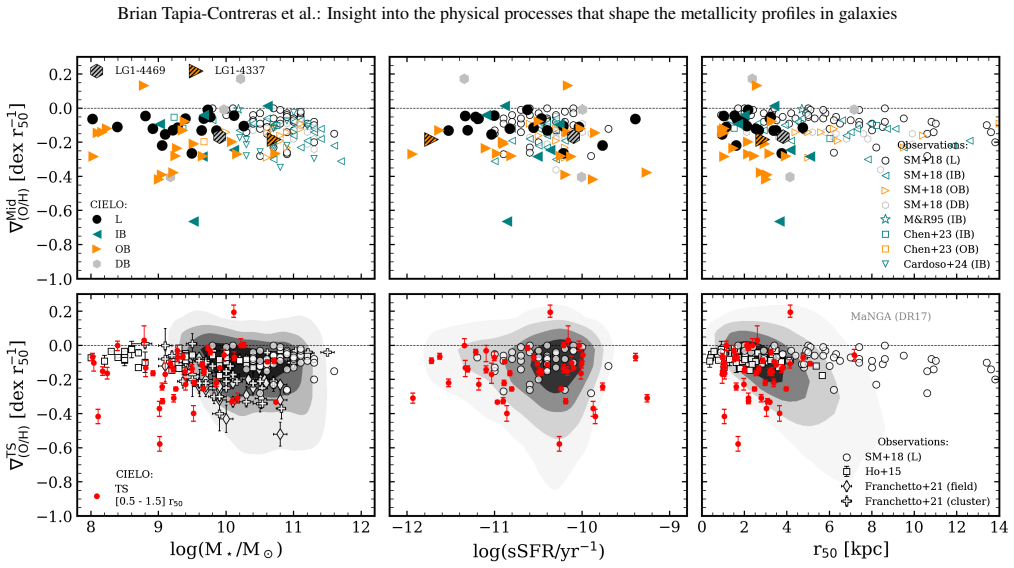
The central discovery is a break taxonomy with a physical cause attached to each entry. Using the DB-A algorithm, which fits piecewise power laws with up to two breaks to the running-median oxygen profile, the paper classifies the $z=0$ sample into 38 per cent linear, 40 per cent outer-broken, 13 per cent inner-broken, and 9 per cent doubly-broken profiles, with middle-region slopes that agree with single-gradient measurements in MUSE and CALIFA galaxies. In the two case studies traced across time, inner breaks occur in 26 per cent of snapshots (72 per cent inner rises, 28 per cent inner drops) and outer breaks in 43 per cent (68 per cent outer rises, 32 per cent outer drops). The authors attribute inner rises to cold gas falling into the centre followed by a starburst that raises central oxygen, inner drops to supernova-driven ejection of enriched gas, outer rises to the return of enriched material from the circumgalactic reservoir plus extended star formation and tidally driven mixing, and outer drops, found almost exclusively at $z>1$, to accretion of pristine cold-flow gas. The claim is that each break shape advertises a specific episode in the cycle of accretion, star formation, and outflow.
Load-bearing premise
The classification of every profile as linear, inner-broken, outer-broken, or doubly-broken rests on the DB-A algorithm's decision about the true number and position of breaks, with ambiguous 'conflictive' cases settled by manual revision rather than a fixed objective rule; if those decisions are biased, the reported break fractions and the process attributions built on them shift.
Editorial extensions
If this is right
- Middle-region gradients from DB-A agree with single linear fits over $[0.5,1.5]\,r_{50}$, so past observational comparisons based on one gradient remain meaningful even when the true profile is broken.
- Inner breaks last about 1.5 Gyr in the massive case study versus about 0.3 Gyr in the lower-mass one, so break persistence carries information about how deep the galaxy's potential well is.
- Inner drops and inverted central gradients are produced by the same feedback-driven ejection of enriched gas, so they should appear together and be accompanied by disturbed gas morphology.
- Outer drops are a high-redshift feature in these simulations, tied to metal-poor cold flows; mapping them at $z>1$ with deep spectroscopy would test whether the simulated cold-flow channel operates in real galaxies.
- Breaks migrate outward in units of $r_{50}$ as enrichment proceeds, so the location of a break can serve as a rough clock for recent accretion and star-formation episodes.
Reading between the lines
- The same break taxonomy could be applied to stellar-population abundance maps rather than gas; if the gas-cycle interpretation is right, starlight-weighted profiles should show smoothed echoes of the same breaks, shifted by the ages of the stars.
- Because these simulations lack AGN feedback and stop at $10^{10.5}$ solar masses, the near absence of inner drops may be a mass-range effect; running DB-A on simulations with AGN feedback or on more massive galaxies would test whether inner drops become as common as observed.
- The tolerance parameter and the two-break maximum are modeling choices; varying them systematically would reveal whether the 38/13/40/9 per cent split is stable or an artifact of the selection rule, and would calibrate the method for noisier observational data.
- Observational outer breaks are likely under-counted because of surface-brightness limits; if profile shape is a true gas-cycle diagnostic, deeper IFU observations at fixed mass should find a higher outer-break fraction than current surveys report.
Editorial analysis
A structured set of objections, weighed in public.
Referee Report
Summary. This paper uses the CIELO cosmological zoom simulations to characterize the gas-phase oxygen abundance profiles of 45 central galaxies at z=0 and to interpret profile breaks physically. The authors introduce a new fitting algorithm, DB-A, which fits up to two broken power laws and classifies profiles as linear, inner-broken, outer-broken, or doubly broken. At z=0 they report 38 per cent linear, 13 per cent inner, 40 per cent outer, and 9 per cent double breaks, with gradient values consistent with MUSE/CALIFA/MaNGA observations. They then follow two galaxies in a Local Group analog across about 87 snapshots to z~6, finding that inner rises are associated with gas inflows and subsequent star formation, inner drops with feedback-driven outflows, outer rises with re-accretion and CGM mixing, and outer drops with metal-poor cold-flow accretion. The paper concludes that metallicity-profile shapes can serve as diagnostics of these processes.
Significance. If the claims hold, the paper provides a simulation-based interpretation of broken metallicity profiles that ties break types to specific baryon-cycle processes, and it offers a new automatic fitting tool that is benchmarked against Theil-Sen single-slope fits and against observational break statistics. The authors are candid about the main limitations: no AGN feedback, restriction to sub-Milky-Way masses, and the case-study nature of the process attributions. The strength of the paper is its use of full cosmological simulations with metal-dependent cooling, star formation, and SN feedback, and its detailed temporal tracking of two galaxies, including a quantitative decomposition of accretion sources. The main risks are the subjectivity in the break-detection step and the extrapolation from two case studies to population-level statements.
major comments (4)
- [2.2] The description of the DB-A algorithm leaves a load-bearing subjective step unspecified. The text states that "conflictive cases (i.e. very small or very large break radius or inner and outer break radius too close to each other) were manually revised, decreasing the number of breaks used to fit the profiles," but no quantitative thresholds are given for "very small," "very large," or "too close." Because every downstream result — the z=0 profile fractions (Section 3), the temporal break statistics (Section 4: 26 per cent inner, 43 per cent outer, 72 per cent inner rises, 68 per cent outer rises), and the case-study attributions (Section 5) — depends on the number and location of breaks, this manual intervention could bias all of them. The authors should specify the criteria in advance and should show that the reported fractions are stable when the revision step is replaced by an objective rule (for example, requiring the break radius to lie within a fixed range and requiring separated inner and outer breaks).
- [2.2 and Table A.1] The fitted gradients and break radii are presented without any uncertainty estimates. Table A.1 lists single values for each galaxy, and the time series in Figure 8 are plotted without error bars, although the underlying profiles are noisy, as Figure 1 shows broad abundance distributions at fixed radius. Without uncertainties one cannot assess whether the 38/40/13/9 per cent distribution is distinguishable from, say, a 30/40/15/15 distribution, nor whether the 72 per cent inner-rise fraction or the redshift dependence of outer drops is statistically significant. The authors should provide bootstrap or resampling errors on the gradients and break radii and propagate them to the quoted fractions.
- [2.2 and Section 3] The robustness of DB-A to its hand-set parameters is not demonstrated. The running-median window N=40, the KDE outlier threshold 0.05, the tolerance tau=0.99, and nmax=2 are chosen once and used everywhere; the only validation reported is a statement that BIC and AIC give similar results. Since the break-detection method is the paper's central tool, the authors should show how the z=0 fractions and the temporal classifications change under plausible variations of N, tau, and the outlier threshold (for example, N=20 and N=80), and they should describe the BIC/AIC comparison in enough detail to be checked.
- [Abstract and Sections 4-5] The abstract and conclusions generalize the physical attributions to the population: "Most inner breaks show central oxygen enhancement, linked to gas accretion and star formation. Inner drops result from disrupted gas due to feedback-driven outflows. Outer breaks with high metallicities arise from re-accreted material..." However, the quantitative link between break type and measured inflow/outflow/accretion properties is established only for the two case-study galaxies LG1-4469 and LG1-4337 (Sections 4-5). The z=0 sample (Section 3) provides frequencies of profile shapes but not measurements of the physical processes responsible for those shapes. The authors themselves note in Section 5 that these results "will be used to define a strategy to perform a statistical study in a forthcoming paper." As it stands, the paper should either soften the population-level wording or add a quantitative test, such as comparing the dominant accretion source, outflow strength, or SFR enhancement between break types across the full sample.
minor comments (6)
- [2.2] The abbreviation B17 is used in the phrase "B17 and SM18" but is never defined; it presumably refers to Belfiore et al. 2017, which should be cited explicitly at that point.
- [Throughout] There are several typos that should be corrected in a revision: "Form the upper panels" (Sec. 5.4), "ouflows" (Sec. 4.2), "statical study" (Sec. 5), "high redshit" (Sec. 5.1), "shirring sphere" (Sec. 2.1), "understating" (Conclusions), and a duplicated "showing showing" in the caption of Fig. 12.
- [Table A.1] The table header labels the columns as "Inner, Middle, Outer" but the caption does not explicitly say that the middle value is the DB-A middle-region gradient and that linear profiles use the full [epsilon, 2 r83] range; please state this in the caption.
- [Figure 3] The observational comparison would be more informative if the SM18 break categories (linear, inner, outer, double) were shown in the same panels; currently only their linear-gradient values are overplotted in the lower panels.
- [Section 3] The binomial probability quoted for the difference in break fractions between CIELO and SM18 should be accompanied by the mass-range caveat already mentioned in the text, and a chi-square or Anderson-Darling test on the category counts would be more natural than a binomial test on mutually exclusive fractions of one sample.
- [4.1.3 and Figs. 9/12] The sign convention delta_r < 0 for outward flow is opposite to the usual radial-coordinate convention and is easy to misread; please state it explicitly in the captions of Figs. 9 and 12 as well as in the text.
Circularity Check
No significant circularity: the physical-process attributions are based on independently measured gas accretion, star formation, and merger diagnostics, not on the fitted profile parameters themselves.
full rationale
The paper's central claims are not derived from assumptions that already contain the conclusions. Break detection with DB-A fits piecewise linear slopes to simulated oxygen abundance profiles; this is a descriptive measurement step, not a prediction built from the physical diagnostics. The physical attributions (inner rises from gas inflows plus star formation; inner drops from feedback-driven outflows; outer rises from re-accreted CGM gas and mixing; outer drops from metal-poor cold-flow accretion) are supported by independent per-particle diagnostics: accretion source fractions (satellite gas, unbound gas, CGM gas, inflowing/outflowing ISM) measured by tracing gas particles between snapshots, SFR and SFR surface density in the same regions, particle displacements, temperatures, enrichment relative to the region, and merger/interaction histories. These diagnostics are not fitted to the profile-shape classifications; the classifications use only the radial oxygen profile, while the process variables use kinematics, temperature, progenitor origin, and independent simulation quantities. The z=0 comparison of simulated gradients and break radii against MUSE, CALIFA, TYPHOON, and MaNGA observations provides an external benchmark that is not constrained by the paper's fitted values. The only notable self-citations (CIELO simulation description in Tissera et al. 2025; earlier process studies such as Sillero et al. 2017) are normal references to prior work and are not used as a uniqueness theorem or as a substitute for the new temporal analysis. The paper explicitly frames the two-galaxy analysis as illustrative and announces a future statistical study, so any concern about generalization is a scope or completeness issue, not circularity. No equation or fitted parameter is reused as both input and output; no prediction reduces to its own construction.
Assumptions & free parameters
free parameters (5)
- DB-A tolerance tau =
0.99
- Running median window N =
40 particles
- KDE outlier threshold =
0.05
- Break classification threshold =
1.5 r50
- Maximum number of breaks nmax =
2
assumptions (5)
- domain assumption The CIELO subgrid model (density threshold 1e-26 g cm^-3, T<15000 K, convergent flow for star formation; SNII yields from Woosley & Weaver 1995; SNIa from Mosconi et al. 2001) faithfully reproduces the chemical enrichment and feedback relevant to metallicity gradients.
- domain assumption The 45 CIELO central galaxies with M* between 10^8.5 and 10^10.5 Msun at z=0 are a representative sample of the local galaxy population in that mass range.
- ad hoc to paper The DB-A algorithm with tau=0.99 and manual revision identifies the true number and location of breaks without systematic bias.
- ad hoc to paper The running median over 40 radially ordered particles preserves the underlying radial metallicity profile shape.
- domain assumption Oxygen abundance in cool dense gas traces the physical processes (inflows, outflows, accretion) responsible for the breaks.
Cite this review
Pith. "Pith review of Insight into the physical processes that shape the metallicity profiles in galaxies." pith.science (2026). https://pith.science/paper/JMQUSRU3
@misc{pith2026250202080,
  author       = {Pith},
  title        = {Pith review of: Insight into the physical processes that shape the metallicity profiles in galaxies},
  year         = {2026},
  howpublished = {\url{https://pith.science/paper/JMQUSRU3}},
  note         = {Machine review of arXiv:2502.02080}
}
abstract
The distribution of chemical elements in the star-forming regions can store information on the chemical enrichment history of the galaxies. Negative metallicity gradients are expected in galaxies forming inside-out. However, observations show that the metallicity profiles can be broken. We aim to study the diversity of metallicity profiles that can arise in the current cosmological context and compare them with available observations. We also seek to identify the physical processes responsible for breaks in metallicity profiles by using two galaxies as case studies. We analyze central galaxies from the cosmological simulations of the CIELO project, within the stellar mass range [$10^{8.5}$, $10^{10.5}$] M$_\odot$ at $z=0$. A new algorithm, DB-A, was developed to fit multiple power laws to the metallicity profiles, enabling a flexible assessment of metallicity gradients in various galactic regions. The simulations include detailed modeling of gas, metal-dependent cooling, star formation, and supernova feedback. At $z=0$, we find diverse profile shapes, including inner and outer drops and rises, with some galaxies exhibiting double breaks. Gradient values align with observations. A temporal analysis of Local Group analogs shows inner and outer breaks occurring at all cosmic times, with outer breaks being more frequent. Metallicity gradients show high variability at high redshift, transitioning to mild evolution at lower redshift. Most inner breaks show central oxygen enhancement, linked to gas accretion and star formation. Inner drops result from disrupted gas due to feedback-driven outflows. Outer breaks with high metallicities arise from re-accreted material, extended star formation, and CGM-driven gas mixing. Outer drops are common at high redshift, linked to metal-poor gas accretion from cold flows. We highlight the complex interplay of these processes which often act together.
Figures


Figures from the paper (11 more)


Reference graph
Works this paper leans on
-
[1]
2024, A&A, 688, A146 Astropy Collaboration, Price-Whelan, A
Arribas, S., Perna, M., Rodríguez Del Pino, B., et al. 2024, A&A, 688, A146 Astropy Collaboration, Price-Whelan, A. M., Sip˝ocz, B. M., et al. 2018, AJ, 156, 123 Astropy Collaboration, Robitaille, T. P., Tollerud, E. J., et al. 2013, A&A, 558, A33
2024
-
[2]
Barnes, J. E. & Hernquist, L. 1996, ApJ, 471, 115
1996
-
[3]
2017, MNRAS, 469, 151
Belfiore, F., Maiolino, R., Tremonti, C., et al. 2017, MNRAS, 469, 151
2017
-
[4]
2015, py-sphviewer: Py-SPHViewer v1.0.0
Benitez-Llambay, A. 2015, py-sphviewer: Py-SPHViewer v1.0.0
2015
-
[5]
2008, AJ, 136, 2846
Bigiel, F., Leroy, A., Walter, F., et al. 2008, AJ, 136, 2846
2008
-
[6]
C., & Ryan-Weber, E
Bresolin, F., Kennicutt, R. C., & Ryan-Weber, E. 2012, ApJ, 750, 122
2012
-
[7]
C., & Goddard, Q
Bresolin, F., Ryan-Weber, E., Kennicutt, R. C., & Goddard, Q. 2009, ApJ, 695, 580
2009
-
[8]
A., Law, D
Bundy, K., Bershady, M. A., Law, D. R., et al. 2015, ApJ, 798, 7
2015
Show all 100 references
-
[9]
L., Patton, D
Bustamante, S., Ellison, S. L., Patton, D. R., & Sparre, M. 2020, MNRAS, 494, 3469
2020
-
[10]
Cardoso, A. F. S., Cavichia, O., Mollá, M., & Sánchez-Menguiano, L. 2025, ApJ, 980, 45
2025
-
[11]
2018, MNRAS, 478, 4293
Carton, D., Brinchmann, J., Contini, T., et al. 2018, MNRAS, 478, 4293
2018
-
[12]
B., Padilla, N., et al
Casanueva-Villarreal, C., Tissera, P. B., Padilla, N., et al. 2024, A&A, 688, A183
2024
-
[13]
E., Tissera, P
Cataldi, P., Pedrosa, S. E., Tissera, P. B., et al. 2023, MNRAS, 523, 1919
2023
-
[14]
2016, MNRAS, 457, 2605
Ceverino, D., Sánchez Almeida, J., Muñoz Tuñón, C., et al. 2016, MNRAS, 457, 2605
2016
-
[15]
2003, ApJ, 586, L133
Chabrier, G. 2003, ApJ, 586, L133
2003
-
[16]
J., et al
Chen, Q.-H., Grasha, K., Battisti, A. J., et al. 2023, MNRAS, 519, 4801
2023
-
[17]
B., et al
Cornejo, A., Sillero, E., Tissera, P. B., et al. 2025, Accepted for publication in A&A, Article reference: aa52226-24 Davé, R., Finlator, K., & Oppenheimer, B. D. 2011, MNRAS, 416, 1354
2025
-
[18]
S., & White, S
Davis, M., Efstathiou, G., Frenk, C. S., & White, S. D. M. 1985, ApJ, 292, 371
1985
-
[19]
& Silk, J
Dekel, A. & Silk, J. 1986, ApJ, 303, 39
1986
-
[20]
Diaz, A. I. 1989, in Evolutionary Phenomena in Galaxies, ed. J. E. Beckman & B. E. J. Pagel, 377
1989
-
[21]
2009, MNRAS, 399, 497
Dolag, K., Borgani, S., Murante, G., & Springel, V . 2009, MNRAS, 399, 497
2009
-
[22]
Easeman, B., Schady, P., Wuyts, S., & Yates, R. M. 2022, MNRAS, 511, 371
2022
-
[23]
L., Mendel, J
Ellison, S. L., Mendel, J. T., Patton, D. R., & Scudder, J. M. 2013, MNRAS, 435, 3627
2013
-
[24]
L., Thorp, M
Ellison, S. L., Thorp, M. D., Pan, H.-A., et al. 2020, MNRAS, 492, 6027
2020
-
[25]
Fall, S. M. & Efstathiou, G. 1980, MNRAS, 193, 189
1980
-
[26]
2016, MNRAS, 462, L41
Fragkoudi, F., Athanassoula, E., & Bosma, A. 2016, MNRAS, 462, L41
2016
-
[27]
M., et al
Franchetto, A., Mingozzi, M., Poggianti, B. M., et al. 2021, ApJ, 923, 28 Gámez-Marín, M., Santos-Santos, I., Domínguez-Tenreiro, R., et al. 2024, ApJ, 965, 154
2021
-
[28]
K., Carigi, L., et al
Garay-Solis, Y ., Barrera-Ballesteros, J. K., Carigi, L., et al. 2024, MNRAS, 533, 880
2024
-
[29]
M., Torrey, P., Bhagwat, A., et al
Garcia, A. M., Torrey, P., Bhagwat, A., et al. 2025, arXiv e-prints, arXiv:2503.03804
2025 arXiv
-
[30]
M., Torrey, P., Hemler, Z
Garcia, A. M., Torrey, P., Hemler, Z. S., et al. 2023, MNRAS, 519, 4716 García-Benito, R., Zibetti, S., Sánchez, S. F., et al. 2015, A&A, 576, A135
2023
-
[31]
R., Shields, G
Garnett, D. R., Shields, G. A., Skillman, E. D., Sagan, S. P., & Dufour, R. J. 1997, ApJ, 489, 63
1997
-
[32]
K., Pilkington, K., Brook, C
Gibson, B. K., Pilkington, K., Brook, C. B., Stinson, G. S., & Bailin, J. 2013, A&A, 554, A47
2013
-
[33]
B., Monachesi, A., et al
Gonzalez-Jara, J., Tissera, P. B., Monachesi, A., et al. 2025, A&A, 693, A282
2025
-
[34]
& Abel, T
Hahn, O. & Abel, T. 2011, MNRAS, 415, 2101
2011
-
[35]
S., Torrey, P., Qi, J., et al
Hemler, Z. S., Torrey, P., Qi, J., et al. 2021, MNRAS, 506, 3024
2021
-
[36]
T., Kudritzki, R.-P., Kewley, L
Ho, I. T., Kudritzki, R.-P., Kewley, L. J., et al. 2015, MNRAS, 448, 2030
2015
-
[37]
T., Seibert, M., Meidt, S
Ho, I. T., Seibert, M., Meidt, S. E., et al. 2017, ApJ, 846, 39
2017
-
[38]
Hunter, J. D. 2007, Computing In Science & Engineering, 9, 90
2007
-
[39]
& Kobayashi, C
Ibrahim, D. & Kobayashi, C. 2025, arXiv e-prints, arXiv:2501.11209
2025
-
[40]
1999, ApJS, 125, 439
Iwamoto, K., Brachwitz, F., Nomoto, K., et al. 1999, ApJS, 125, 439
1999
-
[41]
B., Sillero, E., et al
Jara-Ferreira, F., Tissera, P. B., Sillero, E., et al. 2024, MNRAS, 530, 1369 Jiménez, N., Tissera, P. B., & Matteucci, F. 2015, ApJ, 810, 137
2024
-
[42]
B., et al
Jones, T., Wang, X., Schmidt, K. B., et al. 2015, AJ, 149, 107
2015
-
[43]
2025, ApJ, 978, L39
Ju, M., Wang, X., Jones, T., et al. 2025, ApJ, 978, L39
2025
-
[44]
J., Geller, M
Kewley, L. J., Geller, M. J., & Barton, E. J. 2006, AJ, 131, 2004
2006
-
[45]
J., Rupke, D., Zahid, H
Kewley, L. J., Rupke, D., Zahid, H. J., Geller, M. J., & Barton, E. J. 2010, ApJ, 721, L48
2010
-
[46]
Khoram, A. H. & Belfiore, F. 2025, A&A, 693, A150
2025
-
[47]
Knollmann, S. R. & Knebe, A. 2009, ApJS, 182, 608 Article number, page 18 Brian Tapia-Contreras et al.: Insight into the physical processes that shape the metallicity profiles in galaxies
2009
-
[48]
T., Blanc, G
Kreckel, K., Ho, I. T., Blanc, G. A., et al. 2019, ApJ, 887, 80
2019
-
[49]
R., McKee, C
Krumholz, M. R., McKee, C. F., & Tumlinson, J. 2009, ApJ, 699, 850
2009
-
[50]
K., Walter, F., Brinks, E., et al
Leroy, A. K., Walter, F., Brinks, E., et al. 2008, AJ, 136, 2782
2008
-
[51]
2022, ApJ, 929, L8
Li, Z., Wang, X., Cai, Z., et al. 2022, ApJ, 929, L8
2022
-
[52]
F., Feldmann, R., et al
Ma, X., Hopkins, P. F., Feldmann, R., et al. 2017, MNRAS, 466, 4780
2017
-
[53]
& Mannucci, F
Maiolino, R. & Mannucci, F. 2019, A&A Rev., 27, 3
2019
-
[54]
& Roy, J.-R
Martin, P. & Roy, J.-R. 1995, ApJ, 445, 161
1995
-
[55]
2012, Chemical Evolution of Galaxies
Matteucci, F. 2012, Chemical Evolution of Galaxies
2012
-
[56]
Mihos, J. C. & Hernquist, L. 1996, ApJ, 464, 641
1996
-
[57]
H., Sbordone, L., Rojas-Arriagada, A., et al
Minniti, J. H., Sbordone, L., Rojas-Arriagada, A., et al. 2020, A&A, 640, A92 Mollá, M., Díaz, Á. I., Cavichia, O., et al. 2019, MNRAS, 482, 3071
2020
-
[58]
B., Tissera, P
Mosconi, M. B., Tissera, P. B., Lambas, D. G., & Cora, S. A. 2001, MNRAS, 325, 34
2001
-
[59]
& Ostriker, J
Naab, T. & Ostriker, J. P. 2017, ARA&A, 55, 59
2017
-
[60]
E., Burkhart, B., Wetzel, A., et al
Orr, M. E., Burkhart, B., Wetzel, A., et al. 2023, MNRAS, 521, 3708
2023
-
[61]
F., Barrera-Ballesteros, J
Pan, H.-A., Lin, L., Sánchez, S. F., Barrera-Ballesteros, J. K., & Hsieh, B.-C. 2025, ApJ, 982, 130
2025
-
[62]
Pedrosa, S. E. & Tissera, P. B. 2015, A&A, 584, A43
2015
-
[63]
Peeples, M. S. & Shankar, F. 2011, MNRAS, 417, 2962
2011
-
[64]
Perez, J., Michel-Dansac, L., & Tissera, P. B. 2011, MNRAS, 417, 580 Péroux, C. & Howk, J. C. 2020, ARA&A, 58, 363 Péroux, C., Nelson, D., van de V oort, F., et al. 2020, MNRAS, 499, 2462
2011
-
[65]
G., Gibson, B
Pilkington, K., Few, C. G., Gibson, B. K., et al. 2012, A&A, 540, A56
2012
-
[66]
M., Villata, M., & Navarro, J
Raiteri, C. M., Villata, M., & Navarro, J. F. 1996, A&A, 315, 105 Rodríguez, S., Garcia Lambas, D., Padilla, N. D., et al. 2022, MNRAS, 514, 6157
1996
-
[67]
V ., Navarro, J
Sales, L. V ., Navarro, J. F., Theuns, T., et al. 2012, MNRAS, 423, 1544 Sánchez, S. F., Rosales-Ortega, F. F., Iglesias-Páramo, J., et al. 2014, A&A, 563, A49 Sánchez-Menguiano, L., Sánchez, S. F., Pérez, I., et al. 2016, A&A, 587, A70 Sánchez-Menguiano, L., Sánchez, S. F., P...
2012
-
[68]
B., White, S
Scannapieco, C., Tissera, P. B., White, S. D. M., & Springel, V . 2005, MNRAS, 364, 552
2005
-
[69]
B., White, S
Scannapieco, C., Tissera, P. B., White, S. D. M., & Springel, V . 2006, MNRAS, 371, 1125
2006
-
[70]
1971, ApJ, 168, 327
Searle, L. 1971, ApJ, 168, 327
1971
-
[71]
Sen, P. K. 1968, Journal of the American statistical association, 63, 1379
1968
-
[72]
B., Lambas, D
Sillero, E., Tissera, P. B., Lambas, D. G., & Michel-Dansac, L. 2017, MNRAS, 472, 4404
2017
-
[73]
C., Papovich, C., Momcheva, I., et al
Simons, R. C., Papovich, C., Momcheva, I., et al. 2021, ApJ, 923, 203
2021
-
[74]
B., & Hernandez-Jimenez, J
Solar, M., Tissera, P. B., & Hernandez-Jimenez, J. A. 2020, MNRAS, 491, 4894
2020
-
[75]
Somerville, R. S. & Davé, R. 2015, ARA&A, 53, 51
2015
-
[76]
Springel, V ., White, S. D. M., Tormen, G., & Kauffmann, G. 2001, MNRAS, 328, 726
2001
-
[77]
S., Brook, C., Macciò, A
Stinson, G. S., Brook, C., Macciò, A. V ., et al. 2013, MNRAS, 428, 129
2013
-
[78]
1950, Indagationes mathematicae, 12, 173
Theil, H. 1950, Indagationes mathematicae, 12, 173
1950
-
[79]
Tinsley, B. M. 1980, Fund. Cosmic Phys., 5, 287
1980
-
[80]
B., Bignone, L., Gonzalez-Jara, J., et al
Tissera, P. B., Bignone, L., Gonzalez-Jara, J., et al. 2025, A&A, 697, A134
2025
-
[81]
B., Pedrosa, S
Tissera, P. B., Pedrosa, S. E., Sillero, E., & Vilchez, J. M. 2016, MNRAS, 456, 2982
2016
-
[82]
B., Rosas-Guevara, Y ., Bower, R
Tissera, P. B., Rosas-Guevara, Y ., Bower, R. G., et al. 2019, MNRAS, 482, 2208
2019
-
[83]
B., Rosas-Guevara, Y ., Sillero, E., et al
Tissera, P. B., Rosas-Guevara, Y ., Sillero, E., et al. 2022, MNRAS, 511, 1667
2022
-
[84]
J., Kewley, L., & Hernquist, L
Torrey, P., Cox, T. J., Kewley, L., & Hernquist, L. 2012, ApJ, 746, 108
2012
-
[85]
2014, A&A, 563, A58
Troncoso, P., Maiolino, R., Sommariva, V ., et al. 2014, A&A, 563, A58
2014
-
[86]
S., & Werk, J
Tumlinson, J., Peeples, M. S., & Werk, J. K. 2017, ARA&A, 55, 389
2017
-
[87]
2019, A&A, 624, A141
Urrutia, T., Wisotzki, L., Kerutt, J., et al. 2019, A&A, 624, A141
2019
-
[88]
2024, MNRAS, 527, 10
Vallini, L., Witstok, J., Sommovigo, L., et al. 2024, MNRAS, 527, 10
2024
-
[89]
2024, A&A, 691, A19
Venturi, G., Carniani, S., Parlanti, E., et al. 2024, A&A, 691, A19
2024
-
[90]
Vila-Costas, M. B. & Edmunds, M. G. 1992, MNRAS, 259, 121
1992
-
[91]
& Lilly, S
Wang, E. & Lilly, S. J. 2022, ApJ, 929, 95
2022
-
[92]
2022, ApJ, 938, L16
Wang, X., Jones, T., Vulcani, B., et al. 2022, ApJ, 938, L16
2022
-
[93]
A., Treu, T., et al
Wang, X., Jones, T. A., Treu, T., et al. 2020, ApJ, 900, 183
2020
-
[94]
K., Putman, M
Werk, J. K., Putman, M. E., Meurer, G. R., & Santiago-Figueroa, N. 2011, ApJ, 735, 71
2011
-
[95]
White, S. D. M. & Rees, M. J. 1978, MNRAS, 183, 341
1978
-
[96]
Woosley, S. E. & Weaver, T. A. 1995, ApJS, 101, 181
1995
-
[97]
2016, ApJ, 827, 74
Wuyts, E., Wisnioski, E., Fossati, M., et al. 2016, ApJ, 827, 74
2016
-
[98]
M., Henriques, B
Yates, R. M., Henriques, B. M. B., Fu, J., et al. 2021, MNRAS, 503, 4474
2021
-
[99]
Zahid, H. J. & Bresolin, F. 2011, AJ, 141, 192
2011
-
[100]
Zaritsky, D., Kennicutt, Robert C., J., & Huchra, J. P. 1994, ApJ, 420, 87 Article number, page 19 A&A proofs:manuscript no. aa54013-25 Appendix A: Physical properties ofCIELOgalaxies atz=0. Table A.1: Physical properties and profile characteristics of CIELO galaxies atz=0. Ga...
1994
Reviewed August 9, 2026 · model on record in the stance chip above.
Discussion (0). Continue with ORCID to comment.