REVIEW 5 major objections 7 minor 48 references
EdgeGFL: Rethinking Edge Information in Graph Feature Preference Learning
T0 review · 5 major / 7 minor · reviewed 2026-08-09 · deepseek-v4-flash
Pith's one-line read The paper claims that representing edges as learnable multidimensional vectors, used to gate node-feature dimensions during message passing, improves node classification and clustering on heterogeneous graphs, beating the strongest prior…
desk verdict The edge-gating idea is sensible and the reported gains are plausible, but the paper never specifies which model produced Table III; that is a load-bearing hole. read the letter →
The pith
A machine-rendered reading of the paper's core claim, the machinery that carries it, and where it could break.
The reading
What carries the argument
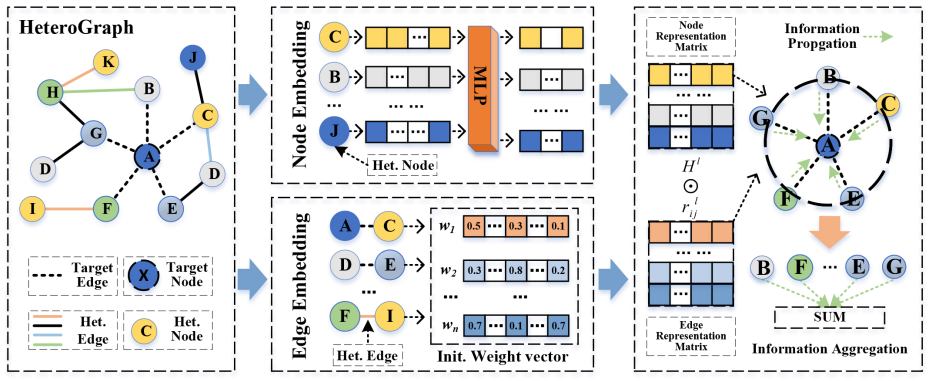
The central object is the edge feature preference vector $r^l_{ij}$: for each edge type, an initialized encoding vector is mapped into the node feature space by a shared learnable transformation, and this vector multiplies the source node representation elementwise in Eq. (9), so each feature dimension of a message is scaled differently. This replaces the scalar aggregation weights of GCN and GAT with a multidimensional gate. The aggregation phase then uses sum aggregators with node and edge residual connections, Eq. (11)-(13), where the residual attention coefficient $\hat{\alpha}$ is said to combine edge type embeddings and node embeddings, although its concrete formula is not given.
What would settle it
Attempt a faithful reproduction of EdgeGFL on DBLP, ACM, IMDB, and Freebase using only the equations given: the computation of $\hat{\alpha}$ in Eq. (13) is unspecified, so no unique implementation exists. If no definition of $\hat{\alpha}$ reproduces the reported micro-F1 numbers, in particular 95.98 on DBLP and 69.04 on Freebase, the state-of-the-art claim cannot be substantiated.
Extended reading notes
Core claim
The central claim is that enriching edges from scalar weights to multidimensional, learnable relation vectors makes message passing selective at the feature-dimension level, so that each neighbor's contribution is amplified or dampened per feature rather than scaled uniformly. The paper proposes EdgeGFL, a message-passing framework where each edge type is mapped to an initialization vector, transformed into the node feature space, and multiplied elementwise with the source node's representation in Eq. (9). This refined message is then aggregated with residual connections on both node representations and attention scores, and the final embeddings are L2-normalized. On the DBLP, ACM, IMDB, and Freebase heterogeneous graphs, the paper reports improvements over SeHGNN averaging 1.51% in micro-F1 and 0.64% in macro-F1 for node classification, with a 5.38% micro-F1 gain on Freebase, and consistent gains in clustering ARI and NMI.
Load-bearing premise
The reported results presuppose a concrete formula for the residual attention coefficient $\hat{\alpha}$ in Eqs. (11)-(13), but that formula, which combines edge type embeddings and node embeddings, is never defined anywhere in the paper.
Editorial extensions
If this is right
- Heterogeneous graph models may not need hand-designed meta-path selection, since learned edge vectors carry relation semantics; EdgeGFL reports strong results without meta-path enumeration.
- Per-dimension edge gating gives larger relative gains on Freebase, which has 36 edge types, suggesting the benefit grows with the number of relation types.
- Deep GCN stacks with node and edge residual connections can avoid the over-smoothing that limits ordinary convolutional layers; EdgeGFL reports best performance near two layers and stable convergence within about 60 training rounds.
- L2 normalization of the output embeddings makes the learned representations directly usable for retrieval-style tasks such as clustering and similarity search.
- Replacing scalar edge weights with vectorized edge features could transfer to any graph where relation types carry rich semantics, including knowledge graphs and recommendation networks.
Reading between the lines
- A natural testable extension is to replace the edge-type dictionary initialization with continuous relation features, such as text or attribute embeddings of relations, which the paper does not explore.
- The missing definition of $\hat{\alpha}$ in Eq. (13) means the current write-up does not provide a fully reproducible algorithm; a reader cannot tell whether the reported gains come from the edge-vector gating itself or from an unspecified attention module.
- If the gains hold, the per-dimension gating mechanism could serve as a generic relational inductive bias for message passing, applicable beyond heterogeneous graphs to any network with typed or attributed edges.
Editorial analysis
A structured set of objections, weighed in public.
Referee Report
Summary. The paper proposes EdgeGFL, a heterogeneous graph neural network layer in which each edge type is represented by a learnable multidimensional vector that scales individual feature dimensions of propagated messages, and which combines this with residual connections and attention-based aggregation. The authors evaluate node classification (micro-F1/macro-F1), clustering (ARI/NMI and Precision/MAP), embedding visualization, and parameter sensitivity on DBLP, ACM, IMDB, and Freebase, and report state-of-the-art results over SeHGNN and other baselines. The central claimed contribution is that per-dimension edge gating improves node representations compared to scalar or attention-only weighting.
Significance. The multidimensional edge-gating idea is a plausible and potentially useful incremental contribution over scalar or type-level relation weighting in heterogeneous graph learning, and the experimental coverage (four benchmarks, multiple baselines, ablations, parameter sensitivity, and reported p-values) is a strength. However, the manuscript currently does not define the exact model that produced the tables: the propagation and aggregation equations describe conflicting instantiations, and the attention score used in the implemented aggregator is never specified. Until these definitions are supplied and the reported summary statistics are reconciled with the tables, the claimed state-of-the-art result cannot be credited. No code or data-release statement is provided, which further limits reproducibility.
major comments (5)
- [IV-C, IV-D, Algorithm 1] The manuscript specifies at least two incompatible message-passing instantiations. Equation (9) defines the message as the product of the source node representation h^l_j and the edge preference vector r^l_ij, followed in Eq. (10) by a plain sum aggregator; Algorithm 1 instructs the implementation to use Eqs. (9)-(10). In contrast, Eqs. (11)-(12) define an attention-weighted aggregation with a residual connection in which the edge vector r^l_ij does not explicitly appear, and Eq. (13) adds a residual connection to attention scores. As written, the reader cannot determine which aggregation produced Table III, so the central claim that EdgeGFL outperforms SeHGNN by 1.51% and 0.64% is not attached to a uniquely specified algorithm. The revision must either unify these formulations or explicitly state which variant generated each reported result.
- [IV-D, Eq. (13)] The attention coefficient alpha-hat in Eq. (13) is never defined. The sentence following the equation only says that it employs both edge type embeddings and node embeddings, with no formula for computing the score, no normalization, and no statement of how it depends on r^l_ij, h^l_i, and h^l_j. Because Eq. (12) is the only aggregator that uses attention, and the ablation description for w/o FGL refers to removing an edge-to-node mapping and dot product, the missing definition of alpha-hat is load-bearing for the implementation and for the reported numbers. The exact computation of alpha-hat must be supplied.
- [IV-F] The complexity analysis is incorrect. The propagation phase in Eq. (9) creates one message per edge, and the aggregation phase in Eq. (10) consumes one message per edge, so the per-layer cost is Theta(e*d) (or Theta(e) with d treated as constant), not O(n). On Freebase, where e is approximately 10^6 and n is approximately 1.8*10^5, this distinction is material. The claimed O(n) total should be replaced with Theta((n+e)*d) per layer or an equivalent statement that makes the dependence on the number of edges explicit.
- [V-D and Table III] The summary sentence that EdgeGFL outperforms SeHGNN by an average of 1.51% (micro-F1) and 0.64% (macro-F1) is not supported by the Improve(%) row of Table III. The per-dataset micro-F1 improvements are 0.59, 0.47, 0.27, and 5.38, whose average is 1.68, and the macro-F1 improvements are 0.65, 0.45, 0.27, and 2.53, whose average is 0.98. No simple average of the reported values yields 1.51 and 0.64. Additionally, the text in the same section says Freebase improvements are 5.3% and 0.91%, while Table III reports 5.38% and 2.53%. These numbers should be reconciled and the summary statistic recomputed.
- [IV-C, Eq. (9)] Equation (9) uses the symbol '·' and calls it a dot product, but the mechanism described in Definition 1 and in the Introduction is per-dimension scaling of the source features by the edge preference vector (a Hadamard product). If '·' is an inner product, M^l_ij is a scalar and the message loses the feature dimension that the paper claims to preserve; if it is an elementwise product, the notation is wrong. This needs to be corrected because the entire feature-preference claim rests on per-dimension gating.
minor comments (7)
- [V-A] The dataset bullet descriptions appear mismatched: DBLP is described as a computer science bibliography, ACM as a movie-oriented website, and IMDB as a citation network; the ACM and IMDB descriptions should be swapped.
- [V-D] The text gives Freebase improvements of 5.3% and 0.91% in micro-F1 and macro-F1, but Table III reports 5.38% and 2.53%; these numbers should be reconciled.
- [IV-A] The text 'using a rule or softmax function' should read 'ReLU or softmax function'.
- [III-A and Table I] The notation for dimensions is inconsistent: h^l_i is given as an element of R^{1*d} in Table I but as an element of R^{n*d_l} in Section III-A, and W^l is listed with dimensions that do not match its use as a projection matrix in Eqs. (11) and (12).
- [II] The citation of CensNet as [35] and translation mechanisms as [36] does not match the reference list, where the CensNet paper is reference [36].
- [V-G] The discussion in the time analysis mentions an 'HGB' model, but no model named HGB appears in the list of compared methods in Section V-B.
- [Figures 6 and 7] The axis labels in Figures 6 and 7 contain glyph artifacts (visible as /uni... strings) in the submitted version, making the parameter-sensitivity plots difficult to read.
Circularity Check
No significant circularity: EdgeGFL's SOTA claim is an empirical benchmark result trained on labeled data and evaluated on held-out test labels, and the paper's self-citations are not load-bearing.
full rationale
I examined the derivation chain from the message-passing formulation (Eqs. 1-13) through the loss (Eq. 16) and the empirical comparisons in Tables III-V. The central claim, that EdgeGFL outperforms SeHGNN by an average of 1.51% and 0.64% in micro-F1 and macro-F1, is an experimental result obtained by training model parameters with cross-entropy on a 24% training split and evaluating on a 70% test split; no fitted parameter is later relabeled as a prediction. The edge feature preference mechanism in Eqs. (8)-(9) is a model architecture choice, not a quantity derived from the benchmark labels, so there is no self-definitional loop. The self-citations ([11], [23], [30]) appear only in background or related-work discussions and do not justify the benchmark outcomes. I also checked for imported uniqueness theorems or ansatz-smuggling via citation; none are present. The manuscript does have a separate reproducibility and correctness concern: Eq. (13) defines the residual attention update in terms of an attention score α-hat that is never concretely specified, and Eqs. (10) and (12) describe different aggregation forms. That is an under-specification and potential implementation-completeness problem, but it is not a circularity between the paper's inputs and its claimed outputs, so it does not raise the circularity score.
Assumptions & free parameters
free parameters (4)
- residual scaling factor beta
- weight decay lambda
- number of layers L
- embedding dimension d =
128 for DBLP and ACM (from Fig. 6b)
assumptions (4)
- ad hoc to paper Per-dimension multiplicative gating of messages by edge embeddings captures feature preferences better than scalar weighting or additive mechanisms.
- domain assumption The transductive setting with 24% training, 6% validation, 70% test labels is a fair and standard benchmark for comparing methods.
- domain assumption The graph is undirected, attributed, and provides node type and edge type information.
- domain assumption L2 normalization of the output embedding improves downstream task performance.
Cite this review
Pith. "Pith review of EdgeGFL: Rethinking Edge Information in Graph Feature Preference Learning." pith.science (2026). https://pith.science/paper/UJPVPHYC
@misc{pith2026250202302,
  author       = {Pith},
  title        = {Pith review of: EdgeGFL: Rethinking Edge Information in Graph Feature Preference Learning},
  year         = {2026},
  howpublished = {\url{https://pith.science/paper/UJPVPHYC}},
  note         = {Machine review of arXiv:2502.02302}
}
read the original abstract
Graph Neural Networks (GNNs) have significant advantages in handling non-Euclidean data and have been widely applied across various areas, thus receiving increasing attention in recent years. The framework of GNN models mainly includes the information propagation phase and the aggregation phase, treating nodes and edges as information entities and propagation channels, respectively. However, most existing GNN models face the challenge of disconnection between node and edge feature information, as these models typically treat the learning of edge and node features as independent tasks. To address this limitation, we aim to develop an edge-empowered graph feature preference learning framework that can capture edge embeddings to assist node embeddings. By leveraging the learned multidimensional edge feature matrix, we construct multi-channel filters to more effectively capture accurate node features, thereby obtaining the non-local structural characteristics and fine-grained high-order node features. Specifically, the inclusion of multidimensional edge information enhances the functionality and flexibility of the GNN model, enabling it to handle complex and diverse graph data more effectively. Additionally, integrating relational representation learning into the message passing framework allows graph nodes to receive more useful information, thereby facilitating node representation learning. Finally, experiments on four real-world heterogeneous graphs demonstrate the effectiveness of theproposed model.
Figures


Figures from the paper (5 more)


Reference graph
Works this paper leans on
-
[47]
Multi-hierarchical spatial- temporal graph convolutional networks for traffic flow forecasting,
Z. Li, Q. Ren, L. Chen, X. Sui, and J. Li, “Multi-hierarchical spatial- temporal graph convolutional networks for traffic flow forecasting,” in Proceedings of ICPR . IEEE, 2022, pp. 4913–4919
work page 2022
-
[1]
Learning graph representations with global structural information,
L. CAOS and Q. G. XU, “Learning graph representations with global structural information,” Proceedings of CIKM , 2015
work page 2015
-
[2]
Tabularnet: A neural network architecture for understanding semantic structures of tabular data,
L. Du, F. Gao, X. Chen, R. Jia, J. Wang, J. Zhang, S. Han, and D. Zhang, “Tabularnet: A neural network architecture for understanding semantic structures of tabular data,” in Proceedings of KDD , 2021, pp. 322–331
work page 2021
-
[3]
Structured subspace embedding on attributed networks,
Z. Yu, Z. Zhang, H. Chen, and J. Shao, “Structured subspace embedding on attributed networks,” Information Sciences, vol. 512, pp. 726–740, 2020
work page 2020
-
[4]
Structural deep network embedding,
D. Wang, P. Cui, and W. Zhu, “Structural deep network embedding,” in Proceedings of KDD , 2016, pp. 1225–1234
work page 2016
-
[5]
Deep neural networks for learning graph representations,
S. Cao, W. Lu, and Q. Xu, “Deep neural networks for learning graph representations,” in Proceedings of AAAI , vol. 30, no. 1, 2016
work page 2016
-
[6]
Content to node: Self- translation network embedding,
Z. He, J. Liu, Y . Zeng, L. Wei, and Y . Huang, “Content to node: Self- translation network embedding,” IEEE Transactions on Knowledge and Data Engineering, vol. 33, no. 2, pp. 431–443, 2019
work page 2019
-
[7]
P. Veli ˇckovi´c, G. Cucurull, A. Casanova, A. Romero, P. Lio, and Y . Bengio, “Graph attention networks,” arXiv preprint arXiv:1710.10903, 2017
arXiv 2017
Show all 48 references
-
[8]
A critical review of recurrent neural networks for sequence learning,
Z. C. Lipton, J. Berkowitz, and C. Elkan, “A critical review of recurrent neural networks for sequence learning,” arXiv preprint arXiv:1506.00019, 2015
2015 arXiv
-
[9]
Heterogeneous graph neural networks,
C. Shi, “Heterogeneous graph neural networks,” Graph Neural Networks: Foundations, Frontiers, and Applications, pp. 351–369, 2022
2022
-
[10]
Heterogeneous graph attention network,
X. Wang, H. Ji, C. Shi, B. Wang, Y . Ye, P. Cui, and P. S. Yu, “Heterogeneous graph attention network,” in The world wide web conference, 2019, pp. 2022–2032
2019
-
[11]
Explicit message-passing heterogeneous graph neural network,
L. Xu, Z.-Y . He, K. Wang, C.-D. Wang, and S.-Q. Huang, “Explicit message-passing heterogeneous graph neural network,” IEEE Transac- tions on Knowledge and Data Engineering , 2022
2022
-
[12]
Diffmg: Differentiable meta graph search for heterogeneous graph neural networks,
Y . Ding, Q. Yao, H. Zhao, and T. Zhang, “Diffmg: Differentiable meta graph search for heterogeneous graph neural networks,” in Proceedings of KDD, 2021, pp. 279–288
2021
-
[13]
Semi-supervised classification with graph convolutional networks,
T. N. Kipf and M. Welling, “Semi-supervised classification with graph convolutional networks,” arXiv preprint arXiv:1609.02907 , 2016
2016 arXiv
-
[14]
Multiplex heterogeneous graph convolutional network,
P. Yu, C. Fu, Y . Yu, C. Huang, Z. Zhao, and J. Dong, “Multiplex heterogeneous graph convolutional network,” in Proceedings of KDD , 2022, pp. 2377–2387
2022
-
[15]
word2vec explained: deriving mikolov et al.’s negative-sampling word-embedding method,
Y . Goldberg and O. Levy, “word2vec explained: deriving mikolov et al.’s negative-sampling word-embedding method,” arXiv preprint arXiv:1402.3722, 2014
2014 arXiv
-
[16]
Nonlinear dimensionality reduction by locally linear embedding,
S. T. Roweis and L. K. Saul, “Nonlinear dimensionality reduction by locally linear embedding,” science, vol. 290, no. 5500, pp. 2323–2326, 2000
2000
-
[17]
A global geometric framework for nonlinear dimensionality reduction,
J. B. Tenenbaum, V . d. Silva, and J. C. Langford, “A global geometric framework for nonlinear dimensionality reduction,” science, vol. 290, no. 5500, pp. 2319–2323, 2000
2000
-
[18]
Laplacian eigenmaps and spectral techniques for embedding and clustering,
M. Belkin and P. Niyogi, “Laplacian eigenmaps and spectral techniques for embedding and clustering,” Proceedings of NeurIPS , vol. 14, 2001
2001
-
[19]
Dis- tributed representations of words and phrases and their compositionality,
T. Mikolov, I. Sutskever, K. Chen, G. S. Corrado, and J. Dean, “Dis- tributed representations of words and phrases and their compositionality,” Proceedings of NeurIPS , vol. 26, 2013
2013
-
[20]
Deepwalk: Online learning of social representations,
B. Perozzi, R. Al-Rfou, and S. Skiena, “Deepwalk: Online learning of social representations,” in Proceedings of KDD , 2014, pp. 701–710
2014
-
[21]
node2vec: Scalable feature learning for networks,
A. Grover and J. Leskovec, “node2vec: Scalable feature learning for networks,” in Proceedings of KDD , 2016, pp. 855–864
2016
-
[22]
Community preserving network embedding,
X. Wang, P. Cui, J. Wang, J. Pei, W. Zhu, and S. Yang, “Community preserving network embedding,” in Proceedings of AAAI , vol. 31, no. 1, 2017
2017
-
[23]
Attributed network embedding with micro-meso structure,
J.-H. Li, L. Huang, C.-D. Wang, D. Huang, J.-H. Lai, and P. Chen, “Attributed network embedding with micro-meso structure,” ACM Trans- actions on Knowledge Discovery from Data , vol. 15, no. 4, pp. 1–26, 2021
2021
-
[24]
Extracting semantic representations from word co-occurrence statistics: A computational study,
J. A. Bullinaria and J. P. Levy, “Extracting semantic representations from word co-occurrence statistics: A computational study,” Behavior research methods, vol. 39, pp. 510–526, 2007
2007
-
[25]
Cane: Context-aware network embedding for relation modeling,
C. Tu, H. Liu, Z. Liu, and M. Sun, “Cane: Context-aware network embedding for relation modeling,” in Proceedings of ACL , 2017, pp. 1722–1731
2017
-
[26]
Content to node: Self-translation network embedding,
J. Liu, Z. He, L. Wei, and Y . Huang, “Content to node: Self-translation network embedding,” in Proceedings of KDD , 2018, pp. 1794–1802
2018
-
[27]
Deep attributed network embedding,
H. Gao and H. Huang, “Deep attributed network embedding,” in Proceedings of IJCAI , 2018
2018
-
[28]
Self-paced network embedding,
——, “Self-paced network embedding,” in Proceedings of KDD , 2018, pp. 1406–1415
2018
-
[29]
Deep network embedding for graph represen- tation learning in signed networks,
X. Shen and F.-L. Chung, “Deep network embedding for graph represen- tation learning in signed networks,” IEEE transactions on cybernetics , vol. 50, no. 4, pp. 1556–1568, 2018
2018
-
[30]
Node pair information preserving network embedding based on adversarial networks,
C.-D. Wang, W. Shi, L. Huang, K.-Y . Lin, D. Huang, and S. Y . Philip, “Node pair information preserving network embedding based on adversarial networks,” IEEE Transactions on Cybernetics , vol. 52, no. 7, pp. 5908–5922, 2020
2020
-
[31]
Hierarchical graph convolutional networks for semi-supervised node classification,
F. Hu, Y . Zhu, S. Wu, L. Wang, and T. Tan, “Hierarchical graph convolutional networks for semi-supervised node classification,” arXiv preprint arXiv:1902.06667, 2019
1902 arXiv
-
[32]
Relation-aware graph convolutional networks for agent-initiated social e-commerce recommendation,
F. Xu, J. Lian, Z. Han, Y . Li, Y . Xu, and X. Xie, “Relation-aware graph convolutional networks for agent-initiated social e-commerce recommendation,” in Proceedings of CIKM , 2019, pp. 529–538
2019
-
[33]
Dynamic hypergraph neural networks
J. Jiang, Y . Wei, Y . Feng, J. Cao, and Y . Gao, “Dynamic hypergraph neural networks.” in Proceedings of IJCAI , 2019, pp. 2635–2641
2019
-
[34]
Inductive representation learning on large graphs,
W. Hamilton, Z. Ying, and J. Leskovec, “Inductive representation learning on large graphs,” Proceedings of NeurIPS , vol. 30, 2017
2017
-
[35]
Learning graph embedding with adversarial training methods,
S. Pan, R. Hu, S.-f. Fung, G. Long, J. Jiang, and C. Zhang, “Learning graph embedding with adversarial training methods,” IEEE transactions on cybernetics, vol. 50, no. 6, pp. 2475–2487, 2019
2019
-
[36]
Censnet: Convolution with edge-node switching in graph neural networks
X. Jiang, P. Ji, and S. Li, “Censnet: Convolution with edge-node switching in graph neural networks.” in Proceedings of IJCAI, 2019, pp. 2656–2662
2019
-
[37]
A vectorized relational graph convolutional network for multi-relational network alignment
R. Ye, X. Li, Y . Fang, H. Zang, and M. Wang, “A vectorized relational graph convolutional network for multi-relational network alignment.” in Proceedings of IJCAI , 2019, pp. 4135–4141
2019
-
[38]
Realformer: Transformer likes residual attention,
R. He, A. Ravula, B. Kanagal, and J. Ainslie, “Realformer: Transformer likes residual attention,” arXiv preprint arXiv:2012.11747 , 2020
2012 arXiv
-
[39]
Freebase: a collaboratively created graph database for structuring human knowledge,
K. Bollacker, C. Evans, P. Paritosh, T. Sturge, and J. Taylor, “Freebase: a collaboratively created graph database for structuring human knowledge,” in Proceedings of SIGMOD , 2008, pp. 1247–1250
2008
-
[40]
Heterogeneous network representation learning: A unified framework with survey and benchmark,
C. Yang, Y . Xiao, Y . Zhang, Y . Sun, and J. Han, “Heterogeneous network representation learning: A unified framework with survey and benchmark,” IEEE Transactions on Knowledge and Data Engineering , vol. 34, no. 10, pp. 4854–4873, 2020
2020
-
[41]
Graph transformer networks,
S. Yun, M. Jeong, R. Kim, J. Kang, and H. J. Kim, “Graph transformer networks,” Proceedings of NeurIPS , vol. 32, 2019
2019
-
[42]
Heterogeneous graph transformer,
Z. Hu, Y . Dong, K. Wang, and Y . Sun, “Heterogeneous graph transformer,” in Proceedings of WWW , 2020, pp. 2704–2710
2020
-
[43]
Modeling relational data with graph convolutional networks,
M. Schlichtkrull, T. N. Kipf, P. Bloem, R. Van Den Berg, I. Titov, and M. Welling, “Modeling relational data with graph convolutional networks,” in Proceedings of ESWC . Springer, 2018, pp. 593–607
2018
-
[44]
Magnn: Metapath aggregated graph neural network for heterogeneous graph embedding,
X. Fu, J. Zhang, Z. Meng, and I. King, “Magnn: Metapath aggregated graph neural network for heterogeneous graph embedding,” in Proceed- ings of WWW , 2020, pp. 2331–2341
2020
-
[45]
Are we really making much progress? revisiting, benchmarking and refining heterogeneous graph neural networks,
Q. Lv, M. Ding, Q. Liu, Y . Chen, W. Feng, S. He, C. Zhou, J. Jiang, Y . Dong, and J. Tang, “Are we really making much progress? revisiting, benchmarking and refining heterogeneous graph neural networks,” in Proceedings of KDD , 2021, pp. 1150–1160
2021
-
[46]
Simple and efficient heterogeneous graph neural network,
X. Yang, M. Yan, S. Pan, X. Ye, and D. Fan, “Simple and efficient heterogeneous graph neural network,” in Proceedings of AAAI , vol. 37, no. 9, 2023, pp. 10 816–10 824
2023
-
[48]
Attributed social network embedding,
L. Liao, X. He, H. Zhang, and T.-S. Chua, “Attributed social network embedding,” IEEE Transactions on Knowledge and Data Engineering , vol. 30, no. 12, pp. 2257–2270, 2018. Shengda Zhuo received the M.S. degree in computer technology from Guangzhou University, Guangzhou, China...
2018
Reviewed August 9, 2026 · model on record in the stance chip above.
Discussion (0). Continue with ORCID to comment.