REVIEW 3 major objections 5 minor 3 cited by
Computing with Smart Rings: A Systematic Literature Review
T0 review · 3 major / 5 minor · reviewed 2026-08-09 · deepseek-v4-flash
Pith's one-line read A systematic review of 206 smart-ring papers organizes the field into four application areas connected by a phenomena-to-sensor taxonomy.
desk verdict A genuinely useful survey whose central distributional claims are undermined by arithmetic inconsistencies that should be fixed before publication. read the letter →
The pith
A machine-rendered reading of the paper's core claim, the machinery that carries it, and where it could break.
The reading
What carries the argument
The load-bearing mechanism is the four-layer taxonomy of application, phenomena, fundamental phenomena, and sensors, modeled on the structure used for earable computing. Fundamental phenomena are defined as what a sensor can directly observe, such as blood perfusion, body resistance, motion, temperature, or emitted acoustic and laser signals; all higher-level phenomena in the review, from gesture to heart rate to drink composition, are derived from these primitives. A companion binary decision tree classifies applications by user intention, splitting first into interaction versus passive sensing and then into input/output and in-body/out-body categories. Together the two structures let the review compare 206 papers on a common grid and expose which sensing primitives already have mature applications and which remain underexplored.
What would settle it
Run the same inclusion protocol with additional scholarly databases and broader keyword variants; if that search surfaces a substantial number of relevant English-language ring papers from 2000 to 2024 that the current 206-paper set omits, the claimed comprehensiveness fails. A second check is to re-run the two-author screening on the 593 initially retrieved records and see whether a comparable review converges on the same 159-plus-47 paper selection.
Extended reading notes
Core claim
The central claim is that smart ring research can be organized into a single taxonomy with two levels: a binary decision tree over user intention (active interaction versus passive sensing, then input/output and in-body/out-body) and a four-layer sensing chain of application, phenomena, fundamental phenomena, and sensors. The review places the 206 collected papers in this structure, showing that most work concentrates on gesture and trajectory input, that haptic vibration dominates output research, and that physiological monitoring relies heavily on a small set of commercial rings. It also enumerates the fundamental phenomena, such as motion, blood perfusion, body resistance, emitted sound, and visual appearance, that sensors directly capture and from which higher-level applications are inferred. If the taxonomy is right, the field's scattered prototypes and products become commensurable: any ring system can be located by what it senses, what it derives, and what it lets users do.
Load-bearing premise
The review's coverage depends on the assumption that searching two major digital libraries with the chosen keywords, filtered by an English-only, peer-reviewed, evaluation-required criterion, and then backward-chaining from reference lists, captures essentially all relevant smart-ring research.
Editorial extensions
If this is right
- Gesture and trajectory input form the largest cluster of ring research, so future input work can build on a cataloged set of gesture types rather than starting from scratch.
- Because fundamental phenomena are few and reusable, a designer can choose a sensor by asking which directly observable signal a new application needs, rather than by copying an existing device.
- Health-oriented ring studies depend heavily on commercial products such as the Oura Ring, and the review's finding that raw sensor data is often inaccessible implies that validation and custom algorithms will require more open platforms.
- Haptic output is almost the entire output category, and the absence of systematic ring-versus-watch or ring-versus-glove comparisons marks a concrete gap for future studies.
Reading between the lines
- If the taxonomy generalizes, it could be used prospectively: classify an unreleased ring's sensors and intended use, and the map predicts which application families it can enter and which phenomena it can support.
- The field's literature total is probably a lower bound, since commercial activity tracking and proprietary health algorithms are often documented outside peer-reviewed venues; the four-category counts may therefore underrepresent passive sensing.
- The clean separation between interaction and passive sensing is a review-time convenience; real products will increasingly combine both, and a merged category might be where the next generation of rings is built.
- A testable extension would be to map the taxonomy onto smartwatches or earables; the same application-to-fundamental-phenomena chain could reveal which finger-worn capabilities are genuinely unique to rings.
Editorial analysis
A structured set of objections, weighed in public.
Referee Report
Summary. The paper presents a systematic literature review of smart ring research, reporting a final corpus of 206 publications collected from ACM Digital Library and IEEE Xplore plus backward chaining. It proposes a four-layer taxonomy (Application, Phenomena, Fundamental Phenomena, Sensors) and organizes the literature into four application areas: interaction-input, interaction-output, passive sensing of in-body features, and passive sensing of out-body features. For each area it reviews sensing modalities, actuators, applications, and evaluation practices, and it closes with challenges and future research directions.
Significance. If the reported corpus and counts are made internally consistent, this would be a timely and useful contribution. It updates older surveys (Rissanen et al. 2013; Shilkrot et al. 2015) and broadens the scope of Vatavu and Bilius (2021) by covering not only gesture input but also haptic output, physiological sensing, activity recognition, and authentication. The phenomena-to-fundamental-phenomena flow in Section 3.2 is a valuable organizing device, and the paper explicitly credits prior taxonomies from Shilkrot et al. and Röddiger et al. The main empirical anchor of the survey, however, is the distribution of papers across categories, and the reported counts are not internally consistent; this currently prevents the reader from trusting the principal descriptive claims.
major comments (3)
- [§3.1, Figure 2 and Abstract] The category counts in Figure 2 do not sum to the claimed corpus size. The four top-level categories give 116 + 29 + 46 + 24 = 215, while the abstract and Section 2 state that the final set contains 206 papers. Section 2 does not state whether a paper may be assigned to multiple categories. If multi-label assignment is allowed, the overlap must be quantified and described; if single-label assignment is used, the arithmetic is wrong. This is load-bearing because the claimed distribution is the main evidence for RQ1 and for the taxonomy's empirical grounding.
- [§4.1, Figure 5 and §7.1, Figure 9] Several subsection counts contradict their parent counts. In Figure 5, Gesture is labeled N=66 but the listed subcategories sum to 26+6+9+5+3+25=74, and Trajectory is labeled N=25 but its subcategories sum to 3+13+8+3=27. In Figure 9, Activity Recognition is labeled N=8 but Full-body Activity (N=2) and Hand Activity (N=8) sum to 10. These inconsistencies are too large to be rounding or typographical noise, and they directly affect the taxonomy's structure as presented in the main outline.
- [§6, Figure 8] The passive sensing - in-body feature section has a similar accounting problem. Figure 8 labels the top-level category as N=46, but the subcategories sum to 18 (Physiological Sensing) + 17 (Health Tracking) + 13 (Diagnoses and Treatment) + 2 (Biometric Authentication) = 50. Section 8.2 also relies on such counts (e.g., 'haptic feedback (26 out of 29)'), so the internal inconsistency propagates into the discussion. The authors should re-audit every count in Figures 2, 5, 8, and 9 and state the assignment rule (single-label vs. multi-label) explicitly in Section 2.
minor comments (5)
- [§2] There are several language issues in the methodology section, e.g., 'we perfomed' and 'In total, we this results in 593 relevant publications'. These should be corrected in revision.
- [§2] The search is limited to ACM Digital Library and IEEE Xplore, supplemented by backward chaining. This is a defensible choice, but the authors should explicitly acknowledge the risk of missing venues and non-English publications, and explain why the backward-chaining step is expected to mitigate that risk.
- [§2] 'IEEE Explore' should be 'IEEE Xplore'.
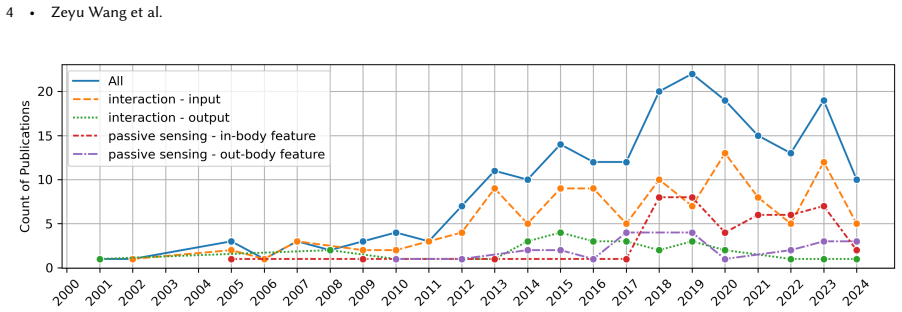
- [Figure 1] The caption states that one paper in the interaction-input category was published in 1997, but the figure axes are labeled 2000 to 2024. The authors should clarify how the 1997 paper is displayed.
- [Table 6] The price column mixes different currencies (e.g., $, €) without a consistent notation. A footnote explaining currency and approximate conversion would improve readability.
Circularity Check
No circular derivation chain: the survey's taxonomy and counts are descriptive summaries of the included corpus, not predictions derived from its own definitions.
full rationale
This is a systematic literature review, not a derivation. The paper defines smart rings, selects 206 papers using explicit inclusion criteria, and then organizes them into a taxonomy. That process is descriptive and bottom-up: the categories were developed iteratively from the corpus (Section 2: 'The columns and the main taxonomy... were developed in an iterative manner'), and the counts are summaries of the selected papers, not analytic consequences of the definition. No fitted parameter is later reported as a prediction, and no equations are derived. The closest self-citational element is Section 3, where the four-layer taxonomy structure is 'Inspired by Röddiger et al. [147]', a prior survey co-authored by one of the current authors. This is an organizational inspiration rather than a load-bearing inference: the leaf categories and individual paper assignments come from the authors' own reading of the corpus, and the paper explicitly diverges from [147] by reclassifying authentication (Section 3.1). No uniqueness theorem, forced-choice argument, or ansatz-smuggling citation appears. The internal arithmetic inconsistencies in Figure 2 and section-level counts (e.g., subsections summing beyond their stated parents) are reproducibility or correctness concerns, not circularity: they do not make any claimed result equivalent to its input by construction. Overall, the central claims are self-contained descriptive statements about a manually curated literature set, so the circularity score is low.
Assumptions & free parameters
assumptions (3)
- domain assumption Smart rings are defined as small, circular electronic devices worn on a phalanx of a finger, following the ring form factor of Shilkrot et al.
- domain assumption ACM Digital Library and IEEE Xplore contain the majority of wearable and HCI publications.
- domain assumption Manual screening of abstracts, introductions, and outlines can reliably judge whether a paper fits the smart ring definition and inclusion criteria.
Cite this review
Pith. "Pith review of Computing with Smart Rings: A Systematic Literature Review." pith.science (2026). https://pith.science/paper/KV4OXMT2
@misc{pith2026250202459,
  author       = {Pith},
  title        = {Pith review of: Computing with Smart Rings: A Systematic Literature Review},
  year         = {2026},
  howpublished = {\url{https://pith.science/paper/KV4OXMT2}},
  note         = {Machine review of arXiv:2502.02459}
}
read the original abstract
A smart ring is a wearable electronic device in the form of a ring that incorporates diverse sensors and computing technologies to perform a variety of functions. Designed for use with fingers, smart rings are capable of sensing more subtle and abundant hand movements, thus making them a good platform for interaction. Meanwhile, fingers are abundant with blood vessels and nerve endings and accustomed to wearing rings, providing an ideal site for continuous health monitoring through smart rings, which combine comfort with the ability to capture vital biometric data, making them suitable for all-day wear. We collected in total of 206 smart ring-related publications and conducted a systematic literature review. We provide a taxonomy regarding the sensing and feedback modalities, applications, and phenomena. We review and categorize these literatures into four main areas: (1) interaction - input, (2) interaction - output, (3) passive sensing - in body feature, (4) passive sensing - out body activity. This comprehensive review highlights the current advancements within the field of smart ring and identifies potential areas for future research.
Figures


Figures from the paper (6 more)


Forward citations
Cited by 3 Pith papers
-
CITRUS: Candidate Inference and Temporal-tracking for Reliable, Unobtrusive Sensing of Wearable Heart Rate under Motion
A candidate-based causal Viterbi estimator with a learned accept/hold/reject reporting policy reduces motion-window heart-rate MAE from ≈10.8 to 6.2 BPM at 50% coverage on ring PPG and improves reported-window accurac...
-
{\tau}-Ring: A Smart Ring Platform for Multimodal Physiological and Behavioral Sensing
An open-source smart ring platform offering time-synchronized PPG, IMU, temperature, storage, adjustable firmware, and an Android app is introduced and demonstrated for heart-rate and handwriting sensing.
-
A Survey of Earable Technology: Trends, Tools, and the Road Ahead
A structured survey of earable computing research from 2022 to 2025, covering sensing modalities, applications, hardware platforms, datasets, and future directions.
Reference graph
Works this paper leans on
-
[1]
Mohammad Hasan Ahmadilivani, Mahdi Taheri, Jaan Raik, Masoud Daneshtalab, and Maksim Jenihhin. 2024. A systematic literature review on hardware reliability assessment methods for deep neural networks. Comput. Surveys 56, 6 (2024), 1–39
2024
-
[2]
Bashar Altakrouri, Daniel Burmeister, Dennis Boldt, and Andreas Schrader. 2016. Insights on the impact of physical impairments in full-body motion gesture elicitation studies. In Proceedings of the 9th Nordic Conference on Human-Computer Interaction . 1–10
2016
-
[3]
Ariza, P
O. Ariza, P. Lubos, F. Steinicke, and G. Bruder. 2015. Ring-shaped haptic device with vibrotactile feedback patterns to support natural spatial interaction. In Proceedings of the 25th International Conference on Artificial Reality and Telexistence and 20th Eurographics Symposium on Virtual Environments (Kyoto, Japan) (ICAT - EGVE ’15). Eurographics Associ...
2015
-
[4]
Daniel Ashbrook, Patrick Baudisch, and Sean White. 2011. Nenya: subtle and eyes-free mobile input with a magnetically-tracked finger ring. In Proceedings of the SIGCHI Conference on Human Factors in Computing Systems . 2043–2046
2011
-
[5]
Sandra Bardot, Surya Rawat, Duy Thai Nguyen, Sawyer Rempel, Huizhe Zheng, Bradley Rey, Jun Li, Kevin Fan, Da-Yuan Huang, Wei Li, et al. 2021. ARO: Exploring the design of smart-ring interactions for encumbered hands. In Proceedings of the 23rd International Conference on Mobile Human-Computer Interaction . 1–11
2021
-
[6]
Andrea Bianchi and Seungwoo Je. 2017. Disambiguating touch with a smart-ring. In Proceedings of the 8th Augmented Human International Conference. 1–5
2017
-
[7]
I Could Wear It All of the Time, Just Like My Wedding Ring:
Laura-Bianca Bilius and Radu-Daniel Vatavu. 2023. “I Could Wear It All of the Time, Just Like My Wedding Ring:” Insights into Older People’s Perceptions of Smart Rings. In Extended Abstracts of the 2023 CHI Conference on Human Factors in Computing Systems . 1–8
2023
-
[8]
Roger Boldu, Alexandru Dancu, Denys JC Matthies, Thisum Buddhika, Shamane Siriwardhana, and Suranga Nanayakkara. 2018. Fingerreader2. 0: Designing and evaluating a wearable finger-worn camera to assist people with visual impairments while shopping. Proceedings of the ACM on Interactive, Mobile, Wearable and Ubiquitous Technologies 2, 3 (2018), 1–19
2018
Show all 223 references
-
[9]
Roger Boldu, Alexandru Dancu, Denys JC Matthies, Pablo Gallego Cascón, Shanaka Ransir, and Suranga Nanayakkara. 2018. Thumb- In-Motion: Evaluating thumb-to-ring microgestures for athletic activity. In Proceedings of the 2018 ACM Symposium on Spatial User Interaction. 150–157
2018
-
[10]
Assim Boukhayma, Anthony Barison, Serj Haddad, and Antonino Caizzone. 2021. Ring-embedded micro-power mm-sized optical sensor for accurate heart beat monitoring. IEEE Access 9 (2021), 127217–127225
2021
-
[11]
Frederik Brudy, Christian Holz, Roman Rädle, Chi-Jui Wu, Steven Houben, Clemens Nylandsted Klokmose, and Nicolai Marquardt
-
[12]
Yifeng Cao, Ashutosh Dhekne, and Mostafa Ammar. 2024. SigningRing: Signature-based Authentication using Inertial Sensors on a Ring Form-factor. In Proceedings of the Workshop on Body-Centric Computing Systems . 11–16
2024
-
[13]
Andrea Casalino, Costanza Messeri, Maria Pozzi, Andrea Maria Zanchettin, Paolo Rocco, and Domenico Prattichizzo. 2018. Operator awareness in human–robot collaboration through wearable vibrotactile feedback. IEEE Robotics and Automation Letters 3, 4 (2018), Proc. ACM Interact. ...
2018
-
[14]
Liwei Chan, Yi-Ling Chen, Chi-Hao Hsieh, Rong-Hao Liang, and Bing-Yu Chen. 2015. Cyclopsring: Enabling whole-hand and context- aware interactions through a fisheye ring. In Proceedings of the 28th Annual ACM Symposium on User Interface Software & Technology . 549–556
2015
-
[15]
Ranajit Chatterjee and Fumtoshi Matsuno. 2006. Design of a touch sensor based single finger operated wearable user-interface terminal. In 2006 SICE-ICASE International Joint Conference . IEEE, 4142–4147
2006
-
[16]
Dongyao Chen, Mingke Wang, Chenxi He, Qing Luo, Yasha Iravantchi, Alanson Sample, Kang G Shin, and Xinbing Wang. 2021. MagX: wearable, untethered hands tracking with passive magnets. In Proceedings of the 27th Annual International Conference on Mobile Computing and Networking. 269–282
2021
-
[17]
Ke-Yu Chen, Kent Lyons, Sean White, and Shwetak Patel. 2013. uTrack: 3D input using two magnetic sensors. InProceedings of the 26th annual ACM symposium on User interface software and technology . 237–244
2013
-
[18]
Taizhou Chen, Tianpei Li, Xingyu Yang, and Kening Zhu. 2023. Efring: Enabling thumb-to-index-finger microgesture interaction through electric field sensing using single smart ring.Proceedings of the ACM on Interactive, Mobile, Wearable and Ubiquitous Technologies 6, 4 (2023), 1–31
2023
-
[19]
Yi-Lin Chen, Yi-Lung Tsai, Kailing Huang, and Pai H Chou. 2014. MobiRing: A Finger-Worn Wireless Motion Tracker. In2014 IEEE International Conference on Internet of Things (iThings), and IEEE Green Computing and Communications (GreenCom) and IEEE Cyber, Physical and Social Com...
2014
-
[20]
Zixue Cheng and Yinghui Zhou. 2018. Finger-worn device based hand gesture recognition using long short-term memory. In 2018 IEEE International Conference on Systems, Man, and Cybernetics (SMC) . IEEE, 2067–2072
2018
-
[21]
Victor Cheung and Audrey Girouard. 2019. Tangible around-device interaction using rotatory gestures with a magnetic ring. In Proceedings of the 21st International Conference on Human-Computer Interaction with Mobile Devices and Services . 1–8
2019
-
[22]
Yongsoon Choi, Jordan Tewell, Yukihiro Morisawa, Gilang A Pradana, and Adrian David Cheok. 2014. Ring* U: a wearable system for intimate communication using tactile lighting expressions. InProceedings of the 11th Conference on Advances in Computer Entertainment Technology. 1–4
2014
-
[23]
Brian Coffen and Md Shaad Mahmud. 2021. Tinydl: Edge computing and deep learning based real-time hand gesture recognition using wearable sensor. In 2020 IEEE International Conference on E-health Networking, Application & Services (HEALTHCOM) . IEEE, 1–6
2021
-
[24]
Febus Reidj G Cruz, Charmaine C Paglinawan, Celina Nadine V Catindig, John Charles B Lamchek, Danielle Diane C Almiranez, and Anne Flereece Sanchez. 2019. Application of reflectance mode photoplethysmography for non-invasive monitoring of blood glucose level with moving averag...
2019
-
[25]
Rajkumar Darbar, Mainak Choudhury, and Vikalp Mullick. 2019. RingIoT: A Smart Ring Controlling Things in Physical Spaces. May (2019) (2019), 2–9
2019
-
[26]
Satabdi Das, Arshad Nasser, and Khalad Hasan. 2023. FingerButton: Enabling Controller-Free Transitions between Real and Virtual Environments. In 2023 IEEE International Symposium on Mixed and Augmented Reality (ISMAR) . IEEE, 533–542
2023
-
[27]
Satabdi Das, Arshad Nasser, and Khalad Hasan. 2024. Exploring Finger-Worn Solutions for Transitioning between the Reality-Virtuality Continuum. In 2024 IEEE International Symposium on Mixed and Augmented Reality (ISMAR) . IEEE, 1167–1176
2024
-
[28]
Shome S Das. 2020. Real time direction estimation for pointing interactions using a depth sensor and a nine axis inertial motion unit. In Proceedings of the 13th ACM International Conference on PErvasive Technologies Related to Assistive Environments . 1–10
2020
-
[29]
Massimiliano de Zambotti, Leonardo Rosas, Ian M Colrain, and Fiona C Baker. 2019. The sleep of the ring: comparison of the ¯OURA sleep tracker against polysomnography. Behavioral sleep medicine 17, 2 (2019), 124–136
2019
-
[30]
Yufeng Deng, Dong Wang, Qian Zhang, and Run Zhao. 2019. MType: A Magnetic Field-based Typing System on the Hand for Around-Device Interaction. In 2019 16th Annual IEEE International Conference on Sensing, Communication, and Networking (SECON) . IEEE, 1–9
2019
-
[31]
Quan Dong, R Scott Downen, Baichen Li, Nam Tran, and Zhenyu Li. 2021. A cloud-connected multi-lead electrocardiogram (ECG) sensor ring. IEEE Sensors Journal 21, 14 (2021), 16340–16349
2021
-
[32]
Fred F Ferri. 2009. Ferri’s Clinical Advisor 2010 E-Book: 5 Books in 1 . Elsevier Health Sciences
2009
-
[33]
Euan Freeman, Stephen Brewster, and Vuokko Lantz. 2014. Tactile Feedback for Above-Device Gesture Interfaces: Adding Touch to Touchless Interactions. In Proceedings of the 16th International Conference on Multimodal Interaction (Istanbul, Turkey) (ICMI ’14). Association for Co...
2014
-
[34]
Nizan Friedman, Justin B Rowe, David J Reinkensmeyer, and Mark Bachman. 2014. The manumeter: a wearable device for monitoring daily use of the wrist and fingers. IEEE journal of biomedical and health informatics 18, 6 (2014), 1804–1812
2014
-
[35]
Rebecca Fenton Friesen and Yasemin Vardar. 2023. Perceived realism of virtual textures rendered by a vibrotactile wearable ring display. IEEE Transactions on Haptics (2023)
2023
-
[36]
Masaaki Fukumoto. 2005. A finger-ring shaped wearable handset based on bone-conduction. In Ninth IEEE International Symposium on Wearable Computers (ISWC’05). IEEE, 10–13. Proc. ACM Interact. Mob. Wearable Ubiquitous Technol., Vol. 1, No. 1, Article . Publication date: Februar...
2005
-
[37]
Chiara Gaudeni, Leonardo Meli, Lynette A Jones, and Domenico Prattichizzo. 2019. Presenting surface features using a haptic ring: A psychophysical study on relocating vibrotactile feedback. IEEE transactions on haptics 12, 4 (2019), 428–437
2019
-
[38]
Bogdan-Florin Gheran, Jean Vanderdonckt, and Radu-Daniel Vatavu. 2018. Gestures for smart rings: Empirical results, insights, and design implications. In Proceedings of the 2018 Designing Interactive Systems Conference . 623–635
2018
-
[39]
Sarthak Ghosh, Hyeong Cheol Kim, Yang Cao, Arne Wessels, Simon T Perrault, and Shengdong Zhao. 2016. Ringteraction: coordinated thumb-index interaction using a ring. In Proceedings of the 2016 CHI Conference Extended Abstracts on Human Factors in Computing Systems. 2640–2647
2016
-
[40]
Joseph Greenspun and Kristofer SJ Pister. 2014. Ring GINA: a wearable computer interaction device. In Mobile Computing, Applications, and Services: 5th International Conference, MobiCASE 2013, Paris, France, November 7-8, 2013, Revised Selected Papers 5 . Springer, 98–103
2014
-
[41]
Yizheng Gu, Chun Yu, Zhipeng Li, Weiqi Li, Shuchang Xu, Xiaoying Wei, and Yuanchun Shi. 2019. Accurate and low-latency sensing of touch contact on any surface with finger-worn IMU sensor. In Proceedings of the 32nd annual ACM symposium on user interface software and technology...
2019
-
[42]
Yizheng Gu, Chun Yu, Zhipeng Li, Zhaoheng Li, Xiaoying Wei, and Yuanchun Shi. 2020. Qwertyring: Text entry on physical surfaces using a ring. Proceedings of the ACM on Interactive, Mobile, Wearable and Ubiquitous Technologies 4, 4 (2020), 1–29
2020
-
[43]
Jeremy Gummeson, Bodhi Priyantha, and Jie Liu. 2014. An energy harvesting wearable ring platform for gestureinput on surfaces. In Proceedings of the 12th annual international conference on Mobile systems, applications, and services . 162–175
2014
-
[44]
Hongbo Guo, Hao Wu, Jiahui Xia, Yibang Cheng, Qianhui Guo, Yi Chen, Tingyan Xu, Jiguang Wang, and Guoxing Wang. 2024. OSAHS Detection Capabilities of RingConn Smart Ring: A Feasibility Study. In2024 IEEE 6th International Conference on AI Circuits and Systems (AICAS). IEEE, 597–601
2024
-
[45]
Aakar Gupta, Jiushan Yang, and Ravin Balakrishnan. 2018. Asterisk and obelisk: Motion codes for passive tagging. In Proceedings of the 31st Annual ACM Symposium on User Interface Software and Technology . 725–736
2018
-
[46]
Serj Haddad, Assim Boukhayma, and Antonino Caizzone. 2020. Beat-to-beat detection accuracy using the ultra low power senbiosys PPG sensor. In European Medical and Biological Engineering Conference . Springer, 178–188
2020
-
[47]
Serj Haddad, Assim Boukhayma, and Antonino Caizzone. 2021. Ear and finger ppg wearables for night and day beat-to-beat interval detection. In 2021 43rd Annual International Conference of the IEEE Engineering in Medicine & Biology Society (EMBC) . IEEE, 1686–1689
2021
-
[48]
Eija Halkola, Lauri Lovén, Marta Cortes, Ekaterina Gilman, and Susanna Pirttikangas. 2019. Towards measuring well-being in smart environments. In Adjunct Proceedings of the 2019 ACM International Joint Conference on Pervasive and Ubiquitous Computing and Proceedings of the 201...
2019
-
[49]
Teng Han, David Ahlström, Xing-Dong Yang, Ahmad Byagowi, and Pourang Irani. 2016. Exploring design factors for transforming passive vibration signals into smartwear interactions. In Proceedings of the 9th Nordic Conference on Human-Computer Interaction . 1–10
2016
-
[50]
Teng Han, Qian Han, Michelle Annett, Fraser Anderson, Da-Yuan Huang, and Xing-Dong Yang. 2017. Frictio: Passive kinesthetic force feedback for smart ring output. In Proceedings of the 30th Annual ACM Symposium on User Interface Software and Technology . 131–142
2017
-
[51]
Xinying Han, Hiroaki Seki, Yoshitsugu Kamiya, and Masatoshi Hikizu. 2007. Wearable handwriting input device using magnetic field. In SICE Annual Conference 2007. IEEE, 365–368
2007
-
[52]
Chris Harrison and Scott E Hudson. 2009. Abracadabra: wireless, high-precision, and unpowered finger input for very small mobile devices. In Proceedings of the 22nd annual ACM symposium on User interface software and technology . 121–124
2009
-
[53]
Anuradha Herath, Bradley Rey, Sandra Bardot, Sawyer Rempel, Lucas Audette, Huizhe Zheng, Jun Li, Kevin Fan, Da-Yuan Huang, Wei Li, et al. 2022. Expanding Touch Interaction Capabilities for Smart-rings: An Exploration of Continual Slide and Microroll Gestures. In CHI Conference...
2022
-
[54]
Anuruddha Hettiarachchi, Suranga Nanayakkara, Kian Peen Yeo, Roy Shilkrot, and Pattie Maes. 2013. FingerDraw: more than a digital paintbrush. In Proceedings of the 4th Augmented Human International Conference . 1–4
2013
-
[55]
Tatsuya Horie, Tsutomu Terada, Takuya Katayama, and Masahiko Tsukamoto. 2012. A pointing method using accelerometers for graphical user interfaces. In Proceedings of the 3rd Augmented Human International Conference . 1–8
2012
-
[56]
Hua Huang, Hongkai Chen, and Shan Lin. 2019. Magtrack: Enabling safe driving monitoring with wearable magnetics. In Proceedings of the 17th annual international conference on mobile systems, applications, and services . 326–339
2019
-
[57]
Sharjeel Imtiaz, Avais Khatri, Faraz Ahmed Shaikh, Sheroz Khan, et al. 2018. Finger-Worn Assistive Device for Detection Tracking and Recognition. In 2018 7th International Conference on Computer and Communication Engineering (ICCCE) . IEEE, 470–475
2018
-
[58]
Shunsuke Iwakiri and Kazuya Murao. 2023. User Authentication Method for Wearable Ring Devices using Active Acoustic Sensing. In Proceedings of the 2023 ACM International Symposium on Wearable Computers . 17–21
2023
-
[59]
Takayuki Iwamoto and Hiroyuki Shinoda. 2007. Finger ring device for tactile sensing and human machine interface. In SICE Annual Conference 2007. IEEE, 2132–2136
2007
-
[60]
Seungwoo Je, Okyu Choi, Kyungah Choi, Minkyeong Lee, Hyeon-Jeong Suk, Liwei Chan, and Andrea Bianchi. 2017. Designing skin-dragging haptic motions for wearables. In Proceedings of the 2017 ACM International Symposium on Wearable Computers . 98–101
2017
-
[61]
Seungwoo Je, Minkyeong Lee, Yoonji Kim, Liwei Chan, Xing-Dong Yang, and Andrea Bianchi. 2018. Pokering: Notifications by poking around the finger. In Proceedings of the 2018 CHI Conference on Human Factors in Computing Systems . 1–10. Proc. ACM Interact. Mob. Wearable Ubiquito...
2018
-
[62]
Seungwoo Je, Brendan Rooney, Liwei Chan, and Andrea Bianchi. 2017. tactoRing: a skin-drag discrete display. In Proceedings of the 2017 CHI Conference on Human Factors in Computing Systems . 3106–3114
2017
-
[63]
Lei Jing. 2013. A brand-independent low memory footprint universal remote control method for resource-constrained wearable remote controller. In 2013 IEEE 2nd Global Conference on Consumer Electronics (GCCE) . IEEE, 367–368
2013
-
[64]
Lei Jing, Zixue Cheng, Yinghui Zhou, Junbo Wang, and Tongjun Huang. 2013. Magic ring: A self-contained gesture input device on finger. In Proceedings of the 12th International Conference on Mobile and Ubiquitous Multimedia . 1–4
2013
-
[65]
Lei Jing, Yinghui Zhou, Zixue Cheng, and Junbo Wang. 2011. A recognition method for one-stroke finger gestures using a MEMS 3D accelerometer. IEICE transactions on information and systems 94, 5 (2011), 1062–1072
2011
-
[66]
A Benjamin Joseph, TP Anithaashri, JR Lourdu Jennifer, and S Amudhapriya. 2022. Integrated Health Care System Using Smart Wearables Based on Intelligent-Internet of Things. In 2022 8th International Conference on Smart Structures and Systems (ICSSS) . IEEE, 01–04
2022
-
[67]
Kianoosh Kazemi, Iman Azimi, Pasi Liljeberg, and Amir M Rahmani. 2023. Can Sleep Quality Attributes be Predicted from Physical Activity in Everyday Settings?. In 2023 45th Annual International Conference of the IEEE Engineering in Medicine & Biology Society (EMBC). IEEE, 1–5
2023
-
[68]
Lauryn Keeler Bruce, Dalila González, Subhasis Dasgupta, and Benjamin L Smarr. 2024. Biometrics of complete human pregnancy recorded by wearable devices. NPJ Digital Medicine 7, 1 (2024), 207
2024
-
[69]
Hamed Ketabdar, Peyman Moghadam, and Mehran Roshandel. 2012. Pingu: A new miniature wearable device for ubiquitous computing environments. In 2012 Sixth International Conference on Complex, Intelligent, and Software Intensive Systems . IEEE, 502–506
2012
-
[70]
Hamed Ketabdar, Mehran Roshandel, and Kamer Ali Yüksel. 2010. Towards using embedded magnetic field sensor for around mobile device 3D interaction. In Proceedings of the 12th international conference on Human computer interaction with mobile devices and services . 153–156
2010
-
[71]
Wolf Kienzle and Ken Hinckley. 2014. LightRing: always-available 2D input on any surface. In Proceedings of the 27th annual ACM symposium on User interface software and technology . 157–160
2014
-
[72]
Wolf Kienzle, Eric Whitmire, Chris Rittaler, and Hrvoje Benko. 2021. Electroring: Subtle pinch and touch detection with a ring. In Proceedings of the 2021 CHI Conference on Human Factors in Computing Systems . 1–12
2021
-
[73]
Junhyeok Kim, William Delamare, and Pourang Irani. 2018. Thumbtext: Text entry for wearable devices using a miniature ring. In Graphics Interface
2018
-
[74]
Jina Kim, Minyung Kim, Woo Suk Lee, and Sang Ho Yoon. 2023. VibAware: Context-Aware Tap and Swipe Gestures Using Bio-Acoustic Sensing. In Proceedings of the 2023 ACM Symposium on Spatial User Interaction . 1–12
2023
-
[75]
Maruchi Kim, Antonio Glenn, Bandhav Veluri, Yunseo Lee, Eyoel Gebre, Aditya Bagaria, Shwetak Patel, and Shyamnath Gollakota
-
[76]
Yoojung Kim, Hee-Tae Jung, Joonwoo Park, Yangsoo Kim, Nathan Ramasarma, Paolo Bonato, Eun Kyoung Choe, and Sunghoon Ivan Lee. 2019. Towards the design of a ring sensor-based mHealth system to achieve optimal motor function in stroke survivors.Proceedings of the ACM on Interact...
2019
-
[77]
Christine E King and Majid Sarrafzadeh. 2018. A survey of smartwatches in remote health monitoring. Journal of healthcare informatics research 2 (2018), 1–24
2018
-
[78]
HO Kinnunen and H Koskimäki. 2018. 0312 The HRV Of The Ring-Comparison of nocturnal HR and HRV between a commercially available wearable ring and ECG. Sleep 41 (2018), A120
2018
-
[79]
Harutoshi Kokubu, Koki Tominaga, and Buntarou Shizuki. 2022. One–Handed Control for Smartwatches Using Thumb Gestures to Ring. In Proceedings of the Asian HCI Symposium 2022 . 30–32
2022
-
[80]
Heli Koskimäki, Hannu Kinnunen, Teemu Kurppa, and Juha Röning. 2018. How do we sleep: a case study of sleep duration and quality using data from oura ring. In Proceedings of the 2018 ACM international joint conference and 2018 international symposium on pervasive and ubiquitou...
2018
-
[81]
Heli Koskimäki, Hannu Kinnunen, Salla Rönkä, and Benjamin Smarr. 2019. Following the heart: What does variation of resting heart rate tell about us as individuals and as a population. In Adjunct proceedings of the 2019 ACM international joint conference on pervasive and ubiqui...
2019
-
[82]
Elina Kuosmanen, Aku Visuri, Saba Kheirinejad, Niels van Berkel, Heli Koskimäki, Denzil Ferreira, and Simo Hosio. 2022. How does sleep tracking influence your life? experiences from a longitudinal field study with a wearable ring. Proceedings of the ACM on Human-Computer Inter...
2022
-
[83]
Kengo Kuroki, Yiming Zhou, Zixue Cheng, Zixian Lu, Yinghui Zhou, and Lei Jing. 2015. A remote conversation support system for deaf-mute persons based on bimanual gestures recognition using finger-worn devices. In 2015 IEEE International Conference on Pervasive Computing and Co...
2015
-
[84]
Alicia Y Kwon, Claire D Vallotton, Mechthild Kiegelmann, and Kim Hughes Wilhelm. 2018. Cultural diversification of communicative gestures through early childhood: A comparison of children in English-, German-, and Chinese-speaking families. Infant Behavior and Proc. ACM Intera...
2018
-
[85]
Alan HF Lam, Wen Jung Li, Yunhui Liu, and Ning Xi. 2002. MIDS: micro input devices system using MEMS sensors. In IEEE/RSJ International Conference on Intelligent Robots and Systems , Vol. 2. IEEE, 1184–1189
2002
-
[86]
Mathieu Lavallée, Pierre-N Robillard, and Reza Mirsalari. 2013. Performing systematic literature reviews with novices: An iterative approach. IEEE Transactions on Education 57, 3 (2013), 175–181
2013
-
[87]
Jupyung Lee, Seung-Ho Lim, Jong-Woon Yoo, Ki-Woong Park, Hyun-Jin Choi, and Kyu Ho Park. 2007. A ubiquitous fashionable computer with an i-Throw device on a location-based service environment. In 21st International Conference on Advanced Information Networking and Applications...
2007
-
[88]
Yongseok Lee, Inyoung Jang, and Dongjun Lee. 2015. Enlarging just noticeable differences of visual-proprioceptive conflict in VR using haptic feedback. In 2015 IEEE World Haptics Conference (WHC) . IEEE, 19–24
2015
-
[89]
Jiyang Li, Lin Huang, Siddharth Shah, Sean J Jones, Yincheng Jin, Dingran Wang, Adam Russell, Seokmin Choi, Yang Gao, Junsong Yuan, et al. 2023. Signring: Continuous american sign language recognition using imu rings and virtual imu data. Proceedings of the ACM on Interactive,...
2023
-
[90]
Tianyu Li, Yue Liu, Shining Ma, Mingwei Hu, Tong Liu, and Weitao Song. 2022. NailRing: An Intelligent Ring for Recognizing Micro-gestures in Mixed Reality. In 2022 IEEE International Symposium on Mixed and Augmented Reality (ISMAR) . IEEE, 178–186
2022
-
[91]
Xiaosa Li, Runze Zhao, Xinyue Chai, Zimo Wang, Qianqian Tong, and Wenbo Ding. 2024. VibroBot: A Lightweight and Wirelessly Programmable Vibration Bot for Haptic Guidance. IEEE Robotics and Automation Letters (2024)
2024
-
[92]
Zisu Li, Chen Liang, Yuntao Wang, Yue Qin, Chun Yu, Yukang Yan, Mingming Fan, and Yuanchun Shi. 2023. Enabling voice- accompanying hand-to-face gesture recognition with cross-device sensing. In Proceedings of the 2023 CHI Conference on Human Factors in Computing Systems. 1–17
2023
-
[93]
Zhenjiang Li, Xinglin Zhang, and Chenshu Wu. 2023. RingVKB: A Ring-Shaped Virtual Keyboard Using Low-Cost IMU. Proceedings of the ACM on Human-Computer Interaction 7, MHCI (2023), 1–20
2023
-
[94]
Chao Lian, Xianshou Ren, Yuliang Zhao, Xueliang Zhang, Ruoyu Chen, Shuyu Wang, Xiaopeng Sha, and Wen J Li. 2020. Towards a virtual keyboard scheme based on wearing one motion sensor ring on each hand. IEEE Sensors Journal 21, 3 (2020), 3379–3387
2020
-
[95]
Chen Liang, Chi Hsia, Chun Yu, Yukang Yan, Yuntao Wang, and Yuanchun Shi. 2023. DRG-Keyboard: Enabling subtle gesture typing on the fingertip with dual IMU rings. Proceedings of the ACM on Interactive, Mobile, Wearable and Ubiquitous Technologies 6, 4 (2023), 1–30
2023
-
[96]
Chen Liang, Chun Yu, Yue Qin, Yuntao Wang, and Yuanchun Shi. 2021. DualRing: Enabling subtle and expressive hand interaction with dual IMU rings. Proceedings of the ACM on Interactive, Mobile, Wearable and Ubiquitous Technologies 5, 3 (2021), 1–27
2021
-
[97]
Rong-Hao Liang, Shun-Yao Yang, and Bing-Yu Chen. 2019. Indexmo: exploring finger-worn RFID motion tracking for activity recognition on tagged objects. In Proceedings of the 2019 ACM International Symposium on Wearable Computers . 129–134
2019
-
[98]
Xiaohui Liang and David Kotz. 2017. AuthoRing: Wearable user-presence authentication. In Proceedings of the 2017 Workshop on Wearable Systems and Applications. 5–10
2017
-
[99]
Hyunchul Lim, Jungmin Chung, Changhoon Oh, SoHyun Park, Joonhwan Lee, and Bongwon Suh. 2018. Touch+ Finger: Extending Touch-Based User Interface Capabilities with" Idle" Finger Gestures in the Air. In Proceedings of the 31st Annual ACM Symposium on User Interface Software and ...
2018
-
[100]
Guanhong Liu, Yizheng Gu, Yiwen Yin, Chun Yu, Yuntao Wang, Haipeng Mi, and Yuanchun Shi. 2020. Keep the phone in your pocket: Enabling smartphone operation with an imu ring for visually impaired people. Proceedings of the ACM on Interactive, Mobile, Wearable and Ubiquitous Tec...
2020
-
[101]
Jing Liu, Charles G Sodini, Yanghui Ou, Bryan Yan, Yuan-Ting Zhang, and Ni Zhao. 2019. Feasibility of fingertip oscillometric blood pressure measurement: Model-based analysis and experimental validation. IEEE Journal of Biomedical and Health Informatics 24, 2 (2019), 533–542
2019
-
[102]
Jing Liu, Bryan P Yan, Yuan-Ting Zhang, Xiao-Rong Ding, Peng Su, and Ni Zhao. 2018. Multi-wavelength photoplethysmography enabling continuous blood pressure measurement with compact wearable electronics. IEEE Transactions on Biomedical Engineering 66, 6 (2018), 1514–1525
2018
-
[103]
Xin Liu, Smita Rajan, Gabriel Hollander, Nathan Ramasarma, Paolo Bonato, and Sunghoon I Lee. 2017. A novel finger-worn sensor for ambulatory monitoring of hand use. In 2017 IEEE/ACM International Conference on Connected Health: Applications, Systems and Engineering Technologie...
2017
-
[104]
Xin Liu, Smita Rajan, Nathan Ramasarma, Paolo Bonato, and Sunghoon Ivan Lee. 2018. The use of a finger-worn accelerometer for monitoring of hand use in ambulatory settings. IEEE journal of biomedical and health informatics 23, 2 (2018), 599–606
2018
-
[105]
Xiaoyi Liu, Yingtian Shi, Chun Yu, Cheng Gao, Tianao Yang, Chen Liang, and Yuanchun Shi. 2023. Understanding In-Situ Programming for Smart Home Automation. Proceedings of the ACM on Interactive, Mobile, Wearable and Ubiquitous Technologies 7, 2 (2023), 1–31
2023
-
[106]
Yilin Liu, Fengyang Jiang, and Mahanth Gowda. 2020. Finger gesture tracking for interactive applications: A pilot study with sign languages. Proceedings of the ACM on Interactive, Mobile, Wearable and Ubiquitous Technologies 4, 3 (2020), 1–21
2020
-
[107]
Yilin Liu, Shijia Zhang, and Mahanth Gowda. 2021. When video meets inertial sensors: Zero-shot domain adaptation for finger motion analytics with inertial sensors. In Proceedings of the International Conference on Internet-of-Things Design and Implementation . 182–194. Proc. A...
2021
-
[108]
Zhe-Ting Liu, Davy PY Wong, and Pai H Chou. 2020. An IMU-based wearable ring for on-surface handwriting recognition. In 2020 international symposium on VLSI design, automation and test (VLSI-DAT) . IEEE, 1–4
2020
-
[109]
Tomosuke Maeda, Roshan Peiris, Nakatani Masashi, Yoshihiro Tanaka, and Kouta Minamizawa. 2016. HapticAid: wearable haptic augmentation system for enhanced, enchanted and empathised haptic experiences. In SIGGRAPH ASIA 2016 Emerging Technologies (Macau) (SA ’16). Association fo...
2016
-
[110]
Michele Magno, Giovanni A Salvatore, Petar Jokic, and Luca Benini. 2019. Self-sustainable smart ring for long-term monitoring of blood oxygenation. IEEE access 7 (2019), 115400–115408
2019
-
[111]
Md Shaad Mahmud, Hua Fang, and Honggang Wang. 2018. An integrated wearable sensor for unobtrusive continuous measurement of autonomic nervous system. IEEE Internet of Things Journal 6, 1 (2018), 1104–1113
2018
-
[112]
Md Shaad Mahmud, Honggang Wang, and Hua Fang. 2018. SensoRing: An integrated wearable system for continuous measurement of physiological biomarkers. In 2018 IEEE International Conference on Communications (ICC) . IEEE, 1–7
2018
-
[113]
Elena Malakhatka, Anas Al Rahis, Osman Osman, and Per Lundqvist. 2021. Monitoring and predicting occupant’s sleep quality by using wearable device OURA ring and smart building sensors data (living laboratory case study). Buildings 11, 10 (2021), 459
2021
-
[114]
Stefan Marti and Chris Schmandt. 2005. Giving the caller the finger: collaborative responsibility for cellphone interruptions. In CHI ’05 Extended Abstracts on Human Factors in Computing Systems (Portland, OR, USA) (CHI EA ’05). Association for Computing Machinery, New York, N...
2005
-
[115]
Seiji Matsumoto, Yasuhito Takeuchi, and Hidehiro Kakizaki. 2012. Wearable airborne ultrasound Doppler device for natural urodynamics measurement. In 2012 Proceedings of SICE Annual Conference (SICE) . IEEE, 1181–1183
2012
-
[116]
Franck Paulin Ludovig Pehn Mayo, Kansu Oğuz Canbek, and Mehmet Ayyıldız. 2022. Development and Characterization of a Wearable Ring Providing Haptic Feedback. In 2022 Innovations in Intelligent Systems and Applications Conference (ASYU) . IEEE, 1–5
2022
-
[117]
Leonardo Meli, Davide Barcelli, Tommaso Lisini Baldi, and Domenico Prattichizzo. 2017. Hand in air tapping: A wearable input technology to type wireless. In 2017 26th IEEE International Symposium on Robot and Human Interactive Communication (RO-MAN) . IEEE, 936–941
2017
-
[118]
Kouta Minamizawa, Souichiro Fukamachi, Naoki Kawakami, and Susumu Tachi. 2008. Interactive representation of virtual object in hand-held box by finger-worn haptic display. In 2008 Symposium on Haptic Interfaces for Virtual Environment and Teleoperator Systems . IEEE, 367–368
2008
-
[119]
Miner, Denise M
Cameron S. Miner, Denise M. Chan, and Christopher Campbell. 2001. Digital jewelry: wearable technology for everyday life. In CHI ’01 Extended Abstracts on Human Factors in Computing Systems (Seattle, Washington) (CHI EA ’01). Association for Computing Machinery, New York, NY, ...
2001
-
[120]
Alessandra Moschetti, Laura Fiorini, Dario Esposito, Paolo Dario, and Filippo Cavallo. 2016. Recognition of daily gestures with wearable inertial rings and bracelets. Sensors 16, 8 (2016), 1341
2016
-
[121]
Seyed Ahmadreza Mousavi and Rastko Selmic. 2023. Wearable smart rings for multi-finger gesture recognition using supervised learning. IEEE Transactions on Instrumentation and Measurement (2023)
2023
-
[122]
Adiyan Mujibiya, Xiang Cao, Desney S Tan, Dan Morris, Shwetak N Patel, and Jun Rekimoto. 2013. The sound of touch: on-body touch and gesture sensing based on transdermal ultrasound propagation. In Proceedings of the 2013 ACM international conference on Interactive tabletops an...
2013
-
[123]
Rahul Kumar Namdev and Pattie Maes. 2015. An interactive and intuitive stem accessibility system for the blind and visually impaired. In Proceedings of the 8th ACM international conference on pervasive technologies related to assistive environments . 1–7
2015
-
[124]
Suranga Nanayakkara, Roy Shilkrot, Kian Peen Yeo, and Pattie Maes. 2013. EyeRing: a finger-worn input device for seamless interactions with our surroundings. In Proceedings of the 4th Augmented Human International Conference . 13–20
2013
-
[125]
Anh Nguyen and Amy Banic. 2015. 3DTouch: A wearable 3D input device for 3D applications . IEEE
2015
-
[126]
Son Nguyen, Connie Duong, and Rajeevan Amirtharajah. 2021. A smart health tracking ring powered by wireless power transfer. In 2021 IEEE Wireless Power Transfer Conference (WPTC) . IEEE, 1–4
2021
-
[127]
Hugo Nicolau, João Guerreiro, Tiago Guerreiro, and Luís Carriço. 2013. UbiBraille: designing and evaluating a vibrotactile Braille-reading device. In Proceedings of the 15th International ACM SIGACCESS Conference on Computers and Accessibility . 1–8
2013
-
[128]
Shahriar Nirjon, Jeremy Gummeson, Dan Gelb, and Kyu-Han Kim. 2015. Typingring: A wearable ring platform for text input. In Proceedings of the 13th Annual International Conference on Mobile Systems, Applications, and Services . 227–239
2015
-
[129]
Noriyasu Obushi, Sohei Wakisaka, Shunichi Kasahara, Katie Seaborn, Atsushi Hiyama, and Masahiko Inami. 2019. MagniFinger: Fingertip probe microscope with direct micro movements. In Proceedings of the 10th Augmented Human International Conference 2019 . 1–7
2019
-
[130]
Masa Ogata, Yuta Sugiura, Hirotaka Osawa, and Michita Imai. 2012. iRing: intelligent ring using infrared reflection. In Proceedings of the 25th annual ACM symposium on User interface software and technology . 131–136
2012
-
[131]
Seungjae Oh, Chaeyong Park, Yo-Seb Jeon, and Seungmoon Choi. 2021. Identifying Contact Fingers on Touch Sensitive Surfaces by Ring-Based Vibratory Communication. In The 34th Annual ACM Symposium on User Interface Software and Technology . 208–222. Proc. ACM Interact. Mob. Wear...
2021
-
[132]
Deen Osman, Matija Jankovic, Kaan Sel, Roderic I Pettigrew, and Roozbeh Jafari. 2022. Blood pressure estimation using a single channel bio-impedance ring sensor. In 2022 44th Annual International Conference of the IEEE Engineering in Medicine & Biology Society (EMBC) . IEEE, 4286–4290
2022
-
[133]
Claudio Pacchierotti, Gionata Salvietti, Irfan Hussain, Leonardo Meli, and Domenico Prattichizzo. 2016. The hRing: A wearable haptic device to avoid occlusions in hand tracking. In 2016 IEEE Haptics Symposium (HAPTICS) . 134–139. doi:10.1109/HAPTICS.2016.7463167
2016
-
[134]
Birut˙e Paliakait˙e, Peter H Charlton, Andrius Rapalis, Vilma Pluščiauskait˙e, Povilas Piartli, Eugenijus Kaniusas, and Vaidotas Marozas
-
[135]
Anala Pandit, Dhairya Dand, Sisil Mehta, Shashank Sabesan, and Ankit Daftery. 2009. A Simple Wearable Hand Gesture Recognition Device Using iMEMS. In 2009 International Conference of Soft Computing and Pattern Recognition . 592–597. doi:10.1109/SoCPaR.2009.117
2009 doi
-
[136]
Tajammul Pangarkar. 2025. Smartwatch Statistics. https://scoop.market.us/smartwatch-statistics/#:~:text=The%20global% 20smartwatch%20adoption%20rate,smartphone%20owners%20now%20use%20smartwatches Accessed: 2025-02-01
2025
-
[137]
Tuukka Panula, Tero Koivisto, Mikko Pänkäälä, Teemu Niiranen, Ilkka Kantola, and Matti Kaisti. 2020. An instrument for measuring blood pressure and assessing cardiovascular health from the fingertip. Biosensors and Bioelectronics 167 (2020), 112483
2020
-
[138]
Farshid Salemi Parizi, Eric Whitmire, and Shwetak Patel. 2019. Auraring: Precise electromagnetic finger tracking. Proceedings of the ACM on Interactive, Mobile, Wearable and Ubiquitous Technologies 3, 4 (2019), 1–28
2019
-
[139]
Keunwoo Park, Daehwa Kim, Seongkook Heo, and Geehyuk Lee. 2020. MagTouch: Robust Finger Identification for a Smartwatch Using a Magnet Ring and a Built-in Magnetometer. In Proceedings of the 2020 CHI Conference on Human Factors in Computing Systems . 1–13
2020
-
[140]
Ella Peltonen, Parsa Sharmila, Elina Kuosmanen, Heli Koskimäki, and Aku Visuri. 2022. The impact of smartphone usage on circadian cycles: A case study with wearable ring. In 2022 IEEE International Conference on Pervasive Computing and Communications Workshops and other Affili...
2022
-
[141]
M Poongodi, Mounir Hamdi, Mohit Malviya, Ashutosh Sharma, Gaurav Dhiman, and S Vimal. 2022. Diagnosis and combating COVID-19 using wearable Oura smart ring with deep learning methods. Personal and ubiquitous computing (2022), 1–11
2022
-
[142]
Gilang Andi Pradana, Adrian David Cheok, Masahiko Inami, Jordan Tewell, and Yongsoon Choi. 2014. Emotional priming of mobile text messages with ring-shaped wearable device using color lighting and tactile expressions. In Proceedings of the 5th Augmented Human International Con...
2014
-
[143]
Shweta Purawat, Subhasis Dasgupta, Jining Song, Shakti Davis, Kajal T Claypool, Sandeep Chandra, Ashley Mason, Varun Viswanath, Amit Klein, Patrick Kasl, et al. 2021. TemPredict: a big data analytical platform for scalable exploration and monitoring of personalized multimodal ...
2021
-
[144]
Sanjay Rajput, Alexandra Jamieson, Nishi Chaturvedi, Alan Hughes, and Michele Orini. 2023. Assessment of Consumer-Grade Wearable Devices to Track Sleep in Healthy Individuals in Free-Living Conditions. In 2023 Computing in Cardiology (CinC) , Vol. 50. IEEE, 1–4
2023
-
[145]
Gabriel Reyes, Jason Wu, Nikita Juneja, Maxim Goldshtein, W Keith Edwards, Gregory D Abowd, and Thad Starner. 2018. Synchrowatch: One-handed synchronous smartwatch gestures using correlation and magnetic sensing. Proceedings of the ACM on Interactive, Mobile, Wearable and Ubiq...
2018
-
[146]
Mikko J Rissanen, Samantha Vu, Owen Noel Newton Fernando, Natalie Pang, and Schubert Foo. 2013. Subtle, Natural and Socially Acceptable Interaction Techniques for Ringterfaces—Finger-Ring Shaped User Interfaces. In Distributed, Ambient, and Pervasive Interactions: First Intern...
2013
-
[147]
Tobias Röddiger, Christopher Clarke, Paula Breitling, Tim Schneegans, Haibin Zhao, Hans Gellersen, and Michael Beigl. 2022. Sensing with earables: A systematic literature review and taxonomy of phenomena. Proceedings of the ACM on interactive, mobile, wearable and ubiquitous t...
2022
-
[148]
Mehran Roshandel, Aarti Munjal, Peyman Moghadam, Shahin Tajik, and Hamed Ketabdar. 2014. Multi-sensor finger ring for authenti- cation based on 3D signatures. In Human-Computer Interaction. Advanced Interaction Modalities and Techniques: 16th International Conference, HCI Inte...
2014
-
[149]
Volker Roth, Philipp Schmidt, and Benjamin Güldenring. 2010. The IR ring: authenticating users’ touches on a multi-touch display. In Proceedings of the 23nd annual ACM symposium on User interface software and technology . 259–262
2010
-
[150]
Thijs Roumen, Simon T Perrault, and Shengdong Zhao. 2015. Notiring: A comparative study of notification channels for wearable interactive rings. In Proceedings of the 33rd Annual ACM Conference on Human Factors in Computing Systems . 2497–2500
2015
-
[151]
Mauro Santos, Sarah Vollam, Marco AF Pimentel, Carlos Areia, Louise Young, Cristian Roman, Jody Ede, Philippa Piper, Elizabeth King, Mirae Harford, et al. 2022. The use of wearable pulse oximeters in the prompt detection of hypoxemia and during movement: Diagnostic accuracy st...
2022
-
[152]
Francesco Scardulla, Gloria Cosoli, Susanna Spinsante, Angelica Poli, Grazia Iadarola, Riccardo Pernice, Alessandro Busacca, Salvatore Pasta, Lorenzo Scalise, and Leonardo D’Acquisto. 2023. Photoplethysmograhic sensors, potential and limitations: Is it time for regulation? A c...
2023
-
[153]
Stefano Scheggi, Gionata Salvietti, and Domenico Prattichizzo. 2010. Shape and weight rendering for haptic augmented reality. In 19th International Symposium in Robot and Human Interactive Communication . IEEE, 44–49
2010
-
[154]
Dominik Schürmann, Sergej Dechand, and Lars Wolf. 2017. Openkeychain: an architecture for cryptography with smart cards and nfc rings on android. Proceedings of the ACM on Interactive, Mobile, Wearable and Ubiquitous Technologies 1, 3 (2017), 1–24
2017
-
[155]
Xiyuan Shen, Chun Yu, Xutong Wang, Chen Liang, Haozhan Chen, and Yuanchun Shi. 2024. MouseRing: Always-available Touchpad Interaction with IMU Rings. In Proceedings of the CHI Conference on Human Factors in Computing Systems . 1–19
2024
-
[156]
Yilei Shi, Haimo Zhang, Kaixing Zhao, Jiashuo Cao, Mengmeng Sun, and Suranga Nanayakkara. 2020. Ready, steady, touch! sensing physical contact with a finger-mounted IMU. Proceedings of the ACM on Interactive, Mobile, Wearable and Ubiquitous Technologies 4, 2 (2020), 1–25
2020
-
[157]
Roy Shilkrot, Jochen Huber, Jürgen Steimle, Suranga Nanayakkara, and Pattie Maes. 2015. Digital digits: A comprehensive survey of finger augmentation devices. ACM Computing Surveys (CSUR) 48, 2 (2015), 1–29
2015
-
[158]
John L Sibert and Mehmet Gokturk. 1997. A finger-mounted, direct pointing device for mobile computing. In Proceedings of the 10th annual ACM symposium on User interface software and technology . 41–42
1997
-
[159]
Benjamin L Smarr, Kirstin Aschbacher, Sarah M Fisher, Anoushka Chowdhary, Stephan Dilchert, Karena Puldon, Adam Rao, Frederick M Hecht, and Ashley E Mason. 2020. Feasibility of continuous fever monitoring using wearable devices. Scientific reports 10, 1 (2020), 21640
2020
-
[160]
Yilin Song, Shumei Gao, Akira Ikarashi, and Ken-Ichi Yamakoshi. 2009. A new cuff unit for measuring instantaneous blood pressure at the finger artery by local pressurization. In 2009 3rd International Conference on Bioinformatics and Biomedical Engineering . IEEE, 1–4
2009
-
[161]
Janis Spigulis. 2005. Optical noninvasive monitoring of skin blood pulsations. Applied optics 44, 10 (2005), 1850–1857
2005
-
[162]
Dennis Stanke, Tim Duente, and Michael Rohs. 2020. TactileWear: A comparison of electrotactile and vibrotactile feedback on the wrist and ring finger. In Proceedings of the 11th Nordic Conference on Human-Computer Interaction: Shaping Experiences, Shaping Society . 1–13
2020
-
[163]
Lee Stearns, Ruofei Du, Uran Oh, Catherine Jou, Leah Findlater, David A Ross, and Jon E Froehlich. 2016. Evaluating haptic and auditory directional guidance to assist blind people in reading printed text using finger-mounted cameras. ACM Transactions on Accessible Computing (T...
2016
-
[164]
Lee Stearns, Ruofei Du, Uran Oh, Yumeng Wang, Leah Findlater, Rama Chellappa, and Jon E Froehlich. 2015. The design and preliminary evaluation of a finger-mounted camera and feedback system to enable reading of printed text for the blind. In Computer Vision-ECCV 2014 Workshops...
2015
-
[165]
Lee Stearns, Uran Oh, Leah Findlater, and Jon E Froehlich. 2018. Touchcam: Realtime recognition of location-specific on-body gestures to support users with visual impairments. Proceedings of the ACM on Interactive, Mobile, Wearable and Ubiquitous Technologies 1, 4 (2018), 1–23
2018
-
[166]
Yu-Sheng Su, Chien-Hsing Chou, Yung-Long Chu, and Zhao-Yu Yang. 2019. A finger-worn device for exploring Chinese printed text with using CNN algorithm on a micro IoT processor. Ieee Access 7 (2019), 116529–116541
2019
-
[167]
Wei Sun, Franklin Mingzhe Li, Congshu Huang, Zhenyu Lei, Benjamin Steeper, Songyun Tao, Feng Tian, and Cheng Zhang. 2021. Thumbtrak: Recognizing micro-finger poses using a ring with proximity sensing. In Proceedings of the 23rd International Conference on Mobile Human-Computer...
2021
-
[168]
Ryo Takahashi, Masaaki Fukumoto, Changyo Han, Takuya Sasatani, Yoshiaki Narusue, and Yoshihiro Kawahara. 2020. TelemetRing: A Batteryless and Wireless Ring-shaped Keyboard using Passive Inductive Telemetry. In Proceedings of the 33rd Annual ACM Symposium on User Interface Soft...
2020
-
[169]
Ryo Takahashi, Eric Whitmire, Roger Boldu, Shiu Ng, Wolf Kienzle, and Hrvoje Benko. 2024. picoRing: battery-free rings for subtle thumb-to-index input. In Proceedings of the 37th Annual ACM Symposium on User Interface Software and Technology . 1–11
2024
-
[170]
Aishwari Talhan, Hwangil Kim, and Seokhee Jeon. 2019. Tactile ring: Multi-mode finger-worn soft actuator for rich haptic feedback. IEEE Access 8 (2019), 957–966
2019
-
[171]
Paul S Taylor and John C Batchelor. 2019. Finger-worn UHF far-field RFID tag antenna. IEEE Antennas and Wireless Propagation Letters 18, 12 (2019), 2513–2517
2019
-
[172]
Hsin-Ruey Tsai, Min-Chieh Hsiu, Jui-Chun Hsiao, Lee-Ting Huang, Mike Chen, and Yi-Ping Hung. 2016. TouchRing: subtle and always-available input using a multi-touch ring. In Proceedings of the 18th International Conference on Human-Computer Interaction with Mobile Devices and S...
2016
-
[173]
Hsin-Ruey Tsai, Cheng-Yuan Wu, Lee-Ting Huang, and Yi-Ping Hung. 2016. ThumbRing: private interactions using one-handed thumb motion input on finger segments. In Proceedings of the 18th International Conference on Human-Computer Interaction with Mobile Devices and Services Adj...
2016
-
[174]
Sebastian Urban, Justin Bayer, Christian Osendorfer, Göran Westling, Benoni B Edin, and Patrick Van Der Smagt. 2013. Computing grip force and torque from finger nail images using gaussian processes. In 2013 IEEE/RSJ International Conference on Intelligent Robots and Systems. I...
2013
-
[175]
M Usman, AK Gupta, and W Xue. 2019. Analyzing dry electrodes for wearable bioelectrical impedance analyzers. In 2019 IEEE Signal Processing in Medicine and Biology Symposium (SPMB) . IEEE, 1–5
2019
-
[176]
Muhammad Usman, Shani Thapa, Adarsh K Gupta, and Wei Xue. 2018. Ring based wearable bioelectrical impedance analyzer for body fat estimation. In 2018 IEEE International Symposium on Signal Processing and Information Technology (ISSPIT) . IEEE, 291–296
2018
-
[177]
Radu-Daniel Vatavu and Laura-Bianca Bilius. 2021. GestuRING: A web-based tool for designing gesture input with rings, ring-like, and ring-ready devices. In The 34th Annual ACM Symposium on User Interface Software and Technology . 710–723
2021
-
[178]
Tam Vu, Akash Baid, Simon Gao, Marco Gruteser, Richard Howard, Janne Lindqvist, Predrag Spasojevic, and Jeffrey Walling. 2012. Distinguishing users with capacitive touch communication. In Proceedings of the 18th annual international conference on Mobile computing and networkin...
2012
-
[179]
Anandghan Waghmare, Youssef Ben Taleb, Ishan Chatterjee, Arjun Narendra, and Shwetak Patel. 2023. Z-Ring: Single-Point Bio- Impedance Sensing for Gesture, Touch, Object and User Recognition. In Proceedings of the 2023 CHI Conference on Human Factors in Computing Systems. 1–18
2023
-
[180]
Anandghan Waghmare, Roger Boldu, Eric Whitmire, and Wolf Kienzle. 2023. OptiRing: Low-Resolution Optical Sensing for Subtle Thumb-to-Index Micro-Interactions. In Proceedings of the 2023 ACM Symposium on Spatial User Interaction . 1–13
2023
-
[181]
Anandghan Waghmare, Ishan Chatterjee, and Shwetak Patel. 2023. Z-Pose: Continuous 3D Hand Pose Tracking Using Single-Point Bio-Impedance Sensing on a Ring. In Proceedings of the 2nd Workshop on Smart Wearable Systems and Applications . 1–6
2023
-
[182]
Dangxiao Wang, Cailing Yang, Jiangxia Shi, and Yuru Zhang. 2012. A portable in-vivo device of friction force and torque measurement for vascular surgery. In 2012 IEEE International Conference on Virtual Environments Human-Computer Interfaces and Measurement Systems (VECIMS) Pr...
2012
-
[183]
Xue Wang and Yang Zhang. 2024. TextureSight: Texture Detection for Routine Activity Awareness with Wearable Laser Speckle Imaging. Proceedings of the ACM on Interactive, Mobile, Wearable and Ubiquitous Technologies 7, 4 (2024), 1–27
2024
-
[184]
Zeyu Wang, Yuanchun Shi, Yuntao Wang, Yuchen Yao, Kun Yan, Yuhan Wang, Lei Ji, Xuhai Xu, and Chun Yu. 2024. G-VOILA: Gaze-Facilitated Information Querying in Daily Scenarios. Proceedings of the ACM on Interactive, Mobile, Wearable and Ubiquitous Technologies 8, 2 (2024), 1–33
2024
-
[185]
Julia Werner, Reto Wettach, and Eva Hornecker. 2008. United-pulse: feeling your partner’s pulse. InProceedings of the 10th international conference on Human computer interaction with mobile devices and services . 535–538
2008
-
[186]
Mathias Wilhelm, Daniel Krakowczyk, and Sahin Albayrak. 2020. PeriSense: ring-based multi-finger gesture interaction utilizing capacitive proximity sensing. Sensors 20, 14 (2020), 3990
2020
-
[187]
Mathias Wilhelm, Daniel Krakowczyk, Frank Trollmann, and Sahin Albayrak. 2015. eRing: multiple finger gesture recognition with one ring using an electric field. In Proceedings of the 2nd international Workshop on Sensor-based Activity Recognition and Interaction . 1–6
2015
-
[188]
Katrin Wolf. 2013. Ubiquitous grasp interfaces. In Proceedings of the 7th International Conference on Tangible, Embedded and Embodied Interaction. 377–378
2013
-
[189]
Katrin Wolf, Sven Mayer, and Stephan Meyer. 2016. Microgesture detection for remote interaction with mobile devices. In Proceedings of the 18th International Conference on Human-Computer Interaction with Mobile Devices and Services Adjunct . 783–790
2016
-
[190]
Katrin Wolf, Robert Schleicher, Sven Kratz, and Michael Rohs. 2013. Tickle: a surface-independent interaction technique for grasp interfaces. In Proceedings of the 7th International Conference on Tangible, Embedded and Embodied Interaction . 185–192
2013
-
[191]
Katrin Wolf and Jonas Willaredt. 2015. PickRing: seamless interaction through pick-up detection. In Proceedings of the 6th augmented human international conference. 13–20
2015
-
[192]
Chanphot Wongtaweesup, Kristina Thapa, Chutiporn Anutariya, Aekavute Sujarae, and James Tisyakorn. 2023. Using Consumer- Graded Wearable Devices for Sleep Apnea Pre-Diagnosis: A Survey and Recommendations. In 2023 20th International Joint Conference on Computer Science and Sof...
2023
-
[193]
Zetong Wu, Hao Wu, Kaiqun Fang, Keith Siu-Fung Sze, and Qianjin Feng. 2024. A Transformer-Based Deep Learning Model for Sleep Apnea Detection and Application on RingConn Smart Ring. In 2024 IEEE International Symposium on Circuits and Systems (ISCAS) . IEEE, 1–5
2024
-
[194]
Renqiang Xie, Xia Sun, Xiang Xia, and Juncheng Cao. 2015. Similarity matching-based extensible hand gesture recognition. IEEE sensors journal 15, 6 (2015), 3475–3483
2015
-
[195]
Weitao Xu, Huanqi Yang, Jiongzhang Chen, Chengwen Luo, Jia Zhang, Yuliang Zhao, and Wen Jung Li. 2022. Washring: An energy- efficient and highly accurate handwashing monitoring system via smart ring. IEEE Transactions on Mobile Computing 23, 1 (2022), 971–984
2022
-
[196]
Kaoru Yamagishi, Lei Jing, and Zixue Cheng. 2014. A system for controlling personal computers by hand gestures using a wireless sensor device. In 2014 IEEE International Symposium on Independent Computing (ISIC) . IEEE, 1–7
2014
-
[197]
Naoya Yamamoto, Takato Matsumoto, Tamami Sudo, Megumi Miyashita, and Toshiyuki Kondo. 2022. Ring-shaped wearable device for logging finger usage in daily life. In 2022 International Symposium on Micro-NanoMehatronics and Human Science (MHS) . IEEE, 1–6
2022
-
[198]
Xing-Dong Yang, Tovi Grossman, Daniel Wigdor, and George Fitzmaurice. 2012. Magic finger: always-available input through finger instrumentation. In Proceedings of the 25th annual ACM symposium on User interface software and technology . 147–156. Proc. ACM Interact. Mob. Wearab...
2012
-
[199]
Yui-Pan Yau, Lik Hang Lee, Zheng Li, Tristan Braud, Yi-Hsuan Ho, and Pan Hui. 2020. How subtle can it get? a trimodal study of ring-sized interfaces for one-handed drone control. Proceedings of the ACM on Interactive, Mobile, Wearable and Ubiquitous Technologies 4, 2 (2020), 1–29
2020
-
[200]
Hui-Shyong Yeo, Juyoung Lee, Hyung-il Kim, Aakar Gupta, Andrea Bianchi, Daniel Vogel, Hideki Koike, Woontack Woo, and Aaron Quigley. 2019. Wrist: Watch-ring interaction and sensing technique for wrist gestures and macro-micro pointing. In Proceedings of the 21st international ...
2019
-
[201]
Kiwon Yeom, Jounghuem Kwon, JooHyun Maeng, and Bum-Jae You. 2015. [POSTER] Haptic Ring Interface Enabling Air-Writing in Virtual Reality Environment. In 2015 IEEE International Symposium on Mixed and Augmented Reality . IEEE, 124–127
2015
-
[202]
Zhigang Yin, Mohan Liyanage, Abdul-Rasheed Ottun, Souvik Paul, Agustin Zuniga, Petteri Nurmi, and Huber Flores. 2023. HIPPO: Pervasive Hand-Grip Estimation from Everyday Interactions. Proceedings of the ACM on Interactive, Mobile, Wearable and Ubiquitous Technologies 6, 4 (2023), 1–30
2023
-
[203]
Zhigang Yin, Mohan Liyanage, Agustin Zuniga, Petteri Nurmi, and Huber Flores. 2023. Hedgehog: Detecting drink spiking on wearables. In Proceedings of the 24th International Workshop on Mobile Computing Systems and Applications . 61–67
2023
-
[204]
Sang Ho Yoon, Yunbo Zhang, Ke Huo, and Karthik Ramani. 2016. TRing: Instant and customizable interactions with objects using an embedded magnet and a finger-worn device. In Proceedings of the 29th Annual Symposium on User Interface Software and Technology . 169–181
2016
-
[205]
Junaid Younas, Hector Margarito, Sizhen Bian, and Paul Lukowicz. 2020. Finger air writing-movement reconstruction with low-cost imu sensor. In MobiQuitous 2020-17th EAI International Conference on Mobile and Ubiquitous Systems: Computing, Networking and Services. 69–75
2020
-
[206]
Junaid Younas, Hector Margarito, and Paul Lukowicz. 2022. Fairwrite-movement reconstruction and recognition using a low-cost imu. In 2022 IEEE International Conference on Pervasive Computing and Communications Workshops and other Affiliated Events (PerCom Workshops). IEEE, 298–303
2022
-
[207]
Tianhong Catherine Yu, Guilin Hu, Ruidong Zhang, Hyunchul Lim, Saif Mahmud, Chi-Jung Lee, Ke Li, Devansh Agarwal, Shuyang Nie, Jinseok Oh, et al. 2024. Ring-a-Pose: A Ring for Continuous Hand Pose Tracking. Proceedings of the ACM on Interactive, Mobile, Wearable and Ubiquitous...
2024
-
[208]
Boning Zhang, Yiqiang Chen, Yueliang Qian, and Xiangdong Wang. 2011. A ring-shaped interactive device for large remote display and mobile device control. In Proceedings of the 13th international conference on Ubiquitous computing . 473–474
2011
-
[209]
Cheng Zhang, Anandghan Waghmare, Pranav Kundra, Yiming Pu, Scott Gilliland, Thomas Ploetz, Thad E Starner, Omer T Inan, and Gregory D Abowd. 2017. FingerSound: Recognizing unistroke thumb gestures using a ring. Proceedings of the ACM on Interactive, Mobile, Wearable and Ubiqui...
2017
-
[210]
Cheng Zhang, Xiaoxuan Wang, Anandghan Waghmare, Sumeet Jain, Thomas Ploetz, Omer T Inan, Thad E Starner, and Gregory D Abowd. 2017. FingOrbits: interaction with wearables using synchronized thumb movements. InProceedings of the 2017 ACM International Symposium on Wearable Comp...
2017
-
[211]
Cheng Zhang, Qiuyue Xue, Anandghan Waghmare, Sumeet Jain, Yiming Pu, Sinan Hersek, Kent Lyons, Kenneth A Cunefare, Omer T Inan, and Gregory D Abowd. 2017. Soundtrak: Continuous 3d tracking of a finger using active acoustics. Proceedings of the ACM on Interactive, Mobile, Weara...
2017
-
[212]
Cheng Zhang, Qiuyue Xue, Anandghan Waghmare, Ruichen Meng, Sumeet Jain, Yizeng Han, Xinyu Li, Kenneth Cunefare, Thomas Ploetz, Thad Starner, et al. 2018. FingerPing: Recognizing fine-grained hand poses using active acoustic on-body sensing. In Proceedings of the 2018 CHI confe...
2018
-
[213]
Tengxiang Zhang, Xin Zeng, Yinshuai Zhang, Ke Sun, Yuntao Wang, and Yiqiang Chen. 2020. Thermalring: Gesture and tag inputs enabled by a thermal imaging smart ring. In Proceedings of the 2020 CHI Conference on Human Factors in Computing Systems . 1–13
2020
-
[214]
Xin Zhang, Karteek Kadimisetty, Kun Yin, Carlos Ruiz, Michael G Mauk, and Changchun Liu. 2019. Smart ring: a wearable device for hand hygiene compliance monitoring at the point-of-need. Microsystem Technologies 25 (2019), 3105–3110
2019
-
[215]
Yang Zhang, Junhan Zhou, Gierad Laput, and Chris Harrison. 2016. Skintrack: Using the body as an electrical waveguide for continuous finger tracking on the skin. In Proceedings of the 2016 CHI Conference on Human Factors in Computing Systems . 1491–1503
2016
-
[216]
Zeyuan Zhang. 2020. Tapsonic: One dimensional finger mounted multimodal line chart reader. In Proceedings of the 22nd International ACM SIGACCESS Conference on Computers and Accessibility . 1–4
2020
-
[217]
Congcong Zhou, Hongwei Wang, Yiming Zhang, and Xuesong Ye. 2020. Study of a ring-type surgical pleth index monitoring system based on flexible PPG sensor. IEEE Sensors Journal 21, 13 (2020), 14360–14368
2020
-
[218]
Hao Zhou, Taiting Lu, Yilin Liu, Shijia Zhang, Runze Liu, and Mahanth Gowda. 2023. One ring to rule them all: An open source smartring platform for finger motion analytics and healthcare applications. In Proceedings of the 8th ACM/IEEE Conference on Internet of Things Design a...
2023
-
[219]
Yinghui Zhou, Daisuke Saito, and Lei Jing. 2013. Adaptive template adjustment for personalized gesture recognition based on a finger-worn device. In 2013 International Joint Conference on A wareness Science and Technology & Ubi-Media Computing (iCAST 2013 & UMEDIA 2013). IEEE,...
2013
-
[220]
Yinghui Zhou, Dido Vongsa, Yiming Zhou, Zixue Cheng, and Lei Jing. 2015. A healthcare system for detection and analysis of daily activity based on wearable sensor and smartphone. In 2015 IEEE 12th Intl Conf on Ubiquitous Intelligence and Computing and 2015 IEEE 12th Intl Conf ...
2015
-
[2019]
In Proceedings of the 2019 chi conference on human factors in computing systems
Cross-device taxonomy: Survey, opportunities and challenges of interactions spanning across multiple devices. In Proceedings of the 2019 chi conference on human factors in computing systems . 1–28
2019
-
[2021]
In 2021 Computing in Cardiology (CinC) , Vol
Blood pressure estimation based on photoplethysmography: Finger versus wrist. In 2021 Computing in Cardiology (CinC) , Vol. 48. IEEE, 1–4
2021
-
[2024]
In Proceedings of the 37th Annual ACM Symposium on User Interface Software and Technology
IRIS: Wireless ring for vision-based smart home interaction. In Proceedings of the 37th Annual ACM Symposium on User Interface Software and Technology. 1–16
Reviewed August 9, 2026 · model on record in the stance chip above.
Discussion (0). Continue with ORCID to comment.