REVIEW 3 major objections 5 minor 126 references
Short-Term Balmer Line Emission Variability in M Dwarfs
T0 review · 3 major / 5 minor · reviewed 2026-08-09 · deepseek-v4-flash
Pith's one-line read In M dwarfs, the blue Balmer lines H-beta through H-delta are intrinsically more variable than H-alpha, and photometric spot amplitude does not predict line activity.
desk verdict Solid observational extension of the G23 Balmer-line program, but the headline intrinsic-variability gradient rests on an error-subtraction assumption that the paper itself flags as contaminated by blue-side S/N, and the dark-spot claim for TIC 283866910 is suggestive, not solid. read the letter →
The pith
A machine-rendered reading of the paper's core claim, the machinery that carries it, and where it could break.
The reading
What carries the argument
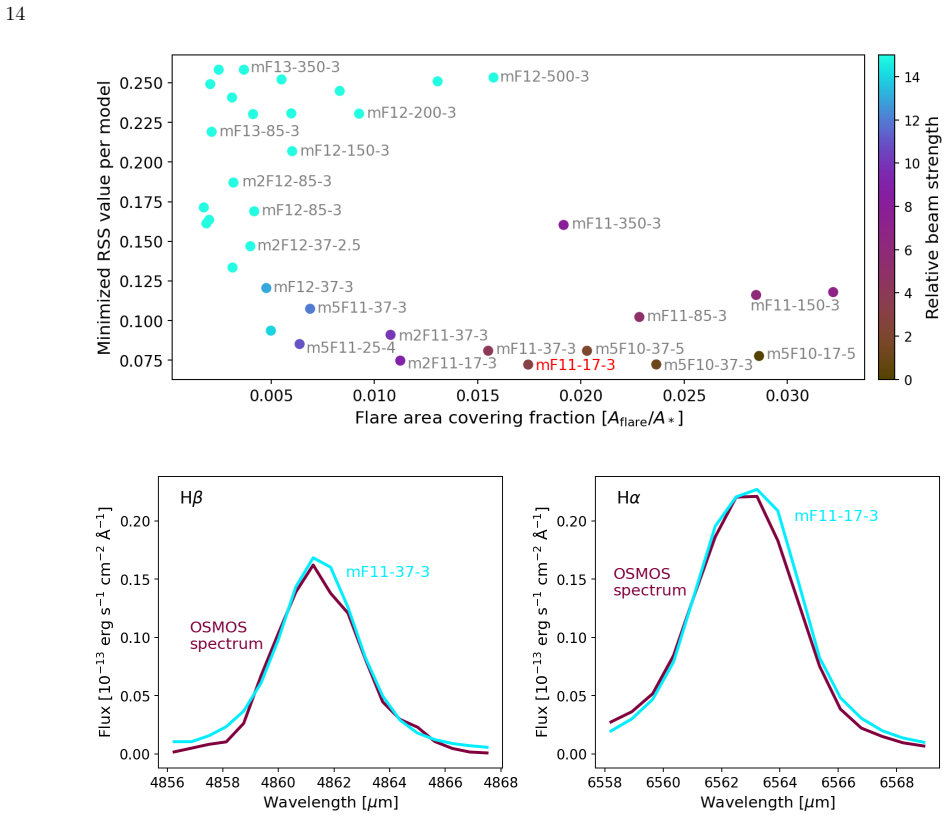
The load-bearing object is the fractional intrinsic variability parameter $\sigma_{\rm intrinsic} = \sqrt{\sigma_{\rm observed}^2 - \sigma_{\rm measurement}^2} / |{\rm Median(measurement)}|$, which takes the scatter of each star's measured equivalent widths, subtracts the reported per-measurement error in quadrature, and normalizes by the median line strength so that stars can be compared. The entire claim that higher-order lines are more intrinsically variable rests on this subtraction isolating astrophysical signal from noise. Two supporting tools carry the rest of the analysis: the $\chi$ factor, the ratio of the continuum flux near a line to the bolometric flux, converts equivalent widths into $L_{\rm line}/L_{\rm bol}$ without flux calibration (recomputed here for all four lines from model spectra), and the Balmer decrement relative to H$\beta$ tracks how relative line fluxes change during flares. For flare energetics, the paper uses RADYN, a one-dimensional non-local-thermodynamic-equilibrium radiative-hydrodynamic code, to forward-model the H$\alpha$ and H$\beta$ profiles of the strongest observed flare and identify the electron-beam parameters that best reproduce them.
What would settle it
Re-observe a subset of these stars with a fringing-free, high-signal-to-noise blue spectrograph at the same cadence and recompute $\sigma_{\rm intrinsic}$ for each line: if the median intrinsic variability of H$\delta$ is no longer larger than that of H$\alpha$ once the bluer lines are measured cleanly, the claimed gradient is a measurement artifact, whereas if the ordering H$\alpha$ < H$\beta$ < H$\gamma$ < H$\delta$ survives, the trend is astrophysical.
Extended reading notes
Core claim
On its own terms, this paper establishes three connected results. First, using a fractional intrinsic variability parameter that subtracts reported measurement errors in quadrature from the observed scatter of equivalent widths, it finds that higher-order Balmer lines are progressively more variable: the distribution of $\sigma_{\rm intrinsic}$ shifts toward larger values from H$\alpha$ to H$\beta$ to H$\gamma$ to H$\delta$ across the 61 stars with more than six spectra. Second, the Spearman correlation between $R_{\rm var}$ (the semi-amplitude of the TESS light curve) and $L_{\rm line}/L_{\rm bol}$ is weak and not statistically significant for H$\alpha$ ($\rho \approx 0.39$), H$\beta$ ($\rho \approx 0.43$), H$\gamma$ ($\rho \approx 0.49$), or H$\delta$ ($\rho \approx 0.36$), meaning photometric spot amplitude does not determine chromospheric line output. Third, for stars observed simultaneously in TESS and in Balmer lines, white-light flares and Balmer flares frequently do not coincide: TIC 415508270 shows strong, long Balmer flares during weak TESS activity, and Balmer-only flares appear in TIC 220044948. The paper also shows that the Balmer decrement (line flux relative to H$\beta$) becomes shallower during Balmer-detected flares and differs between flares on the same star, and that in TIC 283866910 the H$\alpha$ equivalent width is anti-correlated with TESS flux, indicating an active region darker than the photosphere.
Load-bearing premise
The result that higher-order lines are more intrinsically variable assumes that the reported measurement uncertainties fully capture every non-stellar source of scatter, so that subtracting them in quadrature leaves only true astrophysical variability; if errors are underestimated for the bluer, noisier lines, or if fringing and continuum misplacement add scatter the error bars do not include, the apparent H$\gamma$/H$\delta$ excess could be partly instrumental.
Editorial extensions
If this is right
- Because H$\gamma$ and H$\delta$ carry the largest intrinsic variability per epoch, they are the most sensitive chromospheric tracers of short-term changes on ~15–60 minute timescales.
- $R_{\rm var}$ is not a dependable predictor of an individual star's chromospheric activity: the amplitude-activity relation is weak for H$\alpha$ and statistically insignificant for all four lines, so photometric spot amplitude alone cannot rank activity levels.
- Single-band flare surveys are incomplete: Balmer-line flares occur without detectable TESS white-light flares, and some TESS flares have no Balmer counterpart, so white-light monitoring alone underestimates the flare budget of M dwarfs.
- The Balmer decrement shallows during Balmer-detected flares, consistent with higher-order lines brightening relative to lower-order lines as the latter become optically thick, and the decrement's shape differs between flares on the same star.
- The RADYN fits attribute the largest observed flare to a modest electron beam (flux ≈ $10^{11}$ erg s$^{-1}$ cm$^{-2}$, electron energies 10–40 keV), providing concrete inputs for modeling the photochemical irradiation of M dwarf exoplanet atmospheres.
Reading between the lines
- If the bluer lines are both more variable and noisier, a decisive test of the gradient would be repeat observations at higher signal-to-noise with fringing-free blue coverage: if the H$\gamma$/H$\delta$ excess over H$\alpha$ persists, the trend is astrophysical, and if it shrinks, part of it is instrumental (a test the authors' own caveat invites).
- If Balmer-only, sub-white-light flares are as common as this sample suggests, then white-light flare statistics—and the UV irradiation doses used in exoplanet habitability studies—systematically undercount low-energy flaring on M dwarfs.
- The anti-correlation of H$\alpha$ with TESS flux for TIC 283866910 suggests a general diagnostic: the phase relationship between chromospheric lines and broadband photometry can reveal whether active regions are darker or brighter than the photosphere, and applying the same F-test to a larger sample with full rotation-phase coverage could map spot contrasts across spectral types.
- The newly tabulated $\chi$ values for H$\beta$, H$\gamma$, and H$\delta$ let other groups convert published equivalent widths into line luminosities for stars down to 2300 K, which could homogenize activity measurements across surveys that use different lines.
Signed reviews
Editorial analysis
A structured set of objections, weighed in public.
Referee Report
Summary. This paper analyzes short-term (≥15 min) variability in Hα, Hβ, Hγ, and Hδ equivalent widths for 77 M dwarfs, combining new OSMOS/ModSpec spectroscopy with TESS photometry. It presents new χ factors converting equivalent widths to Balmer luminosities, updates the Rvar–activity relation, quantifies intrinsic line variability via Eq. (2), reports flare behavior in three stars, phase-folds observations of TIC 283866910, and fits a RADYN model to a flare. The main conclusions are that the Rvar–activity relation is weak for all four Balmer lines, that higher-order Balmer lines show progressively larger intrinsic short-term variability, and that TIC 283866910 shows an anti-correlation between Hα emission and TESS flux consistent with dark spots.
Significance. If the intrinsic-variability gradient is real, it is a useful observational constraint on chromospheric heating and flare microphysics in M dwarfs, and the published χ factors plus equivalent-width time series will be a valuable community resource. The paper is careful in describing data reduction, provides machine-readable tables and software links, and makes the observational products reproducible. However, the central gradient currently rests on an unvalidated quadrature subtraction of measurement errors and on qualitative fringing cuts; the dark-spot interpretation for TIC 283866910 likewise depends on an assumed phase zero-point. These load-bearing points need additional support before the headline claims can be regarded as established.
major comments (3)
- [§5.2, Eq. (2)] The central claim that higher-order Balmer lines are intrinsically more variable than Hα rests on subtracting σ_measurement^2 from σ_observed^2 in quadrature. The text itself notes, in the discussion of Figure 3, that the apparent variability 'also includes the impact of decreased signal-to-noise towards the bluer wavelengths,' and fringing is excluded only by a per-star visual cut. If the quoted EW uncertainties undercount continuum-placement errors, residual fringing, or flux-calibration systematics—which are not quantified anywhere in the paper—the inferred σ_intrinsic gradient could be an artifact. Because the sample shrinks from 61 stars for Hα to 16 for Hδ, the trend is also partially a statement about a changing subsample. I request robustness tests: (i) show that a systematic error floor added to σ_measurement does not erase the gradient; (ii) recompute the gradient on the subset of stars with all four lines measured; and (iii) quantify how σ_intrinsic changes when the Table 5 continuum regions are perturbed.
- [§5.2, Eq. (2) normalization] The denominator in Eq. (2) is the median EW, which is systematically smaller for Hγ and Hδ than for Hα. A fixed absolute systematic uncertainty in the EW therefore maps to a larger fractional σ_intrinsic for the higher-order lines even if the astrophysical variability is identical. This bias is separate from the completeness of σ_measurement. The paper should report absolute σ_intrinsic (in Å) alongside the fractional value, or demonstrate that the gradient survives when a constant absolute error of plausible size is added to all lines.
- [§5.4] The dark-spot conclusion for TIC 283866910 depends on the phase-folding zero-point 2458423.7150, which the authors state is an 'assumption' for the epoch used by Medina et al. (2022a). They also report that they were unable to reproduce the Medina et al. figure with that zero-point. A different zero-point can change the sign of the correlation between Hα EW and TESS flux, so the anti-correlation shown in Figure 9 is not yet robust. The authors' own new data yield F-test = 3 with p = 0.08, only marginal. I ask that the authors justify the zero-point from the data or demonstrate that the anti-correlation persists over a plausible range of zero-points.
minor comments (5)
- [Figure 4 caption] The caption says the intrinsic variability is 'calculated by Equation 5.2'; this cross-reference should be to Eq. (2).
- [§5.4 and Table 6] The text reports F-test = 33 for the re-analysis and F-test = 3 for the 2020 December data, but Table 6 lists F-test = 2.84 for the 2020 December row; the text and table should be reconciled.
- [Table 5] The line widths are described as visually selected for each star; please clarify whether the same integration windows are used for all epochs of a given star, since varying the window between epochs would inflate σ_observed independently of astrophysical variability.
- [§5.2] Please state how many stars were excluded by the fringing criterion for each Balmer line, so the reader can assess the impact of that qualitative cut on the reported sample sizes.
- [Table 1 heading] The table heading appears as 'T able 1.Parameters'; this formatting typo should be corrected.
Circularity Check
No significant circularity: central results are derived from independent spectra and TESS photometry, with acknowledged systematics as uncertainty rather than constructed equivalence.
full rationale
Walking the derivation chain: EW values are measured directly from the spectra; Rvar is computed from TESS light curves; the χ-factor conversion in Eq. 1 is calibrated against PHOENIX model spectra and is not fit to the variability result. The amplitude-activity correlations in §5.1 are Spearman tests on independently measured luminosities and amplitudes, with no parameter adjusted to force the null result. Equation (2) in §5.2 defines σ_intrinsic as the quadrature excess of observed EW scatter over quoted measurement errors; this is a variance decomposition, not a prediction re-fit from the conclusion, and the paper explicitly flags that the blue-side excess 'also includes the impact of decreased signal-to-noise towards the bluer wavelengths' (Figure 3 discussion, §5.2). That is an unquantified systematic uncertainty, which could affect the claimed higher-order Balmer variability trend, but it is not a circular step. The paper also warns in §4.2.1 that 'systematic uncertainties likely dominate the error budget,' again an uncertainty caveat rather than a constructed equivalence. The RADYN analysis fits beam parameters to observed Hα/Hβ profiles, but the comparison of the predicted TESS-band peak luminosity (1.4±0.1×10^28 erg/s) to independent TESS observations (1.7±0.5×10^28 erg/s) is an external benchmark, not a re-statement of the fitted input. Self-citations (G23, Duvvuri et al. 2023, Núñez et al. 2024) supply methods or prior supporting context; the present variability trend is computed from the present data and does not reduce to those citations. No step equates a prediction to its own input by construction, and no load-bearing claim is forced by a self-citation chain.
Assumptions & free parameters
free parameters (4)
- Flare covering fraction (RADYN fits) =
0.036 ± 0.002 (H-alpha-only, mF11-17-3); 0.024 ± 0.004 (m2F11-17-3); 0.009 ± 0.006 (H-beta-only, m2F11-37-3); 0.017 ±…
- Line width regions for EW integration =
Not specified; chosen visually per star
- Phase-folding zero-point for TIC 283866910 =
2458423.7150 (assumed)
- stella flare detection threshold =
0.5
assumptions (5)
- domain assumption Mann et al. (2015) empirical radius-mass and mass-magnitude relations are accurate for M dwarfs.
- domain assumption PHOENIX ACES model spectra correctly represent the continuum flux ratio used in the chi factor.
- domain assumption Measurement errors on EW are Gaussian and independent, so quadrature subtraction in Eq. 2 isolates intrinsic variability.
- domain assumption RADYN initial conditions (Teff about 3600 K, log g=4.75, 1e9 cm loop, 3e10 cm^-3 density) are representative of the flaring M dwarf.
- ad hoc to paper The assumed phase-folding zero-point for TIC 283866910 reproduces the rotation phase used in Medina et al. (2022a).
Cite this review
Pith. "Pith review of Short-Term Balmer Line Emission Variability in M Dwarfs." pith.science (2026). https://pith.science/paper/L4PFIVHT
@misc{pith2026250202568,
  author       = {Pith},
  title        = {Pith review of: Short-Term Balmer Line Emission Variability in M Dwarfs},
  year         = {2026},
  howpublished = {\url{https://pith.science/paper/L4PFIVHT}},
  note         = {Machine review of arXiv:2502.02568}
}
abstract
M Dwarfs make up the majority of stars, offering an avenue for discovering exoplanets due to their smaller sizes. However, their magnetic activity poses challenges for exoplanet detection, characterization, and planetary habitability. Understanding its magnetic activity, including surface starspots and internal dynamos, is crucial for exoplanet research. In this study, we present short-term variability in four Balmer emission lines \ha, \hb, \hg, and \hd\ for a sample of 77 M dwarfs of varying spectral types, and binarity. Stars were observed using the MDM Observatory's Ohio State Multi-Object Spectrograph on the 2.4m Telescope and the Modular Spectrograph on the 1.3 m Telescope. These data are combined with TESS photometry to explore the connection between spectroscopic and photometric variability. We observe sporadic short-term variability in Balmer lines for some stars, on timescale $\gtrsim$ 15-min, but much shorter than the stellar rotation period. We calculate periods for stars lacking those measurements, re-evaluated the relationship between amplitude (\rvar)-activity relation for the \ha \ line from \citet{garcia_soto_contemporaneous_2023}, and extended our analysis to the \hb, \hg \ and \hd \ lines, which indicates that the relation becomes increasingly dispersed for higher-order Balmer lines. This is consistent with increased intrinsic variability from lower to higher order lines. Additionally, we compute the Balmer decrement, using \hb \ as the fiducial, for stars where we could measure \hg \ and/or \hd. The Balmer decrement can show distinct patterns during white-light flares, with significant differences even for the same star. We also find evidence for dark spots on \object{TIC 283866910}.
Figures


Figures from the paper (6 more)


Reference graph
Works this paper leans on
-
[1]
, " * write output.state after.block = add.period write newline
ENTRY address archivePrefix author booktitle chapter doi edition editor eprint howpublished institution journal key month number organization pages publisher school series title misctitle type volume year version url label extra.label sort.label short.list INTEGERS output.state before.all mid.sentence after.sentence after.block FUNCTION init.state.consts ...
-
[2]
write newline
" write newline "" before.all 'output.state := FUNCTION format.url url empty "" new.block "" url * "" * if FUNCTION format.eprint eprint empty "" archivePrefix empty "" archivePrefix "arXiv" = new.block " " eprint * " " * new.block " " eprint * " " * if if if FUNCTION format.doi doi empty "" " " doi * " " * if FUNCTION format.pid doi empty eprint empty ur...
-
[3]
0(N# l H 8T Mmyo^*CʦZb L5#Sr* <8S GgMPX_ʧ s #] )9W ``!)c7ε|uJYK E fm4S Gׄ5tZ!| 14 ,
thebibliography [1] 20pt to REFERENCES 6pt =0pt -12pt 10pt plus 3pt =0pt =0pt =1pt plus 1pt =0pt =0pt -12pt =13pt plus 1pt =20pt =13pt plus 1pt \@M =10000 =-1.0em =0pt =0pt 0pt =0pt =1.0em @enumiv\@empty 10000 10000 `\.\@m \@noitemerr \@latex@warning Empty `thebibliography' environment \@ifnextchar \@reference \@latexerr Missing key on reference command E...
2021
-
[4]
2020, The Astronomical Journal, 159, 123, 10.3847/1538-3881/ab4fee
Agol, E., Luger, R., & Foreman-Mackey, D. 2020, The Astronomical Journal, 159, 123, 10.3847/1538-3881/ab4fee
-
[5]
2016, in SF2A -2016: Proceedings of the Annual meeting of the French Society of Astronomy and Astrophysics
Allard, F. 2016, in SF2A -2016: Proceedings of the Annual meeting of the French Society of Astronomy and Astrophysics . https://ui.adsabs.harvard.edu/abs/2016sf2a.conf..223A
2016
-
[6]
Allred, J. C., Hawley, S. L., Abbett, W. P., & Carlsson, M. 2006, The Astrophysical Journal, 644, 484, 10.1086/503314
-
[7]
Allred, J. C., Kowalski, A. F., & Carlsson, M. 2015, The Astrophysical Journal, 809, 104, 10.1088/0004-637X/809/1/104
-
[8]
2021, Zenodo, 10.5281/zenodo.4613887
Angus, R. 2021, Zenodo, 10.5281/zenodo.4613887
Show all 126 references
-
[9]
2023, agarciasoto18/starrotate: Alternate Starrotate for Paper , Zenodo, 10.5281/zenodo.7697238
Angus, R., & Garcia Soto, A. 2023, agarciasoto18/starrotate: Alternate Starrotate for Paper , Zenodo, 10.5281/zenodo.7697238
2023 doi
-
[10]
Aschwanden, M. J. 2004, The Astrophysical Journal, 608, 554, 10.1086/392494
2004 doi
-
[11]
P., Tollerud, E
Astropy Collaboration , Robitaille, T. P., Tollerud, E. J., et al. 2013, Astronomy and Astrophysics, 558, A33, 10.1051/0004-6361/201322068
2013 doi
-
[12]
M., Sipőcz, B
Astropy Collaboration , Price-Whelan, A. M., Sipőcz, B. M., et al. 2018, The Astronomical Journal, 156, 123, 10.3847/1538-3881/aabc4f
2018 doi
-
[13]
M., Lim, P
Astropy Collaboration , Price-Whelan, A. M., Lim, P. L., et al. 2022, The Astrophysical Journal, 935, 167, 10.3847/1538-4357/ac7c74
2022 doi
-
[14]
2020, KeplerGO /lightkurve: Lightkurve v1.11.0, Zenodo, 10.5281/zenodo.3836658
Barentsen, G., Hedges, C., Vinícius, Z., et al. 2020, KeplerGO /lightkurve: Lightkurve v1.11.0, Zenodo, 10.5281/zenodo.3836658
2020 doi
-
[15]
C., Ribas, I., et al
Baroch, D., Morales, J. C., Ribas, I., et al. 2021, Astron. Astrophys., 653, A49, 10.1051/0004-6361/202141031
2021 doi
-
[16]
M., Batalha, N., et al
Basri, G., Walkowicz, L. M., Batalha, N., et al. 2010, The Astrophysical Journal Letters, 713, L155, 10.1088/2041-8205/713/2/L155
2010 doi
-
[17]
2011, The Astronomical Journal, 141, 20, 10.1088/0004-6256/141/1/20
---. 2011, The Astronomical Journal, 141, 20, 10.1088/0004-6256/141/1/20
2011 doi
-
[18]
J., Hilton, E
Bell, K. J., Hilton, E. J., Davenport, J. R. A., et al. 2012, Publications of the Astronomical Society of the Pacific, 124, 14, 10.1086/664024
2012 doi
-
[19]
K., Irwin, J., Charbonneau, D., Burke, C
Berta, Z. K., Irwin, J., Charbonneau, D., Burke, C. J., & Falco, E. E. 2012, The Astronomical Journal, 144, 145, 10.1088/0004-6256/144/5/145
2012 doi
-
[20]
M., Newton, E
Boudreaux, E. M., Newton, E. R., Mondrik, N., Charbonneau, D., & Irwin, J. 2022, Astrophys. J., 929, 80, 10.3847/1538-4357/ac5cbf
2022 doi
-
[21]
J., et al
Cadieux, C., Doyon, R., MacDonald, R. J., et al. 2024, The Astrophysical Journal, 970, L2, 10.3847/2041-8213/ad5afa
2024 doi
-
[22]
C., Penn, M
Canfield, R. C., Penn, M. J., Wulser, J.-P., & Kiplinger, A. L. 1990, The Astrophysical Journal, 363, 318, 10.1086/169345
1990 doi
-
[23]
Carlsson, M., & Stein, R. F. 1992, The Astrophysical Journal, 397, L59, 10.1086/186544
1992 doi
-
[24]
1995, The Astrophysical Journal, 440, L29, 10.1086/187753
---. 1995, The Astrophysical Journal, 440, L29, 10.1086/187753
1995 doi
-
[25]
1997, The Astrophysical Journal, 481, 500, 10.1086/304043
---. 1997, The Astrophysical Journal, 481, 500, 10.1086/304043
1997 doi
-
[26]
2002, The Astrophysical Journal, 572, 626, 10.1086/340293
---. 2002, The Astrophysical Journal, 572, 626, 10.1086/340293
2002 doi
-
[27]
C., Oran, E
Cheng, C. C., Oran, E. S., Doschek, G. A., Boris, J. P., & Mariska, J. T. 1983, The Astrophysical Journal, 265, 1090, 10.1086/160751
1983 doi
-
[28]
Collier Cameron, A., & Robinson, R. D. 1989, Monthly Notices of the Royal Astronomical Society, 236, 57, 10.1093/mnras/236.1.57
1989 doi
-
[29]
E., & Mullan, D
Cram, L. E., & Mullan, D. J. 1979, The Astrophysical Journal, 234, 579, 10.1086/157532
1979 doi
-
[30]
M., Skrutskie, M
Cutri, R. M., Skrutskie, M. F., van Dyk, S., et al. 2003, VizieR Online Data Catalog, 2246, II/246. https://ui.adsabs.harvard.edu/abs/2003yCat.2246....0C
2003
-
[31]
Davenport, J. R. A. 2016, The Astrophysical Journal, 829, 23, 10.3847/0004-637X/829/1/23
2016 doi
- [32]
-
[33]
A., Irwin, J
Dittmann, J. A., Irwin, J. M., Charbonneau, D., & Berta-Thompson, Z. K. 2014, The Astrophysical Journal, 784, 156, 10.1088/0004-637X/784/2/156
2014 doi
-
[34]
A., Cheng, C
Doschek, G. A., Cheng, C. C., Oran, E. S., Boris, J. P., & Mariska, J. T. 1983, The Astrophysical Journal, 265, 1103, 10.1086/160752
1983 doi
-
[35]
T., Agüeros, M
Douglas, S. T., Agüeros, M. A., Covey, K. R., et al. 2014, ApJ, 795, 161, 10.1088/0004-637X/795/2/161
2014 doi
-
[36]
G., Butler, C
Doyle, J. G., Butler, C. J., Bryne, P. B., & van den Oord, G. H. J. 1988, Astronomy and Astrophysics, 193, 229. https://ui.adsabs.harvard.edu/abs/1988A&A...193..229D
1988
-
[37]
M., Pineda, J
Duvvuri, G. M., Pineda, J. S., Berta-Thompson, Z. K., France, K., & Youngblood, A. 2023, The Astronomical Journal, 165, 12, 10.3847/1538-3881/ac9b49
2023 doi
-
[38]
2019, astropy/specutils: v0.6, Zenodo, 10.5281/zenodo.3450769
Earl, N., Jones, C., Kerzendorf, W., et al. 2019, astropy/specutils: v0.6, Zenodo, 10.5281/zenodo.3450769
2019 doi
-
[39]
2020 a , The Journal of Open Source Software, 5, 2347, 10.21105/joss.02347
Feinstein, A., Montet, B., & Ansdell, M. 2020 a , The Journal of Open Source Software, 5, 2347, 10.21105/joss.02347
2020 doi
-
[40]
D., Montet, B
Feinstein, A. D., Montet, B. T., Ansdell, M., et al. 2020 b , The Astronomical Journal, 160, 219, 10.3847/1538-3881/abac0a
2020 doi
-
[41]
2017, Astrophysics Source Code Library, ascl:1709.008
Foreman-Mackey, D., Agol, E., Ambikasaran, S., & Angus, R. 2017, Astrophysics Source Code Library, ascl:1709.008. http://adsabs.harvard.edu/abs/2017ascl.soft09008F
2017
-
[42]
2020 a , exoplanet-dev/exoplanet: exoplanet v0.3.2, Zenodo, 10.5281/zenodo.3785072
Foreman-Mackey, D., Luger, R., Czekala, I., et al. 2020 a , exoplanet-dev/exoplanet: exoplanet v0.3.2, Zenodo, 10.5281/zenodo.3785072
2020 doi
-
[43]
2020 b , dfm/celerite: celerite v0.4.0, Zenodo, 10.5281/zenodo.3934421
Foreman-Mackey, D., Agol, E., Angus, R., et al. 2020 b , dfm/celerite: celerite v0.4.0, Zenodo, 10.5281/zenodo.3934421
2020 doi
-
[44]
2018, Monthly Notices of the Royal Astronomical Society, 475, 1960, 10.1093/mnras/stx3246
Fouqué, P., Moutou, C., Malo, L., et al. 2018, Monthly Notices of the Royal Astronomical Society, 475, 1960, 10.1093/mnras/stx3246
2018 doi
-
[45]
Gaia Collaboration , Vallenari, A., Brown, A. G. A., et al. 2023, Astronomy and Astrophysics, 674, A1, 10.1051/0004-6361/202243940
2023 doi
-
[46]
Gaia Collaboration, G., Prusti, T., de Bruijne, J. H. J., et al. 2016, Astronomy and Astrophysics, 595, A1, 10.1051/0004-6361/201629272
2016 doi
-
[47]
Gaia Collaboration, G., Brown, A. G. A., Vallenari, A., et al. 2018, Astronomy and Astrophysics, 616, A1, 10.1051/0004-6361/201833051
2018 doi
-
[48]
Gaia Collaboration, G., Vallenari, A., Brown, A. G. A., et al. 2022, arXiv e-prints. https://ui.adsabs.harvard.edu/abs/2022arXiv220800211G
2022
-
[49]
R., Douglas, S
García Soto, A., Newton, E. R., Douglas, S. T., Burrows, A., & Kesseli, A. Y. 2023, The Astronomical Journal, 165, 192, 10.3847/1538-3881/acc2ba
2023 doi
-
[50]
S., Africano, J
Giampapa, M. S., Africano, J. L., Klimke, A., et al. 1982, The Astrophysical Journal, 252, L39, 10.1086/183715
1982 doi
-
[51]
E., Reid, I
Gizis, J. E., Reid, I. N., & Hawley, S. L. 2002, The Astronomical Journal, 123, 3356, 10.1086/340465
2002 doi
-
[52]
2014, General- Scripts \_v1.0, Zenodo, 10.5281/zenodo.10013
Gullikson, K. 2014, General- Scripts \_v1.0, Zenodo, 10.5281/zenodo.10013
2014 doi
-
[53]
J., Jao, W.-C., Subasavage, J
Henry, T. J., Jao, W.-C., Subasavage, J. P., et al. 2006, The Astronomical Journal, 132, 2360, 10.1086/508233
2006 doi
-
[54]
1986, Publications of the Astronomical Society of the Pacific, 98, 609, 10.1086/131801
Horne, K. 1986, Publications of the Astronomical Society of the Pacific, 98, 609, 10.1086/131801
1986 doi
-
[55]
R., & Doyle, J
Houdebine, E. R., & Doyle, J. G. 1994, Astronomy and Astrophysics, 289, 185. https://ui.adsabs.harvard.edu/abs/1994A&A...289..185H
1994
-
[56]
S., Corbett, H., Law, N
Howard, W. S., Corbett, H., Law, N. M., et al. 2019, The Astrophysical Journal, 881, 9, 10.3847/1538-4357/ab2767
2019 doi
-
[57]
S., Kowalski, A
Howard, W. S., Kowalski, A. F., Flagg, L., et al. 2023, The Astrophysical Journal, 959, 64, 10.3847/1538-4357/acfe75
2023 doi
-
[58]
O., Wende-von Berg, S., Dreizler, S., et al
Husser, T. O., Wende-von Berg, S., Dreizler, S., et al. 2013, Astronomy and Astrophysics, 553, A6, 10.1051/0004-6361/201219058
2013 doi
-
[59]
D., Albelo-Corchado, M
Kazachenko, M. D., Albelo-Corchado, M. F., Tamburri, C. A., & Welsch, B. T. 2022, Solar Physics, 297, 59, 10.1007/s11207-022-01987-6
2022 doi
-
[60]
Y., Muirhead, P
Kesseli, A. Y., Muirhead, P. S., Mann, A. W., & Mace, G. 2018, The Astronomical Journal, 155, 225, 10.3847/1538-3881/aabccb
2018 doi
-
[61]
L., Ribas, I., Lammer, H., et al
Khodachenko, M. L., Ribas, I., Lammer, H., et al. 2007, Astrobiology, 7, 167, 10.1089/ast.2006.0127
2007
-
[62]
F., Allred, J
Kowalski, A. F., Allred, J. C., & Carlsson, M. 2024, The Astrophysical Journal, 969, 121, 10.3847/1538-4357/ad4148
2024 doi
-
[63]
F., Hawley, S
Kowalski, A. F., Hawley, S. L., Holtzman, J. A., Wisniewski, J. P., & Hilton, E. J. 2010, The Astrophysical Journal, 714, L98, 10.1088/2041-8205/714/1/L98
2010 doi
-
[64]
F., Hawley, S
Kowalski, A. F., Hawley, S. L., Wisniewski, J. P., et al. 2013, The Astrophysical Journal Supplement Series, 207, 15, 10.1088/0067-0049/207/1/15
2013 doi
-
[65]
F., Allred, J
Kowalski, A. F., Allred, J. C., Uitenbroek, H., et al. 2017, The Astrophysical Journal, 837, 125, 10.3847/1538-4357/aa603e
2017 doi
-
[66]
A., Berger, E., Knapp, G
Kruse, E. A., Berger, E., Knapp, G. R., et al. 2010, The Astrophysical Journal, 722, 1352, 10.1088/0004-637X/722/2/1352
2010 doi
-
[67]
S., Srivastava, M
Kumar, V., Rajpurohit, A. S., Srivastava, M. K., Fernández-Trincado, J. G., & Queiroz, A. B. A. 2023, Monthly Notices of the Royal Astronomical Society, 10.1093/mnras/stad2222
2023 doi
-
[68]
Lammer, H., Lichtenegger, H. I. M., Kulikov, Y. N., et al. 2007, Astrobiology, 7, 185, 10.1089/ast.2006.0128
2007
-
[69]
Lee, K.-G., Berger, E., & Knapp, G. R. 2010, The Astrophysical Journal, 708, 1482, 10.1088/0004-637X/708/2/1482
2010 doi
-
[70]
2014, Monthly Notices of the Royal Astronomical Society, 443, 898, 10.1093/mnras/stu1161
Leitzinger, M., Odert, P., Greimel, R., et al. 2014, Monthly Notices of the Royal Astronomical Society, 443, 898, 10.1093/mnras/stu1161
2014 doi
-
[71]
Lightkurve Collaboration , Cardoso, J. V. d. M., Hedges, C., et al. 2018, Astrophysics Source Code Library, ascl:1812.013. http://adsabs.harvard.edu/abs/2018ascl.soft12013L
2018
-
[72]
2018, Astronomy & Astrophysics, 616, A2, 10.1051/0004-6361/201832727
Lindegren, L., Hernández, J., Bombrun, A., et al. 2018, Astronomy & Astrophysics, 616, A2, 10.1051/0004-6361/201832727
2018 doi
-
[73]
A., Hernández, J., et al
Lindegren, L., Klioner, S. A., Hernández, J., et al. 2021, Astronomy and Astrophysics, 649, A2, 10.1051/0004-6361/202039709
2021 doi
-
[74]
A., Weinberger, A
MacGregor, M. A., Weinberger, A. J., Loyd, R. O. P., et al. 2021, The Astrophysical Journal, 911, L25, 10.3847/2041-8213/abf14c
2021 doi
-
[75]
R., et al
Magaudda, E., Stelzer, B., Covey, K. R., et al. 2020, Astronomy & Astrophysics, 638, A20, 10.1051/0004-6361/201937408
2020 doi
-
[76]
G., et al
Mallonn, M., Herrero, E., Juvan, I. G., et al. 2018, Astronomy and Astrophysics, 614, A35, 10.1051/0004-6361/201732300
2018 doi
-
[77]
E., & Hillenbrand, L
Mamajek, E. E., & Hillenbrand, L. A. 2008, The Astrophysical Journal, 687, 1264, 10.1086/591785
2008 doi
-
[78]
W., Feiden, G
Mann, A. W., Feiden, G. A., Gaidos, E., Boyajian, T., & Braun, K. v. 2015, The Astrophysical Journal, 804, 64, 10.1088/0004-637X/804/1/64
2015 doi
-
[79]
W., Dupuy, T., Kraus, A
Mann, A. W., Dupuy, T., Kraus, A. L., et al. 2019, The Astrophysical Journal, 871, 63, 10.3847/1538-4357/aaf3bc
2019 doi
-
[80]
A., et al
Martini, P., Stoll, R., Derwent, M. A., et al. 2011, Publications of the Astronomical Society of the Pacific, 123, 187, 10.1086/658357
2011 doi
-
[81]
2013, Monthly Notices of the Royal Astronomical Society, 432, 1203, 10.1093/mnras/stt536
McQuillan, A., Aigrain, S., & Mazeh, T. 2013, Monthly Notices of the Royal Astronomical Society, 432, 1203, 10.1093/mnras/stt536
2013 doi
-
[82]
2012, Astronomy and Astrophysics, 539, A137, 10.1051/0004-6361/201016148
McQuillan, A., Aigrain, S., & Roberts, S. 2012, Astronomy and Astrophysics, 539, A137, 10.1051/0004-6361/201016148
2012 doi
-
[83]
A., Charbonneau, D., Winters, J
Medina, A. A., Charbonneau, D., Winters, J. G., Irwin, J., & Mink, J. 2022 a , The Astrophysical Journal, 928, 185, 10.3847/1538-4357/ac5738
2022 doi
-
[84]
A., Winters, J
Medina, A. A., Winters, J. G., Irwin, J. M., & Charbonneau, D. 2022 b , The Astrophysical Journal, 935, 104, 10.3847/1538-4357/ac77f9
2022 doi
-
[85]
Mekkaden, M. V. 1985, Astrophysics and Space Science, 117, 381, 10.1007/BF00650163
1985 doi
-
[86]
E., Stevenson, K
Moran, S. E., Stevenson, K. B., Sing, D. K., et al. 2023, The Astrophysical Journal, 948, L11, 10.3847/2041-8213/accb9c
2023 doi
-
[87]
F., Forveille, T., et al
Morin, J., Donati, J. F., Forveille, T., et al. 2008, Mon. Not. R. Astron. Soc., 384, 77, 10.1111/j.1365-2966.2007.12709.x
2008
-
[88]
W., Mutabazi, T., & Jurua, E
Muheki, P., Guenther, E. W., Mutabazi, T., & Jurua, E. 2020, Astronomy and Astrophysics, 637, A13, 10.1051/0004-6361/201936904
2020 doi
-
[89]
2020, Publications of the Astronomical Society of Japan, 72, 68, 10.1093/pasj/psaa051
Namekata, K., Maehara, H., Sasaki, R., et al. 2020, Publications of the Astronomical Society of Japan, 72, 68, 10.1093/pasj/psaa051
2020 doi
-
[90]
1999, Astrophysics Source Code Library, ascl:9911.002
National Optical Astronomy Observatories . 1999, Astrophysics Source Code Library, ascl:9911.002. http://adsabs.harvard.edu/abs/1999ascl.soft11002N
1999
-
[91]
Neupert, W. M. 1968, The Astrophysical Journal, 153, L59, 10.1086/180220
1968 doi
-
[92]
R., Irwin, J., Charbonneau, D., et al
Newton, E. R., Irwin, J., Charbonneau, D., et al. 2017, The Astrophysical Journal, 834, 85, 10.3847/1538-4357/834/1/85
2017 doi
-
[93]
R., Irwin, J., Charbonneau, D., Berta-Thompson, Z
Newton, E. R., Irwin, J., Charbonneau, D., Berta-Thompson, Z. K., & Dittmann, J. A. 2016, The Astrophysical Journal, 821, L19, 10.3847/2041-8205/821/1/L19
2016 doi
-
[94]
2015, Publications of the Astronomical Society of Japan, 67, 32, 10.1093/pasj/psv001
Notsu, Y., Honda, S., Maehara, H., et al. 2015, Publications of the Astronomical Society of Japan, 67, 32, 10.1093/pasj/psv001
2015 doi
-
[95]
A., Curtis, J
Núñez, A., Agüeros, M. A., Curtis, J. L., et al. 2024, The Astrophysical Journal, 962, 12, 10.3847/1538-4357/ad117e
2024 doi
-
[96]
Oliphant, T. E. 2006, A guide to NumPy , Vol. 1 (Trelgol Publishing USA)
2006
-
[97]
J., & Mamajek, E
Pecaut, M. J., & Mamajek, E. E. 2013, The Astrophysical Journal Supplement Series, 208, 9, 10.1088/0067-0049/208/1/9
2013 doi
-
[98]
1993, Astronomy and Astrophysics, 278, 179
Peres, G., Ventura, R., Pagano, I., & Rodono, M. 1993, Astronomy and Astrophysics, 278, 179. https://ui.adsabs.harvard.edu/abs/1993A&A...278..179P
1993
-
[99]
2024, Promise and Peril : Stellar Contamination and Strict Limits on the Atmosphere Composition of TRAPPIST -1c from JWST NIRISS Transmission Spectra , 10.48550/arXiv.2409.19333
Radica, M., Piaulet-Ghorayeb, C., Taylor, J., et al. 2024, Promise and Peril : Stellar Contamination and Strict Limits on the Atmosphere Composition of TRAPPIST -1c from JWST NIRISS Transmission Spectra , 10.48550/arXiv.2409.19333
-
[100]
2009, The Astrophysical Journal, 692, 538, 10.1088/0004-637X/692/1/538
Reiners, A., Basri, G., & Browning, M. 2009, The Astrophysical Journal, 692, 538, 10.1088/0004-637X/692/1/538
2009 doi
-
[101]
A., et al
Reiners, A., Zechmeister, M., Caballero, J. A., et al. 2018, Astronomy and Astrophysics, 612, A49, 10.1051/0004-6361/201732054
2018 doi
-
[102]
J., et al
Reiners, A., Shulyak, D., Käpylä, P. J., et al. 2022, Astron. Astrophys., 662, A41, 10.1051/0004-6361/202243251
2022 doi
-
[103]
R., Winn, J
Ricker, G. R., Winn, J. N., Vanderspek, R., et al. 2015, Journal of Astronomical Telescopes, Instruments, and Systems, 1, 014003, 10.1117/1.JATIS.1.1.014003
2015 doi
-
[104]
Rodono, M., Pucillo, M., Sedmak, G., & de Biase, G. A. 1979, Astronomy and Astrophysics, 76, 242. https://ui.adsabs.harvard.edu/abs/1979A&A....76..242R
1979
-
[105]
V., & Fonnesbeck, C
Salvatier, J., Wiecki, T. V., & Fonnesbeck, C. 2016, PeerJ Computer Science, 2, e55, 10.7717/peerj-cs.55
2016 doi
-
[106]
2012, Astrophysics Source Code Library, ascl:1207.011
Science Software Branch at STScI . 2012, Astrophysics Source Code Library, ascl:1207.011. https://ui.adsabs.harvard.edu/abs/2012ascl.soft07011S
2012
-
[107]
M., Meadows, V., Kasting, J., & Hawley, S
Segura, A., Walkowicz, L. M., Meadows, V., Kasting, J., & Hawley, S. 2010, Astrobiology, 10, 751, 10.1089/ast.2009.0376
2010
-
[108]
L., et al
Shan, Y., Revilla, D., Skrzypinski, S. L., et al. 2024, Astronomy and Astrophysics, 684, A9, 10.1051/0004-6361/202346794
2024 doi
-
[109]
G., Oelkers, R
Stassun, K. G., Oelkers, R. J., Pepper, J., et al. 2018, The Astronomical Journal, 156, 102, 10.3847/1538-3881/aad050
2018 doi
-
[110]
1986, IN: Instrumentation in astronomy VI; Proceedings of the Meeting, Tucson, AZ, Mar
Tody, D. 1986, IN: Instrumentation in astronomy VI; Proceedings of the Meeting, Tucson, AZ, Mar. 4-8, 1986. Part 2 (A87-36376 15-35). Bellingham, WA, Society of Photo-Optical Instrumentation Engineers, 1986, p. 733., 627, 733, 10.1117/12.968154
1986 doi
-
[111]
1993, Astronomical Data Analysis Software and Systems II, A.S.P
---. 1993, Astronomical Data Analysis Software and Systems II, A.S.P. Conference Series, Vol. 52, 1993, R. J. Hanisch, R. J. V. Brissenden, and Jeannette Barnes, eds., p. 173., 52, 173. http://adsabs.harvard.edu/abs/1993ASPC...52..173T
1993
-
[112]
E., & Bergeron, P
Tremblay, P. E., & Bergeron, P. 2009, The Astrophysical Journal, 696, 1755, 10.1088/0004-637X/696/2/1755
2009 doi
- [113]
-
[114]
Vaughan, A. H. 1980, Publications of the Astronomical Society of the Pacific, 92, 392, 10.1086/130684
1980 doi
-
[115]
A., Gregory, S
Vidotto, A. A., Gregory, S. G., Jardine, M., et al. 2014, Monthly Notices of the Royal Astronomical Society, 441, 2361, 10.1093/mnras/stu728
2014 doi
-
[116]
E., et al
Virtanen, P., Gommers, R., Oliphant, T. E., et al. 2020, Nature Methods, 17, 261, 10.1038/s41592-019-0686-2
2020 doi
-
[117]
M., & Hawley, S
Walkowicz, L. M., & Hawley, S. L. 2009, The Astronomical Journal, 137, 3297, 10.1088/0004-6256/137/2/3297
2009 doi
-
[118]
M., Hawley, S
Walkowicz, L. M., Hawley, S. L., & West, A. A. 2004, Publications of the Astronomical Society of the Pacific, 116, 1105, 10.1086/426792
2004 doi
-
[119]
M., Johns-Krull, C
Walkowicz, L. M., Johns-Krull, C. M., & Hawley, S. L. 2008, The Astrophysical Journal, 677, 593, 10.1086/526421
2008 doi
-
[120]
2017, The Astrophysical Journal, 850, 204, 10.3847/1538-4357/aa9659
Watanabe, K., Kitagawa, J., & Masuda, S. 2017, The Astrophysical Journal, 850, 204, 10.3847/1538-4357/aa9659
2017 doi
-
[121]
A., & Hawley, S
West, A. A., & Hawley, S. L. 2008, Publications of the Astronomical Society of the Pacific, 120, 1161, 10.1086/593024
2008 doi
-
[122]
A., Hawley, S
West, A. A., Hawley, S. L., Walkowicz, L. M., et al. 2004, The Astronomical Journal, 128, 426, 10.1086/421364
2004 doi
-
[123]
J., Froning, C
Wilson, D. J., Froning, C. S., Duvvuri, G. M., et al. 2021, The Astrophysical Journal, 911, 18, 10.3847/1538-4357/abe771
2021 doi
-
[124]
Woolley, R. V. D. R. 1936, Monthly Notices of the Royal Astronomical Society, 96, 515, 10.1093/mnras/96.5.515
1936 doi
-
[125]
J., Newton, E
Wright, N. J., Newton, E. R., Williams, P. K. G., Drake, J. J., & Yadav, R. K. 2018, Monthly Notices of the Royal Astronomical Society, 479, 2351, 10.1093/mnras/sty1670
2018 doi
-
[126]
2022, Publications of the Astronomical Society of Japan, 74, 1295, 10.1093/pasj/psac069
Yamashita, M., Itoh, Y., & Oasa, Y. 2022, Publications of the Astronomical Society of Japan, 74, 1295, 10.1093/pasj/psac069
2022 doi
Reviewed August 9, 2026 · model on record in the stance chip above.
Discussion (0). Continue with ORCID to comment.