REVIEW 5 major objections 5 minor 31 references
Dexterous Safe Control for Humanoids in Cluttered Environments via Projected Safe Set Algorithm
T0 review · 5 major / 5 minor · reviewed 2026-08-09 · deepseek-v4-flash
Pith's one-line read Projected Safe Set Algorithm (p-SSA) splits feasibility projection from task tracking, so a humanoid's multi-constraint safety QP is always feasible and needs no parameter tuning.
desk verdict Deserves peer review: the two-phase slack-projection idea is clean and the problem setting is real, but the paper overstates a surrogate-objective result as a safety guarantee. read the letter →
The pith
A machine-rendered reading of the paper's core claim, the machinery that carries it, and where it could break.
The reading
What carries the argument
The central object is the projection of an infeasible safe-control constraint set onto the nearest feasible set, measured by the $p$-norm of total relaxation. Phase I (12) minimizes that relaxation, choosing slack variables $s^*$; Phase II (13) then solves the original tracking objective $\|u - u_{\text{ref}}\|^2_{2,Q}$ subject to the safety constraints relaxed by exactly $s^*$. Because $s^*$ is feasible for (12), (13) is guaranteed to have a solution. The decoupling removes the trade-off between safety and performance that plagues weighted slack regularization, which is what makes p-SSA parameter-free.
What would settle it
Run p-SSA on a humanoid arm with a deliberately degraded velocity tracker (e.g., 200 ms latency or 30% gain error) inside a narrow cavity, while recording actual collisions; if the QP remains feasible but the robot still hits the obstacle, the accuracy assumption is refuted. Equivalently, construct a two-plane example where the minimal-slack projection moves the end-effector parallel to the planes while the true distance still decreases, showing that minimal constraint slack is not minimal physical violation.
Extended reading notes
Core claim
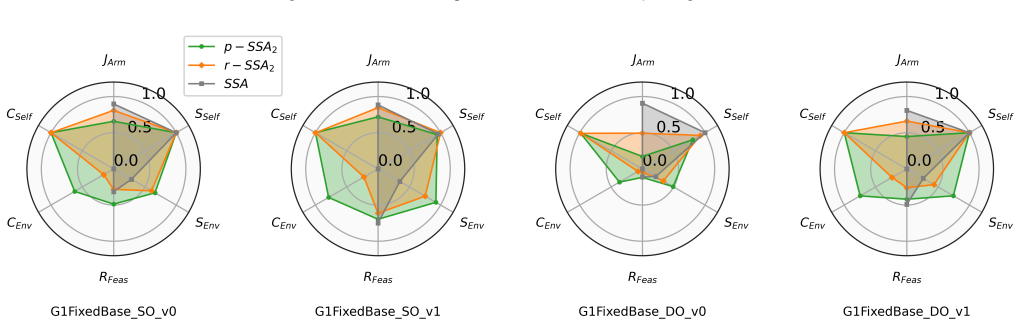
The paper's central claim is that p-SSA always operates within the maximal feasible region indicated by the given constraint set while being totally tuning-free, and that it achieves top performance across various task settings without parameter tuning. Concretely, the two-stage procedure—minimize the slack $s$ in (12), then solve the tracking QP with the optimal $s^*$ in (13)—guarantees that the second QP is feasible by construction. In experiments p-SSA yields lower control-constraint violation and distance-safety violation scores than naive SSA and r-SSA on all eight simulated dexterous safety tasks, and it prevents collisions in a real Unitree G1 teleoperation test where the operator deliberately makes risky motions.
Load-bearing premise
The load-bearing premise is that the robot's low-level controller tracks commanded joint velocities accurately enough that the first-order model $\dot{x}=u$ matches the real robot, so the linearized safety constraints describe the true evolution of the safety index.
Editorial extensions
If this is right
- p-SSA can be deployed directly on high-dimensional humanoid models with hundreds of collision-avoidance constraints without per-task tuning.
- When a collision is physically inevitable, p-SSA provides a principled minimal-violation response instead of passing through an arbitrary reference.
- The same projection idea extends to any energy-function safe controller that yields a control-affine QP, including CBF-based filters.
- Joint-space velocity commands computed by p-SSA can act as a safety filter for teleoperation interfaces, allowing operators to issue unsafe goals while the robot remains safe.
- The guarantee that the second QP is feasible holds even under dynamic obstacles, since feasibility comes from the projection, not from the obstacle distribution.
Reading between the lines
- We infer that the slack amount $s^*$ solved in Phase I can serve as an online indicator of how close the current situation is to local infeasibility, something the paper does not exploit.
- The paper sets the slack weighting to identity and leaves smart balancing to future work; an obvious test is whether distance- or torque-aware weights push p-SSA's Pareto frontier further.
- Because the projection step only needs the constraint set, the same Phase-I/Phase-II split could be applied to CBF-based multi-constraint QPs, which face the same infeasibility problem.
- The linearization in the safety constraints means the 'minimal violation' is minimal in constraint space, not necessarily in physical distance; we infer this gap would grow under fast dynamics and imperfect tracking.
Editorial analysis
A structured set of objections, weighed in public.
Referee Report
Summary. The paper addresses dexterous safe control for humanoid robots in cluttered environments, where a multi-constraint safe control QP with hundreds of collision-avoidance constraints frequently becomes infeasible. The authors propose r-SSA, which adds weighted slack variables to relax the safety constraints, and p-SSA, a two-phase method that first computes a minimal slack vector to render the constraints feasible and then solves a tracking QP with that slack fixed, guaranteeing feasibility of the second QP by construction. The paper reports simulation results on eight tasks with a Unitree G1 model and a real hardware teleoperation demonstration, claiming minimal safety violations, zero parameter tuning, and top performance relative to baselines.
Significance. The Phase I / Phase II decoupling is a clean idea with practical value: it avoids the safety-performance weight tuning of r-SSA and guarantees feasibility of the tracking QP whenever the projection step is solved, which is nontrivial for high-dimensional multi-constraint problems. The real-robot demonstration is also a useful step toward deployable dexterous safety. However, the headline claims are not fully supported. The 'minimal safety violations' assertion concerns a slack variable in a linearized derivative constraint, not the distance-based safety specification, and the reported advantage is partly built into the evaluation metric. The velocity-tracking assumption underlying the hardware experiments is not validated. With a corrected evaluation and a more careful statement of what is minimized, the contribution would be solid.
major comments (5)
- [Section V-D, Eq. (15); Section IV-B, Eq. (12)] The 'minimal safety violations' claim is not supported by the evidence as presented. In Eq. (15), the C score for p-SSA uses s_i,t from the Phase I solution of (12), but the executed control is the Phase II solution of (13); the realized control-constraint slack of that control, max(dot-phi_i(x_t,u_t)+eta_i,0), is generally different from the Phase I slack, so the reported C advantage is partly an artifact of the projection rather than of the actual behavior. More importantly, the Phase I objective is a norm of the slack in the linearized derivative constraint (12b), not a measure of distance-based safety violation; no theorem or experiment connects this slack to the S metric in (16). Section VI explicitly concedes that once relaxation is active, no safety guarantee holds. The abstract and Section IV-B should either rephrase the claim to 'minimal violation of the linearized safety constraints' or provide a concrete link, such as a bound S <= F(||s||) for the first-order model.
- [Section V-A and V-G] The safety constraints are derived from the first-order model x_dot = u, with the text stating 'assuming an accurate velocity tracker at the downstream.' In the real Unitree G1 experiment, no tracking-error measurements or robustness margins are reported. If the low-level velocity tracker is imperfect, the inequality (9b) does not describe the actual evolution of the safety index, and a feasible p-SSA solution can still permit collisions. The paper should either quantify the tracking error on the real robot, add a margin to dmin to absorb it, or explicitly limit the hardware claim to an empirical demonstration rather than a safety guarantee.
- [Section IV-B and abstract] The claim of being 'totally tuning-free' / 'zero parameter tuning' is overstated. p-SSA still requires choosing eta, the safety margins dmin,env and dmin,self, the norm order p, and Qpssa_s (set to identity in the paper). What is tuning-free is the relative weight between the tracking objective and the slack penalty, compared with r-SSA's Qrssa_s. Please rephrase to 'without tuning the safety-performance trade-off weight'.
- [Section IV-B, Eq. (12)] The Phase I optimization is written as minimizing over s only, while u appears in the constraints (12b)-(12c). As written, u is not a decision variable and the problem is not well-posed. To guarantee the Phase II feasibility argument, Phase I must be understood as an optimization over (u,s), or at least as an existential projection over u. Please correct the notation and specify the metric with respect to which the constraint set is projected.
- [Section V-E and V-F] The headline comparisons are based on a single 2000-step trajectory per task, with no multiple seeds, error bars, or statistical significance tests. Since the dynamic-obstacle tasks use Brownian motion, run-to-run variance is non-negligible, and the Pareto-front plots in Figures 7 and 8 represent point estimates. The claim that p-SSA 'automatically secures the sweet spot' on the Pareto fronts needs at least a few seeds per configuration or a statistical comparison.
minor comments (5)
- [Abstract] Typo: 'sprase' should be 'sparse'.
- [Figure 9 caption] Typo: 'simluated' should be 'simulated' and 'teleopration' should be 'teleoperation'.
- [Section V-E-a] The statement 'the naive SSA essentially ignores the obstacles if the QP is infeasible' is imprecise; SSA actually passes uref unmodified when the QP is infeasible, which may or may not avoid obstacles. Consider rewording.
- [Section V-D, Eq. (15)] The C and S metrics are undefined (0/0) when there are no infeasible steps or no distance violations, respectively. Please state the convention used in the plots for these cases.
- [Section IX-C, Figure 10] The caption states that p-SSA 'consistently bounds phi below zero,' but the text acknowledges a tolerance due to discretization. Please quantify this tolerance and the conditions under which it is bounded.
Circularity Check
One metric-level circularity: the C score is computed from the same slack variables p-SSA minimizes, but the central safety claim is independently supported by the S metric and hardware demo.
-
self definitional
[Section V-D, Eq. (15); Section IV-B, Eq. (12)]
"C: control constraint satisfaction score, given by C = Σ_t I(s_t > 0) exp(−s_t^2/0.2) / Σ_t I(s_t > 0) (15) ... For p-SSA, s_{i,t} is the solution to (12)."
Phase I of p-SSA, Eq. (12a), minimizes (1/p)||s||_p^p, and Eq. (15) is a decreasing, exponentiated function of the total slack s_t = Σ_i s_{i,t}; for p-SSA, the s values entering Eq. (15) are exactly the optimal s* produced by Eq. (12). Hence p-SSA's high C score is guaranteed by construction: it is the same quantity minimized in Phase I. Consequently, the statement 'p-SSA guarantees to operate with minimal safety violations thanks to Phase I' is only definitionally true for the slack surrogate, not for distance-based safety. The paper's independent S metric (Eq. 16) measures actual margin invasion and does not reduce to the p-SSA objective, so this is a metric-level tautology rather than a full collapse of the central claim.
full rationale
The derivation chain is otherwise self-contained. The p-SSA feasibility guarantee is constructive: Phase I finds any feasible slack s*, which is then fixed in Phase II, so Eq. (13) is feasible by construction; no parameter is fitted to the evaluation data and then reported as a prediction. No load-bearing self-citation or imported uniqueness theorem was found; self-citations are to prior SSA/SIS work and are not used to justify the core projection argument. The only self-referential element is the C metric, which is definitionally aligned with the p-SSA objective. This does not invalidate the central contribution because the paper also reports the independent distance-based S metric and a real-robot teleoperation demonstration. Section VI candidly states that 'as long as relaxation is needed, the safety violation cannot be bounded, preventing any safety guarantee to hold,' which appropriately limits the strength of the safety claim and further supports the view that the paper is not systematically circular.
Assumptions & free parameters
free parameters (7)
- eta (safety index decay rate) =
0.5 for all constraints
- dmin_env (external safety margin) =
0.05 m
- dmin_self (self-collision margin) =
0.01 m
- p (norm order for slack) =
2
- Q (tracking objective weight) =
Identity
- Q^pssa_s (p-SSA slack weight) =
Identity
- Q^rssa_s (r-SSA slack weight) =
10I for main comparison; ablated over a grid of a*10^b values
assumptions (5)
- standard math Dynamics are control-affine with bounded control (Eq. (1)).
- domain assumption First-order integrator model x_dot = u with an accurate velocity tracker.
- domain assumption Collision safety is fully captured by pairwise distance lower bounds between sphere models of robot links and obstacles or body pairs.
- ad hoc to paper Relaxing the control constraints minimally (small slack s) is a valid proxy for minimal physical safety violation.
- domain assumption Obstacle positions and robot states are known and tracked (via Apple Vision Pro for hardware).
Cite this review
Pith. "Pith review of Dexterous Safe Control for Humanoids in Cluttered Environments via Projected Safe Set Algorithm." pith.science (2026). https://pith.science/paper/QEVW5G5W
@misc{pith2026250202858,
  author       = {Pith},
  title        = {Pith review of: Dexterous Safe Control for Humanoids in Cluttered Environments via Projected Safe Set Algorithm},
  year         = {2026},
  howpublished = {\url{https://pith.science/paper/QEVW5G5W}},
  note         = {Machine review of arXiv:2502.02858}
}
read the original abstract
It is critical to ensure safety for humanoid robots in real-world applications without compromising performance. In this paper, we consider the problem of dexterous safety, featuring limb-level geometry constraints for avoiding both external and self-collisions in cluttered environments. Compared to safety with simplified bounding geometries in sprase environments, dexterous safety produces numerous constraints which often lead to infeasible constraint sets when solving for safe robot control. To address this issue, we propose Projected Safe Set Algorithm (p-SSA), an extension of classical safe control algorithms to multi-constraint cases. p-SSA relaxes conflicting constraints in a principled manner, minimizing safety violations to guarantee feasible robot control. We verify our approach in simulation and on a real Unitree G1 humanoid robot performing complex collision avoidance tasks. Results show that p-SSA enables the humanoid to operate robustly in challenging situations with minimal safety violations and directly generalizes to various tasks with zero parameter tuning.
Figures


Figures from the paper (9 more)




Reference graph
Works this paper leans on
-
[1]
Control barrier function based quadratic programs with application to adaptive cruise control
Aaron D Ames, Jessy W Grizzle, and Paulo Tabuada. Control barrier function based quadratic programs with application to adaptive cruise control. In 53rd IEEE Conference on Decision and Control , pages 6271–6278. IEEE, 2014
work page 2014
-
[2]
Control barrier function based quadratic programs for safety critical systems
Aaron D Ames, Xiangru Xu, Jessy W Grizzle, and Paulo Tabuada. Control barrier function based quadratic programs for safety critical systems. IEEE Transactions on Automatic Control , 62(8):3861–3876, 2016
2016
-
[3]
Compositions of multiple control barrier functions under input constraints
Joseph Breeden and Dimitra Panagou. Compositions of multiple control barrier functions under input constraints. In 2023 American Control Conference (ACC) , pages 3688–3695. IEEE, 2023
work page 2023
-
[4]
Safe and sample- efficient reinforcement learning for clustered dynamic environments
Hongyi Chen and Changliu Liu. Safe and sample- efficient reinforcement learning for clustered dynamic environments. IEEE Control Systems Letters , 6:1928– 1933, 2021
work page 1928
-
[5]
Safety index synthesis with state-dependent control space
Rui Chen, Weiye Zhao, and Changliu Liu. Safety index synthesis with state-dependent control space. arXiv preprint, 2023
work page 2023
-
[6]
Real-time safety index adaptation for parameter-varying systems via determinant gradient ascend
Rui Chen, Weiye Zhao, Ruixuan Liu, Weiyang Zhang, and Changliu Liu. Real-time safety index adaptation for parameter-varying systems via determinant gradient ascend. arXiv preprint, 2023
work page 2023
-
[7]
Robust control barrier– value functions for safety-critical control
Jason J Choi, Donggun Lee, Koushil Sreenath, Claire J Tomlin, and Sylvia L Herbert. Robust control barrier– value functions for safety-critical control. In IEEE CDC, pages 6814–6821, 2021
work page 2021
-
[8]
Jason J Choi, Fernando Castaneda, Wonsuhk Jung, Bike Zhang, Claire J Tomlin, and Koushil Sreenath. Constraint-guided online data selection for scalable data- driven safety filters in uncertain robotic systems. arXiv preprint arXiv:2311.13824, 2023
work page Pith review arXiv 2023
Show all 31 references
-
[9]
Safe nonlinear control using robust neural lyapunov- barrier functions
Charles Dawson, Zengyi Qin, Sicun Gao, and Chuchu Fan. Safe nonlinear control using robust neural lyapunov- barrier functions. In Conference on Robot Learning , pages 1724–1735. PMLR, 2022
2022
-
[10]
Robust task-space quadratic programming for kinematic-controlled robots
Mohamed Djeha, Pierre Gergondet, and Abderrahmane Kheddar. Robust task-space quadratic programming for kinematic-controlled robots. IEEE Transactions on Robotics, 2023
2023
-
[11]
Hybrid nonsmooth barrier functions with applications to provably safe and composable collision avoidance for robotic systems
Paul Glotfelter, Ian Buckley, and Magnus Egerstedt. Hybrid nonsmooth barrier functions with applications to provably safe and composable collision avoidance for robotic systems. IEEE Robotics and Automation Letters , 4(2):1303–1310, 2019
2019
-
[12]
Agile but safe: Learn- ing collision-free high-speed legged locomotion
Tairan He, Chong Zhang, Wenli Xiao, Guanqi He, Changliu Liu, and Guanya Shi. Agile but safe: Learn- ing collision-free high-speed legged locomotion. arXiv preprint arXiv:2401.17583, 2024
2024 arXiv
-
[13]
Humanoid self-collision avoidance using whole-body control with control barrier functions
Charles Khazoom, Daniel Gonzalez-Diaz, Yanran Ding, and Sangbae Kim. Humanoid self-collision avoidance using whole-body control with control barrier functions. In 2022 IEEE-RAS 21st International Conference on Humanoid Robots (Humanoids) , pages 558–565. IEEE, 2022
2022
-
[14]
Real-time collision avoidance algorithm on industrial manipulators
Hsien-Chung Lin, Changliu Liu, Yongxiang Fan, and Masayoshi Tomizuka. Real-time collision avoidance algorithm on industrial manipulators. In IEEE CCTA , pages 1294–1299. IEEE, 2017
2017
-
[15]
Control in a safe set: Addressing safety in human-robot interac- tions
Changliu Liu and Masayoshi Tomizuka. Control in a safe set: Addressing safety in human-robot interac- tions. In Dynamic Systems and Control Conference , vol- ume 46209. American Society of Mechanical Engineers, 2014
2014
-
[16]
Safe interac- tive industrial robots using jerk-based safe set algorithm
Ruixuan Liu, Rui Chen, and Changliu Liu. Safe interac- tive industrial robots using jerk-based safe set algorithm. arXiv preprint arXiv:2204.03038 , 2022
2022 arXiv
-
[17]
Proactive human-robot co-assembly: Leveraging human intention prediction and robust safe control
Ruixuan Liu, Rui Chen, Abulikemu Abuduweili, and Changliu Liu. Proactive human-robot co-assembly: Leveraging human intention prediction and robust safe control. In 2023 IEEE Conference on Control Technology and Applications (CCTA) , pages 339–345. IEEE, 2023
2023
-
[18]
Safe control under input saturation with neural control barrier func- tions
Simin Liu, John Dolan, and Changliu Liu. Safe control under input saturation with neural control barrier func- tions. In CoRL, 2022
2022
-
[19]
Model-free safety-critical control for robotic systems
Tamas G Molnar, Ryan K Cosner, Andrew W Singletary, Wyatt Ubellacker, and Aaron D Ames. Model-free safety-critical control for robotic systems. IEEE robotics and automation letters , 7(2):944–951, 2021
2021
-
[20]
3d dynamic walking on stepping stones with control barrier functions
Quan Nguyen, Ayonga Hereid, Jessy W Grizzle, Aaron D Ames, and Koushil Sreenath. 3d dynamic walking on stepping stones with control barrier functions. In 2016 IEEE 55th Conference on Decision and Control (CDC) , pages 827–834. IEEE, 2016
2016
-
[21]
Multi- modal safe control for human-robot interaction
Ravi Pandya, Tianhao Wei, and Changliu Liu. Multi- modal safe control for human-robot interaction. In 2024 American Control Conference (ACC) , pages 2672–2678. IEEE, 2024
2024
-
[22]
Onboard safety guarantees for racing drones: High-speed geofencing with control barrier func- tions
Andrew Singletary, Aiden Swann, Yuxiao Chen, and Aaron D Ames. Onboard safety guarantees for racing drones: High-speed geofencing with control barrier func- tions. IEEE Robotics and Automation Letters, 7(2):2897– 2904, 2022
2022
-
[23]
Learning for safety-critical control with control barrier functions
Andrew Taylor, Andrew Singletary, Yisong Yue, and Aaron Ames. Learning for safety-critical control with control barrier functions. In Learning for Dynamics and Control, pages 708–717. PMLR, 2020
2020
-
[24]
Adaptive safety with control barrier functions
Andrew J Taylor and Aaron D Ames. Adaptive safety with control barrier functions. In 2020 American Control Conference (ACC), pages 1399–1405. IEEE, 2020
2020
-
[25]
High-order control barrier functions-based optimization control for time-varying nonlinear systems with full-state constraints: A dynamic sub-safe set approach
Haijing Wang, Jinzhu Peng, Juanjuan Xu, Fangfang Zhang, and Yaonan Wang. High-order control barrier functions-based optimization control for time-varying nonlinear systems with full-state constraints: A dynamic sub-safe set approach. International Journal of Robust and Nonline...
2023
-
[26]
Safe control algorithms using energy functions: A unified framework, bench- mark, and new directions
Tianhao Wei and Changliu Liu. Safe control algorithms using energy functions: A unified framework, bench- mark, and new directions. In Conference on Decision and Control, 2019
2019
-
[27]
Control barrier functions for systems with high relative degree
Wei Xiao and Calin Belta. Control barrier functions for systems with high relative degree. In CDC, pages 474–
-
[28]
Safe control of quadruped in varying dynamics via safety index adaptation
Kai S Yun, Rui Chen, Chase Dunaway, John M Dolan, and Changliu Liu. Safe control of quadruped in varying dynamics via safety index adaptation. arXiv preprint arXiv:2409.09882, 2024
2024
-
[29]
Model-free safe control for zero-violation reinforcement learning
Weiye Zhao, Tairan He, and Changliu Liu. Model-free safe control for zero-violation reinforcement learning. In Conference on Robot Learning , 2021
2021
-
[30]
Safety index synthesis via sum-of-squares programming
Weiye Zhao, Tairan He, Tianhao Wei, Simin Liu, and Changliu Liu. Safety index synthesis via sum-of-squares programming. In ACC, pages 732–737. IEEE, 2023
2023
-
[31]
Model free safe control for reinforcement learning in a clus- tered dynamic environment
Guiliang Zheng, Minhao Yang, and Yuxuan Wu. Model free safe control for reinforcement learning in a clus- tered dynamic environment. In 2022 5th Interna- tional Conference on Mechatronics, Robotics and Au- tomation (ICMRA) , pages 19–26, 2022. doi: 10.1109/ ICMRA56206.2022.101...
2022
Reviewed August 9, 2026 · model on record in the stance chip above.
Discussion (0). Continue with ORCID to comment.