REVIEW 4 major objections 5 minor 39 references
Label Anything: An Interpretable, High-Fidelity and Prompt-Free Annotator
T0 review · 4 major / 5 minor · reviewed 2026-08-09 · deepseek-v4-flash
Pith's one-line read A single labeled image is claimed to be enough to annotate an entire driving dataset at near-100% accuracy.
desk verdict The single-seed annotator claim collapses on Eq. (13): the seed label appears in every forward pass and the test-time target is never defined. read the letter →
The pith
A machine-rendered reading of the paper's core claim, the machinery that carries it, and where it could break.
The reading
What carries the argument
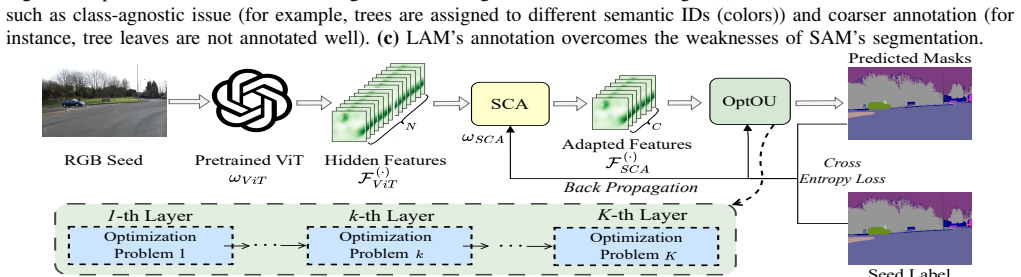
The central object is OptOU, the optimization-oriented unrolling algorithm: K cascaded layers, each implementing a gradient-descent update of the previous layer's output toward the seed ground truth, with learnable scaling factor alpha_k and step size eta_k. It carries the argument because it turns label prediction into an unrolled optimization path whose hyperparameters can be learned from a single image, and its closed form (Eq. (13)) is what the paper says yields crisp, class-aware masks after ten layers. SCA (one conv1x1 plus ReLU) is the supporting adapter that projects ViT features down to C semantic classes.
What would settle it
Run LAM on an unlabeled image with the seed ground truth removed from Eq. (13) and record whether the forward pass is computable and what labels it produces. If the output is undefined, or if it exactly reproduces the seed image's label map, then the near-100% numbers do not demonstrate generalization to new images.
Extended reading notes
Core claim
The central claim is that a parameter-lean model consisting of a frozen ViT backbone, a 1x1-convolution semantic class adapter (SCA), and a K-layer optimization-oriented unrolling algorithm (OptOU) can learn to map RGB images to semantic labels using a single seed image and its ground truth. Each OptOU layer performs one gradient-descent step on the cross-entropy loss between its input and the seed ground truth, with learnable layer-wise scaling factors and step sizes, so the whole cascade is written as a closed-form update (Eq. (13)) and trained end-to-end by backpropagation. After training, the authors report 99.99% mIoU and mF1 on all four test sets and convergence within one epoch, claiming that the optimization structure makes the annotator interpretable, class-aware, and faster than prompt-based segmentation.
Load-bearing premise
The method assumes that the labeled reference image used in training can still drive the update rule for a new unlabeled image without simply being copied, and the paper never states what takes its place at test time.
Editorial extensions
If this is right
- Datasets for autonomous driving could be labeled by annotating one frame per scene class, rather than every pixel of every frame, reducing human labeling cost by orders of magnitude.
- Because LAM needs no prompts at inference, it can be applied to new or rapidly changing data without prompt engineering.
- At 0.12 seconds per image, LAM could produce large labeled corpora far faster than prompt-based segmentation models.
- Training with a few thousand parameters converges in one epoch, so adapting LAM to a new dataset or label set could be a matter of minutes on a single GPU.
- The same architecture could be pointed at other modalities such as LiDAR or depth maps, the extension the authors name as future work.
Reading between the lines
- Beyond the paper, the 99.99% result depends on an unspecified step: Eq. (13) still contains the seed ground truth G(s), and the paper never defines what replaces it when labeling an unlabeled image. If G(s) is retained, the output may be dominated by the seed label; if it is removed, the forward pass is mathematically undefined.
- A stricter test the paper does not report is cross-dataset generalization, e.g., training on one Cityscapes seed and labeling CamVid images; the reported experiments always draw seed and test images from the same dataset distribution.
- If the method does generalize as claimed, the same unrolling trick should transfer to other dense prediction tasks (depth, instance, panoptic) and other frozen backbones, because SCA and OptOU are architecture-agnostic wrappers.
Editorial analysis
A structured set of objections, weighed in public.
Referee Report
Summary. The paper proposes LAM, an automatic semantic segmentation annotator composed of a frozen pretrained ViT, a lightweight 1x1-convolution Semantic Class Adapter (SCA), and an Optimization-Oriented Unrolling (OptOU) module with learnable scaling factors and step sizes. The authors claim that training only on a single pre-annotated RGB seed image suffices to achieve near-perfect (99.99% mIoU) annotation of thousands of held-out images across CamVid, Cityscapes, Apolloscape, and CARLA_ADV. The central methodological device is an unrolled gradient-descent procedure in which each OptOU layer minimizes cross-entropy between its current output and the seed's ground-truth label. The paper argues that the very small number of trainable parameters (a few thousand) explains why a single seed image is sufficient.
Significance. If the central claim were true, LAM would be a striking result: a prompt-free, near-perfect semantic annotator using one labeled example and a frozen ViT, with potential value in reducing annotation cost for autonomous driving. The paper has some strengths: the motivation is clear, the parameter count is genuinely small, and the unrolling formulation is interpretable as a sequence of optimization steps. However, the significance claim rests entirely on a forward-pass definition that the paper never provides for unlabeled test images. Because the inference procedure is mathematically undefined, the reported 99.99% mIoU is not evidence for a working annotator. The paper also lacks code, reproducibility details, and any statistical support for the extraordinary quantitative claims.
major comments (4)
- [Section III-C, Eq. (13) and Algorithm 1, line 10] The inference-time forward pass for an unlabeled test image D(i) is never defined. Equation (13) derives the OptOU output O(s)_Opt,K explicitly as a function of the seed ground truth G(s): the second term contains (f(alpha_k O(s)_{Opt,k-1}) - G(s)) for every layer k. To compute omega(D(i)) in Algorithm 1, line 10, one must choose a target for the cross-entropy term in Eq. (5). If that target is G(s), then every test image is actively pulled toward the seed label, so the prediction cannot encode the test image's own content. If the target is instead G(i), the target is exactly the quantity being predicted, making the pass circular. The paper supplies neither a replacement target nor a procedure to remove the G(s) dependence. The reported 99.99% mIoU on thousands of diverse held-out scenes is therefore not supported by the described algorithm.
- [Section IV-B, Table I] The quantitative results report 99.99% mIoU and 99.99% mF1 for all four datasets, with test set sizes ranging from 700 to 4,683 images. No standard deviations, confidence intervals, or per-class results are given, and no baseline that simply copies the seed label's class distribution is compared. Given the undefined inference pass, these numbers cannot be reproduced from the manuscript. The identical value 99.99 across datasets with different class counts and domain shifts also suggests that the evaluation protocol is not adequately described.
- [Section III-C, Eqs. (8)-(12)] The gradient derivation leading to Eq. (12) is not rigorous and appears to contain a mathematical error. Equation (11) as written sums over the channel index c and then subtracts a channel-dependent G(s,c), which is dimensionally inconsistent. The simplification claimed after Eq. (11), 'since sum_c f(alpha O) G = f(alpha O)', only holds if G(s) is a one-hot vector and if the channel index is carefully handled; this assumption is not stated. The resulting Eq. (12) is the standard softmax-minus-one-hot gradient, but it is not derived correctly from the preceding equations. This undermines the claim that OptOU is a well-defined optimization unrolling.
- [Section III-D, Eq. (14) and following paragraph] The argument that a small number of trainable parameters 'theoretically' implies that a single seed image suffices is not a valid generalization guarantee. No capacity bound, sample-complexity analysis, or related statistical argument is provided. The paper also does not compare with a trivial baseline that trains the same SCA+OptOU parameters only on the seed image and evaluates whether the optimization even fits the seed's training label. Such a control is necessary to separate the effect of the OptOU update from the memorization of the seed label.
minor comments (5)
- [Section IV-A.3] The implementation details state that 'SAC and OptOU are developed', but the module is called SCA in the rest of the paper; this typo should be corrected.
- [Section III-D] The text refers to 'OptOC' in the first paragraph; this should be 'OptOU'.
- [Abstract] The phrase 'though which OptOU acts as being interpretable' contains a typo; it should be 'through which'.
- [Section IV-A.2] The metric 'mF1' is not formally defined; the paper should state whether it is the mean per-class F1 score and how it is averaged across classes.
- [Table I] The columns '1 700', '1 3,474', etc. are ambiguous; the paper should clarify that the first number is the number of training images and the second is the test set size, or use separate rows/columns.
Circularity Check
Eq. (13) hard-wires the seed ground truth G(s) into the OptOU forward pass; Eq. (17) then calls the output a prediction for D(i) without ever defining a test-time target, so the claimed near-100% mIoU is forced by the seed label rather than derived from D(i).
-
fitted input called prediction
[Section III-C, Eq. (13); Section III-D, Eq. (17); Algorithm 1]
"O(s) Opt,K = (∏K k=1 αk) F(s) SCA − ΣK k=1 [ηk (∏K i=k+1 αi)(f(αkO(s) Opt,k−1) − G(s))] ... Once ωωω is available, we can annotate unlabeled RGB image D(i) by assigning labels G(i) = arg maxωωω(D(i)), i ∈ {1, 2, · · ·, |D|}, (17)"
The trained model ω includes the OptOU layers, and the only closed-form expression for OptOU, Eq. (13), contains the seed ground truth G(s) in every gradient-correction term. No test-time replacement for G(s) is specified. Thus 'annotating' D(i) via ω(D(i)) is not a function of D(i) alone; every output is actively pulled toward the known seed label. The reported 99.99% mIoU would then measure how well the output mimics G(s), not how well G(i) is predicted from D(i). The seed label is a fitted input that remains inside the predictor, so calling Table I a held-out prediction is not supported by the paper's derivation.
-
self definitional
[Section III-C, Eqs. (4a) and (5); Section III-D, Eq. (17)]
"P(k) : min ... ΣC c=1 LCE(G(s,c), O(s,c) Opt,k) ... O(s) Opt,k = I(s) Opt,k − ηk∇_{I(s) Opt,k} LCE(G(s), I(s) Opt,k) ... G(i) = arg maxωωω(D(i))"
To evaluate Eq. (17) on an unlabeled image, one must choose a target for the cross-entropy term in Eq. (5). If the target is G(s), a ground-truth label is an input to the predictor. If the target is instead G(i), then the label being predicted is required on the right-hand side of the forward pass, making the prediction circular by construction. The paper provides no third option. Either reading reduces the claimed derivation of G(i) to a label that is already part of the forward pass, so the central 'label anything' claim is not a well-defined prediction from the test image alone.
full rationale
The circularity is internal to the method section, not a matter of self-citation. The paper's own equations define the OptOU layers only for the seed image: the layer update in Eq. (5) minimizes cross-entropy to G(s), and the unrolled output in Eq. (13) carries the term −(f(α_k O_{k−1}) − G(s)) in every layer. Algorithm 1 and Eq. (17) then state that an unlabeled image D(i) is annotated by G(i)=argmax ω(D(i)), with ω containing those same OptOU layers. No inference-time target is defined. If G(s) is used, the output for every test image is attracted to the seed's ground truth, so the 99.99% mIoU in Table I would measure seed-label copying, not prediction of G(i). If G(i) is used as the target, the predicted label appears on the right-hand side of the forward pass, making the prediction circular by construction. The small parameter count in Eq. (14) does not resolve this: it only explains why one image could be overfit, not why the same G(s)-dependent forward pass should generalize to diverse held-out scenes. The paper's self-citations to prior work are not load-bearing in this failure; the problem is the undefined and label-dependent definition of the annotator itself. Score 8 reflects that the central claim reduces, by the paper's own equations, to a forward pass that depends on a ground-truth label.
Assumptions & free parameters
free parameters (3)
- SCA conv1x1 weights and bias =
(N+1)*C, e.g., 3,104 for CamVid
- OptOU scaling factors alpha_k =
learned per layer (2K=20 values)
- OptOU step sizes eta_k =
learned per layer (2K=20 values)
assumptions (4)
- domain assumption Pretrained ViT features are informative for semantic classes across datasets without fine-tuning
- standard math Cross-entropy loss and softmax are the correct objective for pixel-wise annotation
- ad hoc to paper One seed image is sufficient to fit SCA and OptOU
- ad hoc to paper G(s) can be used in the inference-time gradient without making predictions independent of the test image
Cite this review
Pith. "Pith review of Label Anything: An Interpretable, High-Fidelity and Prompt-Free Annotator." pith.science (2026). https://pith.science/paper/EDM3S2WW
@misc{pith2026250202972,
  author       = {Pith},
  title        = {Pith review of: Label Anything: An Interpretable, High-Fidelity and Prompt-Free Annotator},
  year         = {2026},
  howpublished = {\url{https://pith.science/paper/EDM3S2WW}},
  note         = {Machine review of arXiv:2502.02972}
}
read the original abstract
Learning-based street scene semantic understanding in autonomous driving (AD) has advanced significantly recently, but the performance of the AD model is heavily dependent on the quantity and quality of the annotated training data. However, traditional manual labeling involves high cost to annotate the vast amount of required data for training robust model. To mitigate this cost of manual labeling, we propose a Label Anything Model (denoted as LAM), serving as an interpretable, high-fidelity, and prompt-free data annotator. Specifically, we firstly incorporate a pretrained Vision Transformer (ViT) to extract the latent features. On top of ViT, we propose a semantic class adapter (SCA) and an optimization-oriented unrolling algorithm (OptOU), both with a quite small number of trainable parameters. SCA is proposed to fuse ViT-extracted features to consolidate the basis of the subsequent automatic annotation. OptOU consists of multiple cascading layers and each layer contains an optimization formulation to align its output with the ground truth as closely as possible, though which OptOU acts as being interpretable rather than learning-based blackbox nature. In addition, training SCA and OptOU requires only a single pre-annotated RGB seed image, owing to their small volume of learnable parameters. Extensive experiments clearly demonstrate that the proposed LAM can generate high-fidelity annotations (almost 100% in mIoU) for multiple real-world datasets (i.e., Camvid, Cityscapes, and Apolloscapes) and CARLA simulation dataset.
Figures


Figures from the paper (2 more)


Reference graph
Works this paper leans on
-
[1]
J. Rückin, F. Magistri, C. Stachniss, and M. Popovi ´c, “Semi-supervised active learning for semantic segmentation in unknown environments using informative path planning,” IEEE Robotics and Automation Letters, vol. 9, no. 3, pp. 2662–2669, 2024
work page 2024
-
[2]
Lightweight semantic segmentation network for semantic scene understanding on low-compute devices,
H. Son and J. Weiland, “Lightweight semantic segmentation network for semantic scene understanding on low-compute devices,” in 2023 IEEE/RSJ International Conference on Intelligent Robots and Systems (IROS), 2023, pp. 62–69
work page 2023
-
[3]
W.-B. Kou, Q. Lin, M. Tang, S. Wang, G. Zhu, and Y .-C. Wu, “Fedrc: A rapid-converged hierarchical federated learning framework in street scene semantic understanding,” arXiv preprint arXiv:2407.01103 , 2024
work page Pith review arXiv 2024
-
[4]
Motionsc: Data set and network for real- time semantic mapping in dynamic environments,
J. Wilson, J. Song, Y . Fu, A. Zhang, A. Capodieci, P. Jayakumar, K. Barton, and M. Ghaffari, “Motionsc: Data set and network for real- time semantic mapping in dynamic environments,” IEEE Robotics and Automation Letters, vol. 7, no. 3, pp. 8439–8446, 2022
work page 2022
-
[5]
W.-B. Kou, Q. Lin, M. Tang, S. Xu, R. Ye, Y . Leng, S. Wang, G. Li, Z. Chen, G. Zhu, and Y .-C. Wu, “pfedlvm: A large vision model (lvm)-driven and latent feature-based personalized federated learning framework in autonomous driving,” 2024
work page 2024
-
[6]
Z. Feng, Y . Guo, and Y . Sun, “Cekd: Cross-modal edge-privileged knowledge distillation for semantic scene understanding using only thermal images,” IEEE Robotics and Automation Letters , vol. 8, no. 4, pp. 2205–2212, 2023
work page 2023
-
[7]
W.-B. Kou, Q. Lin, M. Tang, S. Wang, R. Ye, G. Zhu, and Y .-C. Wu, “Enhancing large vision model in street scene semantic understanding through leveraging posterior optimization trajectory,” arXiv preprint arXiv:2501.01710, 2025
arXiv 2025
-
[8]
Under- standing bird’s-eye view of road semantics using an onboard camera,
Y . B. Can, A. Liniger, O. Unal, D. Paudel, and L. V . Gool, “Under- standing bird’s-eye view of road semantics using an onboard camera,” 2022
work page 2022
Show all 39 references
-
[9]
An adverse weather-immune scheme with unfolded regularization and foundation model knowledge distillation for street scene understand- ing,
W.-B. Kou, G. Zhu, R. Ye, S. Wang, Q. Lin, M. Tang, and Y .-C. Wu, “An adverse weather-immune scheme with unfolded regularization and foundation model knowledge distillation for street scene understand- ing,” arXiv preprint arXiv:2409.14737 , 2024
2024 arXiv
-
[10]
Towards compact autonomous driving perception with balanced learning and multi-sensor fusion,
O. Natan and J. Miura, “Towards compact autonomous driving perception with balanced learning and multi-sensor fusion,” IEEE Transactions on Intelligent Transportation Systems , vol. 23, no. 9, pp. 16 249–16 266, 2022
2022
-
[11]
Fast-convergent and communication-alleviated heterogeneous hierarchical federated learning in autonomous driving,
W.-B. Kou, Q. Lin, M. Tang, R. Ye, S. Wang, G. Zhu, and Y .- C. Wu, “Fast-convergent and communication-alleviated heterogeneous hierarchical federated learning in autonomous driving,” arXiv preprint arXiv:2409.19560, 2024
2024 arXiv
-
[12]
Segment anything,
A. Kirillov, E. Mintun, N. Ravi, H. Mao, C. Rolland, L. Gustafson, T. Xiao, S. Whitehead, A. C. Berg, W.-Y . Lo, P. Dollár, and R. Gir- shick, “Segment anything,” arXiv:2304.02643, 2023
2023 arXiv
-
[13]
An image is worth 16x16 words: Transformers for image recognition at scale,
A. Dosovitskiy, L. Beyer, A. Kolesnikov, D. Weissenborn, X. Zhai, T. Unterthiner, M. Dehghani, M. Minderer, G. Heigold, S. Gelly et al., “An image is worth 16x16 words: Transformers for image recognition at scale,” arXiv preprint arXiv:2010.11929 , 2020
2010 arXiv
-
[14]
Carla: An open urban driving simulator,
A. Dosovitskiy, G. Ros, F. Codevilla, A. Lopez, and V . Koltun, “Carla: An open urban driving simulator,” in Proceedings of The 1st Annual Conference on Robot Learning , 2017, pp. 1–16
2017
-
[15]
Scaling up visual and vision-language representation learning with noisy text supervision,
C. Jia, Y . Yang, Y . Xia, Y .-T. Chen, Z. Parekh, H. Pham, Q. Le, Y .-H. Sung, Z. Li, and T. Duerig, “Scaling up visual and vision-language representation learning with noisy text supervision,” in International conference on machine learning . PMLR, 2021, pp. 4904–4916
2021
-
[16]
Learning transferable visual models from natural language supervision,
A. Radford, J. W. Kim, C. Hallacy, A. Ramesh, G. Goh, S. Agarwal, G. Sastry, A. Askell, P. Mishkin, J. Clark et al., “Learning transferable visual models from natural language supervision,” in International Conference on Machine Learning . PMLR, 2021, pp. 8748–8763
2021
-
[17]
Vilt: Vision-and-language transformer without convolution or region supervision,
W. Kim, B. Son, and I. Kim, “Vilt: Vision-and-language transformer without convolution or region supervision,” in International Confer- ence on Machine Learning . PMLR, 2021, pp. 5583–5594
2021
-
[18]
Vlmo: Unified vision-language pre- training with mixture-of-modality-experts,
H. Bao, W. Wang, L. Dong, Q. Liu, O. K. Mohammed, K. Aggarwal, S. Som, S. Piao, and F. Wei, “Vlmo: Unified vision-language pre- training with mixture-of-modality-experts,” Advances in Neural Infor- mation Processing Systems , vol. 35, pp. 32 897–32 912, 2022
2022
-
[19]
Blip: Bootstrapping language- image pre-training for unified vision-language understanding and gen- eration,
J. Li, D. Li, C. Xiong, and S. Hoi, “Blip: Bootstrapping language- image pre-training for unified vision-language understanding and gen- eration,” in International Conference on Machine Learning . PMLR, 2022, pp. 12 888–12 900
2022
-
[20]
Lit: Zero-shot transfer with locked-image text tuning,
X. Zhai, X. Wang, B. Mustafa, A. Steiner, D. Keysers, A. Kolesnikov, and L. Beyer, “Lit: Zero-shot transfer with locked-image text tuning,” in Proceedings of the IEEE/CVF Conference on Computer Vision and Pattern Recognition, 2022, pp. 18 123–18 133
2022
-
[21]
Blip-2: Bootstrapping language- image pre-training with frozen image encoders and large language models,
J. Li, D. Li, S. Savarese, and S. Hoi, “Blip-2: Bootstrapping language- image pre-training with frozen image encoders and large language models,” arXiv preprint arXiv:2301.12597 , 2023
2023 arXiv
-
[22]
A comprehensive survey of hallucination mitigation tech- niques in large language models,
S. Tonmoy, S. Zaman, V . Jain, A. Rani, V . Rawte, A. Chadha, and A. Das, “A comprehensive survey of hallucination mitigation tech- niques in large language models,” arXiv preprint arXiv:2401.01313 , 2024
2024 arXiv
-
[23]
Graspgpt: Leveraging semantic knowledge from a large language model for task- oriented grasping,
C. Tang, D. Huang, W. Ge, W. Liu, and H. Zhang, “Graspgpt: Leveraging semantic knowledge from a large language model for task- oriented grasping,” IEEE Robotics and Automation Letters , vol. 8, no. 11, pp. 7551–7558, 2023
2023
-
[24]
Zero-shot open-vocabulary tracking with large pre- trained models,
W.-H. Chu, A. W. Harley, P. Tokmakov, A. Dave, L. Guibas, and K. Fragkiadaki, “Zero-shot open-vocabulary tracking with large pre- trained models,” in 2024 IEEE International Conference on Robotics and Automation (ICRA) , 2024, pp. 4916–4923
2024
-
[25]
Prompt, plan, perform: Llm-based humanoid control via quantized imitation learning,
J. Sun, Q. Zhang, Y . Duan, X. Jiang, C. Cheng, and R. Xu, “Prompt, plan, perform: Llm-based humanoid control via quantized imitation learning,” in 2024 IEEE International Conference on Robotics and Automation (ICRA) , 2024, pp. 16 236–16 242
2024
-
[26]
Extracting prompts by inverting llm outputs,
C. Zhang, J. X. Morris, and V . Shmatikov, “Extracting prompts by inverting llm outputs,” arXiv preprint arXiv:2405.15012 , 2024
2024 arXiv
-
[27]
Efficient prompting for llm-based generative internet of things,
B. Xiao, B. Kantarci, J. Kang, D. Niyato, and M. Guizani, “Efficient prompting for llm-based generative internet of things,” arXiv preprint arXiv:2406.10382, 2024
2024 arXiv
-
[28]
A simple zero-shot prompt weighting technique to improve prompt ensembling in text-image models,
J. U. Allingham, J. Ren, M. W. Dusenberry, X. Gu, Y . Cui, D. Tran, J. Z. Liu, and B. Lakshminarayanan, “A simple zero-shot prompt weighting technique to improve prompt ensembling in text-image models,” in International Conference on Machine Learning . PMLR, 2023, pp. 547–568
2023
-
[29]
Fantasti- cally ordered prompts and where to find them: Overcoming few-shot prompt order sensitivity,
Y . Lu, M. Bartolo, A. Moore, S. Riedel, and P. Stenetorp, “Fantasti- cally ordered prompts and where to find them: Overcoming few-shot prompt order sensitivity,” arXiv preprint arXiv:2104.08786 , 2021
2021 arXiv
-
[30]
Design guidelines for prompt engineering text-to-image generative models,
V . Liu and L. B. Chilton, “Design guidelines for prompt engineering text-to-image generative models,” in Proceedings of the 2022 CHI conference on human factors in computing systems , 2022, pp. 1–23
2022
-
[31]
The cityscapes dataset for semantic urban scene understanding,
M. Cordts, M. Omran, S. Ramos, T. Rehfeld, M. Enzweiler, R. Benen- son, U. Franke, S. Roth, and B. Schiele, “The cityscapes dataset for semantic urban scene understanding,” in Proc. of the IEEE Conference on Computer Vision and Pattern Recognition (CVPR) , 2016
2016
-
[32]
Segmentation and recognition using structure from motion point clouds,
G. J. Brostow, J. Shotton, J. Fauqueur, and R. Cipolla, “Segmentation and recognition using structure from motion point clouds,” in Com- puter Vision–ECCV 2008: 10th European Conference on Computer Vision, Marseille, France, October 12-18, 2008, Proceedings, Part I
2008
-
[33]
Springer, 2008, pp. 44–57
2008
-
[34]
The apolloscape open dataset for autonomous driving and its application,
P. Wang, X. Huang, X. Cheng, D. Zhou, Q. Geng, and R. Yang, “The apolloscape open dataset for autonomous driving and its application,” IEEE transactions on pattern analysis and machine intelligence , 2019
2019
-
[35]
Bisenet v2: Bilateral network with guided aggregation for real-time semantic segmentation,
C. Yu, C. Gao, J. Wang, G. Yu, C. Shen, and N. Sang, “Bisenet v2: Bilateral network with guided aggregation for real-time semantic segmentation,” International Journal of Computer Vision , vol. 129, pp. 3051–3068, 2021
2021
-
[36]
Segnet: A deep convolutional encoder-decoder architecture for image segmentation,
V . Badrinarayanan, A. Kendall, and R. Cipolla, “Segnet: A deep convolutional encoder-decoder architecture for image segmentation,” IEEE transactions on pattern analysis and machine intelligence , vol. 39, no. 12, pp. 2481–2495, 2017
2017
-
[37]
Encoder-decoder with atrous separable convolution for semantic image segmentation,
L.-C. Chen, Y . Zhu, G. Papandreou, F. Schroff, and H. Adam, “Encoder-decoder with atrous separable convolution for semantic image segmentation,” 2018
2018
-
[38]
Segformer: Simple and efficient design for semantic segmen- tation with transformers,
E. Xie, W. Wang, Z. Yu, A. Anandkumar, J. M. Alvarez, and P. Luo, “Segformer: Simple and efficient design for semantic segmen- tation with transformers,” in Neural Information Processing Systems (NeurIPS), 2021
2021
-
[39]
Deeplab: Semantic image segmentation with deep convolutional nets, atrous convolution, and fully connected crfs,
L.-C. Chen, G. Papandreou, I. Kokkinos, K. Murphy, and A. L. Yuille, “Deeplab: Semantic image segmentation with deep convolutional nets, atrous convolution, and fully connected crfs,” IEEE transactions on pattern analysis and machine intelligence , vol. 40, no. 4, pp. 834– 848, 2017
2017
Reviewed August 9, 2026 · model on record in the stance chip above.
Discussion (0). Continue with ORCID to comment.