REVIEW 3 major objections 4 minor 67 references
Scaling Laws for Upcycling Mixture-of-Experts Language Models
T0 review · 3 major / 4 minor · reviewed 2026-08-09 · deepseek-v4-flash
Pith's one-line read This paper claims that upcycled MoE language models follow a two-stage power law with a positive interaction term, which makes upcycling beat from-scratch training only below a model-size-dependent token threshold.
desk verdict A genuinely useful empirical scaling law for MoE upcycling, with honest limitations, but the headline threshold rests on an unexplained order-of-magnitude discrepancy in the fitted interaction exponent. read the letter →
The pith
A machine-rendered reading of the paper's core claim, the machinery that carries it, and where it could break.
The reading
What carries the argument
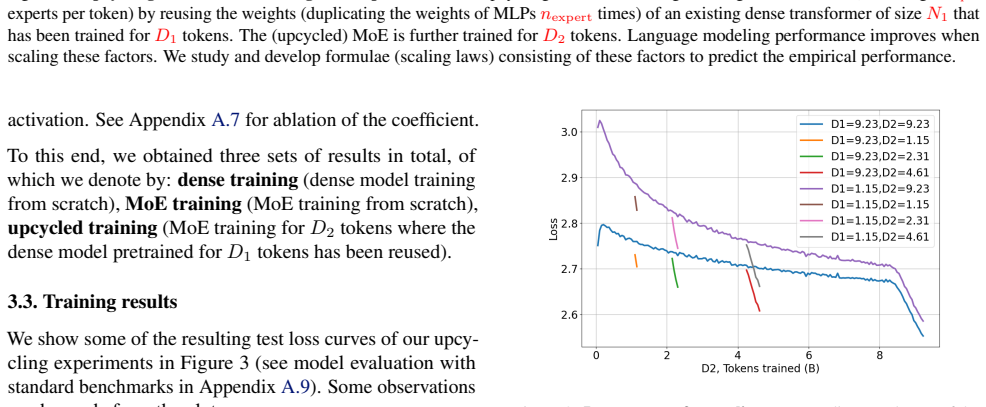
The load-bearing object is Equation (12), the joint scaling law $L = A D_1^{-\alpha_1} D_2^{-(\alpha_2+\alpha_3 \log D_1)} + B N_1^{-\beta} + E$. It is a multiplicative power law in the two token budgets whose $D_2$ exponent is modulated by $\log D_1$, so the two budgets interact rather than contributing additively. The paper arrives at this form by imposing three requirements: power-law scaling in $D_2$ for fixed $D_1$; reduction to the dense Chinchilla law $A D_1^{-\alpha_1} + B N_1^{-\beta} + E$ as $D_2 \to 0$; and the empirical observation that the fitted $D_2$ exponent falls linearly in $\log D_1$ (Equation 10), which turns the single-variable power law into a bilinear form in $\log D_1$ and $\log D_2$. This interaction term carries the argument because it is what makes upcycling advantages shrink with sunk cost and produces the threshold $D^*$.
What would settle it
At the 8x1B scale the paper predicts $D^* = 4$B tokens: train a 1B dense model on 4B tokens, upcycle it, and in parallel train an 8x1B MoE from scratch for 4B tokens; the law requires the two final losses to match, and requires from-scratch to win for any $D_2 > D^*$. Running that comparison, or the analogous one at 7B scale with $D_1$ far above the fitted range, would falsify the scaling law if the crossover token count is off.
Extended reading notes
Core claim
The central discovery is that the upcycled MoE loss has a multiplicative power-law structure with an interaction between the two training budgets, not just two additive terms. The paper states it as $L(D_1,D_2,N_1) = A D_1^{-\alpha_1} D_2^{-(\alpha_2+\alpha_3 \log D_1)} + B N_1^{-\beta} + E$, fitted at 8-expert top-2 Mixtral-like architectures with positive exponents ($\alpha_1 \approx 0.043$, $\alpha_2 \approx 0.085$, $\alpha_3 \approx 7.98\times 10^{-4}$, $\beta \approx 0.112$). The interaction term means the effective exponent of $D_2$ is $\alpha_2 - \alpha_3 \log D_1$, so a larger dense pretraining budget lowers the starting loss but also slows later progress. From this the paper derives a threshold $D^* \simeq 4 (N_1/10^9)^{-0.7+0.04\log(N_1/10^9)}$ billion tokens separating regimes where upcycling beats from-scratch MoE training, shows that from-scratch training is compute-optimal when no pretrained checkpoint exists, and obtains $D_2 \propto N_1^{1.8}$ for compute-optimal upcycling of an existing checkpoint.
Load-bearing premise
The argument stands on the assumption that the measured slowdown in upcycling gains keeps following the same straight-line trend as the dense pretraining budget grows, all the way out to 7B, 13B, and 70B models trained on roughly two trillion tokens; if that trend bends or changes with model size, the predicted threshold and compute guidance collapse.
Editorial extensions
If this is right
- Upcycling a dense checkpoint into an 8-expert top-2 MoE is more token-efficient than from-scratch MoE training only while the additional upcycling budget $D_2$ stays below $D^*$; above $D^*$, from-scratch training wins.
- The threshold falls with dense model size, so for larger models upcycling pays off only for very small continued-training budgets: the paper's formula gives $D^* \simeq 4 (N_1/10^9)^{-0.7+0.04\log(N_1/10^9)}$ billion tokens.
- If no pretrained checkpoint is available, compute-optimal dense or from-scratch MoE training outperforms the two-stage dense-to-upcycled pipeline under the fitted scaling law.
- When a pretrained dense checkpoint already exists, compute-optimal upcycling obeys $D_2 \propto N_1^{1.8}$, so larger dense models need nearly quadratically more upcycling tokens to remain efficient.
- Within the explored ranges, increasing sparsity and active parameters improves the upcycled MoE's loss without a noticeable performance trade-off.
Reading between the lines
- The same interaction structure would apply to other two-stage training regimes, which the paper notes but does not develop: additive scaling laws for transfer learning and fine-tuning would systematically over-value the pretraining budget at large $D_1$.
- The linear dependence on $\log D_1$ predicts a crossover at which, for a fixed $D_2$, more dense pretraining stops helping; measuring losses at $D_1$ well beyond the fitted range would test whether the linear form bends before that crossover.
- The appendix's dataset comparison hints that the interaction exponent depends on task difficulty, with code saturating quickly and Japanese text saturating slowly, so fitting $\alpha_3$ per dataset and checking whether $D^*$ moves is a natural next experiment.
- A practical decision rule follows from the threshold: fix the MoE architecture, estimate $D^*$, and only upcycle when the planned continued-pretraining budget is below it; otherwise train from scratch.
Editorial analysis
A structured set of objections, weighed in public.
Referee Report
Summary. The paper studies upcycling a pretrained dense language model into a mixture-of-experts (MoE) model by duplicating MLP weights and continuing training. It fits an empirical scaling law L(D1,D2,N1) = A D1^{-alpha1} D2^{-(alpha2 + alpha3 log D1)} + B N1^{-beta} + E, with a positive interaction exponent alpha3, and uses it to derive a threshold D* below which upcycling beats from-scratch MoE training (Eq. 2) and to give compute-optimal allocation guidance (Eq. 14). The experiments cover dense models from 15M to 1B parameters, several MoE configurations, multiple datasets, and the paper releases code and loss data.
Significance. If the proposed form is correct, this would be one of the first systematic scaling laws for upcycling and would give practitioners a concrete decision rule with a nontrivial interaction between the dense pretraining budget and the upcycled training budget. The paper has real empirical support: the multiplicative form with interaction wins leave-one-out comparisons across four MoE architectures in Table 1, the joint law extrapolates to a held-out 8x1B model with RMS error 0.015 in Figure 6, and the released code and data make the results reproducible. The main caveat is quantitative: the interaction exponent alpha3, which drives the headline threshold and compute-optimal conclusions, is fit-dependent by an order of magnitude across the paper's own tables, and no uncertainty intervals are reported. Because Section 7 explicitly states that the interaction term is theoretically unexplained, the numerical robustness of alpha3 is load-bearing for the paper's conclusions.
major comments (3)
- [Section 4.1/Table 8 vs Section 5/Table 2] The fitted interaction exponent alpha3 differs by an order of magnitude between the dataset-size fits and the joint law used for the headline applications. Table 8 reports alpha3 in the range 0.008-0.01 for 8x0.1B upcycled MoEs, while Table 2 reports alpha3 = 7.98e-4 for the joint law. Since alpha3 is the term that makes the effective D2 exponent alpha_eff = alpha2 - alpha3 log D1 decrease with D1 and directly enters the threshold D* (Eqs. 2 and 13) and the compute-optimal exponent (Eq. 14), the paper needs either to reconcile these two fits or to provide uncertainty intervals showing that they are statistically compatible. As written, the Section 4.1 scaling law does not transfer to the exact joint-law setting used for Eqs. 2 and 14, and no explanation is given for the discrepancy.
- [Section 5.2 / Eq. 14] The application to Llama2 models (7B, 13B, 70B, D1 about 2T tokens) extrapolates Eq. 12 far outside the fitted range: the joint law is fit with N1 at most 1B and D1 values in the few-billion-token range. Because alpha_eff appears in the denominator of the exponent beta/alpha_eff in Eq. 14, the claim D2 ~ N1^1.8 is highly sensitive to the value of alpha3 at large log D1. With no confidence interval on alpha3, the reported near-quadratic relation is not robust; a modest perturbation of alpha3 changes the exponent substantially. The held-out validation at 8x1B does not cover this regime.
- [Section 5.1 / Eq. 13] The threshold D* is the root of an equality between two fitted scaling laws and is therefore an algebraic consequence of the fit, not an independent measurement. The manuscript presents D* as a headline prediction, and Figure 1 extends it to model sizes beyond the fitted range. At minimum, the paper should state clearly that D* inherits all the uncertainty of both fitted laws, and should provide a sensitivity analysis with respect to the fitted exponents, in particular alpha3.
minor comments (4)
- [Section 4.1 / Eq. 7] Equation 7 writes the prefactor as A independent of D1, but later in the same section the prefactor is fitted as a function of D1 (Eq. 16 and Figure 12); please make the D1-dependence of the prefactor explicit in Eqs. 7-9.
- [Section 4.1 / Eq. 10] Equation 10 uses E' for the intercept although E denotes the irreducible loss elsewhere; this overloading is confusing and should be relabeled.
- [Appendix C.1] The text says 'Figure 8 shows the fitting' but the fitted exponents appear in Table 8; the cross-reference should be corrected.
- [Section 5.2] The compute cost is written as C2 = 6 N2 D2, but it is not stated whether the FLOPs budget C in Eq. 14 refers only to the upcycling stage or to the sum of dense and upcycled training; please clarify.
Circularity Check
No circularity: the scaling laws are explicitly fitted empirical models, and the threshold and compute-optimal relations are openly derived consequences of those fits rather than independently predicted data.
full rationale
Section 2.2 introduces the loss model as an empirical ansatz: "All parameters are to be fitted with experimental observations." Equation 12 is therefore a fitted regression surface, not a first-principles theorem. The interaction term α3 is not smuggled in: Table 1 compares multiplicative and additive forms with and without interaction by leave-one-out RMS, and Section 4.1 together with Appendix C shows that the multiplicative dependence arises from independent empirical fits (Equations 10 and 16). The later quantities are consequences: D* is defined in Equation 13 as the root of two fitted laws, Equation 2 is derived as its approximate analytic solution, and Equation 14 is derived by differentiating the fitted joint law under a FLOP constraint in Appendix F.3. These are legitimate applications of a fitted model, and the paper does not relabel regression output as an independent measurement. Held-out validation (RMS 0.015 in Section 5) and cross-dataset generalization checks (Appendix B) are independent checks rather than circular reuse of the fitted data. The citations to prior scaling work supply a standard ansatz, and the cited Mixtral and Sarashina2 models are used for architecture choices, not to prove the law; there is no load-bearing self-citation or imported uniqueness theorem. The paper honestly states in Section 7 that the interaction term "remains theoretically unexplained," and the numerical discrepancy in α3 between Table 2 and Table 8 is a correctness or extrapolation concern, not a definitional reduction: both values are fitted from data and neither is defined in terms of the threshold or the compute-optimal exponent. Because every claimed prediction is either a fitted functional form or an explicit algebraic consequence of that form, no circular step can be exhibited.
Assumptions & free parameters
free parameters (9)
- A (upcycled prefactor) =
16.3
- B (model-size prefactor) =
8.53
- alpha_1 (dense-token exponent) =
0.043
- alpha_2 (upcycled-token exponent) =
0.085
- alpha_3 (interaction exponent) =
7.98e-4 in Table 2; 0.008-0.01 in Table 8
- beta (upcycled N1 exponent) =
0.112
- E (irreducible loss) =
0.165
- beta_1 (sparsity exponent) =
1.87
- beta_2 (active-parameter exponent) =
0.34
assumptions (6)
- domain assumption Power-law ansatz L = A X^-alpha + E for loss versus dataset and model size.
- domain assumption Function-preserving initialization makes the D2 -> 0 limit equal to the dense scaling law.
- ad hoc to paper The multiplicative form with a log D1 interaction is the correct interpolation between the dense and upcycled limits.
- ad hoc to paper The scaling exponent alpha(D1) is linear in log D1.
- domain assumption The irreducible loss E is universal across dense, MoE, and upcycled training.
- ad hoc to paper Fitted scaling-law parameters remain valid when extrapolated to 7B-70B models and roughly 2T dense tokens.
Cite this review
Pith. "Pith review of Scaling Laws for Upcycling Mixture-of-Experts Language Models." pith.science (2026). https://pith.science/paper/DXBWIRUN
@misc{pith2026250203009,
  author       = {Pith},
  title        = {Pith review of: Scaling Laws for Upcycling Mixture-of-Experts Language Models},
  year         = {2026},
  howpublished = {\url{https://pith.science/paper/DXBWIRUN}},
  note         = {Machine review of arXiv:2502.03009}
}
read the original abstract
Pretraining large language models (LLMs) is resource-intensive, often requiring months of training time even with high-end GPU clusters. There are two approaches of mitigating such computational demands: reusing smaller models to train larger ones (upcycling), and training computationally efficient models like mixture-of-experts (MoE). In this paper, we study the upcycling of LLMs to MoE models, of which the scaling behavior remains underexplored. Through extensive experiments, we identify empirical scaling laws that describe how performance depends on dataset size and model configuration. Particularly, we show that, while scaling these factors improves performance, there is a novel interaction term between the dense and upcycled training dataset that limits the efficiency of upcycling at large computational budgets. Based on these findings, we provide guidance to scale upcycling, and establish conditions under which upcycling outperforms from-scratch trainings within budget constraints.
Figures


Figures from the paper (13 more)


Reference graph
Works this paper leans on
-
[1]
write newline
" write newline "" before.all 'output.state := FUNCTION n.dashify 't := "" t empty not t #1 #1 substring "-" = t #1 #2 substring "--" = not "--" * t #2 global.max substring 't := t #1 #1 substring "-" = "-" * t #2 global.max substring 't := while if t #1 #1 substring * t #2 global.max substring 't := if while FUNCTION format.date year duplicate empty "emp...
-
[2]
L., Almeida, D., Altenschmidt, J., Altman, S., Anadkat, S., et al
Achiam, J., Adler, S., Agarwal, S., Ahmad, L., Akkaya, I., Aleman, F. L., Almeida, D., Altenschmidt, J., Altman, S., Anadkat, S., et al. Gpt-4 technical report. arXiv preprint arXiv:2303.08774, 2023
arXiv 2023
-
[3]
Explaining neural scaling laws
Bahri, Y., Dyer, E., Kaplan, J., Lee, J., and Sharma, U. Explaining neural scaling laws. Proceedings of the National Academy of Sciences, 121 0 (27): 0 e2311878121, 2024
work page 2024
-
[4]
Estimating or propagating gradients through stochastic neurons for conditional computation
Bengio, Y., L \'e onard, N., and Courville, A. Estimating or propagating gradients through stochastic neurons for conditional computation. arXiv preprint arXiv:1308.3432, 2013
arXiv 2013
-
[5]
Deepseek llm: Scaling open-source language models with longtermism
Bi, X., Chen, D., Chen, G., Chen, S., Dai, D., Deng, C., Ding, H., Dong, K., Du, Q., Fu, Z., et al. Deepseek llm: Scaling open-source language models with longtermism. arXiv preprint arXiv:2401.02954, 2024
arXiv 2024
-
[6]
G., Bradley, H., O’Brien, K., Hallahan, E., Khan, M
Biderman, S., Schoelkopf, H., Anthony, Q. G., Bradley, H., O’Brien, K., Hallahan, E., Khan, M. A., Purohit, S., Prashanth, U. S., Raff, E., et al. Pythia: A suite for analyzing large language models across training and scaling. pp.\ 2397--2430. PMLR, 2023
work page 2023
-
[7]
Piqa: Reasoning about physical commonsense in natural language
Bisk, Y., Zellers, R., Gao, J., Choi, Y., et al. Piqa: Reasoning about physical commonsense in natural language. In Proceedings of the AAAI Conference on Artificial Intelligence, volume 34, pp.\ 7432--7439, 2020
2020
-
[8]
A dynamical model of neural scaling laws
Bordelon, B., Atanasov, A., and Pehlevan, C. A dynamical model of neural scaling laws. In Proceedings of the 41st International Conference on Machine Learning, pp.\ 4345--4382, 2024
work page 2024
Show all 67 references
-
[9]
A survey on mixture of experts
Cai, W., Jiang, J., Wang, F., Tang, J., Kim, S., and Huang, J. A survey on mixture of experts. arXiv preprint arXiv:2407.06204, 2024
2024 arXiv
-
[10]
Net2net: Accelerating learning via knowledge transfer
Chen, T., Goodfellow, I., and Shlens, J. Net2net: Accelerating learning via knowledge transfer. arXiv preprint arXiv:1511.05641, 2015
2015 arXiv
-
[11]
W., Sutton, C., Gehrmann, S., et al
Chowdhery, A., Narang, S., Devlin, J., Bosma, M., Mishra, G., Roberts, A., Barham, P., Chung, H. W., Sutton, C., Gehrmann, S., et al. Palm: Scaling language modeling with pathways. Journal of Machine Learning Research, 24 0 (240): 0 1--113, 2023
2023
-
[12]
Unified scaling laws for routed language models
Clark, A., de Las Casas, D., Guy, A., Mensch, A., Paganini, M., Hoffmann, J., Damoc, B., Hechtman, B., Cai, T., Borgeaud, S., et al. Unified scaling laws for routed language models. pp.\ 4057--4086. PMLR, 2022
2022
-
[13]
Think you have solved question answering? try arc, the ai2 reasoning challenge
Clark, P., Cowhey, I., Etzioni, O., Khot, T., Sabharwal, A., Schoenick, C., and Tafjord, O. Think you have solved question answering? try arc, the ai2 reasoning challenge. arXiv preprint arXiv:1803.05457, 2018
2018 arXiv
-
[14]
Redpajama: an open dataset for training large language models, October 2023
Computer, T. Redpajama: an open dataset for training large language models, October 2023. URL https://github.com/togethercomputer/RedPajama-Data
2023
-
[15]
Deepseekmoe: Towards ultimate expert specialization in mixture-of-experts language models
Dai, D., Deng, C., Zhao, C., Xu, R., Gao, H., Chen, D., Li, J., Zeng, W., Yu, X., Wu, Y., et al. Deepseekmoe: Towards ultimate expert specialization in mixture-of-experts language models. arXiv preprint arXiv:2401.06066, 2024
2024 arXiv
-
[16]
Flashattention: Fast and memory-efficient exact attention with io-awareness
Dao, T., Fu, D., Ermon, S., Rudra, A., and R \'e , C. Flashattention: Fast and memory-efficient exact attention with io-awareness. Advances in Neural Information Processing Systems, 35: 0 16344--16359, 2022
2022
-
[17]
Stacking your transformers: A closer look at model growth for efficient llm pre-training
Du, W., Luo, T., Qiu, Z., Huang, Z., Shen, Y., Cheng, R., Guo, Y., and Fu, J. Stacking your transformers: A closer look at model growth for efficient llm pre-training. arXiv preprint arXiv:2405.15319, 2024
2024 arXiv
-
[18]
Learning factored representations in a deep mixture of experts
Eigen, D., Ranzato, M., and Sutskever, I. Learning factored representations in a deep mixture of experts. arXiv preprint arXiv:1312.4314, 2013
2013 arXiv
-
[19]
Switch transformers: Scaling to trillion parameter models with simple and efficient sparsity
Fedus, W., Zoph, B., and Shazeer, N. Switch transformers: Scaling to trillion parameter models with simple and efficient sparsity. Journal of Machine Learning Research, 23 0 (120): 0 1--39, 2022
2022
-
[20]
A framework for few-shot language model evaluation, 07 2024
Gao, L., Tow, J., Abbasi, B., Biderman, S., Black, S., DiPofi, A., Foster, C., Golding, L., Hsu, J., Le Noac'h, A., Li, H., McDonell, K., Muennighoff, N., Ociepa, C., Phang, J., Reynolds, L., Schoelkopf, H., Skowron, A., Sutawika, L., Tang, E., Thite, A., Wang, B., Wang, K., a...
2024
-
[21]
Scaling laws and compute-optimal training beyond fixed training durations
H \"a gele, A., Bakouch, E., Kosson, A., Von Werra, L., Jaggi, M., et al. Scaling laws and compute-optimal training beyond fixed training durations. Advances in Neural Information Processing Systems, 37: 0 76232--76264, 2024
2024
-
[22]
Upcycling large language models into mixture of experts
He, E., Khattar, A., Prenger, R., Korthikanti, V., Yan, Z., Liu, T., Fan, S., Aithal, A., Shoeybi, M., and Catanzaro, B. Upcycling large language models into mixture of experts. arXiv preprint arXiv:2410.07524, 2024
2024 arXiv
-
[23]
B., Dhariwal, P., Gray, S., et al
Henighan, T., Kaplan, J., Katz, M., Chen, M., Hesse, C., Jackson, J., Jun, H., Brown, T. B., Dhariwal, P., Gray, S., et al. Scaling laws for autoregressive generative modeling. arXiv preprint arXiv:2010.14701, 2020
2010 arXiv
-
[24]
Scaling laws for transfer
Hernandez, D., Kaplan, J., Henighan, T., and McCandlish, S. Scaling laws for transfer. arXiv preprint arXiv:2102.01293, 2021
2021 arXiv
-
[25]
Hestness, J., Narang, S., Ardalani, N., Diamos, G., Jun, H., Kianinejad, H., Patwary, M. M. A., Yang, Y., and Zhou, Y. Deep learning scaling is predictable, empirically. arXiv preprint arXiv:1712.00409, 2017
2017 arXiv
-
[26]
Beyond human-level accuracy: Computational challenges in deep learning
Hestness, J., Ardalani, N., and Diamos, G. Beyond human-level accuracy: Computational challenges in deep learning. pp.\ 1--14, 2019
2019
-
[27]
A., Welbl, J., Clark, A., et al
Hoffmann, J., Borgeaud, S., Mensch, A., Buchatskaya, E., Cai, T., Rutherford, E., de Las Casas, D., Hendricks, L. A., Welbl, J., Clark, A., et al. Training compute-optimal large language models. Proceedings of the 36th International Conference on Neural Information Processing ...
2022
-
[28]
Minicpm: Unveiling the potential of small language models with scalable training strategies
Hu, S., Tu, Y., Han, X., He, C., Cui, G., Long, X., Zheng, Z., Fang, Y., Huang, Y., Zhao, W., et al. Minicpm: Unveiling the potential of small language models with scalable training strategies. arXiv preprint arXiv:2404.06395, 2024
2024 arXiv
-
[29]
Learning curve theory
Hutter, M. Learning curve theory. arXiv preprint arXiv:2102.04074, 2021
2021 arXiv
-
[30]
Q., Sablayrolles, A., Roux, A., Mensch, A., Savary, B., Bamford, C., Chaplot, D
Jiang, A. Q., Sablayrolles, A., Roux, A., Mensch, A., Savary, B., Bamford, C., Chaplot, D. S., Casas, D. d. l., Hanna, E. B., Bressand, F., et al. Mixtral of experts. arXiv preprint arXiv:2401.04088, 2024
2024 arXiv
-
[31]
B., Chess, B., Child, R., Gray, S., Radford, A., Wu, J., and Amodei, D
Kaplan, J., McCandlish, S., Henighan, T., Brown, T. B., Chess, B., Child, R., Gray, S., Radford, A., Wu, J., and Amodei, D. Scaling laws for neural language models. arXiv preprint arXiv:2001.08361, 2020
2001 arXiv
-
[32]
M., Hughes, S., Wolf, T., Bahdanau, D., et al
Kocetkov, D., Li, R., Jia, L., Mou, C., Jernite, Y., Mitchell, M., Ferrandis, C. M., Hughes, S., Wolf, T., Bahdanau, D., et al. The stack: 3 tb of permissively licensed source code. Transactions on Machine Learning Research
-
[33]
R., Mustafa, B., Ainslie, J., Tay, Y., Dehghani, M., and Houlsby, N
Komatsuzaki, A., Puigcerver, J., Lee-Thorp, J., Ruiz, C. R., Mustafa, B., Ainslie, J., Tay, Y., Dehghani, M., and Houlsby, N. Sparse upcycling: Training mixture-of-experts from dense checkpoints
-
[34]
A., Casper, J., Lym, S., McAfee, L., Andersch, M., Shoeybi, M., and Catanzaro, B
Korthikanti, V. A., Casper, J., Lym, S., McAfee, L., Andersch, M., Shoeybi, M., and Catanzaro, B. Reducing activation recomputation in large transformer models. Proceedings of Machine Learning and Systems, 5: 0 341--353, 2023
2023
-
[35]
Scaling laws for fine-grained mixture of experts
Krajewski, J., Ludziejewski, J., Adamczewski, K., Pi \'o ro, M., Krutul, M., Antoniak, S., Ciebiera, K., Kr \'o l, K., Odrzyg \'o \'z d \'z , T., Sankowski, P., et al. Scaling laws for fine-grained mixture of experts. arXiv preprint arXiv:2402.07871, 2024
2024 arXiv
-
[36]
S., Biderman, S., Elsahar, H., Muennighoff, N., Phang, J., Press, O., Raffel, C., Sanh, V., Shen, S., Sutawika, L., Tae, J., Yong, Z
Le Scao, T., Wang, T., Hesslow, D., Bekman, S., Bari, M. S., Biderman, S., Elsahar, H., Muennighoff, N., Phang, J., Press, O., Raffel, C., Sanh, V., Shen, S., Sutawika, L., Tae, J., Yong, Z. X., Launay, J., and Beltagy, I. What language model to train if you have one million G...
2022 doi
-
[37]
Gshard: Scaling giant models with conditional computation and automatic sharding
Lepikhin, D., Lee, H., Xu, Y., Chen, D., Firat, O., Huang, Y., Krikun, M., Shazeer, N., and Chen, Z. Gshard: Scaling giant models with conditional computation and automatic sharding
-
[38]
M., Bartlett, P., and Lee, J
Lin, L., Wu, J., Kakade, S. M., Bartlett, P., and Lee, J. D. Scaling laws in linear regression: Compute, parameters, and data. In The Thirty-eighth Annual Conference on Neural Information Processing Systems
-
[39]
Logiqa: a challenge dataset for machine reading comprehension with logical reasoning
Liu, J., Cui, L., Liu, H., Huang, D., Wang, Y., and Zhang, Y. Logiqa: a challenge dataset for machine reading comprehension with logical reasoning. pp.\ 3622--3628, 2021
2021
-
[40]
J., Wang, S., Liang, C., Shen, Y., Cheng, H., Liu, X., Tanaka, M., Wu, X., Hu, W., et al
Liu, L., Kim, Y. J., Wang, S., Liang, C., Shen, Y., Cheng, H., Liu, X., Tanaka, M., Wu, X., Hu, W., et al. Grin: Gradient-informed moe. arXiv preprint arXiv:2409.12136, 2024
2024 arXiv
-
[41]
M., Huang, Z., Qiu, Z., Wang, Z., and Fu, J
Lo, K. M., Huang, Z., Qiu, Z., Wang, Z., and Fu, J. A closer look into mixture-of-experts in large language models. arXiv preprint arXiv:2406.18219, 2024
2024 arXiv
-
[42]
Fixing weight decay regularization in adam
Loshchilov, I., Hutter, F., et al. Fixing weight decay regularization in adam. arXiv preprint arXiv:1711.05101, 5, 2017
2017 arXiv
-
[43]
A., and Sully, J
Maloney, A., Roberts, D. A., and Sully, J. A solvable model of neural scaling laws. arXiv preprint arXiv:2210.16859, 2022
2022 arXiv
-
[44]
A scaling law for syn2real transfer: How much is your pre-training effective? pp.\ 477--492
Mikami, H., Fukumizu, K., Murai, S., Suzuki, S., Kikuchi, Y., Suzuki, T., Maeda, S.-i., and Hayashi, K. A scaling law for syn2real transfer: How much is your pre-training effective? pp.\ 477--492. Springer, 2022
2022
-
[45]
Muennighoff, N., Rush, A., Barak, B., Le Scao, T., Tazi, N., Piktus, A., Pyysalo, S., Wolf, T., and Raffel, C. A. Scaling data-constrained language models. Advances in Neural Information Processing Systems, 36: 0 50358--50376, 2023
2023
-
[46]
Olmoe: Open mixture-of-experts language models
Muennighoff, N., Soldaini, L., Groeneveld, D., Lo, K., Morrison, J., Min, S., Shi, W., Walsh, P., Tafjord, O., Lambert, N., et al. Olmoe: Open mixture-of-experts language models. arXiv preprint arXiv:2409.02060, 2024
2024 arXiv
-
[47]
The lambada dataset: Word prediction requiring a broad discourse context
Paperno, D., Kruszewski, G., Lazaridou, A., Pham, N.-Q., Bernardi, R., Pezzelle, S., Baroni, M., Boleda, G., and Fern \'a ndez, R. The lambada dataset: Word prediction requiring a broad discourse context. Proceedings of the 54th Annual Meeting of the Association for Computatio...
2016
-
[48]
4+ 3 phases of compute-optimal neural scaling laws
Paquette, E., Paquette, C., Xiao, L., and Pennington, J. 4+ 3 phases of compute-optimal neural scaling laws. The Thirty-eighth Annual Conference on Neural Information Processing Systems
-
[49]
Resolving discrepancies in compute-optimal scaling of language models
Porian, T., Wortsman, M., Jitsev, J., Schmidt, L., and Carmon, Y. Resolving discrepancies in compute-optimal scaling of language models. Advances in Neural Information Processing Systems, 37: 0 100535--100570, 2024
2024
-
[50]
S., Rosenfeld, A., Belinkov, Y., and Shavit, N
Rosenfeld, J. S., Rosenfeld, A., Belinkov, Y., and Shavit, N. A constructive prediction of the generalization error across scales
-
[51]
L., Bhagavatula, C., and Choi, Y
Sakaguchi, K., Bras, R. L., Bhagavatula, C., and Choi, Y. Winogrande: An adversarial winograd schema challenge at scale. Communications of the ACM, 64 0 (9): 0 99--106, 2021
2021
-
[52]
Glu variants improve transformer
Shazeer, N. Glu variants improve transformer. arXiv preprint arXiv:2002.05202, 2020
2002 arXiv
-
[53]
Outrageously large neural networks: The sparsely-gated mixture-of-experts layer
Shazeer, N., Mirhoseini, A., Maziarz, K., Davis, A., Le, Q., Hinton, G., and Dean, J. Outrageously large neural networks: The sparsely-gated mixture-of-experts layer. 2017
2017
-
[54]
Slimpajama-dc: Understanding data combinations for llm training
Shen, Z., Tao, T., Ma, L., Neiswanger, W., Liu, Z., Wang, H., Tan, B., Hestness, J., Vassilieva, N., Soboleva, D., et al. Slimpajama-dc: Understanding data combinations for llm training. arXiv preprint arXiv:2309.10818, 2023
2023 arXiv
-
[55]
Megatron-lm: Training multi-billion parameter language models using model parallelism
Shoeybi, M., Patwary, M., Puri, R., LeGresley, P., Casper, J., and Catanzaro, B. Megatron-lm: Training multi-billion parameter language models using model parallelism. arXiv preprint arXiv:1909.08053, 2019
1909 arXiv
-
[56]
R., Hestness, J., and Dey, N
Soboleva, D., Al-Khateeb, F., Myers, R., Steeves, J. R., Hestness, J., and Dey, N. SlimPajama: A 627B token cleaned and deduplicated version of RedPajama , June 2023. URL https://huggingface.co/datasets/cerebras/SlimPajama-627B
2023
-
[57]
Roformer: Enhanced transformer with rotary position embedding
Su, J., Ahmed, M., Lu, Y., Pan, S., Bo, W., and Liu, Y. Roformer: Enhanced transformer with rotary position embedding. Neurocomputing, 568: 0 127063, 2024
2024
-
[58]
Hunyuan-large: An open-source moe model with 52 billion activated parameters by tencent
Sun, X., Chen, Y., Huang, Y., Xie, R., Zhu, J., Zhang, K., Li, S., Yang, Z., Han, J., Shu, X., et al. Hunyuan-large: An open-source moe model with 52 billion activated parameters by tencent. arXiv preprint arXiv:2411.02265, 2024
2024 arXiv
-
[59]
Llama 2: Open foundation and fine-tuned chat models
Touvron, H., Martin, L., Stone, K., Albert, P., Almahairi, A., Babaei, Y., Bashlykov, N., Batra, S., Bhargava, P., Bhosale, S., et al. Llama 2: Open foundation and fine-tuned chat models. arXiv preprint arXiv:2307.09288, 2023
2023 arXiv
-
[60]
N., Kaiser, ., and Polosukhin, I
Vaswani, A., Shazeer, N., Parmar, N., Uszkoreit, J., Jones, L., Gomez, A. N., Kaiser, ., and Polosukhin, I. Attention is all you need. Advances in neural information processing systems, 30, 2017
2017
-
[61]
Skywork-moe: A deep dive into training techniques for mixture-of-experts language models
Wei, T., Zhu, B., Zhao, L., Cheng, C., Li, B., L \"u , W., Cheng, P., Zhang, J., Zhang, X., Zeng, L., et al. Skywork-moe: A deep dive into training techniques for mixture-of-experts language models. arXiv preprint arXiv:2406.06563, 2024
2024 arXiv
-
[62]
F., and Gardner, M
Welbl, J., Liu, N. F., and Gardner, M. Crowdsourcing multiple choice science questions. W-NUT 2017, pp.\ 94, 2017
2017
-
[63]
Qwen2 technical report
Yang, A., Yang, B., Hui, B., Zheng, B., Yu, B., Zhou, C., Li, C., Li, C., Liu, D., Huang, F., et al. Qwen2 technical report. arXiv preprint arXiv:2407.10671, 2024
2024 arXiv
-
[64]
Glm-130b: An open bilingual pre-trained model
Zeng, A., Liu, X., Du, Z., Wang, Z., Lai, H., Ding, M., Yang, Z., Xu, Y., Zheng, W., Xia, X., et al. Glm-130b: An open bilingual pre-trained model. arXiv preprint arXiv:2210.02414, 2022
2022 arXiv
-
[65]
Scaling vision transformers
Zhai, X., Kolesnikov, A., Houlsby, N., and Beyer, L. Scaling vision transformers. pp.\ 12104--12113, 2022
2022
-
[66]
When scaling meets llm finetuning: The effect of data, model and finetuning method
Zhang, B., Liu, Z., Cherry, C., and Firat, O. When scaling meets llm finetuning: The effect of data, model and finetuning method
-
[67]
Tinyllama: An open-source small language model
Zhang, P., Zeng, G., Wang, T., and Lu, W. Tinyllama: An open-source small language model. arXiv preprint arXiv:2401.02385, 2024
2024 arXiv
Reviewed August 9, 2026 · model on record in the stance chip above.
Discussion (0). Continue with ORCID to comment.