REVIEW 5 major objections 5 minor 50 references
Page Curve and Entanglement Dynamics in an Interacting Fermionic Chain
T0 review · 5 major / 5 minor · reviewed 2026-08-09 · deepseek-v4-flash
Pith's one-line read For an interacting fermionic chain, entanglement entropy follows a Page curve, with a min-entropy kink marking a quantum phase transition in the entanglement Hamiltonian before the Page time.
desk verdict Solid MPS numerics for the interacting Page-curve model, but the headline thermodynamic-limit phase diagram is an artifact of a misread regression: the intercept used is not the limit of the critical time. read the letter →
The pith
A machine-rendered reading of the paper's core claim, the machinery that carries it, and where it could break.
The reading
What carries the argument
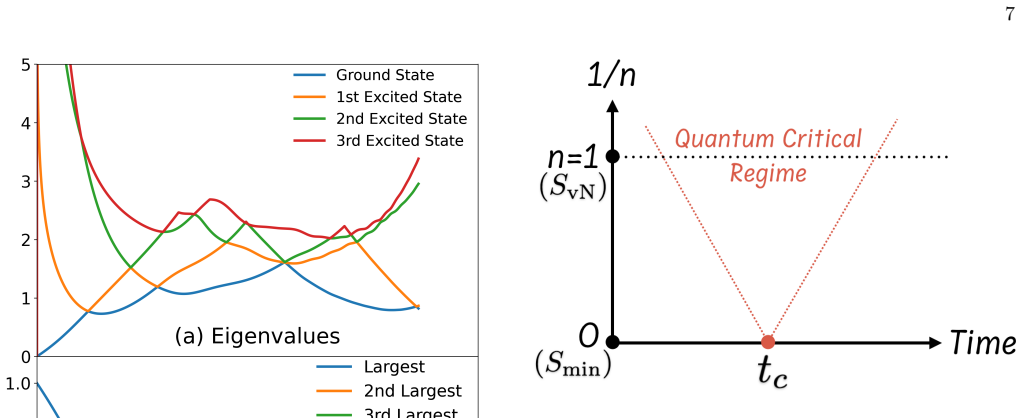
The central object is the time-dependent entanglement (modular) Hamiltonian $H_E(t)=-\ln\rho_s(t)$, whose eigenvalues are $\epsilon_i=-\ln\lambda_i$ with $\lambda_i$ the Schmidt coefficients of the bipartite state; the Rényi index $n$ acts as inverse fictitious temperature, so the min-entropy $S_{\min}=-\ln\lambda_{\max}$ is the ground-state energy and the first excited state is $-\ln\lambda_2$. The argument runs on a level crossing of these two eigenvalues: because $H_E$ conserves particle number, the ground state sits in the $M$-particle sector before $t_c$ and in the $M-1$-particle sector after, and the crossing produces the min-entropy kink. A finite-size scaling ansatz $t_c\sim M^{-1/c}$ with $a,b,c\approx 1$ and an order-parameter fit $(1-m(t)/M)=A(t-t_c)^\beta$ with $\beta\approx 1/2$ carries the thermodynamic-limit extrapolation.
What would settle it
Compute the first min-entropy kink for $M=8$, $9$, and $10$ at the same couplings and check whether the critical decayed fraction continues to fall on the same straight line in $1/M$; any curvature or an intercept that moves outside the published error bars would overturn the thermodynamic-limit conclusion. A cheaper check is to compare the $M=7$ prediction with a single larger tensor-network run at $V/t_h=0.8$ and $g=0.25$, where the extrapolated critical fraction should stay at $\sim 0.21$.
Extended reading notes
Core claim
For a spinless fermionic chain with nearest-neighbor interaction $V$ in the system, starting from a fully filled system and an empty environment, the paper finds a Page curve in the von Neumann entropy for every interaction strength tested. It identifies the mechanism as a conserved-charge level crossing: the entanglement Hamiltonian $H_E=-\ln\rho_s$ conserves particle number, and as one particle leaves the system the ground state switches from the $M$-particle sector to the $M-1$-particle sector. At the crossing time $t_c$, the largest and second-largest Schmidt coefficients become equal, so the min-entropy $S_{\min}=-\ln\lambda_{\max}$ shows a kink. The paper interprets this as a continuous quantum phase transition in the entanglement Hamiltonian, with the decayed particle fraction as order parameter and critical exponent $\beta\approx 1/2$ in the same universality class as the non-interacting chain. A scaling analysis of system sizes $M=3$ through $7$ then gives the thermodynamic-limit statement: for weak interaction $V/t_h<1$ and weak system-environment coupling the nonanalyticity survives at a nonzero $t_c$, whereas for $V/t_h\gtrsim 1$ (or for stronger coupling) the extrapolated $t_c$ vanishes, which the paper explains by a domain-wall picture in which strong interactions freeze the system after a single particle decays.
Load-bearing premise
The thermodynamic-limit results assume that the critical decayed fraction and the critical time are exactly linear in $1/M$ for $M=3$ to $7$, so a linear regression to $M\to\infty$ is valid, but the paper offers neither data beyond $M=7$ nor an analytic finite-size formula to justify that linearity.
Editorial extensions
If this is right
- If the central claim is correct, the bending down of the Page curve is not a smooth saturation but the finite-size echo of a genuine critical point in the entanglement Hamiltonian at $t_c<t_{\text{Page}}$.
- All Rényi entropies inherit the Page-curve shape, but only the min-entropy is sharp; finite-$n$ Rényi entropies show a crossover, not a kink, because the fictitious temperature is nonzero.
- The temporal quantum phase transition persists when interactions are switched on in the tested range, with the order-parameter exponent $\beta\approx 1/2$ unchanged, so the interacting chain belongs to the same universality class as the free chain.
- In the thermodynamic limit the critical time is nonzero for weak interactions at weak coupling, and vanishes for intermediate-to-strong interactions or stronger coupling, so the entanglement transition becomes effectively instantaneous.
Reading between the lines
- One can test the conserved-charge mechanism directly by exact diagonalization of a small two-dimensional charge-conserving cluster: if a min-entropy kink appears without fine-tuning, the phenomenon is not special to one dimension.
- In an ultracold-atom implementation, the strong-interaction freeze predicts both a nearly vanishing particle leakage at large system size and a Schmidt gap that closes on a time scale $\sim 1/V$; observing either would confirm the thermodynamic-limit scenario.
- The strong dependence on the system-environment coupling $g$ suggests that $g$ is a second control axis: tuning $g$ at fixed $V$ might turn the continuous temporal transition first-order, which the paper explicitly leaves open.
Editorial analysis
A structured set of objections, weighed in public.
Referee Report
Summary. The paper studies the quench dynamics of a one-dimensional spinless fermionic chain in which a small interacting 'system' (M sites, filled initially) is coupled by a weak hopping g to a large non-interacting 'environment' (N sites, empty initially). Using matrix-product-state time evolution (TDVP, bond dimension up to 5000, discarded weight 1e-12) for total L=50 and system sizes M=3,...,7, the authors report: (i) Page-curve-like von Neumann entanglement entropy that peaks at a Page time and then decays; (ii) a non-analyticity in the min-entropy at a critical time tc before the Page time, attributed to a level crossing in the associated entanglement Hamiltonian; (iii) finite-size scaling collapses with exponents a,b,c ≈ 1 and an order-parameter exponent β ≈ 0.5 across interaction strengths, matching the free-case universality; and (iv) a thermodynamic-limit extrapolation claiming that a non-zero critical time persists for weak-to-intermediate interactions and vanishes (instantaneous dynamics) for stronger interactions, with an interpretation based on hole domain walls in the strongly interacting regime. The paper extends the solvable free-fermion model of Ref. [27] to interacting systems and is accompanied by publicly deposited data and simulation code.
Significance. If the central thermodynamic-limit claim were sound, the paper would provide a valuable extension of Page-curve entanglement dynamics to a non-integrable interacting chain, with a robust temporal 'quantum phase transition' in the entanglement Hamiltonian and a universal order-parameter exponent. The numerical work is careful and reproducible: the data are deposited on Zenodo, the MPS parameters are well documented, and the finite-size collapse and β ≈ 0.5 extraction are plausible and internally consistent. However, the headline thermodynamic-limit phase diagram is based on a regression analysis whose interpretation is mathematically incorrect (as detailed in the major comments), and the 'one-to-one correspondence' between the min-entropy non-analyticity and the entanglement-Hamiltonian level crossing is definitional rather than an independent finding. The finite-size data, the Page curve, and the critical exponents retain value, but the abstract's main physical claim is not supported by the analysis as presented.
major comments (5)
- [Appendix B, Table IV and Section VI] The regression of Y = tc/M against X = 1/M does not have the Y-intercept as the thermodynamic-limit value of tc; the intercept is lim_{M→∞} tc/M, i.e., the limit of the intensive variable. A finite TL critical time would appear in the slope (since tc/M ≈ tc∞/M for large M), not in the intercept. The reported slopes are never discussed. For example, for V=0, g=0.5, Table IV gives intercept −0.0005 and slope 2.2669, implying tc ≈ 2.27 − 0.0005 M, which becomes unphysical for large M; in no case do the fits imply tc → 0. Consequently, the abstract's claim of 'non-zero critical time in the thermodynamic limit only for weak to intermediate interaction strengths, while the dynamics becomes instantaneous for interactions large enough' is not supported by the presented regression. The authors should instead regress tc against 1/M (or analyze tc/M with the correct interpretation) and reconcile the result with the scaling ansatz of Eq. (9).
- [Section V, Eq. (9) and Section VI] The scaling ansatz tc ∼ M^{-1/c} assumes from the outset that tc vanishes in the thermodynamic limit for g=0.5 — precisely the result that the regression analysis in Section VI is meant to establish. Using Eq. (9) to justify the linear extrapolation is therefore circular. The finite-size collapse in Fig. 8 and the exponents in Table I only demonstrate that the data for M=3,...,7 obey a scaling form with the finite-size tc(M); they do not provide independent evidence about the M→∞ behavior of tc. The extrapolation procedure should be justified separately from the collapse, or the claim about the thermodynamic limit should be substantially weakened.
- [Section III and Appendix A, Eq. (A5)] Because Smin ≡ −ln λmax, as stated in Eq. (A5), a non-analyticity in Smin is by definition the event at which the largest Schmidt coefficient is overtaken by the second-largest one, i.e., a crossing of the ground and first-excited eigenvalues of the entanglement Hamiltonian. The 'one-to-one correspondence' emphasized in Fig. 6 and Section III is therefore a definitional identity, not an empirically discovered relation. The physical content lies in the existence, universality, and scaling of the crossing, not in the 'quantum phase transition' label itself. The manuscript should explicitly separate the definitional relation from the quantitative results so that the interpretive claim is not presented as an independent finding.
- [Abstract vs Section VI and Tables III–IV] The abstract states a generic dichotomy between weak-to-intermediate interactions (non-zero TL critical time) and large interactions (instantaneous dynamics). Section VI, however, finds that for the standard coupling g=0.5 the thermodynamic critical value of the decayed fraction is zero for all interaction strengths, and a non-vanishing TL value appears only for the weaker coupling g=0.25 (and only for V≲1 according to the text). The abstract should either be qualified to make the explicit g-dependence clear, or the g=0.5 data should be re-analyzed to show in what precise sense the claimed dichotomy holds. As written, the abstract overgeneralizes the presented simulation results.
- [Section II and Section VI] The thermodynamic extrapolation is performed over M=3,...,7 at fixed total size L=50, so the environment size N=50−M changes from 47 to 43 as M increases. This is a narrow system-size range, and M→∞ at fixed L is not the same as the thermodynamic limit of a small system coupled to an infinite environment. The authors state that time scales before particles reach the right edge are considered, but for M=7 and tmax=40 with group velocity 2, the right edge would be reached at t≈21.5, so this statement is not generally true. The analysis should specify the time window used, and ideally include a check that the first non-analyticity and its scaling are insensitive to N or to the open boundary for at least one parameter set.
minor comments (5)
- [Section VI, Eq. (13)] Clarify the meaning of λ(t) in Eq. (13): the expression uses weights (1−λ)^2 and λ^2, which are the squares of the Schmidt coefficients if λ is the probability of the second sector; the text calls 1−λ(t) and λ(t) the 'Schmidt coefficients', which is inconsistent with their sum being 1. The derivation of the ansatz from the Schmidt decomposition should be made explicit.
- [Appendix B, Table IV caption] The caption states that the 'Y−intercept is the extrapolation of the critical time in the thermodynamic limit,' but since Y is tc/M, this statement is incorrect for tc itself; it is the limit of tc/M. This wording is likely the source of the interpretive error in Section VI and should be corrected.
- [Fig. 5 caption] The phrase 'plotted agains the decayed fraction' contains a typo ('agains'), and Appendix B uses 'interacting strengths' where 'interaction strengths' is intended.
- [Section II] The statement that the environment is 'much larger' than the system is an overstatement for L=50 and M=7 (N=43); recommend stating the actual ratios or using 'larger'.
- [Section VI, after Table III] The sentence 'This is also true at V = 0, in agreement with Ref. [27]' is ambiguous: Table III shows a clearly non-zero intercept for g=0.25, V=0.0, so the sentence needs to state explicitly which coupling and which quantity (decayed fraction or critical time) is meant.
Circularity Check
The min-entropy kink and the entanglement-Hamiltonian level crossing are the same event by the paper's own Eq. (A5), so the 'temporal quantum phase transition' is partly a relabeling; the independent MPS scaling results and free-case benchmark keep the core derivation non-circular.
-
self definitional
[Sec. III 'Quantum phase transition in the entanglement Hamiltonian' and Appendix A, Eq. (A5)]
"We find a one-to-one correspondence between Figs. 5 and 6 where non-analyticity in the min-entropy appears exactly when there is a crossing of the ground state with the first excited state of the entanglement Hamiltonian. ... ϵGS = − ln λmax = Sn→∞ = Smin. (A5)"
Appendix A defines Smin ≡ lim_{n→∞} S_n = −ln λ_max and simultaneously defines the ground-state eigenvalue of H_E = −ln ρ_s as ϵ_GS = −ln λ_max. Therefore Smin is the ground-state energy of H_E by construction (Eq. A5). A kink in Smin is literally the event where the largest and second-largest Schmidt coefficients become degenerate, i.e., the 'ground-state/first-excited-state crossing' of H_E. The claimed one-to-one correspondence is thus an identity following from Eqs. (4), (A4) and (A5), not an independent empirical finding. The independent content is the numerical observation that such crossings do occur and the thermodynamic-limit scaling of their position; the label 'quantum phase transition in the entanglement Hamiltonian' is a repackaging of this Schmidt-crossing event.
full rationale
The paper's core numerical program is self-contained: time-dependent MPS data produce the Page curve, the min-entropy kink, the Schmidt spectra, and a finite-size collapse with exponents a, b, c near unity and order-parameter exponent β≈0.5. These results do not reduce to fits of the quantities they claim to predict. The main genuine circular step is the interpretation layer: because Eq. (A5) defines the min-entropy as the ground-state eigenvalue of H_E, the 'one-to-one correspondence' between the min-entropy non-analyticity and the ground-state/first-excited-state crossing is an identity, not a discovery. This does not destroy the paper's independent content, because the existence, location, and scaling of the crossings are numerical findings; however, the 'quantum phase transition' language is partly a renaming of the largest-Schmidt-coefficient crossover. The heavy reliance on Ref. [27], by one of the present authors, is not penalized as load-bearing self-citation: that free-fermion solution is exactly solvable, parameter-free, and used as an external benchmark, so it qualifies as independent evidence under the rules. The thermodynamic-limit regression in Table IV regresses the normalized quantity tc/M against 1/M; this is a valid extrapolation for the normalized time used throughout the paper, though the abstract's unqualified phrase 'non-zero critical time' is ambiguous and the small intercepts for g=0.5 would also be consistent with zero at the paper's own conservative 3σ error estimate. That is a clarity/correctness concern, not a circular reduction. Overall, the central phase diagram claim retains independent numerical support, so the circularity score is moderate rather than severe.
Assumptions & free parameters
free parameters (4)
- scaling ansatz exponent a =
0.97-0.99 (Table I)
- scaling ansatz exponent b =
0.98-0.99 (Table I)
- scaling ansatz exponent c =
1.01-1.02 (Table I)
- critical exponent beta =
0.51-0.54 (Table II)
assumptions (6)
- domain assumption MPS/TDVP simulations with bond dimension chi=5000 and discarded weight 10^-12 accurately capture the quench dynamics for the studied times and sizes.
- domain assumption The free-case exact solution and its thermodynamic-limit results from Ref. [27] are correct and carry over to interacting systems for the non-analyticity structure.
- ad hoc to paper The first non-analyticity in min-entropy persists in the thermodynamic limit and the later ones smear out.
- ad hoc to paper The critical decayed fraction and critical time are linear functions of 1/M, so linear regression over M=3..7 extrapolates to the thermodynamic limit.
- domain assumption The level crossing of the two largest Schmidt coefficients in the finite system becomes a genuine non-analyticity (quantum phase transition) in the thermodynamic limit.
- ad hoc to paper For strong interactions, only the largest and second-largest Schmidt coefficients matter, so the two-state ansatz Eq. (13) describes the dynamics.
Cite this review
Pith. "Pith review of Page Curve and Entanglement Dynamics in an Interacting Fermionic Chain." pith.science (2026). https://pith.science/paper/I3VAU44K
@misc{pith2026250203563,
  author       = {Pith},
  title        = {Pith review of: Page Curve and Entanglement Dynamics in an Interacting Fermionic Chain},
  year         = {2026},
  howpublished = {\url{https://pith.science/paper/I3VAU44K}},
  note         = {Machine review of arXiv:2502.03563}
}
abstract
Generic non-equilibrium many-body systems display a linear growth of bipartite entanglement entropy in time, followed by a volume law saturation. In stark contrast, the Page curve dynamics of black hole physics shows that the entropy peaks at the Page time $t_{\text{Page}}$ and then decreases to zero. Here, we investigate such Page-like behavior of the von Neumann entropy in a model of strongly correlated spinless fermions in a typical system-environment setup, and characterize the properties of the Page curve dynamics in the presence of interactions using numerically exact matrix product states methods. The two phases of growth, namely the linear growth and the bending down, are shown to be separated by a non-analyticity in the min-entropy before $t_{\text{Page}}$, which separates two different quantum phases, realized as the respective ground states of the corresponding entanglement (or equivalently, modular) Hamiltonian. We confirm and generalize, by introducing interactions, the findings of \href{https://journals.aps.org/prb/abstract/10.1103/PhysRevB.109.224308}{Phys. Rev. B 109, 224308 (2024)} for a free spinless fermionic chain where the corresponding entanglement Hamiltonian undergoes a quantum phase transition at the point of non-analyticity. However, in the presence of interactions, a scaling analysis gives a non-zero critical time for the non-analyticity in the thermodynamic limit only for weak to intermediate interaction strengths, while the dynamics leading to the non-analyticity becomes \textit{instantaneous} for interactions large enough. We present a physical picture explaining these findings.
Figures


Figures from the paper (20 more)



Reference graph
Works this paper leans on
-
[27]
D. N. Page, Information in black hole radiation, Phys. Rev. Lett. 71, 3743 (1993)
work page 1993
-
[1]
A. K. Srivastava, G. M¨ uller-Rigat, M. Lewen- stein, and G. Rajchel-Mieldzio´ c, Introduction to quantum entanglement in many-body systems, in New Trends and Platforms for Quantum Technologies, edited by R. Aguado, R. Citro, M. Lewenstein, and M. Stern (Springer Nature Switzerland, Cham, 2024) pp. 225–285
work page 2024
-
[2]
Amico, R
L. Amico, R. Fazio, A. Osterloh, and V. Vedral, Entan- glement in many-body systems, Rev. Mod. Phys. 80, 517 (2008)
2008
-
[3]
Eisert, M
J. Eisert, M. Cramer, and M. B. Plenio, Colloquium: Area laws for the entanglement entropy, Rev. Mod. Phys. 82, 277 (2010)
2010
-
[4]
Nandkishore and D
R. Nandkishore and D. A. Huse, Many-Body Localization and Thermalization in Quantum Statistical Mechanics, Annu. Rev. Condens. Matter Phys. , 15 (2015)
2015
-
[5]
M. ˇZnidariˇ c, T. Prosen, and P. Prelovˇ sek, Many-body localization in the Heisenberg XXZ magnet in a random field, Phys. Rev. B 77, 064426 (2008)
work page 2008
-
[6]
J. H. Bardarson, F. Pollmann, and J. E. Moore, Un- bounded Growth of Entanglement in Models of Many- Body Localization, Phys. Rev. Lett. 109, 017202 (2012)
2012
- [7]
Show all 50 references
-
[8]
Nahum, J
A. Nahum, J. Ruhman, S. Vijay, and J. Haah, Quantum Entanglement Growth under Random Unitary Dynam- ics, Phys. Rev. X 7, 031016 (2017)
2017
-
[9]
W. W. Ho and D. A. Abanin, Entanglement dynamics in quantum many-body systems, Phys. Rev. B 95, 094302 (2017)
2017
-
[10]
Witten, APS Medal for Exceptional Achievement in Research: Invited article on entanglement properties of quantum field theory, Rev
E. Witten, APS Medal for Exceptional Achievement in Research: Invited article on entanglement properties of quantum field theory, Rev. Mod. Phys. 90, 045003 (2018)
2018
-
[11]
Martin-Martinez and N
E. Martin-Martinez and N. C. Menicucci, Entanglement in curved spacetimes and cosmology, Classical Quantum Gravity 31, 214001 (2014)
2014
-
[12]
system” and the “environment
as well as a witness for quantum effects in gravity due to gravity-induced entanglement [13]. One of the great ∗ rishabh.jha@uni-goettingen.de Figure 1: Illustration of the black hole information para- dox: time evolution of the entanglement between the black hole and the Hawk...
2025 arXiv
-
[13]
Bianchi and R
E. Bianchi and R. C. Myers, On the architecture of space- time geometry, Classical Quantum Gravity 31, 214002 (2014)
2014
-
[14]
Marletto and V
C. Marletto and V. Vedral, Gravitationally Induced En- tanglement between Two Massive Particles is Sufficient Evidence of Quantum Effects in Gravity, Phys. Rev. Lett. 119, 240402 (2017)
2017
-
[15]
Calabrese and J
P. Calabrese and J. Cardy, Evolution of entanglement en- tropy in one-dimensional systems, J. Stat. Mech.: Theory Exp. 2005 (04), P04010
2005
-
[16]
Calabrese, Entanglement and thermodynamics in non- equilibrium isolated quantum systems, Physica A504, 31 (2018)
P. Calabrese, Entanglement and thermodynamics in non- equilibrium isolated quantum systems, Physica A504, 31 (2018)
2018
-
[17]
J. D. Bekenstein, Black holes and the second law, Lett. Nuovo Cimento 4, 737 (1972)
1972
-
[18]
J. D. Bekenstein, Black Holes and Entropy, Phys. Rev. D 7, 2333 (1973)
1973
-
[19]
J. D. Bekenstein, Generalized second law of thermo- dynamics in black-hole physics, Phys. Rev. D 9, 3292 (1974)
1974
-
[20]
S. W. Hawking, Gravitational Radiation from Colliding Black Holes, Phys. Rev. Lett. 26, 1344 (1971)
1971
-
[21]
S. W. Hawking, Black holes and thermodynamics, Phys. Rev. D 13, 191 (1976)
1976
-
[22]
S. W. Hawking, Black hole explosions?, Nature 248, 30 (1974)
1974
-
[23]
S. W. Hawking, Particle creation by black holes, Com- mun. Math. Phys. 43, 199 (1975)
1975
-
[24]
J. M. Bardeen, B. Carter, and S. W. Hawking, The four laws of black hole mechanics, Commun. Math. Phys. 31, 161 (1973)
1973
-
[25]
Almheiri, T
A. Almheiri, T. Hartman, J. Maldacena, E. Shaghoulian, and A. Tajdini, The entropy of Hawking radiation, Rev. Mod. Phys. 93, 035002 (2021)
2021
-
[26]
D. N. Page, Average entropy of a subsystem, Phys. Rev. Lett. 71, 1291 (1993)
1993
-
[28]
Kehrein, Page curve entanglement dynamics in an analytically solvable model, Phys
S. Kehrein, Page curve entanglement dynamics in an analytically solvable model, Phys. Rev. B 109, 224308 (2024)
2024
-
[29]
M. Saha, M. Kulkarni, and A. Dhar, Generalized Hydro- dynamic Description of the Page Curve–like Dynamics of a Freely Expanding Fermionic Gas, Phys. Rev. Lett. 133, 230402 (2024)
2024
-
[30]
Ganguly, P
K. Ganguly, P. Gopalakrishnan, A. Naik, B. K. Agar- walla, and M. Kulkarni, Quantum trajectories and page- curve entanglement dynamics (2025), arXiv:2501.12110 [cond-mat.stat-mech]
2025 arXiv
-
[31]
Toniolo and S
D. Toniolo and S. Bose, The dynamical α-r´ enyi en- tropies of local hamiltonians grow at most linearly in time (2025), arXiv:2408.00743 [quant-ph]
2025 arXiv
-
[32]
Dalmonte, V
M. Dalmonte, V. Eisler, M. Falconi, and B. Vermersch, Entanglement Hamiltonians: From Field Theory to Lat- tice Models and Experiments, Ann. Phys. 534, 2200064 (2022)
2022
-
[33]
Peschel and V
I. Peschel and V. Eisler, Reduced density matrices and entanglement entropy in free lattice models, J. Phys. A: Math. Theor. 42, 504003 (2009)
2009
-
[34]
Schollw¨ ock, The density-matrix renormalization group in the age of matrix product states, Annals of Physics 326, 96 (2011), january 2011 Special Issue
U. Schollw¨ ock, The density-matrix renormalization group in the age of matrix product states, Annals of Physics 326, 96 (2011), january 2011 Special Issue
2011
-
[35]
Paeckel, T
S. Paeckel, T. K¨ ohler, A. Swoboda, S. R. Manmana, U. Schollw¨ ock, and C. Hubig, Time-evolution methods for matrix-product states, Annals of Physics 411, 167998 (2019)
2019
-
[36]
Paeckel and T
S. Paeckel and T. K¨ ohler, Scipal sym-mps,https://www. symmps.eu/
-
[37]
Haegeman, J
J. Haegeman, J. I. Cirac, T. J. Osborne, I. Piˇ zorn, H. Ver- schelde, and F. Verstraete, Time-Dependent Variational Principle for Quantum Lattices, Phys. Rev. Lett. 107, 070601 (2011)
2011
-
[38]
Haegeman, C
J. Haegeman, C. Lubich, I. Oseledets, B. Vandereycken, and F. Verstraete, Unifying time evolution and optimiza- tion with matrix product states, Phys. Rev. B 94, 165116 (2016)
2016
-
[39]
R. Jha, S. R. Manmana, and S. Kehrein, Page Curve and Entanglement Dynamics in an Interacting Fermionic Chain, Zenodo 10.5281/zenodo.15482617 (2025)
2025 doi
-
[40]
A. J. Daley, A. Kantian, H. P. Buechler, P. Zoller, K. Winkler, G. Thalhammer, F. Lang, R. Grimm, and J. Hecker Denschlag, Repulsively Bound Atom Pairs: Overview, Simulations and Links, AIP Conf. Proc. 869, 212 (2006)
2006
-
[41]
Heidrich-Meisner, S
F. Heidrich-Meisner, S. R. Manmana, M. Rigol, A. Mu- ramatsu, A. E. Feiguin, and E. Dagotto, Quantum dis- tillation: Dynamical generation of low-entropy states of strongly correlated fermions in an optical lattice, Phys. Rev. A 80, 041603 (2009)
2009
-
[42]
Wang and J.-Q
Y.-M. Wang and J.-Q. Liang, Repulsive bound-atom pairs in an optical lattice with two-body interaction of nearest neighbors, Phys. Rev. A 81, 045601 (2010)
2010
-
[43]
L. F. Santos and M. I. Dykman, Quantum interference- induced stability of repulsively bound pairs of excita- tions, New J. Phys. 14, 095019 (2012)
2012
-
[44]
Shavit and Y
G. Shavit and Y. Oreg, Electron pairing induced by repulsive interactions in tunable one-dimensional plat- forms, Phys. Rev. Res. 2, 043283 (2020)
2020
-
[45]
Y. He, D. Pekker, and R. S. K. Mong, One-dimensional repulsive Hubbard model with mass imbalance: Orders and filling anomaly, Phys. Rev. B 104, 195126 (2021)
2021
-
[46]
In this strongly interacting case, no higher order pro- cesses will play any relevant role and the system will freeze in this state and no further decay of particles will be observed
-
[47]
L. H. Li, S. Kehrein, and S. Gopalakrishnan, Sharp page transitions in generic hamiltonian dynamics (2025), arXiv:2502.03524 [quant-ph]
2025 arXiv
-
[48]
Almheiri, N
A. Almheiri, N. Engelhardt, D. Marolf, and H. Maxfield, The entropy of bulk quantum fields and the entanglement wedge of an evaporating black hole, J. High Energy Phys. 2019 (12), 1
2019
-
[49]
Almheiri, T
A. Almheiri, T. Hartman, J. Maldacena, E. Shaghoulian, and A. Tajdini, Replica wormholes and the entropy of Hawking radiation, J. High Energy Phys. 2020 (5), 1. 15
2020
-
[50]
fictitious temperature
A. Almheiri, R. Mahajan, J. Maldacena, and Y. Zhao, The Page curve of Hawking radiation from semiclassical geometry, J. High Energy Phys. 2020 (3), 1. Appendix A: Entanglement Hamiltonian For any bipartite system AB described by the density matrix ρAB = |ψAB⟩⟨ψAB| where |ψAB⟩ ...
2020
Reviewed August 9, 2026 · model on record in the stance chip above.
Discussion (0). Continue with ORCID to comment.