REVIEW 3 major objections 5 minor 16 references
The Last Meridian Circles of Pulkovo Observatory
T0 review · 3 major / 5 minor · reviewed 2026-08-09 · deepseek-v4-flash
Pith's one-line read This paper argues that the meridian-circle epoch at Pulkovo Observatory ended with the MK-200, the Kislovodsk Ertel-Struve instruments, and the Sukharev Horizontal Meridian Circle.
desk verdict A readable, photo-rich memoir of Pulkovo's final meridian circle programs, but its end-of-era claim needs archival backing before I'd treat it as definitive history. read the letter →
The pith
A machine-rendered reading of the paper's core claim, the machinery that carries it, and where it could break.
The reading
What carries the argument
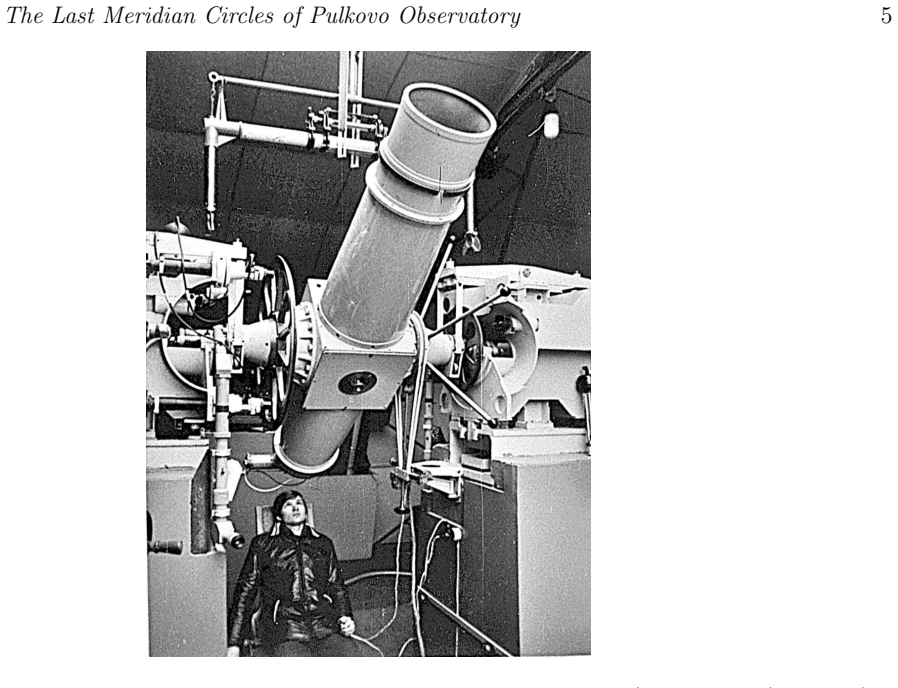
The carrying object is the meridian circle itself: a telescope that rotates only in the plane of the meridian and combines a timing of a star's transit with a measurement of its zenith distance to fix both celestial coordinates. The technical details that carry the narrative are the MK-200's scanning photoelectric micrometer with a V-shaped slit pair driven at constant speed relative to a moving star image, its CCD-based automatic circle readers, and the Sukharev Horizontal Meridian Circle's flat-mirror design with electronic control for automatic observations. Together these mechanisms show the last Pulkovo meridian circles working at the technical frontier of ground astrometry, which is precisely what made their replacement by space astrometry visible.
What would settle it
Look in the observatory's archived observing logs and publication lists: any meridian-circle transit recorded after the early 2000s, or a discrepancy with the cited Kislovodsk counts of 566 solar, 230 Mercury, 413 Venus, and 207 Mars declinations, would show the 'last' claim is not the full story.
Extended reading notes
Core claim
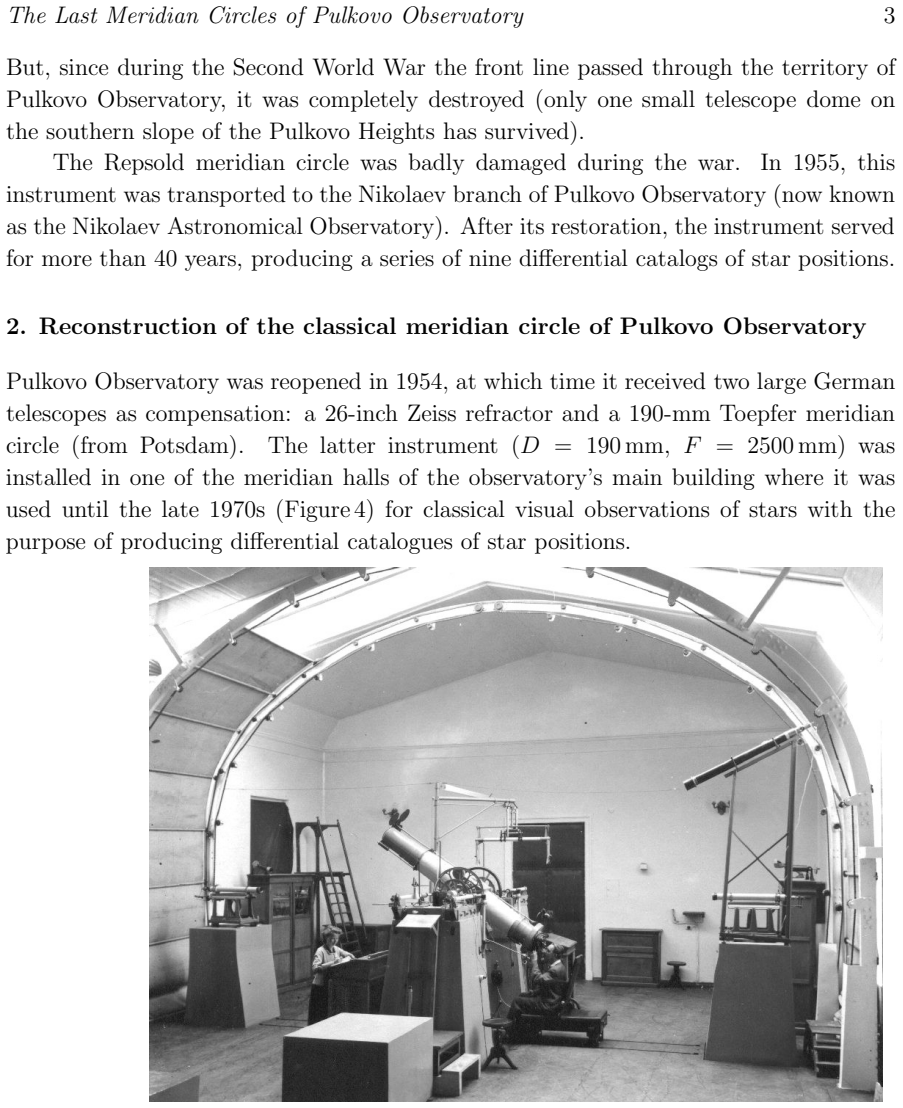
The central claim is that the meridian-circle epoch at Pulkovo Observatory ended with the instruments and programs described here. After the war destroyed the observatory and badly damaged the Repsold circle (later sent to Nikolaev), the reopened observatory received the Toepfer circle, which was rebuilt as MK-200 with a 200-mm blue-optimized objective, a scanning V-shaped slit photoelectric micrometer, and CCD circle readers; this instrument was Pulkovo's main meridian-circle effort from the 1980s onward. At the Kislovodsk Mountain Station, the two Ertel-Struve instruments originally acquired by Struve were reinstalled in 1984 and produced 566 solar, 230 Mercury, 413 Venus, and 207 Mars declinations, with comparable right-ascension counts, before returning to the museum in 1989. The Sukharev Horizontal Meridian Circle, built in 1960 and automated in the 1980s, produced differential catalogues until the early 2000s, and a planned giant near-infrared meridian circle with autocollimating optics on an ultra-low-expansion glass-ceramic block was started but halted when the economy collapsed. The paper concludes that with these observations the epoch of meridian circles had finished at Pulkovo, with the fundamental frame now maintained by very-long-baseline radio interferometry and space astrometry while the observatory's continued astrometry targets near-Earth objects.
Load-bearing premise
The account rests on the author's personal recollections, photographs, and earlier self-published reports; if those sources are incomplete or inaccurate, the history of the last instruments would be incomplete.
Editorial extensions
If this is right
- If the paper is right, the end date for ground meridian astronomy at Pulkovo is fixed: the Sukharev Horizontal Meridian Circle's automatic catalogues in the early 2000s are the last meridian-circle data from the observatory.
- The 1984–1989 Kislovodsk campaign becomes the final scientific use of Struve's original Ertel-Struve instruments, so their museum display marks the closure of that instrument lineage.
- The MK-200's photoelectric scanning micrometer is the endpoint of classical meridian-circle technique at Pulkovo; the next step would have been the infrared meridian circle, which was never completed.
- Because Hipparcos and Gaia now maintain the fundamental frame, the loss of these instruments did not create a gap in coordinate astronomy; Pulkovo's remaining astrometry is directed at near-Earth objects with different telescopes.
Reading between the lines
- A testable extension the author leaves implicit: checking observatory archives against the claimed end dates and Kislovodsk observation counts would turn this memoir into a documented historical record.
- The abandoned giant near-infrared meridian circle, with its autocollimating optics and Astrositall block, could plausibly be revisited as a ground-based complement to Gaia-era astrometry, although the paper only reports its termination.
- The pattern implies that meridian circles became obsolete not from neglect but from solving their own technical problems: once photoelectric scanning and automatic circle reading made them fast and accurate, space astrometry could replace them.
Editorial analysis
A structured set of objections, weighed in public.
Referee Report
Summary. This paper is a historical sketch of the final decades of meridian-circle observations at Pulkovo Observatory. It describes the reconstruction of the Toepfer meridian circle into the MK-200 with photoelectric and CCD devices, the installation of two Ertel-Struve instruments at the Kislovodsk Mountain Station from 1984 to 1989, and the development and use of the Sukharev Horizontal Meridian Circle. The paper concludes that with these observations, the epoch of meridian circles finished at Pulkovo, and that the fundamental coordinate system is now maintained by VLBI and space astrometry such as Gaia. The narrative is based on the author's personal recollections, photographs, and mostly self-cited publications; no independent archival sources are cited.
Significance. If the historical claims are accurate, the paper is a valuable first-hand technical and historical record of instruments that are now museum pieces. It provides specific dates, personnel, technical details (e.g., the active V-slit scanning micrometer, the CCD circle-reading system, and the Astrositall optics), and observational output (such as the counts of solar and planetary declinations). This kind of material is rarely published in journal form and could be useful to historians of astronomy and to studies of the transition from ground-based meridian astrometry to space astrometry. The strengths are the specificity of the recollection and the documentation of the design lineage from MK-200 to the planned infrared meridian circle. The main weakness is evidentiary: the account is largely unsupported outside the author's own papers, so the factual reliability of the end-of-era claim cannot yet be independently checked.
major comments (3)
- [Abstract and §5] The central claim that 'the epoch of meridian circles had finished at Pulkovo Observatory' with these observations is not supported by explicit termination dates. Section 2 describes the MK-200 reconstruction but never gives the date when MK-200 observations ended. Section 4 states that a series of four automatic horizontal meridian circles based on Sukharev's design [11] 'were active until the early 2000s' without specifying which, if any, were located at Pulkovo or when the original Pulkovo Sukharev HMC made its last observation. If a Sukharev-type instrument at Pulkovo operated into the 2000s, the abstract's 'last quarter of the XX century' framing and the §5 conclusion would need to be qualified. Please add a chronological table of each Pulkovo meridian-circle instrument with its first and last observation dates and the corresponding sources.
- [§2–§4] The factual basis for the historical claims is almost entirely the author's memory and photographs, supported by self-citations [1,2,4,5,6,7,10,11] and co-authored works; no independent archival sources (observatory annual reports, observing logs, or third-party catalogues) are cited. This is a load-bearing issue because the paper's main assertion is an endpoint claim about which instrument was last. At minimum, the paper should cite one independent document or clearly label the end-of-era claim as an unverified personal recollection.
- [§4] The text says that a cooperation 'led to the creation of a series of four automatic horizontal meridian circles based on the Sukharev's design [11]' and that 'they were active until the early 2000s,' but reference [11] is titled 'L. A. Sukharev, Pulkovo Meridional Automatic Horizontal Instrument (MAGIS),' which suggests a single instrument. Please clarify whether [11] actually documents four instruments, what their locations were, and which of them counts as a Pulkovo instrument; this is necessary to assess the 'finished at Pulkovo' claim.
minor comments (5)
- [Figure 9 caption] The Figure 9 caption in §2 is grammatically broken ('The control cabin of MK-200 (Figure 9) The room-temperature cabin...'); please rewrite it as a complete sentence.
- [References] Reference [14] contains a typo: 'Optical Nelescopes' should be 'Optical Telescopes.'
- [§3] The statement 'Similar numbers of right ascensions were obtained by the Ertel-Struve large transit instrument' is vague; please give the actual counts or state explicitly that they are reported in references [8,9].
- [References] Reference [15] has an access date of 25.02.2025, which postdates the arXiv submission of 5 Feb 2025; please verify the access dates or update the reference list.
- [§2] The phrase 'it was renamed to be MK-200' is awkward; suggest 'the instrument was renamed MK-200.'
Circularity Check
No significant circularity: this is a historical narrative supported by independent technical references and archival material, not a derivation that reduces to its own inputs.
full rationale
The paper is an historical sketch rather than a quantitative derivation, so the usual circular-derivation failure modes do not apply. There is no equation in which an output is defined in terms of an input, no fitted parameter renamed as a prediction, and no uniqueness theorem invoked from prior work. The central claim that meridian-circle work ended at Pulkovo is an empirical historical statement supported by descriptions of specific instruments, observation intervals, and references to external publications such as the Kanaev et al. paper on the Pulkovo MAGIS instrument and the Devyatkin et al. papers on the Kislovodsk observations. The author's own earlier technical papers are cited for instrumental details, but those details are not used as premises that force the historical conclusion; they are background evidence. Even if the termination dates or completeness of the historical record could be questioned, that would be a factual-support concern, not a circularity. The paper does not rename a known result or smuggle an ansatz in by citation. Therefore the appropriate finding is no significant circularity.
Assumptions & free parameters
assumptions (1)
- domain assumption The author's personal recollections, photographs, and self-cited publications accurately represent the history of Pulkovo meridian circles.
Cite this review
Pith. "Pith review of The Last Meridian Circles of Pulkovo Observatory." pith.science (2026). https://pith.science/paper/LCVU4VCX
@misc{pith2026250203583,
  author       = {Pith},
  title        = {Pith review of: The Last Meridian Circles of Pulkovo Observatory},
  year         = {2026},
  howpublished = {\url{https://pith.science/paper/LCVU4VCX}},
  note         = {Machine review of arXiv:2502.03583}
}
read the original abstract
Meridian circles played a fundamental role in astronomy since their invention in 1704. Then, at the end of the XX century, this function had been taken over by space astrometry, when the Hipparcos mission demonstrated the advantages of space astrometry by achieving the milliarcsecond level of accuracy. This historical sketch describes the development of the last meridian circles at Pulkovo Observatory (St. Petersburg) in the last quarter of the XX century.
Figures


Figures from the paper (9 more)



Reference graph
Works this paper leans on
-
[11]
I. I. Kanaev, T. R. Kir’yan, N. A. Shkutova, A. V. Shumakher, K. N. Naumov, A. V. Devyatkin, V. V. Nikiforov, O. P. Rusakov, I. N. Kondratenko, D. L. Gorshan ov, and V. V. Kupriyanov, L. A. Sukharev ,Pulkovo Meridional Automatic Horizontal Instrument (MAGIS), J. Opt. Techn. 2010, 77 (4), 257-263. https://doi.org/10.1364/JOT.77.000257
-
[1]
Yershov V.N., Zhilinsky E.G., Pliss V.E., Sokolov G.O., Streletskij Yu. S., P hotoelectric active micrometer for a meridian circle, in “Problems of Astrometry”, Mosc ow State University Publ., 1984, 196-201
work page 1984
-
[2]
Ershov V.N., Pliss V.E., Streletsky Yu.S., The photoelectric meridian c ircle of the Pulkovo, in Astrometric Techniques: Proc. of the 109th IAU Symp., ed. H.K.Eich horn and R. Leacock, Reidel Publ., Dordrecht Holland (1986) 407-412
work page 1986
-
[3]
Høg E., A Scanning Micrometer with On-Line Computer, Astrophys . Space Sci. 1971, 11, 22-27. https://doi.org/10.1007/BF02385016
-
[4]
Arutyunov, V. A., Ershov, V. N., Ostrensky, Y. G., A Circle Readin g System on CCD Array for the Photoelectric Meridian Circle, Astronomicheskii Tsirkulyar, 142 2/FEB, 1986, p.6
work page 1986
-
[5]
Yershov V. N., Giant Meridian Circle-Reflector, Astronomical and astrophysical objectives of sub-milliarcsecond optical astrometry, Proc. of the 166th IAU Sy mp., Hague, Netherlands, August 15-19, 1994 Ed. E. Høg, P. K. Seidelmann, Kluwer Acad. Pub l., Dordrecht, 1995, 360. https://doi.org/10.1007/978-94-011-0069-4 69
-
[6]
N., PbS and CCD Array Autocollimation Micrometers for the Infrared Meridian Circle, Proc
Yershov V. N., PbS and CCD Array Autocollimation Micrometers for the Infrared Meridian Circle, Proc. of the 167th IAU Symp., Ed. A. G. D. Philip, K. A. Janes and A. R . Upgren, Kluwer Acad. Publ., Dordrecht, 1995, 337-338. Bibl. code: 1995IAUS..167 ..337Y
work page 1995
-
[7]
Yershov V. N., Nemiro A. A., An Autocollimation Circle Reading System for the Infrared Meridian Instrument, Proc. of the 166th IAU Symp., Hague, Netherlands, August 15-19, 1994 Ed. E. Høg, P. K. Seidelmann, Kluwer Acad. Publ., Dordrecht, 1995, 361. https ://doi.org/10.1007/978-94- 011-0069-4 70
doi:10.1007/978-94- 1994
Show all 16 references
-
[8]
(e ds) IAU Vol.141 (1990)
Devyatkin, A.V., Gnevysheva, K.G., Equator and Ecliptic FK5 Positio ns on the Basis of Sun and Planets Observations by the Ertel-Struve Vertical Circle at the Kis lovodsk Mount Station, in: Inertial Coordinate System on the Sky Lieske, J.H., Abalakin, V.K. (e ds) IAU Vol.141 (...
1990 doi
-
[9]
& Baturina, G.D
Devyatkin, A.V., Gnevysheva, K.G. & Baturina, G.D. Results of ast rometrical observations of the Sun and major planets at the mountain astronomical station of the Pulkovo Observatory. Sol. Syst. Res, 2009, 43, 533–542. https://doi.org/10.1134/S00380 94609060082
2009 doi
-
[10]
Pinigin G.I., Telescopes of the ground-based optical astrometr y, Nikolaev Astron. Obs. Publ., 2000, 104 pp. ISBN 966-7726-14-2 (in Russian)
2000
-
[12]
V., Gorshanov D
Devyatkin A. V., Gorshanov D. L., Yershov V. N., Melnikov A. V., Ma rtyusheva A. A., Petrova S. N., L’vov V. N., Tsekmeister S. D., Naumov K. N., A study of the asteroid (367943) Duende at Pulkovo Observatory; Mon. Not. Royal Astr . Soc., 2016, 459, 3986-3997. https://doi.org/...
2016 doi
-
[13]
et al., Gaia Early Data Release 3
Lindegren L., Klioner S.A., Hernandez J., Bombrun A., Ramos-Lera te M., Steidelm¨ uller H., The Last Meridian Circles of Pulkovo Observatory 11 Bastian U., Biermann M. et al., Gaia Early Data Release 3. The astromet ric solution, Astron. & Astrophys., 2021, 649, id.A2, 35 pp. ...
2021 doi
-
[14]
Theory and construction, “ Nauka” Publ., Moscow 1976 (512 pp.) 282-287
Mikhelson N.N., Optical Nelescopes. Theory and construction, “ Nauka” Publ., Moscow 1976 (512 pp.) 282-287
1976
-
[15]
Deviatkin A., Zinoviev S., Yershov V., Karashevich S., Mashianova N ., Chistyakov F, Soviet Telescope in Chile: To restore or to abandon? 2015, online article URL : azt16.mystrikingly.com (accessed: 25.02.2025)
2015
-
[16]
Alonso P.I., Palmarola H., The Soviet Maksutov AZT-16 Telescope in Chile, Revista Indexada de Textos Academicos 2022, 18(10) 182-201 DOI 10.241 92/2386-7027(2022)(v18)(10) https://redfundamentos.com/article-view.php?id=49 (accessed : 25.02.2025)
2022
Reviewed August 9, 2026 · model on record in the stance chip above.
Discussion (0). Continue with ORCID to comment.