Strange-metal data back holography
ARPES power-law self-energies in cuprates support a common core theory shared by metal and black hole, the paper argues.
· “Holographic Strange Metals for Philosophers and Physicists”

History and Philosophy of Physics
History and philosophy of all branches of physics, astrophysics, and cosmology, including appreciations of physicists.
sort pith recommended most recent
ARPES power-law self-energies in cuprates support a common core theory shared by metal and black hole, the paper argues.
· “Holographic Strange Metals for Philosophers and Physicists”
Quantum matter sources a classical Einstein tensor, with the metric re-glued continuously along future light cones of collapses.

A new historical taxonomy maps how physicists and philosophers interpreted two singularities from 1916 to the late 1960s.
A complexity measure that ignores grue-like rewrites of models reproduces the choices scientists actually make.
· “A not-too-simple solution to Goodman's new riddle of induction in the age of AI”
New translation shows Lambert's plan for synchronized observations and shared registers, decades before official networks.

A 40-person replication poll finds the same split as the 1990s, with swings driven by conference crowds.
· “Has Anything Changed? Tracking Long-Term Interpretational Preferences in Quantum Mechanics”

Quantum mechanics shows science yields no unique theory choice, so anti-exceptionalism could rest on antirealist foundations.
· “Disentangling scientific realism from anti-exceptionalism”
Einstein's own words: the wave-function description must be incomplete or accept action-at-a-distance.

A single-frame electromagnetic calculation derives both effects from forces on a bound electron.

A philosopher's guide separates logical worlds, quantum branches, and cosmic bubbles—and gives each its own verdict.
Erasing a bit can be heat-free when the value is unknown or when a single time-varying field steers both initial states to 0.
· “Energy and information: a chronicle of hesitations on the role of the observer in physics”

It frames the clash between conventional and axiomatic QFT as a ratio of realist to instrumental structures.

A reanalysis credits Chien-Shiung Wu with the first controlled quantum entanglement, ahead of later Bell tests.
· “Chien-Shiung Wu as the experimental pioneer in quantum entanglement: a 2022 note”
The MK-200, the Kislovodsk classics, and the Sukharev circle closed the tradition as space astrometry took over.

If local conservation of charge holds in 3D space, the field equations must take Maxwellian form, and Newtonian physics fails.
· “On the "Universality" of the Form of Maxwell's Equations”
Parisi's terse 1970s notes made the parton model a field-theoretic result, not a guess.
· “Asymptotic Freedom in Parton Language: the Birth of Perturbative QCD”
Measurement, entanglement, and Born probabilities become Bayesian updates and utility-weighted predictions.
· “Algorithmic Idealism III: "Algorithmic State" Formulation of Quantum Mechanics”
Measurements are islands, meta-perspectives are continents, and the whole Hilbert lattice is a unified reality that no observer can exhaust.
The review traces how supersymmetric methods produced exact solutions and entropy counts from charges alone.
Algorithmic idealism also dissolves Boltzmann brains and the simulation divide.
· “Algorithmic Idealism I: Reconceptualizing Reality Through Information and Experience”
Once ideal clocks and infinite boundaries are dropped, only frame-relative descriptions of spacetime remain.
A ±1 two-particle eigenvalue separates Z2xZ2 parabosons from ordinary bosons, opening a lab test route.
· “On the detectability of paraparticles beyond bosons and fermions”
Reconstructed skies tie Moonrise's red moon to the 1889 eclipse and Starry Night to 19th-century astrophysics.
· “The lunar eclipse and the dawn of astrophysics in van Gogh's masterpieces”
A 163-measurement history shows quoted error bars were too small; the claimed 4.4-sigma anomaly is a 1-in-28 fluctuation, not a crisis.
· “Underestimation of Hubble constant error bars: a historical analysis”
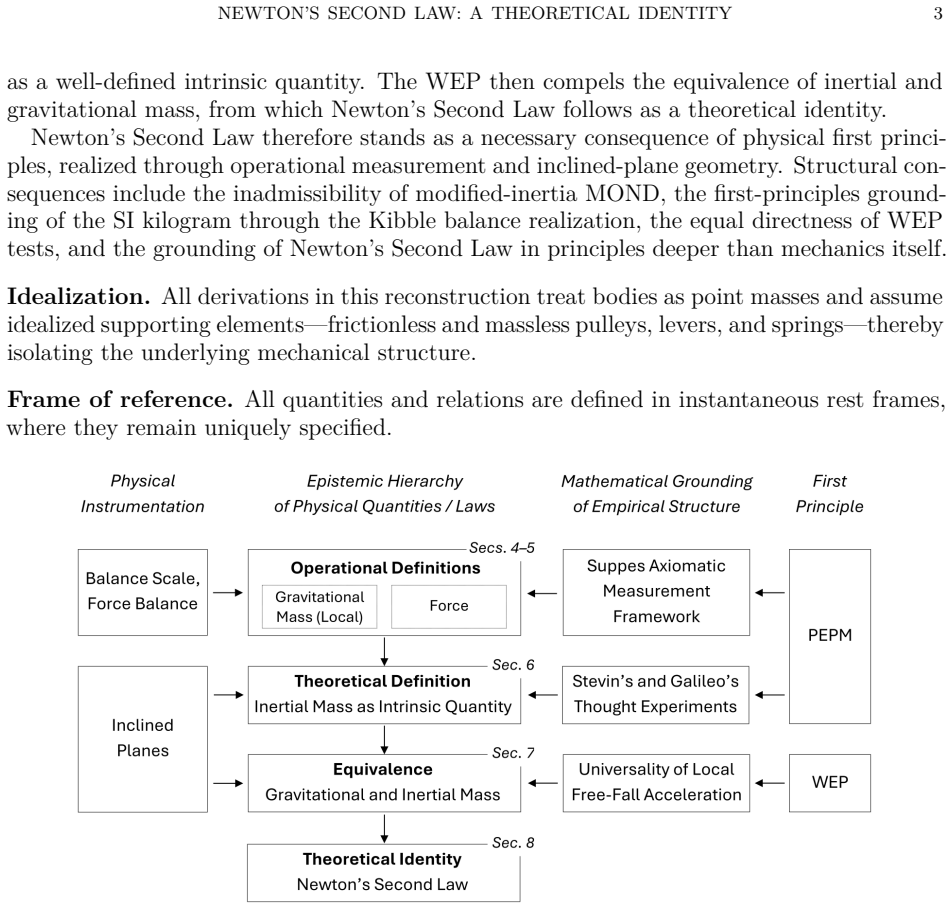
A new derivation gets F=ma out of two physical principles, making it an identity between measured quantities.
Strip away absolute size: a total collapse and an infinite dispersal end at the same critical shape.

Absolute uncertainty and the POVM theorem both depend on information tied to particle positions.
Even smooth bijections like the cube function yield superluminal velocities, so an external physical rule is needed

LLM-based world models would let agents learn from self-generated experience.
· “The Missing Reward: Active Inference in the Era of Experience”
A realist reading of the wave function makes it a 3D object with genuinely unsettled values at empty points.
Why is there something? Two kinds of nothing meet at a boundary to make matter.
· “On something and nothing: The interface of two types of nothing”
The paper also recovers his forgotten 1894 report on an apparent rotation of NGC205.
If quantum indeterminacy is genuinely open, phenomenal properties can act causally, making consciousness foundational.
· “Quantum panprotopsychism and a consciousness-centered universe”
The First Law supplies the inertial frame the Second Law needs; the paper also proposes a Zeroth Law for mass.
· “Newtons First Law Is Not a Special Case of the Second Law”

A new framework models quantum systems as introspective streams of qualia, embedding the observer inside the theory.
· “Beyond the Wavefunction: Qualia Abstraction Language Mechanics and the Grammar of Awareness”
From Kramers-Wannier to gauge-gravity, dual theories become one structure in different words.
For a five-dimensional gravity theory, Jordan axiomatized differentiation without parallel transport.
Quantum correlations violate Balke-Pearl bounds, so joint exogeneity fails even though the true causal effect is zero.

Experts rate each question's difficulty and surprise; the scores separate real reasoning from mere recall.

Gödel, Tarski, and Chaitin imply a complete theory of everything needs non-computable understanding.
· “Consequences of Undecidability in Physics on the Theory of Everything”
Pragmatic virtues like simplicity cannot replace the claim that the framework itself is true.
· “Antirealism in sheep's clothing: Wave function realism and scientific realism”
Relativity suggests positions and spins exist only relative to a frame, so the world's furniture is modal structure.
· “Relational Observables, Quiddities, and Structural Realism”
A supervenience relation on empirical structure lets physicalism avoid both horns of Hempel's dilemma.
· “Empirical structure physicalism and realism, Hempel's dilemma, and an optimistic meta-induction”
The Italian original and a new English version bring the slow-neutron discovery back into reach.
· “Slow neutrons in Palermo: a forgotten conference by Enrico Fermi”
If true, quantum correlations need no action at a distance—just the choice of initial state, backed by the low-entropy past.

The West Ford needle-belt backlash made 'harmful interference' consultation law, setting a precedent for today's satellites.

A nested-observer version of the friend-in-the-box experiment shows that absolute facts cannot survive universal quantum mechanics.
The clamped-nuclei step fixes nuclear positions as classical parameters, blocking a clean reduction of chemistry to physics.
· “What are we talking about when we discuss the Born-Oppenheimer approximation?”
Without microphysical causes, logical and physical constraints still explain why things begin selectively.
· “Without microphysical causation, just anything cannot begin to exist just anywhere”
The winner solved more problems, fit established physics, and promised independent tests; dark energy shows why.
· “Why did the dark matter hypothesis supersede modified gravity in the 1980s?”
The paper integrates responsibility ethics, existential risk, and posthuman ontology into one research agenda.
No single successor to classical temperature survives general relativity, because time itself fragments.
· “The Toll of the Tolman Effect: On the Status of Classical Temperature in General Relativity”

Re-reading the 1924 thesis: each microscopic system carries its own units, not the lab's
Upper bounds: under one proton per litre every 10^30 years; no massless photon creation.

A master bi-trajectory measure, not a quantum state, becomes the system itself — and the Heisenberg cut disappears.
· “Phenomenological quantum mechanics II: deducing the formalism from experimental observations”
Euclid's definition of proportion excludes zero, so the second law could not cover the no-force case.
A new account shows why Fermi theory can stand in for the Standard Model, and why new-physics searches cannot.

With no new particles and no new collider, pursuit shifts to radical novelty and cheap tests, the paper argues.

The paper defines model independence as no target model plus a well-defined background, then shows autoencoders meet the bar.

Machines can mimic choice but never originate ends, discover means, or signal value through prices.
· “Epistemic Scarcity: The Economics of Unresolvable Unknowns”
A derivation shows the projector structure and Born rule follow from propositions being unobservable.

Identity-linked, blockchain-anchored commentary could make null results and retractions count as scholarship.
An undated pamphlet by Cassini's great-grandson documents Delambre's unfair account of lunar libration.
· “A Cassini pamphlet against Delambre on lunar libration and other issues”

His 1928 tunneling model launched nuclear quantum mechanics; he later pioneered electrochemistry and latent-image theory.
· “The physics, travels, and tribulations of Ronald Wilfrid Gurney”

Pareto-tail outliers in a cooling gas form low-entropy clusters; gravity-like attraction makes them persist.
An English text plus the Latin original shows how conservation of vis viva drove early hydrodynamics.
A quantum-age revival of the old energetics view recasts fields and quanta as bookkeeping for energy.
Fifty years after the J/psi, the last quarkonium sibling may have appeared at the LHC.
Personal memories plus textbook and software presence make the case that the man behind the Petrov types was undervalued at home.

The paper argues his 1974 equations already contained the Altarelli-Parisi ones.

Read Boltzmann's own 1898 argument that entropy curves fluctuate, and a new formula for how bias multiplies humps.
· “A commented translation of Boltzmann's work, "Ueber die sogenannte H-Curve."”

The same vector is certain in one basis and uncertain in another, so the standard notion is self-contradictory.
· “On the Physical Untenability of the Standard Notion of Quantum State”
If correct, quantum randomness is branching, not an open unreal future: a block multiverse with no global now.
Fox's portrait of Einstein as a pantheistic sage overrides his documented restraint, irony, and source record.
· “How One Quiet Man Became Everyone's Sage: The Spiritual Recasting of Einstein”
A Leiden manuscript shows he measured angles below one arc-minute and saw the 1032 Venus transit.

The Crisp axiom only works if Everettian branching or spontaneous collapse supplies the trigger.
A counterfactual 1946 has von Neumann building quantum computing from Boolean operators and C*-algebras, not qubits.
· “A Short History of Rocks: or, How to Invent Quantum Computing”
An essay shows that adequate descriptions of the same quantum experiment cannot be combined without positing impossible events.
A theologian-astronomer says the real clue is not improbability but the awe that anything exists at all.
A north entrance and east-west burial chamber place Shepseskaf's tomb in the Fourth Dynasty pyramid line.