REVIEW 5 major objections 5 minor 35 references
Fourier Asymmetric Attention on Domain Generalization for Pan-Cancer Drug Response Prediction
T0 review · 5 major / 5 minor · reviewed 2026-08-08 · deepseek-v4-flash
Pith's one-line read FourierDrug, trained only on cell-line expression data, claims pan-cancer drug-response prediction on unseen single-cell and patient data via a Fourier asymmetric attention constraint that clusters sensitive and disperses resistant…
desk verdict A useful drug-response DG application undermined by a vacuous Fourier mechanism and target-label leakage in the TCGA evaluation. read the letter →
The pith
A machine-rendered reading of the paper's core claim, the machinery that carries it, and where it could break.
The reading
What carries the argument
The Fourier asymmetric attention constraint (FAAC) is the load-bearing component. Given an encoded feature vector $h_i \in \mathbb{R}^d$, the model samples $d$ points on $[-T,T]$ and builds discrete cosine and sine basis vectors $\phi_k, \psi_k$; the projection $z_i \triangleq \mathcal{F}(h_i)$ is the set of Fourier coefficients of $h_i$ on this basis. The loss then maximizes the cosine similarity $\frac{z_i^\top z_j}{\lVert z_i\rVert \lVert z_j\rVert}$ between a sensitive anchor and other sensitive samples while minimizing it against resistant samples, with no constraint among resistant samples themselves. Because $z_i^\top z_j = \lVert z_i\rVert \lVert z_j\rVert \cos(z_i,z_j)$, this cosine similarity is a normalized dot-product attention weight, and by the convolution theorem the paper reads the inner product as a parameter-free global convolution-like operation. The asymmetry is what produces the reported geometry: one compact sensitive cluster, dispersed resistant samples, and, in the paper's ablations, less overfitting on out-of-distribution single-cell data.
What would settle it
Re-run the patient-level pipeline with the gene selection done without any access to patient response labels—for example, selecting the 3,000 most variable genes from the training cell lines only, or using a fixed gene panel—and compare AUROC against the paper's DEG-based selection. If the no-leak version loses much of the reported accuracy on Fluorouracil, Gemcitabine, Temozolomide, or Cisplatin, the patient-level generalization claim depends on target-domain leakage rather than on FourierDrug.
Extended reading notes
Core claim
The central claim is that a domain-generalization architecture can replace target-domain adaptation in drug response prediction. FourierDrug trains an encoder to fool a domain discriminator, removing cancer-type-specific signal, then maps encoded features onto a discrete sine/cosine basis to obtain frequency-domain coefficients. On these coefficients an asymmetric attention loss pulls sensitive samples toward each other, pushes resistant samples away from sensitive ones, and leaves resistant samples unconstrained among themselves; the paper argues this mirrors the biology that sensitive cells share common features while resistant cells are heterogeneous. A classifier predicts sensitive/resistant from the frequency representation, and the full loss combines adversarial domain loss, asymmetric attention loss, and classification loss. Evaluated on leave-one-out cell-line tests, single-cell datasets, and TCGA patient cohorts, the paper reports that FourierDrug, trained solely on GDSC cell lines, outperforms or matches all compared methods, including ones that used target-domain data during training, and that it captures the progressive shift to resistance in MCF7 cells under Bortezomib.
Load-bearing premise
The patient-level evaluation picks the 3,000 input genes using each patient's own expression profile and the patient's response status; if that picking leaks response information, the claim of generalizing without target-domain data is not supported by the TCGA results.
Editorial extensions
If this is right
- A cell-line-only model can be deployed directly on scRNA-seq drug response data and TCGA patient cohorts, matching or beating methods that were allowed to see the target domain during training.
- The FAAC module, not the adversarial domain generalization alone, carries much of the cross-domain gain; removing it lowers leave-one-out AUC and produces overfitting on single-cell training curves.
- The learned frequency representation separates sensitive from resistant samples at the population level, with UMAP showing one sensitive cluster and several resistant clusters across the training cancer types.
- The same frozen model traces temporal resistance dynamics, predicting a rising resistant fraction in MCF7 cells from baseline through 96 hours of Bortezomib exposure.
- Because no target-domain data are needed, the approach can be applied to cancer types, drugs, or clinical cohorts whose response data have not yet been collected.
Reading between the lines
- If the patient-level results survive a leakage check, the implication is that bulk cell-line transcriptomes carry enough drug-response signal to stratify patients directly, and the in vitro-to-in vivo gap for these four drugs may be smaller than transfer-learning approaches assume.
- The asymmetric-cluster premise—sensitive is homogeneous, resistant is heterogeneous—is a general claim about biological response classes; testing FAAC on other paired homogeneous/heterogeneous response settings (e.g., immune checkpoint responders, resistant tumor clones) would reveal whether the mechanism or the specific drug-response setup drives the gain.
- The paper's reading of cosine similarity as normalized attention suggests a direct ablation the authors did not report: replacing the Fourier basis with a random or learned orthogonal basis would show whether frequency geometry itself matters or whether any contrastive clustering in a fixed basis would do.
- A stronger generalization stress test would hold out entire drug classes or train on one drug and test on another, checking whether the learned domain invariance is about cancer types, drugs, or both.
Editorial analysis
A structured set of objections, weighed in public.
Referee Report
Summary. The paper proposes FourierDrug, a domain generalization framework for drug response prediction. The model trains an encoder on bulk RNA-seq cell-line data from multiple cancer types (treated as source domains) and is then applied to unseen cancer types, single-cell RNA-seq data, and patient-level TCGA data. The method combines an adversarial domain discriminator with a proposed Fourier asymmetric attention constraint (FAAC), which is meant to cluster drug-sensitive samples and disperse drug-resistant samples in a frequency-domain representation. The authors report strong AUROC results on hold-out cancer types, single-cell datasets, and TCGA patient cohorts, and claim that FourierDrug consistently outperforms or matches state-of-the-art methods while never using target-domain data during training.
Significance. If the central claim were supported, FourierDrug would be a practically valuable contribution to precision oncology, offering a train-once, adapt-anywhere predictor that generalizes from cell lines to single cells and patients without target-domain access. The paper also provides an anonymous source-code link, which is a strength for reproducibility. However, the current manuscript contains load-bearing flaws: the patient-level evaluation appears to use target response labels to select input genes, the Fourier transform of Eq. (3) is effectively an identity-like projection so the 'frequency domain' mechanism is vacuous, an ablation refers to an undefined 'latent independent projection module,' and the entire evaluation lacks error bars or significance tests. These issues jointly undermine the empirical and conceptual basis for the headline claim. The work may contain useful ideas, but it is not ready for publication in its present form.
major comments (5)
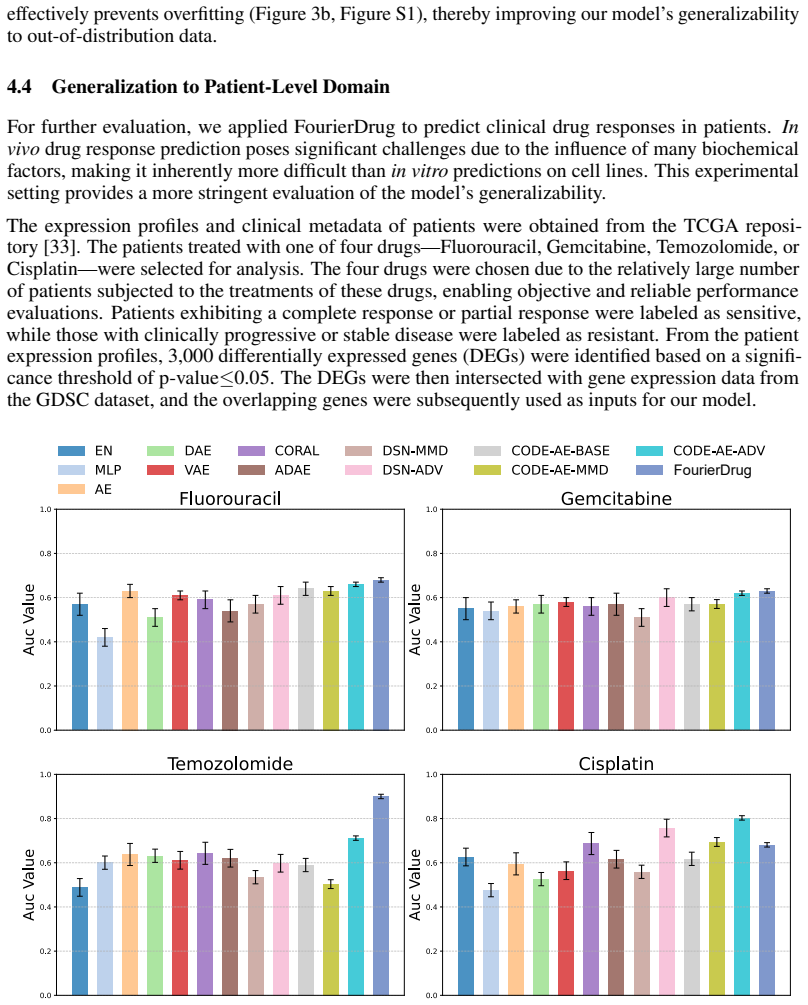
- [Section 4.4] The patient-level evaluation leaks target-domain response information into the test pipeline. The text states: 'From the patient expression profiles, 3,000 differentially expressed genes (DEGs) were identified based on a significance threshold of p-value≤0.05. The DEGs were then intersected with gene expression data from the GDSC dataset, and the overlapping genes were subsequently used as inputs for our model.' In a sensitive-versus-resistant clinical endpoint, the standard DEG contrast is exactly the response label, so the test labels are used to select the input features before model inference. Even if a different contrast was intended, no two comparison groups are named, and no post-intersection gene count is provided. Moreover, the model's input layer was described in Section 4.1 as being trained on 3,000 highly variable GDSC genes; it is not explained how the model is re-initialized or retrained when a different set of patient-derived DEGs is used as input. This undermines the abstract's claim of evaluating 'without access to target-domain data' for the patient-level results.
- [Equation (3)] The Fourier transform defined in Eq. (3) is effectively a near-identity projection, making the 'frequency domain' content vacuous. The vectors {φ_k, ψ_k}_{k=1}^{d/2} form d basis vectors in R^d (for even d), and if they were orthonormal the reconstruction z_i = Σ_k ⟨h_i, φ_k⟩φ_k + ⟨h_i, ψ_k⟩ψ_k would simply be h_i itself. The basis functions are not normalized, so Eq. (3) is not even a valid orthogonal projection as written. Consequently, the cosine similarity in Eq. (4) computed on z_i is identical (or nearly identical) to cosine similarity in the original encoder-feature space, so the asymmetric attention constraint cannot be attributed to any Fourier-specific mechanism. The paper also states that z_i 'does not represent the Fourier expansion' but 'corresponds to a set of Fourier coefficients,' which contradicts the reconstruction form of Eq. (3). No ablation isolates the effect of the Fourier projection itself, since the with/without-FAAC comparison changes both the loss and the representation simultaneously.
- [Section 4.4] The ablation for additional drugs refers to a 'latent independent projection module,' but no such module is defined anywhere in the Methods, in Figure 1, or in the model description. The paper states, 'we conducted ablation studies on four additional drugs—Docetaxel, Paclitaxel, Sorafenib, and Vinorelbine—to evaluate the contribution of the latent independent projection module,' yet the reader cannot determine what this module is or how it was removed. The referenced Figure S2 is not included in the manuscript. This missing definition prevents verification of the claimed 'substantial performance gains, exceeding 10%.'
- [Sections 4.2–4.4] No error bars, standard deviations, or statistical significance tests are reported for any experiment. Figures 2, 3, and 4 report only single-point AUROC estimates, despite the small sample sizes in many leave-one-out cancer types and single-cell datasets. Without repeated runs across multiple random seeds or paired statistical tests, the claimed improvements over baselines (e.g., 'remarkably outperformed' for Temozolomide, or marginal differences on Cisplatin) cannot be distinguished from training noise. This is particularly important because the model architecture includes stochastic components (dropout, batch normalization, random initialization) and the loss weights λ1 and λ2 are chosen without a sensitivity analysis.
- [Section 4.3] The single-cell evaluation uses target-domain data during preprocessing, which weakens the zero-shot claim. The paper says 'we selected a subset of highly variable genes that exhibited the most significant differences in expression levels across both bulk and single-cell RNA-seq data.' This selection uses the target single-cell expression profiles to determine the input genes. Unless these genes are selected using only source-domain data, the statement that the model is 'trained solely on in vitro cell line data without access to target-domain data' is not strictly accurate for the single-cell experiments. The manuscript should either describe a target-blind gene-selection procedure or qualify the claim.
minor comments (5)
- [Equation (8)] The text says 'where λ1 and λ1 are the balanced parameters'; the second λ1 should presumably be λ2.
- [Section 3.5] The implementation paragraph states 'implemented in PyTorch 3.10,' which is likely intended to say Python 3.10; PyTorch is a library, not a Python version.
- [Section 3.3] The phrase 'an Fourier asymmetric attention constraint' contains a grammatical error; it should be 'a Fourier asymmetric attention constraint.' Similar minor grammatical issues appear throughout the introduction and methods.
- [Section 4.3] The baseline for single-cell comparison is described as 'a baseline model composed of only three fully-connected layers,' but the exact architecture, activation functions, and training hyperparameters are not specified, making the comparison difficult to reproduce.
- [Section 4.5] The description of the Ben-David et al. dataset says '7,440 single-cell clones' but then lists counts for time points (n=160, 994, 1,623, 963) that do not sum to 7,440; the discrepancy should be clarified.
Circularity Check
Fourier projection collapses to identity by construction; TCGA DEG selection uses target response labels.
-
self definitional
[Section 3.3, Eq. (3) and Eq. (4)]
"For each feature vector hi ∈R d extracted by encoder G, we project it onto the discrete orthogonal basis to obtain its representation in the frequency domain: zi ≜F(h i) = d/2 X k=1 ⟨hi, ϕk⟩ϕk +⟨h i, ψk⟩ψk,(3) ... Note that zi does not represent the Fourier expansion, it instead corresponds to a set of Fourier coefficients obtained from the Fourier expansion."
The discrete basis {φ_k, ψ_k}_{k=1}^{d/2} has d vectors in R^d and is declared an orthogonal basis, so it spans R^d. The projection in Eq. (3) therefore reconstructs h_i exactly (z_i = h_i up to a positive normalization scalar). If Eq. (3) is instead read as the coefficient vector, Parseval's identity gives z_i^T z_j = h_i^T h_j, so the cosine in Eq. (4) is again identical. Hence the FAAC loss is precisely the standard cosine/contrastive loss on the encoder features; the 'frequency-domain' constraint contains no Fourier-derived information beyond a change of basis. The paper's claimed mechanism ('cluster sensitive samples ... in the frequency domain') is equivalent by construction to clustering the original features.
-
fitted input called prediction
[Section 4.4, TCGA preprocessing/evaluation]
"Patients exhibiting a complete response or partial response were labeled as sensitive, while those with clinically progressive or stable disease were labeled as resistant. From the patient expression profiles, 3,000 differentially expressed genes (DEGs) were identified based on a significance threshold of p-value≤0.05. The DEGs were then intersected with gene expression data from the GDSC dataset, and the overlapping genes were subsequently used as inputs for our model."
A DEG analysis requires a two-group contrast. In this subsection the only group labels defined for the TCGA patients are the target response labels ('complete response or partial response ... sensitive ... progressive or stable disease ... resistant'). Selecting 3,000 genes by p-value ≤ 0.05 from these patient expression profiles therefore selects input features using the very labels the evaluation then tries to predict from held-out data. The reported AUCs conflate the model's generalization with the discriminative power of label-selected genes. If a different, response-independent contrast was intended, it is not described; as written, the patient-level results do not support the claim of evaluating 'without access to target-domain data.'
full rationale
Step 1 is a self-definitional collapse: the Fourier representation is defined so that the cosine similarities used by the FAAC loss equal the cosine similarities of the encoder features, so the Fourier-specific mechanism is not independent of the input features. This does not by itself invalidate the leave-one-out bulk or single-cell empirical gains, which could come from the adversarial domain generalization and contrastive objective. Step 2 is a construction-level evaluation leak: the only textual description of patient-level DEG selection implies target response labels are used to choose input genes; without a specified alternative contrast, the TCGA results cannot support the abstract's no-target-domain claim. There are no load-bearing self-citations, and the dynamic-resistance experiment is an external consistency check. Because one central evaluation ('generalization to patient-level domain') reduces by construction while the model's broader empirical claim retains independent content, the score is 6.
Assumptions & free parameters
free parameters (4)
- loss weights lambda1 and lambda2 =
not reported
- IC50 binarization threshold =
mean IC50 per drug
- number of input genes =
3000
- architecture hyperparameters =
1024, 740, dropout 0.1, learning rate 8e-5
assumptions (4)
- domain assumption Sensitive cells share a common pattern in frequency domain while resistant cells are heterogeneous (Section 3.3: 'Without loss of generality, we assume...').
- standard math The sampled sine and cosine basis in Eq. (1)-(3) is a complete orthogonal basis of the d-dimensional feature space.
- domain assumption Adversarial domain discrimination with a gradient reversal layer yields domain-invariant features that transfer to unseen cancer types (Section 3.4).
- domain assumption The 3,000 highly variable genes or DEGs are sufficient inputs for drug-response prediction (Sections 4.1 and 4.4).
Cite this review
Pith. "Pith review of Fourier Asymmetric Attention on Domain Generalization for Pan-Cancer Drug Response Prediction." pith.science (2026). https://pith.science/paper/OQZSAWDX
@misc{pith2026250204034,
  author       = {Pith},
  title        = {Pith review of: Fourier Asymmetric Attention on Domain Generalization for Pan-Cancer Drug Response Prediction},
  year         = {2026},
  howpublished = {\url{https://pith.science/paper/OQZSAWDX}},
  note         = {Machine review of arXiv:2502.04034}
}
read the original abstract
The accurate prediction of drug responses remains a formidable challenge, particularly at the single-cell level and in clinical treatment contexts. Some studies employ transfer learning techniques to predict drug responses in individual cells and patients, but they require access to target-domain data during training, which is often unavailable or only obtainable in future. In this study, we propose a novel domain generalization framework, termed FourierDrug, to address this challenge. Given the extracted feature from expression profile, we performed Fourier transforms and then introduced an asymmetric attention constraint that would cluster drug-sensitive samples into a compact group while drives resistant samples dispersed in the frequency domain. Our empirical experiments demonstrate that our model effectively learns task-relevant features from diverse source domains, and achieves accurate predictions of drug response for unseen cancer type. When evaluated on single-cell and patient-level drug response prediction tasks, FourierDrug--trained solely on in vitro cell line data without access to target-domain data--consistently outperforms or, at least, matched the performance of current state-of-the-art methods. These findings underscore the potential of our method for real-world clinical applications.
Figures


Figures from the paper (2 more)

Reference graph
Works this paper leans on
-
[1]
Wanjuan Yang, Jorge Soares, Patricia Greninger, Elena J Edelman, Howard Lightfoot, Simon Forbes, Nidhi Bindal, Dave Beare, James A Smith, I Richard Thompson, et al. Genomics of drug sensitivity in cancer (gdsc): a resource for therapeutic biomarker discovery in cancer cells. Nucleic acids research, 41(D1):D955–D961, 2012
work page 2012
-
[2]
The cancer cell line encyclopedia enables predictive modeling of anticancer drug sensitivity
Jordi Barretina, Giordano Caponigro, Nicolas Stransky, Kavitha Venkatesan, Adam A Margolin, Sangwoo Kim, Cameron J Wilson, Jaroslav Lehár, Gregory V Kryukov, Dmitriy Sonkin, et al. The cancer cell line encyclopedia enables predictive modeling of anticancer drug sensitivity. Nature, 483(7391):603–607, 2012
work page 2012
-
[3]
Di He, Qiao Liu, You Wu, and Lei Xie. A context-aware deconfounding autoencoder for robust prediction of personalized clinical drug response from cell-line compound screening.Nature Machine Intelligence, 4(10):879–892, 2022
work page 2022
-
[4]
Gene expression based inference of cancer drug sensitivity.Nature communications, 13(1):5680, 2022
Smriti Chawla, Anja Rockstroh, Melanie Lehman, Ellca Ratther, Atishay Jain, Anuneet Anand, Apoorva Gupta, Namrata Bhattacharya, Sarita Poonia, Priyadarshini Rai, et al. Gene expression based inference of cancer drug sensitivity.Nature communications, 13(1):5680, 2022
work page 2022
-
[5]
Jianzhu Ma, Samson H Fong, Yunan Luo, Christopher J Bakkenist, John Paul Shen, Soufiane Mourragui, Lodewyk FA Wessels, Marc Hafner, Roded Sharan, Jian Peng, et al. Few-shot learning creates predictive models of drug response that translate from high-throughput screens to individual patients.Nature Cancer, 2(2):233–244, 2021
work page 2021
-
[6]
Generalizing to unseen domains: A survey on domain general- ization.IEEE transactions on knowledge and data engineering, 35(8):8052–8072, 2022
Jindong Wang, Cuiling Lan, Chang Liu, Yidong Ouyang, Tao Qin, Wang Lu, Yiqiang Chen, Wenjun Zeng, and S Yu Philip. Generalizing to unseen domains: A survey on domain general- ization.IEEE transactions on knowledge and data engineering, 35(8):8052–8072, 2022
2022
-
[7]
Domain generalization with mixstyle
Kaiyang Zhou, Yongxin Yang, Yu Qiao, and Tao Xiang. Domain generalization with mixstyle. arXiv preprint arXiv:2104.02008, 2021
arXiv 2021
-
[8]
Domain generalization by solving jigsaw puzzles
Fabio M Carlucci, Antonio D’Innocente, Silvia Bucci, Barbara Caputo, and Tatiana Tommasi. Domain generalization by solving jigsaw puzzles. InProceedings of the IEEE/CVF conference on computer vision and pattern recognition, pages 2229–2238, 2019
work page 2019
Show all 35 references
-
[9]
Fnet: Mixing tokens with fourier transforms
James Lee-Thorp, Joshua Ainslie, Ilya Eck, and Santiago Ontanon. Fnet: Mixing tokens with fourier transforms. InAdvances in Neural Information Processing Systems, volume 34, pages 16774–16785, 2021
2021
-
[10]
Interpretable multivariate time series forecasting using neural fourier transform.arXiv preprint arXiv:2405.13812, 2024
Noam Koren and Kira Radinsky. Interpretable multivariate time series forecasting using neural fourier transform.arXiv preprint arXiv:2405.13812, 2024
2024 arXiv
-
[11]
State sequences prediction via fourier transform for representation learning.Advances in Neural Information Processing Systems, 36:67565–67588, 2023
Mingxuan Ye, Yufei Kuang, Jie Wang, Yang Rui, Wengang Zhou, Houqiang Li, and Feng Wu. State sequences prediction via fourier transform for representation learning.Advances in Neural Information Processing Systems, 36:67565–67588, 2023
2023
-
[12]
Fan: Fourier analysis networks.arXiv preprint arXiv:2410.02675, 2024
Yihong Dong, Ge Li, Yongding Tao, Xue Jiang, Kechi Zhang, Jia Li, Jinliang Deng, Jing Su, Jun Zhang, and Jingjing Xu. Fan: Fourier analysis networks.arXiv preprint arXiv:2410.02675, 2024
2024
-
[13]
Single-cell rna-seq data augmentation using generative fourier transformer
Nima Nouri. Single-cell rna-seq data augmentation using generative fourier transformer. Communications Biology, 8(1):113, 2025
2025
-
[14]
scgenerythm: Using neural networks and fourier transfor- mation to cluster genes by time-frequency patterns in single-cell data.bioRxiv, pages 2023–11, 2023
Yiming Jia, Hao Wu, and Jun Ding. scgenerythm: Using neural networks and fourier transfor- mation to cluster genes by time-frequency patterns in single-cell data.bioRxiv, pages 2023–11, 2023
2023
-
[15]
Generalizing across domains via cross-gradient training.arXiv preprint arXiv:1804.10745, 2018
Shiv Shankar, Vihari Piratla, Soumen Chakrabarti, Siddhartha Chaudhuri, Preethi Jyothi, and Sunita Sarawagi. Generalizing across domains via cross-gradient training.arXiv preprint arXiv:1804.10745, 2018. 10
2018 arXiv
-
[16]
Domain randomization and pyramid consistency: Simulation-to-real general- ization without accessing target domain data
Xiangyu Yue, Yang Zhang, Sicheng Zhao, Alberto Sangiovanni-Vincentelli, Kurt Keutzer, and Boqing Gong. Domain randomization and pyramid consistency: Simulation-to-real general- ization without accessing target domain data. InProceedings of the IEEE/CVF international conference...
2019
-
[17]
Domain gen- eralization for object recognition with multi-task autoencoders
Muhammad Ghifary, W Bastiaan Kleijn, Mengjie Zhang, and David Balduzzi. Domain gen- eralization for object recognition with multi-task autoencoders. InProceedings of the IEEE international conference on computer vision, pages 2551–2559, 2015
2015
-
[18]
Domain generalization with adversarial feature learning
Haoliang Li, Sinno Jialin Pan, Shiqi Wang, and Alex C Kot. Domain generalization with adversarial feature learning. InProceedings of the IEEE conference on computer vision and pattern recognition, pages 5400–5409, 2018
2018
-
[19]
Multi-adversarial discriminative deep domain generalization for face presentation attack detection
Rui Shao, Xiangyuan Lan, Jiawei Li, and Pong C Yuen. Multi-adversarial discriminative deep domain generalization for face presentation attack detection. InProceedings of the IEEE/CVF conference on computer vision and pattern recognition, pages 10023–10031, 2019
2019
-
[20]
Domain adversarial neural networks for domain generalization: When it works and how to improve.Machine Learning, 112(7):2685– 2721, 2023
Anthony Sicilia, Xingchen Zhao, and Seong Jae Hwang. Domain adversarial neural networks for domain generalization: When it works and how to improve.Machine Learning, 112(7):2685– 2721, 2023
2023
-
[21]
Towards principled disentanglement for domain generalization
Hanlin Zhang, Yi-Fan Zhang, Weiyang Liu, Adrian Weller, Bernhard Schölkopf, and Eric P Xing. Towards principled disentanglement for domain generalization. InProceedings of the IEEE/CVF conference on computer vision and pattern recognition, pages 8024–8034, 2022
2022
-
[22]
Discriminative adversarial domain generalization with meta-learning based cross-domain validation.Neurocomputing, 467:418–426, 2022
Keyu Chen, Di Zhuang, and J Morris Chang. Discriminative adversarial domain generalization with meta-learning based cross-domain validation.Neurocomputing, 467:418–426, 2022
2022
-
[23]
Neuron coverage-guided domain generalization.IEEE Transactions on Pattern Analysis and Machine Intelligence, 45(1):1302–1311, 2022
Chris Xing Tian, Haoliang Li, Xiaofei Xie, Yang Liu, and Shiqi Wang. Neuron coverage-guided domain generalization.IEEE Transactions on Pattern Analysis and Machine Intelligence, 45(1):1302–1311, 2022
2022
-
[24]
Single-side domain generalization for face anti-spoofing
Yunpei Jia, Jie Zhang, Shiguang Shan, and Xilin Chen. Single-side domain generalization for face anti-spoofing. InProceedings of the IEEE/CVF Conference on Computer Vision and Pattern Recognition, pages 8484–8493, 2020
2020
-
[25]
A survey on deep learning based time series analysis with frequency transformation.arXiv preprint arXiv:2302.02173, 2023
Kun Yi, Qi Zhang, Longbing Cao, Shoujin Wang, Guodong Long, Liang Hu, Hui He, Zhendong Niu, Wei Fan, and Hui Xiong. A survey on deep learning based time series analysis with frequency transformation.arXiv preprint arXiv:2302.02173, 2023
2023 arXiv
-
[26]
Domain separation networks.Advances in neural information processing systems, 29, 2016
Konstantinos Bousmalis, George Trigeorgis, Nathan Silberman, Dilip Krishnan, and Dumitru Erhan. Domain separation networks.Advances in neural information processing systems, 29, 2016
2016
-
[27]
Deep transfer learning of cancer drug responses by integrating bulk and single-cell rna-seq data.Nature Communications, 13(1):6494, 2022
Junyi Chen, Xiaoying Wang, Anjun Ma, Qi-En Wang, Bingqiang Liu, Lang Li, Dong Xu, and Qin Ma. Deep transfer learning of cancer drug responses by integrating bulk and single-cell rna-seq data.Nature Communications, 13(1):6494, 2022
2022
-
[28]
A kernel two-sample test.The Journal of Machine Learning Research, 13(1):723–773, 2012
Arthur Gretton, Karsten M Borgwardt, Malte J Rasch, Bernhard Schölkopf, and Alexander Smola. A kernel two-sample test.The Journal of Machine Learning Research, 13(1):723–773, 2012
2012
-
[29]
Attention is all you need
Ashish Vaswani, Noam Shazeer, Niki Parmar, Jakob Uszkoreit, Llion Jones, Aidan N Gomez, Łukasz Kaiser, and Illia Polosukhin. Attention is all you need. InAdvances in Neural Informa- tion Processing Systems, volume 30, pages 5998–6008, 2017
2017
-
[30]
Single-cell transcriptional changes associated with drug tolerance and response to combination therapies in cancer.Nature communications, 12(1):1628, 2021
Alexandre F Aissa, Abul BMMK Islam, Majd M Ariss, Cammille C Go, Alexandra E Rader, Ryan D Conrardy, Alexa M Gajda, Carlota Rubio-Perez, Klara Valyi-Nagy, Mary Pasquinelli, et al. Single-cell transcriptional changes associated with drug tolerance and response to combination th...
2021
-
[31]
Single-cell rna-seq analysis identifies markers of resistance to targeted braf inhibitors in melanoma cell populations.Genome research, 28(9):1353–1363, 2018
Yu-Jui Ho, Naishitha Anaparthy, David Molik, Grinu Mathew, Toby Aicher, Ami Patel, James Hicks, and Molly Gale Hammell. Single-cell rna-seq analysis identifies markers of resistance to targeted braf inhibitors in melanoma cell populations.Genome research, 28(9):1353–1363, 2018. 11
2018
-
[32]
Enabling single-cell drug response annotations from bulk rna-seq using scad.Advanced Science, page 2204113, 2023
Zetian Zheng, Junyi Chen, Xingjian Chen, Lei Huang, Weidun Xie, Qiuzhen Lin, Xiangtao Li, and Ka-Chun Wong. Enabling single-cell drug response annotations from bulk rna-seq using scad.Advanced Science, page 2204113, 2023
2023
-
[33]
The cancer genome atlas: creating lasting value beyond its data.Cell, 173(2):283–285, 2018
Carolyn Hutter and Jean Claude Zenklusen. The cancer genome atlas: creating lasting value beyond its data.Cell, 173(2):283–285, 2018
2018
-
[34]
Genetic and transcriptional evolution alters cancer cell line drug response.Nature, 560(7718):325–330, 2018
Uri Ben-David, Benjamin Siranosian, Gavin Ha, Helen Tang, Yaara Oren, Kunihiko Hinohara, Craig A Strathdee, Joshua Dempster, Nicholas J Lyons, Robert Burns, et al. Genetic and transcriptional evolution alters cancer cell line drug response.Nature, 560(7718):325–330, 2018
2018
-
[35]
Predicting drug response from single-cell expression profiles of tumours.BMC medicine, 21(1):476, 2023
Simona Pellecchia, Gaetano Viscido, Melania Franchini, and Gennaro Gambardella. Predicting drug response from single-cell expression profiles of tumours.BMC medicine, 21(1):476, 2023. 12
2023
Reviewed August 8, 2026 · model on record in the stance chip above.
Discussion (0). Continue with ORCID to comment.