REVIEW 4 major objections 6 minor 1 cited by
Leading and beyond leading-order spectral form factor in chaotic quantum many-body systems across all Dyson symmetry classes
T0 review · 4 major / 6 minor · reviewed 2026-08-08 · deepseek-v4-flash
Pith's one-line read For generic periodically kicked interacting many-body systems, the spectral form factor beyond a Thouless time exactly reproduces the random-matrix predictions of the circular orthogonal, unitary, and symplectic ensembles, up to the…
desk verdict Genuinely new CSE and beyond-leading-order SFF results with a mostly explicit derivation; the RPA assumption is the real soft spot, and the paper deserves refereeing. read the letter →
The pith
A machine-rendered reading of the paper's core claim, the machinery that carries it, and where it could break.
The reading
What carries the argument
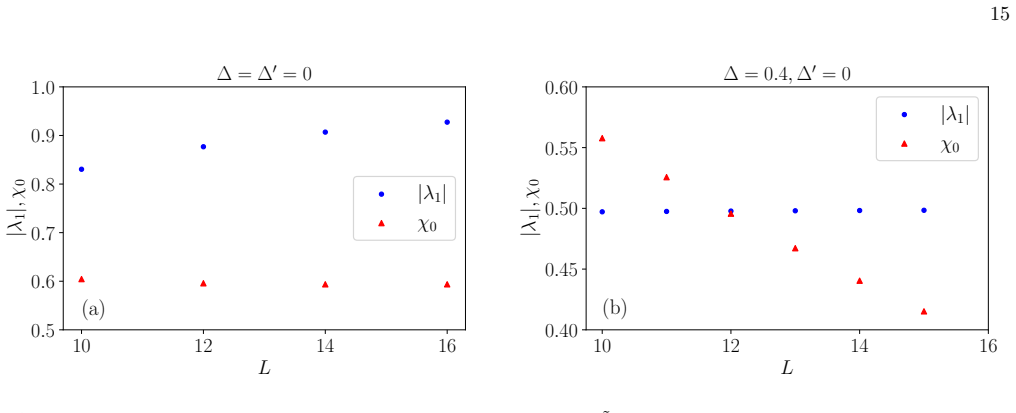
The central object is the doubly stochastic matrix $\mathcal{M}=\mathcal{V}\bullet\mathcal{V}^*$, the Hadamard (elementwise) product of the kick matrix $\mathcal{V}$ with its complex conjugate, in the eigenbasis of $\mathcal{H}_0$; its Hermitian counterpart $\tilde{\mathcal{M}}=\mathcal{V}\bullet\mathcal{V}^\dagger$ also appears when time reversal is absent or $\mathcal{T}^2=-1$. The SFF is expanded as a sum over permutations of $t$ time steps, and the random phase approximation factorizes the phase average into permutation sums. A diagrammatic calculus assigns powers of $\mathcal{M}$ and $\tilde{\mathcal{M}}$ to arcs, and passing to reduced diagrams (replacing an arc by $1/\mathcal{N}$) isolates the universal Type I terms. Theorems 3 and 4 then show that most reduced diagrams cancel in identical pairs, leaving the linear ramp and two extra 'SR' diagrams that produce the second-order correction. The Thouless time is governed by the second-largest eigenvalue $\lambda_1$ of $\mathcal{M}$ through $t^*\simeq(\ln d_1+1)/|\ln\lambda_1|$.
What would settle it
Take a specific kicked model in which the eigenphases of $\mathcal{H}_0$ are known to be correlated, for example a weakly disordered or integrable $\mathcal{H}_0$, and compute the SFF directly: the RPA prediction $K^{(1)}(t)=2t\,\mathrm{tr}\,\mathcal{M}^t$ should already disagree in the linear-ramp regime. More sharply, numerically sample the joint distribution of the $\mathcal{H}_0$ eigenphases and test the independence-and-uniformity assumption; if the distribution is not uniform on the torus, the derivation's starting point is violated.
Extended reading notes
Core claim
The paper's central claim is that the late-time spectral statistics of a generic Floquet many-body system are identical to the RMT circular-ensemble SFFs, not merely similar. The linear ramp comes from the identity permutation and its cyclic and anticyclic variants, giving $K^{(1)}=2t\,\mathrm{tr}\,\mathcal{M}^t$ for COE, $K^{(1)}=t(\mathrm{tr}\,\mathcal{M}^t+\mathrm{tr}\,\tilde{\mathcal{M}}^t)$ for CUE, and $K^{(1)}=2t(\mathrm{tr}\,\mathcal{M}^t+\mathrm{tr}\,\tilde{\mathcal{M}}^t)$ for CSE. The second-order correction comes from two extra sub-sequence-reversal-with-repetition diagrams whose reduced diagrams do not cancel, yielding $-2t^2/\mathcal{N}$ for COE, $+2t^2/\mathcal{N}$ for CSE, and no universal term for CUE. Beyond $t^*$, all nonuniversal Type III terms decay exponentially, leaving exactly the COE, CUE, and CSE SFFs of RMT.
Load-bearing premise
The whole derivation rests on the random phase approximation: the eigenphases of $\mathcal{H}_0$ are treated as independent and uniformly distributed on $[0,2\pi)$, with only Kramers degeneracy when $\mathcal{T}^2=-1$. If physical eigenphases carry correlations or extra degeneracies, the factorization behind Eq. (14) and every permutation-sum identity built on it fails.
Editorial extensions
If this is right
- Beyond $t^*$, the full SFF curve up to second order in time is the RMT curve: $2t-2t^2/\mathcal{N}$ for COE, $t$ for CUE, and $2t+2t^2/\mathcal{N}$ for CSE; any sustained deviation flags nonuniversal physics.
- The Thouless time is not an adjustable parameter; it is fixed by the second-largest eigenvalue $\lambda_1$ of $\mathcal{M}$, making $t^*$ computable for large systems from single-particle data when $\mathcal{M}$ is $SU(2)$ invariant.
- In strongly interacting fermionic chains, $U(1)$ conservation forces diffusive scaling $t^*\propto L^2$; breaking $U(1)$ yields $t^*\propto L^0$ or $t^*\propto \ln L$ depending on whether $\lambda_1$ is nondegenerate or degenerate with a growing degeneracy.
- The same diagrammatic machinery extends to higher spatial dimensions, giving the same $t^*$ scalings, so experimental probes in two- and three-dimensional systems are feasible.
- The absence of a universal $1/\mathcal{N}$ second-order term in the no-time-reversal case is itself a prediction that distinguishes CUE from COE and CSE in a physical system.
Reading between the lines
- Because $\lambda_1$ of $\mathcal{M}$ controls both the ramp onset and the nonuniversal approach, one could invert the relation and use a measured SFF to extract $\lambda_1$ and thereby infer the symmetry class and conserved-charge structure of an unknown many-body system; the authors do not state this inversion.
- The reduced-diagram cancellation suggests the RPA-plus-permutation method may extend to other RMT symmetry classes, such as the Altland-Zirnbauer tenfold classification, since only the pairing structure of time reversal enters the diagram rules; the authors mention this extension only as a future direction.
- A direct numerical test in two dimensions with short-range interactions and $U(1)$ symmetry would check the predicted $t^*\propto L^2$ scaling and the universal second-order correction, thereby validating the higher-dimensional claim.
- The RPA is defined for kicked systems, where the eigenbasis of $\mathcal{H}_0$ supplies the random phases; the present results should not be applied to autonomous (non-kicked) systems without an additional averaging mechanism.
Editorial analysis
A structured set of objections, weighed in public.
Referee Report
Summary. The paper derives the spectral form factor K(t) for periodically kicked interacting many-body systems in all three Dyson symmetry classes, working in the basis of the unperturbed Hamiltonian H0 and assuming a random phase approximation for its eigenphases. Under this assumption the authors obtain K(t) ≈ 2t − 2t^2/N for time-reversal-invariant systems with T^2 = 1, K(t) ≈ t for systems without time-reversal symmetry, and K(t) ≈ 2t + 2t^2/N for T^2 = −1, matching the COE, CUE, and CSE random-matrix predictions beyond a Thouless time t*. They also relate t* to the second-largest eigenvalue of the doubly stochastic matrix M = V • V* and derive system-size scalings t* ∝ L^2, L^0, or ln L for strongly interacting fermionic chains, with an extension to two dimensions. The technical core is a diagrammatic expansion organized into four theorems, with explicit second-order algebra in Appendices D and E.
Significance. If the results are correct, this is a valuable step beyond earlier work by Roy and Prosen and by Kos et al.: it extends the analytic RPA-based derivation of the RMT spectral form factor from the COE case to the CUE and, for the first time in this framework, CSE cases, and it gives a unified description of the Thouless-time scaling. The paper contains genuinely useful technical machinery: the diagrammatic rules in Secs. IV–VI, the reduced-diagram cancellations in Secs. VIII–IX, and the explicit second-order computations in Appendices D and E are detailed enough to be checked independently. The numerical checks in Figs. 17, 20, and 28 provide direct evidence for the leading-order ramp and for the t/L^2 collapse in the CUE and CSE cases. The main weakness is that the random phase approximation is assumed rather than derived, and the most novel quantitative claim, the CSE second-order correction, is not directly verified numerically. The paper does not provide code or data, which limits the reproducibility of the numerical figures.
major comments (4)
- [Sec. II, Eq. (14)] The entire derivation is conditional on the random phase approximation, which is stated rather than derived. The paper's opening claim of 'generic periodically kicked interacting many-body systems' is therefore broader than what is shown: the numerical support (Fig. 28 for T^2 = 1; Figs. 17 and 20 for CUE and CSE ramps) covers disorder-averaged models with long-range interactions and random potentials, and no direct test of Eq. (14) against the actual eigenphase statistics is reported for the T^2 = −1 case. I request that the scope be stated as 'systems supporting the RPA', and that a direct diagnostic of Eq. (14) be added, at least for the CSE model, comparing the phase-averaged identity with exact averages over the H0 eigenphases used in the numerics. Without this, the genericity of the central claim is not established.
- [Sec. XI C, Eqs. (107)–(110)] The central second-order result for the CSE class, K−1^(2)(t) = +2t^2/N, is not verified numerically. Figure 20 shows only the leading ramp and the t/L^2 collapse; it does not isolate the signed curvature of the SFF. Since the CSE calculation is a principal novelty of the paper, please add a plot of N(K(t) − 2t) versus t/N for the T^2 = −1 fermionic chain, together with the RPA prediction 2t^2/N and, ideally, a direct comparison to the exact Floquet SFF for the same parameters. This check is essential because the second-order sign distinguishes the CSE result from the COE result and is not visible in the leading-order collapse.
- [Sec. X A–C, Table II] The t* ∝ L^2 scalings rest on the assertion that M is SU(2) invariant and that its second-largest eigenvalue λ1 is doubly degenerate. This is supported by numerical observation and by Trotter-regime mappings (Eqs. (74), (81), (90)) valid for small |J|, |Δ|, but the direct SFF simulations use parameters outside that regime (e.g., J = 1, U0 = 22 in Fig. 28). Please either prove the SU(2) invariance from the structure of V, or provide a systematic numerical check of the claimed degeneracy and of λ1 ≈ 1 − cβ/L^2 for the exact parameter values used in the SFF plots. The same comment applies to the d1 = O(L^ζ) rows in Table II, which drive the t* ∝ ln L scaling.
- [Sec. II, Eqs. (20)–(22)] The paper states that only double repetitions are retained in the overcounting corrections, and this truncation is used to derive the second-order terms. It would be helpful to show explicitly that triple and higher repetitions contribute only at higher order in the combined 1/N and t/N expansion when 1 ≪ t ≪ N, and to state the precise regime in which the 'up to second order in time' claim holds. As written, the truncation is an assumption, and a reader cannot tell whether omitted multiplicity corrections could shift the coefficient of the t^2/N term at t close to the Heisenberg time.
minor comments (6)
- [Eq. (107)] The symbol V^*_{−c,d} is not defined; if it denotes the matrix element with a time-reversed state, it should be written consistently as V^*_{Tc,d} or similar.
- [Table II] The column header 'Parameters (β)' is confusing: β appears in the text as part of cβ (a model-dependent constant) and is not defined as the Dyson index. Please rename the column or define β explicitly.
- [Sec. XII] The statement that the RPA works better in higher dimensions is plausible but unquantified; consider adding a criterion or a short argument beyond the coordination-number remark.
- [Figs. 17, 20, 28] No code or data release accompanies the numerical claims; a data availability statement or a deposition of the exact SFF datasets would substantially improve reproducibility.
- [Sec. IV–VI] The diagrammatic notation is dense; a combined glossary of the arc, arrow, and vertex conventions for all three symmetry classes would help readers verify the rules.
- [Sec. IX, proof of Theorem 4] The proof is very brief; a sentence explaining why the two cases in Figs. 14 and 15 exhaust the possibilities would improve readability.
Circularity Check
No circular reduction: the derivation is a parameter-free RPA calculation; RMT targets enter only as comparisons, not as inputs, and the self-citations are not load-bearing.
full rationale
The central derivation is a direct computation from one declared premise, the random phase approximation formalized in Eq. (14). Given that premise, the permutation-sum expressions (17)-(22), the diagram rules of Secs. IV-VI, the Type I/II/III classification of Theorem 2, the reduced-diagram cancellations of Theorems 3-4, and the second-order evaluation in Sec. XI and App. D are all algebraic consequences; no term in K(t)=2t-2t^2/N, K(t)=t, or K(t)=2t+2t^2/N is fitted to the RMT value it is compared against. The RMT formulas (2)-(4) are used as benchmark targets, not as inputs. The RPA is an assumption, explicitly acknowledged in Sec. II, and its validity is checked in this paper by direct SFF simulations (Figs. 17, 20, 28) rather than merely inherited from prior work. The self-citations (Refs. [19,26,30,37]) supply antecedent numerical tests of the RPA and Trotter mappings, but the load-bearing algebra is re-derived here, so they do not constitute a self-citation chain that forces the result. The Thouless-time scalings are determined by eigenvalues of M computed from the model and then compared with direct numerics, again without fitting the claimed SFF. No equation in the paper reduces the target SFF to an input by construction; the main correctness risk is the validity of the RPA for genuinely generic systems, which is a physical assumption rather than a circular step.
Assumptions & free parameters
free parameters (1)
- Thouless time threshold constant =
1/e (chosen in Eq. 70)
assumptions (5)
- domain assumption Random phase approximation: eigenphases of H0 are independent and uniformly distributed over [0, 2π), apart from Kramers degeneracy for T^2 = -1 (Sec. II, Eq. 14).
- domain assumption Kramers degeneracy structure for T^2 = -1: phases are exactly doubly degenerate, basis states satisfy ⟨n|Tn⟩ = 0, and there are no additional degeneracies beyond those enforced by symmetry (Tab. I).
- standard math Spectral properties of M and M~: M = V • V* is doubly stochastic with largest eigenvalue 1; M~ = V • V† has spectral radius less than 1 unless a nonconventional time-reversal symmetry is present (App. B).
- domain assumption SU(2) invariance of M in number-conserving fermionic chains, used to extract λ1 from the one-particle sector (Sec. X, Figs. 16, 21).
- domain assumption Trotter-limit mapping of M to a Heisenberg or XXZ spin Hamiltonian when |J|, |Δ| ≪ 1 (Eqs. 74, 81, 90).
Cite this review
Pith. "Pith review of Leading and beyond leading-order spectral form factor in chaotic quantum many-body systems across all Dyson symmetry classes." pith.science (2026). https://pith.science/paper/5U6EHO52
@misc{pith2026250204152,
  author       = {Pith},
  title        = {Pith review of: Leading and beyond leading-order spectral form factor in chaotic quantum many-body systems across all Dyson symmetry classes},
  year         = {2026},
  howpublished = {\url{https://pith.science/paper/5U6EHO52}},
  note         = {Machine review of arXiv:2502.04152}
}
abstract
We show the emergence of random matrix theory (RMT) spectral correlations in the chaotic phase of generic periodically kicked interacting quantum many-body systems by analytically calculating spectral form factor (SFF), $K(t)$, up to two leading orders in time, $t$. We explicitly consider the presence or absence of time reversal ($\mathcal{T}$) symmetry to investigate all three Dyson's symmetry classes. Our derivation only assumes random phase approximation to enable ensemble average. For $\mathcal{T}$-invariant systems with $\mathcal{T}^2=1$, we show that beyond the Thouless time $t^*$, the SFF takes the form $K(t)\simeq 2t-2t^2/\mathcal{N}$ up to second order in time, where $\mathcal{N}$ is the Hilbert space dimension. This is identical to the result from circular orthogonal ensemble of RMT. In the absence of $\mathcal{T}$-symmetry, we show that $K(t)\simeq t$ beyond $t^*$, and there is no universal term in the second order, unlike the $\mathcal{T}^2=1$ case, in agreement with the result of circular unitary ensemble. For $\mathcal{T}$-invariant systems with $\mathcal{T}^2=-1$, we show that $K(t)\simeq 2t+2t^2/\mathcal{N}$ up to two orders in time beyond $t^*$, in agreement with the result of circular symplectic ensemble. In all three cases, the system-size, $L$, scaling of $t^*$ is determined by eigenvalues of a doubly stochastic matrix $\mathcal{M}$. For strongly interacting fermionic chains, $\mathcal{M}$ is $SU(2)$ invariant in all three cases, leading to $t^*\propto L^2$ in the presence of $U(1)$ symmetry. In the absence of $U(1)$ symmetry, we find $t^*\propto L^0$, due to gapped non-degenerate second-largest eigenvalue of $\mathcal{M}$ or $t^*\propto \ln(L)$ due to gapped second-largest eigenvalue with degeneracy $\propto L^\zeta$. Our calculation of SFF is plausible in higher space dimensions as well, where similar system-size scalings of $t^*$ can be obtained.
Figures


Figures from the paper (20 more)




Forward citations
Cited by 1 Pith paper
-
Chaotic many-body quantum dynamics, spectral correlations, and energy diffusion
For a chain of random-matrix-coupled quantum sites, energy diffusion and the spectral form factor are exactly related through a classical master equation, yielding a linear ramp and L-dependent timescales.
Reference graph
Works this paper leans on
-
[1]
This term determines t∗. We define t∗ as the solution of the equation: d1λt∗ 1 ≃ 1 e , (70) where d1 is the degeneracy of eigenvalue λ1. We find t∗ by solving Eq. (70): t∗ ≃ ln(d1) + 1 | ln λ1| . (71) Following Roy and Prosen [26], we study a periodi- cally kicked strongly interacting spinless fermion chain in Eqs. (34,35) with the parameters in Eqs. (43,...
-
[2]
T and R An arbitrary variant of a transposition diagram is shown in Fig. 29. A necessary requirement for a vari- FIG. 29 ant to have Type I or Type II terms in its contribution is the existence of non-vanishing reduced diagrams. From the definition of reduced diagrams in Sec. VIII, a diagram must contain either a red arc with a counterclockwise ar- row on...
-
[3]
Theorem 5 implies that the reduced diagrams of such variants give a non-vanishing contribution when at least one of the arcs does not have a jump to the inner circle at its ends, as shown in Fig. 30a. We obtain the reduced diagram in Fig. 30b by removing the lower red arc from Fig. 30a. This reduced diagram has a vanishing contribution due to the time rev...
-
[4]
Also, both the endpoints of the reversed part should lie on the same circle as in Fig
S and SR As in the case of transposition, the variants of a S dia- gram containing a red arc with a counterclockwise arrow on the outer circle or a red arc with a clockwise arrow on the inner circle can contribute Type I and Type II terms. Also, both the endpoints of the reversed part should lie on the same circle as in Fig. 34. Otherwise, the reduced dia...
-
[5]
M. V. Berry, Quantizing a classically ergodic system: Sinai’s billiard and the KKR method, Ann. Phys. 131, 163 (1981)
work page 1981
-
[6]
D33, which we ignore in our calculation with the reduced diagrams in Eq
(D33) We include the contribution of all the Type III terms in Eq. D33, which we ignore in our calculation with the reduced diagrams in Eq. 95. Appendix E: Derivation of the second-order correction in the absence ofT -symmetry using only the rules in Sec. V a. Transposition Following the rules in Sec. V, the calculation for the cyclic variants of transpos...
-
[7]
Bohigas, M
O. Bohigas, M. J. Giannoni, and C. Schmit, Character- ization of chaotic quantum spectra and universality of level fluctuation laws, Phys. Rev. Lett. 52, 1 (1984)
1984
-
[8]
S. W. McDonald and A. N. Kaufman, Spectrum and eigenfunctions for a Hamiltonian with stochastic trajec- tories, Phys. Rev. Lett. 42, 1189 (1979)
work page 1979
Show all 54 references
-
[9]
Casati, F
G. Casati, F. Valz-Gris, and I. Guarnieri, On the connec- tion between quantization of nonintegrable systems and statistical theory of spectra, Lett. Nuovo Cimento 28, 279 (1980)
1980
-
[10]
M. V. Berry and M. Tabor, Level clustering in the regular spectrum, Proc. R. Soc. Lond. A 356, 375 (1977). 33
1977
-
[11]
M. V. Berry, theory of spectral rigidity, Proc. R. Soc. Lond. A 400, 229 (1985)
1985
-
[12]
M. L. Mehta, Random matrices, 2nd ed. (Academic Press, San Diego, 1991)
1991
-
[13]
E. P. Wigner, Characteristic vectors of bordered matrices with infinite dimensions, Ann. Math. 62, 548 (1955)
1955
-
[14]
E. P. Wigner, Group Theory and its Application to the Quantum Mechanics of Atomic Spectra(Academic Press Inc., New York, 1959)
1959
-
[15]
F. J. Dyson, Statistical theory of the energy levels of complex systems. i, J. Math. Phys. 3, 140 (1962)
1962
-
[16]
F. J. Dyson, Correlations between eigenvalues of a ran- dom matrix, Commun. Math. Phys. 19, 235 (1970)
1970
-
[17]
Pluhar and H
Z. Pluhar and H. A. Weidenm¨ uller, Quantum graphs and random-matrix theory, J. Phys. A-Math. 48, 275102 (2015)
2015
-
[18]
Sieber and K
M. Sieber and K. Richter, Correlations between periodic orbits and their role in spectral statistics, Phys. Scr.T90, 128 (2001)
2001
-
[19]
Sieber, Leading off-diagonal approximation for the spectral form factor for uniformly hyperbolic systems, J
M. Sieber, Leading off-diagonal approximation for the spectral form factor for uniformly hyperbolic systems, J. Phys. A 35, L613 (2002)
2002
-
[20]
M¨ uller, S
S. M¨ uller, S. Heusler, P. Braun, F. Haake, and A. Alt- land, Semiclassical foundation of universality in quantum chaos, Phys. Rev. Lett. 93, 014103 (2004)
2004
-
[21]
M¨ uller, S
S. M¨ uller, S. Heusler, P. Braun, F. Haake, and A. Al- tland, Periodic-orbit theory of universality in quantum chaos, Phys. Rev. E 72, 046207 (2005)
2005
-
[22]
Pluhaˇ r and H
Z. Pluhaˇ r and H. A. Weidenm¨ uller, Universal quantum graphs, Phys. Rev. Lett. 112, 144102 (2014)
2014
-
[23]
Bertini, P
B. Bertini, P. Kos, and T. Prosen, Exact correlation func- tions for dual-unitary lattice models in 1 + 1 dimensions, Phys. Rev. Lett. 123, 210601 (2019)
2019
-
[24]
Dubertrand and S
R. Dubertrand and S. M¨ uller, Spectral statistics of chaotic many-body systems, New J. Phys. 18, 033009 (2016)
2016
-
[25]
P. Kos, M. Ljubotina, and T. Prosen, Many-body quan- tum chaos: Analytic connection to random matrix the- ory, Phys. Rev. X 8, 021062 (2018)
2018
-
[26]
A. Chan, A. De Luca, and J. T. Chalker, Solution of a minimal model for many-body quantum chaos, Phys. Rev. X 8, 041019 (2018)
2018
-
[27]
A. Chan, A. De Luca, and J. T. Chalker, Spectral statis- tics in spatially extended chaotic quantum many-body systems, Phys. Rev. Lett. 121, 060601 (2018)
2018
-
[28]
Bertini, P
B. Bertini, P. Kos, and T. Prosen, Exact spectral form factor in a minimal model of many-body quantum chaos, Phys. Rev. Lett. 121, 264101 (2018)
2018
-
[29]
S. J. Garratt and J. T. Chalker, Local pairing of Feynman histories in many-body Floquet models, Phys. Rev. X 11, 021051 (2021)
2021
-
[30]
Bertini, P
B. Bertini, P. Kos, and T. Prosen, Entanglement spread- ing in a minimal model of maximal many-body quantum chaos, Phys. Rev. X 9, 021033 (2019)
2019
-
[31]
A. J. Friedman, A. Chan, A. De Luca, and J. T. Chalker, Spectral statistics and many-body quantum chaos with conserved charge, Phys. Rev. Lett. 123, 210603 (2019)
2019
-
[32]
Roy and T
D. Roy and T. Prosen, Random matrix spectral form factor in kicked interacting fermionic chains, Phys. Rev. E 102, 060202(R) (2020)
2020
-
[33]
Moudgalya, A
S. Moudgalya, A. Prem, D. A. Huse, and A. Chan, Spec- tral statistics in constrained many-body quantum chaotic systems, Phys. Rev. Research 3, 023176 (2021)
2021
-
[34]
Bertini, P
B. Bertini, P. Kos, and T. Prosen, Random matrix spec- tral form factor of dual-unitary quantum circuits, Com- mun. Math. Phys. 387, 597 (2021)
2021
-
[35]
L. K. Joshi, A. Elben, A. Vikram, B. Vermersch, V. Gal- itski, and P. Zoller, Probing many-body quantum chaos with quantum simulators, Phys. Rev. X 12, 011018 (2022)
2022
-
[36]
D. Roy, D. Mishra, and T. Prosen, Spectral form factor in a minimal bosonic model of many-body quantum chaos, Phys. Rev. E 106, 024208 (2022)
2022
-
[37]
Richter, J
K. Richter, J. Diego Urbina, and S. Tomsovic, Semiclas- sical roots of universality in many-body quantum chaos, J. Phys. A 55, 453001 (2022)
2022
-
[38]
Winer and B
M. Winer and B. Swingle, Hydrodynamic theory of the connected spectral form factor, Phys. Rev. X 12, 021009 (2022)
2022
-
[39]
We apply the rules in Sec. IV to find XS = X ij λτ2−τ1 i λt−τ2+τ1−2 j Qij S , (D21) where Qij S = M(i) b,cM(j) d,aVa,bVc,dV ∗ a,cV ∗ b,d (D22) To determine the contribution of all the S diagrams, we sum over all the allowed values of τ1 and τ2. Nat- urally, 1 ≤ τ1 ≤ t, however...
-
[40]
Winer and B
M. Winer and B. Swingle, The Loschmidt spectral form factor, J. High Energ. Phys. 2022, 137 (2022)
2022
-
[41]
Liao and V
Y. Liao and V. Galitski, Emergence of many-body quan- tum chaos via spontaneous breaking of unitarity, Phys. Rev. B 105, L140202 (2022)
2022
-
[42]
C. Dag, S. Mistakidis, A. Chan, and H. R. Sadegh- pour, Many-body quantum chaos in stroboscopically- driven cold atoms, Commun. Phys. 6, 136 (2023)
2023
-
[43]
Kumar and D
V. Kumar and D. Roy, Many-body quantum chaos in mixtures of multiple species, Phys. Rev. E 109, L032201 (2024)
2024
-
[44]
Vikram and V
A. Vikram and V. Galitski, Exact universal bounds on quantum dynamics and fast scrambling, Phys. Rev. Lett. 132, 040402 (2024)
2024
-
[45]
T. N. Ikeda, L. Vidmar, and M. O. Flynn, Exact spec- tral form factors of non-interacting fermions with dyson statistics, arXiv:2410.08269 (2024)
2024 arXiv
-
[46]
Haake, Quantum Signatures of Chaos, 2nd ed
F. Haake, Quantum Signatures of Chaos, 2nd ed. (Springer, New York, 2001)
2001
-
[47]
Gharibyan, M
H. Gharibyan, M. Hanada, S. H. Shenker, and M. Tezuka, Onset of random matrix behavior in scrambling systems, J. High Energ. Phys. 2018, 124 (2018)
2018
-
[48]
Heusler, The semiclassical origin of the logarithmic singularity in the symplectic form factor, J
S. Heusler, The semiclassical origin of the logarithmic singularity in the symplectic form factor, J. Phys. A 34, L483 (2001)
2001
-
[49]
A. K. Das, C. Cianci, D. G. Cabral, D. A. Zarate- Herrada, P. Pinney, S. Pilatowsky-Cameo, A. S. Matsoukas-Roubeas, V. S. Batista, A. del Campo, E. J. Torres-Herrera, et al., Proposal for many-body quantum chaos detection, arXiv:2401.01401 (2024)
2024 arXiv
-
[50]
H. Dong, P. Zhang, C. B. Da˘ g, Y. Gao, N. Wang, J. Deng, X. Zhang, J. Chen, S. Xu, K. Wang, Y. Wu, C. Zhang, F. Jin, X. Zhu, A. Zhang, Y. Zou, Z. Tan, Z. Cui, Z. Zhu, F. Shen, T. Li, J. Zhong, Z. Bao, H. Li, Z. Wang, Q. Guo, C. Song, F. Liu, A. Chan, L. Ying, and H. Wang, Mea...
2025
-
[51]
L. E. Fischer, M. Leahy, A. Eddins, N. Keenan, D. Ferracin, M. A. Rossi, Y. Kim, A. He, F. Pietra- caprina, B. Sokolov, et al., Dynamical simulations of many-body quantum chaos on a quantum computer, arXiv:2411.00765 (2024)
2024
-
[52]
Altland and M
A. Altland and M. R. Zirnbauer, Nonstandard symme- try classes in mesoscopic normal-superconducting hybrid structures, Phys. Rev. B 55, 1142 (1997). 34
1997
-
[53]
S. A. Gershgorin, Uber die abgrenzung der eigenwerte einer matrix, Izv. Math. , 749 (1931)
1931
-
[54]
R. A. Horn and C. R. Johnson, Matrix Analysis (Cam- bridge University Press, 1985)
1985
Reviewed August 8, 2026 · model on record in the stance chip above.
Discussion (0). Continue with ORCID to comment.