REVIEW 3 major objections 3 minor 1 cited by
Radon Removal in XENONnT down to the Solar Neutrino Level
T0 review · 3 major / 3 minor · reviewed 2026-08-08 · deepseek-v4-flash
Pith's one-line read XENONnT reports a 222Rn activity concentration of (0.90 ± 0.01 stat. ± 0.07 sys.) µBq/kg in its 5.9-tonne liquid xenon target, making radon-induced backgrounds comparable to solar neutrino-induced backgrounds for the first time.
desk verdict Real sub-µBq/kg radon result in XENONnT; the 14% analysis gap in the key mode is a systematic caveat, not a reason to reject. read the letter →
The pith
A machine-rendered reading of the paper's core claim, the machinery that carries it, and where it could break.
The reading
What carries the argument
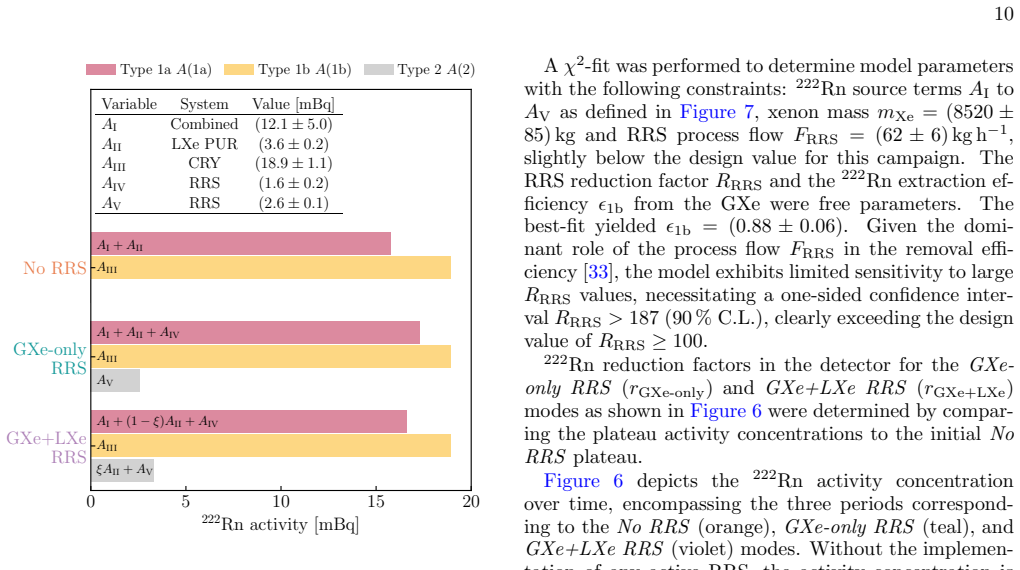
The load-bearing mechanism is the Radon Removal System (RRS), a cryogenic distillation column whose top condenser, packed column, and reboiler exploit radon's roughly ten-fold lower vapor pressure than xenon at about $-100\,^\circ\text{C}$. Radon-rich gas and liquid enter the column, radon is trapped in the liquid reservoir at the bottom, and because $^{222}$Rn has a 3.8-day half-life it decays there, so the process runs continuously without xenon loss. The removal effectiveness enters a time-dependent model through a single constant reduction factor $R_{\text{RRS}}$, which the fit finds to exceed 187 at 90% confidence. On the measurement side, the argument is carried by two independent analyses that reconstruct $\alpha$-decay positions from the S1 scintillation pattern alone -- one using polynomial light-collection corrections, the other a convolutional neural network -- and convert Gaussian-fitted $^{222}$Rn peak counts in inner fiducial masses into activity concentrations.
What would settle it
In the combined removal mode, reconstruct the same $\alpha$ events with the standard S1+S2 method in a subvolume where both signals are available and compare the resulting $^{222}$Rn concentration with the S1-only value; a difference larger than the quoted total uncertainty would falsify the claim. Alternatively, insert a calibrated $^{222}$Rn source of known activity into the detector during RRS operation and check whether the measured concentration reproduces the expected value.
Extended reading notes
Core claim
The paper's central discovery is a measured lower bound on how clean a large liquid xenon detector can be: with the Radon Removal System operating in its combined gas-plus-liquid mode, XENONnT sustains a $^{222}$Rn activity concentration of $(0.90 \pm 0.01\, \text{stat.} \pm 0.07\, \text{sys.})\,\mu\text{Bq/kg}$ in the inner 5.9 t of liquid xenon. The paper presents this as the lowest $^{222}$Rn concentration ever achieved in an operational liquid xenon TPC, about five times lower than in other currently operational multi-tonne xenon detectors and 15 times lower than the value reported for its predecessor's main science runs. It also reports reduction factors of $1.94 \pm 0.04$ for gas-only removal and $4.01 \pm 0.28$ for combined gas and liquid removal, and it argues that at this level the $^{214}$Pb electronic recoil rate is, for the first time, comparable to the solar neutrino-induced electronic recoil rate in the 5-30 keV window. The equivalence is model-dependent: the paper quotes the equivalent solar-neutrino $^{222}$Rn activity as a band bounded by a free-electron-approximation calculation and a relativistic random-phase-approximation calculation that differ by about 23%.
Load-bearing premise
The headline number assumes that reconstructing $\alpha$ events from the scintillation light pattern alone is unbiased: if the light-collection correction is wrong, both the corrected $\alpha$ energies and the inferred fiducial masses shift, which would move the reported 0.90 $\mu$Bq/kg value.
Editorial extensions
If this is right
- Radon no longer dominates the low-energy electronic recoil background in XENONnT; $^{214}$Pb betas and solar neutrino scatters now contribute comparably in the 5-30 keV range.
- The sub-$\mu$Bq/kg level opens searches for solar axions, axion-like particles, dark photons, neutrino magnetic moments, and low-mass WIMPs through electronic recoils with sensitivity at the solar-neutrino floor.
- Future multi-tonne xenon observatories can adopt the same heat-pump-integrated distillation design to reach the solar-neutrino background floor.
- Radon tagging analyses can be combined with the reduced concentration to push the effective $^{214}$Pb background still lower.
- The reported reduction factors ($1.94$ and $4.01$) calibrate how much removal can be expected per unit process flow, informing the sizing of RRS systems in larger detectors.
Reading between the lines
- If the two S1-only analyses are averaged rather than reconciled, the 14% discrepancy in the combined mode implies that the true systematic uncertainty in S1-only alpha position reconstruction may be larger than the quoted 0.07 $\mu$Bq/kg; a third reconstruction using drift-time positions in the same volume would test this directly.
- The exact point at which radon matches solar neutrinos depends on the atomic-physics model of neutrino-electron scattering, so improved bound-electron cross-section calculations would sharpen the comparison and change the implied target radon level for future detectors.
- Because plate-out reduces $^{214}$Pb to about 70% of the $^{222}$Rn activity in XENONnT, the equivalent solar-neutrino radon level is detector-specific; a detector with less plate-out would need an even lower radon concentration to reach the same equivalence.
- The removal model assumes a well-mixed xenon volume and a constant reduction factor; if circulation is imperfect in a larger 40-60 tonne detector, the required process flow may need to scale faster than target mass to maintain the same equilibrium concentration.
Editorial analysis
A structured set of objections, weighed in public.
Referee Report
Summary. The paper reports the 222Rn activity concentration in XENONnT's 5.9 t liquid-xenon target, measured by in-situ alpha spectroscopy of S1-only events, and claims a value of (0.90 ± 0.01 stat. ± 0.07 sys.) µBq/kg during combined GXe+LXe radon removal with a cryogenic distillation system. The central measurement is extracted from a Gaussian fit to the 222Rn alpha peak, cross-checked by two independent position-reconstruction analyses. The paper also presents a time-dependent removal model, estimates radon reduction factors of 1.94 and 4.01 for the two RRS modes, and argues that the radon-induced electronic-recoil background is now comparable to the solar-neutrino-induced background. If the measurement is correct, this is a major technical milestone for multi-tonne liquid-xenon detectors.
Significance. The paper's central measurement chain is unusually direct: the activity concentration is obtained from counting 222Rn alpha decays in the TPC itself, rather than from an extrapolation of emanation measurements, and it is cross-checked with two independent reconstruction analyses that agree well in two of the three operating modes. A successful demonstration of sub-µBq/kg 222Rn in an operational multi-tonne LXe TPC would be a reference result for XENONnT, LZ, PandaX, and future detectors such as XLZD and nEXO, and it would qualitatively change the low-energy ER background budget. The main caveat is that the headline value relies on S1-only position and energy reconstruction in a degraded-light environment, without a fully demonstrated validation of that reconstruction for the specific GXe+LXe mode.
major comments (3)
- [Sec. II B, Fig. 6] The headline number in the GXe+LXe mode is the simple average of two analyses that disagree by 14%, with half of that difference added to the systematic uncertainty. The resulting 0.06 µBq/kg cross-check term covers the spread between the two analyses only if the analysis errors are statistically independent; both analyses, however, inherit the same S1 light-collection model (PMT response, reflections, total internal reflection) and the same photoabsorption correction in the degraded-light GXe+LXe environment, so a common-mode bias would shift both results together. I ask the authors to report the two analysis values and fiducial volumes separately, state which analysis gives the higher concentration, and provide a validation of S1-only alpha reconstruction under GXe+LXe conditions using an independent calibration source. Without this, the quoted systematic does not fully bound a common-mode bias of the size of the observed 14% spread.
- [Sec. II B, photoabsorption correction] The text states that a correction of less than 5% to the observed photon count was applied in the GXe+LXe mode because of photoabsorbing impurities, but it does not state the uncertainty assigned to this correction or show that it is included in the quoted 0.07 µBq/kg systematic. A 5% correction corresponds to roughly 0.045 µBq/kg on the reported 0.90 value, which is comparable to the quoted systematic. Please quantify the correction and its uncertainty, and specify how it propagates into both analyses and into the fiducial-mass cross-calibration.
- [Sec. II C, Eqs. (2)-(4) and Fig. 6] The reduction factors rGXe-only and rGXe+LXe are ratios of measured plateau concentrations and do not depend on the removal model, but the interpretation of the 14% cross-analysis spread as a pure systematic rather than as a real radial concentration gradient is not tested. The two fiducial masses, 1.22 t and 2.05 t, sample different volumes, and the paper does not state which analysis reads higher or provide a radial profile of the 222Rn peak. If the discrepancy reflects a radial gradient, the reported concentration depends on the chosen fiducial volume and the well-mixed assumption in the model would be violated. I ask the authors to add a radial consistency check and, if possible, to report the concentration as a function of fiducial radius.
minor comments (3)
- [Abstract, Sec. II C, Fig. 6] The statistical uncertainty for the GXe+LXe concentration is quoted as ±0.01 in the abstract and in Sec. II C, but the corresponding line in Fig. 6 shows ±0.06. Please clarify whether these are different estimators (e.g., model-fit bootstrap vs. daily-bin mean) and use consistent labeling in the text and figure.
- [Fig. 6 caption, Fig. 8] The Fig. 6 caption calls the value 'the lowest ever achieved in an operational LXe TPC,' while Fig. 8 includes EXO-200 at a lower level with the explanation that it is a liquid-only phase detector. Adding the qualification 'dual-phase TPC' would avoid an apparent contradiction.
- [Sec. III] The text quotes the 214Pb/222Rn activity ratio used for the solar-neutrino equivalence as 'approximately 70%' without an uncertainty. Since this ratio is detector-specific and directly sets the position of the yellow band in Fig. 8, its uncertainty should be stated and, where possible, reflected in the band.
Circularity Check
No significant circularity: the headline radon concentration is a direct in-situ alpha-count measurement, not an output of the removal model or of any fitted parameter.
full rationale
The central claim, (0.90 ± 0.01 stat. ± 0.07 sys.) µBq/kg, is obtained by counting 222Rn alpha decays reconstructed from the S1 signal: the spectrum in Fig. 4 is fitted with Gaussians, a ±3σ window around the 222Rn peak is selected, and the resulting activity is divided by the independently cross-calibrated fiducial mass (Sec. II B). The removal model of Eqs. (2)-(4), taken from the collaboration's own design paper [33], only describes the time evolution of the measured activity; the quoted reduction factors are explicitly defined as ratios of measured plateau concentrations ('222Rn reduction factors ... were determined by comparing the plateau activity concentrations to the initial No RRS plateau'), so they do not reduce to the model's fitted parameters. The parameters RRRS and ε_1b are fit to the data but are not inputs to the headline concentration; RRRS is only loosely bounded (RRRS > 187), confirming that the result is not driven by that parameter. The solar-neutrino comparison is anchored to external calculations [50] and to a calibration-source measurement of the 214Pb/222Rn ratio, not to the present fit. Self-citations to earlier XENON design and emanation papers supply context and model forms, but the load-bearing measurement is self-contained. The 14% discrepancy between Analysis-I and Analysis-II in the GXe+LXe mode and the S1-only reconstruction systematics are accuracy/robustness concerns that the paper explicitly folds into the systematic uncertainty; they do not make the derivation circular.
Assumptions & free parameters
free parameters (4)
- epsilon_1b (GXe radon extraction efficiency) =
0.88 ± 0.06
- RRRS (RRS inlet-to-outlet radon reduction factor) =
RRRS > 187 at 90% C.L. (one-sided)
- xi (LXe fraction diverted to RRS in GXe+LXe mode) =
0.2 (design value, not measured)
- 214Pb bulk activity fraction relative to 222Rn =
~0.7
assumptions (4)
- domain assumption The LXe volume is well mixed and the removal model of Ref. [33] (Eq. 2) applies with a constant, concentration-independent reduction factor RRRS.
- domain assumption S1-only alpha position reconstruction and the S1+S2 cross-calibration of fiducial masses are unbiased.
- standard math Nuclear data (half-lives, branching ratios, alpha energies) from ENSDF, Ref. [25], are correct.
- domain assumption Solar neutrino-electron scattering rates in xenon are bracketed by the FEA and RRPA models of Ref. [50].
Cite this review
Pith. "Pith review of Radon Removal in XENONnT down to the Solar Neutrino Level." pith.science (2026). https://pith.science/paper/ILOA2XZG
@misc{pith2026250204209,
  author       = {Pith},
  title        = {Pith review of: Radon Removal in XENONnT down to the Solar Neutrino Level},
  year         = {2026},
  howpublished = {\url{https://pith.science/paper/ILOA2XZG}},
  note         = {Machine review of arXiv:2502.04209}
}
abstract
The XENONnT experiment has achieved an exceptionally low $^\text{222}$Rn activity concentration within its inner 5.9$\,$tonne liquid xenon detector of (0.90$\,\pm\,$0.01$\,$stat.$\,\pm\,$0.07 sys.)$\,\mu$Bq/kg, equivalent to about 430 $^\text{222}$Rn atoms per tonne of xenon. This was achieved by active online radon removal via cryogenic distillation after stringent material selection. The achieved $^\text{222}$Rn activity concentration is five times lower than that in other currently operational multi-tonne liquid xenon detectors engaged in dark matter searches. This breakthrough enables the pursuit of various rare event searches that lie beyond the confines of the standard model of particle physics, with world-leading sensitivity. The ultra-low $^\text{222}$Rn levels have diminished the radon-induced background rate in the detector to a point where it is for the first time comparable to the solar neutrino-induced background, which is poised to become the primary irreducible background in liquid xenon-based detectors.
Figures


Figures from the paper (5 more)



Forward citations
Cited by 1 Pith paper
-
Flow-dependent tagging of $^{214}$Pb decays in the LZ dark matter detector
Flow-dependent tagging, built from paired radon-polonium decays, identifies 63% of 214Pb beta-decay backgrounds in LZ's fiducial volume at 9.0% exposure cost.
Reference graph
Works this paper leans on
-
[1]
The XENONnT dark matter experiment,
E. Aprile et al. (XENON), “The XENONnT dark matter experiment,” Eur. Phys. J. C84, 784 (2024), arXiv:2402.10446 [physics.ins-det]
arXiv 2024
-
[2]
First Dark Matter Search with Nuclear Recoils from the XENONnT Experiment,
E. Aprile et al. (XENON), “First Dark Matter Search with Nuclear Recoils from the XENONnT Experiment,” Phys. Rev. Lett. 131, 041003 (2023), arXiv:2303.14729 [hep-ex]
arXiv 2023
-
[3]
Search for New Physics in Electronic Recoil Data from XENONnT,
E. Aprile et al. (XENON), “Search for New Physics in Electronic Recoil Data from XENONnT,” Phys. Rev. Lett. 129, 161805 (2022), arXiv:2207.11330 [hep-ex]
arXiv 2022
-
[4]
The LUX-ZEPLIN (LZ) experiment,
D.S. Akerib et al., “The LUX-ZEPLIN (LZ) experiment,” Nuclear Instruments and Methods in Physics Research Section A: Accelerators, Spectrometers, Detectors and Associated Equipment 953, 163047 (2020)
work page 2020
-
[5]
First Dark Matter Search Results from the LUX-ZEPLIN (LZ) Experiment,
J. Aalbers et al., “First Dark Matter Search Results from the LUX-ZEPLIN (LZ) Experiment,” Phys. Rev. Lett. 131, 041002 (2023)
work page 2023
-
[6]
Dark Matter Search Results from the PandaX-4T Commissioning Run,
Yue Meng et al. , “Dark Matter Search Results from the PandaX-4T Commissioning Run,” Phys. Rev. Lett. 127, 261802 (2021)
work page 2021
-
[7]
DarkSide-50 532-day dark matter search with low-radioactivity argon,
P. Agnes et al., “DarkSide-50 532-day dark matter search with low-radioactivity argon,” Phys. Rev. D 98, 102006 (2018)
work page 2018
-
[8]
Par- ticle dark matter: evidence, candidates and constraints,
Gianfranco Bertone, Dan Hooper, and Joseph Silk, “Par- ticle dark matter: evidence, candidates and constraints,” Physics Reports 405, 279–390 (2005)
work page 2005
Show all 55 references
-
[9]
WIMP dark matter candidates and searches - current status and future prospects,
Leszek Roszkowski, Enrico Maria Sessolo, and Sebas- tian Trojanowski, “WIMP dark matter candidates and searches - current status and future prospects,” Reports on Progress in Physics 81, 066201 (2018)
2018
-
[10]
Design and performance of the XENON10 dark matter experiment,
E. Aprile et al. (XENON), “Design and performance of the XENON10 dark matter experiment,” Astroparticle Physics 34, 679–698 (2011)
2011
-
[11]
The XENON100 dark matter experi- ment,
E. Aprile et al. , “The XENON100 dark matter experi- ment,” Astroparticle Physics 35, 573–590 (2012)
2012
-
[12]
The XENON1T dark matter experiment,
E. Aprile et al. (XENON), “The XENON1T dark matter experiment,” Eur. Phys. J. C77, 881 (2017), arXiv:1708.07051 [astro-ph.IM]
2017 arXiv
-
[13]
First limits on WIMP nuclear recoil signals in ZEPLIN-II: A two-phase xenon detector for dark matter detection,
G.J. Alner et al. , “First limits on WIMP nuclear recoil signals in ZEPLIN-II: A two-phase xenon detector for dark matter detection,” Astroparticle Physics 28, 287– 302 (2007)
2007
-
[14]
The ZEPLIN-III dark matter de- tector: Instrument design, manufacture and commission- ing,
D.Yu. Akimov et al. , “The ZEPLIN-III dark matter de- tector: Instrument design, manufacture and commission- ing,” Astroparticle Physics 27, 46–60 (2007)
2007
-
[15]
The Large Underground Xenon (LUX) experiment,
D.S. Akerib et al. , “The Large Underground Xenon (LUX) experiment,” Nuclear Instruments and Methods 13 in Physics Research Section A: Accelerators, Spectrome- ters, Detectors and Associated Equipment 704, 111–126 (2013)
2013
-
[16]
Dual-phase xenon time projection cham- bers for rare-event searches,
Laura Baudis, “Dual-phase xenon time projection cham- bers for rare-event searches,” Phil. Trans. Roy. Soc. Lond. A 382, 20230083 (2023), arXiv:2311.05320 [physics.ins- det]
2023 arXiv
-
[17]
DarkSide-20k: a 20 Tonne two-phase LAr TPC for direct dark matter detection at LNGS,
C.E Aalseth et al., “DarkSide-20k: a 20 Tonne two-phase LAr TPC for direct dark matter detection at LNGS,” Eur. Phys. J. Plus 133, 131 (2018)
2018
-
[18]
Toward the discovery of matter creation with neutrinoless ββ decay,
Matteo Agostini et al. , “Toward the discovery of matter creation with neutrinoless ββ decay,” Rev. Mod. Phys. 95, 025002 (2023)
2023
-
[19]
Sensitivity of NEXT- 100 to Neutrinoless Double Beta Decay,
J. Mart ´ ın-Alboet al. (NEXT), “Sensitivity of NEXT- 100 to Neutrinoless Double Beta Decay,” JHEP 05, 159 (2016), arXiv:1511.09246 [physics.ins-det]
2016 arXiv
-
[20]
The EXO-200 detector, part I: detector design and construction,
M Auger et al., “The EXO-200 detector, part I: detector design and construction,” Journal of Instrumentation 7, P05010 (2012)
2012
-
[21]
nEXO: neutrinoless double beta de- cay search beyond 1028 year half-life sensitivity,
G. Adhikari et al. , “nEXO: neutrinoless double beta de- cay search beyond 1028 year half-life sensitivity,” Journal of Physics G: Nuclear and Particle Physics 49, 015104 (2021)
2021
-
[22]
Observation of two-neutrino double electron capture in 124Xe with XENON1T,
E. Aprile et al. (XENON), “Observation of two-neutrino double electron capture in 124Xe with XENON1T,” Na- ture 568, 532–535 (2019), arXiv:1904.11002 [nucl-ex]
2019 arXiv
-
[23]
Double-Weak Decays of 124Xe and 136Xe in the XENON1T and XENONnT Experiments,
E. Aprile et al. (XENON), “Double-Weak Decays of 124Xe and 136Xe in the XENON1T and XENONnT Experiments,” Phys. Rev. C 106, 024328 (2022), arXiv:2205.04158 [hep-ex]
2022 arXiv
-
[24]
Removing krypton from xenon by cryogenic distillation to the ppq level,
E. Aprile et al. (XENON), “Removing krypton from xenon by cryogenic distillation to the ppq level,” Eur. Phys. J. C 77, 275 (2017), arXiv:1612.04284 [physics.ins- det]
2017 arXiv
-
[25]
http://www.nndc.bnl.gov/ensarchivals/,
ENSDF database, “http://www.nndc.bnl.gov/ensarchivals/,” (2023)
2023
-
[26]
Offline tagging of radon-induced backgrounds in XENON1T and applicability to other liquid xenon time projection chambers,
E. Aprile et al. ((XENON Collaboration) ¶, XENON), “Offline tagging of radon-induced backgrounds in XENON1T and applicability to other liquid xenon time projection chambers,” Phys. Rev. D 110, 012011 (2024), arXiv:2403.14878 [hep-ex]
2024 arXiv
-
[27]
Dark Mat- ter Search Results from 4.2 Tonne-Years of Expo- sure of the LUX-ZEPLIN (LZ) Experiment,
J. Aalbers et al. (LZ Collaboration), “Dark Mat- ter Search Results from 4.2 Tonne-Years of Expo- sure of the LUX-ZEPLIN (LZ) Experiment,” (2024), arXiv:2410.17036 [hep-ex]
2024 arXiv
-
[28]
Magnetically-coupled piston pump for high-purity gas applications,
Ethan Brown et al. , “Magnetically-coupled piston pump for high-purity gas applications,” Eur. Phys. J. C 78, 604 (2018), arXiv:1803.08498 [physics.ins-det]
2018 arXiv
-
[29]
222Rn emanation measure- ments for the XENON1T experiment,
E. Aprile et al. (XENON), “ 222Rn emanation measure- ments for the XENON1T experiment,” Eur. Phys. J. C 81, 337 (2021), arXiv:2009.13981 [physics.ins-det]
2021 arXiv
-
[30]
A next-generation liquid xenon obser- vatory for dark matter and neutrino physics,
J. Aalbers et al., “A next-generation liquid xenon obser- vatory for dark matter and neutrino physics,” J. Phys. G 50, 013001 (2023), arXiv:2203.02309 [physics.ins-det]
2023
-
[31]
Liquid- phase purification for multi-tonne xenon detectors,
G. Plante, E. Aprile, J. Howlett, and Y. Zhang, “Liquid- phase purification for multi-tonne xenon detectors,” Eur. Phys. J. C 82, 860 (2022), arXiv:2205.07336 [physics.ins- det]
2022 arXiv
-
[32]
Material radiopurity control in the XENONnT experiment,
E. Aprile et al. (XENON), “Material radiopurity control in the XENONnT experiment,” Eur. Phys. J. C 82, 599 (2022), arXiv:2112.05629 [physics.ins-det]
2022 arXiv
-
[33]
Design, construction and commissioning of a high-flow radon removal system for XENONnT,
M. Murra, D. Schulte, C. Huhmann, and C. Weinheimer, “Design, construction and commissioning of a high-flow radon removal system for XENONnT,” Eur. Phys. J. C 82, 1104 (2022), arXiv:2205.11492 [physics.ins-det]
2022 arXiv
-
[34]
Lemmon, Ian H
Eric W. Lemmon, Ian H. Bell, Marcia L. Huber, and Mark O. McLinden, Thermophysical Properties of Fluid Systems (NIST Chemistry WebBook, NIST Standard Reference Database Number 69, Eds. P.J. Linstrom and W.G. Mallard, 2024)
2024
-
[35]
Cryogenic bath-type heat exchangers for ultra-pure noble gas applications,
M. Murra et al. , “Cryogenic bath-type heat exchangers for ultra-pure noble gas applications,” JINST 17, P05037 (2022), arXiv:2203.01026 [physics.ins-det]
2022 arXiv
-
[36]
Ultra-clean radon-free four cylinder magnetically-coupled piston pump,
D. Schulte et al. , “Ultra-clean radon-free four cylinder magnetically-coupled piston pump,” JINST 16, P09011 (2021), arXiv:2107.00755 [physics.ins-det]
2021 arXiv
-
[37]
M.-M. B´ e, V. Chist´ e, C. Dulieu, E. Browne, V. Chechev, N. Kuzmenko, F. Kondev, A. Luca, M. Gal´ an, A. Pearce, and X. Huang, Table of Radionuclides , Monographie BIPM-5, Vol. 4 (Bureau International des Poids et Mesures, Pavillon de Breteuil, F-92310 S` evres, France, 2008)
2008
-
[38]
SRIM - The stopping and range of ions in matter (2010),
J. F. Ziegler, M. D. Ziegler, and J. P. Biersack, “SRIM - The stopping and range of ions in matter (2010),” Nucl. Instrum. Meth. B268, 1818 (2010)
2010
-
[39]
XENONnT Analysis: Signal Reconstruction, Calibration and Event Selection,
E. Aprile et al. (XENON), “XENONnT Analysis: Signal Reconstruction, Calibration and Event Selection,” Phys. Rev. D accepted (2024), arXiv:2409.08778 [hep-ex]
2024 arXiv
-
[40]
First Indication of Solar 8B Neutrinos via Coherent Elastic Neutrino-Nucleus Scat- tering with XENONnT,
E. Aprile et al. (XENON), “First Indication of Solar 8B Neutrinos via Coherent Elastic Neutrino-Nucleus Scat- tering with XENONnT,” Phys. Rev. Lett. 133, 191002 (2024), arXiv:2408.02877 [hep-ex]
2024
-
[41]
Matteo Guida, Position Reconstruction Based on Prompt Scintillation Light in XENONnT Exploiting Deep Learn- ing, Master’s thesis, Padua U. (2021)
2021
-
[42]
The XLZD Design Book: Towards the Next-Generation Liquid Xenon Observa- tory for Dark Matter and Neutrino Physics,
J. Aalbers et al. (XLZD), “The XLZD Design Book: Towards the Next-Generation Liquid Xenon Observa- tory for Dark Matter and Neutrino Physics,” (2024), arXiv:2410.17137 [hep-ex]
2024
-
[43]
Online 222Rn removal by cryogenic distillation in the XENON100 experi- ment,
E. Aprile et al. (XENON100), “Online 222Rn removal by cryogenic distillation in the XENON100 experi- ment,” Eur. Phys. J. C77, 358 (2017), arXiv:1702.06942 [physics.ins-det]
2017 arXiv
-
[44]
Investiga- tion of radioactivity-induced backgrounds in EXO-200,
J. B. Albert et al. (EXO-200 Collaboration), “Investiga- tion of radioactivity-induced backgrounds in EXO-200,” Phys. Rev. C 92, 015503 (2015)
2015
-
[45]
Radon-related Backgrounds in the LUX Dark Matter Search,
A. Bradley et al. , “Radon-related Backgrounds in the LUX Dark Matter Search,” Physics Procedia 61, 658– 665 (2015), 13th International Conference on Topics in Astroparticle and Underground Physics, TAUP 2013
2015
-
[46]
Dark Matter Results from First 98.7 Days of Data from the PandaX-II Experiment,
A. Tan et al. (PandaX-II Collaboration), “Dark Matter Results from First 98.7 Days of Data from the PandaX-II Experiment,” Phys. Rev. Lett. 117, 121303 (2016)
2016
-
[47]
XMASS detector,
K. Abe et al., “XMASS detector,” Nucl. Instrum. Meth- ods Phys. Res. A 716, 78–85 (2013)
2013
-
[48]
Background determination for the LUX-ZEPLIN dark matter experiment,
J. Aalbers et al. (The LUX-ZEPLIN Collaboration), “Background determination for the LUX-ZEPLIN dark matter experiment,” Phys. Rev. D 108, 012010 (2023)
2023
-
[49]
PandaX-xT: a Multi-ten-tonne Liquid Xenon Observatory at the China Jinping Underground Laboratory,
Abdusalam Abdukerim et al. (PandaX), “PandaX-xT: a Multi-ten-tonne Liquid Xenon Observatory at the China Jinping Underground Laboratory,” Sci. China Phys. Mech. Astron. 68, 221011 (2025), arXiv:2402.03596 [hep- ex]
2025 arXiv
-
[50]
Low-energy electronic recoil in xenon detectors by solar neutrinos,
J.-W. Chen et al., “Low-energy electronic recoil in xenon detectors by solar neutrinos,” Physics Letters B 774, 656–661 (2017)
2017
-
[51]
Production and characterization of a 222Rn-emanating stainless steel source,
F. J¨ org et al. , “Production and characterization of a 222Rn-emanating stainless steel source,” Applied Radi- 14 ation and Isotopes 194, 110666 (2023)
2023
-
[52]
Comprehensive mea- surement of pp-chain solar neutrinos with Borexino,
M. Agostini et al. (BOREXINO), “Comprehensive mea- surement of pp-chain solar neutrinos with Borexino,” PoS EPS-HEP2019, 400 (2020)
2020
-
[53]
First Indication of Solar 8B Neu- trino Flux through Coherent Elastic Neutrino-Nucleus Scattering in PandaX-4T,
Z. Bo et al. (PandaX), “First Indication of Solar 8B Neu- trino Flux through Coherent Elastic Neutrino-Nucleus Scattering in PandaX-4T,” Phys. Rev. Lett. 133, 191001 (2024), arXiv:2407.10892 [hep-ex]
2024 arXiv
-
[54]
New Definition of the Neutrino Floor for Direct Dark Matter Searches,
Ciaran A. J. O’Hare, “New Definition of the Neutrino Floor for Direct Dark Matter Searches,” Phys. Rev. Lett. 127, 251802 (2021)
2021
-
[85]
The RRS reduction factor RRRS and the 222Rn extraction ef- ficiency ϵ1b from the GXe were free parameters
kg and RRS process flow FRRS = (62 ± 6) kg h−1, slightly below the design value for this campaign. The RRS reduction factor RRRS and the 222Rn extraction ef- ficiency ϵ1b from the GXe were free parameters. The best-fit yielded ϵ1b = (0 .88 ± 0.06). Given the domi- nant role of...
2020
Reviewed August 8, 2026 · model on record in the stance chip above.
Discussion (0). Continue with ORCID to comment.