REVIEW 5 major objections 6 minor 1 cited by
sshELF: Single-Shot Hierarchical Extrapolation of Latent Features for 3D Reconstruction from Sparse-Views
T0 review · 5 major / 6 minor · reviewed 2026-08-08 · deepseek-v4-flash
Pith's one-line read sshELF reconstructs a full 360-degree driving scene from six sparse outward-facing cameras in one feed-forward pass, using intermediate virtual views to fill in occluded regions instead of leaving them blurry.
desk verdict Solid two-stage sparse-view reconstruction with a genuinely useful virtual-view idea; synthetic results credible, but the nuScenes evaluation is temporally confounded and the paper overclaims on LPIPS. read the letter →
The pith
A machine-rendered reading of the paper's core claim, the machinery that carries it, and where it could break.
The reading
What carries the argument
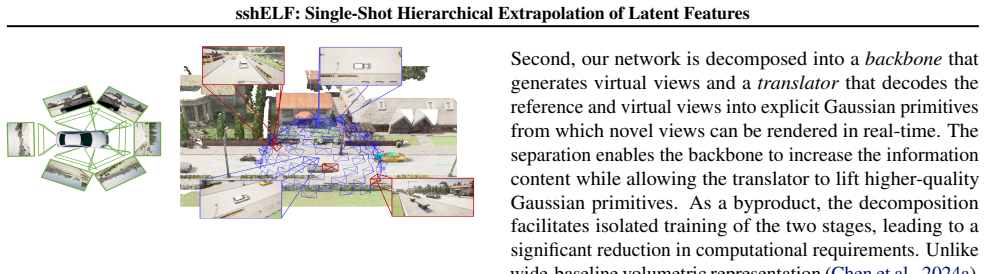
The central machinery is the ELF block, a hierarchical extrapolation unit that refines virtual-view latent features by alternating epipolar-constrained cross-attention with reference-view features, self-attention, and an MLP. It is stacked four times in the backbone and once in the translator. Around it sit three load-bearing components: a pre-trained DINOv2 encoder that supplies multi-stage patch latents and a class token for both texture and semantics; a pre-trained dense depth head that initializes virtual views by projecting reference pixels into 3D and back-projecting them; and a UNet translator that decodes reference and virtual views into per-pixel 3D Gaussian primitives with probabilistic depth prediction, later rendered by Gaussian rasterization. The two stages are trained separately, with the backbone minimizing an MSE loss on reconstructed virtual-view features plus a cycle-consistency term on reference features, and the translator minimizing an MSE/MAE loss on rendered novel views and Z-buffer depth.
What would settle it
A decisive check would be to hold out a real static driving scene, hide one sensor-occluded region (such as the ground under the vehicle) from all six inputs, and compare the rendered reconstruction of that region against a dense LiDAR or drone scan; if the recovered geometry is no better than a blurry filled average, the claim that occluded regions are faithfully reconstructed would be refuted. A second check is to insert a fast-moving vehicle into an otherwise static scene and see whether the TD2–TD4 renderings degrade with the vehicle's speed, as the paper's own limitation about dynamic objects predicts.
Extended reading notes
Core claim
The paper's core discovery is that information extrapolation should be separated from primitive decoding in sparse-view 3D reconstruction: the network first hallucinates image-and-latent content for intermediate viewpoints, and only then predicts explicit 3D Gaussians from those views. This virtual-view bottleneck gives the model a place to deposit cross-scene structural priors, so the translator never has to simultaneously inpaint and reconstruct. The backbone takes six reference images, extracts multi-layer DINOv2 latent features, initializes six virtual views by depth-based point-cloud projection, and refines them with hierarchical ELF blocks built from epipolar cross-attention and self-attention, with a cycle-consistency loss that keeps reference features stable. The translator, a UNet with a single ELF block, converts the aggregated reference and virtual views into 3D Gaussian splats that are rasterized into novel views. With this design the paper reports 18.93 dB PSNR on SEED4D in 0.182 seconds and higher PSNR and SSIM than MVSplat and pixelSplat on nuScenes at all tested temporal offsets, and concludes that occluded regions are reconstructed faithfully and that jointly predicted latent features can support downstream scene understanding.
Load-bearing premise
The load-bearing premise is that ground-truth virtual views are available to supervise the backbone during training, either from synthetic exocentric cameras or by treating later timesteps of a nearly static scene as virtual views; on real nuScenes data this reduces to assuming the scene is mostly static across the temporal window, and the paper itself concedes that dynamic objects introduce transient artifacts when multi-timestep data are aggregated.
Editorial extensions
If this is right
- A six-camera surround rig can produce a complete $360^\circ$ scene model in a single forward pass, removing the per-scene optimization step that makes iterative methods too slow for online driving use.
- Occluded and ego-occluded regions are filled by the virtual-view stage instead of being left blurry, because representational capacity is spent on extrapolation before the 3D decoder runs.
- Because backbone and translator train separately, raising the number or resolution of virtual views does not force a full end-to-end retrain, keeping training practical on the reported hardware.
- The same inference pass emits latent features, texture, and depth together, enabling scene-understanding tasks to reuse the reconstruction rather than recompute features from rendered images.
- 3D Gaussian splatting output keeps rendering real-time, so the reconstructed scene can be navigated at interactive frame rates, unlike slower triplane or volumetric single-shot baselines.
Reading between the lines
- Beyond the paper, the virtual-view supervision requirement could be relaxed by generating pseudo-supervision with any strong novel-view model, which would allow training on real data without exocentric cameras.
- Beyond the paper, because the backbone and translator are separate, the learned extrapolation prior could be paired with a different scene decoder (NeRF, triplane, or occupancy grid) without retraining the whole system from scratch.
- Beyond the paper, the claimed faithfulness of occlusion reconstruction could be turned into a measurable claim by reporting per-region PSNR or Chamfer distance specifically inside ego-occluded and object-occluded areas, which the paper does not do.
- Beyond the paper, the jointly predicted latent features are an untested asset: a natural next experiment is zero-shot semantic segmentation or 3D object detection from the latent codes, which would make the reconstruction useful beyond rendering.
Editorial analysis
A structured set of objections, weighed in public.
Referee Report
Summary. The paper introduces sshELF, a single-shot feed-forward pipeline for reconstructing unbounded 360-degree outdoor scenes from six outward-facing input views with minimal overlap. The architecture is two-stage: a backbone encodes reference views with DINOv2, initializes intermediate 'virtual views' by depth-based projection, and refines them with hierarchical cross-/self-attention ELF blocks under an MSE loss on virtual-view latents and texture; a translator UNet then lifts the reference and virtual views into 3D Gaussian primitives that are rendered with the 3DGS rasterizer. Training assumes virtual views are available for supervision, sampled from exocentric views on SEED4D and from temporally offset egocentric views on nuScenes (TD=2,3,4). The authors report the best PSNR on SEED4D, a second rank in SSIM and D-RMSE, an 182 ms end-to-end runtime, and claim competitive or superior results on nuScenes.
Significance. If the claims hold, the paper addresses a practically important problem: real-time reconstruction of driving scenes from sparse surround cameras with almost no overlap. The virtual-view intermediate representation is a sensible mechanism for injecting global context, and decoupling extrapolation from primitive decoding is a clean design that also lowers training cost. The evaluation is standard supervised training with held-out testing, and the integration of pretrained DINOv2 features and depth priors is a strength. However, the real-world validation rests on a temporal-aggregation protocol that assumes near-static scenes, and several textual claims exceed what the reported tables support; both need correction before the contribution is fully established. The method is nevertheless a reasonable candidate for the community if those issues are addressed.
major comments (5)
- [Section 1 (third key insight)] The sentence 'Our results outperform previous methods' is contradicted by the paper's own Table 1: sshELF's SSIM (0.65) and LPIPS (0.50) are worse than 6Img-to-3D's (0.73 and 0.45), and pixelSplat's LPIPS (0.44) is also better. The abstract and Section 4.3 use the accurate word 'competitive' (the latter correctly notes the second rank in SSIM and D-RMSE); the introduction should be reworded to match its own data rather than claiming overall superiority.
- [Section 4.3 (NuScenes paragraph)] The claim that Table 2 'demonstrate[s] our method's superiority across visual and geometric metrics' is not supported by the table: sshELF's LPIPS (0.634 / 0.650 / 0.653 at TD=2/3/4) is worse than pixelSplat (0.495 / 0.532 / 0.539) at every temporal difference and worse than MVSplat at TD=3 (0.650 vs 0.575). The superiority statement holds only for PSNR, SSIM, and Chamfer; the claim should either be restricted to those metrics or the LPIPS deficit should be discussed quantitatively.
- [Section 4.1 (NuScenes), Section 3.5, Section 5] The nuScenes protocol aggregates egocentric views across time (TD=2,3,4) to define both virtual and novel view supervision. This treats the scene as predominantly static: moving objects appear in the target views without corresponding geometry in the reference views, so the reported errors conflate true novel-view extrapolation with failure to predict object motion. Section 5 concedes 'sensitivity to dynamic objects when aggregating multi-timestep data, which can introduce transient artifacts,' and Section 3.5 states the supervision assumption explicitly. Because this protocol is the only real-world validation, the nuScenes numbers do not yet substantiate the headline claim of faithful reconstruction of occluded regions in dynamic outdoor scenes. I recommend reporting metrics on static-region masks (or with dynamic objects masked), and re-framing the real-world claim accordingly.
- [Table 2 (Chamfer column)] The pixelSplat Chamfer values (1.191M, 0.144M, 0.163M at TD=2/3/4) are three to six orders of magnitude larger than every other value in the same table (e.g., 646.11 for MVSplat and 51.67 for sshELF at TD=2), which is implausible for scene-scale point cloud distances and suggests a units or normalization error. Since the text appeals to geometric metrics for superiority, these numbers must be corrected or recomputed before the comparison can be interpreted.
- [Section 4.2–4.3 (baselines on nuScenes)] The paper does not state how MVSplat and pixelSplat were trained or fine-tuned for the nuScenes evaluation, while sshELF is explicitly fine-tuned on nuScenes from synthetic checkpoints for 100K steps. If the baselines were evaluated with public checkpoints without nuScenes training, the Table 2 comparison is unfair; if they were trained under the same temporal-aggregation protocol, that protocol should be described. This information is needed to interpret the claimed superiority on real-world data.
minor comments (6)
- [Abstract and Section 1] Typos: 'hierarchal' should be 'hierarchical'; 'Our key insights is' should be 'Our key insight is'; the Section 1 heading 'Problem Statment' should be 'Problem Statement'.
- [Table 1] The Time column mixes seconds and milliseconds without a consistent unit label (0.42ms, 32ms, 1.1ms, 182ms, 2.85s). Also, the 182ms figure is for SEED4D at 256×256 novel view resolution, while the introduction's 0.18s claim refers to six surround views; it should be stated whether this runtime includes DINOv2 feature extraction and whether it holds at the 896×896 nuScenes rendering resolution.
- [Section 4.3 (NuScenes paragraph)] The phrase 'as seen in Figure 4 for MVSplat' appears to cite the wrong figure: nuScenes qualitative results are shown in Figure 5, while Figure 4 shows the SEED4D comparison.
- [Section 4.2] The rationale for setting λ4 = 0 on nuScenes is unclear given that LiDAR-based Chamfer supervision is used in the same section (Table 5); a brief explanation of why the Z-buffer depth loss is disabled there would help.
- [Sections 3.2–3.3] Several implementation details are missing: the number n of DINOv2 blocks used for latent features, the channel/resolution configuration of the ELF blocks, and the specifics of the 'probabilistic depth map prediction similar to pixelSplat' are referenced but not described.
- [Section 4.3 and Conclusion] The claim that sshELF 'faithfully reconstructs occluded regions' is supported only by qualitative figures; a quantitative evaluation restricted to regions unobserved in all reference views would substantiate this central claim.
Circularity Check
No circularity found: virtual-view supervision is ground-truth based, the novel-view targets are held-out or future-time data, and the self-citations are dataset/baseline references rather than load-bearing derivations.
full rationale
None of the seven circularity patterns applies to the paper's derivation chain. The backbone is trained with an MSE loss between reconstructed and ground-truth virtual-view latents and textures (Eq. 10), where ground truth comes from exocentric SEED4D views or from temporally aggregated nuScenes views; these supervision targets are not constructed from the model's own predicted Gaussians or from the reported evaluation metrics. The evaluation is standard supervised training with held-out Town 2 scenes and nuScenes future-time views, so the central novel-view-synthesis claim does not reduce to a fitted parameter renamed as a prediction. The explicit assumption in Section 3.5 that virtual views are available for supervision is disclosed as a data-availability assumption, not smuggled in as a conclusion. On nuScenes this assumption is implemented by temporal aggregation, and the conclusion's statement 'A current limitation is sensitivity to dynamic objects when aggregating multi-timestep data, which can introduce transient artifacts' flags the static-scene validity risk rather than hiding it; this is a domain-gap limitation, not circular reasoning. The self-citations, SEED4D as a dataset and 6Img-to-3D as a baseline, are not used to justify the architectural claim, and the method is benchmarked against external data and external components (nuScenes, DINOv2, 3DGS, epipolar-attention ideas from latentSplat). No uniqueness theorem or prior-work authority is invoked to forbid alternatives. The main correctness concern is whether temporal aggregation on dynamic real-world scenes validates the 360-degree single-shot claim, but that concern is about external validity and static-scene assumptions, not about equivalence of inputs and outputs by construction.
Assumptions & free parameters
free parameters (4)
- Backbone loss weights lambda1, lambda2 =
lambda1=1000.0, lambda2=0.1
- Translator loss weights lambda3, lambda4 =
lambda3=100.0, lambda4=0.001
- Number of virtual views n_vrt =
6
- Virtual view resolution =
64x64
assumptions (4)
- domain assumption Ground-truth virtual views are available for supervision during training (sampled from exocentric data in SEED4D, or interpolated from temporal neighbors in nuScenes)
- domain assumption DINOv2 pre-trained features retain sufficient semantic and geometric information to support view extrapolation
- domain assumption A pre-trained depth head (DPT) provides approximately metric depth maps that can reliably unproject reference pixels into 3D
- domain assumption Scene is predominantly static when novel views are taken from future timesteps (nuScenes evaluation)
invented entities (1)
-
Virtual views
Cite this review
Pith. "Pith review of sshELF: Single-Shot Hierarchical Extrapolation of Latent Features for 3D Reconstruction from Sparse-Views." pith.science (2026). https://pith.science/paper/VMNUZQOD
@misc{pith2026250204318,
  author       = {Pith},
  title        = {Pith review of: sshELF: Single-Shot Hierarchical Extrapolation of Latent Features for 3D Reconstruction from Sparse-Views},
  year         = {2026},
  howpublished = {\url{https://pith.science/paper/VMNUZQOD}},
  note         = {Machine review of arXiv:2502.04318}
}
read the original abstract
Reconstructing unbounded outdoor scenes from sparse outward-facing views poses significant challenges due to minimal view overlap. Previous methods often lack cross-scene understanding and their primitive-centric formulations overload local features to compensate for missing global context, resulting in blurriness in unseen parts of the scene. We propose sshELF, a fast, single-shot pipeline for sparse-view 3D scene reconstruction via hierarchal extrapolation of latent features. Our key insights is that disentangling information extrapolation from primitive decoding allows efficient transfer of structural patterns across training scenes. Our method: (1) learns cross-scene priors to generate intermediate virtual views to extrapolate to unobserved regions, (2) offers a two-stage network design separating virtual view generation from 3D primitive decoding for efficient training and modular model design, and (3) integrates a pre-trained foundation model for joint inference of latent features and texture, improving scene understanding and generalization. sshELF can reconstruct 360 degree scenes from six sparse input views and achieves competitive results on synthetic and real-world datasets. We find that sshELF faithfully reconstructs occluded regions, supports real-time rendering, and provides rich latent features for downstream applications. The code will be released.
Figures


Figures from the paper (2 more)


Forward citations
Cited by 1 Pith paper
-
Sparse-View 3D Reconstruction: Recent Advances and Open Challenges
A comprehensive survey that organizes sparse-view 3D reconstruction methods into geometry-based, NeRF, 3DGS, and diffusion-based categories, with benchmarks and open challenges.
Reference graph
Works this paper leans on
-
[4]
Mvsplat: Efficient 3d gaussian splatting from sparse multi-view images
Chen, Y ., Xu, H., Zheng, C., Zhuang, B., Pollefeys, M., Geiger, A., Cham, T.-J., and Cai, J. Mvsplat: Efficient 3d gaussian splatting from sparse multi-view images. In Leonardis, A., Ricci, E., Roth, S., Russakovsky, O., Sat- tler, T., and Varol, G. (eds.), Computer Vision – ECCV 2024, pp. 370–386, Cham,
work page 2024
-
[6]
doi: 10.1109/CVPR52729.2023.01263
IEEE Computer Society. doi: 10.1109/CVPR52729.2023.01263. Dosovitskiy, A., Beyer, L., Kolesnikov, A., Weissenborn, D., Zhai, X., Unterthiner, T., Dehghani, M., Minderer, M., Heigold, G., Gelly, S., Uszkoreit, J., and Houlsby, N. An image is worth 16x16 words: Transformers for image recognition at scale. ICLR,
-
[9]
VEGS: view extrapolation of urban scenes in 3d gaussian splat- ting using learned priors
Hwang, S., Kim, M., Kang, T., Kang, J., and Choo, J. VEGS: view extrapolation of urban scenes in 3d gaussian splat- ting using learned priors. CoRR, abs/2407.02945,
-
[10]
doi: 10.48550/ARXIV .2407.02945. Irshad, M. Z., Zakharov, S., Liu, K., Guizilini, V ., Kollar, T., Gaidon, A., Kira, Z., and Ambrus, R. Neo 360: Neural fields for sparse view synthesis of outdoor scenes. Intern- taional Conference on Computer Vision (ICCV) ,
-
[11]
Accelerating 3d deep learning with pytorch3d
9 sshELF: Single-Shot Hierarchical Extrapolation of Latent Features Johnson, J., Ravi, N., Reizenstein, J., Novotny, D., Tul- siani, S., Lassner, C., and Branson, S. Accelerating 3d deep learning with pytorch3d. In SIGGRAPH Asia 2020 Courses, SA ’20, New York, NY , USA,
work page 2020
-
[13]
Autosplat: Constrained gaussian splatting for autonomous driving scene reconstruction
Khan, M., Fazlali, H., Sharma, D., Cao, T., Bai, D., Ren, Y ., and Liu, B. Autosplat: Constrained gaussian splatting for autonomous driving scene reconstruction. arXiv preprint, arXiv:2407.02598,
-
[14]
Kingma, D. P. and Ba, J. Adam: A method for stochastic optimization. In Bengio, Y . and LeCun, Y . (eds.), 3rd International Conference on Learning Representations, ICLR 2015, San Diego, CA, USA, May 7-9, 2015, Confer- ence Track Proceedings,
work page 2015
-
[16]
URL https://arxiv.org/abs/2412.00730. Lefaudeux, B., Massa, F., Liskovich, D., Xiong, W., Caggiano, V ., Naren, S., Xu, M., Hu, J., Tintore, M., Zhang, S., Labatut, P., Haziza, D., Wehrstedt, L., Reizen- stein, J., and Sizov, G. xformers: A modular and hack- able transformer modelling library. https://github. com/facebookresearch/xformers,
Show all 25 references
-
[17]
Vdg: Vision-only dynamic gaussian for driving simulation
Li, H., Li, J., Zhang, D., Wu, C., Shi, J., Zhao, C., Feng, H., Ding, E., Wang, J., and Han, J. Vdg: Vision-only dynamic gaussian for driving simulation. arXiv preprint, 2024a. Li, J., Zhang, J., Bai, X., Zheng, J., Ning, X., Zhou, J., and Gu, L. Dngaussian: Optimizing sparse-...
-
[18]
Oquab, M., Darcet, T., Moutakanni, T., V o, H. V ., Szafraniec, M., Khalidov, V ., Fernandez, P., Haziza, D., Massa, F., El-Nouby, A., Howes, R., Huang, P.-Y ., Xu, H., Sharma, V ., Li, S.-W., Galuba, W., Rabbat, M., As- sran, M., Ballas, N., Synnaeve, G., Misra, I., Jegou, H....
-
[19]
Common objects in 3d: Large-scale learning and evaluation of real-life 3d category reconstruction
Reizenstein, J., Shapovalov, R., Henzler, P., Sbordone, L., Labatut, P., and Novotny, D. Common objects in 3d: Large-scale learning and evaluation of real-life 3d category reconstruction. In 2021 IEEE/CVF Interna- tional Conference on Computer Vision (ICCV), pp. 10881– 10891, ...
2021
-
[20]
doi: 10.1109/ICCV48922.2021.01072
IEEE Com- puter Society. doi: 10.1109/ICCV48922.2021.01072. Ronneberger, O., Fischer, P., and Brox, T. U-net: Con- volutional networks for biomedical image segmentation. CoRR, abs/1505.04597,
2021
-
[21]
Flash3d: Feed-forward generalisable 3d scene reconstruction from a single image
10 sshELF: Single-Shot Hierarchical Extrapolation of Latent Features Szymanowicz, S., Insafutdinov, E., Zheng, C., Campbell, D., Henriques, J., Rupprecht, C., and Vedaldi, A. Flash3d: Feed-forward generalisable 3d scene reconstruction from a single image. arxiv, 2024a. Szymano...
-
[23]
Gaussianobject: High-quality 3d object reconstruction from four views with gaussian splatting
Yang, C., Li, S., Fang, J., Liang, R., Xie, L., Zhang, X., Shen, W., and Tian, Q. Gaussianobject: High-quality 3d object reconstruction from four views with gaussian splatting. ACM Transactions on Graphics, 2024a. Yang, J., Ivanovic, B., Litany, O., Weng, X., Kim, S. W., Li, B...
2024
-
[24]
Grm: Large gaussian reconstruction model for efficient 3d reconstruction and generation
Yinghao, X., Zifan, S., Wang, Y ., Hansheng, C., Ceyuan, Y ., Sida, P., Yujun, S., and Gordon, W. Grm: Large gaussian reconstruction model for efficient 3d reconstruction and generation. arXiv preprint, arXiv:2403.14621,
-
[25]
Sgd: Street view synthe- sis with gaussian splatting and diffusion prior
Yu, Z., Wang, H., Yang, J., Wang, H., Xie, Z., Cai, Y ., Cao, J., Ji, Z., and Sun, M. Sgd: Street view synthe- sis with gaussian splatting and diffusion prior. ArXiv, abs/2403.20079,
-
[26]
A., Shechtman, E., and Wang, O
Zhang, R., Isola, P., Efros, A. A., Shechtman, E., and Wang, O. The unreasonable effectiveness of deep features as a perceptual metric. 2018 IEEE/CVF Conference on Computer Vision and Pattern Recognition, pp. 586–595,
2018
-
[2004]
Wewer, C., Raj, K., Ilg, E., Schiele, B., and Lenssen, J. E. {latentSplat}: {A}utoencoding Variational {G}aussians for Fast Generalizable {3D} Reconstruction. In Com- puter Vision – ECCV 2024 , Lecture Notes in Computer Science, Milano, Italy,
2024
-
[2019]
2019.00939
doi: 10.1109/ICCV . 2019.00939. Bhat, S. F., Birkl, R., Wofk, D., Wonka, P., and M¨uller, M. Zoedepth: Zero-shot transfer by combining relative and metric depth. CoRR, abs/2302.12288,
2019
-
[2020]
ISBN 9781450381123
Association for Computing Machinery. ISBN 9781450381123. doi: 10.1145/3415263.3419160. Ke, B., Obukhov, A., Huang, S., Metzger, N., Daudt, R. C., and Schindler, K. Repurposing diffusion-based image generators for monocular depth estimation. In Proceed- ings of the IEEE/CVF Con...
-
[2021]
Lara: Efficient large-baseline radiance fields
Chen, A., Xu, H., Esposito, S., Tang, S., and Geiger, A. Lara: Efficient large-baseline radiance fields. In Euro- pean Conference on Computer Vision (ECCV) , 2024a. Chen, Y ., Gu, C., Jiang, J., Zhu, X., and Zhang, L. Periodic vibration gaussian: Dynamic urban scene reconstruc...
-
[2022]
Guo, J., Deng, N., Li, X., Bai, Y ., Shi, B., Wang, C., Ding, C., Wang, D., and Li, Y
doi: 10.1109/LRA.2022.3150884. Guo, J., Deng, N., Li, X., Bai, Y ., Shi, B., Wang, C., Ding, C., Wang, D., and Li, Y . Streetsurf: Extending multi- view implicit surface reconstruction to street views.arXiv preprint arXiv:2306.04988,
2022
-
[2023]
Semantickitti: A dataset for semantic scene understanding of lidar sequences
Behley, J., Garbade, M., Milioto, A., Quenzel, J., Behnke, S., Stachniss, C., and Gall, J. Semantickitti: A dataset for semantic scene understanding of lidar sequences. In 2019 IEEE/CVF International Conference on Computer Vision (ICCV), pp. 9296–9306,
2019
-
[2024]
6img-to-3d: Few-image large-scale outdoor driving scene reconstruction
Gieruc, T., K¨astingsch¨afer, M., Bernhard, S., and Salzmann, M. 6img-to-3d: Few-image large-scale outdoor driving scene reconstruction. arXiv preprint, arXiv:2404.12378,
-
[2025]
Chen, Z., Yang, J., Huang, J., Lutio, R
Springer Nature Switzer- land. Chen, Z., Yang, J., Huang, J., Lutio, R. d., Esturo, J. M., Ivanovic, B., Litany, O., Gojcic, Z., Fidler, S., Pavone, M., Song, L., and Wang, Y . Omnire: Omni urban scene reconstruction. arXiv preprint arXiv:2408.16760, 2024b. Deitke, M., Schwenk...
2023 arXiv
Reviewed August 8, 2026 · model on record in the stance chip above.
Discussion (0). Continue with ORCID to comment.