REVIEW 4 major objections 6 minor 14 references
Illuminating Spaces: Deep Reinforcement Learning and Laser-Wall Partitioning for Architectural Layout Generation
T0 review · 4 major / 6 minor · reviewed 2026-08-09 · deepseek-v4-flash
Pith's one-line read A deep reinforcement learning agent, acting on laser-wall partitions in the SpaceLayoutGym simulator, can generate 4-to-9-room layouts whose areas and aspect ratios stay within 5% of the target and that satisfy 70 of 72 required…
desk verdict Genuinely new laser-wall partitioning for RL-based layout generation, but the quantitative claims are under-supported without code, per-seed stats, and a reachability analysis. read the letter →
The pith
A machine-rendered reading of the paper's core claim, the machinery that carries it, and where it could break.
The reading
What carries the argument
The load-bearing object is the laser-wall: a hard base wall made of two connected segments plus imaginary light beams emitted from its ends. The beams travel until they hit the plan boundary, another base wall, or another beam, and the infiltration rate decides whether a beam can cut through a beam it meets. This converts a wall placement into a complete partition in one shot, and the discrete action space (8 directional moves, 90-degree rotations, two transformation modes) turns layout refinement into a Markov decision process whose state is an RGB image of the current plan. The reward function balances hard constraints, geometric closeness, and adjacency bonuses, and Proximal Policy Optimization trains the policy.
What would settle it
Train the same PPO setup on a scenario whose only feasible layout requires a partition shape not in the predefined wall library, such as a T-junction or a non-orthogonal intersection that the infiltration rules forbid, and check whether the agent can still meet the reward thresholds; a systematic failure in such cases would show the successes depend on favorable wall choices rather than on the laser-wall mechanism itself.
Extended reading notes
Core claim
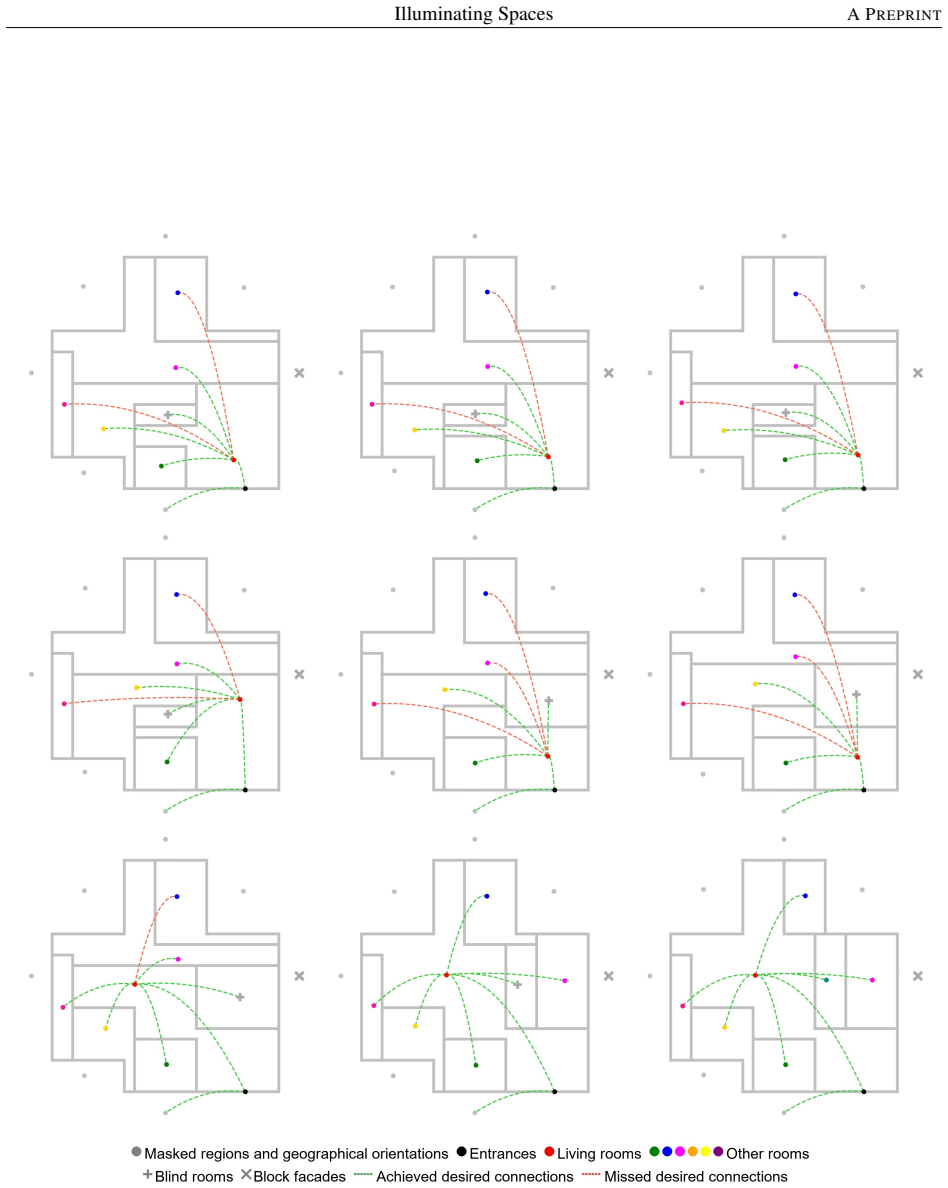
The central claim is that a deep-RL agent, acting on laser-wall partitions through dynamic planning, can generate diverse and functional architectural layouts that simultaneously satisfy geometric constraints (room areas, aspect ratios) and topological requirements (adjacencies to living room and facade). The evidence is six design scenarios: averaged area and aspect-ratio errors under 5%, and 70 of 72 required connections established. The paper attributes this to the laser-wall representation, which bridges vector-based and pixel-based partitioning, and to the on-light/off-light transformation scheme that lets walls be moved and rotated while keeping room identity coherent.
Load-bearing premise
The laser-wall library and the 8-directional, 90-degree-rotation action space can transform any initial random wall configuration into any layout the reward function demands; the paper does not analyze this reachability.
Editorial extensions
If this is right
- Architects can use a trained agent to explore diverse functional layouts for briefs of 4 to 9 rooms, with room areas and aspect ratios within 5% of the requested values.
- Angled walls achieve adjacency requirements more reliably than straight-only walls, indicating that layout methods should allow non-rectangular partitions.
- Because the agent works from an image state and discrete transformations, the same setup can be re-run for new scenarios without redefining the environment, only the reward and scenario table.
- Both on-light and off-light transformations support successful training, so the laser-wall partitioning is robust to the choice of transformation mechanics.
Reading between the lines
- The MDP framing is domain-neutral, so the same laser-wall plus PPO recipe could be applied to facility layout, urban block layout, or other partition problems, provided the wall library is extended accordingly.
- A quantitative comparison against pixel-based generative models on coverage, constraint satisfaction, and wall length would test whether the claimed 'intuitive' procedural representation actually yields better architectural outcomes, something the paper does not yet provide.
- The 2-of-72 missed adjacencies may reflect a bound of the current action space; extending it with diagonal or multi-segment walls could close the gap.
- A reachability analysis of the laser-wall action space would turn the empirical success into a statement about what layouts are generatable and would predict scenario difficulty before training.
Editorial analysis
A structured set of objections, weighed in public.
Referee Report
Summary. This paper proposes "laser-wall" partitioning, a space-composition representation in which walls consist of a hard base segment plus emitted light beams that partition a plan, and uses it to frame architectural space layout design as an MDP. The authors build SpaceLayoutGym, an OpenAI-Gym-compatible simulator, and train PPO agents with two variants of "dynamic planning" (on-light and off-light wall transformations) on six design scenarios of 4 to 9 rooms. The paper reports that trained agents produce layouts whose room areas and aspect ratios differ from desired values by less than 5% on average, and that 70 of 72 required adjacencies are satisfied across all scenarios; it also compares straight versus angled walls and visualizes the action trajectory of one agent. One-shot planning is mentioned but deferred to previous work, and the experiments focus exclusively on dynamic planning.
Significance. If the reported results survive closer scrutiny, the paper's main contribution is a procedural, interpretable RL formulation of layout synthesis, and the laser-wall representation is a genuinely distinct middle ground between vector-based and pixel-based partitioning. The open-sourced simulator (claimed in Section 4) and the explicit disclosure of failed adjacencies (two missing connections) are commendable. The trajectory analysis in Figure 6 gives a rare view of how a trained agent refines a layout, which is valuable for designer-facing tools. However, the significance is currently capped by the absence of quantitative per-scenario results, seed-level statistics, and any comparison to the prior generative (e.g., House-GAN++, HouseDiffusion) or one-shot-policy baselines the paper criticizes; the strength of the central claim is therefore hard to calibrate.
major comments (4)
- [2.5, 2.8] The dynamic-planning action space contains only two decisions—selecting an existing wall and applying one of 8 directional moves or 6 rotation options—so every reachable layout lies in the translation/rotation orbit of the initial random wall configuration described in Section 2.8. If that orbit cannot produce the target areas, aspect ratios, and adjacencies within the acceptance threshold, the task is infeasible for the MDP and any success would be an artifact of initialization or scenario choice rather than evidence for the laser-wall method. The paper neither provides a completeness or reachability argument nor reports success rates over repeated random initializations, so the reader cannot determine whether the layouts in Figures 3 and 5 are typical outcomes or selected positive cases.
- [3.1.1] The headline quantitative claims (area and aspect-ratio errors "both less than 5%" and "all but 2 of 72" connections) are presented only as aggregate prose, with no per-scenario table of desired versus achieved areas and aspect ratios, no standard deviations across training seeds, and no failure rate over episodes. Because the reward function in Section 2.6 directly encodes these same geometric and topological targets, the reported numbers partly measure how well the reward was optimized; without the underlying error distributions, the claim that the approach "can generate diverse and functional space layouts" is not quantitatively established.
- [2.6] The reward function is specified only as qualitative bullet categories (negative penalties for hard constraints and deviations, non-negative terminal rewards within an unspecified threshold, and an adjacency bonus), and the reward weights, terminal acceptance thresholds, and scaling functions are never given. Section 4 states that SpaceLayoutGym is "open sourced" but provides no repository URL or version identifier, and Section 2.7 gives no PPO hyperparameters or network architecture details; these omissions make the experiments impossible to reproduce or compare against.
- [3] No quantitative baseline is provided against any prior method (e.g., House-GAN++, HouseDiffusion, or the authors' own one-shot planning work cited as Kakooee and Dillenburger 2024), even though Section 1 motivates the paper by the limitations of pixel-based generative approaches. As a result, the relative claim of flexibility and exploratory power is supported only by qualitative figure inspection, and the reader cannot assess whether laser-wall dynamic planning improves over existing methods on the same scenarios.
minor comments (6)
- [2.6] The sentence "The reward consists of two components: instant reward, and terminal reward. The reward is calculated from two elements: an instant reward and a terminal reward." is duplicated; one occurrence should be removed.
- [2.7] There are small language errors: "following by fully connected layers" should read "followed by fully connected layers," and "SDL" in Section 2.3 should be "SLD."
- [4] The open-source claim names the project as "SpaceLayoutGym" without a URL or a citation; a working link or DOI is needed for the reproducibility claim to be actionable.
- [2.1.1] The infiltration rate is described verbally (beams stop upon encountering other beams, or the rate decreases with distance) but never defined formally; an equation would be needed to implement the fixed versus decreasing variant.
- [3.1] The sentence "The agent's ability to find a design solution indicates that the generated layouts closely match the geometric properties... because geometric properties are integral constraints of the optimization problem" is circular, since a "solution" is defined as a layout satisfying those constraints; the claim should instead be supported by the reported error metrics.
- [Figures 3 and 5] The figure captions do not say which design scenario each panel corresponds to; adding panel labels referencing Table 1 would make the per-scenario claims checkable.
Circularity Check
No significant circularity: the RL results are genuine optimization outcomes, not reductions to the reward definition, and the sole self-citation is not load-bearing.
full rationale
The paper makes no first-principles derivation or prediction in the sense required for circularity. Its central demonstration is that a PPO agent, trained in SpaceLayoutGym with a reward that penalizes geometric and topological deviations, produces layouts that score well on those same geometric and topological criteria. This is an empirical optimization result: maximizing the terminal reward requires nontrivial search over the discrete wall-transformation action space, and the reward definition alone does not guarantee that any policy reaches a satisfying layout. Although the reported figures (area and aspect-ratio errors below 5%, 70 of 72 adjacencies) mirror the terminal-reward criteria, this is objective alignment rather than construction-equivalence. The only self-citation, to Kakooee and Dillenburger (2024) for one-shot planning, is explicitly set aside by the statement 'we focus exclusively on dynamic planning' and is not load-bearing for the dynamic-planning results. The unexamined reachability of the initial random wall configurations is a validity or correctness threat, not a circularity: it concerns whether the action space can express target layouts, which is an assumption about the MDP rather than a conclusion that reduces to its inputs. No step in the manuscript equates a claimed output with an input by construction.
Assumptions & free parameters
free parameters (5)
- Reward penalty weights and terminal threshold
- Infiltration rate
- Wall library contents
- Maximum transformations per episode
- PPO and network hyperparameters
assumptions (4)
- domain assumption The MDP state can be represented as an RGB image of the current layout, and the transition depends only on the current image and action.
- domain assumption Laser-wall light propagation and infiltration rules always yield a valid partition into subregions that can be assigned to rooms.
- domain assumption The discrete action space (8 directions, 90-degree rotations) can reach a near-optimal layout from any initial random wall configuration.
- domain assumption PPO with the described convolutional architecture converges to a policy that maximizes the reward within the training budget.
invented entities (2)
-
Laser-wall (base wall plus emitted light beams)
-
On-light and off-light wall transformations
Cite this review
Pith. "Pith review of Illuminating Spaces: Deep Reinforcement Learning and Laser-Wall Partitioning for Architectural Layout Generation." pith.science (2026). https://pith.science/paper/DJJHC3R7
@misc{pith2026250204407,
  author       = {Pith},
  title        = {Pith review of: Illuminating Spaces: Deep Reinforcement Learning and Laser-Wall Partitioning for Architectural Layout Generation},
  year         = {2026},
  howpublished = {\url{https://pith.science/paper/DJJHC3R7}},
  note         = {Machine review of arXiv:2502.04407}
}
read the original abstract
Space layout design (SLD), occurring in the early stages of the design process, nonetheless influences both the functionality and aesthetics of the ultimate architectural outcome. The complexity of SLD necessitates innovative approaches to efficiently explore vast solution spaces. While image-based generative AI has emerged as a potential solution, they often rely on pixel-based space composition methods that lack intuitive representation of architectural processes. This paper leverages deep Reinforcement Learning (RL), as it offers a procedural approach that intuitively mimics the process of human designers. Effectively using RL for SLD requires an explorative space composing method to generate desirable design solutions. We introduce "laser-wall", a novel space partitioning method that conceptualizes walls as emitters of imaginary light beams to partition spaces. This approach bridges vector-based and pixel-based partitioning methods, offering both flexibility and exploratory power in generating diverse layouts. We present two planning strategies: one-shot planning, which generates entire layouts in a single pass, and dynamic planning, which allows for adaptive refinement by continuously transforming laser-walls. Additionally, we introduce on-light and off-light wall transformations for smooth and fast layout refinement, as well as identity-less and identity-full walls for versatile room assignment. We developed SpaceLayoutGym, an open-source OpenAI Gym compatible simulator for generating and evaluating space layouts. The RL agent processes the input design scenarios and generates solutions following a reward function that balances geometrical and topological requirements. Our results demonstrate that the RL-based laser-wall approach can generate diverse and functional space layouts that satisfy both geometric constraints and topological requirements and is architecturally intuitive.
Figures


Figures from the paper (3 more)


Reference graph
Works this paper leans on
-
[8]
Spatial geometric reasoning for room layout estimation via deep reinforcement learning
Liangliang Ren, Yangyang Song, Jiwen Lu, and Jie Zhou. Spatial geometric reasoning for room layout estimation via deep reinforcement learning. In Computer Vision–ECCV 2020: 16th European Conference, Glasgow, UK, August 23–28, 2020, Proceedings, Part XXVII 16, pages 550–565. Springer,
work page 2020
-
[9]
Lawrence Mandow, José-Luis Pérez-de-la Cruz, Ana Belén Rodríguez-Gavilán, and Manuela Ruiz-Montiel
doi:https://doi.org/10.1016/j.aei.2012.12.004. Lawrence Mandow, José-Luis Pérez-de-la Cruz, Ana Belén Rodríguez-Gavilán, and Manuela Ruiz-Montiel. Architec- tural planning with shape grammars and reinforcement learning: Habitability and energy efficiency. Engineering Applications of Artificial Intelligence, 96:103909,
-
[10]
Feng Shi, Ranjith K Soman, Ji Han, and Jennifer K Whyte
doi:https://doi.org/10.1016/j.engappai.2020.103909. Feng Shi, Ranjith K Soman, Ji Han, and Jennifer K Whyte. Addressing adjacency constraints in rect- angular floor plans using monte-carlo tree search. Automation in Construction , 115:103187,
-
[11]
Matthias Klar, Moritz Glatt, and Jan C Aurich
doi:https://doi.org/10.1016/j.autcon.2020.103187. Matthias Klar, Moritz Glatt, and Jan C Aurich. An implementation of a reinforcement learning based algorithm for factory layout planning. Manufacturing Letters, 30:1–4,
-
[12]
Multi-Agent Reinforcement Learning of 3D Furniture Layout Simulation in Indoor Graphics Scenes
Xinhan Di and Pengqian Yu. Multi-agent reinforcement learning of 3d furniture layout simulation in indoor graphics scenes. arXiv preprint arXiv:2102.09137,
-
[13]
Proximal policy optimization algorithms
John Schulman, Filip Wolski, Prafulla Dhariwal, Alec Radford, and Oleg Klimov. Proximal policy optimization algorithms. arXiv preprint arXiv:1707.06347,
-
[1998]
Architectural layout planning using genetic algorithms
Manish K Thakur, Monika Kumari, and Madhabananda Das. Architectural layout planning using genetic algorithms. In 2010 3rd International Conference on Computer Science and Information Technology, volume 4, pages 5–11. IEEE,
work page 2010
-
[2010]
doi:https://doi.org/10.1145/1882261.1866203. Benjamin Dillenburger. Raumindex. Ein datenbasiertes Entwurfsinstrument. PhD thesis, ETH Zurich,
Show all 14 references
-
[2013]
Gplan: Computer-generated dimensioned floorplans for given adjacencies
Krishnendra Shekhawat, Nitant Upasani, Sumit Bisht, and Rahil Jain. Gplan: Computer-generated dimensioned floorplans for given adjacencies. arXiv preprint arXiv:2008.01803,
2008 arXiv
- [2017]
-
[2020]
10 Illuminating Spaces A PREPRINT Dasong Wang and Roland Snooks
URL https://proceedings.neurips.cc/paper_files/paper/ 2020/file/4c5bcfec8584af0d967f1ab10179ca4b-Paper.pdf. 10 Illuminating Spaces A PREPRINT Dasong Wang and Roland Snooks. Artificial intuitions of generative design: An approach based on reinforcement learning. In Proceedings ...
2020
-
[2021]
Mohammad Amin Shabani, Sepidehsadat Hosseini, and Yasutaka Furukawa
doi:https://doi.org/10.48550/arXiv.2103.02574. Mohammad Amin Shabani, Sepidehsadat Hosseini, and Yasutaka Furukawa. Housediffusion: Vector floorplan genera- tion via a diffusion model with discrete and continuous denoising. In Proceedings of the IEEE/CVF Conference on Computer...
-
[2023]
Jonathan Ho, Ajay Jain, and Pieter Abbeel
doi:https://doi.org/10.48550/arXiv.2211.13287. Jonathan Ho, Ajay Jain, and Pieter Abbeel. Denoising diffusion probabilistic models. In H. Larochelle, M. Ranzato, R. Hadsell, M.F. Balcan, and H. Lin, editors, Advances in Neural Information Processing Systems, volume 33, pages 6...
-
[2024]
House-gan++: Generative adversarial layout refinement networks
Nelson Nauata, Sepidehsadat Hosseini, Kai-Hung Chang, Hang Chu, Chin-Yi Cheng, and Yasutaka Furukawa. House-gan++: Generative adversarial layout refinement networks. arXiv preprint arXiv:2103.02574 ,
Reviewed August 9, 2026 · model on record in the stance chip above.
Discussion (0). Continue with ORCID to comment.