REVIEW 4 major objections 6 minor 54 references
Verifiable Format Control for Large Language Model Generations
T0 review · 4 major / 6 minor · reviewed 2026-08-08 · deepseek-v4-flash
Pith's one-line read A fully verifiable format-following dataset lets 7B-parameter LLMs self-train with Python checkers, and the resulting model beats GPT-4 on the hardest format-control level.
desk verdict Useful verifiable format dataset and a plausible self-improvement pipeline, but the in-domain gains need a train/test-disjointness check and the out-of-domain transfer is inconsistent across base models; worth reviewing with requested clarifications. read the letter →
The pith
A machine-rendered reading of the paper's core claim, the machinery that carries it, and where it could break.
The reading
What carries the argument
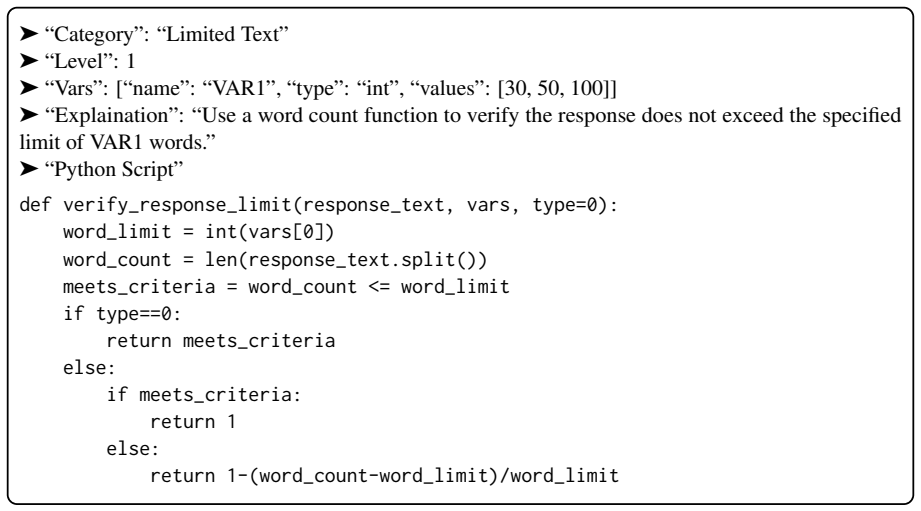
The load-bearing object is VFF, a dataset of about 60 human-curated meta constraints, each carrying an executable Python boolean verifier. An instruction is formed by concatenating an Alpaca question with one to three instantiated constraints, so the correctness label is the product $I(y)=\prod_{k=1}^{c}F_k(y)$ of the per-constraint verifier outputs. That exact binary signal makes the training loop fully automatic: it labels self-generated responses, builds SFT and DPO data, and enables progressive level-by-level training. A secondary mechanism is the one-shot wrong demonstration used during response sampling, which raises the share of verifier-passing samples from 55 to 79 percent at level 1 and thereby supplies enough positive examples for the next training round.
What would settle it
Run the same progressive pipeline but swap the preferred responses for deliberately nonsensical yet format-correct text, such as JSON objects filled with random tokens, while keeping the verifier labels unchanged; if the trained models still improve on VFF and IFEval, the learning signal is purely structural, but if human-evaluated relevance collapses, the format-pass-as-quality assumption is broken.
Extended reading notes
Core claim
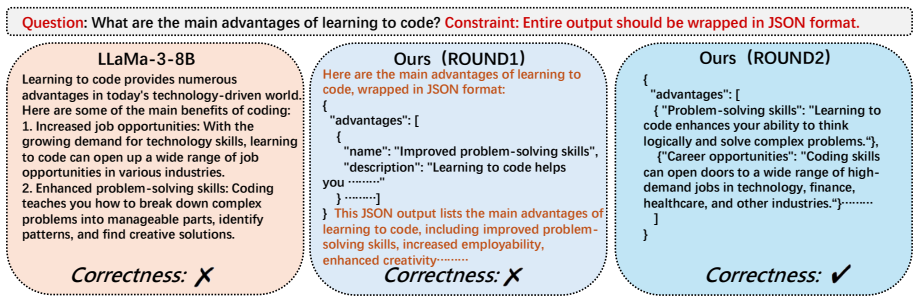
The central claim is that format-following is a separately learnable skill that small open LLMs can acquire without human-written or LLM-generated training data. The VFF dataset defines each format constraint as a triple: a natural-language constraint with fill-in variables, candidate values for those variables, and a Python function that returns true exactly when a response satisfies the constraint. The training loop samples several responses per instruction, marks every response that passes all active checkers as preferred and every non-passing response as dispreferred, then applies SFT on the preferred responses and DPO on the pairs. Training starts with one constraint, then two, then three, re-sampling and re-annotating at each level. The paper reports that this progression raises format-following accuracy on all three tested 7B models and that the best trained model exceeds GPT-4 on the hardest VFF level.
Load-bearing premise
The whole method treats any response that passes the Python format check as a good response to train on, even though nothing verifies that the content is relevant, coherent, or factually right.
Editorial extensions
If this is right
- Training with verifier-labelled self-generated data can lift 7B models' format-following accuracy close to or above frontier-model levels on the same benchmark.
- Because the verifier is deterministic, evaluation and data labelling scale without API cost and without the inconsistency of LLM judges.
- Progressive training from one to three constraints is needed to get usable positive samples at harder levels; skipping levels leaves the hardest accuracy near baseline.
- The trained models transfer part of the gain to out-of-domain format following on IFEval, suggesting the skill is not purely memorized.
- The method may slightly reduce general instruction-following performance on InfoBench, indicating a trade-off that needs to be managed.
Reading between the lines
- Editorial: A natural testable extension is to use the Python verifier as a reward in reinforcement learning; the paper notes this itself, and it could push hard-level accuracy above what DPO alone achieves.
- Editorial: The 60-meta-constraint pool is small and domain-specific, but the same loop should work for any constraint expressible as a decoder-verifiable property such as regexes, schema validators, or unit tests, broadening VFF into a general verifiable-instruction trainer.
- Editorial: Because the verifier checks form, not meaning, the pipeline risks rewarding fluent but vacuous answers; adding a lightweight relevance filter would be a cheap robustness test.
- Editorial: Since constraints are paired randomly with questions, some instructions conflict; if conflict rates rise with constraint count, there may be an upper bound on how many stacked constraints can be learned before the model is trained on contradictions.
Editorial analysis
A structured set of objections, weighed in public.
Referee Report
Summary. The paper introduces VFF, a fully verifiable format-following dataset constructed by pairing Alpaca questions with up to three Python-checkable meta constraints, and a progressive self-improvement training pipeline (response sampling, verifier-based annotation, SFT and DPO, repeated from level 1 to level 3) to improve the format control of 7B-level LLMs. Experiments on three 7B models (Mistral-7B, LLaMA-2-7B, LLaMA-3-8B) report large in-domain VFF gains, mixed out-of-domain IFEval results, and some decline on InfoBench; the trained LLaMA-3-8B is claimed to outperform GPT-4 on level-3 VFF. The paper also compares Python-based verification with LLM judges, reporting that Python is more accurate, faster, and cheaper.
Significance. If the central claims hold, the paper makes two useful contributions: a deterministic, verifiable format-following benchmark that removes LLM-judge bias and cost, and a self-improvement recipe that lets small open-source models improve format adherence using only self-generated data. The dataset release and the Python-versus-LLM-judge comparison (Table 6) are concrete, reproducible strengths. However, the evidence for the training method's general effectiveness is currently weakened by potential train/test leakage in VFF, absence of any uncertainty quantification, and inconsistent out-of-domain transfer across the three trained models. The stated limitation that general instruction-following performance can slightly degrade is acknowledged but not resolved. These issues make the headline claims disproportionate to the current evidence, though the underlying approach remains plausible.
major comments (4)
- [Sections 3.1 and 4.1] The construction of VFF may allow the same Alpaca question to appear in both training and test splits. Section 3.1 creates instructions by pairing each question from the 52k Alpaca set with up to 3 randomly selected meta constraints, and Section 4.1 curates 10k training and 7k test samples per level from this pool, but the paper never states that the splits are disjoint at the question level. With only about 60 meta constraints, it is statistically likely that many questions occur in both splits with different constraint combinations. If so, a model can memorize the content during training and only need to reformat it at test time, inflating VFF scores. The authors should report the degree of question-level overlap between their training and test sets, or construct the splits at the question level. Without this, the in-domain VFF improvements—including the claim that trained LLaMA-3-8B surpasses GPT-4 on level-3—are not trustworthy.
- [Table 2] All main results are single runs without variance, confidence intervals, or significance tests. Since IFEval and InfoBench each contain roughly 500 test samples, the observed differences (e.g., LLaMA-3-8B IFEval instruction 77.14 to 77.24, Mistral prompt-level 40.85 to 37.50) are likely within noise. The paper should report standard deviations across multiple runs or bootstrap confidence intervals, and apply a paired significance test for key comparisons such as the claimed superiority of trained LLaMA-3-8B over GPT-4 on VFF level-3. Without uncertainty quantification, the mixed out-of-domain results cannot be distinguished from sampling noise.
- [Section 3.2, Training Data Annotation] The training-data annotation step marks every response with I(y)=1 as the preferred response y_w with no check of content quality, relevance, or factual correctness. Table 8 assesses quality only on 200 responses per setting, and the observed InfoBench declines for Mistral and LLaMA-3-8B (Table 2) suggest that format-only preferences can degrade general instruction quality. The authors should quantify the content quality of the self-generated preferred responses at scale (e.g., with automatic metrics or an LLM-based relevance filter) and either filter the training data or explicitly document the trade-off. The current reliance on a single verifier pass as the sole preference signal is a core design choice that is not independently validated.
- [Section 4.2 and Table 2] The in-domain VFF benchmark shares the same verifier functions that label the training data, making the large in-domain gains partly circular: the model is directly optimized on the exact functions used for evaluation. The independent out-of-domain transfer to IFEval is inconsistent: LLaMA-2-7B improves substantially (31.42 to 40.48 prompt-level; 44.96 to 54.08 instruction-level), Mistral-7B declines (40.85 to 37.50 prompt-level), and LLaMA-3-8B is essentially unchanged (68.22 to 68.50). The paper's conclusion that the method demonstrates effectiveness in format following is therefore clearly supported only for one of the three models on out-of-domain data. The authors should either temper the generalization claim or provide stronger out-of-domain evidence with uncertainty quantification.
minor comments (6)
- [Section 3.1] Typo: "filing the variables" should be "filling the variables."
- [Table 2] The footnote marker for the results taken from Sun et al. (2024) is missing in the table; the caption contains an incomplete reference "Results with are from Sun et al. (2024)."
- [Figures 1 and 3] The variable placeholder is inconsistently rendered as "[[V AR1]]" with a space; it should be "[[VAR1]]" throughout.
- [Section 5.2 and Table 4] The description of the one-shot demonstration is unclear; please specify explicitly that the demonstration is a wrong response generated by the base model and how it is incorporated into the sampling prompt.
- [Equation (2) and following text] Typo: "preferece learning" should be "preference learning."
- [Limitations section] The statement that the training method "may slightly harm some general instruction following performance" is important; this trade-off should be quantified in the main results (e.g., with error bars on InfoBench) rather than left only as a limitation.
Circularity Check
No significant circularity: VFF improvements are an in-domain check, while IFEval and InfoBench provide independent out-of-domain grounding.
full rationale
The paper's derivation chain is self-contained. VFF constraints are defined by Python verifier functions, and those same functions label the self-generated training responses (Section 3.2, Algorithm 1) and score the VFF test set (Section 3.1). This is an intended in-domain evaluation, not a hidden reduction: training uses the 10k training samples and evaluation uses the 7k test samples described in Section 4.1, so the VFF score is a held-out measure of the same distribution. The paper explicitly identifies IFEval as an out-of-domain format-following benchmark and InfoBench as a general-instruction benchmark (Table 2 note), providing evidence beyond the training distribution. The mixed out-of-domain results (e.g., Mistral IFEval prompt 40.85 to 37.50; LLaMA-3-8B IFEval nearly unchanged) are a robustness or validity concern, not a circularity, because no load-bearing conclusion is justified solely by re-stating an input. The self-citations, such as Wang et al. 2023c for self-improvement inspiration, are not load-bearing. No fitted parameter is renamed as a prediction, and no uniqueness theorem or ansatz is imported from the authors' prior work. The limitations section honestly observes that the verifiable rule can be viewed as a reward function, which is a design choice rather than a circular step.
Assumptions & free parameters
free parameters (5)
- DPO beta =
0.1
- LoRA rank and alpha =
rank=64, alpha=128
- Learning rate and epochs =
5e-6, 8 epochs, batch size 4
- Number of sampled responses per instruction =
4
- Training and test data sizes =
10k training, 7k test per level
assumptions (4)
- domain assumption Python verifier functions exactly capture whether a response follows the intended format constraint.
- domain assumption A response that passes the verifier is a high-quality training target for SFT and DPO.
- domain assumption Self-generated data from the model, filtered by the verifier, is sufficient to improve format following without harming other abilities.
- domain assumption Progressive training from level-1 to level-3 with resampling at each stage is beneficial.
Cite this review
Pith. "Pith review of Verifiable Format Control for Large Language Model Generations." pith.science (2026). https://pith.science/paper/IVMOXZQ6
@misc{pith2026250204498,
  author       = {Pith},
  title        = {Pith review of: Verifiable Format Control for Large Language Model Generations},
  year         = {2026},
  howpublished = {\url{https://pith.science/paper/IVMOXZQ6}},
  note         = {Machine review of arXiv:2502.04498}
}
read the original abstract
Recent Large Language Models (LLMs) have demonstrated satisfying general instruction following ability. However, small LLMs with about 7B parameters still struggle fine-grained format following (e.g., JSON format), which seriously hinder the advancements of their applications. Most existing methods focus on benchmarking general instruction following while overlook how to improve the specific format following ability for small LLMs. Besides, these methods often rely on evaluations based on advanced LLMs (e.g., GPT-4), which can introduce the intrinsic bias of LLMs and be costly due to the API calls. In this paper, we first curate a fully verifiable format following dataset VFF. In contrast to existing works often adopting external LLMs for instruction-following validations, every sample of VFF can be easily validated with a Python function. Further, we propose to leverage this verifiable feature to synthesize massive data for progressively training small LLMs, in order to improve their format following abilities. Experimental results highlight the prevalent limitations in the format following capabilities of 7B level open-source LLMs and demonstrate the effectiveness of our method in enhancing this essential ability.
Figures


Figures from the paper (6 more)


Reference graph
Works this paper leans on
-
[1]
1rgs . 2023. https://github.com/1rgs/jsonformer jsonformer - github repository
work page 2023
-
[2]
Jinze Bai, Shuai Bai, Yunfei Chu, Zeyu Cui, Kai Dang, Xiaodong Deng, Yang Fan, Wenbin Ge, Yu Han, Fei Huang, Binyuan Hui, Luo Ji, Mei Li, Junyang Lin, Runji Lin, Dayiheng Liu, Gao Liu, Chengqiang Lu, Keming Lu, Jianxin Ma, Rui Men, Xingzhang Ren, Xuancheng Ren, Chuanqi Tan, Sinan Tan, et al. 2023. Qwen technical report. arXiv preprint arXiv:2309.16609
arXiv 2023
-
[3]
Yuntao Bai, Andy Jones, Kamal Ndousse, Amanda Askell, Anna Chen, Nova DasSarma, Dawn Drain, Stanislav Fort, Deep Ganguli, Tom Henighan, Nicholas Joseph, Saurav Kadavath, Jackson Kernion, Tom Conerly, Sheer El-Showk, Nelson Elhage, Zac Hatfield-Dodds, Danny Hernandez, Tristan Hume, Scott Johnston, Shauna Kravec, Liane Lovitt, Neel Nanda, Catherine Olsson, ...
arXiv 2022
-
[4]
Yejin Bang, Samuel Cahyawijaya, Nayeon Lee, Wenliang Dai, Dan Su, Bryan Wilie, Holy Lovenia, Ziwei Ji, Tiezheng Yu, Willy Chung, et al. 2023. A multitask, multilingual, multimodal evaluation of chatgpt on reasoning, hallucination, and interactivity. arXiv preprint arXiv:2302.04023
arXiv 2023
-
[5]
Tom B. Brown, Benjamin Mann, Nick Ryder, Melanie Subbiah, Jared Kaplan, Prafulla Dhariwal, Arvind Neelakantan, Pranav Shyam, Girish Sastry, Amanda Askell, Sandhini Agarwal, Ariel Herbert-Voss, Gretchen Krueger, Tom Henighan, Rewon Child, Aditya Ramesh, Daniel M. Ziegler, Jeffrey Wu, Clemens Winter, Christopher Hesse, Mark Chen, Eric Sigler, Mateusz Litwin...
work page 2020
-
[6]
S \'e bastien Bubeck, Varun Chandrasekaran, Ronen Eldan, Johannes Gehrke, Eric Horvitz, Ece Kamar, Peter Lee, Yin Tat Lee, Yuanzhi Li, Scott Lundberg, et al. 2023. Sparks of artificial general intelligence: Early experiments with gpt-4. arXiv preprint arXiv:2303.12712
arXiv 2023
-
[7]
Chi-Min Chan, Weize Chen, Yusheng Su, Jianxuan Yu, Wei Xue, Shanghang Zhang, Jie Fu, and Zhiyuan Liu. 2023. Chateval: Towards better llm-based evaluators through multi-agent debate. arXiv preprint arXiv:2308.07201
arXiv 2023
-
[8]
Cheng-Han Chiang and Hung-yi Lee. 2023. https://doi.org/10.18653/v1/2023.acl-long.870 Can large language models be an alternative to human evaluations? In Proceedings of the 61st Annual Meeting of the Association for Computational Linguistics (Volume 1: Long Papers), pages 15607--15631, Toronto, Canada. Association for Computational Linguistics
Show all 54 references
-
[9]
Gonzalez, Ion Stoica, and Eric P
Wei-Lin Chiang, Zhuohan Li, Zi Lin, Ying Sheng, Zhanghao Wu, Hao Zhang, Lianmin Zheng, Siyuan Zhuang, Yonghao Zhuang, Joseph E. Gonzalez, Ion Stoica, and Eric P. Xing. 2023. https://lmsys.org/blog/2023-03-30-vicuna/ Vicuna: An open-source chatbot impressing gpt-4 with 90\
2023
-
[10]
Hanze Dong, Wei Xiong, Deepanshu Goyal, Rui Pan, Shizhe Diao, Jipeng Zhang, Kashun Shum, and T. Zhang. 2023. Raft: Reward rAnked FineTuning for Generative Foundation Model Alignment . Transactions on Machine Learning Research, abs/2304.06767
2023 arXiv
-
[11]
Yixin Dong, Charlie F Ruan, Yaxing Cai, Ruihang Lai, Ziyi Xu, Yilong Zhao, and Tianqi Chen. 2024. Xgrammar: Flexible and efficient structured generation engine for large language models. arXiv preprint arXiv:2411.15100
2024 arXiv
-
[12]
ETH SRI . 2023. https://github.com/eth-sri/lmql Lmql - github repository
2023
-
[13]
Kawin Ethayarajh, Winnie Xu, Niklas Muennighoff, Dan Jurafsky, and Douwe Kiela. 2024. Kto: Model alignment as prospect theoretic optimization. arXiv preprint arXiv:2402.01306
2024 arXiv
-
[14]
Jinlan Fu, See-Kiong Ng, Zhengbao Jiang, and Pengfei Liu. 2023. Gptscore: Evaluate as you desire. arXiv, abs/2302.04166
2023 arXiv
-
[15]
Zhibin Gou, Zhihong Shao, Yeyun Gong, yelong shen, Yujiu Yang, Nan Duan, and Weizhu Chen. 2024. https://openreview.net/forum?id=Sx038qxjek CRITIC : Large language models can self-correct with tool-interactive critiquing . In The Twelfth International Conference on Learning Rep...
2024
-
[16]
Qianyu He, Jie Zeng, Qianxi He, Jiaqing Liang, and Yanghua Xiao. 2024. From complex to simple: Enhancing multi-constraint complex instruction following ability of large language models. arXiv preprint arXiv:2404.15846
2024 arXiv
-
[17]
Jiwoo Hong, Noah Lee, and James Thorne. 2024. Orpo: Monolithic preference optimization without reference model. arXiv preprint arXiv:2403.07691, 2(4):5
2024 arXiv
-
[18]
Edward J Hu, Yelong Shen, Phillip Wallis, Zeyuan Allen-Zhu, Yuanzhi Li, Shean Wang, Lu Wang, and Weizhu Chen. 2021. Lora: Low-rank adaptation of large language models. arXiv preprint arXiv:2106.09685
2021 arXiv
-
[19]
Jiaxin Huang, Shixiang Gu, Le Hou, Yuexin Wu, Xuezhi Wang, Hongkun Yu, and Jiawei Han. 2023. https://doi.org/10.18653/v1/2023.emnlp-main.67 Large language models can self-improve . In Proceedings of the 2023 Conference on Empirical Methods in Natural Language Processing, pages...
2023 doi
-
[20]
Neel Jain, Khalid Saifullah, Yuxin Wen, John Kirchenbauer, Manli Shu, Aniruddha Saha, Micah Goldblum, Jonas Geiping, and Tom Goldstein. 2023. Bring your own data! self-supervised evaluation for large language models. arXiv preprint arXiv:2306.13651
2023 arXiv
-
[21]
Albert Q Jiang, Alexandre Sablayrolles, Arthur Mensch, Chris Bamford, Devendra Singh Chaplot, Diego de las Casas, Florian Bressand, Gianna Lengyel, Guillaume Lample, Lucile Saulnier, et al. 2023 a . Mistral 7b. arXiv preprint arXiv:2310.06825
2023 arXiv
-
[22]
Yuxin Jiang, Yufei Wang, Xingshan Zeng, Wanjun Zhong, Liangyou Li, Fei Mi, Lifeng Shang, Xin Jiang, Qun Liu, and Wei Wang. 2023 b . Followbench: A multi-level fine-grained constraints following benchmark for large language models. arXiv preprint arXiv:2310.20410
2023 arXiv
-
[23]
Zaifan Jiang, Xing Huang, and Chao Wei. 2023 c . Preference as reward, maximum preference optimization with importance sampling. arXiv preprint arXiv:2312.16430
2023 arXiv
-
[24]
Yen-Ting Lin and Yun-Nung Chen. 2023. https://doi.org/10.18653/v1/2023.nlp4convai-1.5 LLM -eval: Unified multi-dimensional automatic evaluation for open-domain conversations with large language models . In Proceedings of the 5th Workshop on NLP for Conversational AI (NLP4ConvA...
2023 doi
-
[25]
Yang Liu, Dan Iter, Yichong Xu, Shuohang Wang, Ruochen Xu, and Chenguang Zhu. 2023 a . G-eval: Nlg evaluation using gpt-4 with better human alignment (2023). URL http://arxiv. org/abs/2303.16634
2023 arXiv
-
[26]
Yuxuan Liu, Tianchi Yang, Shaohan Huang, Zihan Zhang, Haizhen Huang, Furu Wei, Weiwei Deng, Feng Sun, and Qi Zhang. 2023 b . Calibrating llm-based evaluator. arXiv, abs/2309.13308
2023 arXiv
-
[27]
Shayne Longpre, Le Hou, Tu Vu, Albert Webson, Hyung Won Chung, Yi Tay, Denny Zhou, Quoc V Le, Barret Zoph, Jason Wei, et al. 2023. The flan collection: Designing data and methods for effective instruction tuning. In International Conference on Machine Learning, pages 22631--22...
2023
-
[28]
Ilya Loshchilov and Frank Hutter. 2019. https://openreview.net/forum?id=Bkg6RiCqY7 Decoupled weight decay regularization . In International Conference on Learning Representations
2019
-
[29]
Jingkun Ma, Runzhe Zhan, Derek F Wong, and Lidia S Chao. 2024. Activate integrated controllable generation with soft prompt. In CCF International Conference on Natural Language Processing and Chinese Computing, pages 239--251. Springer
2024
-
[30]
Yu Meng, Mengzhou Xia, and Danqi Chen. 2024. Simpo: Simple preference optimization with a reference-free reward. arXiv preprint arXiv:2405.14734
2024 arXiv
-
[31]
Swaroop Mishra, Daniel Khashabi, Chitta Baral, and Hannaneh Hajishirzi. 2021. Cross-task generalization via natural language crowdsourcing instructions. arXiv preprint arXiv:2104.08773
2021 arXiv
-
[32]
OpenAI. 2023. https://arxiv.org/abs/2303.08774 Gpt-4 technical report . arXiv, abs/2303.08774
2023 arXiv
-
[33]
OpenAI . 2023. https://openai.com/index/introducing-structured-outputs-in-the-api Introducing structured outputs in the api
2023
-
[34]
Outlines Development Team . 2023. https://github.com/outlines-dev/outlines Outlines - github repository
2023
-
[35]
Long Ouyang, Jeffrey Wu, Xu Jiang, Diogo Almeida, Carroll Wainwright, Pamela Mishkin, Chong Zhang, Sandhini Agarwal, Katarina Slama, Alex Ray, et al. 2022. Training language models to follow instructions with human feedback. Advances in neural information processing systems, 3...
2022
-
[36]
Yiwei Qin, Kaiqiang Song, Yebowen Hu, Wenlin Yao, Sangwoo Cho, Xiaoyang Wang, Xuansheng Wu, Fei Liu, Pengfei Liu, and Dong Yu. 2024. https://arxiv.org/abs/2401.03601 Infobench: Evaluating instruction following ability in large language models . arXiv
2024 arXiv
-
[37]
Rafael Rafailov, Archit Sharma, Eric Mitchell, Christopher D Manning, Stefano Ermon, and Chelsea Finn. 2024. Direct preference optimization: Your language model is secretly a reward model. Advances in Neural Information Processing Systems, 36
2024
-
[38]
Haoran Sun, Lixin Liu, Junjie Li, Fengyu Wang, Baohua Dong, Ran Lin, and Ruohui Huang. 2024. https://arxiv.org/abs/2404.02823 Conifer: Improving complex constrained instruction-following ability of large language models . arxiv preprint arXiv:2404.02823
2024 arXiv
-
[39]
Hashimoto
Rohan Taori, Ishaan Gulrajani, Tianyi Zhang, Yann Dubois, Xuechen Li, Carlos Guestrin, Percy Liang, and Tatsunori B. Hashimoto. 2023. Stanford alpaca: An instruction-following llama model. https://github.com/tatsu-lab/stanford_alpaca
2023
-
[41]
Hugo Touvron, Louis Martin, Kevin Stone, Peter Albert, Amjad Almahairi, Yasmine Babaei, Nikolay Bashlykov, Soumya Batra, Prajjwal Bhargava, Shruti Bhosale, et al. 2023 b . Llama 2: Open foundation and fine-tuned chat models. arXiv preprint arXiv:2307.09288
2023 arXiv
-
[42]
Hugo Touvron, Meta AI Team, et al. 2024. https://ai.meta.com/blog/meta-llama-3/ Introducing Meta Llama 3: The most capable openly available LLM to date
2024
-
[43]
Yidong Wang, Zhuohao Yu, Zhengran Zeng, Linyi Yang, Cunxiang Wang, Hao Chen, Chaoya Jiang, Rui Xie, Jindong Wang, Xing Xie, et al. 2023 a . Pandalm: An automatic evaluation benchmark for llm instruction tuning optimization. arXiv preprint arXiv:2306.05087
2023 arXiv
-
[44]
Smith, Daniel Khashabi, and Hannaneh Hajishirzi
Yizhong Wang, Yeganeh Kordi, Swaroop Mishra, Alisa Liu, Noah A. Smith, Daniel Khashabi, and Hannaneh Hajishirzi. 2023 b . https://doi.org/10.18653/v1/2023.acl-long.754 Self-instruct: Aligning language models with self-generated instructions . In Proceedings of the 61st Annual ...
2023 doi
-
[45]
Zhaoyang Wang, Shaohan Huang, Yuxuan Liu, Jiahai Wang, Minghui Song, Zihan Zhang, Haizhen Huang, Furu Wei, Weiwei Deng, Feng Sun, and Qi Zhang. 2023 c . https://doi.org/10.18653/v1/2023.emnlp-main.120 Democratizing reasoning ability: Tailored learning from large language model...
2023 doi
-
[46]
Chi, Tatsunori Hashimoto, Oriol Vinyals, Percy Liang, Jeff Dean, and William Fedus
Jason Wei, Yi Tay, Rishi Bommasani, Colin Raffel, Barret Zoph, Sebastian Borgeaud, Dani Yogatama, Maarten Bosma, Denny Zhou, Donald Metzler, Ed H. Chi, Tatsunori Hashimoto, Oriol Vinyals, Percy Liang, Jeff Dean, and William Fedus. 2022. https://arxiv.org/abs/2206.07682 Emergen...
2022 arXiv
-
[47]
Congying Xia, Chen Xing, Jiangshu Du, Xinyi Yang, Yihao Feng, Ran Xu, Wenpeng Yin, and Caiming Xiong. 2024. Fofo: A benchmark to evaluate llms' format-following capability. arXiv preprint arXiv:2402.18667
2024 arXiv
-
[48]
Can Xu, Qingfeng Sun, Kai Zheng, Xiubo Geng, Pu Zhao, Jiazhan Feng, Chongyang Tao, Qingwei Lin, and Daxin Jiang. 2023. Wizardlm: Empowering large pre-trained language models to follow complex instructions. In The Twelfth International Conference on Learning Representations
2023
-
[49]
Huang, Chenghua Lin, Wenhu Chen, and Jie Fu
Li Yizhi, Ge Zhang, Xingwei Qu, Jiali Li, Zhaoqun Li, Zekun Wang, Hao Li, Ruibin Yuan, Yi Ma, Kai Zhang, Wangchunshu Zhou, Yiming Liang, Lei Zhang, Lei Ma, Jiajun Zhang, Zuowen Li, Stephen W. Huang, Chenghua Lin, Wenhu Chen, and Jie Fu. 2024. Cif- Bench : A Chinese Instruction...
2024
-
[50]
Shengyu Zhang, Linfeng Dong, Xiaoya Li, Sen Zhang, Xiaofei Sun, Shuhe Wang, Jiwei Li, Runyi Hu, Tianwei Zhang, Fei Wu, et al. 2023. Instruction tuning for large language models: A survey. arXiv preprint arXiv:2308.10792
2023
-
[51]
Yaowei Zheng, Richong Zhang, Junhao Zhang, Yanhan Ye, Zheyan Luo, and Yongqiang Ma. 2024. http://arxiv.org/abs/2403.13372 Llamafactory: Unified efficient fine-tuning of 100+ language models . arXiv preprint arXiv:2403.13372
2024 arXiv
-
[52]
Yu, Susan Zhang, Gargi Ghosh, M
Chunting Zhou, Pengfei Liu, Puxin Xu, Srini Iyer, Jiao Sun, Yuning Mao, Xuezhe Ma, Avia Efrat, Ping Yu, L. Yu, Susan Zhang, Gargi Ghosh, M. Lewis, Luke Zettlemoyer, and Omer Levy. 2023 a . Lima: Less Is More for Alignment . In Thirty-seventh Conference on Neural Information Pr...
2023 arXiv
-
[53]
Jeffrey Zhou, Tianjian Lu, Swaroop Mishra, Siddhartha Brahma, Sujoy Basu, Yi Luan, Denny Zhou, and Le Hou. 2023 b . Instruction- Following Evaluation for Large Language Models . arXiv, abs/2311.07911
2023 arXiv
-
[54]
online" 'onlinestring :=
ENTRY address archivePrefix author booktitle chapter edition editor eid eprint eprinttype howpublished institution journal key month note number organization pages publisher school series title type volume year doi pubmed url lastchecked label extra.label sort.label short.list...
-
[55]
write newline
" write newline "" before.all 'output.state := FUNCTION n.dashify 't := "" t empty not t #1 #1 substring "-" = t #1 #2 substring "--" = not "--" * t #2 global.max substring 't := t #1 #1 substring "-" = "-" * t #2 global.max substring 't := while if t #1 #1 substring * t #2 gl...
Reviewed August 8, 2026 · model on record in the stance chip above.
Discussion (0). Continue with ORCID to comment.