REVIEW 3 major objections 5 minor 1 cited by
State estimator design using Jordan based long short-term memory networks
T0 review · 3 major / 5 minor · reviewed 2026-08-08 · deepseek-v4-flash
Pith's one-line read A Jordan-style LSTM filters states as accurately as an Elman LSTM but trains far faster, and both beat the extended Kalman filter on nonlinear systems.
desk verdict A modest but real LSTM variant whose claimed speed advantage is confounded by unequal learning rates; worth refereeing, not citing yet. read the letter →
The pith
A machine-rendered reading of the paper's core claim, the machinery that carries it, and where it could break.
The reading
What carries the argument
The central object is the JLSTM cell, defined by forward-propagation equations in which the four gate and cell-update operations use $\hat{x}(t-1)$, the previous state estimate, in place of the previous hidden vector $a(t-1)$ used by an ELSTM. This recurrent connection type is inherited from Jordan recurrent neural networks, whose estimator form is $\hat{x}(t+1)=W_{xa}\sigma(W_{ay}y(t)+W_{ax}\hat{x}(t)-b)$; the paper proves a universal approximation theorem showing that such recurrences can approximate any continuous state estimator of the form $\bar{x}(t+1)=F(\bar{x}(t),y(t))$. The architecture matters because it makes the network's recurrence conform to the structure of the discrete-time dynamical system, and that structural match is what the paper credits for faster loss minimization during training.
What would settle it
Train both networks on the down-pendulum or van der Pol example using the same learning rate, the same early-stopping patience, and the same number of hidden units, then record epochs and NMSE; if JLSTM does not reach comparable error in fewer epochs, the paper's central claim about faster training is unsupported.
Extended reading notes
Core claim
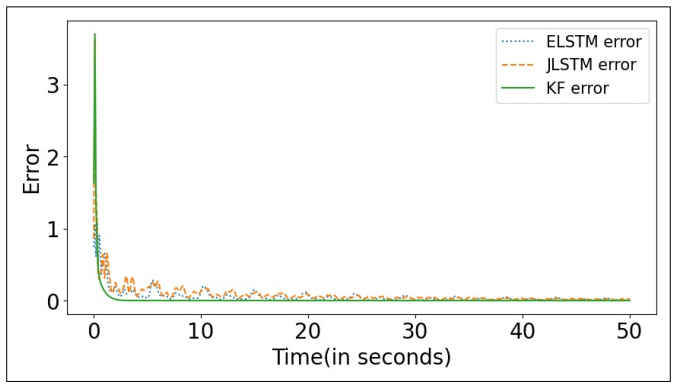
The central discovery is empirical: changing the feedback path in an LSTM state estimator from hidden-state feedback (Elman) to previous-estimate feedback (Jordan) preserves estimation accuracy while reducing training time. For the three systems tested, the normalized mean-square errors of JLSTM and ELSTM are close, and the training time for JLSTM is smaller in every example (15983 versus 16298 seconds for the springs, 95644 versus 99473 for the pendulum, and 619 versus 3389 for the van der Pol oscillator). Both LSTM filters have lower NMSE than the extended Kalman filter for the nonlinear systems and NMSE comparable to the Kalman filter for the linear system. The authors conclude that using a JLSTM instead of an ELSTM appears preferable because the JLSTM reaches the same error with considerably less training, and they attribute the advantage to the Jordan structure's direct use of the previous state estimate, which resembles the discrete-time dynamics being estimated.
Load-bearing premise
The training-time comparison assumes that the different learning rates chosen for ELSTM and JLSTM, selected so the final errors would match, are fair choices, and that the faster convergence comes from the Jordan feedback rather than from the more favorable learning rate.
Editorial extensions
If this is right
- On the two nonlinear test systems, both JLSTM and ELSTM yield lower normalized mean-square error than the extended Kalman filter, suggesting that the nonlinear activation in LSTM cells reduces the linearization error that limits the EKF.
- When initial conditions lie outside the training range, both LSTM estimators still beat the EKF on the nonlinear examples, so the learned filters appear to generalize beyond the training distribution in at least these cases.
- For the linear spring system, JLSTM and ELSTM errors are close to the Kalman filter's error, while the KF remains the best estimator when testing outside the training range.
- JLSTM requires substantially less training time than ELSTM across all three examples while reaching similar error, making it the preferable structure for these problems.
- Testing time for both LSTM filters is much smaller than for the KF and EKF on the tested systems, with the LSTM filters taking 0.2 to 2.7 seconds versus 0.8 to 38.2 seconds for ten test sequences.
Reading between the lines
- If the faster training is caused by the Jordan feedback rather than by unequal learning-rate settings, the same advantage should appear when both networks are trained with identical learning-rate schedules; this is a direct test of the architectural claim.
- The structural match between the JLSTM and the state-space model suggests the architecture may extend to higher-order nonlinear systems, the paper's stated future goal, but this remains untested because the nonlinear examples are only second-order.
- Because the JLSTM feeds back the state estimate itself, its recurrence resembles an observer, so existing observer theory could potentially yield convergence and stability guarantees rather than purely empirical accuracy.
- The observation that both LSTM filters outperform the EKF outside the training range on nonlinear examples hints that learned estimators may be less sensitive to initial-condition mismatch than local linearization, which would matter for applications with uncertain starting states.
Signed reviews
Editorial analysis
A structured set of objections, weighed in public.
Referee Report
Summary. The paper introduces a Jordan-based long short-term memory (JLSTM) estimator for discrete-time state estimation, in which the previous state estimate, rather than the previous hidden state, is fed back into the gate and cell-input units. It states a universal approximation theorem for Jordan recurrent networks (Theorem 2.11), describes the ELSTM and JLSTM implementations, and compares them with the Kalman filter on a 20-state linear spring system and with the extended Kalman filter on a pendulum and a reversed van der Pol oscillator. The reported results claim that both LSTM filters achieve lower NMSE than the EKF on the nonlinear examples, that JLSTM matches ELSTM estimation error, and that JLSTM trains considerably faster than ELSTM.
Significance. If the claims were established, the paper would make a modest but useful contribution: a simple architectural variant that feeds the state estimate back into LSTM gates, with evidence that recurrent neural filters can outperform the EKF on low-order nonlinear systems and that the Jordan feedback structure can reduce training time. The paper's strengths are the use of standard benchmark examples, the inclusion of out-of-distribution initial-condition tests, and the transparent reporting of the network hyperparameters and training/test times. However, the central comparative claim is not yet supported: the training-time comparison is confounded by unequal learning rates chosen to equalize final errors, and the linear-system result appears inconsistent with Kalman optimality. The universal approximation theorem, although presented as supporting motivation, also has a proof gap. These issues are local and can be addressed with additional experiments and a revised proof, so the manuscript merits revision rather than rejection.
major comments (3)
- [Section 2, Theorem 2.11] The proof of Theorem 2.11 establishes only a one-step uniform approximation of the map F on a compact set K, as in Eq. (7), and then asserts that continuity of F yields the recurrent bound ||\bar{x}(t) - \hat{x}(t)|| < epsilon. This does not follow: even if the network approximates F when evaluated at the same argument, the recurrent error can grow through the recursion unless a Lipschitz or contraction bound is imposed and an induction over t is carried out. In addition, K is assumed to contain both trajectories, but the network-generated trajectory \hat{x}(t) cannot be assumed a priori to remain in K. As written, the theorem is unproved.
- [Section 5 and Table 2] The paper's main conclusion, stated in Section 6 as 'Using a JLSTM instead of an ELSTM appears preferable because the JLSTM network has considerably smaller training time to achieve the same error,' rests on Table 2. For the down pendulum and reversed van der Pol examples, Sections 5.2 and 5.3 explicitly set different Adam learning rates for ELSTM and JLSTM (1e-4 versus 1e-3, and 1e-3 versus 1e-2) in order to make the final NMSE values comparable. A higher learning rate can reduce the number of epochs needed to reach a given loss, so the reported 5.5x training-time advantage on the van der Pol example cannot be attributed to the Jordan feedback structure. The other two examples show only 2-4% differences. No repeated runs, seeds, epoch counts, or error bars are reported, and training time is wall-clock time, which mixes epoch count with per-epoch cost. The authors should compare both architectures at matched learning rates, or report full training-time-versus-error curves over a range of learning rates with several random seeds.
- [Table 1, connected springs] The connected-springs model is linear with Gaussian noises, for which the Kalman filter is optimal. Yet Table 1 reports NMSE 0.0153 for ELSTM and 0.0162 for JLSTM, both below the Kalman filter's 0.0174. Unless the KF was deliberately initialized with a mismatched covariance, or the finite test set makes the difference statistically insignificant, this contradicts KF optimality. Please clarify the KF initialization, report per-sequence variance or confidence intervals, and reconcile this result with the statement in Section 5.1 that 'theory shows the KF to be the best estimator for a linear system.'
minor comments (5)
- [Section 6] The first paragraph of Section 6 refers to 'a 100 dimensional linear system,' but the connected-springs example has a 20-dimensional state vector; please correct this.
- [Equation (12)] The quantity in Eq. (12) is called NMSE, but no normalization by the variance of the true signal is displayed; please define the normalization explicitly or rename the metric.
- [Section 3] The statement 'simple recurrent networks are a special case of long short term memory networks where the gates are not involved' is asserted without showing how the gate equations (8) and (9) reduce to the JRN/ERN recursions (2) and (3); a one-sentence construction would make the transfer of Theorem 2.11 to LSTMs transparent.
- [Figure 2] The caption of Figure 2 mentions a bias 'by' that does not appear in Eq. (3); please clarify whether this is a typo or whether a bias term is missing from the forward-propagation equations.
- [Table 3] The testing-time comparison in Table 3 may be unfair if the KF/EKF is implemented in Python on a CPU while the LSTM models run on a T4 GPU; please state the hardware and software used for all estimators.
Circularity Check
No central circularity: empirical LSTM comparisons are measurements; one auxiliary universal-approximation proof has a self-referential compact-set step.
-
other
[Theorem 2.11 proof, after Eq. (7)]
"Let ϵ > 0 and K ⊆ Rn × Rm be a compact set which contains (¯x(t), y(t)) and (ˆx(t), y(t)), ∀t = 1, 2, ..., T. From Theorem 2.8 and Corollary 2.9, we know that ... a function N N(¯x(t), y(t)) = Wxaσ(Wayy(t) + Wax ¯x(t) − b) ... exists, such that ... sup ∥F (¯x(t), y(t)) − N N(¯x(t), y(t))∥∞ < δ."
The compact set K on which Hornik's theorem is invoked is required to contain the trajectory \xhat(t) of the very recurrent network NN that the theorem is supposed to construct. Since NN is chosen using K, and K is defined using \xhat (which is generated by NN), the proof has a self-referential dependency: it presupposes the approximating network's trajectory in order to define the domain of approximation. A non-circular proof would fix K from the target estimator F and then prove, by continuity and small approximation error, that the constructed NN's trajectory stays in a slightly enlarged compact set. This is a technical proof gap in an auxiliary theoretical motivation, not in the empirical claims.
full rationale
The paper's central claims are empirical: NMSE values (Table 1), training and testing times (Tables 2 and 3), and out-of-distribution NMSE (Table 4) are measurements, not quantities forced by construction. The JLSTM/ELSTM training-time comparison is weakened by unequal learning rates chosen to equalize final error (Section 5: 1e-4 vs 1e-3 for the pendulum, 1e-3 vs 1e-2 for van der Pol), but that is an experimental-control concern, not a circular derivation; the learning rates are disclosed and the claim is falsifiable by matched-learning-rate runs. The self-citation to Kaur et al. (2024) is motivational and not load-bearing for the empirical results. The one genuine circularity signal is in the proof of the auxiliary universal approximation theorem for JRNs (Theorem 2.11), where the compact set K is defined in terms of the approximating network's trajectory before that network is constructed. Because this theorem is used only as motivation and the empirical comparison is self-contained against external benchmarks (KF/EKF, ELSTM), the overall circularity score is low.
Assumptions & free parameters
free parameters (3)
- Learning rates =
1e-3/1e-3 (springs), 1e-4/1e-3 (pendulum), 1e-3/1e-2 (van der Pol) for ELSTM/JLSTM
- Number of hidden units =
50 for both networks
- Early stopping patience and max epochs =
patience 50/50/15, max epochs 8000/3000/3000
assumptions (4)
- standard math Hornik-Stinchcombe-White universal approximation theorem for feedforward networks
- domain assumption F and h are measurable/continuous and relevant trajectories lie in a compact set
- ad hoc to paper Simple recurrent networks are a special case of LSTMs when gates are not involved
- domain assumption Initial condition, process noise, and measurement noise are Gaussian with known covariance 0.01I
Cite this review
Pith. "Pith review of State estimator design using Jordan based long short-term memory networks." pith.science (2026). https://pith.science/paper/OXGQG2IO
@misc{pith2026250204518,
  author       = {Pith},
  title        = {Pith review of: State estimator design using Jordan based long short-term memory networks},
  year         = {2026},
  howpublished = {\url{https://pith.science/paper/OXGQG2IO}},
  note         = {Machine review of arXiv:2502.04518}
}
read the original abstract
State estimation of a dynamical system refers to estimating the state of a system given an imperfect model, noisy measurements and some or no information about the initial state. While Kalman filtering is optimal for estimation of linear systems with Gaussian noises, calculation of optimal estimators for nonlinear systems is challenging. We focus on establishing a pathway to optimal estimation of high-order systems by using recurrent connections motivated by Jordan recurrent neural networks(JRNs). The results are compared to the corresponding Elman structure based long short-term memory network(ELSTM) and the KF for linear and EKF for nonlinear systems. The results suggest that for nonlinear systems, the use of long short-term memory networks can improve estimation error and also computation time. Also, the Jordan based long short-term memory networks(JLSTMs) require less training to achieve performance similar to ELSTMs.
Figures


Figures from the paper (7 more)




Forward citations
Cited by 1 Pith paper
-
Stability of Jordan Recurrent Neural Network Estimator
A Jordan recurrent network estimator is shown to have input-to-state stable error dynamics, with stability certified by SMT-verified Lyapunov functions and demonstrated on three example systems.
Reference graph
Works this paper leans on
-
[1]
adhyaru APACrefauthors Adhyaru, D M. APACrefauthors \ 2012 . State observer design for nonlinear systems using neural network State observer design for nonlinear systems using neural network . Applied Soft Computing 12 8 2530-2537
work page 2012
-
[2]
AfsharGermMorris APACrefauthors Afshar, S. , Germ, F. \ Morris, K. APACrefauthors \ 2023 . Extended K alman filter based observer design for semilinear infinite-dimensional systems Extended K alman filter based observer design for semilinear infinite-dimensional systems . IEEE Transactions on Automatic Control
work page 2023
-
[3]
benosman_borggaard_red_order_2 APACrefauthors Benosman, M. \ Borggaard, J. APACrefauthors \ 2021 1 . Data-driven robust state estimation for reduced-order models of 2d B oussinesq equations with parametric uncertainties Data-driven robust state estimation for reduced-order models of 2d B oussinesq equations with parametric uncertainties . Computers and Fl...
work page 2021
-
[4]
benosman_borggaard_red_order APACrefauthors Benosman, M. \ Borggaard, J. APACrefauthors \ 2021 2 . Robust nonlinear state estimation for a class of infinite-dimensional systems using reduced-order models Robust nonlinear state estimation for a class of infinite-dimensional systems using reduced-order models . International Journal of Control 94 1309-1320
work page 2021
-
[5]
bernard2022observer APACrefauthors Bernard, P. , Andrieu, V. \ Astolfi, D. APACrefauthors \ 2022 . Observer design for continuous-time dynamical systems Observer design for continuous-time dynamical systems . Annual Reviews in Control
work page 2022
-
[6]
rl_book APACrefauthors Bertsekas, D P. APACrefauthors \ 2019 . Reinforcement learning and optimal control Reinforcement learning and optimal control . Athena Scientific
work page 2019
-
[7]
kunisch APACrefauthors Breiten, T. \ Kunisch, K. APACrefauthors \ 2021 . Neural network based nonlinear observers Neural network based nonlinear observers . Systems & Control Letters 148 104829
work page 2021
-
[8]
llerena2021forecasting APACrefauthors Cana, J P L. , Herrero, J G. \ Lopez, J M M. APACrefauthors \ 2021 . Forecasting nonlinear systems with LSTM : analysis and comparison with EKF Forecasting nonlinear systems with LSTM : analysis and comparison with EKF . Sensors 21 5 1805
work page 2021
Show all 42 references
-
[9]
Ramos, L
ramos APACrefauthors da C. Ramos, L. , Meglio, F D. , Morgenthaler, V. , da Silva, L F F. \ Bernard, P. APACrefauthors \ 2020 . Numerical design of L uenberger observers for nonlinear systems Numerical design of L uenberger observers for nonlinear systems . 59th IEEE Conferenc...
2020
-
[10]
, Xie, W F
zhijunfu APACrefauthors Fu, Z J. , Xie, W F. \ Na, J. APACrefauthors \ 2016 . Robust adaptive nonlinear observer design via multi-time scales neural network Robust adaptive nonlinear observer design via multi-time scales neural network . Neurocomputing 190 217-225
2016
-
[11]
, Yan, J
gao_2019 APACrefauthors Gao, C. , Yan, J. , Zhou, S. , Varshney, P K. \ Liu, H. APACrefauthors \ 2019 . Long short-term memory-based deep recurrent neural networks for target tracking Long short-term memory-based deep recurrent neural networks for target tracking . Information...
2019
-
[12]
, Luo, H
rl_paper APACrefauthors Gao, X. , Luo, H. , Ning, B. , Zhao, F. , Bao, L. , Gong, Y. Jiang, J. APACrefauthors \ 2020 . RL-AKF : An adaptive K alman filter navigation algorithm based on reinforcement learning for ground vehicles RL-AKF : An adaptive K alman filter navigation al...
2020
-
[13]
\ Liu, T
gencay1997nonlinear APACrefauthors Gencay, R. \ Liu, T. APACrefauthors \ 1997 . Nonlinear modelling and prediction with feedforward and recurrent networks Nonlinear modelling and prediction with feedforward and recurrent networks . Physica D: Nonlinear Phenomena 108 1-2 119-134
1997
-
[14]
, Stinchcombe, M
hornik1989multilayer APACrefauthors Hornik, K. , Stinchcombe, M. \ White, H. APACrefauthors \ 1989 . Multilayer feedforward networks are universal approximators Multilayer feedforward networks are universal approximators . Neural networks 2 5 359--366
1989
-
[15]
, Jeremiah, R J R
jin2021new APACrefauthors Jin, X B. , Jeremiah, R J R. , Su, T L. , Bai, Y T. \ Kong, J L. APACrefauthors \ 2021 1 . The new trend of state estimation: from model-driven to hybrid-driven methods The new trend of state estimation: from model-driven to hybrid-driven methods . Se...
2021
-
[16]
, Jeremiah, R J R
trends_of_estimation APACrefauthors Jin, X B. , Jeremiah, R J R. , Su, T L. , Bai, Y T. \ Kong, J L. APACrefauthors \ 2021 2 . The new trend of state estimation: from model-driven to hybrid-driven methods The new trend of state estimation: from model-driven to hybrid-driven me...
2021
-
[17]
APACrefauthors \ 1960
kalman1960new APACrefauthors Kalman, R E. APACrefauthors \ 1960 . A new approach to linear filtering and prediction problems A new approach to linear filtering and prediction problems . J. Basic Eng. 82 1 35-45
1960
-
[18]
\ Hacinliyan, A
kandiran2019comparison APACrefauthors Kandiran, E. \ Hacinliyan, A. APACrefauthors \ 2019 . Comparison of feedforward and recurrent neural network in forecasting chaotic dynamical system Comparison of feedforward and recurrent neural network in forecasting chaotic dynamical sy...
2019
-
[19]
\ Wilcox, L C
kang2017mitigating APACrefauthors Kang, W. \ Wilcox, L C. APACrefauthors \ 2017 . Mitigating the curse of dimensionality: sparse grid characteristics method for optimal feedback control and HJB equations Mitigating the curse of dimensionality: sparse grid characteristics metho...
2017
-
[20]
, Ibrahim, Z
kasiran2012mobile APACrefauthors Kasiran, Z. , Ibrahim, Z. \ Ribuan, M S M. APACrefauthors \ 2012 . Mobile phone customers churn prediction using E lman and J ordan recurrent neural network Mobile phone customers churn prediction using E lman and J ordan recurrent neural netwo...
2012
-
[21]
, Zhou, R
cdc_submission APACrefauthors Kaur, A. , Zhou, R. , Liu, J. \ Morris, K. APACrefauthors \ 2024 . Stability of J ordan recurrent neural network estimator Stability of J ordan recurrent neural network estimator . preprint
2024
-
[22]
APACrefauthors \ 2003 1
krener_2002 APACrefauthors Krener, A J. APACrefauthors \ 2003 1 . The convergence of the extended K alman filter The convergence of the extended K alman filter . Directions in Mathematical Systems Theory and Optimization (Lecture Notes in Control and Information Sciences) by R...
2003
-
[23]
APACrefauthors \ 2003 2
krener_2003 APACrefauthors Krener, A J. APACrefauthors \ 2003 2 . The convergence of the minimum energy estimator The convergence of the minimum energy estimator . New Trends in Nonlinear Dynamics and Control and their Applications 187-208
2003
-
[24]
, Hornik, K
kuan_convergence_1994 APACrefauthors Kuan, C M. , Hornik, K. \ White, H. APACrefauthors \ 1994 . A convergence result for learning in recurrent neural networks A convergence result for learning in recurrent neural networks . Neural Computation 6 3 420--440 . APACrefDOI doi:10....
1994 doi
-
[25]
, Surace, S C
kutschireiter2020hitchhiker APACrefauthors Kutschireiter, A. , Surace, S C. \ Pfister, J P. APACrefauthors \ 2020 . The H itchhiker’s guide to nonlinear filtering The H itchhiker’s guide to nonlinear filtering . Journal of Mathematical Psychology 94 102307
2020
-
[26]
APACrefauthors \ 2018
manaswi2018rnn APACrefauthors Manaswi, N K. APACrefauthors \ 2018 . RNN and LSTM ) RNN and LSTM ) . Deep Learning with Applications Using Python: Chatbots and Face, Object, and Speech Recognition With TensorFlow and Keras 115--126
2018
-
[27]
APACrefauthors \ 2018
moireau APACrefauthors Moireau, P. APACrefauthors \ 2018 . A discrete-time optimal filtering approach for non-linear systems as a stable discretization of the M ortensen observer A discrete-time optimal filtering approach for non-linear systems as a stable discretization of th...
2018
-
[28]
APACrefauthors \ 1968
mortensen APACrefauthors Mortensen, R. APACrefauthors \ 1968 . Maximum-likelihood recursive nonlinear filtering Maximum-likelihood recursive nonlinear filtering . Journal of Optimization Theory and Applications 2 6 386-394
1968
-
[29]
\ Goza, A
nair_goza APACrefauthors Nair, N J. \ Goza, A. APACrefauthors \ 2020 . Leveraging reduced-order models for state estimation using deep learning Leveraging reduced-order models for state estimation using deep learning . Journal of Fluid Mechanics 897
2020
-
[30]
, Gong, Q
nakamura2021adaptive APACrefauthors Nakamura-Zimmerer, T. , Gong, Q. \ Kang, W. APACrefauthors \ 2021 . Adaptive deep learning for high-dimensional H amilton- J acobi- B ellman equations Adaptive deep learning for high-dimensional H amilton- J acobi- B ellman equations . SIAM ...
2021
-
[31]
park2020analysis APACrefauthors Park, J. , Yi, D. \ Ji, S. APACrefauthors \ 2020 . Analysis of recurrent neural network and predictions Analysis of recurrent neural network and predictions . Symmetry 12 4 615
2020
-
[32]
, Aguiar, A P
pequito APACrefauthors Pequito, S. , Aguiar, A P. , Sinopoli, B. \ Gomes, D A. APACrefauthors \ 2011 . Nonlinear estimation using mean field games Nonlinear estimation using mean field games . International Conference on NETwork Games, Control and Optimization (NetGCooP 2011) 1-5
2011
-
[33]
\ Nadri, M
dl_based_observer APACrefauthors Peralez, J. \ Nadri, M. APACrefauthors \ 2021 . Deep learning-based L uenberger observer design for discrete-time nonlinear systems Deep learning-based L uenberger observer design for discrete-time nonlinear systems . 60th IEEE Conference on De...
2021
-
[34]
\ Zimmermann, H G
schafer2007recurrent APACrefauthors Sch \"a fer, A M. \ Zimmermann, H G. APACrefauthors \ 2007 . Recurrent neural networks are universal approximators Recurrent neural networks are universal approximators . International journal of neural systems 17 04 253--263
2007
-
[35]
APACrefauthors \ 2006
dansimon APACrefauthors Simon, D. APACrefauthors \ 2006 . Optimal state estimation: K alman, H ^ , and nonlinear approaches Optimal state estimation: K alman, H ^ , and nonlinear approaches . Wiley-Interscience
2006
-
[36]
, Sunberg, Z N
patrick APACrefauthors Slade, P. , Sunberg, Z N. \ Kochenderfer, M J. APACrefauthors \ 2020 . Estimation and control using sampling-based B ayesian reinforcement learning Estimation and control using sampling-based B ayesian reinforcement learning . IET Cyber-Physical Systems:...
2020
-
[37]
, An, S Y
wu2019time APACrefauthors Wu, W. , An, S Y. , Guan, P. , Huang, D S. \ Zhou, B S. APACrefauthors \ 2019 . Time series analysis of human brucellosis in mainland C hina by using E lman and J ordan recurrent neural networks Time series analysis of human brucellosis in mainland C ...
2019
-
[38]
\ Zhang, Q
xie_deep_2021 APACrefauthors Xie, B. \ Zhang, Q. APACrefauthors \ 2021 . Deep filtering with DNN , CNN and RNN Deep filtering with DNN , CNN and RNN . arXiv
2021
-
[39]
, Bapi, R S
yadaiah APACrefauthors Yadaiah, N. , Bapi, R S. , Singh, L. \ Deekshatulu, B L. APACrefauthors \ 2011 . DEKF based recurrent neural network for state estimation of nonlinear dynamical systems DEKF based recurrent neural network for state estimation of nonlinear dynamical syste...
2011
-
[40]
@esa (Ref
\@ifxundefined[1] #1\@undefined \@firstoftwo \@secondoftwo \@ifnum[1] #1 \@firstoftwo \@secondoftwo \@ifx[1] #1 \@firstoftwo \@secondoftwo [2] @ #1 \@temptokena #2 #1 @ \@temptokena \@ifclassloaded agu2001 natbib The agu2001 class already includes natbib coding, so you should ...
-
[41]
\@lbibitem[] @bibitem@first@sw\@secondoftwo \@lbibitem[#1]#2 \@extra@b@citeb \@ifundefined br@#2\@extra@b@citeb \@namedef br@#2 \@nameuse br@#2\@extra@b@citeb \@ifundefined b@#2\@extra@b@citeb @num @parse #2 @tmp #1 NAT@b@open@#2 NAT@b@shut@#2 \@ifnum @merge>\@ne @bibitem@firs...
-
[42]
Philippe Moireau
@open @close @open @close and [1] URL: #1 \@ifundefined chapter * \@mkboth \@ifxundefined @sectionbib * \@mkboth * \@mkboth\@gobbletwo \@ifclassloaded amsart * \@ifclassloaded amsbook * \@ifxundefined @heading @heading NAT@ctr thebibliography [1] @ \@biblabel @NAT@ctr \@bibset...
2018
Reviewed August 8, 2026 · model on record in the stance chip above.
Discussion (0). Continue with ORCID to comment.