REVIEW 3 major objections 8 minor 1 cited by
Position-aware Automatic Circuit Discovery
T0 review · 3 major / 8 minor · reviewed 2026-08-08 · deepseek-v4-flash
Pith's one-line read Position-aware circuit discovery treats each token position separately, producing circuits that are much smaller and at least as faithful as position-agnostic ones.
desk verdict Solid, useful extension of circuit discovery to positions, with a real but addressable validation gap around the PEAP approximation. read the letter →
The pith
A machine-rendered reading of the paper's core claim, the machinery that carries it, and where it could break.
The reading
What carries the argument
The mechanism that carries the argument is the position-resolved attribution score. For an attention head $h^i_t$ at position $t$, the paper approximates the indirect effect of patching a value, key, or query edge as $(z^*_{h^i_t}-z_{h^i_t})^\top \nabla_{z_{h^i_t}} M(x)$, where $z$ is the head output and $z^*$ the corrupted output (Eqs. 3-6). This turns each cross-position attention connection into a separately rankable edge. The second piece is a dataset schema, an ordered list of span labels; it defines an abstract computation graph in which each span is one position, and edge scores are summed across the concrete edges mapped into each span (Eqs. 7-9). The greedy circuit construction then runs on these schema-level scores, and faithfulness is evaluated by mapping the abstract circuit back onto each example's full computation graph.
What would settle it
Run direct activation patching on a random sample of top- and bottom-ranked PEAP edges in the Greater-Than setup; if the resulting faithfulness curves or edge rankings differ materially from PEAP's, or if circuits built from direct scores are not smaller and equally faithful, the paper's central claim is undercut.
Extended reading notes
Core claim
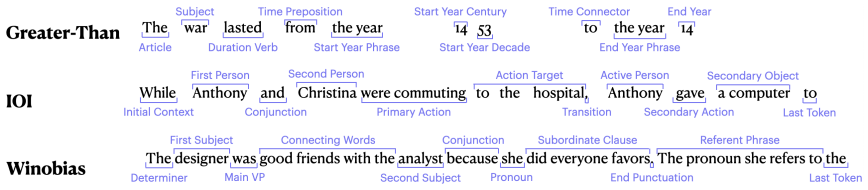
The central claim is that position matters in circuit discovery: separate token positions often implement different computations, and ignoring this produces circuits that are both too large and less faithful than they need to be. The paper introduces PEAP, an extension of edge attribution patching that computes approximate causal effects for attention edges at individual positions, including cross-position key, query, and value edges, then builds circuits greedily from the highest-scoring position-resolved edges. For variable-length datasets it introduces a schema, an ordered labeling of token spans with shared semantics, and an abstract computation graph in which each span acts as one position, with edge scores summed over the concrete edges inside each span. Experiments on IOI, Greater-Than, and Winobias with GPT2-small and Llama-3-8B show position-aware circuits reaching comparable or better faithfulness with far fewer edges than position-agnostic circuits, and LLM-generated schemas guided by saliency masks matching human-designed schemas.
Load-bearing premise
The load-bearing premise is that the quick gradient-based scores used to rank attention edges actually match how much each edge changes the model's answer; every circuit in the paper is built from those scores, and they are never checked against the slow direct way of measuring that change.
Editorial extensions
If this is right
- Position-aware circuits reach comparable or higher faithfulness with far fewer edges than position-agnostic circuits on the tested tasks.
- Aggregating importance across positions can hide an edge that is decisive at one position, which explains why position-agnostic circuits are needlessly large.
- Schemas make positional circuit discovery possible on datasets with variable-length examples by aligning semantically equivalent spans instead of raw token indices.
- Automatically generated schemas, especially when guided by model saliency masks, perform as well as human-designed schemas in faithfulness.
- Circuit components found at different positions can be reported separately, giving a more precise basis for mechanistic explanations.
Reading between the lines
- One implication left implicit is that the same schema idea could be applied to other causal interpretability methods, such as node attribution or causal abstraction, wherever a dataset has a natural role structure.
- A testable extension: on tasks with no positional structure at all, PEAP and position-agnostic circuits should converge; a large divergence there would indicate the schema is imposing an artificial alignment.
- The saliency-mask-guided schema generation suggests a general recipe: use a cheap model-based importance signal to steer an LLM's structural analysis of a dataset, which could be evaluated on more tasks and models.
- The Winobias observation that positional circuits can flip the model's prediction from biased to correct at small sizes hints that position-aware circuits may isolate behavior-controlling components more sharply; direct causal tests on those components would confirm whether the effect is real.
Editorial analysis
A structured set of objections, weighed in public.
Referee Report
Summary. This paper proposes Position-aware Edge Attribution Patching (PEAP), an extension of edge attribution patching that assigns importance scores to attention edges at specific token positions, including cross-position key and query edges, with the goal of discovering position-sensitive circuits. Because real datasets contain variable-length examples that are not token-aligned, the authors introduce 'dataset schemas,' which group tokens into ordered semantic spans, and an LLM-based pipeline (optionally guided by input-by-gradient saliency masks) for generating and applying schemas automatically. Circuit discovery proceeds in the abstract schema graph, and faithfulness is evaluated by mapping the abstract circuit back to the token-level computation graph and ablating non-circuit edges. Experiments on Greater-Than (GPT2-small), IOI (GPT2-small and Llama-3-8B), and Winobias (Llama-3-8B) show that PEAP/schema circuits achieve better faithfulness-versus-size trade-offs than a position-agnostic EAP baseline, with the automated LLM+mask schemas performing comparably to human-designed schemas.
Significance. If the findings hold, the paper makes a solid contribution to automated circuit discovery: it provides a concrete, code-released method for recovering position-specific mechanisms, and its faithfulness results are consistent across two models and three tasks, with large gaps between position-aware and non-positional curves. The held-out evaluation design (500 discovery versus 500 evaluation examples) is a strength, as is the control analysis in Table 1, which quantifies cancellation and overestimation effects with reported significance against permutation-style controls. The main risks are that the PEAP attribution estimator is not validated against brute-force patching and that the headline comparisons lack error bars and significance tests; the central claim is nevertheless a falsifiable, reproducible empirical claim rather than a circular one.
major comments (3)
- [§3.1, Eqs. (3)–(6)] The PEAP attribution scores for key and query patches are never validated against brute-force activation patching. For value patches (Eq. 4), the corrupted head output changes linearly in the corrupted value, whereas for key and query patches (Eqs. 5–6), the corruption passes through the softmax, so the change in the head output can be large and the first-order approximation (z*−z)^T ∇_z M may carry uncontrolled error. Because the greedy circuit construction (App. C) and every faithfulness curve in Figs. 1 and 6 are downstream of these scores, the paper should report a direct validation: for a sample of value, key, and query edges, both within- and cross-position, compare PEAP rankings against brute-force indirect-effect rankings, e.g., Spearman correlation and top-k overlap. I note that the faithfulness evaluation itself uses actual ablations on held-out examples, so attribution error would most plausibly attenuate the reported advantage rather than create it; the requested validation would nonetheless rule out a systematic bias in the edge ranking that the greedy algorithm consumes.
- [§6 and App. F] The main-text curves are single runs (the best of three by validity), no error bars or significance tests are reported, yet §6 uses causal language such as 'adding mask information yields an additional significant boost' and 'achieves a faithfulness not significantly different from the human-designed schema.' The appendix reveals material trial-to-trial variance, especially for Winobias, where 'the shape of the faithfulness curves makes it difficult to determine a best method' (App. F.1.2). The paper should either present all three trials or error bars in the main text and support the word 'significant' with a defined test across runs or examples, or replace 'significant' with descriptive language about the observed runs.
- [Figs. 6 and 9–11; §6] For the IOI and Winobias tasks, the position-aware method combines PEAP with span-level schema aggregation, so the comparison against the position-agnostic baseline conflates position-awareness with the effect of aggregating attribution scores within semantically meaningful spans. The Greater-Than demonstration in §3.2 isolates position-awareness because its schema is word-level, but the other two tasks do not provide this control. I request a control in which a position-agnostic circuit is discovered on the same schema graph (aggregating span-level scores across span positions), or an explicit statement that the IOI and Winobias results support the combined PEAP+schema method rather than position-awareness alone, which would sharpen the paper's central claim.
minor comments (8)
- [Table 5] The Greater-Than edge count '423,59.0' appears to be a typo for '423,590.0'.
- [§3.1] The sentence 'Equation 1 holds only when u and v are at the same position' is imprecise; the standard EAP approximation applies to general edges, and the real requirement for cross-position attention edges is the v/k/q decomposition introduced in Eqs. (4)–(6).
- [§6] The word 'faithulness' should be 'faithfulness'.
- [§4] The phrase 'while two conditions' should be 'with two conditions'.
- [§4.2 and App. D.1] The saliency method is called 'inputXgradient (Shrikumar et al., 2017)'; the cited work introduces DeepLIFT, not input-by-gradient, so the attribution should be corrected or re-cited.
- [Limitations] The automated pipeline depends on Claude 3.5 Sonnet, with Llama-3-70B and GPT-4o failing the validity thresholds; this closed-model dependency should be acknowledged as a reproducibility limitation in the Limitations section.
- [Fig. 1] Figure 1 appears twice (in the introduction and in §3.2) with x-axis labels '2^5 ... 2^17' that are never explained in the caption text; please label the axis as log2(#edges) and define the curves.
- [Table 1] Table 1 reports p < .01 for the cancellation and overestimation comparisons but does not describe the statistical test used; a one-sentence description of the test would aid reproducibility.
Circularity Check
No circularity found: PEAP's central comparison is empirical and held-out; attribution and faithfulness share the metric M by design, but the evaluation is not fitted.
full rationale
The derivation chain is not circular. The central claim that position-aware PEAP circuits are smaller and achieve similar faithfulness is established by an empirical comparison on held-out examples (Section 3.2, Figure 1, Section 6), not by a fitted equivalence. The attribution scores in Eqs. 3-6 approximate the indirect effect of edge patches on the target metric M, and the faithfulness metrics F_S and F_H in Section 3.2 reuse the same M - but on held-out evaluation examples, and no parameter of the greedy circuit construction (Appendix C) is fit to maximize those faithfulness curves. The mask threshold in Eq. 10 and the LLM schema pipeline are heuristics validated by intrinsic (validity/correctness) and extrinsic (faithfulness) metrics, not parameters fitted to the headline result. The greedy algorithm is adopted from Hanna et al. (2024b), which includes a co-author, but it is applied symmetrically to all compared methods and is not used to justify the central premise; this is not load-bearing. No uniqueness theorem or ansatz is smuggled in via self-citation. The main scientific risk - that PEAP's first-order approximation of cross-position key/query patches is unvalidated against brute-force patching - is an accuracy threat, not circularity, because even if the approximation is poor it is not true by construction and does not make the comparison to EAP equivalent to its input.
Assumptions & free parameters
free parameters (3)
- mask threshold =
1/n
- schema validity threshold =
90% (dataset) / 80% (schema)
- best-of-3 run selection =
3 runs, max validity
assumptions (4)
- domain assumption EAP linear approximation accurately estimates indirect effects of patching attention edges, including key and query patches.
- domain assumption Attribution scores are additive across token positions within a span and across examples.
- domain assumption The abstract computation graph over spans has the same causal structure as the model on any example with the same schema.
- domain assumption LLM-generated schemas and their applications are semantically aligned with human-designed ones.
invented entities (1)
-
dataset schema
Cite this review
Pith. "Pith review of Position-aware Automatic Circuit Discovery." pith.science (2026). https://pith.science/paper/RLJMXNZX
@misc{pith2026250204577,
  author       = {Pith},
  title        = {Pith review of: Position-aware Automatic Circuit Discovery},
  year         = {2026},
  howpublished = {\url{https://pith.science/paper/RLJMXNZX}},
  note         = {Machine review of arXiv:2502.04577}
}
read the original abstract
A widely used strategy to discover and understand language model mechanisms is circuit analysis. A circuit is a minimal subgraph of a model's computation graph that executes a specific task. We identify a gap in existing circuit discovery methods: they assume circuits are position-invariant, treating model components as equally relevant across input positions. This limits their ability to capture cross-positional interactions or mechanisms that vary across positions. To address this gap, we propose two improvements to incorporate positionality into circuits, even on tasks containing variable-length examples. First, we extend edge attribution patching, a gradient-based method for circuit discovery, to differentiate between token positions. Second, we introduce the concept of a dataset schema, which defines token spans with similar semantics across examples, enabling position-aware circuit discovery in datasets with variable length examples. We additionally develop an automated pipeline for schema generation and application using large language models. Our approach enables fully automated discovery of position-sensitive circuits, yielding better trade-offs between circuit size and faithfulness compared to prior work.
Figures


Figures from the paper (7 more)


Forward citations
Cited by 1 Pith paper
-
All for One: LLMs Solve Mental Math at the Last Token With Information Transferred From Other Tokens
LLMs solve arithmetic in-context via an All-for-One pattern, with all input-specific computation occurring at the last token after a two-layer information transfer window.
Reference graph
Works this paper leans on
-
[1]
Input Attribution: This method involves patching the embedding of each input token individually and measuring the importance of each position based on its impact on a down- stream metric
-
[2]
Aggregated Node Attribution Scores: The importance of a position is derived from the significance of its components. While edge at- tribution patching could theoretically be used for each example to identify important compo- nents, this approach is computationally expen- sive. Instead, we propose using Node Attri- bution Patching, which uses a linear appr...
-
[3]
Your task is to find a schema that defines how to divide this list into meaningful spans
** Tokens **: A list of tokens representing the example . Your task is to find a schema that defines how to divide this list into meaningful spans
-
[4]
** Mask **: A list of pairs in the format `[( token , value ) ] `, where a value of `1` indicates that the token is important and should be placed in its own span , separated from other tokens . ### Instructions : ###
-
[5]
Use syntactic and semantic rules to create a schema that defines how to divide all the examples in the dataset into meaningful spans
-
[6]
Each of these tokens should be placed in its own span
Use the Masks to create additional spans for any token marked as significant ( ` value = 1 `) . Each of these tokens should be placed in its own span . ** Note **: Apply this rule only if a specific token or token role is marked as important across many examples
-
[7]
If you think certain parts or tokens are crucial for the model ' s processing of the prompt , assign them to a separate span to highlight their importance
-
[8]
The spans should provide a complete division of the prompt , ensuring that every token is assigned to a span , and the spans should reflect the chronological structure of the prompt
Show all 21 references
-
[9]
Significant Token
The examples may vary , so you must define a schema that is not tailored to any specific example but can be applied consistently across all examples . ### Goal : ### Given a set of examples , your goal is to define a schema - - - a structure that divides all examples into the ...
-
[10]
, ( ' afterwards ' , 1) , ( ' Michael ' , 1) , ( ' said ' , 0) , ( ' to ' , 0) ] ` --- ** Example 1:** ** Tokens :** `[' Then ' , ',', ' Jennifer ' , ' and ' , ' John ' , ' had ' , ' a ' , ' long ' , ' argument ' , ',', ' and ' , ' afterwards ' , ' Jennifer ' , ' said ' , ' to...
-
[11]
, ( ' and ' , 1) , ( ' John ', 1) , ( ' had ' , 0) , ( ' a ' , 0) , ( ' long ' , 0) , ( ' argument ' , 0) , ( ' , ' , 0) , ( ' and ' ,
-
[12]
, ( ' afterwards ', 1) , ( ' Jennifer ' , 1) , ( ' said ' , 0) , ( ' to ' , 0) ] ` --- ** Example 2:** ** Tokens :** `[' Then ' , ',', ' Michael ' , ' and ' , ' William ' , ' had ' , ' a ' , ' long ' , ' argument ' , ',', ' and ' , ' afterwards ' , ' Michael ' , ' said ' , ' t...
-
[13]
, ( ' afterwards ', 1) , ( ' Michael ' , 1) , ( ' said ' , 0) , ( ' to ' , 0) ] ` --- ** Example 3:** ** Tokens :** `[' Then ' , ',', ' Jessica ' , ' and ' , ' Elizabeth ' , ' went ' , ' to ' , ' the ' , ' office ' , '. ' , ' Jessica ' , ' gave ' , ' a ' , ' drink ' , ' to '] ...
-
[14]
' , ' Afterwards ' , ' Kimberly ' , ' said ' , ' to '] ` ** Mask :** `[( ' Then ', 0) , ( ', ' , 0) , ( ' Kimberly ' ,
, ( ' drink ' , 0) , ( ' to ' , 0) ] ` --- ** Example 4:** ** Tokens :** `[' Then ' , ',', ' Kimberly ' , ' and ', ' Michelle ' , ' had ' , ' a ' , ' long ' , ' argument ' , '. ' , ' Afterwards ' , ' Kimberly ' , ' said ' , ' to '] ` ** Mask :** `[( ' Then ', 0) , ( ', ' , 0) ...
-
[15]
' , 0) , ( ' Afterwards ', 0) , ( ' Kimberly ' , 1) , ( ' said ' , 0) , ( ' to ', 0) ] ` --- ### Guidelines : ###
, ( ' and ', 0) , ( ' Michelle ' , 1) , ( ' had ' , 0) , ( ' a ' , 0) , ( ' long ' , 0) , ( ' argument ' , 0) , ( '. ' , 0) , ( ' Afterwards ', 0) , ( ' Kimberly ' , 1) , ( ' said ' , 0) , ( ' to ', 0) ] ` --- ### Guidelines : ###
-
[16]
Ensure the schema assigns each part in the prompt to a span
-
[17]
The final token in every prompt must always be placed in its own span
-
[18]
The final token is always placed in the last span
-
[19]
Any token marked with a value of `1` is considered important and should be placed in its own span in the schema
-
[20]
Create spans that can be applied to all the examples
-
[21]
Initial Time Marker
Ensure spans are relevant and consistent across the entire dataset . An example of the models’ response: Based on the given examples and instructions , I ' ve created a schema that divides the prompts into meaningful spans . Here ' s the JSON object describing the schema : { "...
Reviewed August 8, 2026 · model on record in the stance chip above.
Discussion (0). Continue with ORCID to comment.