REVIEW 3 major objections 5 minor 1 cited by
Tolerance-Aware Deep Optics
T0 review · 3 major / 5 minor · reviewed 2026-08-08 · deepseek-v4-flash
Pith's one-line read Deep optics usually assumes a perfect lens; this paper claims the first end-to-end framework that instead trains the lens and its reconstruction network against sampled manufacturing and assembly tolerances, recovering more than 2 dB of…
desk verdict First to co-optimize refractive-lens deep optics against manufacturing tolerances in the loop, but the headline robustness claim is in-sample and the '>2dB' gain is overstated. read the letter →
The pith
A machine-rendered reading of the paper's core claim, the machinery that carries it, and where it could break.
The reading
What carries the argument
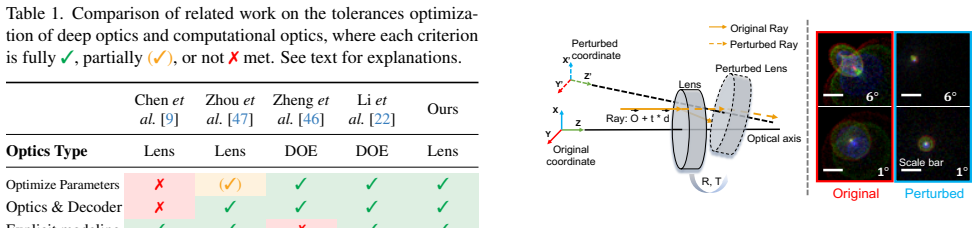
The load-bearing object is a tolerance-aware differentiable ray tracer. In each forward pass, the four tolerance types are converted into per-surface spatial transformations—translation for decentration and central thickness, rotation for tilt, plus a curvature offset—and applied as an equivalent coordinate transform on the ray before intersection and refraction, keeping the whole pipeline differentiable. Training then minimizes three terms: a standard image-quality loss, a Spot loss that keeps the traced spot size within a reasonable range, and a PSF similarity loss that penalizes changes in the point spread function under random tolerances. The PSF-similarity term is what couples the optical design to the decoder's expectations, stabilizing the Monte Carlo training and forcing the lens to keep its encoding stable under perturbations.
What would settle it
Fabricate, say, 100 copies of the tolerance-optimized Lens 2, measure their actual decentration, tilt, thickness, and curvature errors, and compare the distribution of measured deblurring PSNR against the simulated 100-sample tolerance test in Table 2; if the measured performance spread matches the conventional design's spread rather than the tolerance-aware design's, the Gaussian independence model and the >2 dB claim are falsified. A cheaper preliminary check is to measure a real factory's tolerance statistics and test whether they fit the assumed normal distribution with the stated ranges.
Extended reading notes
Core claim
The central claim is that explicitly modeling manufacturing and assembly tolerances inside the differentiable ray tracer, and optimizing against them jointly with the decoder, produces a deep-optics system whose performance no longer collapses when the real lens deviates from the nominal design. Concretely, the paper shows that sampling decentration, tilt, central-thickness, and curvature errors per lens and per training iteration, rendering the perturbed point spread function map, and training the optics and reconstruction network together yields more than 2 dB higher average PSNR than the same pipeline trained without tolerances, when both are tested under random tolerances. It also shows that the perturbed ray tracing matches Zemax spot diagrams to within about 1 micrometer in root-mean-square spot size, that a tolerance-aware design has substantially better manufacturing yield, and that optimizing only the optics or only the decoder is not enough: the gain appears only when both are updated together. On the basis of its real-world experiment, the paper further claims that the optimized decoder is more robust to actual perturbations during image acquisition.
Load-bearing premise
The load-bearing assumption is that real manufacturing and assembly errors are well described by independent Gaussian deviations of each lens with the hand-set ranges in Table A1 (for example, ±0.04 mm decentration and ±0.05 degrees tilt), since the same distribution is used for training, evaluation, and yield analysis; if a factory's actual errors are larger, correlated, or non-Gaussian, the claimed >2 dB gain may not carry over to fabricated lenses.
Editorial extensions
If this is right
- Under the paper's tolerance model, a deep-optics lens optimized with this framework keeps an average PSNR above 28 dB when a conventional design drops to around 26 dB on the paper's deblurring test set with random tolerances.
- The same designs show higher manufacturing yield: for Lens 1, the tolerance-aware design reaches 26.26 dB PSNR with 90% confidence, versus 24.30 dB for the non-tolerant design.
- Tolerance optimization by optics-only metrics, as done with Zemax, can degrade end-to-end deblurring because it ignores the encoder-decoder pairing; the paper's joint optimization avoids this mismatch, as seen for Lens 2 in its Table 2.
- Optimizing only the decoder improves its robustness but leaves the design fragile, and optimizing only the optics also fails, so the framework's benefit requires joint optimization of both.
- The two-stage recipe—pretrain without tolerances, then tolerance-aware fine-tuning—offers a stable path that protects the pre-trained design's image-quality goals while hardening the system against deviations.
Reading between the lines
- A direct next test is physical fabrication: the paper's real-world experiment perturbs an off-the-shelf lens and optimizes only the decoder, so it never manufactures the tolerance-optimized lens designs; measuring actual point spread functions and tolerance statistics of fabricated copies of Lens 1 or Lens 2 would confirm or refute whether the Gaussian model and the claimed >2 dB gain survive real
- Because the framework treats tolerances as differentiable random perturbations, the same recipe could be transferred to other fabrication errors, such as surface irregularity or refractive-index inhomogeneity, or to non-refractive optics like diffractive elements and metasurfaces where manufacturing errors have different distributions.
- The PSF-similarity loss acts as a stability regularizer, so a plausible untested consequence is that it may also improve robustness to defocus, thermal drift, or other perturbations that alter the point spread function, not only assembly tolerances.
- If the tolerance model is accurate, the proposed flow suggests an industrial recipe: start from a standard design that already meets image-quality goals, then harden it and its decoder against measured factory tolerance statistics rather than hand-set ranges.
Editorial analysis
A structured set of objections, weighed in public.
Referee Report
Summary. The paper proposes a tolerance-aware deep optics framework that incorporates manufacturing and assembly tolerances (decentration, tilt, central thickness, curvature) into differentiable ray tracing, and jointly optimizes the lens design and the computational decoder. The method is evaluated in simulation on two lens designs against a non-tolerance-aware baseline and a Zemax-based tolerance optimization, and with a real-world experiment using an off-the-shelf lens. The main claims are improved deblurring robustness under tolerances, accurate tolerance modeling validated against Zemax, and a design flow that reduces the design-to-manufacturing gap.
Significance. The problem addressed is important: conventional deep optics assumes perfect fabrication, which creates a gap between simulation and physical systems. Incorporating multiple tolerance types into differentiable ray tracing is a sensible and practically relevant extension, and the Zemax comparison (Sec. 4.1) gives evidence that the perturbed ray tracing is physically accurate. The ablations (Secs. 5.1–5.3) are also useful, particularly the finding that joint optics-decoder optimization is needed for robustness. If the tolerance model were validated against real fabricated lenses, the framework would be a solid contribution to computational imaging. The paper also provides a useful analysis of loss terms and sampling numbers.
major comments (3)
- [Abstract; Sec. 4.2; Tab. 2] The abstract and Sec. 4.2 claim 'over 2dB improvement' in average deblurring performance, but the numbers in Tab. 2 show improvements of 0.36 dB for Lens1 (29.61 vs. 29.25) and 2.33 dB for Lens2 (28.08 vs. 25.75), averaging about 1.35 dB. This claim should be corrected to match the reported results, or the statistical basis for a 2 dB figure should be stated explicitly.
- [Sec. 4.3] The 'real-world experiment' does not fabricate or test the tolerance-optimized lens designs; it only retrains a decoder on an off-the-shelf lens and applies artificial perturbations to the acquired images. As a result, this experiment does not validate the central claim of design-to-manufacturing transfer. The section should be reframed as a decoder-robustness study, or supplemented with a fabricated-lens experiment that actually measures performance under real manufacturing deviations.
- [Sec. 3.1; Supp. A; Sec. 4.2] The tolerance perturbations are defined in Sec. 3.1 and Supp. A as independent clamped Gaussians with hand-set ranges (Tab. A1), and the evaluation in Sec. 4.2 samples from exactly the same distribution used in training. Consequently, the robustness gains in Tab. 2 are in-sample with respect to the assumed error model and do not yet establish robustness under measured manufacturing statistics. The authors should either validate the tolerance model against real fabrication measurements (e.g., measured decentration/tilt distributions of produced lenses) or explicitly qualify the central robustness claim as conditional on the assumed Gaussian model.
minor comments (5)
- [Eq. (5)] In Eq. (5), the same symbol Pλ,f is used for both the traced ray position and the averaged centroid; please use a distinct notation such as P̄λ,f for the centroid to avoid ambiguity.
- [Eq. (7)] Eq. (7) is missing an operator between PSFIdeal and PSFP erb; the intended convolution or correlation should be explicitly written.
- [Sec. 4.1] The claim that spot-size errors relative to Zemax are '< 1µm' is not backed by a quantitative table; please report the per-field RMS spot error values so the accuracy claim is verifiable.
- [Sec. 4.3] Please clarify whether the off-the-shelf lens used in the real-world experiment corresponds to Lens1 or Lens2, and if not, state explicitly that the physical experiment does not use the designed lens parameters.
- [Abstract] The phrase 'the first end-to-end tolerance-aware optimization framework' should be qualified, since Li et al. [22] and Zheng et al. [46] already address fabrication tolerances in deep optics; if the claim is restricted to refractive lenses, this restriction should be stated explicitly.
Circularity Check
No significant circularity: the shared train/test tolerance sampler is an external-validity limitation, not a circular derivation.
full rationale
The paper's derivation chain does not reduce to its own inputs. The tolerance ranges in Tab. A1 are assumed, not fitted to data: Sec. 3.1 states 'theta_Delta obeys the normal distribution, theta_Delta ~ N(0, max^2/9)' and the ranges are hand-set tolerances. During training, Sec. 3.3 samples N=64 tolerance patterns per iteration; during evaluation, Supp. B.2 samples randomized tolerances multiple times using the same perturbation model. This means the simulation-based robustness numbers are in-sample with respect to the assumed Gaussian tolerance model, but that is a standard train/test setup for a robustness objective, not a case where a predicted quantity is equivalent by construction to a fitted parameter. The paper does not claim to have measured real manufacturing statistics for the designed lenses, so the realism of the tolerance model is an external-validity concern, not circularity. The real-world experiment in Sec. 4.3 uses an off-the-shelf lens and optimizes only the decoder, so it does not validate the co-designed optics; this is a scope/overclaim issue, not a circular step. The abstract's 'over 2dB improvement' is not supported by the tabulated arithmetic (Lens1: 29.61 vs 29.25 = +0.36 dB; Lens2: 28.08 vs 25.75 = +2.33 dB; average about 1.35 dB), but an inaccurate summary number is not circularity. Self-citations, including [42] for the differentiable PSF-map rendering, are implementation details and do not carry a uniqueness theorem or load-bearing premise that would force the result. No step exhibits the reduction patterns: no self-definitional fitting, no fitted-input-called-prediction, no imported uniqueness theorem, and no renaming of a known result. The central contribution is an optimization framework with novel losses; even if the evaluation is conditional on the assumed tolerance distribution, the derivation is self-contained and not circular.
Assumptions & free parameters
free parameters (3)
- Tolerance ranges (decentration, tilt, central thickness, curvature) =
+/- 0.04 mm, +/- 0.05 deg, +/- 0.04 mm, +/- 0.3%
- Loss weights lambda_Spot and lambda_PSF =
Not given numerically, described as dependent on lens structure
- Number of sampled tolerance patterns N =
64 for training
assumptions (3)
- domain assumption Geometric ray tracing with Snell's law is an accurate model of the optical systems under study; diffraction and wave effects are ignored.
- domain assumption Manufacturing and assembly tolerances are independent across lenses, independent across tolerance types, and follow a clipped Gaussian distribution with the specified ranges.
- domain assumption The PSF-based spatially-variant convolution model adequately represents the imaging process for training and evaluation.
Cite this review
Pith. "Pith review of Tolerance-Aware Deep Optics." pith.science (2026). https://pith.science/paper/J2BEEETR
@misc{pith2026250204719,
  author       = {Pith},
  title        = {Pith review of: Tolerance-Aware Deep Optics},
  year         = {2026},
  howpublished = {\url{https://pith.science/paper/J2BEEETR}},
  note         = {Machine review of arXiv:2502.04719}
}
read the original abstract
Deep optics has emerged as a promising approach by co-designing optical elements with deep learning algorithms. However, current research typically overlooks the analysis and optimization of manufacturing and assembly tolerances. This oversight creates a significant performance gap between designed and fabricated optical systems. To address this challenge, we present the first end-to-end tolerance-aware optimization framework that incorporates multiple tolerance types into the deep optics design pipeline. Our method combines physics-informed modelling with data-driven training to enhance optical design by accounting for and compensating for structural deviations in manufacturing and assembly. We validate our approach through computational imaging applications, demonstrating results in both simulations and real-world experiments. We further examine how our proposed solution improves the robustness of optical systems and vision algorithms against tolerances through qualitative and quantitative analyses. Code and additional visual results are available at openimaginglab.github.io/LensTolerance.
Figures


Figures from the paper (5 more)


Forward citations
Cited by 1 Pith paper
-
Deep Learning for Optical Misalignment Diagnostics in Multi-Lens Imaging Systems
Deep learning models can infer per-lens misalignment errors from simulated optical measurements in multi-lens systems, with accuracy of about 0.03 mm and 0.01 degrees in the spot-diagram method.
Reference graph
Works this paper leans on
-
[1]
Ntire 2017 challenge on single image super-resolution: Dataset and study
Eirikur Agustsson and Radu Timofte. Ntire 2017 challenge on single image super-resolution: Dataset and study. In Pro- ceedings of the IEEE conference on computer vision and pat- tern recognition workshops, pages 126–135, 2017. 5, 1
work page 2017
-
[2]
Single-shot hyperspectral-depth imaging with learned diffractive optics
Seung-Hwan Baek, Hayato Ikoma, Daniel S Jeon, Yuqi Li, Wolfgang Heidrich, Gordon Wetzstein, and Min H Kim. Single-shot hyperspectral-depth imaging with learned diffractive optics. In Proceedings of the IEEE/CVF Inter- national Conference on Computer Vision, pages 2651–2660,
-
[3]
PhoCoLens: Photorealistic and Consistent Reconstruction in Lensless Imaging
Xin Cai, Zhiyuan You, Hailong Zhang, Wentao Liu, Jinwei Gu, and Tianfan Xue. Phocolens: Photorealistic and con- sistent reconstruction in lensless imaging. arXiv preprint arXiv:2409.17996, 2024. 1, 4
work page Pith review arXiv 2024
-
[4]
Thin on-sensor nanophotonic array cameras
Praneeth Chakravarthula, Jipeng Sun, Xiao Li, Chenyang Lei, Gene Chou, Mario Bijelic, Johannes Froesch, Arka Ma- jumdar, and Felix Heide. Thin on-sensor nanophotonic array cameras. ACM Transactions on Graphics (TOG) , 42(6):1– 18, 2023. 3
work page 2023
-
[5]
Antonin Chambolle, Vicent Caselles, Daniel Cremers, Mat- teo Novaga, Thomas Pock, et al. An introduction to total variation for image analysis.Theoretical foundations and nu- merical methods for sparse recovery, 9(263-340):227, 2010. 4
work page 2010
-
[6]
Deep optics for monocu- lar depth estimation and 3d object detection
Julie Chang and Gordon Wetzstein. Deep optics for monocu- lar depth estimation and 3d object detection. In Proceedings of the IEEE/CVF International Conference on Computer Vi- sion, pages 10193–10202, 2019. 2, 3
work page 2019
-
[7]
Extreme-quality computational imaging via degradation framework
Shiqi Chen, Huajun Feng, Keming Gao, Zhihai Xu, and Yueting Chen. Extreme-quality computational imaging via degradation framework. In Proceedings of the IEEE/CVF International Conference on Computer Vision, pages 2632– 2641, 2021. 4
work page 2021
-
[8]
Optical aberrations correction in postprocess- ing using imaging simulation
Shiqi Chen, Huajun Feng, Dexin Pan, Zhihai Xu, Qi Li, and Yueting Chen. Optical aberrations correction in postprocess- ing using imaging simulation. ACM Transactions on Graph- ics (TOG), 40(5):1–15, 2021. 2
work page 2021
Show all 47 references
-
[9]
Computational optics for mobile terminals in mass production
Shiqi Chen, Ting Lin, Huajun Feng, Zhihai Xu, Qi Li, and Yueting Chen. Computational optics for mobile terminals in mass production. IEEE Transactions on Pattern Analysis and Machine Intelligence, 45(4):4245–4259, 2022. 2, 3
2022
-
[10]
The differentiable lens: Compound lens search over glass surfaces and materials for object detection
Geoffroi C ˆot´e, Fahim Mannan, Simon Thibault, Jean- Franc ¸ois Lalonde, and Felix Heide. The differentiable lens: Compound lens search over glass surfaces and materials for object detection. In Proceedings of the IEEE/CVF Confer- ence on Computer Vision and Pattern Recogniti...
2023
-
[11]
Learned rotationally symmetric diffractive achromat for full-spectrum computa- tional imaging
Xiong Dun, Hayato Ikoma, Gordon Wetzstein, Zhanshan Wang, Xinbin Cheng, and Yifan Peng. Learned rotationally symmetric diffractive achromat for full-spectrum computa- tional imaging. Optica, 7(8):913–922, 2020. 3
2020
-
[12]
A formal evaluation of psnr as quality measurement parameter for image segmen- tation algorithms
Fernando A Fardo, Victor H Conforto, Francisco C de Oliveira, and Paulo S Rodrigues. A formal evaluation of psnr as quality measurement parameter for image segmen- tation algorithms. arXiv preprint arXiv:1605.07116 , 2016. 6
2016 arXiv
-
[13]
Statistical tolerancing for optics
David P Forse. Statistical tolerancing for optics. In Specifi- cation, Production, and Testing of Optical Components and Systems, pages 18–27. SPIE, 1996. 2
1996
-
[14]
Mamba: Linear-time sequence modeling with selective state spaces
Albert Gu and Tri Dao. Mamba: Linear-time sequence modeling with selective state spaces. arXiv preprint arXiv:2312.00752, 2023. 2
2023 arXiv
-
[15]
Depth estimation from a single image using deep learned phase coded mask.IEEE Transactions on Computational Imaging, 4(3):298–310, 2018
Harel Haim, Shay Elmalem, Raja Giryes, Alex M Bronstein, and Emanuel Marom. Depth estimation from a single image using deep learned phase coded mask.IEEE Transactions on Computational Imaging, 4(3):298–310, 2018. 3
2018
-
[16]
Design and tolerance of a free- form optical system for an optical see-through multi-focal- plane display
Xinda Hu and Hong Hua. Design and tolerance of a free- form optical system for an optical see-through multi-focal- plane display. Applied Optics, 54(33):9990–9999, 2015. 2
2015
-
[17]
Depth from defocus with learned optics for imaging and occlusion-aware depth esti- mation
Hayato Ikoma, Cindy M Nguyen, Christopher A Metzler, Yi- fan Peng, and Gordon Wetzstein. Depth from defocus with learned optics for imaging and occlusion-aware depth esti- mation. In 2021 IEEE International Conference on Compu- tational Photography (ICCP), pages 1–12. IEEE, 2021. 2
2021
-
[18]
Percep- tual losses for real-time style transfer and super-resolution
Justin Johnson, Alexandre Alahi, and Li Fei-Fei. Percep- tual losses for real-time style transfer and super-resolution. In Computer Vision–ECCV 2016: 14th European Confer- ence, Amsterdam, The Netherlands, October 11-14, 2016, Proceedings, Part II 14, pages 694–711. Springer, 2016. 4
2016
-
[19]
Minimalist vision with freeform pixels
Jeremy Klotz and Shree K Nayar. Minimalist vision with freeform pixels. In European Conference on Computer Vi- sion, pages 329–346. Springer, 2025. 1
2025
-
[20]
A realistic camera model for computer graphics
Craig Kolb, Don Mitchell, and Pat Hanrahan. A realistic camera model for computer graphics. In Proceedings of the 22nd annual conference on Computer graphics and interac- tive techniques, pages 317–324, 1995. 4
1995
-
[21]
Lens design
Milton Laikin. Lens design. Crc Press, 2018. 2
2018
-
[22]
Quantization-aware deep optics for diffractive snapshot hyperspectral imaging
Lingen Li, Lizhi Wang, Weitao Song, Lei Zhang, Zhiwei Xiong, and Hua Huang. Quantization-aware deep optics for diffractive snapshot hyperspectral imaging. In Proceedings of the IEEE/CVF Conference on Computer Vision and Pat- tern Recognition, pages 19780–19789, 2022. 2, 3
2022
-
[23]
End-to-end learned single lens design using fast differentiable ray tracing
Zongling Li, Qingyu Hou, Zhipeng Wang, Fanjiao Tan, Jin Liu, and Wei Zhang. End-to-end learned single lens design using fast differentiable ray tracing. Optics Letters, 46(21): 5453–5456, 2021. 1, 2
2021
-
[24]
Optical design and tolerancing of freeform surfaces using anisotropic radial basis functions
Milan Maksimovic. Optical design and tolerancing of freeform surfaces using anisotropic radial basis functions. Optical Engineering, 55(7):071203–071203, 2016. 2
2016
-
[25]
Designing easily manufactured lenses us- ing a global method
James P McGuire. Designing easily manufactured lenses us- ing a global method. In International Optical Design Con- ference, page TuA6. Optica Publishing Group, 2006. 4
2006
-
[26]
Deep optics for single-shot high-dynamic- range imaging
Christopher A Metzler, Hayato Ikoma, Yifan Peng, and Gor- don Wetzstein. Deep optics for single-shot high-dynamic- range imaging. In Proceedings of the IEEE/CVF Conference on Computer Vision and Pattern Recognition , pages 1375– 1385, 2020. 2, 3 9
2020
-
[27]
Description and tolerance analysis of freeform sur- face figure error using specific-probability-distributed gaus- sian radial basis functions
Junhao Ni, Tong Yang, Yue Liu, Dewen Cheng, and Yongtian Wang. Description and tolerance analysis of freeform sur- face figure error using specific-probability-distributed gaus- sian radial basis functions. Optics express, 27(22):31820– 31839, 2019. 2
2019
-
[28]
A new approach to the simulation of optical manufacturing processes
Don Oinen. A new approach to the simulation of optical manufacturing processes. In Optical Fabrication and Test- ing, page JWC3. Optica Publishing Group, 1990. 2
1990
-
[29]
Learned large field-of-view imaging with thin-plate optics
Yifan Peng, Qilin Sun, Xiong Dun, Gordon Wetzstein, Wolf- gang Heidrich, and Felix Heide. Learned large field-of-view imaging with thin-plate optics. ACM Trans. Graph., 38(6): 219–1, 2019. 1, 2
2019
-
[30]
End-to-end optimization of optics and image processing for achromatic extended depth of field and super- resolution imaging
Vincent Sitzmann, Steven Diamond, Yifan Peng, Xiong Dun, Stephen Boyd, Wolfgang Heidrich, Felix Heide, and Gor- don Wetzstein. End-to-end optimization of optics and image processing for achromatic extended depth of field and super- resolution imaging. ACM Transactions on Graph...
2018
-
[31]
End-to-end optimization of optics and image processing for achromatic extended depth of field and super- resolution imaging
Vincent Sitzmann, Steven Diamond, Yifan Peng, Xiong Dun, Stephen Boyd, Wolfgang Heidrich, Felix Heide, and Gor- don Wetzstein. End-to-end optimization of optics and image processing for achromatic extended depth of field and super- resolution imaging. ACM Transactions on Graph...
2018
-
[32]
Learning rank-1 diffractive optics for single-shot high dynamic range imaging
Qilin Sun, Ethan Tseng, Qiang Fu, Wolfgang Heidrich, and Felix Heide. Learning rank-1 diffractive optics for single-shot high dynamic range imaging. In Proceedings of the IEEE/CVF conference on computer vision and pattern recognition, pages 1386–1396, 2020. 1, 2, 3
2020
-
[33]
End-to-end complex lens design with differen- tiable ray tracing
Qilin Sun, Congli Wang, Fu Qiang, Dun Xiong, and Heidrich Wolfgang. End-to-end complex lens design with differen- tiable ray tracing. ACM Trans. Graph, 40(4):1–13, 2021. 1, 3
2021
-
[34]
Optical design tolerancing, 2015
Synopsys. Optical design tolerancing, 2015. Avail- able: https : / / www . synopsys . com / content / dam / synopsys / optical - solutions / documents / whitepapers / optical - design - tolerancing.pdf. 2
2015
-
[35]
Neural nano-optics for high-quality thin lens imag- ing
Ethan Tseng, Shane Colburn, James Whitehead, Luocheng Huang, Seung-Hwan Baek, Arka Majumdar, and Felix Heide. Neural nano-optics for high-quality thin lens imag- ing. Nature communications, 12(1):6493, 2021. 3
2021
-
[36]
Differentiable compound optics and processing pipeline op- timization for end-to-end camera design
Ethan Tseng, Ali Mosleh, Fahim Mannan, Karl St-Arnaud, Avinash Sharma, Yifan Peng, Alexander Braun, Derek Nowrouzezahrai, Jean-Francois Lalonde, and Felix Heide. Differentiable compound optics and processing pipeline op- timization for end-to-end camera design. ACM Transaction...
2021
-
[37]
do: A differ- entiable engine for deep lens design of computational imag- ing systems
Congli Wang, Ni Chen, and Wolfgang Heidrich. do: A differ- entiable engine for deep lens design of computational imag- ing systems. IEEE Transactions on Computational Imaging, 8:905–916, 2022. 2, 3, 4, 5
2022
-
[38]
Image quality assessment: from error visibility to structural similarity
Zhou Wang, Alan C Bovik, Hamid R Sheikh, and Eero P Si- moncelli. Image quality assessment: from error visibility to structural similarity. IEEE transactions on image processing, 13(4):600–612, 2004. 6
2004
-
[39]
Inference in artifi- cial intelligence with deep optics and photonics
Gordon Wetzstein, Aydogan Ozcan, Sylvain Gigan, Shan- hui Fan, Dirk Englund, Marin Solja ˇci´c, Cornelia Denz, David AB Miller, and Demetri Psaltis. Inference in artifi- cial intelligence with deep optics and photonics. Nature, 588 (7836):39–47, 2020. 3
2020
-
[40]
Phase- cam3d—learning phase masks for passive single view depth estimation
Yicheng Wu, Vivek Boominathan, Huaijin Chen, Aswin Sankaranarayanan, and Ashok Veeraraghavan. Phase- cam3d—learning phase masks for passive single view depth estimation. In 2019 IEEE International Conference on Com- putational Photography (ICCP), pages 1–12. IEEE, 2019. 3
2019
-
[41]
Aberration-aware depth-from-focus
Xinge Yang, Qiang Fu, Mohamed Elhoseiny, and Wolfgang Heidrich. Aberration-aware depth-from-focus. IEEE Trans- actions on Pattern Analysis and Machine Intelligence, 2023. 2, 3
2023
-
[42]
Curriculum learning for ab initio deep learned refractive optics
Xinge Yang, Qiang Fu, and Wolfgang Heidrich. Curriculum learning for ab initio deep learned refractive optics. Nature communications, 15(1):6572, 2024. 1, 2, 3, 5
2024
-
[43]
Opticstudio, 2013
Zemax. Opticstudio, 2013. Available: https://www. zemax.com/. 2, 5, 6
2013
-
[44]
The unreasonable effectiveness of deep features as a perceptual metric
Richard Zhang, Phillip Isola, Alexei A Efros, Eli Shecht- man, and Oliver Wang. The unreasonable effectiveness of deep features as a perceptual metric. In Proceedings of the IEEE conference on computer vision and pattern recogni- tion, pages 586–595, 2018. 6
2018
-
[45]
Large depth-of-field ultra-compact micro- scope by progressive optimization and deep learning.Nature Communications, 14(1):4118, 2023
Yuanlong Zhang, Xiaofei Song, Jiachen Xie, Jing Hu, Jiawei Chen, Xiang Li, Haiyu Zhang, Qiqun Zhou, Lekang Yuan, Chui Kong, et al. Large depth-of-field ultra-compact micro- scope by progressive optimization and deep learning.Nature Communications, 14(1):4118, 2023. 2
2023
-
[46]
Neu- ral lithography: Close the design-to-manufacturing gap in computational optics with a’real2sim’learned photolithogra- phy simulator
Cheng Zheng, Guangyuan Zhao, and Peter TC So. Neu- ral lithography: Close the design-to-manufacturing gap in computational optics with a’real2sim’learned photolithogra- phy simulator. arXiv preprint arXiv:2309.17343, 2023. 3
2023 arXiv
-
[47]
Optical degradation correction of manufacturing-perturbed glass-plastic hybrid lens systems via a joint hardware- software optimization framework
Jingwen Zhou, Bingkun Chen, Jiapu Yan, Zheng Ren, Wen- guan Zhang, Huajun Feng, Yueting Chen, and Meijuan Bian. Optical degradation correction of manufacturing-perturbed glass-plastic hybrid lens systems via a joint hardware- software optimization framework. Optics Express, 32...
2024
Reviewed August 8, 2026 · model on record in the stance chip above.
Discussion (0). Continue with ORCID to comment.