REVIEW 4 major objections 6 minor 1 cited by
SeDi-Instruct: Enhancing Alignment of Language Models through Self-Directed Instruction Generation
T0 review · 4 major / 6 minor · reviewed 2026-08-08 · deepseek-v4-flash
Pith's one-line read A self-directed instruction generation framework claims to improve instruction-tuned model accuracy by 5.2% while cutting the API cost of dataset construction by 36%.
desk verdict A reasonable combination of known ideas for cheaper instruction generation, but the headline 5.2% accuracy gain is an artifact of averaging per-benchmark relative gains and is not supported by the paper's own Table 1. read the letter →
The pith
A machine-rendered reading of the paper's core claim, the machinery that carries it, and where it could break.
The reading
What carries the argument
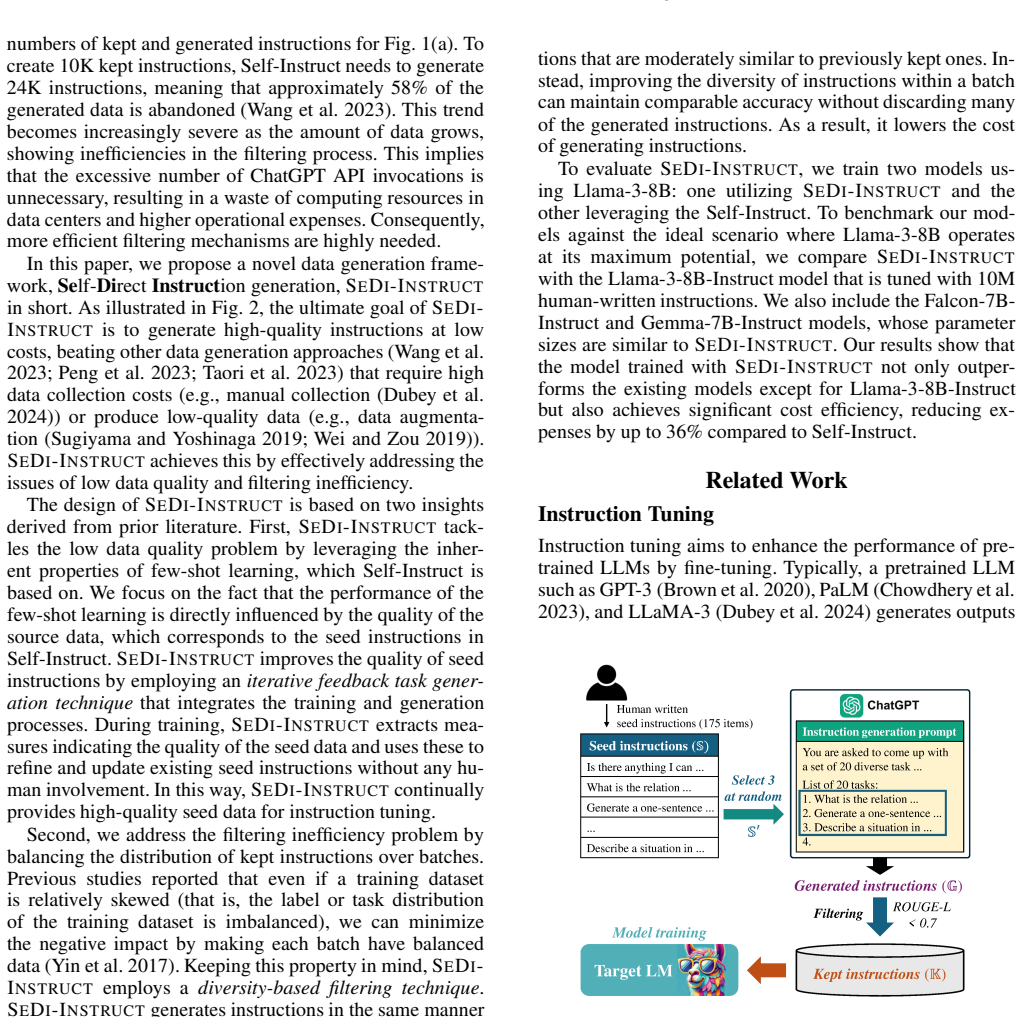
The machinery is a two-part pipeline: diversity-based filtering and iterative feedback task generation. Diversity-based filtering uses a ROUGE-L threshold of 0.85 instead of Self-Instruct's 0.7, so only highly redundant instructions are dropped; accepted instructions are classified via PCA-reduced embeddings into as many clusters as the batch size, and each batch samples one instruction per cluster. Iterative feedback task generation tracks batch gradient norms during training, selects the highest-norm batch every ten iterations, and uses those instructions to replenish the seed set while a seed score table (the ratio SeedKept/SeedGen) identifies which seeds to evict.
What would settle it
Run SeDi-Instruct's training loop while scrambling the batch selection rule, for example replacing the highest-gradient-norm batch with a randomly chosen batch or with the lowest-gradient-norm batch, and compare final benchmark accuracy. If the randomly replenished model matches or beats the gradient-norm model, the feedback mechanism is not doing the claimed work; the paper does not report this control. A simpler check is to verify whether instructions added from high-gradient-norm batches actually raise the kept-instruction quality of later generations, measured by the SeedKept/SeedGen ratio over successive rounds.
Extended reading notes
Core claim
The central claim is that instruction-tuning data can be synthesized more cheaply and effectively by closing the loop between generation and training. SeDi-Instruct replaces Self-Instruct's static, aggressive filtering with two mechanisms: a relaxed similarity threshold that retains up to 80% of generated instructions, and a clustering-based batch sampler that groups similar instructions and draws one per cluster so each batch remains diverse. It also monitors training quality and, every ten iterations, selects the batch with the highest gradient norm, adds any of its instructions not already similar to the seed set, and evicts seed instructions with low SeedKept/SeedGen ratios. The paper reports that a Llama-3-8B model tuned on 30,164 instructions produced this way outperforms the equivalent Self-Instruct model on four benchmarks and on all five competitive evaluation test sets, and that generating 10,000 kept instructions costs 36% less because fewer API calls are wasted on discarded data.
Load-bearing premise
The load-bearing premise is that the training batch with the highest gradient norm contains the most valuable instructions for future generation; if gradient norm does not track instruction quality, the seed-replacement loop that forms the paper's main novelty has no effect.
Editorial extensions
If this is right
- If the reported numbers hold, instruction-tuning pipelines can cut API spend by about a third without sacrificing model quality.
- The results support loosening similarity-based filtering (threshold 0.7 to 0.85) whenever batch construction enforces local diversity.
- Training signals such as gradient norms can serve as a no-human-in-the-loop signal for which synthetic instructions to reuse as seeds.
- The pipeline reproduces its advantage on five competitive evaluation sets, not just on accuracy benchmarks, suggesting the effect is not benchmark-specific.
- The method carries a known safety cost: without a refusal system prompt, the tuned model answers harmful queries, so real deployments would need an alignment guard.
Reading between the lines
- A random-batch control would separate the contribution of the gradient-norm selector from the contribution of simply adding more diverse instructions to the seed set; the reported experiments do not include this control.
- The seed score (SeedKept/SeedGen) rewards seeds that generate many retained instructions, but it may also favor generic seeds that produce a large volume of redundant variants; the paper does not test whether a diversity-aware score works differently.
- If the cost saving scales with the relaxed threshold, even looser thresholds (with stronger clustering) could push API waste lower, but the accuracy tradeoff beyond 0.85 is not measured.
- The model-collapse experiments suggest the method depends on using a generator larger than the target model; swapping the generator for a smaller one degraded scores in the reported re-evaluation.
Editorial analysis
A structured set of objections, weighed in public.
Referee Report
Summary. SeDi-Instruct is a data-generation framework for instruction tuning that relaxes the ROUGE-L filtering threshold to retain more generated instructions and uses clustering-based batch construction to preserve local diversity. It additionally introduces an iterative feedback loop: during training, the batch with the highest gradient norm is identified every ten iterations, its instructions are filtered for novelty against the seed set, and low-scoring seed instructions (measured by a SeedKept/SeedGen ratio) are replaced. The authors evaluate Llama-3-8B fine-tuned on 30,164 instructions generated with SeDi-Instruct against Self-Instruct and several off-the-shelf instruct models on AlpacaEval, MMLU, Hellaswag, and ARC, and claim a 5.2% accuracy improvement and a 36% reduction in API cost. They also report model-collapse and safety analyses.
Significance. The paper tackles a practical and timely problem: reducing the API cost of self-instructed data generation while maintaining or improving quality. Its cost analysis (Fig. 8) and its explicit check of model collapse with a smaller generator (Table 2) are valuable and give the reader concrete efficiency numbers. The diversity-based filtering idea is plausible and the framework is simple enough to build on. However, the headline accuracy gain is not reproducible from the reported aggregate, the gains on two of the four benchmarks are negligible without uncertainty quantification, and the iterative feedback mechanism—the main novelty—has no ablation or direct evidence. As it stands, the empirical case for the method is not established.
major comments (4)
- [Evaluation, Table 1] The headline '5.2% higher accuracy on average' is not supported by the aggregate in Table 1. Table 1 reports average accuracy 46.1 for Self-Instruct and 46.9 for SeDi-Instruct, an absolute gain of 0.8 points (approximately 1.7% relative). The 5.2% figure is recovered only by averaging per-benchmark relative improvements: AlpacaEval (5.4/4.6 - 1 = 17.4%), MMLU (56.6/56.5 - 1 = 0.18%), Hellaswag (56.1/55.7 - 1 = 0.72%), and ARC (69.3/67.7 - 1 = 2.36%), which average to about 5.2%. Such averaging mixes incomparable metrics and lets the AlpacaEval win-rate change dominate. Please report absolute average accuracy (or a clearly defined primary metric) with uncertainty.
- [Table 1] No error bars, multiple seeds, or significance tests are reported. The MMLU difference (56.6 vs 56.5) and Hellaswag difference (56.1 vs 55.7) are 0.1 and 0.4 points, respectively, and are plausibly within run-to-run variation; the claim that SeDi-Instruct broadly 'outperforms' the Self-Instruct baseline needs statistical support or an explicit statement that these are single-run results.
- [Iterative Feedback Task Generation, Section 4.2] The core novelty is the selection of seed instructions from batches with the highest gradient norm during training, but the paper provides no evidence for this criterion. The sentence 'Based on our empirical study, we decide to use the gradient norm' refers to an unpublished study, and no ablation separates the iterative feedback component from the diversity-based filtering component. Table 1 only compares the full pipeline against Self-Instruct, so the contribution of the feedback loop is unsubstantiated.
- [Algorithm 1, Section 4.2] The candidate-seed selection rule is internally inconsistent. The text states that the algorithm includes instructions 'whose ROUGE-L similarity s_ij exceeds theta_keep = 0.7', yet the goal is to find instructions 'not similar to those in S', which requires keeping instructions with similarity below the threshold (as in Algorithm 1's rejection rule). Please correct the pseudocode or the prose.
minor comments (6)
- [Appendix, Table 3] Table 3 does not specify several hyperparameters needed for reproduction: the clustering/classifier details, the PCA dimensionality (log(batch size) is mentioned in the text but not the implementation), the number of feedback iterations, the seed replacement frequency, and the details of the 'empirical study' that selected gradient norm. Please add these.
- [Cost Analysis, Section 6.3] The text says 'SeDi-Instruct achieves 1.6x reduction in the cost' and later 'reducing expenses by up to 36%'; these figures are consistent (1/1.6 = 0.625), but the relation should be stated explicitly to avoid confusion.
- [Appendix, Table 5] The MMLU humanities subgroup shows SeDi-Instruct (49.8) below Self-Instruct (51.0); the statement 'does not fall behind in overall performance' is acceptable, but please mention subgroup differences.
- [Appendix, Table 3] The table title contains a typo: 'hyterparameter' should be 'hyperparameter'.
- [Evaluation, Training Recipe] The code link is a placeholder ('https://github.com/'), which prevents reproducibility checks. Please provide a working repository or state that code will be released after publication.
- [Safety] The safety section candidly shows that SeDi-Instruct-trained models answer harmful queries without refusal, and the proposed prompt-based mitigation is only a case study; this important limitation should be highlighted in the abstract or conclusion rather than only in a short subsection.
Circularity Check
No circularity: the iterative feedback and diversity-filtering pipeline does not fit parameters to benchmarks or derive its claims from its own outputs.
full rationale
No load-bearing circular step is present. SeDi-Instruct's two mechanisms are (i) a relaxed ROUGE-L threshold (0.85) combined with cluster-based batching, and (ii) an iterative loop that scores seed instructions by the SeedKept/SeedGen ratio and replaces low-scored seeds with instructions taken from the batch having the highest gradient norm. Neither mechanism fits a free parameter to the evaluation labels and then reports that fit as a prediction: the newly generated instructions come from the external GPT-3.5-turbo-instruct API, and the reported benchmark numbers (AlpacaEval, MMLU, Hellaswag, ARC) are independent evaluations of the final model. The paper contains no self-citations used as load-bearing support and imports no uniqueness theorem from the authors' prior work. Two weaknesses should be noted but they are not circularity: the abstract's '5.2% higher accuracy' is not directly recoverable from Table 1's 46.1 vs. 46.9 absolute averages (it appears to be an unstated mean of per-benchmark relative gains), and the choice of gradient norm rests on an undisclosed 'empirical study.' The Safety section also concedes that safety was not given serious attention. These are reproducibility, aggregation, and evidence concerns, not definitional or self-referential reductions.
Assumptions & free parameters
free parameters (6)
- ROUGE-L filtering threshold (diversity) =
0.85
- ROUGE-L threshold for new seeds =
0.7
- Seed subset size (S') =
3
- Batch size =
16
- Gradient-norm selection interval =
10 iterations
- PCA dimensions =
log(batch_size)
assumptions (5)
- domain assumption ROUGE-L similarity is a valid proxy for instruction redundancy
- domain assumption Gradient norm reflects instruction quality
- domain assumption Cluster-balanced batches improve training under redundancy
- domain assumption Seed score (SeedKept/SeedGen) tracks seed quality
- domain assumption Generated instructions from GPT-3.5 are useful training signal for Llama-3-8B
Cite this review
Pith. "Pith review of SeDi-Instruct: Enhancing Alignment of Language Models through Self-Directed Instruction Generation." pith.science (2026). https://pith.science/paper/5OFLHTZL
@misc{pith2026250204774,
  author       = {Pith},
  title        = {Pith review of: SeDi-Instruct: Enhancing Alignment of Language Models through Self-Directed Instruction Generation},
  year         = {2026},
  howpublished = {\url{https://pith.science/paper/5OFLHTZL}},
  note         = {Machine review of arXiv:2502.04774}
}
read the original abstract
The rapid evolution of Large Language Models (LLMs) has enabled the industry to develop various AI-based services. Instruction tuning is considered essential in adapting foundation models for target domains to provide high-quality services to customers. A key challenge in instruction tuning is obtaining high-quality instruction data. Self-Instruct, which automatically generates instruction data using ChatGPT APIs, alleviates the data scarcity problem. To improve the quality of instruction data, Self-Instruct discards many of the instructions generated from ChatGPT, even though it is inefficient in terms of cost owing to many useless API calls. To generate high-quality instruction data at a low cost, we propose a novel data generation framework, Self-Direct Instruction generation (SeDi-Instruct), which employs diversity-based filtering and iterative feedback task generation. Diversity-based filtering maintains model accuracy without excessively discarding low-quality generated instructions by enhancing the diversity of instructions in a batch. This reduces the cost of synthesizing instruction data. The iterative feedback task generation integrates instruction generation and training tasks and utilizes information obtained during the training to create high-quality instruction sets. Our results show that SeDi-Instruct enhances the accuracy of AI models by 5.2%, compared with traditional methods, while reducing data generation costs by 36%.
Figures


Figures from the paper (5 more)


Forward citations
Cited by 1 Pith paper
-
WebArXiv: Evaluating Multimodal Agents on Time-Invariant arXiv Tasks
WebArXiv is a time-invariant 275-task benchmark for multimodal web agents on arXiv, plus a dynamic-reflection prompting method that modestly improves success rates.
Reference graph
Works this paper leans on
-
[1]
AIPRM. 2024. 100+ ChatGPT Statistics 2024. https://www.aiprm.com/chatgpt-statistics/
work page 2024
-
[2]
Bai, Y.; Jones, A.; Ndousse, K.; Askell, A.; Chen, A.; DasSarma, N.; Drain, D.; Fort, S.; Ganguli, D.; Henighan, T.; Joseph, N.; Kadavath, S.; Kernion, J.; Conerly, T.; El-Showk, S.; Elhage, N.; Hatfield-Dodds, Z.; Hernandez, D.; Hume, T.; Johnston, S.; Kravec, S.; Lovitt, L.; Nanda, N.; Olsson, C.; Amodei, D.; Brown, T.; Clark, J.; McCandlish, S.; Olah, ...
arXiv 2022
-
[3]
Brown, T. B.; Mann, B.; Ryder, N.; Subbiah, M.; Kaplan, J.; Dhariwal, P.; Neelakantan, A.; Shyam, P.; Sastry, G.; Askell, A.; Agarwal, S.; Herbert-Voss, A.; Krueger, G.; Henighan, T.; Child, R.; Ramesh, A.; Ziegler, D. M.; Wu, J.; Winter, C.; Hesse, C.; Chen, M.; Sigler, E.; Litwin, M.; Gray, S.; Chess, B.; Clark, J.; Berner, C.; McCandlish, S.; Radford, ...
work page 2020
-
[4]
Bıyık, E.; Wang, K.; Anari, N.; and Sadigh, D. 2019. Batch Active Learning Using Determinantal Point Processes. arXiv preprint arXiv:1906.07975
arXiv 2019
-
[5]
Chen, L.; Li, S.; Yan, J.; Wang, H.; Gunaratna, K.; Yadav, V.; Tang, Z.; Srinivasan, V.; Zhou, T.; Huang, H.; and Jin, H. 2024. AlpaGasus: Training a Better Alpaca with Fewer Data. In The Twelfth International Conference on Learning Representations
work page 2024
-
[6]
Chiang, W.-L.; Li, Z.; Lin, Z.; Sheng, Y.; Wu, Z.; Zhang, H.; Zheng, L.; Zhuang, S.; Zhuang, Y.; Gonzalez, J. E.; Stoica, I.; and Xing, E. P. 2023 . Vicuna: An Open-Source Chatbot Impressing GPT-4 with 90\ https://lmsys.org/blog/2023-03-30-vicuna/
work page 2023
-
[7]
W.; Sutton, C.; Gehrmann, S.; et al
Chowdhery, A.; Narang, S.; Devlin, J.; Bosma, M.; Mishra, G.; Roberts, A.; Barham, P.; Chung, H. W.; Sutton, C.; Gehrmann, S.; et al. 2023. Palm: Scaling language modeling with pathways. Journal of Machine Learning Research, 24(240): 1--113
2023
-
[8]
Chung, H. W.; Hou, L.; Longpre, S.; Zoph, B.; Tay, Y.; Fedus, W.; Li, Y.; Wang, X.; Dehghani, M.; Brahma, S.; Webson, A.; Gu, S. S.; Dai, Z.; Suzgun, M.; Chen, X.; Chowdhery, A.; Castro-Ros, A.; Pellat, M.; Robinson, K.; Valter, D.; Narang, S.; Mishra, G.; Yu, A.; Zhao, V.; Huang, Y.; Dai, A.; Yu, H.; Petrov, S.; Chi, E. H.; Dean, J.; Devlin, J.; Roberts,...
work page 2024
Show all 41 references
-
[9]
W.; Hou, L.; Longpre, S.; Zoph, B.; Tay, Y.; Fedus, W.; Li, Y.; Wang, X.; Dehghani, M.; Brahma, S.; et al
Chung, H. W.; Hou, L.; Longpre, S.; Zoph, B.; Tay, Y.; Fedus, W.; Li, Y.; Wang, X.; Dehghani, M.; Brahma, S.; et al. 2024 b . Scaling instruction-finetuned language models. Journal of Machine Learning Research, 25(70): 1--53
2024
-
[10]
Clark, P.; Cowhey, I.; Etzioni, O.; Khot, T.; Sabharwal, A.; Schoenick, C.; and Tafjord, O. 2018. Think you have solved question answering? try arc, the ai2 reasoning challenge. arXiv preprint arXiv:1803.05457
2018 arXiv
-
[11]
Dubey, A.; Jauhri, A.; Pandey, A.; Kadian, A.; Al-Dahle, A.; Letman, A.; Mathur, A.; Schelten, A.; Yang, A.; Fan, A.; et al. 2024. The Llama 3 Herd of Models. arXiv preprint arXiv:2407.21783
2024 arXiv
-
[12]
Dubois, Y.; Galambosi, B.; Liang, P.; and Hashimoto, T. B. 2024. Length-Controlled AlpacaEval: A Simple Way to Debias Automatic Evaluators. https://arxiv.org/abs/2404.04475
2024 arXiv
-
[13]
Dubois, Y.; Li, X.; Taori, R.; Zhang, T.; Gulrajani, I.; Ba, J.; Guestrin, C.; Liang, P.; and Hashimoto, T. 2023. AlpacaFarm: A Simulation Framework for Methods that Learn from Human Feedback. In Thirty-seventh Conference on Neural Information Processing Systems
2023
-
[14]
Feng, Y.; Dohmatob, E.; Yang, P.; Charton, F.; and Kempe, J. 2024. Beyond Model Collapse: Scaling Up with Synthesized Data Requires Reinforcement. https://arxiv.org/abs/2406.07515
2024 arXiv
-
[15]
Geng, X.; Gudibande, A.; Liu, H.; Wallace, E.; Abbeel, P.; Levine, S.; and Song, D. 2023 . Koala: A Dialogue Model for Academic Research. https://bair.berkeley.edu/blog/2023/04/03/koala/
2023
-
[16]
A.; Yang, D.; Donoho, D
Gerstgrasser, M.; Schaeffer, R.; Dey, A.; Rafailov, R.; Sleight, H.; Hughes, J.; Korbak, T.; Agrawal, R.; Pai, D.; Gromov, A.; Roberts, D. A.; Yang, D.; Donoho, D. L.; and Koyejo, S. 2024. Is Model Collapse Inevitable? Breaking the Curse of Recursion by Accumulating Real and S...
2024 arXiv
-
[17]
Hendrycks, D.; Burns, C.; Basart, S.; Zou, A.; Mazeika, M.; Song, D.; and Steinhardt, J. 2021. Measuring Massive Multitask Language Understanding. In International Conference on Learning Representations
2021
-
[18]
Kaufmann, T.; Weng, P.; Bengs, V.; and Hüllermeier, E. 2024. A Survey of Reinforcement Learning from Human Feedback. arXiv preprint arXiv:2312.14925
2024
-
[19]
o pf, A.; Kilcher, Y.; von R \
K \"o pf, A.; Kilcher, Y.; von R \"u tte, D.; Anagnostidis, S.; Tam, Z. R.; Stevens, K.; Barhoum, A.; Nguyen, D. M.; Stanley, O.; Nagyfi, R.; ES, S.; Suri, S.; Glushkov, D. A.; Dantuluri, A. V.; Maguire, A.; Schuhmann, C.; Nguyen, H.; and Mattick, A. J. 2023. OpenAssistant Con...
2023
-
[20]
Li, C.; Yao, Z.; Wu, X.; Zhang, M.; Holmes, C.; Li, C.; and He, Y. 2024. Deepspeed data efficiency: Improving deep learning model quality and training efficiency via efficient data sampling and routing. In Proceedings of the AAAI Conference on Artificial Intelligence, volume 3...
2024
-
[21]
OpenAI. 2023 a . ChatGPT. https://chatgpt.com/
2023
-
[22]
OpenAI. 2023 b . gpt-3-5-turbo. https://platform.openai.com/docs/models/gpt-3-5-turbo
2023
-
[23]
F.; Leike, J.; and Lowe, R
Ouyang, L.; Wu, J.; Jiang, X.; Almeida, D.; Wainwright, C.; Mishkin, P.; Zhang, C.; Agarwal, S.; Slama, K.; Ray, A.; Schulman, J.; Hilton, J.; Kelton, F.; Miller, L.; Simens, M.; Askell, A.; Welinder, P.; Christiano, P. F.; Leike, J.; and Lowe, R. 2022. Training language model...
2022
-
[24]
Panić, M. 2021. How to Define the Right Price for a Language Dataset. https://www.taus.net/resources/blog/how-to-define-the-right-price-for-a-language-dataset
2021
-
[25]
Peng, B.; Li, C.; He, P.; Galley, M.; and Gao, J. 2023. Instruction tuning with gpt-4. arXiv preprint arXiv:2304.03277
2023 arXiv
-
[26]
Shi, T.; Benton, A.; Malioutov, I.; and \.I rsoy, O. 2021. Diversity-Aware Batch Active Learning for Dependency Parsing. In Proceedings of the 2021 Conference of the North American Chapter of the Association for Computational Linguistics: Human Language Technologies, 2616--262...
2021
-
[27]
Shumailov, I.; Shumaylov, Z.; Zhao, Y.; Gal, Y.; Papernot, N.; and Anderson, R. 2023. The curse of recursion: Training on generated data makes models forget. arXiv preprint arXiv:2305.17493
2023 arXiv
-
[28]
Sugiyama, A.; and Yoshinaga, N. 2019. Data augmentation using back-translation for context-aware neural machine translation. In Proceedings of the Fourth Workshop on Discourse in Machine Translation, 35--44
2019
-
[29]
Taori, R.; Gulrajani, I.; Zhang, T.; Dubois, Y.; Li, X.; Guestrin, C.; Liang, P.; and Hashimoto, T. B. 2023. Alpaca: A strong, replicable instruction-following model. Stanford Center for Research on Foundation Models. https://crfm. stanford. edu/2023/03/13/alpaca. html, 3(6): 7
2023
-
[30]
S.; Love, J.; et al
Team, G.; Mesnard, T.; Hardin, C.; Dadashi, R.; Bhupatiraju, S.; Pathak, S.; Sifre, L.; Rivi \`e re, M.; Kale, M. S.; Love, J.; et al. 2024. Gemma: Open models based on gemini research and technology. arXiv preprint arXiv:2403.08295
2024 arXiv
-
[31]
Torrey, L.; and Shavlik, J. 2010. Transfer Learning. In Handbook of research on machine learning applications and trends: algorithms, methods, and techniques, 242--264. IGI global
2010
-
[32]
Touvron, H.; Martin, L.; Stone, K.; Albert, P.; Almahairi, A.; Babaei, Y.; Bashlykov, N.; Batra, S.; Bhargava, P.; Bhosale, S.; Bikel, D.; Blecher, L.; Ferrer, C. C.; Chen, M.; Cucurull, G.; Esiobu, D.; Fernandes, J.; Fu, J.; Fu, W.; Fuller, B.; Gao, C.; Goswami, V.; Goyal, N....
2023 arXiv
-
[33]
A.; Khashabi, D.; and Hajishirzi, H
Wang, Y.; Kordi, Y.; Mishra, S.; Liu, A.; Smith, N. A.; Khashabi, D.; and Hajishirzi, H. 2023. Self-Instruct: Aligning Language Models with Self-Generated Instructions. In Proceedings of the 61st Annual Meeting of the Association for Computational Linguistics, 13484--13508
2023
-
[34]
W.; Lester, B.; Du, N.; Dai, A
Wei, J.; Bosma, M.; Zhao, V.; Guu, K.; Yu, A. W.; Lester, B.; Du, N.; Dai, A. M.; and Le, Q. V. 2022. Finetuned Language Models are Zero-Shot Learners. In International Conference on Learning Representations
2022
-
[35]
Wei, J.; and Zou, K. 2019. EDA : Easy Data Augmentation Techniques for Boosting Performance on Text Classification Tasks. In Proceedings of the 2019 Conference on Empirical Methods in Natural Language Processing and the 9th International Joint Conference on Natural Language Processing
2019
-
[36]
Yin, C.; Qian, B.; Cao, S.; Li, X.; Wei, J.; Zheng, Q.; and Davidson, I. 2017. Deep Similarity-Based Batch Mode Active Learning with Exploration-Exploitation. In 2017 IEEE International Conference on Data Mining, 575--584
2017
-
[37]
Zellers, R.; Holtzman, A.; Bisk, Y.; Farhadi, A.; and Choi, Y. 2019. HellaSwag: Can a Machine Really Finish Your Sentence? In Annual Meeting of the Association for Computational Linguistics
2019
-
[38]
Zhang, S.; Dong, L.; Li, X.; Zhang, S.; Sun, X.; Wang, S.; Li, J.; Hu, R.; Zhang, T.; Wu, F.; et al. 2023. Instruction Tuning for Large Language Models: A Survey. arXiv preprint arXiv:2308.10792
2023
-
[39]
Zheng, C.; Yin, F.; Zhou, H.; Meng, F.; Zhou, J.; Chang, K.-W.; Huang, M.; and Peng, N. 2024. On prompt-driven safeguarding for large language models. In Forty-first International Conference on Machine Learning
2024
-
[40]
, " * write output.state after.block = add.period write newline
ENTRY address archivePrefix author booktitle chapter edition editor eid eprint howpublished institution isbn journal key month note number organization pages publisher school series title type volume year label extra.label sort.label short.list INTEGERS output.state before.all...
-
[41]
write newline
" write newline "" before.all 'output.state := FUNCTION n.dashify 't := "" t empty not t #1 #1 substring "-" = t #1 #2 substring "--" = not "--" * t #2 global.max substring 't := t #1 #1 substring "-" = "-" * t #2 global.max substring 't := while if t #1 #1 substring * t #2 gl...
Reviewed August 8, 2026 · model on record in the stance chip above.
Discussion (0). Continue with ORCID to comment.