REVIEW 3 major objections 6 minor 54 references
Impact of radiative accelerations on the stellar characterization of FGK-type stars using spectroscopic and seismic constraints
T0 review · 3 major / 6 minor · reviewed 2026-08-08 · deepseek-v4-flash
Pith's one-line read Including radiative accelerations in stellar models shifts inferred masses, radii, and ages by only 2%, 0.7%, and 5%, but is necessary to predict surface abundances such as calcium in F-type stars.
desk verdict Useful, reusable SVP-in-MESA implementation and a clean grid comparison; but the abstract overstates the abundance case, and the paper's own Brewer et al. test cuts against the calcium prediction. read the letter →
The pith
A machine-rendered reading of the paper's core claim, the machinery that carries it, and where it could break.
The reading
What carries the argument
The load-bearing object is the single-valued parameters (SVP) method, a parametric approximation of radiative accelerations that separates atomic data from elemental abundances and compresses the atomic data into six precomputed parameters, so radiative acceleration can be evaluated from local thermodynamic quantities and mass fractions without monochromatic opacity tables. The paper adds a hook to the stellar evolution code so SVP runs alongside the default radiation-acceleration routine, and pairs it with two turbulent mixing prescriptions—Proffitt & Michaud (1991) for GK-type stars (calibrated to solar lithium) and Richer/Verma & Silva Aguirre for F-type stars (calibrated to helium)—to keep surface abundances from drifting unrealistically. This combination is what lets the authors build grid C and still compute models about twenty times faster than the standard approach.
What would settle it
A decisive test would be to measure [Ca/Fe] as a function of effective temperature for a few dozen F-type dwarfs in the 1.2–1.5 solar-mass range with well-determined seismic masses. Grid C predicts that [Ca/Fe] should rise with effective temperature above roughly 6000 K, so a flat or decreasing trend in such a mass-controlled sample would falsify the paper's chemical-composition claim for F stars and point to the turbulent mixing prescription as the source of the discrepancy.
Extended reading notes
Core claim
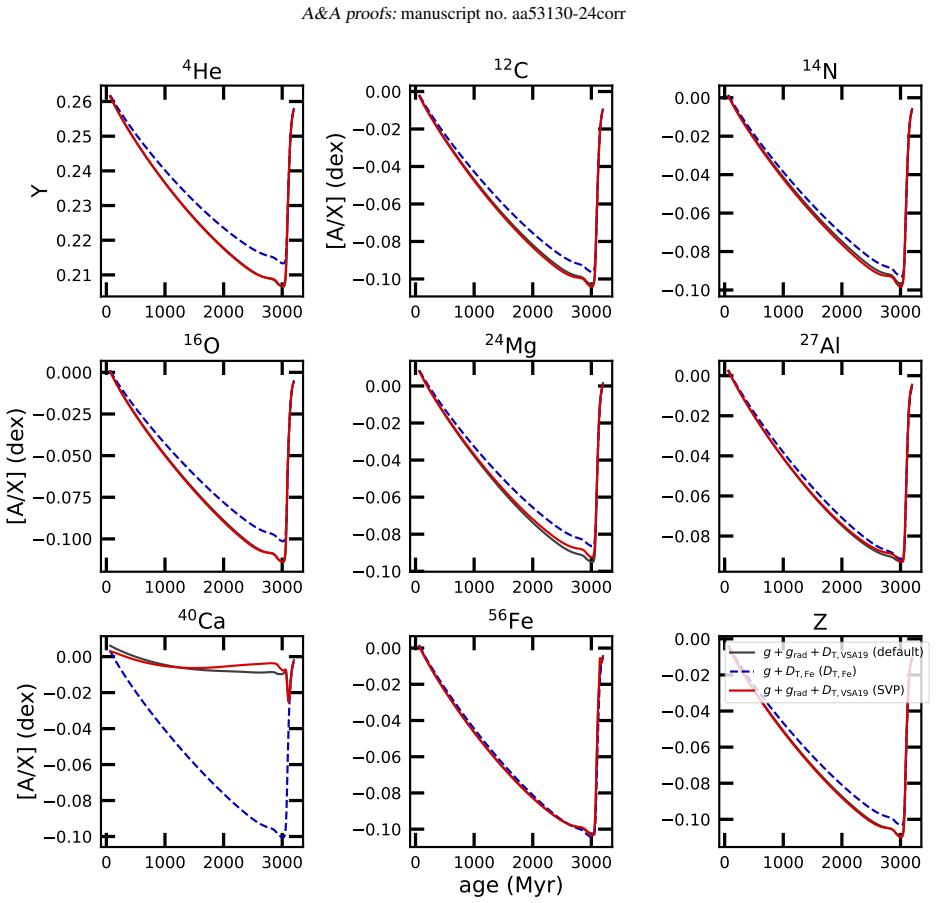
The central claim is that radiative accelerations must be modeled explicitly, not just absorbed into a calibrated turbulent mixing coefficient, if stellar models are to predict surface abundances for F-type stars. The evidence comes from comparing three grids: a diffusion-only grid, a grid with a turbulent mixing calibration tuned to iron (grid B), and a grid with the SVP radiative-acceleration treatment (grid C). Grids B and C agree on fundamental properties—biases below 1% and dispersions of 2%, 0.7%, and 5% for mass, radius, and age—because iron is the only abundance constraint used in the fits. They differ for elements other than iron, most strikingly calcium: grid C predicts calcium accumulation in F-type stars, consistent with the small Morel et al. (2021) sample and with the known physics that radiative acceleration exceeds gravity just below the convective envelope, while grid B predicts depletion. The authors conclude that radiative acceleration treatment is necessary for chemical characterization, while noting that the turbulent mixing prescription in grid C may be unsuitable given the absence of a calcium-temperature trend in the much larger Brewer et al. (2016) sample.
Load-bearing premise
The argument that radiative accelerations are necessary to predict chemical composition rests on the assumption that the two turbulent mixing prescriptions used in grid C—one calibrated to the Sun's lithium for GK stars and one calibrated to helium for F stars—correctly represent the real churning that competes with atomic diffusion; if that assumption fails, the predicted calcium buildup at F-star surfaces could be an artifact of the mixing model.
Editorial extensions
If this is right
- Grid-based stellar characterization can now include radiative accelerations for individual elements at modest cost, so surface abundance predictions can move from iron-only calibrations to element-by-element transport.
- For stars like the Sun and cooler GK stars, the choice between calibrated turbulent mixing and explicit radiative acceleration leaves inferred masses, radii, and ages unchanged at the few-percent level, making previous diffusion-only results more secure.
- For F-type stars, models without radiative acceleration can misestimate individual ages by up to roughly 29% compared with SVP models, so the treatment matters most for hotter, thinner-envelope stars.
- Calcium becomes a diagnostic: the predicted rise of [Ca/Fe] with effective temperature in F stars can be checked against large spectroscopic surveys, and the flat observed trend implies the turbulent mixing prescription must be revised.
- Future space missions that will observe hotter stars, such as PLATO and Ariel, will need radiative acceleration modeling, and the SVP implementation is fast enough to support it.
Reading between the lines
- The absence of the predicted calcium-temperature trend in the 1600-star Brewer et al. sample suggests two testable alternatives: either the SVP method overestimates calcium's radiative acceleration in F-star envelopes, or the real turbulent mixing is more efficient or reaches deeper than the VSA19 calibration; a mass-controlled sample of F stars with seismic masses would separate these.
- Because the SVP computation is element-specific, abundance ratios such as Ca/Fe and Mg/Fe could be added as constraints in grid-based inference, potentially breaking degeneracies between mixing efficiency and initial composition that a single iron constraint cannot resolve.
- The same speed gain could make radiative acceleration modeling practical for other populations—chemically peculiar stars, exoplanet-host stars, or metal-poor turnoff stars—where diffusion and abundance anomalies are known to matter but grids have been too expensive.
- If the SVP predictions are correct, F-star surface abundances should correlate with mass and age in seismic samples, so the absence of such correlations would point to missing physics such as rotation, magnetic fields, or internal waves rather than to the mixing prescription alone.
Editorial analysis
A structured set of objections, weighed in public.
Referee Report
Summary. The paper implements the single-valued parameters (SVP) method for computing radiative accelerations in MESA r12778, reporting a factor-of-20 speedup over the standard Hu et al. (2011) routine. It constructs three grids for stellar characterization: grid A includes atomic diffusion without radiative accelerations (switched off for F-type stars), grid B includes atomic diffusion with the Paper I calibrated turbulent mixing (DT,Fe), and grid C includes SVP radiative accelerations with two turbulent mixing prescriptions (Proffitt & Michaud 1991 for GK stars, VSA19/Richer et al. 2000 for F stars). Using AIMS on 91 Kepler targets, the authors compare inferred masses, radii, ages, and surface abundances across grids. They report small differences in fundamental properties between grids B and C (scatter of 2%, 0.7%, and 5% for mass, radius, and age) and argue that radiative accelerations are necessary for predicting surface abundances, particularly calcium in F-type stars.
Significance. The SVP implementation is a valuable technical contribution: it is publicly available, allows large grids to be computed, and the comparison of inferred fundamental properties across transport models is useful for the community. The paper is also honest about the null result for [Ca/Fe] in the Brewer et al. (2016) sample (Sect. 5.3). However, the abstract and conclusions overstate the support for the compositional claim, and the reported fundamental-property numbers are misattributed to the wrong grid comparison. If these issues are corrected, the paper would be a solid contribution to the modeling of atomic diffusion in FGK stars.
major comments (3)
- [Abstract, Sect. 4.4.1, Sect. 4.4.2] The abstract states that the impact of radiative accelerations is '2%, 0.7%, and 5% for mass, radius, and age' compared to models with 'atomic diffusion (with only gravitational settling)'. These numbers are from the grid B versus grid C comparison (Sect. 4.4.2), where grid B includes the calibrated DT,Fe turbulent mixing, not only gravitational settling. The actual grid A versus grid C comparison, which is the one against models with only gravitational settling, gives 2.6%, 0.9%, and 7.2% (Sect. 4.4.1). Moreover, neither comparison isolates radiative accelerations because grid C differs from both grid A and grid B in the turbulent mixing prescription as well. Please correct the abstract and specify in the text which grid pairs are being compared and what each set of numbers represents.
- [Sect. 5.3, Abstract, Sect. 6] The central claim that radiative accelerations are 'necessary to predict the chemical composition' is not supported by the evidence in the paper. In Sect. 5.3, the predicted increase of [Ca/Fe] with effective temperature in grid C (ODR slope 7.5e-5, correlation 0.35) is absent in the 1600-star Brewer et al. (2016) sample (slope 7.5e-6, correlation 0.02), and the authors themselves conclude that 'the turbulent mixing used in grid C may not be suitable'. Because the calcium accumulation is produced by the combination of SVP radiative accelerations and the VSA19 turbulent mixing prescription, and that prescription is not validated against element abundances, the predicted signal may be an artifact of the assumed mixing rather than a robust prediction. The only directly supporting evidence is a 12-star Morel et al. (2021) subsample with a single F-type star (KIC 12317678) for which the SVP prediction is closer to observation but still below it. Please temper the abstract and conclusion and explicitly discuss the dependence of the compositional predictions on the turbulent mixing model.
- [Sect. 2.2, Table 1] The criterion for switching between the Proffitt & Michaud (1991) and VSA19/Richer et al. (2000) turbulent mixing prescriptions is inconsistent: the text in Sect. 2.2 states 'If MCZ ≥ 10−4 M⊙' while the Table 1 note reports 'DT,PM91 if MCZ ≥ 10−5 M⊙'. This criterion controls which turbulent mixing prescription is applied in grid C, and the discrepancy could change the model physics for stars near the boundary. Please correct the inconsistency and state which value was actually used in the computations.
minor comments (6)
- [Abstract] The phrase 'the treatment of radiative accelerations is necessary to predict the chemical composition of and accurately characterize stars' is grammatically incomplete; 'of stars' is missing after 'composition of'.
- [Sect. 2.2] The sentence 'In this work we set ω and n to 104 and 4' should read '10^4' (the superscript appears to be lost in the text).
- [Sect. 3.2] In the caption of Fig. 2, 'the dot-dashed red lines the the model' contains a duplicated 'the'.
- [Sect. 4.4.1] The statement that 'the biases (µ) are two times smaller than the relative errors (values of the error in ∆X/Xr are larger than 0.015, 0.009, and 0.06...)' is unclear; please specify how these error values are computed and why the quoted thresholds are not shown in the figures.
- [Sect. 5.3] The two statements that the Brewer et al. sample shows 'a tendency for calcium to be 0.02 dex higher than iron' but 'no tendency for the abundance of calcium to increase with effective temperature' could be clarified by describing the offset as a constant rather than a slope.
- [Table 1] The notation 'DT,PM91' in the table note is not introduced in the text; the text refers to the 'Proffitt & Michaud (1991)' prescription, so please unify the notation.
Circularity Check
No significant circularity: radiative-acceleration predictions are independent of fitted calibrations, though empirically contested.
full rationale
The paper's derivation chain is self-contained. The SVP radiative-acceleration implementation is taken from the public routines of LeBlanc & Alecian (2004) and Alecian & LeBlanc (2020) — external, parameterized radiative-acceleration tables — and is validated against MESA's default Hu et al. (2011) routine in Sect. 3.2, with track comparisons shown in Fig. 1. The turbulent mixing in grid C is either the external VSA19 calibration (Richer et al. 2000 prescription, calibrated on helium glitch signatures) or Proffitt & Michaud (1991) calibrated to solar lithium; both are presented as calibrations, not as predictions. The predicted calcium accumulation in F-type stars is not fitted to the observed calcium abundances: it is first compared to the small Morel et al. (2021) sample and then tested against the larger Brewer et al. (2016) sample, where it fails. That failure weakens the abstract's compositional claim but is a falsification, not a circular reduction. Grids A and B reuse the authors' Papers I and II, and the optimization setup is identical to Paper II, but those self-citations supply calibrated input physics and a methodology, not the paper's conclusions; the central grid C versus grid B comparison is an independent model comparison. No equation in the paper defines its predicted quantities in terms of the fitted inputs, and no parameter fitted to the target observable is renamed as a prediction.
Assumptions & free parameters
free parameters (6)
- alpha_MLT (mixing length parameter) =
1.711
- Proffitt & Michaud turbulent mixing constants C and n =
C = 1615.4763, n = 1.3
- Richer et al. turbulent mixing constants omega and n =
omega = 10^4, n = 4
- Core overshoot parameters f and f0 =
f = 0.0101, f0 = 0.0001
- Paper I turbulent mixing reference envelope mass Delta M0 =
3.1e-4 (M/Msun) + 2.7e-4
- VSA19 reference envelope mass Delta M =
1e-4 Msun
assumptions (5)
- domain assumption SVP method tables are valid for main-sequence stars with masses between 1.0 and 10 Msun.
- domain assumption The metal mixture is not strongly modified, so OPAL opacity tables computed for a fixed mixture remain appropriate.
- domain assumption MESA r12778 and its default physics (EOS, atmosphere, nuclear reactions) provide a correct stellar evolution baseline.
- domain assumption AIMS Bayesian inference with the Ball & Gizon (2014) surface correction yields unbiased stellar parameter estimates.
- domain assumption The turbulent mixing prescriptions (Proffitt & Michaud 1991; Richer et al. 2000) capture the macroscopic transport competing with atomic diffusion.
Cite this review
Pith. "Pith review of Impact of radiative accelerations on the stellar characterization of FGK-type stars using spectroscopic and seismic constraints." pith.science (2026). https://pith.science/paper/XWPFSJ2Y
@misc{pith2026250205025,
  author       = {Pith},
  title        = {Pith review of: Impact of radiative accelerations on the stellar characterization of FGK-type stars using spectroscopic and seismic constraints},
  year         = {2026},
  howpublished = {\url{https://pith.science/paper/XWPFSJ2Y}},
  note         = {Machine review of arXiv:2502.05025}
}
read the original abstract
Chemical transport mechanisms are fundamental processes in stellar evolution models. They are responsible for the chemical distribution, and their impact determines how accurately we can characterize stars. Radiative accelerations are one of these processes. They allow the accumulation of elements at different depths in the star. We aim to assess the impact of radiative accelerations on the modeling of FGK-type stars and their impact on the prediction of surface abundances. To reduce the cost of the computation of radiative accelerations, we implemented the single-valued parameters (SVP) method in the stellar evolution code MESA. The SVP method is more efficient in calculating radiative accelerations, which enables computations of large enough grids of models for stellar characterization. Compared to models that include atomic diffusion (with only gravitational settling), the inclusion of radiative accelerations has a small effect on the inference of fundamental properties, with an impact of 2\%, 0.7\%, and 5\% for mass, radius, and age. However, the treatment of radiative accelerations is necessary to predict the chemical composition of and accurately characterize stars.
Figures


Figures from the paper (5 more)


Reference graph
Works this paper leans on
-
[1]
Ahumada , R., Prieto , C. A., Almeida , A., et al. 2020, , 249, 3
work page 2020
- [2]
-
[3]
J., & Scott , P
Asplund , M., Grevesse , N., Sauval , A. J., & Scott , P. 2009, , 47, 481
2009
-
[4]
Ball , W. H. & Gizon , L. 2014, , 568, A123
2014
- [5]
-
[6]
M., Fischer , D
Brewer , J. M., Fischer , D. A., Valenti , J. A., & Piskunov , N. 2016, , 225, 32
2016
- [7]
-
[8]
Chaboyer , B., Fenton , W. H., Nelan , J. E., Patnaude , D. J., & Simon , F. E. 2001, , 562, 521
work page 2001
Show all 54 references
-
[9]
Cox , J. P. & Giuli , R. T. 1968, Principles of stellar structure (Gordon & Breach)
1968
-
[10]
S., Roxburgh , I
Cunha , M. S., Roxburgh , I. W., Aguirre B rsen-Koch , V., et al. 2021, , 508, 5864
2021
-
[11]
2017, in Astronomical Society of the Pacific Conference Series, Vol
Cupani , G., D'Odorico , V., Cristiani , S., et al. 2017, in Astronomical Society of the Pacific Conference Series, Vol. 512, Astronomical Data Analysis Software and Systems XXV, ed. N. P. F. Lorente , K. Shortridge , & R. Wayth , 209
2017
-
[12]
R., Silva Aguirre , V., Bedding , T
Davies , G. R., Silva Aguirre , V., Bedding , T. R., et al. 2016, , 456, 2183
2016
-
[13]
2015, , 584, A105
Deal , M., Richard , O., & Vauclair , S. 2015, , 584, A105
2015
-
[14]
W., Alexander , D
Ferguson , J. W., Alexander , D. R., Allard , F., et al. 2005, , 623, 585
2005
-
[15]
Gaia Collaboration , Brown , A. G. A., Vallenari , A., et al. 2021, , 649, A1
2021
-
[16]
2000, , 360, 952
Herwig , F. 2000, , 360, 952
2000
-
[17]
A., Glebbeek , E., & Dupret , M
Hu , H., Tout , C. A., Glebbeek , E., & Dupret , M. A. 2011, , 418, 195
2011
-
[18]
2024, , 691, A266
Hui-Bon-Hoa , A. 2024, , 691, A266
2024
-
[19]
Iglesias , C. A. & Rogers , F. J. 1996, , 464, 943
1996
-
[20]
S., Bauer , E
Jermyn , A. S., Bauer , E. B., Schwab , J., et al. 2023, , 265, 15
2023
-
[21]
Krishna Swamy , K. S. 1966, , 145, 174
1966
-
[22]
& Alecian , G
LeBlanc , F. & Alecian , G. 2004, , 352, 1329
2004
-
[23]
N., Silva Aguirre , V., Davies , G
Lund , M. N., Silva Aguirre , V., Davies , G. R., et al. 2017, , 835, 172
2017
-
[24]
2015, Atomic Diffusion in Stars (Springer)
Michaud , G., Alecian , G., & Richer , J. 2015, Atomic Diffusion in Stars (Springer)
2015
-
[25]
2011 a , , 529, A60
Michaud , G., Richer , J., & Richard , O. 2011 a , , 529, A60
2011
-
[26]
2011 b , , 534, A18
Michaud , G., Richer , J., & Vick , M. 2011 b , , 534, A18
2011
-
[27]
Moedas , N., Bossini , D., Deal , M., & Cunha , M. S. 2024, , 684, A113
2024
-
[28]
2022, , 666, A43
Moedas , N., Deal , M., Bossini , D., & Campilho , B. 2022, , 666, A43
2022
-
[29]
Mombarg , J. S. G., Dotter , A., Rieutord , M., et al. 2022, , 925, 154
2022
-
[30]
L., Montalb \'a n , J., Miglio , A., & Willett , E
Morel , T., Creevey , O. L., Montalb \'a n , J., Miglio , A., & Willett , E. 2021, , 646, A78
2021
-
[31]
L., Monteiro , M
Nsamba , B., Campante , T. L., Monteiro , M. J. P. F. G., et al. 2018, , 477, 5052
2018
-
[32]
2011, , 192, 3
Paxton , B., Bildsten , L., Dotter , A., & et al. 2011, , 192, 3
2011
-
[33]
2013, , 208, 4
Paxton , B., Cantiello , M., Arras , P., et al. 2013, , 208, 4
2013
-
[34]
2015, , 220, 15
Paxton , B., Marchant , P., Schwab , J., et al. 2015, , 220, 15
2015
-
[35]
B., et al
Paxton , B., Schwab , J., Bauer , E. B., et al. 2018, , 234, 34
2018
-
[36]
2019, , 243, 10
Paxton , B., Smolec , R., Schwab , J., et al. 2019, , 243, 10
2019
-
[37]
Proffitt , C. R. & Michaud , G. 1991, , 371, 584
1991
-
[38]
2024, arXiv e-prints, arXiv:2406.05447
Rauer , H., Aerts , C., Cabrera , J., et al. 2024, arXiv e-prints, arXiv:2406.05447
2024 arXiv
-
[39]
Rehm , R., Mombarg , J. S. G., Aerts , C., et al. 2024, , 687, A175
2024
-
[40]
M., Buldgen , G., Miglio , A., et al
Rendle , B. M., Buldgen , G., Miglio , A., et al. 2019, , 484, 771
2019
-
[41]
2000, , 529, 338
Richer , J., Michaud , G., & Turcotte , S. 2000, , 529, 338
2000
-
[42]
Ricker , G. R. 2016, in AGU Fall Meeting Abstracts, P13C--01
2016
-
[43]
Rogers , F. J. & Nayfonov , A. 2002, , 576, 1064
2002
-
[44]
& Weiss , A
Salaris , M. & Weiss , A. 2001, , 376, 955
2001
-
[45]
Seaton , M. J. 1997, , 289, 700
1997
-
[46]
Seaton , M. J. 2005, , 362, L1
2005
-
[47]
2009, , 704, 1262
Th \'e ado , S., Vauclair , S., Alecian , G., & LeBlanc , F. 2009, , 704, 1262
2009
-
[48]
2018, Experimental Astronomy, 46, 135
Tinetti , G., Drossart , P., Eccleston , P., et al. 2018, Experimental Astronomy, 46, 135
2018
-
[49]
2022, in European Planetary Science Congress, EPSC2022--1114
Tinetti , G., Eccleston , P., Lueftinger , T., et al. 2022, in European Planetary Science Congress, EPSC2022--1114
2022
-
[50]
G., & Degl'Innocenti , S
Valle , G., Dell'Omodarme , M., Prada Moroni , P. G., & Degl'Innocenti , S. 2014, , 561, A125
2014
-
[51]
G., & Degl'Innocenti , S
Valle , G., Dell'Omodarme , M., Prada Moroni , P. G., & Degl'Innocenti , S. 2015, , 575, A12
2015
-
[52]
& Silva Aguirre , V
Verma , K. & Silva Aguirre , V. 2019, , 489, 1850
2019
-
[53]
, " * write output.state after.block = add.period write newline
ENTRY address archiveprefix author booktitle chapter edition editor howpublished institution eprint journal key month note number organization pages publisher school series title type volume year label extra.label sort.label short.list INTEGERS output.state before.all mid.sent...
-
[54]
write newline
" write newline "" before.all 'output.state := FUNCTION n.dashify 't := "" t empty not t #1 #1 substring "-" = t #1 #2 substring "--" = not "--" * t #2 global.max substring 't := t #1 #1 substring "-" = "-" * t #2 global.max substring 't := while if t #1 #1 substring * t #2 gl...
Reviewed August 8, 2026 · model on record in the stance chip above.
Discussion (0). Continue with ORCID to comment.