REVIEW 4 major objections 7 minor 43 references
Graph-based Molecular In-context Learning Grounded on Morgan Fingerprints
T0 review · 4 major / 7 minor · reviewed 2026-08-08 · deepseek-v4-flash
Pith's one-line read GAMIC claims that retrieving in-context demonstrations by a graph-text aligned embedding, grounded in Morgan fingerprints and diversified by MMR, outperforms Morgan-fingerprint retrieval on every tested molecular task.
desk verdict GAMIC is a plausible idea with consistent wins over weak baselines, but the missing reaction-SMILES representation and the broken MMR equation keep it from being a solid yes. read the letter →
The pith
A machine-rendered reading of the paper's core claim, the machinery that carries it, and where it could break.
The reading
What carries the argument
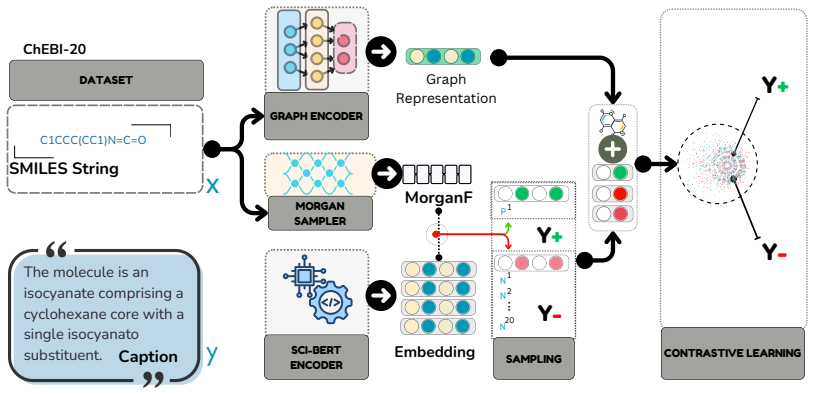
The central object is the GAMIC graph projector plus MMR selector. The graph projector is a two-layer graph attention network that reads atom and bond features, pools node representations, and maps them through an MLP to a latent vector z. Training uses a contrastive (NCE) loss that pulls z toward the SciBERT embedding of a matching caption and pushes it away from negatives chosen by Morgan fingerprint similarity; the Morgan sampler is what grounds the global graph view in local substructure overlap. At retrieval, an MMR objective iteratively chooses demonstrations that are close to the test in latent space and mutually far apart, with hyperparameter lambda balancing the two. This machinery converts a caption-alignment training signal into a demonstration-selection rule for tasks that never see captions.
What would settle it
Re-run property prediction retrieval with a graph projector trained on that property dataset's own SMILES strings using a caption-free contrastive objective; if the margin over Scaffold disappears, the reported gain comes from the caption-trained transfer rather than from the graph representation itself.
Extended reading notes
Core claim
GAMIC is a self-supervised graph projector that, for a given SMILES string, builds a molecular graph and encodes it with a two-layer graph attention network followed by mean pooling and an MLP. The resulting embedding is trained with a noise-contrastive loss to align with SciBERT embeddings of molecule captions, and a Morgan-fingerprint sampler expands the positive and negative caption sets so alignment is grounded in local substructure similarity. At inference, the retriever selects demonstrations by iteratively minimizing distance to the test embedding while penalizing redundancy among selected examples (MMR), and the chosen demonstrations are appended in reverse order in the prompt. The paper reports that this combination beats Scaffold, graph-autoencoder, and random retrieval on all tested datasets and three 7-8B parameter LLMs, and that both Morgan sampling and SciBERT contribute in the ablation.
Load-bearing premise
The graph projector is trained only on molecule-caption pairs from ChEBI-20, but GAMIC's reported wins on property and yield prediction datasets that have no captions depend on that caption-trained embedding transferring to those tasks, which the paper never states or tests.
Editorial extensions
If this is right
- Molecule captioning, property prediction, and yield prediction all show improved LLM accuracy without fine-tuning when demonstrations are selected by GAMIC rather than by Morgan-fingerprint similarity.
- Three 7-8B parameter LLMs (Mistral, OpenChat, Zephyr) benefit from the same retriever, so the gains are not tied to one model family.
- Morgan fingerprints remain useful in the pipeline as a training-time sampling signal even though they are not the retrieval embedding.
- Retrieval diversity matters: ablations show MMR improves yield and captioning results over retrieving only the most similar samples.
- The sensitivity analysis indicates two to three demonstrations is the practical operating point for captioning, with performance degrading beyond that.
Reading between the lines
- Editorial inference: The caption-trained projector's transfer to property and yield tasks is the paper's unstated load-bearing step; re-training the projector on each task's own SMILES data would test whether the gains persist without captions.
- Editorial inference: The same alignment-plus-MMR recipe could be transferred to other graph-text domains, such as protein or materials property prediction, wherever paired descriptions exist.
- Editorial inference: Replacing the Morgan sampler with other substructure kernels (e.g., scaffold or pharmacophore similarity) would show whether the alignment gain is specific to fingerprints or general to substructure grounding.
- Editorial inference: Because MMR helps across captioning and yield tasks, diversity-aware demonstration selection is likely a general ICL lever beyond molecular data.
Editorial analysis
A structured set of objections, weighed in public.
Referee Report
Summary. The paper proposes GAMIC, a graph-text contrastively trained retriever for in-context learning in molecular tasks. A GAT-based graph encoder is aligned with SciBERT caption embeddings using a Morgan-fingerprint-based sampler to select positive and negative pairs; at inference, demonstrations are retrieved with an MMR-style diversity heuristic and appended to the LLM prompt. Experiments cover molecule captioning, property prediction, and yield prediction on nine datasets with Mistral-7B, OpenChat-8B, and Zephyr-7B, reporting gains over random selection, Scaffold (Morgan fingerprint) retrieval, and a GAE graph baseline.
Significance. If substantiated, the core idea is a reasonable contribution: replacing pure fingerprint similarity with graph-aligned text embeddings for molecular ICL demonstration selection, and adding a diversity heuristic. Strengths include the breadth of evaluation (three task families, nine datasets, three LLMs), the inclusion of an additional graph-based baseline (GAE), and dedicated ablation and sensitivity analyses for Morgan sampling, SciBERT, k, and lambda. The paper does not release code, and the central quantitative claims currently rest on several unspecified or mis-specified components; with corrections, the result would be of interest to the molecular ICL community.
major comments (4)
- [§3.3 and §4.1, Figure 4] The reaction representation for yield prediction is undefined. Section 3.3 defines the graph encoder for a single-molecule graph G = (V, E) built from a SMILES string, trained on ChEBI-20 caption pairs. The yield prediction experiments (Table 1, Figure 4) use Suzuki-Miyaura and Buchwald-Hartwig reaction SMILES, which contain multiple reactants, reagents, and optionally products separated by '>'. The paper never states how these reaction strings are converted into G = (V, E), whether a separate graph projector is trained for reactions, or how an encoder aligned with single-molecule captions transfers to multi-component reaction graphs. This is load-bearing for the 'across all tasks' claim and prevents reproduction.
- [§3.4, Eq. (5)] Equation (5) does not implement the described MMR objective. The text states that the optimization should minimize the distance to the test sample while maximizing diversity among selected demonstrations (i.e., maximizing ||zi - zj||). However, Eq. (5) writes min_{z in P} (||zi - zt|| + lambda * sum_{j=1}^{i-1} max ||zi - zj||), which minimizes the sum of both terms. Under this objective, the selector would prefer demonstrations close to those already selected, reducing diversity rather than increasing it. The correct formulation would require a negative sign on the diversity term or a maximization of the marginal-relevance expression.
- [§3.3, Eq. (4)] The contrastive loss is specified inconsistently with the surrounding text. The text says the Morgan Sampler returns a set Y+_i of positive samples and a set Y-_i of negative samples, and the loss is written as NCE(z, Y+_emb, Y-_emb). Yet the displayed equation uses a single y+_i in the numerator, with no explanation of how multiple positives are aggregated (e.g., summed, averaged, or treated as separate terms). The role of N in the formula is also unclear: it appears to index the dataset, but the loss should be per-anchor. This ambiguity prevents reproduction of the training objective.
- [Tables 2, 3, 4, and 5] The central claim that GAMIC 'significantly outperforms' baselines is not supported by appropriate uncertainty quantification. Tables 2, 4, and 5 report captioning metrics without standard deviations or significance tests, despite the experimental setup section stating that five repeated evaluations were performed. Table 3 reports F1 with standard deviations, but many intervals overlap between methods (e.g., BBBP Mistral: Scaffold 0.850 ± 0.494 vs GAMIC 0.905 ± 0.031; HIV: GAMIC 0.400 ± 0.202; Tox21: GAMIC 0.271 ± 0.064). At minimum, the paper should report consistent error bars across all tables and provide a statistical test (e.g., paired bootstrap or Wilcoxon) for the headline comparisons.
minor comments (7)
- [Abstract] There is an unmatched parenthesis in 'GAMIC (Graph-Aligned Molecular In-Context learning, which aligns ...'; the closing parenthesis is missing.
- [Introduction] Several typos appear: 'pre-triend' should be 'pre-trained', 'molecualr' should be 'molecular', and 'pertaining' in the abstract should be 'pre-training'.
- [§3.1] The training set is written as T = (xi, yi)_{i=0}^{n}; the index should likely start at i=1, or the cardinality should be n+1.
- [§3.3] The notation 'SMILE Strings' is inconsistent with the standard 'SMILES strings' used elsewhere in the paper.
- [Table 5] The table formatting is broken: the rows for k=1 and k=2 are merged in the rendered text, and the numeric columns are not aligned. This table needs to be reformatted for readability.
- [Figure 6 and Section 4.4] The MMR ablation is only shown as a figure without numerical values or error bars; the text claims improvement, but the reader cannot verify the magnitude or significance from the figure alone.
- [Table 3] The 'All Data Mean' column is not defined. It appears to be an unweighted average over datasets, but the paper should state how it is computed, especially given the very different dataset sizes (e.g., HIV with 4113 test samples vs ClinTox with 148).
Circularity Check
No load-bearing circularity: GAMIC's retrieval pipeline is a standard contrastive-alignment method, and the only overlapping-author citation is contextual rather than load-bearing.
full rationale
The claimed derivation is a contrastively trained graph retriever followed by MMR demonstration selection; the reported gains are measurements of a frozen LLM under different retrievers, not quantities that the retriever's training objective forces. The graph projector is trained to align GNN embeddings with SciBERT-encoded ChEBI-20 captions using the contrastive loss in Eq. (4), and the captioning evaluation then retrieves from the ChEBI-20 training pool and measures BLEU/ROUGE/METEOR on a separate test split. No test label or caption enters the projector's training or the retrieval objective, so the captioning result is an external measurement of retrieval quality rather than a fitted quantity renamed as a prediction. The Morgan sampler in Section 3.3 only defines positive and negative pairs for the contrastive loss; it does not define the evaluation metrics, so the 'grounded on Morgan fingerprints' claim is an architectural choice, not an equivalence to the Morgan baseline. The MMR coefficient lambda=0.3 is selected via sensitivity analysis (Figure 5) and is a hyperparameter, not an estimated parameter of the target labels, so no fitted-input-called-prediction pattern is present. The only overlapping-author citation is [Wang et al., 2024a], used for the contextual observation that small-to-medium LLMs are underexplored; the experiments compare against external models (Mistral, OpenChat, Zephyr) and external benchmarks, so no load-bearing argument reduces to self-citation. The paper's failure to specify how reaction SMILES are converted to graphs for yield prediction is a reproducibility and correctness gap, but not a circular step, because the retriever is still trained independently of the yield labels. No uniqueness theorem is invoked, and no prior ansatz is imported via citation. Overall circularity is negligible; the nonzero score reflects only the minor, non-load-bearing self-citation.
Assumptions & free parameters
free parameters (5)
- MMR diversity weight lambda =
0.3
- Number of demonstrations k =
2 for captioning, 3 for other tasks
- Contrastive temperature tau
- Morgan fingerprint parameters (radius, bit length)
- Number of positive and negative samples per anchor
assumptions (4)
- standard math InfoNCE contrastive loss (Oord et al. 2018) is a valid objective for aligning graph and text embeddings.
- standard math Graph Attention Networks (GAT) can encode molecular graphs into useful latent vectors.
- domain assumption Morgan fingerprints capture local substructure and graphs capture global structure, and combining them helps retrieval.
- ad hoc to paper A graph encoder trained on ChEBI-20 caption pairs transfers to property prediction and yield prediction datasets without task-specific adaptation.
Cite this review
Pith. "Pith review of Graph-based Molecular In-context Learning Grounded on Morgan Fingerprints." pith.science (2026). https://pith.science/paper/AVKCXCIR
@misc{pith2026250205414,
  author       = {Pith},
  title        = {Pith review of: Graph-based Molecular In-context Learning Grounded on Morgan Fingerprints},
  year         = {2026},
  howpublished = {\url{https://pith.science/paper/AVKCXCIR}},
  note         = {Machine review of arXiv:2502.05414}
}
read the original abstract
In-context learning (ICL) effectively conditions large language models (LLMs) for molecular tasks, such as property prediction and molecule captioning, by embedding carefully selected demonstration examples into the input prompt. This approach avoids the computational overhead of extensive pertaining and fine-tuning. However, current prompt retrieval methods for molecular tasks have relied on molecule feature similarity, such as Morgan fingerprints, which do not adequately capture the global molecular and atom-binding relationships. As a result, these methods fail to represent the full complexity of molecular structures during inference. Moreover, small-to-medium-sized LLMs, which offer simpler deployment requirements in specialized systems, have remained largely unexplored in the molecular ICL literature. To address these gaps, we propose a self-supervised learning technique, GAMIC (Graph-Aligned Molecular In-Context learning, which aligns global molecular structures, represented by graph neural networks (GNNs), with textual captions (descriptions) while leveraging local feature similarity through Morgan fingerprints. In addition, we introduce a Maximum Marginal Relevance (MMR) based diversity heuristic during retrieval to optimize input prompt demonstration samples. Our experimental findings using diverse benchmark datasets show GAMIC outperforms simple Morgan-based ICL retrieval methods across all tasks by up to 45%.
Figures


Figures from the paper (4 more)


Reference graph
Works this paper leans on
-
[1]
Pre- dicting reaction performance in c–n cross-coupling using machine learning
[Ahneman et al., 2018] Derek T Ahneman, Jes´us G Estrada, Shishi Lin, Spencer D Dreher, and Abigail G Doyle. Pre- dicting reaction performance in c–n cross-coupling using machine learning. Science, 360(6385):186–190,
work page 2018
-
[7]
Case- based reasoning for natural language queries over knowl- edge bases
[Das et al., 2021] Rajarshi Das, Manzil Zaheer, Dung Thai, Ameya Godbole, Ethan Perez, Jay Yoon Lee, Lizhen Tan, Lazaros Polymenakos, and Andrew McCallum. Case- based reasoning for natural language queries over knowl- edge bases. In EMNLP, November
work page 2021
-
[9]
A survey on in-context learning
[Dong et al., 2022] Qingxiu Dong, Lei Li, Damai Dai, Ce Zheng, Jingyuan Ma, Rui Li, Heming Xia, Jingjing Xu, Zhiyong Wu, Tianyu Liu, et al. A survey on in-context learning. arXiv preprint arXiv:2301.00234,
arXiv 2022
-
[11]
Translation between Molecules and Natural Language
[Edwards et al., 2022] Carl Edwards, Tuan Lai, Kevin Ros, Garrett Honke, Kyunghyun Cho, and Heng Ji. Translation between Molecules and Natural Language. In EMNLP, November
work page 2022
-
[12]
Text-guided molecule generation with diffu- sion language model
[Gong et al., 2024] Haisong Gong, Qiang Liu, Shu Wu, and Liang Wang. Text-guided molecule generation with diffu- sion language model. In AAAI, volume 38, pages 109–117,
work page 2024
-
[14]
What can large language models do in chemistry? a comprehensive benchmark on eight tasks
[Guo et al., 2023] Taicheng Guo, Bozhao Nan, Zhenwen Liang, Zhichun Guo, Nitesh Chawla, Olaf Wiest, Xian- gliang Zhang, et al. What can large language models do in chemistry? a comprehensive benchmark on eight tasks. Advances in Neural Information Processing Sys- tems, 36:59662–59688,
work page 2023
-
[16]
arXiv:2402.07630 [cs]. [Jiang et al., 2023] Albert Q Jiang, Alexandre Sablayrolles, Arthur Mensch, Chris Bamford, Devendra Singh Chaplot, Diego de las Casas, Florian Bressand, Gianna Lengyel, Guillaume Lample, Lucile Saulnier, et al. Mistral 7b. arXiv preprint arXiv:2310.06825,
arXiv 2023
-
[17]
Enhancing cross text- molecule learning by self-augmentation
[Jiang et al., 2024] Yinuo Jiang, Xiang Zhuang, Keyan Ding, Qiang Zhang, and Huajun Chen. Enhancing cross text- molecule learning by self-augmentation. In Findings of the Association for Computational Linguistics ACL 2024 , pages 9551–9565,
work page 2024
Show all 43 references
-
[18]
Learning multimodal graph- to-graph translation for molecular optimization
[Jin et al., 2018] Wengong Jin, Kevin Yang, Regina Barzi- lay, and Tommi Jaakkola. Learning multimodal graph- to-graph translation for molecular optimization. arXiv preprint arXiv:1812.01070,
2018 arXiv
-
[19]
Pub- chem 2019 update: improved access to chemical data
[Kim et al., 2019] Sunghwan Kim, Jie Chen, Tiejun Cheng, Asta Gindulyte, Jia He, Siqian He, Qingliang Li, Ben- jamin A Shoemaker, Paul A Thiessen, Bo Yu, et al. Pub- chem 2019 update: improved access to chemical data. Nu- cleic acids research, 47(D1):D1102–D1109,
2019
-
[20]
Data-efficient molec- ular generation with hierarchical textual inversion
[Kim et al., 2024] Seojin Kim, Jaehyun Nam, Sihyun Yu, Younghoon Shin, and Jinwoo Shin. Data-efficient molec- ular generation with hierarchical textual inversion. arXiv preprint arXiv:2405.02845,
2024 arXiv
-
[21]
Variational graph auto-encoders
[Kipf and Welling, 2016] Thomas N Kipf and Max Welling. Variational graph auto-encoders. arXiv preprint arXiv:1611.07308,
2016 arXiv
-
[23]
Scaffold-based molecular design with a graph generative model
[Lim et al., 2020] Jaechang Lim, Sang-Yeon Hwang, Seokhyun Moon, Seungsu Kim, and Woo Youn Kim. Scaffold-based molecular design with a graph generative model. Chemical science, 11(4):1153–1164,
2020
-
[24]
Rouge: A package for automatic evaluation of summaries
[Lin, 2004] Chin-Yew Lin. Rouge: A package for automatic evaluation of summaries. In Text summarization branches out, pages 74–81,
2004
-
[26]
Molxpt: Wrapping molecules with text for generative pre- training
[Liu et al., 2023a] Zequn Liu, Wei Zhang, Yingce Xia, Lijun Wu, Shufang Xie, Tao Qin, Ming Zhang, and Tie-Yan Liu. Molxpt: Wrapping molecules with text for generative pre- training. arXiv preprint arXiv:2305.10688,
-
[27]
reaction-ship
[Liu et al., 2024] Zhiyuan Liu, Yaorui Shi, An Zhang, Si- hang Li, Enzhi Zhang, Xiang Wang, Kenji Kawaguchi, and Tat-Seng Chua. Reactxt: Understanding molecular “reaction-ship” via reaction-contextualized molecule-text pretraining
2024
-
[28]
Fantastically or- dered prompts and where to find them: Overcoming few-shot prompt order sensitivity
[Lu et al., 2022] Yao Lu, Max Bartolo, Alastair Moore, Se- bastian Riedel, and Pontus Stenetorp. Fantastically or- dered prompts and where to find them: Overcoming few-shot prompt order sensitivity. In Smaranda Mure- san, Preslav Nakov, and Aline Villavicencio, editors, Pro- c...
2022
-
[29]
[Oord et al., 2018] Aaron van den Oord, Yazhe Li, and Oriol Vinyals
Association for Computational Linguistics. [Oord et al., 2018] Aaron van den Oord, Yazhe Li, and Oriol Vinyals. Representation learning with contrastive predic- tive coding. arXiv preprint arXiv:1807.03748,
2018 arXiv
-
[30]
Bleu: a method for au- tomatic evaluation of machine translation
[Papineni et al., 2002] Kishore Papineni, Salim Roukos, Todd Ward, and Wei-Jing Zhu. Bleu: a method for au- tomatic evaluation of machine translation. In Proceedings of the 40th annual meeting of the Association for Compu- tational Linguistics, pages 311–318,
2002
-
[32]
The graph neural network model
[Scarselli et al., 2008] Franco Scarselli, Marco Gori, Ah Chung Tsoi, Markus Hagenbuchner, and Gabriele Monfardini. The graph neural network model. IEEE transactions on neural networks, 20(1):61–80,
2008
-
[34]
Towards cross-modal text-molecule re- trieval with better modality alignment
[Song et al., 2024] Jia Song, Wanru Zhuang, Yujie Lin, Liang Zhang, Chunyan Li, Jinsong Su, Song He, and Xiaochen Bo. Towards cross-modal text-molecule re- trieval with better modality alignment. arXiv preprint arXiv:2410.23715,
2024 arXiv
-
[35]
3d infomax improves gnns for molecular property prediction
[St¨ark et al., 2022] Hannes St ¨ark, Dominique Beaini, Gabriele Corso, Prudencio Tossou, Christian Dallago, Stephan G ¨unnemann, and Pietro Li `o. 3d infomax improves gnns for molecular property prediction. In International Conference on Machine Learning , pages 20479–20502. PMLR,
2022
-
[36]
Blood–brain barrier penetration prediction enhanced by uncertainty estimation
[Tong et al., 2022] Xiaochu Tong, Dingyan Wang, Xiaoyu Ding, Xiaoqin Tan, Qun Ren, Geng Chen, Yu Rong, Tingyang Xu, Junzhou Huang, Hualiang Jiang, et al. Blood–brain barrier penetration prediction enhanced by uncertainty estimation. Journal of Cheminformatics , 14(1):44,
2022
-
[37]
Zephyr: Direct distillation of lm alignment
[Tunstall et al., 2024] Lewis Tunstall, Edward Beeching, Nathan Lambert, Nazneen Rajani, Kashif Rasul, Younes Belkada, Shengyi Huang, Leandro von Werra, Cl´ementine Fourrier, Nathan Habib, et al. Zephyr: Direct distillation of lm alignment. CoLM,
2024
-
[38]
Attention is all you need
[Vaswani, 2017] A Vaswani. Attention is all you need. Ad- vances in Neural Information Processing Systems ,
2017
-
[40]
A com- prehensive survey of small language models in the era of large language models: Techniques, enhancements, ap- plications, collaboration with llms, and trustworthiness
[Wang et al., 2024a] Fali Wang, Zhiwei Zhang, Xianren Zhang, Zongyu Wu, Tzuhao Mo, Qiuhao Lu, Wanjing Wang, Rui Li, Junjie Xu, Xianfeng Tang, et al. A com- prehensive survey of small language models in the era of large language models: Techniques, enhancements, ap- plications,...
-
[41]
Smiles, a chemical lan- guage and information system
[Weininger, 1988] David Weininger. Smiles, a chemical lan- guage and information system
1988
-
[43]
B Prompt for zero-shot Molecule Captioning For zero-shot molecular captioning results, we utilize the fol- lowing prompt: Zero-shot Prompt You are an expert chemist
A Case Study Figure 7 illustrates retrieved molecules for a set of test molecule using GAMIC, and other baselines. B Prompt for zero-shot Molecule Captioning For zero-shot molecular captioning results, we utilize the fol- lowing prompt: Zero-shot Prompt You are an expert chemi...
2002
-
[1988]
Moleculenet: a benchmark for molecular machine learning
[Wu et al., 2018] Zhenqin Wu, Bharath Ramsundar, Evan N Feinberg, Joseph Gomes, Caleb Geniesse, Aneesh S Pappu, Karl Leswing, and Vijay Pande. Moleculenet: a benchmark for molecular machine learning. Chemical sci- ence, 9(2):513–530,
2018
-
[2002]
Suzuki– miyaura cross-coupling optimization enabled by auto- mated feedback
[Reizman et al., 2016] Brandon J Reizman, Yi-Ming Wang, Stephen L Buchwald, and Klavs F Jensen. Suzuki– miyaura cross-coupling optimization enabled by auto- mated feedback. Reaction chemistry & engineering , 1(6):658–666,
2016
-
[2004]
Multi-modal molecule structure-text model for text-based retrieval and editing
[Liu et al., 2022] Shengchao Liu, Weili Nie, Chengpeng Wang, et al. Multi-modal molecule structure-text model for text-based retrieval and editing. arXiv preprint arXiv:2212.10789,
2022 arXiv
-
[2005]
Scibert: Pretrained language model for scientific text
[Beltagy et al., 2019] Iz Beltagy, Kyle Lo, and Arman Co- han. Scibert: Pretrained language model for scientific text. In EMNLP,
2019
-
[2008]
Prediction of chemical reaction yields with large-scale multi-view pre-training.Journal of Chem- informatics, 16(1):22,
[Shi et al., 2024] Runhan Shi, Gufeng Yu, Xiaohong Huo, and Yang Yang. Prediction of chemical reaction yields with large-scale multi-view pre-training.Journal of Chem- informatics, 16(1):22,
2024
-
[2015]
Meteor: An automatic metric for mt evaluation with improved correlation with human judgments
[Banerjee and Lavie, 2005] Satanjeev Banerjee and Alon Lavie. Meteor: An automatic metric for mt evaluation with improved correlation with human judgments. In Proceed- ings of the acl workshop on intrinsic and extrinsic evalua- tion measures for machine translation and/or summ...
2005
-
[2016]
Mol-bert: An effective molecular representation with bert for molec- ular property prediction
[Li and Jiang, 2021] Juncai Li and Xiaofei Jiang. Mol-bert: An effective molecular representation with bert for molec- ular property prediction. Wireless Communications and Mobile Computing, 2021(1):7181815,
2021
-
[2017]
Graph attention networks
[Veliˇckovi´c et al., 2017] Petar Veliˇckovi´c, Guillem Cucurull, Arantxa Casanova, Adriana Romero, Pietro Lio, and Yoshua Bengio. Graph attention networks. arXiv preprint arXiv:1710.10903,
2017 arXiv
-
[2018]
Why is tanimoto index an appropriate choice for fingerprint-based similarity calculations? Journal of cheminformatics, 7:1–13,
[Bajusz et al., 2015] D´avid Bajusz, Anita R ´acz, and K ´aroly H´eberger. Why is tanimoto index an appropriate choice for fingerprint-based similarity calculations? Journal of cheminformatics, 7:1–13,
2015
-
[2019]
Language models are few-shot learners
[Brown et al., 2020] Tom Brown, Benjamin Mann, Nick Ry- der, Melanie Subbiah, Jared D Kaplan, Prafulla Dhari- wal, Arvind Neelakantan, Pranav Shyam, Girish Sastry, Amanda Askell, et al. Language models are few-shot learners. volume 33, pages 1877–1901,
2020
-
[2020]
Chemberta: large-scale self-supervised pretraining for molecular property predic- tion
[Chithrananda et al., 2020] Seyone Chithrananda, Gabriel Grand, and Bharath Ramsundar. Chemberta: large-scale self-supervised pretraining for molecular property predic- tion. arXiv preprint arXiv:2010.09885,
2020 arXiv
-
[2021]
Bert: Pre-training of deep bidirectional transformers for language understand- ing
[Devlin et al., 2019] Jacob Devlin, Ming-Wei Chang, Ken- ton Lee, and Kristina Toutanova. Bert: Pre-training of deep bidirectional transformers for language understand- ing. In North American Chapter of the Association for Computational Linguistics,
2019
-
[2022]
Text2mol: Cross-modal molecule retrieval with natural language queries
[Edwards et al., 2021] Carl Edwards, ChengXiang Zhai, and Heng Ji. Text2mol: Cross-modal molecule retrieval with natural language queries. In EMNLP,
2021
-
[2023]
Chawla, Thomas Laurent, Yann LeCun, Xavier Bresson, and Bryan Hooi
[He et al., 2024] Xiaoxin He, Yijun Tian, Yifei Sun, Nitesh V . Chawla, Thomas Laurent, Yann LeCun, Xavier Bresson, and Bryan Hooi. G-Retriever: Retrieval- Augmented Generation for Textual Graph Understanding and Question Answering, March
2024
-
[2024]
Few-shot graph learning for molecular property predic- tion
[Guo et al., 2021] Zhichun Guo, Chuxu Zhang, Wenhao Yu, John Herr, Olaf Wiest, Meng Jiang, and Nitesh V Chawla. Few-shot graph learning for molecular property predic- tion. In Proceedings of the web conference 2021 , pages 2559–2567,
2021
Reviewed August 8, 2026 · model on record in the stance chip above.
Discussion (0). Continue with ORCID to comment.