REVIEW 4 major objections 5 minor 1 cited by
ETHEREAL: Energy-efficient and High-throughput Inference using Compressed Tsetlin Machine
T0 review · 4 major / 5 minor · reviewed 2026-08-08 · deepseek-v4-flash
Pith's one-line read A Tsetlin Machine treatment of shared literals as noise yields up to 87.54% smaller models with at most 3.38% accuracy loss.
desk verdict A genuinely useful compression trick for Tsetlin machines, but the headline numbers come from a best-epoch selection protocol that stacks the deck against vanilla TM. read the letter →
The pith
A machine-rendered reading of the paper's core claim, the machinery that carries it, and where it could break.
The reading
What carries the argument
The mechanism is the shared-literal exclusion criterion: a literal $l_i$ that is included by at least one positive clause and at least one negative clause of the same class is marked insignificant. For each clause containing $l_i$, the corresponding Tsetlin automaton state is reduced by $N$ (where each TA has $2N$ states), which moves every include below the middle state while preserving its rank, so a strong include becomes a weak exclude. This preserves relative state ordering so that the standard Type I/Type II feedback can later restore the literal if it is actually class-relevant. A single hyperparameter, the number of training epochs between exclusions, controls how aggressively sparsification happens. This object is load-bearing because the whole compression argument rests on the claim that shared inclusion is a reliable proxy for insignificance.
What would settle it
Compute the mutual information between each shared literal's value and the class label on any of the eight datasets, or run an ablation that excludes the same number of literals at random; if a meaningful fraction of shared literals have above-average predictive power, or if random exclusion matches ETHEREAL's accuracy, the paper's central claim is wrong.
Extended reading notes
Core claim
The central claim is that literals which appear in both positive and negative clauses within the same class are weak class predictors; excluding them during training removes noise rather than signal. The paper supports this with a visual MNIST case study in which border literals, which appear in samples of all classes, are shared by both polarities, while literals near the digit outline are concentrated in one polarity. ETHEREAL operationalizes the insight by lowering the TA states of every shared literal by N in all clauses, converting strong includes into weak excludes and preserving relative ordering, then alternating this exclusion with standard TM training epochs so that accidentally removed significant literals can be re-learned. The reported results claim reductions in includes per clause of up to 87.54% with a maximum accuracy drop of 3.38% across eight TinyML datasets, and in two datasets accuracy slightly improves after removing shared literals.
Load-bearing premise
The whole method rests on taking a literal's presence in both positive and negative clauses of the same class as a sign that it carries no useful class information; if shared literals do contain discriminative signal, the exclusion step deletes relevant features and the reported accuracy depends on retraining to restore them.
Editorial extensions
If this is right
- Model-size reductions of 39.29-87.54% in includes per clause carry through to on-device metrics: across eight datasets ETHEREAL reports lower inference time, memory, and energy than vanilla REDRESS TMs on STM32F746G-DISCO.
- Compared to binarized neural networks, ETHEREAL TMs claim over an order of magnitude reduction in inference time and energy, because inference only touches included literals.
- Compared to random forests, ETHEREAL TMs claim up to 7x smaller memory footprint while maintaining comparable accuracy, at slightly higher inference time and energy.
- For datasets dominated by noisy or weakly correlated features, compression can leave accuracy unchanged or even improve it (mammographic mass and statlog), implying that shared-literal pruning acts as a noise filter.
- The accuracy cost is bounded in the reported experiments: worst case -3.38% (GPS) with 41.59% fewer includes, and best case +1.17% (statlog).
Reading between the lines
- If shared inclusion is a reliable insignificance proxy, the same criterion could be applied during inference-only compression as a static pruning rule, potentially removing the need for the interleaved retraining epochs.
- A natural control experiment would prune the same number of literals at random or by lowest inclusion counts; if ETHEREAL's advantage vanishes, the positive/negative-sharing criterion, rather than the retraining schedule, is the active ingredient.
- The paper leaves the exclusion interval (epochs between exclusions) as a free hyperparameter; its value likely trades off compression speed against accuracy, and an ablation across intervals would map this trade-off.
- The reported energy and time savings are roughly proportional to includes reduction, so methods that drive includes down further, for example clause-level sharing across classes, could compound the gains.
Editorial analysis
A structured set of objections, weighed in public.
Referee Report
Summary. The paper proposes ETHEREAL, a training-time compression method for Tsetlin Machines (TMs). The method iteratively identifies literals that are included in both positive and negative clauses of the same class, treats them as insignificant, and lowers their Tsetlin automaton states to force exclusion. The authors report that across eight TinyML datasets, ETHEREAL reduces the average number of includes per clause by 39.29-87.54% relative to a vanilla TM, with accuracy changes between -3.38% and +1.17%. The compressed models are encoded with the authors' earlier REDRESS format and deployed on an STM32F746G-DISCO microcontroller, where they report proportional reductions in inference time, memory, and energy compared to REDRESS-encoded vanilla TMs, and over 10x improvement over a BNN on some datasets.
Significance. If the reported evaluation protocol is sound, this is a useful empirical contribution: it shows that a simple, interpretability-inspired exclusion heuristic can shrink TM models substantially during training, with modest accuracy costs, and that these size reductions translate to measured improvements on real microcontroller hardware. The paper's strengths are its concrete deployment platform, the availability of source code (stated in Section 4.1), the multi-dataset benchmark coverage, and the explicit comparison against Random Forest and Binarized Neural Network baselines. However, the central accuracy-versus-size claim rests on a best-epoch selection protocol that is asymmetric between vanilla and ETHEREAL TMs, and on a single run without variance reporting. These issues must be addressed before the quantitative headline claims can be accepted.
major comments (4)
- [§4.2, Table 2] The protocol for constructing Table 2 is asymmetric and leads to an unfair comparison. The text states that for both vanilla and ETHEREAL TMs the authors report 'the best test accuracy achieved in the total number of epochs along with the model sizes corresponding to this accuracy.' For vanilla TM, accuracy generally increases monotonically with epochs (Figure 4), so the best-accuracy epoch is also the epoch with the largest model. For ETHEREAL, accuracy and model size oscillate because exclusion and retraining alternate (Figure 7), so the best-accuracy point can be a transient right after an exclusion where the model is temporarily small. The reported 39.29-87.54% includes reduction is therefore not necessarily the size of a final, deployable model. Similarly, the accuracy change is computed at a point selected for best accuracy, which is a form of peeking. I request that the evaluation be repeated under a fixed protocol: for example, report the metrics at the final epoch, or report both 'after training' and 'after exclusion' states separately, or provide the full Pareto frontier with both metrics at every epoch. Table 3 must also state explicitly which ETHEREAL checkpoint is deployed; if it is a temporary post-exclusion point, the on-platform results inherit the same ambiguity.
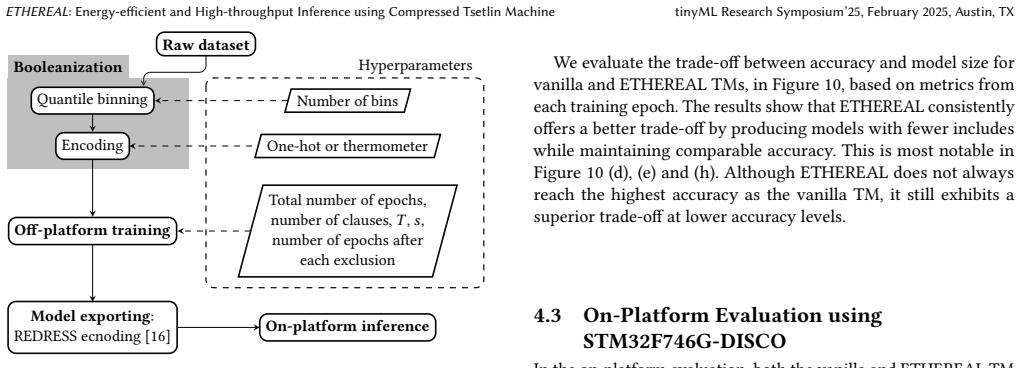
- [§4.1, Table 1 and Figure 9] The hyperparameter 'number of epochs after each exclusion' is listed as an input in the pipeline diagram (Figure 9) and is named in Section 3.2, but it is not reported in Table 1 or anywhere else in the paper. This parameter directly determines how much retraining occurs between exclusion operations and therefore controls both the final accuracy and the final model size. Without it, the experiments are not reproducible, and the claimed trade-off cannot be interpreted. The authors should list this value for every dataset and, ideally, provide a small sensitivity analysis showing how the accuracy-size trade-off varies with this interval.
- [§3.2, Figure 5] The load-bearing premise of the method is that a literal included in both positive and negative clauses of the same class is insignificant and can be excluded. The only evidence offered for this premise is the visual inspection of MNIST feature maps in Figure 5. This is not a quantitative justification: no correlation coefficient, mutual information score, or accuracy-ablation study is given to show that shared-inclusion literals are indeed less class-relevant than literals appearing only in one polarity. If the heuristic is wrong, the exclusion step deletes class-relevant literals, and the reported accuracy retention would rely on the subsequent training epochs to restore them, making the method sensitive to the unspecified exclusion interval. Please provide a quantitative analysis of literal significance (e.g., compare ETHEREAL against random literal exclusion with the same retraining budget, or measure the importance of shared literals via class-conditional statistics).
- [§4.2, Table 2] No repeated runs or error bars are reported for any of the TM experiments. Given that TM training is a stochastic process and that some of the reported accuracy differences are small (e.g., 0.78% for HAR), a single run is insufficient to establish that the accuracy drop is not seed noise. I recommend running each configuration at least five times with different random seeds and reporting the mean and standard deviation (or an equivalent significance measure) for both accuracy and includes per clause. This is particularly important because the central claim of 'only a minor accuracy compromise' depends on differences of a few percentage points.
minor comments (5)
- [§4.3, paragraph 3] The phrase '7× around reduction' should be 'approximately 7× reduction'.
- [§5, Conclusion] The term 'micron-controller' should be 'micro-controller'.
- [Figure 7] The inset panels in Figure 7 are difficult to interpret because the zoomed axis ranges are not labeled; please add explicit axis limits to the insets.
- [Table 2] The column 'Includes per clause' is reported for both vanilla and ETHEREAL, but the 'Includes change (%)' is not defined; please state that it is computed as (1 - ETHEREAL/vanilla) × 100.
- [Figures 5 and 8] The phrase 'complemented features' is ambiguous; use 'included literals' or 'feature inclusion counts' to describe the visualized quantities.
Circularity Check
No significant circularity: ETHEREAL's compression and accuracy results are measured outcomes of a defined training intervention, not fitted inputs or self-cited conclusions.
full rationale
The paper's core claim is empirical: after iteratively excluding literals shared by positive and negative clauses and then retraining, ETHEREAL reports measured accuracy and measured numbers of includes per clause. Section 3.2 defines exclusion as reducing TA states by N, and Section 4.2 reports the resulting test accuracy and model sizes. These numbers are not parameters fitted to the target claim; they are outcomes of the procedure. The heuristic that shared literals are insignificant is justified visually (Figure 5), but a heuristic premise followed by measurement is not a circular derivation. The self-citations to REDRESS (encoding) and to earlier hyperparameter studies are used as implementation tools and baseline references, not as uniqueness theorems or as definitional inputs that force the compression result. The possible asymmetry in selecting the 'best test accuracy' epoch for Table 2 is an evaluation-protocol concern, not a circularity: the reduction in includes is still measured, not analytically equated to the method's definition. No equation in the paper reduces the claimed result to its own inputs, and no fitted parameter is renamed as a prediction. Therefore the derivation chain is self-contained with respect to circularity.
Assumptions & free parameters
free parameters (6)
- Number of epochs after each exclusion =
Not reported
- Number of clauses per class =
50-500 across datasets
- Feedback threshold T =
7-25 across datasets
- Literal inclusion probability s =
3-10 across datasets
- Total training epochs =
50-250
- Booleanization settings (bin count, encoding) =
Not reported per dataset
assumptions (3)
- ad hoc to paper Shared-literal insignificance: a literal included in both positive and negative clauses of the same class is insignificant and can be excluded.
- domain assumption TA state reduction by N fully excludes a literal while preserving relative strength, and retraining restores wrongly excluded literals.
- standard math Standard TM training dynamics and feedback equations (Section 2) are correct.
Cite this review
Pith. "Pith review of ETHEREAL: Energy-efficient and High-throughput Inference using Compressed Tsetlin Machine." pith.science (2026). https://pith.science/paper/BO3EAIMM
@misc{pith2026250205640,
  author       = {Pith},
  title        = {Pith review of: ETHEREAL: Energy-efficient and High-throughput Inference using Compressed Tsetlin Machine},
  year         = {2026},
  howpublished = {\url{https://pith.science/paper/BO3EAIMM}},
  note         = {Machine review of arXiv:2502.05640}
}
read the original abstract
The Tsetlin Machine (TM) is a novel alternative to deep neural networks (DNNs). Unlike DNNs, which rely on multi-path arithmetic operations, a TM learns propositional logic patterns from data literals using Tsetlin automata. This fundamental shift from arithmetic to logic underpinning makes TM suitable for empowering new applications with low-cost implementations. In TM, literals are often included by both positive and negative clauses within the same class, canceling out their impact on individual class definitions. This property can be exploited to develop compressed TM models, enabling energy-efficient and high-throughput inferences for machine learning (ML) applications. We introduce a training approach that incorporates excluded automata states to sparsify TM logic patterns in both positive and negative clauses. This exclusion is iterative, ensuring that highly class-correlated (and therefore significant) literals are retained in the compressed inference model, ETHEREAL, to maintain strong classification accuracy. Compared to standard TMs, ETHEREAL TM models can reduce model size by up to 87.54%, with only a minor accuracy compromise. We validate the impact of this compression on eight real-world Tiny machine learning (TinyML) datasets against standard TM, equivalent Random Forest (RF) and Binarized Neural Network (BNN) on the STM32F746G-DISCO platform. Our results show that ETHEREAL TM models achieve over an order of magnitude reduction in inference time (resulting in higher throughput) and energy consumption compared to BNNs, while maintaining a significantly smaller memory footprint compared to RFs.
Figures


Figures from the paper (7 more)



Forward citations
Cited by 1 Pith paper
-
Explainable and Hardware-Efficient Jamming Detection for 5G Networks Using the Convolutional Tsetlin Machine
A Tsetlin-machine classifier on 5G SSB features achieves 91.5% jamming-detection accuracy with much faster training and a 14x smaller memory footprint than a CNN, at the cost of a 5-point accuracy gap and slower CPU i...
Reference graph
Works this paper leans on
-
[1]
Kerem Altun, Billur Barshan, and Orkun Tunçel. 2010. Comparative study on classifying human activities with miniature inertial and magnetic sensors.Pattern Recognition 43, 10 (2010), 3605–3620
work page 2010
-
[2]
Davide Anguita, Alessandro Ghio, Luca Oneto, Xavier Parra, Jorge Luis Reyes- Ortiz, et al. 2013. A public domain dataset for human activity recognition using smartphones. In Esann, Vol. 3. Bruges, Belgium, 3
work page 2013
-
[3]
Colby R. Banbury, Vijay Janapa Reddi, Max Lam, William Fu, Amin Fazel, Jeremy Holleman, Xinyuan Huang, Robert Hurtado, David Kanter, Anton Lokhmotov, David Patterson, Danilo Pau, Jae sun Seo, Jeff Sieracki, Urmish Thakker, Marian Verhelst, and Poonam Yadav. 2021. Benchmarking TinyML Systems: Challenges and Direction. arXiv:2003.04821 [cs.PF] https://arxiv...
arXiv 2021
-
[4]
Martyna Bator. 2013. Dataset for Sensorless Drive Diagnosis. UCI Machine Learning Repository. DOI: https://doi.org/10.24432/C5VP5F
doi:10.24432/c5vp5f 2013
-
[5]
Matthieu Courbariaux, Itay Hubara, Daniel Soudry, Ran El-Yaniv, and Yoshua Bengio. 2016. Binarized Neural Networks: Training Deep Neural Networks with Weights and Activations Constrained to +1 or -1. arXiv:1602.02830 [cs.LG] https://arxiv.org/abs/1602.02830
arXiv 2016
-
[6]
Li Deng. 2012. The MNIST database of handwritten digit images for machine learning research. IEEE signal processing magazine 29, 6 (2012), 141–142
work page 2012
-
[7]
Matthias Elter, Rüdiger Schulz-Wendtland, and Thomas Wittenberg. 2007. The prediction of breast cancer biopsy outcomes using two CAD approaches that both emphasize an intelligible decision process. Medical physics 34, 11 (2007), 4164–4172
work page 2007
-
[8]
Lukas Geiger and Plumerai Team. 2020. Larq: An open-source library for training binarized neural networks. Journal of Open Source Software 5, 45 (2020), 1746
work page 2020
Show all 21 references
-
[9]
Ole-Christoffer Granmo. 2021. The Tsetlin Machine–A Game Theoretic Ban- dit Driven Approach to Optimal Pattern Recognition with Propositional Logic. arXiv:1804.01508 [cs.AI] https://arxiv.org/abs/1804.01508
2021 arXiv
-
[10]
Peng Jiang, Zhixin Hu, Jun Liu, Shanen Yu, and Feng Wu. 2016. Fault diagnosis based on chemical sensor data with an active deep neural network. Sensors 16, 10 (2016), 1695
2016
-
[11]
Naveen Kumar Karnam, Shiv Ram Dubey, Anish Chand Turlapaty, and Balakr- ishna Gokaraju. 2022. EMGHandNet: A hybrid CNN and Bi-LSTM architecture for hand activity classification using surface EMG signals. Biocybernetics and biomedical engineering 42, 1 (2022), 325–340
2022
-
[12]
King, Cao Feng, and Alistair Sutherland
Ross D. King, Cao Feng, and Alistair Sutherland. 1995. Statlog: comparison of classification algorithms on large real-world problems. Applied Artificial Intelligence an International Journal 9, 3 (1995), 289–333
1995
-
[13]
Ji Lin, Wei-Ming Chen, Yujun Lin, Chuang Gan, Song Han, et al. 2020. Mcunet: Tiny deep learning on iot devices. Advances in neural information processing systems 33 (2020), 11711–11722
2020
-
[14]
Sergey Lobov, Nadia Krilova, Innokentiy Kastalskiy, Victor Kazantsev, and Va- leri A Makarov. 2018. Latent factors limiting the performance of sEMG-interfaces. Sensors 18, 4 (2018), 1122
2018
-
[15]
Renata C. B. Madeo, Clodoaldo A. M. Lima, and Sarajane M. Peres. 2013. Gesture unit segmentation using support vector machines: segmenting gestures from rest positions. In Proceedings of the 28th Annual ACM Symposium on Applied Computing. Association for Computing Machinery, N...
2013
-
[16]
Sidharth Maheshwari, Tousif Rahman, Rishad Shafik, Alex Yakovlev, Ashur Rafiev, Lei Jiao, and Ole-Christoffer Granmo. 2023. Redress: Generating compressed models for edge inference using tsetlin machines. IEEE Transactions on Pattern Analysis and Machine Intelligence 45, 9 (20...
2023
-
[17]
Pete Mowforth and Barry Shepherd. 1987. Statlog (Vehicle Silhouettes). UCI Machine Learning Repository. DOI: https://doi.org/10.24432/C5HG6N
1987 doi
-
[18]
Tousif Rahman, Adrian Wheeldon, Rishad Shafik, Alex Yakovlev, Jie Lei, Ole- Christoffer Granmo, and Shidhartha Das. 2022. Data Booleanization for Energy Efficient On-Chip Learning using Logic Driven AI. In International Symposium on the Tsetlin Machine (ISTM) . IEEE, Grimstad,...
2022
-
[19]
Irene Rodriguez-Lujan, Jordi Fonollosa, Alexander Vergara, Margie Homer, and Ramon Huerta. 2014. On the calibration of sensor arrays for pattern recogni- tion using the minimal number of experiments. Chemometrics and Intelligent Laboratory Systems 130 (2014), 123–134
2014
-
[20]
Chong Tang, Neelam Singh, and Jagmohan Chauhan. 2024. AdaTM: Logic In- spired Adaptive Tsetlin Machines for Efficient and Effective Continual Learning on the Edge. In EWSN. Abu Dhabi, UAE, 1–12
2024
-
[21]
Olga Tarasyuk, Tousif Rahman, Rishad Shafik, Alex Yakovlev, Anatoliy Gorbenko, Ole-Christoffer Granmo, and Lei Jiao. 2023. Systematic Search for Optimal Hyper- parameters of the Tsetlin Machine on MNIST Dataset. InInternational Symposium on the Tsetlin Machine (ISTM) . IEEE, N...
2023
Reviewed August 8, 2026 · model on record in the stance chip above.
Discussion (0). Continue with ORCID to comment.