REVIEW 4 major objections 5 minor 30 references
Explainable and Hardware-Efficient Jamming Detection for 5G Networks Using the Convolutional Tsetlin Machine
T0 review · 4 major / 5 minor · reviewed 2026-08-02 · deepseek-v4-flash
Pith's one-line read A logic-based machine called the Convolutional Tsetlin Machine can detect 5G jamming from synchronization-signal spectrograms, matching most of a CNN's accuracy while training about 9.5x faster and using 14x less memory.
desk verdict The CTM-vs-CNN accuracy comparison is plausible, but the paper's central memory/training claims are contradicted by its own tables; the '14x smaller' and '9.5x faster' numbers do not survive contact with the reported data. read the letter →
The pith
A machine-rendered reading of the paper's core claim, the machinery that carries it, and where it could break.
The reading
What carries the argument
The load-bearing object is the Convolutional Tsetlin Machine (CTM), a variant of the Tsetlin Machine that scans input in patches and learns Boolean clauses using Tsetlin automata — simple reinforcement-learning units that decide whether a feature enters a rule — over binarized features. Here the input is a 100x100 spectrogram of the SSB's first OFDM symbol, binarized with an enhanced Otsu procedure that combines vertical and horizontal thresholded views. The trained model uses 200 clauses, a 10x10 patch size, and a 22-literal limit per clause; inference is bit-level logic, which is what makes the model small, explainable, and potentially FPGA-friendly.
What would settle it
Implement the trained CTM configuration (200 clauses, 10x10 patches, 100x100 binarized inputs) on the paper's target FPGA class and measure actual look-up-table and block-RAM usage and throughput at 100 MHz; if the footprint exceeds the projected 7.7k–48k look-up-table envelope or throughput falls far below the projected kSamples/s range, the hardware-efficiency claim fails. Separately, a larger over-the-air dataset with diverse jammer types would test whether the 91.5% accuracy holds beyond this testbed.
Extended reading notes
Core claim
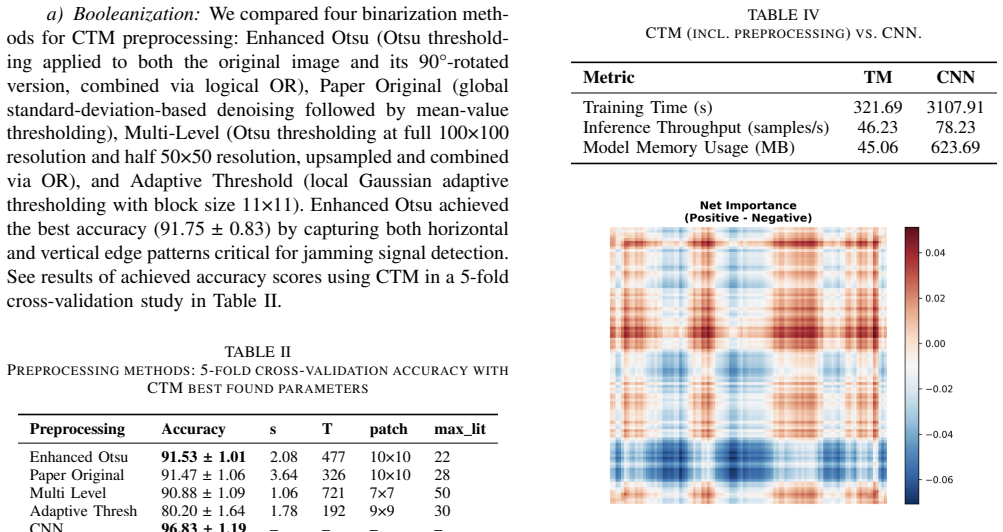
The central claim is that a Convolutional Tsetlin Machine operating on binarized 100x100 spectrograms of the 5G Primary Synchronization Signal within the SSB is a viable jamming detector: it achieves 91.53% accuracy versus 96.83% for a CNN baseline on the same over-the-air data, trains in about 322 seconds versus 3108 seconds, and uses 45 MB of model memory versus 624 MB. The CTM does this by forming a small set of propositional logic clauses over quantized spectrogram patches, which can be read as rules about which time-frequency resource elements indicate jamming. The CNN remains more accurate and has higher online inference throughput in this experiment; the paper's case for the CTM rests
Load-bearing premise
The hardware-efficiency claim rests on unmeasured, literature-based assumptions about FPGA resource use (30–60 look-up tables per clause, 100 MHz, 80% efficiency) — the paper itself labels these 'No new measurements; literature-based projection only' — and if those per-clause costs are wrong for this model, the edge-deployment advantage is unsupported.
Editorial extensions
If this is right
- A field-updatable jammer detector becomes realistic: the 9.5x training-speed advantage means the model can be retrained roughly ten times as often as the CNN on the same hardware when channel or jammer conditions shift.
- The 14x smaller memory footprint (45 MB vs 624 MB) brings the detector into range of embedded and FPGA-based platforms where the CNN would not fit on-chip.
- Detection decisions are auditable: the learned clauses show which lower-frequency SSB resource elements and time slots the model treats as jamming evidence, giving operators a starting point for spectrum forensics.
- If the literature-based look-up-table projections hold, the model can be deployed on a small FPGA at estimated throughputs of roughly 1–4.6 kSamples/s at 100 MHz, supporting real-time edge monitoring.
- For deployments whose only goal is maximum accuracy or peak inference throughput, the paper's own results still favor the CNN.
Reading between the lines
- The interpretability of CTM clauses could be exploited beyond detection: the same rules that flag jamming also localize which SSB subcarriers are corrupted, so a single model might double as a coarse jammer waveform classifier or an alarm tracer.
- Because the hyperparameter search fixed the clause count at 200, the accuracy gap to the CNN may be partly an artifact of model capacity; scaling clauses toward 800 — the paper's own accuracy-oriented FPGA profile — is a direct, testable way to see whether CTM can close the gap while keeping its size advantage.
- The FPGA resource estimates should be treated as a feasibility bound, not a measured specification; a direct synthesis of this exact configuration on the target board is needed before 'hardware-efficient' can be taken as established.
- Since training is so much cheaper, an operator could continuously retrain the CTM on fresh SSB captures without a dedicated GPU cluster, effectively turning jammer detection into an adaptive, learning-in-the-loop defense — something the paper's setup enables but does not yet demonstrate.
Editorial analysis
A structured set of objections, weighed in public.
Referee Report
Summary. The paper proposes a Convolutional Tsetlin Machine (CTM) based jamming detector for 5G networks that operates on over-the-air Synchronization Signal Block (SSB) features. The authors benchmark the CTM against a CNN baseline on a real 5G testbed with controlled jamming injection, using a 5-fold cross-validation protocol and multiple binarization preprocessing methods. The central claims are that the CTM achieves accuracy comparable to a CNN (91.53% vs. 96.83%) while training about 9.5x faster and using 14x less memory, and that a literature-based projection indicates the CTM can be implemented efficiently on a Zybo Z7 FPGA. The paper also highlights the interpretability of the learned Boolean clauses via pixel-contribution visualizations.
Significance. If the quantitative claims hold, the work provides a useful data point for lightweight, interpretable RF-domain jamming detection: a real over-the-air dataset, controlled jammer injection, multiple preprocessing variants, and a clearly described CNN baseline are strengths. The paper also carefully discloses that the FPGA resource projections are not based on new measurements. However, the significance is currently undercut by unresolved inconsistencies in the reported training times and memory figures, and by the fact that the FPGA advantage is entirely projected rather than measured. The central trade-off claim—CTM as a more hardware-efficient alternative—therefore rests on numbers that must be corrected and on projections that need to be validated or explicitly qualified.
major comments (4)
- [Table III vs. Section V.c/V.e and Table IV] The two complexity tables are mutually inconsistent. Table III reports CTM training time 44.4 s and CNN memory 92.1 MB, while Table IV and the surrounding text cite CTM training time 321.69 s and CNN memory 623.69 MB. The abstract's '9.5x faster' and '14x less memory' claims are computed from the Table IV values. These discrepancies are load-bearing: the main contribution is the efficiency trade-off, and a reader cannot tell whether the advantage is 9.5x or 7.2x in training time, or 14x or 2x in memory. In addition, the absolute values raise unit questions: a 1.2M-parameter CNN in float32 should be about 4.8 MB, and a 200-clause CTM with at most 22 literals per clause should be far smaller than 45 MB. The authors must clarify what quantity 'Mem' measures (e.g., peak training RSS, model checkpoint size, or something else), normalize the reporting, and recompute the speedup/memory ratios c
- [Section V.e and Table IV] The claim 'CTM uses ~14x less model memory (45.06 MB vs. 623.69 MB)' is not supported by the rendered text. The same section's training-cost paragraph reports a different training time for CTM (321.69 s vs. 44.42 s in Table III), and the CNN memory in Table III is given as 92.1 MB. These numbers cannot all be correct. Even if the larger CNN memory is the intended peak memory usage, the term 'model memory' is misleading. The authors need to report a single, clearly defined quantity for both models and verify that the ratio holds.
- [Table V footnote and Section V.g] The hardware-efficiency claim relies entirely on an unmeasured projection: 'No new measurements; literature-based projection only.' The assumed 30-60 LUTs per specialized clause, 100 MHz operating frequency, stride 1, and 80% efficiency are not verified for the specific CTM configuration used here (200-800 clauses, 10x10 patch dimension, 100x100 input, max 22 literals). Since the abstract and introduction state that the CTM is 'hardware-efficient' and a 'strong candidate for edge deployment,' this projection must be either backed by experiments or clearly repositioned as a motivating estimate. As written, the central practical advantage of the CTM over the CNN on edge hardware is asserted rather than demonstrated.
- [Abstract and Section V.b] The abstract states 'comparable detection performance (Accuracy 91.53±1.01 vs. 96.83±1.19 for CNN).' A 5.3 percentage-point gap is not obviously 'comparable' in a binary jamming-detection task, especially when the CNN also has higher inference throughput (Section V.d). The authors should either provide a statistical equivalence test or soften the language to 'competitive' while explicitly stating that the CNN has statistically higher accuracy. The current wording overstates the trade-off.
minor comments (5)
- [Section V.a and Table II] The text says Enhanced Otsu achieves 'best accuracy (91.75 ± 0.83)', but Table II lists 91.53 ± 1.01 for the same method. Please reconcile.
- [Section III, after Eq. (5)] The sentence 'where N_FFT is the FFT length' appears after an equation that does not contain N_FFT. Either define it in the right place or remove the dangling clause.
- [Section I, first paragraph] Typo: 'direcly' should be 'directly'.
- [Section V.a] The sentence 'The CNN has shown only loss in performance when used with the same preprocessing techniques' is unclear. Do you mean the CNN always degrades when inputs are binarized? Consider rephrasing.
- [Section V.g, Table V] The throughput column in Table V is labeled 'Samples/s' but the caption says 'kSamples/s'. The numeric ranges (1.0-2.5k, etc.) are ambiguous. Clarify the units.
Circularity Check
No circularity: the central result is a direct empirical benchmark on new data; self-citations and the FPGA projection are not load-bearing.
full rationale
The paper's core claims (CTM vs. CNN accuracy, training time, memory) come from running both models on the same newly collected over-the-air SSB dataset with identical splits and preprocessing. No equation defines a claimed output in terms of the quantity it is supposed to predict. The CTM hyperparameters chosen by Optuna on a validation subset are standard model selection, not a fitted parameter renamed as a prediction. References [20,21,23,24] are same-author background/motivation for the CTM model, but the comparison does not reduce to those citations, and the cited FPGA work [25,26] is external hardware evidence rather than a self-referential theorem. The FPGA resource projections in Table V are explicitly labelled 'literature-based projection only' and 'No new measurements', so they are a clearly stated limitation, not a circular derivation. The numerical inconsistencies between Table III and Table IV/§V.c-e (CTM training time 44.42 vs. 321.69 s; CNN memory 92.1 vs. 623.69 MB) are serious correctness/consistency defects that undermine the reported 9.5x and 14x factors, but they are internal contradictions, not evidence that a result is equivalent to its input by construction. Therefore no circular step is present.
Assumptions & free parameters
free parameters (6)
- number_of_clauses =
200
- T =
477
- s =
2.081
- patch_dim =
(10, 10)
- max_included_literals =
22
- CNN baseline architecture =
4 conv blocks (256/256/128/64), dense 512/256, ~1.2M params
assumptions (4)
- domain assumption The received PSS under jamming is modeled as y = x*h + z + xj (Eq. 8), with the jammer additive at the receiver front end.
- domain assumption The CTM algorithm as defined in [20][21] performs as described and is implemented correctly.
- domain assumption Wireline RF-combiner injection of a synthetic jammer onto one over-the-air 5G capture adequately emulates practical downlink jamming.
- domain assumption A 100x100 spectrogram of the first SSB OFDM symbol (PSS) preserves enough discriminative information for jamming detection.
Cite this review
Pith. "Pith review of Explainable and Hardware-Efficient Jamming Detection for 5G Networks Using the Convolutional Tsetlin Machine." pith.science (2026). https://pith.science/paper/GZR7GOOW
@misc{pith2026260307336,
  author       = {Pith},
  title        = {Pith review of: Explainable and Hardware-Efficient Jamming Detection for 5G Networks Using the Convolutional Tsetlin Machine},
  year         = {2026},
  howpublished = {\url{https://pith.science/paper/GZR7GOOW}},
  note         = {Machine review of arXiv:2603.07336}
}
abstract
All applications in fifth-generation (5G) networks rely on stable radio-frequency (RF) environments to support mission-critical services in mobility, automation, and connected intelligence. Their exposure to intentional interference or low-power jamming threatens availability and reliability, especially when such attacks remain below link-layer observability. This paper investigates lightweight, explainable, and hardware-efficient jamming detection using the Convolutional Tsetlin Machine (CTM) operating directly on 5G Synchronization Signal Block (SSB) features. CTM formulates Boolean logic clauses over quantized inputs, enabling bit-level inference and deterministic deployment on FPGA fabrics. These properties make CTM well suited for real-time, resource-constrained edge environments anticipated in 5G. The proposed approach is experimentally validated on a real 5G testbed using over-the-air SSB data, emulating practical downlink conditions. We benchmark CTM against a convolutional neural network (CNN) baseline under identical preprocessing and training pipelines. On the real dataset, CTM achieves comparable detection performance (Accuracy 91.53 +/- 1.01 vs. 96.83 +/- 1.19 for CNN) while training $9.5\times$ faster and requiring 14x less memory (45~MB vs.\ 624~MB). Furthermore, we outline a compact FPGA-oriented design for Zybo~Z7 (Zynq-7000) and provide resource projections (not measured) under three deployment profiles optimized for latency, power, and accuracy trade-offs. The results show that the CTM provides a practical, interpretable, and resource-efficient alternative to conventional DNNs for RF-domain jamming detection, establishing it as a strong candidate for edge-deployed, low-latency, and security-critical 5G applications while laying the groundwork for B5G systems.
Figures


Figures from the paper (1 more)

Reference graph
Works this paper leans on
-
[1]
A survey on security and privacy of 5g technologies: Potential solutions, recent advancements, and future directions,
R. Khan, P. Kumar, D. N. K. Jayakody, and M. Liyanage, “A survey on security and privacy of 5g technologies: Potential solutions, recent advancements, and future directions,”IEEE Communications Surveys and Tutorials, vol. 22, no. 1, pp. 196–248, 2019
2019
-
[2]
Jamming attacks and anti-jamming strategies in wireless networks: A comprehensive survey,
H. Pirayesh and H. Zeng, “Jamming attacks and anti-jamming strategies in wireless networks: A comprehensive survey,”IEEE Communications Surveys and Tutorials, vol. 24, no. 2, pp. 767–809, 2022
2022
-
[3]
5g nr jamming, spoofing, and sniffing: Threat assessment and mitigation,
M. Lichtman, R. Rao, V . Marojevic, J. H. Reed, and R. P. Jover, “5g nr jamming, spoofing, and sniffing: Threat assessment and mitigation,” in IEEE Intl Conf on Communications Workshops, 2018, pp. 1–6
2018
-
[4]
Implementation and evaluation of a smart uplink jamming attack in a public 5g network,
M. E. Flores, D. D. Poisson, C. J. Stevens, A. V . Nieves, and A. M. Wyglinski, “Implementation and evaluation of a smart uplink jamming attack in a public 5g network,”IEEE Access, vol. 11, pp. 140 705– 140 719, 2023
2023
-
[5]
The impact of mobility, beam sweeping and smart jammers on security vulnerabilities of 5g cells,
G. Asemian, M. Kulhandjian, M. Amini, B. Kantarci, C. D’Amours, and M. Erol-Kantarci, “The impact of mobility, beam sweeping and smart jammers on security vulnerabilities of 5g cells,”arXiv preprint arXiv:2411.05131, 2024
arXiv 2024
-
[6]
Dt-ddnn: A physical layer security attack detector in 5g rf domain for cavs,
G. Asemian, M. Amini, B. Kantarci, and M. Erol-Kantarci, “Dt-ddnn: A physical layer security attack detector in 5g rf domain for cavs,”IEEE Transactions on Vehicular Technology, pp. 1–14, 2025
2025
-
[7]
Deep fusion intelligence: Enhancing 5g security against over-the-air attacks,
M. Amini, G. Asemian, B. Kantarci, C. Ellement, and M. Erol-Kantarci, “Deep fusion intelligence: Enhancing 5g security against over-the-air attacks,”IEEE Transactions on Machine Learning in Communications and Networking, vol. PP, pp. 1–1, 01 2025
2025
-
[8]
Real-time machine learning based on hoeffding decision trees for jamming detection in 5g new radio,
Y . Arjoune and S. Faruque, “Real-time machine learning based on hoeffding decision trees for jamming detection in 5g new radio,” in IEEE International Conference on Big Data, 2020, pp. 4988–4997
2020
Show all 30 references
-
[9]
An efficient evm-based jamming detection in 5g networks,
C. ¨Ornek and M. Kartal, “An efficient evm-based jamming detection in 5g networks,” inIEEE MENACOMM, 2022, pp. 130–135
2022
-
[10]
Jamming detection with subcarrier blanking for 5g and beyond in industry 4.0 scenarios,
L. Chiarello, P. Baracca, K. Upadhya, S. R. Khosravirad, and T. Wild, “Jamming detection with subcarrier blanking for 5g and beyond in industry 4.0 scenarios,” inIEEE PIMRC, 2021, pp. 758–764
2021
-
[11]
Machine learning-based rf jamming detection in wireless networks,
Z. Feng and C. Hua, “Machine learning-based rf jamming detection in wireless networks,” inIntl. Conf. on Security of Smart Cities, Industrial Control System and Communications, 2018, pp. 1–6
2018
-
[12]
Design and implementation of initial cell search in 5g nr systems,
F. Chen, X. Li, Y . Zhang, and Y . Jiang, “Design and implementation of initial cell search in 5g nr systems,”China Communications, vol. 17, no. 5, pp. 38–49, 2020
2020
-
[13]
A comprehensive study on the synchronization procedure in 5g nr with 3gpp-compliant link-level simulator,
R. Tuninato, D. G. Riviello, R. Garello, B. Melis, and R. Fantini, “A comprehensive study on the synchronization procedure in 5g nr with 3gpp-compliant link-level simulator,”EURASIP Journal on Wireless Communications and Networking, vol. 2023, no. 111, pp. 1–20, 2023
2023
-
[14]
Bayesian inference-assisted machine learning for near real-time jamming detection and classification in 5g new radio (nr),
S. Jere, Y . Wang, I. Aryendu, S. Dayekh, and L. Liu, “Bayesian inference-assisted machine learning for near real-time jamming detection and classification in 5g new radio (nr),”IEEE Transactions on Wireless Communications, 2023, early Access
2023
-
[15]
Anonymous jamming detection in 5g with bayesian network model based inference analysis,
Y . Wang, S. Jere, S. Banerjee, L. Liu, S. Shetty, and S. Dayekh, “Anonymous jamming detection in 5g with bayesian network model based inference analysis,” inIEEE International Conference on High Performance Switching and Routing (HPSR), 2022, pp. 151–156
2022
-
[16]
Nr; physical channels and modulation,
3GPP, “Nr; physical channels and modulation,” 3rd Gen. Partnership Project (3GPP), Technical Spec. (TS) 38.211, 2023, v17.6.0, Oct. 2023
2023
-
[17]
Ss/pbch block design in 5g new radio (nr),
Z. Lin, J. Li, Y . Zheng, N. V . Irukulapati, H. Wang, and H. Sahlin, “Ss/pbch block design in 5g new radio (nr),” inIEEE GLOBECOM Workshops (GC Wkshps), 2018, pp. 1–6
2018
-
[18]
Sigunder: A stealthy 5g low-power attack and defenses,
N. Ludant and G. Noubir, “Sigunder: A stealthy 5g low-power attack and defenses,” inACM WiSec, 2021, pp. 250–260
2021
-
[19]
Detecting intelligent jamming on physical broadcast channel in 5g nr,
S.-D. Wang, H.-M. Wang, W. Wang, and V . C. M. Leung, “Detecting intelligent jamming on physical broadcast channel in 5g nr,”IEEE Communications Letters, vol. 27, no. 12, pp. 3196–3200, 2023
2023
-
[20]
The tsetlin machine: A game theoretic bandit- driven approach to interpretable pattern recognition,
O.-C. Granmo, “The tsetlin machine: A game theoretic bandit- driven approach to interpretable pattern recognition,”arXiv preprint arXiv:1804.01508, 2018
2018 arXiv
-
[21]
The convolutional tsetlin machine,
O.-C. Granmo, S. Glimsdal, L. Jiao, M. Goodwin, C. W. Omlin, and G. T. Berge, “The convolutional tsetlin machine,”arXiv preprint arXiv:1905.09688, 2019
1905 arXiv
-
[22]
A weighted tsetlin machine for classification,
K. D. Abeyrathna, O.-C. Granmo, and M. O. Tveit, “A weighted tsetlin machine for classification,”arXiv preprint arXiv:1909.07310, 2019
1909 arXiv
-
[23]
Mixctme: A mixture of convolutional tsetlin machine experts using diverse spectrogram visualizations for jamming signal classification,
S. Jeeru and et al, “Mixctme: A mixture of convolutional tsetlin machine experts using diverse spectrogram visualizations for jamming signal classification,”IEEE Internet of Things Journal, pp. 1–1, 2025
2025
-
[24]
Interpretable rule- based architecture for gnss jamming signal classification,
S. Jeeru, L. Jiao, P.-A. Andersen, and O.-C. Granmo, “Interpretable rule- based architecture for gnss jamming signal classification,”IEEE Sensors Journal, vol. 25, no. 10, pp. 17 942–17 959, 2025
2025
-
[25]
Tsetlin machine-based image classification fpga accelerator with on- device training,
S. A. Tunheim, L. Jiao, R. Shafik, A. Yakovlev, and O.-C. Granmo, “Tsetlin machine-based image classification fpga accelerator with on- device training,”IEEE Transactions on Circuits and Systems I: Regular Papers, vol. 72, no. 2, pp. 830–843, 2025
2025
-
[26]
An all-digital 8.6-nj/frame 65-nm tsetlin machine image classification accelerator,
S. A. Tunheim, Y . Zheng, L. Jiao, R. Shafik, A. Yakovlev, and O.- C. Granmo, “An all-digital 8.6-nj/frame 65-nm tsetlin machine image classification accelerator,”IEEE Transactions on Circuits and Systems I: Regular Papers, pp. 1–14, 2025
2025
-
[27]
Matador: Clause specialization and logic sharing for fpga-accelerated tsetlin machines,
D. Rule, A. Rashid, C. Blum, O. H. Sørensen, A. M. T. Marinho, and O.-C. Granmo, “Matador: Clause specialization and logic sharing for fpga-accelerated tsetlin machines,” inDesign, Automation and Test in Europe Conference (DATE), 2024
2024
-
[28]
Robust frequency and timing synchro- nization for ofdm,
T. M. Schmidl and D. C. Cox, “Robust frequency and timing synchro- nization for ofdm,”IEEE Transactions on Communications, vol. 45, no. 12, pp. 1613–1621, 1997
1997
-
[29]
Ethereal: Energy-efficient and high-throughput inference using compressed tsetlin machine,
S. Duan, R. Shafik, and A. Yakovlev, “Ethereal: Energy-efficient and high-throughput inference using compressed tsetlin machine,” 2025. [Online]. Available: https://arxiv.org/abs/2502.05640
2025 arXiv
-
[30]
Optuna: A next- generation hyperparameter optimization framework,
T. Akiba, S. Sano, T. Yanase, T. Ohta, and M. Koyama, “Optuna: A next- generation hyperparameter optimization framework,” inProceedings of the 25th ACM SIGKDD International Conference on Knowledge Discovery and Data Mining, 2019, pp. 2623–2631
2019
Reviewed August 2, 2026 · model on record in the stance chip above.
Discussion (0). Sign in to comment.