REVIEW 3 major objections 5 minor 4 cited by
Surprise Potential as a Measure of Interactivity in Driving Scenarios
T0 review · 3 major / 5 minor · reviewed 2026-08-08 · deepseek-v4-flash
Pith's one-line read This paper establishes that a driving scenario's interactivity can be quantified by its surprise potential—the shift, under a counterfactual replacement of one agent's past, in the predicted future distributions of others—and shows that…
desk verdict A genuinely useful comparative study of counterfactual surprise metrics, but the headline 0.82 correlation is weakened by an unvalidated reward model and a metric that doesn't actually isolate 'surprise on others'. read the letter →
The pith
A machine-rendered reading of the paper's core claim, the machinery that carries it, and where it could break.
The reading
What carries the argument
The surprise potential is defined as $S(\xi) = D(F(\xi), F(G(\xi)))$, where $F$ is a trajectory prediction model outputting a distribution over all agents' futures, $G$ is a counterfactual generator that edits the scenario, and $D$ is a distribution-shift measure. The winning instantiation uses $G$ = Hist-prim (replacing the target agent's history with collision-free, drivable motion primitives), $F$ = a query-centric feedforward transformer with a Gaussian-mixture prediction head, and $D$ = $W_2$, the 2nd-order Wasserstein distance computed between the modes of the two GMMs with an optimal-transport coupling. Its role is to compute, for every scenario, a scalar score that orders scenes by how strongly the counterfactual intervention propagates through the prediction model.
What would settle it
Test the metric against rankings from human pairwise labels that were not used in training the reward model: if the Spearman correlation of Hist-prim+FFP-QC+W2 with those held-out labels is substantially below 0.82, then the claimed alignment with human intuition is actually alignment with the reward model's approximation of it.
Extended reading notes
Core claim
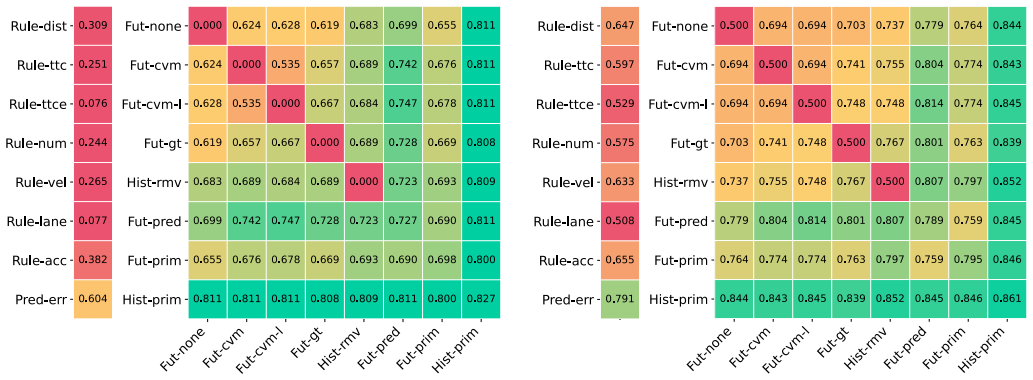
The central discovery is that replacing the target agent's recorded history with a set of motion primitives (short, behavior-level trajectory segments such as left turns or lane changes) and then measuring how much the predicted future trajectories of other agents move is a strong indicator of a scenario's interactivity. On the nuScenes validation set, the best instance of this family—Hist-prim for counterfactual generation, a feedforward query-centric predictor (FFP-QC), and the second-order Wasserstein distance ($W_2$) between Gaussian-mixture predictions—achieves a Spearman correlation of 0.827 with the ranking produced by a reward model learned from 5,000 human pairwise comparisons. The same configuration also yields an AUC-ROC of 0.86 when separating the top 10% of interactive scenarios from the rest. The paper further establishes that the measure is not just descriptive: high-surprise scenarios are exactly where planners have lower time-to-collision, and upsampling high-surprise scenes during planner training improves downstream safety metrics.
Load-bearing premise
The paper assumes that the reward model trained on 5,000 human pairwise preferences is an accurate oracle for interactivity across the full nuScenes validation set, and it never checks that reward model against held-out human labels.
Editorial extensions
If this is right
- Autonomous-vehicle teams can automatically rank raw driving logs by interactivity and curate small test sets focused on the rare critical scenarios, instead of relying on the imbalanced natural distribution.
- Rule-based filters such as time-to-collision, minimum distance, and maximum acceleration are poor substitutes for interaction identification, all falling below 0.3 Spearman correlation on nuScenes.
- Planner validation on curated high-surprise buckets exposes safety differences that are hidden in the full dataset, since mean time-to-collision decreases monotonically as surprise potential increases.
- Training a planner on data upsampled by surprise score, with sampling weights in the intermediate range, improves final planner metrics, while extreme upsampling overfits to a few scenarios.
- A single prediction mode is sufficient for high correlation, suggesting that the distribution-shift signal is robust to the amount of multi-modality captured by the predictor.
Reading between the lines
- The paper's 0.827 figure measures agreement with a reward model trained on human preferences, not with held-out human labels; validating the reward model against held-out annotator pairs would show how much of the number is genuine human alignment versus the model's own bias.
- The superiority of history perturbation over future conditioning suggests a transferable principle: interventions on inputs are more robust than conditioning on outputs because the latter leaks information about the nominal scenario; this may guide interaction scoring in other multi-agent settings such as pedestrian groups or warehouse robots.
- The design-space result that the Wasserstein distance beats KL and L2 for GMM shifts could be exploited in cheaper online deployment, for example with sparse transport plans or fixed mode matching, at some cost to the reported correlation.
- Because even a single-mode predictor works, the metric could be applied at fleet scale with lightweight trajectory forecasters, making large-scale interactive-log mining feasible without heavy generative models.
Editorial analysis
A structured set of objections, weighed in public.
Referee Report
Summary. The paper introduces a family of "surprise potential" metrics for ranking driving scenarios by interactivity, decomposing the metric into three design axes: counterfactual generation, future prediction architecture, and distribution-shift measure. It evaluates many instantiations of these axes on nuScenes, using as ground truth a reward model trained on 5,000 human pairwise preference labels. The proposed configuration Hist-prim + FFP-QC + W2 achieves a Spearman correlation of 0.827 against this reward model's ranking, outperforming rule-based baselines. The paper also demonstrates downstream utility by showing that scenarios ranked as highly surprising correlate with lower planner safety and that upsampling such scenarios improves a learned planner.
Significance. If the central claim holds, the paper provides a practically useful tool for dataset curation in autonomous driving and organizes a previously fragmented design space into a systematic comparison. The Hist-prim counterfactual, the use of query-centric prediction, and the Wasserstein-distance shift measure are sensible contributions, and the downstream planning results are a valuable demonstration. However, the headline evidence is weakened by three load-bearing issues: the reward model is never validated against held-out human labels, the reported 0.827 is a post-selection maximum over a grid evaluated on the same validation set, and the mathematical definition in Eq. (1) does not exclude the manipulated target agent from the distribution shift, creating an internal-consistency problem with the stated goal of measuring "surprise potential on others." These issues are fixable within the manuscript's scope, but they must be addressed before the human-alignment claim can be accepted.
major comments (3)
- [§III-A, Eq. (1)] The definition S(ξ) := D(F(ξ), F∘G(ξ)) applies the shift measure D to the full joint predicted distributions over all agents, yet the paper's stated object is "surprise potential on others" (Abstract, Section I) and the qualitative evidence in Figure 5 concerns predictions for other agents. With the Hist-prim counterfactual (Section IV-A), the target agent's history is replaced by motion primitives, so that agent's own predicted future appears on both sides of D and can shift even in a non-interactive scene merely because the input history changed. No step in Eq. (1) or in the experimental section masks or excludes the target agent from D. Unless the implementation did exclude the target (which the paper should state explicitly), the reported 0.827 correlation may be driven by self-history sensitivity rather than cross-agent interactivity. I request a formal definition of "others," an explicit target-exclusion version of Eq. (1), and an ablation separating the self-shift from the other-agent shift.
- [§III-C, §V-B] The reward model trained on 5,000 pairwise preference labels is treated as the ground-truth ranking, but the paper never validates this model against held-out human labels, for example by reporting pairwise classification accuracy, inter-annotator agreement, or a direct comparison on held-out preference pairs. Figure 6 shows that the Spearman correlation saturates as the reward model is trained on more preference data, but the target being predicted is still the reward model's own ranking; this does not establish that the reward model faithfully represents human intuition. The abstract's claim of "a correlation of more than 0.82 with human labels" is therefore not supported by the reported experiments; the actual quantity is a correlation with a learned proxy. The authors should either validate the reward model directly or soften the claim and compute the surprise metric's agreement on held-out human preference pairs.
- [§V-B, Table I] The headline 0.827 correlation is the maximum over a grid of configurations (counterfactual × architecture × shift measure × mode count) evaluated on the same nuScenes validation set, and the best configuration is selected after inspecting those correlations. The paper reports no confidence intervals, no multiple-comparison control, and no separate model-selection split, so the reported value is a post-selection maximum. The small gaps visible in Table I (e.g., 0.827 versus 0.829 for FFP-QC-W2-5 or 0.828 for FFP-QC-W2-15) are unlikely to be meaningful without uncertainty quantification. I recommend reporting bootstrap confidence intervals and using a nested or held-out protocol for the design-space search, or explicitly framing the result as a selected benchmark.
minor comments (5)
- [§IV-A] The name "Fut-none" is confusing because it denotes the baseline with no counterfactual future conditioning rather than a future perturbation; a one-sentence clarification would help readers map the label to the definition.
- [§IV-C, Eq. (2)] Equation (2) writes D_L2 = Σ_k ‖μ_k^1 − μ_k^2‖^{1/2}; if the intended quantity is the squared L2 distance between means, the exponent should be 2, and the current expression is not a norm. Please correct the formula or justify the root-distance choice.
- [Figure 7 caption] The caption refers to "Hist-prim-Hist-prim," which appears to be a typo for the single method "Hist-prim."
- [Abstract and Conclusion] The phrases "correlation with human labels" and "correlation with human annotation" should be replaced by "correlation with the reward-model ranking" unless direct human-label validation is added.
- [Figure 3] The axes labeled "nominal scenario ξ" and "counterfactual scenario G(ξ)" do not map obviously to the method names in the figure; a small legend or table clarifying which side of each comparison is used for each entry would improve readability.
Circularity Check
The winning surprise-metric configuration is selected by the same reward-model correlation that is then reported as the headline 0.82 result, a mild post-selection circularity; the metric definition itself is independent.
-
other
[Abstract and Section V-B (Figures 3-4; Table I)]
"Our proposed surprise potential, arising from this exhaustive comparative study, achieves a correlation of more than 0.82 with the human-aligned reward function, outperforming existing approaches."
The paper first computes Spearman correlations with the reward-model ranking for every instantiation, then selects Hist-prim (with FFP-QC-W2-10) as the best design on the basis of those very correlations (Figures 3-4, Table I), and finally reports the selected configuration's 0.827 correlation as the proposed metric's achievement. The headline number is therefore the maximum of the search objective, not an independent confirmation that the winning metric aligns with human-aligned reward. The metric itself has no parameters fitted to the labels, so this is a post-selection reporting issue rather than definitional equivalence; the correlation would be expected to be lower if measured on a fresh design hold-out.
full rationale
The core definition S(ξ) := D(F(ξ), F∘G(ξ)) in Eq. (1) is parameter-free with respect to the human-preference reward model: no coefficient or threshold is fitted to the labels, and the same counterfactual recipe is applied to all scenarios before any correlation is computed. The evaluation against rule-based baselines (correlations below 0.3) provides independent evidence that the SP family carries interactivity signal beyond simple velocity, distance, or TTC heuristics. No load-bearing uniqueness theorem or ansatz is imported from the authors' prior work; citations to [10], [11], [16], [27], [28], [31] are contextual or baseline references, not premises that force the conclusion. The one genuine circularity-adjacent step is the selection/reporting loop: the Hist-prim + FFP-QC + W2-10 configuration was chosen as best from Figures 3-4 and Table I, which rank configurations by the same Spearman correlation with the reward model that the abstract then announces as 'more than 0.82.' This is a mild post-selection maximum, not a derivation by construction, so it does not invalidate the metric but does mean the headline correlation is optimistic. Separately, the reviewer's concern that Eq. (1) applies D to the full joint distribution over all agents, including the target agent whose history is replaced by Hist-prim, is a construct-validity risk (the score may partly reflect self-history sensitivity rather than interactivity 'on others'), but that is a correctness and external-validity issue rather than circularity: the formula still computes a shift between two well-defined distributions and does not assume the conclusion. Likewise, the reward model is trained on 5,000 pairwise human labels and then used to rank the whole validation set without reported held-out label accuracy; this weakens the claim of 'human labels' but is an evaluation-proxy limitation, not a circular reduction. Overall circularity score: 2.
Assumptions & free parameters
free parameters (4)
- Number of prediction modes =
10
- Trajectory segment lengths =
5s history, 4s future
- Diffusion sample count =
50
- Primitive feasibility constraints =
collision-free and within drivable area
assumptions (3)
- domain assumption Counterfactual distribution shift is a valid operationalization of interactivity
- domain assumption The reward model trained on human preferences is a reliable oracle for interactivity
- domain assumption The trajectory prediction models are accurate enough that their distribution shift reflects scene interactivity rather than model artifact
Cite this review
Pith. "Pith review of Surprise Potential as a Measure of Interactivity in Driving Scenarios." pith.science (2026). https://pith.science/paper/P7NNSCZE
@misc{pith2026250205677,
  author       = {Pith},
  title        = {Pith review of: Surprise Potential as a Measure of Interactivity in Driving Scenarios},
  year         = {2026},
  howpublished = {\url{https://pith.science/paper/P7NNSCZE}},
  note         = {Machine review of arXiv:2502.05677}
}
read the original abstract
Validating the safety and performance of an autonomous vehicle (AV) requires benchmarking on real-world driving logs. However, typical driving logs contain mostly uneventful scenarios with minimal interactions between road users. Identifying interactive scenarios in real-world driving logs enables the curation of datasets that amplify critical signals and provide a more accurate assessment of an AV's performance. In this paper, we present a novel metric that identifies interactive scenarios by measuring an AV's surprise potential on others. First, we identify three dimensions of the design space to describe a family of surprise potential measures. Second, we exhaustively evaluate and compare different instantiations of the surprise potential measure within this design space on the nuScenes dataset. To determine how well a surprise potential measure correctly identifies an interactive scenario, we use a reward model learned from human preferences to assess alignment with human intuition. Our proposed surprise potential, arising from this exhaustive comparative study, achieves a correlation of more than 0.82 with the human-aligned reward function, outperforming existing approaches. Lastly, we validate motion planners on curated interactive scenarios to demonstrate downstream applications.
Figures


Figures from the paper (4 more)


Forward citations
Cited by 4 Pith papers
-
Safety Evaluation of Motion Plans Using Trajectory Predictors as Forward Reachable Set Estimators
FORCE-OPT extracts calibrated, multi-modal reachable sets from GMM trajectory predictors using convex optimization and conformal prediction, achieving the lowest balanced error rate in safety evaluation on nuScenes.
-
CrashAgent: Crash Scenario Generation via Multi-modal Reasoning
A multi-agent vision-language framework converts NHTSA crash reports into simulation-ready road layouts and collision scenarios, with modest accuracy gains over direct VLM baselines.
-
Test Automation for Interactive Scenarios via Promptable Traffic Simulation
A goal-prompt search with Bayesian optimization over a data-driven traffic simulator automatically finds safety-critical scenarios for testing autonomous vehicle planners.
-
Sim2Val: Leveraging Correlation Across Test Platforms for Variance-Reduced Metric Estimation
Sim2Val adapts control variates and prediction-powered inference to robot validation, using correlated simulator outputs to reduce the real-world sample count needed for a given confidence interval.
Reference graph
Works this paper leans on
-
[1]
Parting with misconceptions about learning-based vehi- cle motion planning,
D. Dauner, M. Hallgarten, A. Geiger, and K. Chitta, “Parting with misconceptions about learning-based vehi- cle motion planning,” in Conf. on Robot Learning , 2023
work page 2023
-
[2]
nuScenes: A multimodal dataset for autonomous driving,
H. Caesar, V . Bankiti, A. H. Lang, S. V ora, V . E. Liong, Q. Xu, A. Krishnan, Y . Pan, G. Baldan, and O. Bei- jbom, “nuScenes: A multimodal dataset for autonomous driving,” in IEEE Conf. on Computer Vision and Pattern Recognition, 2020
work page 2020
-
[3]
A survey on safety-critical driving scenario generation—a methodological perspective,
W. Ding, C. Xu, M. Arief, H. Lin, B. Li, and D. Zhao, “A survey on safety-critical driving scenario generation—a methodological perspective,”IEEE Transactions on Intel- ligent Transportation Systems , vol. 24, no. 7, pp. 6971– 6988, 2023
work page 2023
-
[4]
Diverse complexity measures for dataset curation in self-driving,
A. Sadat, S. Segal, S. Casas, J. Tu, B. Yang, R. Urtasun, and E. Yumer, “Diverse complexity measures for dataset curation in self-driving,” in IEEE/RSJ Int. Conf. on Intelligent Robots & Systems , 2021
work page 2021
-
[5]
Embedding synthetic off-policy experience for autonomous driving via zero-shot curricula,
E. Bronstein, S. Srinivasan, S. Paul, A. Sinha, M. O’Kelly, P. Nikdel, and S. Whiteson, “Embedding synthetic off-policy experience for autonomous driving via zero-shot curricula,” in Conf. on Robot Learning , 2023
work page 2023
-
[6]
Mea- suring surprise in the wild,
A. Dinparastdjadid, I. Supeene, and J. Engstrom, “Mea- suring surprise in the wild,” Available at https://arxiv. org/abs/2305.07733 , 2023
arXiv 2023
-
[7]
Identifying driver interac- tions via conditional behavior prediction,
E. Tolstaya, R. Mahjourian, C. Downey, B. Vadarajan, B. Sapp, and D. Anguelov, “Identifying driver interac- tions via conditional behavior prediction,” in Proc. IEEE Conf. on Robotics and Automation , 2021
work page 2021
-
[8]
Modeling road user response timing in naturalistic traffic conflicts: a surprise-based framework,
J. Engstr ¨om, S.-Y . Liu, A. Dinparastdjadid, and C. Simoiu, “Modeling road user response timing in naturalistic traffic conflicts: a surprise-based framework,” Accident Analysis & Prevention , vol. 198, p. 107460, 2024
work page 2024
Show all 45 references
-
[9]
Lewis, Counterfactuals
D. Lewis, Counterfactuals. John Wiley & Sons, 2013
2013
-
[10]
Interpretable trajectory prediction for au- tonomous vehicles via counterfactual responsibility,
K.-C. Hsu, K. Leung, Y . Chen, J. F. Fisac, and M. Pavone, “Interpretable trajectory prediction for au- tonomous vehicles via counterfactual responsibility,” in IEEE/RSJ Int. Conf. on Intelligent Robots & Systems , 2023
2023
-
[11]
Leveraging neural network gradients within trajectory optimization for proactive human-robot interactions,
S. Schaefer, K. Leung, B. Ivanovic, and M. Pavone, “Leveraging neural network gradients within trajectory optimization for proactive human-robot interactions,” in Proc. IEEE Conf. on Robotics and Automation , 2021
2021
-
[12]
Safeshift: Safety-informed distribution shifts for robust trajectory prediction in autonomous driving,
B. Stoler, I. Navarro, M. Jana, S. Hwang, J. Francis, and J. Oh, “Safeshift: Safety-informed distribution shifts for robust trajectory prediction in autonomous driving,” in IEEE Intelligent Vehicles Symposium , 2024
2024
-
[13]
On exposing the challenging long tail in future prediction of traffic actors,
O. Makansi, ¨O. Cicek, Y . Marrakchi, and T. Brox, “On exposing the challenging long tail in future prediction of traffic actors,” in IEEE Int. Conf. on Computer Vision , 2021
2021
-
[14]
UniTraj: A unified framework for scalable vehicle trajectory prediction,
L. Feng, M. Bahari, K. M. B. Amor, ´E. Zablocki, M. Cord, and A. Alahi, “UniTraj: A unified framework for scalable vehicle trajectory prediction,” in European Conf. on Computer Vision , 2024
2024
-
[15]
InterHub: A naturalistic trajectory dataset with dense interaction for autonomous driving,
X. Jiang, X. Zhao, Y . Liu, Z. Li, P. Hang, L. Xiong, and J. Sun, “InterHub: A naturalistic trajectory dataset with dense interaction for autonomous driving,” Available at https://arxiv.org/abs/2411.18302 , 2024
2024 arXiv
-
[16]
Interaction- dynamics-aware perception zones for obstacle detection safety evaluation,
S. Topan, K. Leung, Y . Chen, P. Tupekar, E. Schmer- ling, J. Nilsson, M. Cox, and M. Pavone, “Interaction- dynamics-aware perception zones for obstacle detection safety evaluation,” in IEEE Intelligent Vehicles Sympo- sium, 2022
2022
-
[17]
Finding critical scenarios for automated driving systems: A systematic mapping study,
L. Westhofen, C. Neurohr, T. Koopmann, M. Butz, B. U. Sch ¨utt, F. Utesch, B. Kramer, C. Gutenkunst, and E. B ¨ode, “Finding critical scenarios for automated driving systems: A systematic mapping study,” Archives of Computational Methods in Engineering , vol. 30, pp. 1–35, 2023
2023
-
[18]
Criticality metric for the safety validation of automated driving using model predictive trajectory optimization,
P. Junietz, F. Bonakdar, B. Klamann, and H. Winner, “Criticality metric for the safety validation of automated driving using model predictive trajectory optimization,” in Proc. IEEE Int. Conf. on Intelligent Transportation Systems, 2018
2018
-
[19]
TNT: Target-driven trajectory prediction,
H. Zhao, J. Gao, T. Lan, C. Sun, B. Sapp, B. Varadarajan, Y . Shen, Y . Shen, Y . Chai, C. Schmid et al. , “TNT: Target-driven trajectory prediction,” in Conf. on Robot Learning, 2021
2021
-
[20]
DenseTNT: End-to-end trajectory prediction from dense goal sets,
J. Gu, C. Sun, and H. Zhao, “DenseTNT: End-to-end trajectory prediction from dense goal sets,” in IEEE Int. Conf. on Computer Vision , 2021
2021
-
[21]
Motion transformer with global intention localization and local movement refinement,
S. Shi, L. Jiang, D. Dai, and B. Schiele, “Motion transformer with global intention localization and local movement refinement,” Conf. on Neural Information Pro- cessing Systems, 2022
2022
-
[22]
Query- centric trajectory prediction,
Z. Zhou, J. Wang, Y .-H. Li, and Y .-K. Huang, “Query- centric trajectory prediction,” in IEEE Conf. on Computer Vision and Pattern Recognition , 2023
2023
-
[23]
MTR++: Multi- agent motion prediction with symmetric scene modeling and guided intention querying,
S. Shi, L. Jiang, D. Dai, and B. Schiele, “MTR++: Multi- agent motion prediction with symmetric scene modeling and guided intention querying,” IEEE Transactions on Pattern Analysis & Machine Intelligence , vol. 46, no. 5, pp. 3955–3971, 2024
2024
-
[24]
Scene transformer: A unified architecture for predicting multiple agent trajectories,
J. Ngiam, B. Caine, V . Vasudevan, Z. Zhang, H.-T. L. Chiang, J. Ling, R. Roelofs, A. Bewley, C. Liu, A. Venu- gopal et al. , “Scene transformer: A unified architecture for predicting multiple agent trajectories,” Available at https://arxiv.org/abs/2106.08417 , 2021
2021 arXiv
-
[25]
Latent variable sequential set transformers for joint multi-agent motion prediction,
R. Girgis, F. Golemo, F. Codevilla, M. Weiss, J. A. D’Souza, S. E. Kahou, F. Heide, and C. Pal, “Latent variable sequential set transformers for joint multi-agent motion prediction,” Available at https://arxiv.org/abs/ 2104.00563, 2021
2021 arXiv
-
[26]
Denoising diffusion probabilistic models,
J. Ho, A. Jain, and P. Abbeel, “Denoising diffusion probabilistic models,” Conf. on Neural Information Pro- cessing Systems, 2020
2020
-
[27]
Guided conditional diffusion for controllable traffic simulation,
Z. Zhong, D. Rempe, D. Xu, Y . Chen, S. Veer, T. Che, B. Ray, and M. Pavone, “Guided conditional diffusion for controllable traffic simulation,” in Proc. IEEE Conf. on Robotics and Automation , 2023
2023
-
[28]
Language-guided traffic simulation via scene-level diffusion,
Z. Zhong, D. Rempe, Y . Chen, B. Ivanovic, Y . Cao, D. Xu, M. Pavone, and B. Ray, “Language-guided traffic simulation via scene-level diffusion,” in Conf. on Robot Learning, 2023
2023
-
[29]
Versatile scene-consistent traffic scenario generation as optimization with diffusion,
Z. Huang, Z. Zhang, A. Vaidya, Y . Chen, C. Lv, and J. F. Fisac, “Versatile scene-consistent traffic scenario generation as optimization with diffusion,” Available at https://arxiv.org/abs/2404.02524 , 2024
2024
-
[30]
Motiondiffuser: Controllable multi- agent motion prediction using diffusion,
C. Jiang, A. Cornman, C. Park, B. Sapp, Y . Zhou, D. Anguelov et al., “Motiondiffuser: Controllable multi- agent motion prediction using diffusion,” in IEEE Conf. on Computer Vision and Pattern Recognition , 2023
2023
-
[31]
Closed-loop supervised fine-tuning of tokenized traffic models,
Z. Zhang, P. Karkus, M. Igl, W. Ding, Y . Chen, B. Ivanovic, and M. Pavone, “Closed-loop supervised fine-tuning of tokenized traffic models,” Available at https://arxiv.org/abs/2412.05334 , 2024
2024 arXiv
-
[32]
Trajeglish: Traffic modeling as next-token prediction,
J. Philion, X. B. Peng, and S. Fidler, “Trajeglish: Traffic modeling as next-token prediction,” in Int. Conf. on Learning Representations, 2024
2024
-
[33]
SMART: Scal- able multi-agent real-time simulation via next-token pre- diction,
W. Wu, X. Feng, Z. Gao, and Y . Kan, “SMART: Scal- able multi-agent real-time simulation via next-token pre- diction,” Available at https://arxiv.org/abs/2405.15677 , 2024
2024 arXiv
-
[34]
Solving motion planning tasks with a scalable generative model,
Y . Hu, S. Chai, Z. Yang, J. Qian, K. Li, W. Shao, H. Zhang, W. Xu, and Q. Liu, “Solving motion planning tasks with a scalable generative model,” in European Conf. on Computer Vision , 2025
2025
-
[35]
Kigras: Kinematic- driven generative model for realistic agent simulation,
J. Zhao, J. Zhuang, Q. Zhou, T. Ban, Z. Xu, H. Zhou, J. Wang, G. Wang, Z. Li, and B. Li, “Kigras: Kinematic- driven generative model for realistic agent simulation,” IEEE Robotics and Automation Letters , 2024
2024
-
[36]
MotionLM: Multi-agent motion forecasting as language modeling,
A. Seff, B. Cera, D. Chen, M. Ng, A. Zhou, N. Nayakanti, K. S. Refaat, R. Al-Rfou, and B. Sapp, “MotionLM: Multi-agent motion forecasting as language modeling,” in IEEE Int. Conf. on Computer Vision, 2023
2023
-
[37]
Conditional predic- tive behavior planning with inverse reinforcement learn- ing for human-like autonomous driving,
Z. Huang, H. Liu, J. Wu, and C. Lv, “Conditional predic- tive behavior planning with inverse reinforcement learn- ing for human-like autonomous driving,” IEEE Trans- actions on Intelligent Transportation Systems , vol. 24, no. 7, pp. 7244–7258, 2023
2023
-
[38]
Villani et al
C. Villani et al. , Optimal transport: old and new . Springer, 2009, vol. 338
2009
-
[39]
At- tention is all you need,
A. Waswani, N. Shazeer, N. Parmar, J. Uszkoreit, L. Jones, A. Gomez, L. Kaiser, and I. Polosukhin, “At- tention is all you need,” in Conf. on Neural Information Processing Systems, 2017
2017
-
[40]
A theory of visual control of braking based on information about time-to-collision,
D. N. Lee, “A theory of visual control of braking based on information about time-to-collision,” Percep- tion, vol. 5, no. 4, pp. 437–459, 1976
1976
-
[41]
Predictive risk estimation for intelligent adas functions,
J. Eggert, “Predictive risk estimation for intelligent adas functions,” in 17th International IEEE Conference on Intelligent Transportation Systems (ITSC). IEEE, 2014, pp. 711–718
2014
-
[42]
The proof and measurement of association between two things,
C. Spearman, “The proof and measurement of association between two things,” International Journal of Epidemi- ology, vol. 39, 1961
1961
-
[43]
The meaning and use of the area under a receiver operating characteristic (roc) curve
J. A. Hanley and B. J. McNeil, “The meaning and use of the area under a receiver operating characteristic (roc) curve.” Radiology, vol. 143, no. 1, pp. 29–36, 1982
1982
-
[44]
Curriculum learning,
Y . Bengio, J. Louradour, R. Collobert, and J. Weston, “Curriculum learning,” in Proceedings of the 26th annual international conference on machine learning , 2009, pp. 41–48
2009
-
[45]
Pearl, Causality
J. Pearl, Causality. Cambridge university press, 2009
2009
Reviewed August 8, 2026 · model on record in the stance chip above.
Discussion (0). Continue with ORCID to comment.