REVIEW 5 major objections 5 minor 39 references
AToM: Adaptive Theory-of-Mind-Based Human Motion Prediction in Long-Term Human-Robot Interactions
T0 review · 5 major / 5 minor · reviewed 2026-08-08 · deepseek-v4-flash
Pith's one-line read AToM predicts human motion by modeling the human's internal game-theoretic belief about the robot and updating that belief online with a Kalman filter.
desk verdict A fresh theory-of-mind framing with an interpretable 'human-predicted robot' trajectory, but the experiments are too circular and under-powered to support the strong claims. read the letter →
The pith
A machine-rendered reading of the paper's core claim, the machinery that carries it, and where it could break.
The reading
What carries the argument
The human internal belief model $G(x_{HR}, g_{HR}, O, \hat\theta)$: a game-theoretic solver (implemented with ILQSolver) that maps the current joint state, goals, obstacles, and behavioral parameters to a Nash-equilibrium open-loop control sequence for all agents, giving both the predicted human trajectory and the human-predicted robot trajectory. Around this sits a UKF whose process model is a random walk on $\theta$ and whose measurement model is $M(x,\theta)=f(x,G(x,\theta))$ plus Gaussian noise, so each observed human position updates the belief parameters.
What would settle it
In a repeated doorway or corridor encounter, have a participant deliberately behave in a way that is not Nash-rational, such as randomly choosing to yield or rush, while AToM continues to update; if prediction error does not decrease or even grows with more rounds, the claim that humans act as the internal game model would be shown not to transfer to non-Nash humans.
Extended reading notes
Core claim
The central claim is that humans in repeated encounters behave as if they predict other agents through an internal game-theoretic model, and that a robot can track this internal model by treating the game solver as the measurement function of an Unscented Kalman Filter. Concretely, the human's prediction of the robot is obtained as one player's Nash strategy in a general-sum differential game parameterized by $\theta = [v_{\max}, d]$, and the behavioral parameter estimate $\hat\theta$ is updated online from the mismatch between predicted and observed trajectories. The paper reports that AToM is the only tested method whose prediction error decreases over the rounds, and that the resulting robot plans show decreasing detour while maintaining safe minimum distances; in the doorway scenario, AToM avoids collisions that a Social Force baseline suffers in 7 of 15 rounds.
Load-bearing premise
The approach assumes real humans actually minimize a fixed cost function in a Nash game with the chosen behavioral parameters, and that the noise around the resulting trajectories is Gaussian, so if a human optimizes a different objective the filter is fitting a misspecified model.
Editorial extensions
If this is right
- AToM is the only among the compared predictors whose error decreases over repeated interaction rounds, meaning the model improves as it sees more behavior.
- Robot plans built on AToM predictions become more efficient over time (decreasing detour) without sacrificing safety, as measured by minimum human-robot distance.
- In the doorway negotiation scenario, AToM predictions let the robot wait for the human when appropriate and avoid the collisions that a Social Force model causes when the human moves fast or intends to pass first.
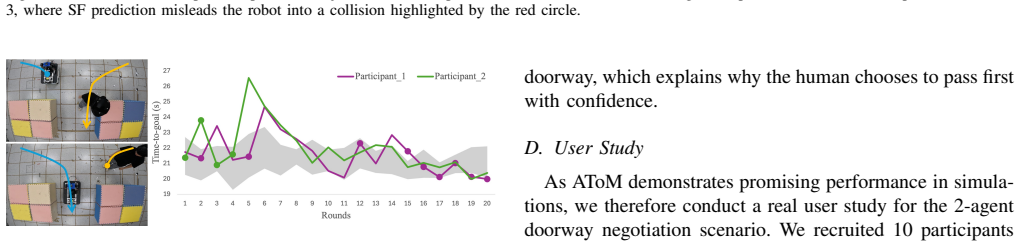
- The user study shows the same qualitative effect with real humans: when participants maintain consistent behaviors, the robot's time-to-goal decreases over rounds and no collisions occur.
Reading between the lines
- The same predict-observe-update loop could be applied to other recurring social settings where the key unknown is the other party's belief about you, such as driving in traffic or multi-agent negotiation.
- Because AToM explicitly outputs the human-predicted robot trajectory, a robot could use it not only to predict but also to shape the human's belief deliberately, e.g., by acting legibly to increase human confidence and efficiency.
- The experimental evidence is built largely from simulated humans whose behaviors are generated from the same kind of speed and distance quantities the model estimates, so the claimed transfer to real, non-Nash humans needs independent validation with more diverse and less cooperative participants.
- A testable extension would be to replace the fixed cost weights in the game with a richer parameter set (e.g., goal priority or altruism) and check whether the UKF can recover those as they change, which would broaden the interpretability claim beyond speed and social distance.
Editorial analysis
A structured set of objections, weighed in public.
Referee Report
Summary. This paper proposes AToM, an adaptive human motion prediction method for long-term human-robot interaction. It models the human's internal belief as a game-theoretic Nash equilibrium parameterized by behavioral parameters θ = [v_max, d], and uses an Unscented Kalman Filter to update these parameters from observed trajectories. The predicted human trajectory is then used by a downstream robot planner. The authors evaluate AToM in three simulated navigation scenarios and in a real user study with 10 participants performing a doorway negotiation task, comparing against Constant Velocity, Social Force, Trajectron++, and Memonet. They report lower prediction error, increased efficiency, and fewer collisions, and claim unique interpretability by inferring how the human predicts the robot.
Significance. If the claims are substantiated, AToM would be a meaningful contribution to long-term human-robot interaction, combining theory-of-mind reasoning with online parameter adaptation and offering a mechanism for interpretable human prediction. The reformulation of nested ToM into a tractable game-theoretic model plus UKF update is elegant, and the real-user study is a useful first step. The paper is generally well-structured and describes an approach that is reproducible from the text, with code promised. However, as detailed below, the current evidence does not yet support the comparative and interpretability claims, and several load-bearing technical points require attention.
major comments (5)
- [Section III-B, Eq. (3)] The social and obstacle cost terms are written as ws * max(0, ||x_i - x_n||_2 - d_s) and wo * max(0, D(x_i, O) - d_o). As written, these terms penalize distances larger than the preferred values, which would encourage agents to move closer together and into obstacles. The intended avoidance objective presumably requires max(0, d_s - ||x_i - x_n||_2) and max(0, d_o - D(x_i, O)). Please verify and correct this equation, since the definition of G and all subsequent results depend on it.
- [Section III-B, Eq. (5) and Algorithm 1 lines 5-7] The UKF measurement model M(x, θ) = f(x, G(x, θ)) predicts the robot state from the Nash solution of the differential game in Eq. (3). In contrast, the actual robot state at line 5 of Algorithm 1 is generated by RobotPlanner, which in all experiments is Pred2Nav, a sampling-based MPC. Unless Pred2Nav is exactly equivalent to the Nash strategy, the robot-state innovation will be a systematic, non-Gaussian error that the UKF can only absorb into θ, biasing the estimated human belief and the inferred 'human-predicted robot trajectory'. This also conflicts with the planner-agnostic claim in Section III. Please either demonstrate that the mismatch is negligible, treat the actual robot trajectory as an exogenous input to the human model, or restrict the UKF update to human-state measurements.
- [Section IV-A] The simulation scenarios specify evolving human behavior only in terms of speed and social distance, which are precisely the components of θ that AToM estimates. The paper does not describe the ground-truth human generator. If the human is simulated with the same game-theoretic model G using time-varying θ, then the simulation reduces to inverting the data generator and cannot independently validate the adaptive mechanism. Please specify the simulation generator explicitly and add at least one scenario where the human is generated by a different model (e.g., a social-force model with time-varying weights) to break the circularity.
- [Section IV-B, Fig. 2] The comparison against Trajectron++ and Memonet uses frozen pretrained weights, while SF weights are tuned per scenario. This treats baselines unevenly: the neural baselines are not adapted to the interaction scenario, so their poor ADE is expected. In addition, no repeated trials, error bars, or significance tests are reported; the claim that AToM's error is 'significantly lower' is therefore not supported. Please report results over multiple runs or seeds with error bars and appropriate statistical tests.
- [Section IV-D] The real-user study includes no baseline human prediction models. It demonstrates that AToM can drive the robot in a real doorway scenario without collisions, but it cannot support the paper's comparative claims of improved prediction, safety, or efficiency relative to existing methods. A within-subject comparison with at least one baseline, or a clear statement that the user study is purely demonstrative, is needed.
minor comments (5)
- [Section IV-A, Baselines] The word 'neighboorhood' is a misspelling of 'neighborhood'.
- [Section IV-B] The claim that AToM is the only method with decreasing error over rounds would be more convincing if the error of the human-predicted robot trajectory were plotted as a function of round, since that metric is central to the interpretability narrative.
- [Section III] The method is described as planner-agnostic, but all experiments use a single planner (Pred2Nav); testing at least one additional planner would substantiate this claim.
- [Section IV-A] The covariances Q_t and R are said to be set with 'empirical values'; a sensitivity analysis over these hyperparameters would help readers assess robustness.
- [Equation (3)] The notation x_min ≤ x_i^k ≤ x_max should state that inequalities are applied elementwise for vector states.
Circularity Check
No significant circularity; derivation is self-contained and predictions are not algebraically forced by the fitted parameters.
full rationale
The claimed derivation is not circular at the equation level. Eq. (3) defines a game-theoretic human internal model with free parameters θ; Eq. (4) obtains the Nash strategies via an external solver G; Eq. (5) is a standard UKF state-space formulation in which θ is a latent state whose evolution is a random walk and whose measurement model is the closed-loop game solver. Predicted human trajectories are generated by forward-simulating f_H with Ũ_H from G, and θ is estimated from observed human/robot states in Algorithm 1; the output X_hat_H is not algebraically equal to a fitted parameter or to the measurement innovation. The simulation scenarios describe human behavior changes in speed and social distance, which overlap with the semantics of θ=[v_max,d], but the paper never states that the simulator is generated by the same G or fitted θ, so there is no exhibited reduction of a prediction to an input by construction. The real user study is an external check, and the baselines (CV, SF, Trajectron++, Memonet) are independent. The only self-citations ([26], [30]) appear in non-load-bearing enumerations of prior planners. The 'human-predicted robot trajectory' is a latent interpretation produced by the model, not a separately predicted quantity, so its use in Sec. IV-C is a modeling interpretation rather than a circular derivation. The planner mismatch between RobotPlanner and the game solver G is a possible model misspecification, but it does not make the prediction equivalent to the input. Overall, no step in the derivation chain reduces to its own inputs.
Assumptions & free parameters
free parameters (7)
- Q and R state/control cost weights
- ws, wo social/obstacle avoidance weights
- ds, do preferred social/obstacle distances
- Initial theta = [v_max, d] for each agent
- Process noise covariance Q_t and measurement noise covariance R =
empirical values
- Scenario parameter schedules for simulated humans =
increasing speed, decreasing social distance; trolley weight; three behavioral stages
- SF baseline force weights =
tuned per scenario
assumptions (6)
- domain assumption The human maintains an internal model of the navigation problem and predicts optimal actions for all agents (Eqs. (3) and (4)).
- domain assumption A Nash equilibrium of the general-sum differential game describes the outcome of the interaction.
- ad hoc to paper Observed trajectories are generated by the measurement model M(x, theta) = f(x, G(x, theta)) plus Gaussian noise (Eq. (5)).
- ad hoc to paper Theta evolves as a random walk with known covariance (Eq. (5)).
- domain assumption Goal positions and obstacles are known to the robot and to the human model.
- domain assumption ILQSolver returns a global Nash equilibrium of the generalized Nash problem.
Cite this review
Pith. "Pith review of AToM: Adaptive Theory-of-Mind-Based Human Motion Prediction in Long-Term Human-Robot Interactions." pith.science (2026). https://pith.science/paper/6APCUYQ4
@misc{pith2026250205792,
  author       = {Pith},
  title        = {Pith review of: AToM: Adaptive Theory-of-Mind-Based Human Motion Prediction in Long-Term Human-Robot Interactions},
  year         = {2026},
  howpublished = {\url{https://pith.science/paper/6APCUYQ4}},
  note         = {Machine review of arXiv:2502.05792}
}
read the original abstract
Humans learn from observations and experiences to adjust their behaviours towards better performance. Interacting with such dynamic humans is challenging, as the robot needs to predict the humans accurately for safe and efficient operations. Long-term interactions with dynamic humans have not been extensively studied by prior works. We propose an adaptive human prediction model based on the Theory-of-Mind (ToM), a fundamental social-cognitive ability that enables humans to infer others' behaviours and intentions. We formulate the human internal belief about others using a game-theoretic model, which predicts the future motions of all agents in a navigation scenario. To estimate an evolving belief, we use an Unscented Kalman Filter to update the behavioural parameters in the human internal model. Our formulation provides unique interpretability to dynamic human behaviours by inferring how the human predicts the robot. We demonstrate through long-term experiments in both simulations and real-world settings that our prediction effectively promotes safety and efficiency in downstream robot planning. Code will be available at https://github.com/centiLinda/AToM-human-prediction.git.
Figures


Figures from the paper (3 more)


Reference graph
Works this paper leans on
-
[1]
Towards robots that influ- ence humans over long-term interaction,
S. Sagheb, Y .-J. Mun, N. Ahmadian, B. A. Christie, A. Bajcsy, K. Driggs-Campbell, and D. P. Losey, “Towards robots that influ- ence humans over long-term interaction,” in 2023 IEEE International Conference on Robotics and Automation (ICRA) . IEEE, 2023, pp. 7490–7496
work page 2023
-
[2]
Human motion trajectory prediction: A survey,
A. Rudenko, L. Palmieri, M. Herman, K. M. Kitani, D. M. Gavrila, and K. O. Arras, “Human motion trajectory prediction: A survey,” The International Journal of Robotics Research , vol. 39, no. 8, pp. 895–935, 2020
2020
-
[3]
R. Korbmacher and A. Tordeux, “Review of pedestrian trajectory prediction methods: Comparing deep learning and knowledge-based approaches,” IEEE Transactions on Intelligent Transportation Systems, vol. 23, no. 12, pp. 24 126–24 144, 2022
work page 2022
-
[4]
A review of deep learning-based methods for pedestrian trajectory prediction,
B. I. Sighencea, R. I. Stanciu, and C. D. C ˘aleanu, “A review of deep learning-based methods for pedestrian trajectory prediction,” Sensors, vol. 21, no. 22, p. 7543, 2021
work page 2021
-
[5]
How much does it help to know what she knows you know? an agent-based simulation study,
H. De Weerd, R. Verbrugge, and B. Verheij, “How much does it help to know what she knows you know? an agent-based simulation study,” Artificial Intelligence, vol. 199, pp. 67–92, 2013
work page 2013
-
[6]
Higher-order theory of mind in the tacit communication game,
——, “Higher-order theory of mind in the tacit communication game,” Biologically Inspired Cognitive Architectures , vol. 11, pp. 10–21, 2015
work page 2015
-
[7]
The minds of many: Opponent modeling in a stochastic game
F. B. V on Der Osten, M. Kirley, and T. Miller, “The minds of many: Opponent modeling in a stochastic game.” in IJCAI, 2017, pp. 3845– 3851
work page 2017
-
[8]
Modeling human plan recognition using bayesian theory of mind,
C. L. Baker and J. B. Tenenbaum, “Modeling human plan recognition using bayesian theory of mind,” Plan, Activity, and Intent Recognition: Theory and Practice , vol. 7, no. 177-204, p. 86, 2014
work page 2014
Show all 39 references
-
[9]
Machine theory of mind,
N. Rabinowitz, F. Perbet, F. Song, C. Zhang, S. A. Eslami, and M. Botvinick, “Machine theory of mind,” in International Conference on Machine Learning . PMLR, 2018, pp. 4218–4227
2018
-
[10]
Learning human rewards by inferring their latent intelligence levels in multi-agent games: A theory- of-mind approach with application to driving data,
R. Tian, M. Tomizuka, and L. Sun, “Learning human rewards by inferring their latent intelligence levels in multi-agent games: A theory- of-mind approach with application to driving data,” in 2021 IEEE/RSJ International Conference on Intelligent Robots and Systems (IROS) . IEEE...
2021
-
[11]
Knowing me, knowing you: theory of mind in ai,
F. Cuzzolin, A. Morelli, B. Cirstea, and B. J. Sahakian, “Knowing me, knowing you: theory of mind in ai,” Psychological Medicine, vol. 50, no. 7, pp. 1057–1061, 2020
2020
-
[12]
Leveraging neural network gradients within trajectory optimization for proactive human-robot interactions,
S. Schaefer, K. Leung, B. Ivanovic, and M. Pavone, “Leveraging neural network gradients within trajectory optimization for proactive human-robot interactions,” in 2021 IEEE International Conference on Robotics and Automation (ICRA) . IEEE, 2021, pp. 9673–9679
2021
-
[13]
Safety assurances for human-robot interaction via confidence-aware game-theoretic human models,
R. Tian, L. Sun, A. Bajcsy, M. Tomizuka, and A. D. Dragan, “Safety assurances for human-robot interaction via confidence-aware game-theoretic human models,” in 2022 International Conference on Robotics and Automation (ICRA) . IEEE, 2022, pp. 11 229–11 235
2022
-
[14]
Legible and proactive robot planning for prosocial human-robot interactions,
J. Geldenbott and K. Leung, “Legible and proactive robot planning for prosocial human-robot interactions,” arXiv preprint arXiv:2404.03734, 2024
2024 arXiv
-
[15]
Dynamically switching human prediction models for efficient planning,
A. Sripathy, A. Bobu, D. S. Brown, and A. D. Dragan, “Dynamically switching human prediction models for efficient planning,” in 2021 IEEE International Conference on Robotics and Automation (ICRA) . IEEE, 2021, pp. 3495–3501
2021
-
[16]
Towards model- ing and influencing the dynamics of human learning,
R. Tian, M. Tomizuka, A. D. Dragan, and A. Bajcsy, “Towards model- ing and influencing the dynamics of human learning,” in Proceedings of the 2023 ACM/IEEE International Conference on Human-Robot Interaction, 2023, pp. 350–358
2023
-
[17]
Learning latent representations to co-adapt to humans,
S. Parekh and D. P. Losey, “Learning latent representations to co-adapt to humans,” Autonomous Robots, vol. 47, no. 6, pp. 771–796, 2023
2023
-
[18]
Adaptive pedestrian agent model- ing for scenario-based testing of autonomous vehicles through behav- ior retargeting,
G. M. Muktadir and J. Whitehead, “Adaptive pedestrian agent model- ing for scenario-based testing of autonomous vehicles through behav- ior retargeting,” in IEEE Int. Conf. Robot. Automat.(ICRA) , 2024
2024
-
[19]
Proactive opinion-driven robot navigation around human movers,
C. Cathcart, M. Santos, S. Park, and N. E. Leonard, “Proactive opinion-driven robot navigation around human movers,” in 2023 IEEE/RSJ International Conference on Intelligent Robots and Systems (IROS). IEEE, 2023, pp. 4052–4058
2023
-
[20]
Depth-based obsta- cle avoidance through deep reinforcement learning,
K. Wu, M. A. Esfahani, S. Yuan, and H. Wang, “Depth-based obsta- cle avoidance through deep reinforcement learning,” in Proceedings of the 5th International Conference on Mechatronics and Robotics Engineering, 2019, pp. 102–106
2019
-
[21]
Learn to steer through deep reinforcement learning,
K. Wu, M. Abolfazli Esfahani, S. Yuan, and H. Wang, “Learn to steer through deep reinforcement learning,”Sensors, vol. 18, no. 11, p. 3650, 2018
2018
-
[22]
Learn to navigate au- tonomously through deep reinforcement learning,
K. Wu, H. Wang, M. A. Esfahani, and S. Yuan, “Learn to navigate au- tonomously through deep reinforcement learning,” IEEE Transactions on Industrial Electronics , vol. 69, no. 5, pp. 5342–5352, 2021
2021
-
[23]
Achieving real-time path planning in unknown environments through deep neural networks,
——, “Achieving real-time path planning in unknown environments through deep neural networks,” IEEE Transactions on Intelligent Transportation Systems, vol. 23, no. 3, pp. 2093–2102, 2020
2020
-
[24]
Bnd*-ddqn: Learn to steer autonomously through deep rein- forcement learning,
——, “Bnd*-ddqn: Learn to steer autonomously through deep rein- forcement learning,” IEEE Transactions on Cognitive and Develop- mental Systems, vol. 13, no. 2, pp. 249–261, 2019
2019
-
[25]
Tdpp-net: Achieving three-dimensional path planning via a deep neural network architec- ture,
K. Wu, M. A. Esfahani, S. Yuan, and H. Wang, “Tdpp-net: Achieving three-dimensional path planning via a deep neural network architec- ture,” Neurocomputing, vol. 357, pp. 151–162, 2019
2019
-
[26]
Direct: A differential dy- namic programming based framework for trajectory generation,
K. Cao, M. Cao, S. Yuan, and L. Xie, “Direct: A differential dy- namic programming based framework for trajectory generation,” IEEE Robotics and Automation Letters , vol. 7, no. 2, pp. 2439–2446, 2022
2022
-
[27]
Social force model for pedestrian dynam- ics,
D. Helbing and P. Molnar, “Social force model for pedestrian dynam- ics,” Physical Review E , vol. 51, no. 5, p. 4282, 1995
1995
-
[28]
Tra- jectron++: Dynamically-feasible trajectory forecasting with heteroge- neous data,
T. Salzmann, B. Ivanovic, P. Chakravarty, and M. Pavone, “Tra- jectron++: Dynamically-feasible trajectory forecasting with heteroge- neous data,” in Computer Vision–ECCV 2020: 16th European Confer- ence, Glasgow, UK, August 23–28, 2020, Proceedings, Part XVIII 16 . Springer, 2...
2020
-
[29]
Remember intentions: Retrospective-memory-based trajectory prediction,
C. Xu, W. Mao, W. Zhang, and S. Chen, “Remember intentions: Retrospective-memory-based trajectory prediction,” in Proceedings of the IEEE/CVF Conference on Computer Vision and Pattern Recogni- tion, 2022, pp. 6488–6497
2022
-
[30]
Learning dynamic weight adjustment for spatial-temporal trajectory planning in crowd navigation,
M. Cao, X. Xu, Y . Yang, J. Li, T. Jin, P. Wang, T.-Y . Hung, G. Lin, and L. Xie, “Learning dynamic weight adjustment for spatial-temporal trajectory planning in crowd navigation,” 2024. [Online]. Available: https://arxiv.org/abs/2412.00555
2024 arXiv
-
[31]
Multi-agent navigation in human-shared environments: A safe and socially-aware approach,
M. Boldrer, A. Antonucci, P. Bevilacqua, L. Palopoli, and D. Fontanelli, “Multi-agent navigation in human-shared environments: A safe and socially-aware approach,” Robotics and Autonomous Sys- tems, vol. 149, p. 103979, 2022
2022
-
[32]
Socially-aware reactive obstacle avoidance strategy based on limit cycle,
M. Boldrer, M. Andreetto, S. Divan, L. Palopoli, and D. Fontanelli, “Socially-aware reactive obstacle avoidance strategy based on limit cycle,” IEEE Robotics and Automation Letters, vol. 5, no. 2, pp. 3251– 3258, 2020
2020
-
[33]
Integrating predictive motion uncertainties with distributionally robust risk-aware control for safe robot navigation in crowds,
K. Ryu and N. Mehr, “Integrating predictive motion uncertainties with distributionally robust risk-aware control for safe robot navigation in crowds,” arXiv preprint arXiv:2403.05081 , 2024
2024 arXiv
-
[34]
From crowd motion prediction to robot navigation in crowds,
S. Poddar, C. Mavrogiannis, and S. S. Srinivasa, “From crowd motion prediction to robot navigation in crowds,” in 2023 IEEE/RSJ Interna- tional Conference on Intelligent Robots and Systems (IROS) . IEEE, 2023, pp. 6765–6772
2023
-
[35]
Generalized nash equilibrium problems,
F. Facchinei and C. Kanzow, “Generalized nash equilibrium problems,” Annals of Operations Research , vol. 175, no. 1, pp. 177–211, 2010
2010
-
[36]
Efficient iterative linear-quadratic approximations for non- linear multi-player general-sum differential games,
D. Fridovich-Keil, E. Ratner, L. Peters, A. D. Dragan, and C. J. Tomlin, “Efficient iterative linear-quadratic approximations for non- linear multi-player general-sum differential games,” in 2020 IEEE International Conference on Robotics and Automation (ICRA). IEEE, 2020, pp. ...
2020
-
[37]
Lucidgames: Online unscented inverse dynamic games for adaptive trajectory prediction and planning,
S. Le Cleac’h, M. Schwager, and Z. Manchester, “Lucidgames: Online unscented inverse dynamic games for adaptive trajectory prediction and planning,” IEEE Robotics and Automation Letters , vol. 6, no. 3, pp. 5485–5492, 2021
2021
-
[38]
Emergent coordination through game-induced nonlinear opinion dy- namics,
H. Hu, K. Nakamura, K.-C. Hsu, N. E. Leonard, and J. F. Fisac, “Emergent coordination through game-induced nonlinear opinion dy- namics,” in 2023 62nd IEEE Conference on Decision and Control (CDC). IEEE, 2023, pp. 8122–8129
2023
-
[39]
The unscented kalman filter for nonlinear estimation,
E. A. Wan and R. Van Der Merwe, “The unscented kalman filter for nonlinear estimation,” in Proceedings of the IEEE 2000 Adaptive Sys- tems for Signal Processing, Communications, and Control Symposium (Cat. No. 00EX373) . IEEE, 2000, pp. 153–158
2000
Reviewed August 8, 2026 · model on record in the stance chip above.
Discussion (0). Continue with ORCID to comment.