REVIEW 1 major objections 5 minor 17 references
Homology in Combinatorial Refraction Billiards
T0 review · 1 major / 5 minor · reviewed 2026-08-08 · deepseek-v4-flash
Pith's one-line read The paper proves a torus billiard system built from a graph expels every trajectory exactly when the graph is bipartite, and gives a partial classification of the opposite, ensnaring case.
desk verdict Clean new classification — expelling iff bipartite — with a correct proof; later sections are sketchier but the core is solid. read the letter →
The pith
A machine-rendered reading of the paper's core claim, the machinery that carries it, and where it could break.
The reading
What carries the argument
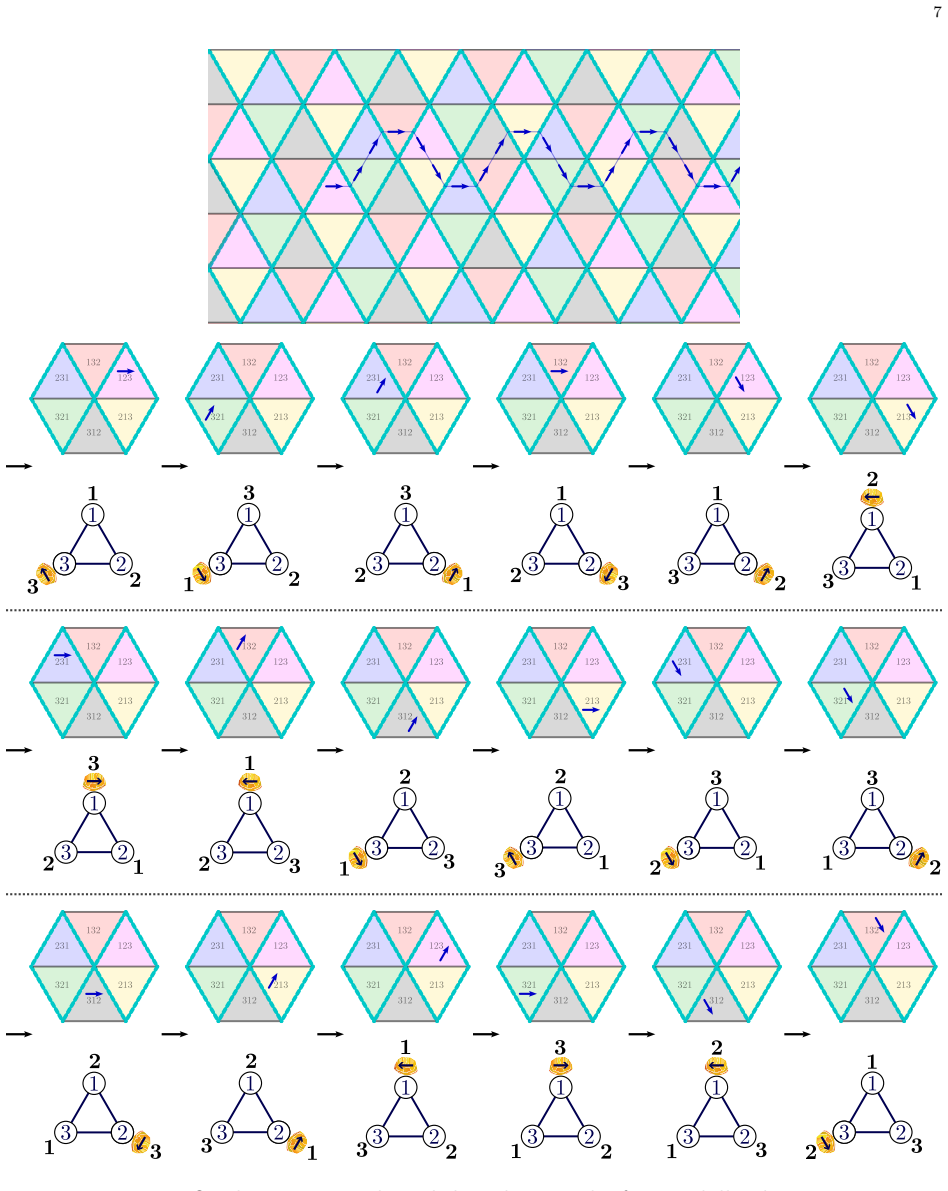
The load-bearing object is the stone diagram, a finite combinatorial picture of an orbit: each vertex of $G$ has a labeled replica on a cycle of length $n$, and a stone with a clockwise or counterclockwise orientation marks the active position. The map $\Theta_G$ swaps the two replicas next to the stone and either moves the stone (if the corresponding vertices are non-adjacent) or reverses its direction (if they are adjacent). For an orbit $\mathcal{O}$, the winding vector $\vec w_{\mathcal O}\in\mathbb{Z}^n$ records the net clockwise displacement of each replica after one full period, and Proposition 2.4 reduces the topological question to algebra: a trajectory is contractible exactly when this vector is the zero vector, because zero winding is equivalent to boundedness of every lift to the affine symmetric group. Ensnaring and expelling thus become properties of the winding vectors of a finite dynamical system.
What would settle it
Run the orbit of $\Theta_G$ for the triangle graph $K_3$ starting from the identity stone diagram $(\mathrm{id},1,1)$; the paper predicts the orbit has zero winding vector. Alternatively, run any orbit for an even cycle such as $C_4$, which the paper predicts always has nonzero winding vector; a single counterexample to either prediction would disprove the expelling-bipartite dichotomy.
Extended reading notes
Core claim
The central claim is a dichotomy: a graph $G$ is expelling, meaning no billiard trajectory in the toric system is contractible, if and only if $G$ is bipartite (Theorem 3.1). In the bipartite direction, the stone-diagram model shows that two replicas belonging to opposite parts of the bipartition always wind in opposite directions, so the winding vector cannot be zero. In the converse direction, an induced odd cycle is used to build a periodic orbit whose replicas never cross a particular edge of the surrounding cycle, forcing the winding vector to vanish and the trajectory to contract. The paper then studies ensnaring graphs, where all trajectories are contractible: complete graphs $K_n$ for $n\ge 3$ are ensnaring, a cycle $C_n$ is ensnaring exactly for odd $n$, wedging two ensnaring graphs at a vertex preserves ensnaring, and a disjoint union is ensnaring exactly when both factors are ensnaring and neither is revolutionary, meaning no orbit's stone has nonzero winding. It also proves a complement reduction: a graph with $n$ vertices is ensnaring exactly when, for every connected component $C$ of its complement, the $n$-vertex complement of $C$ is ensnaring.
Load-bearing premise
The classification rests on identifying contractibility of a continuous toric trajectory with vanishing of the discrete winding vector; if a continuous loop could fail to contract while its discretization had zero winding, or vice versa, the theorems would no longer follow.
Editorial extensions
If this is right
- Every bipartite graph is expelling, and every expelling graph is bipartite, so the topological behavior of all trajectories in the expelling case is decided by a single classical graph invariant.
- Complete graphs with at least three vertices are ensnaring: the stone never leaves its initial position, so no replica crosses the cycle edge opposite the stone, forcing zero winding.
- A cycle graph $C_n$ is ensnaring exactly when $n$ is odd; even cycles are expelling by bipartiteness, while odd cycles force all replicas to share the same winding number, which must be zero.
- Wedging two ensnaring graphs at a vertex preserves ensnaring, whereas a disjoint union is ensnaring exactly when both factors are ensnaring and neither is revolutionary.
- The complement reduction says ensnaring can be checked componentwise on the complement, and it implies, for instance, that a graph whose complement has a clique of size at least two as a connected component is not ensnaring.
Reading between the lines
- The bipartite dichotomy suggests a broader principle: for the mirror-and-refraction generalization sketched in Section 9, expelling may correspond to contracting all reflection edges and then asking whether the quotient is bipartite; testing this on materialized cycles would be a direct next step.
- The local obstruction in Theorem 7.1 indicates that non-ensnaring can be caused by small induced configurations, so it is reasonable to ask whether ensnaring admits a forbidden-induced-configuration characterization rather than only a global one.
- The parity condition in the classification of complements of complete bipartite graphs points toward a general rule in which the ensnaring status of an $n$-vertex complement depends only on the parity of $n$, as Conjecture 8.3 proposes.
- The winding-vector criterion is effectively a discrete homology invariant for periodic trajectories, so the paper's result offers a purely finite way to certify contractibility or non-contractibility in a continuous torus billiard system.
Editorial analysis
A structured set of objections, weighed in public.
Referee Report
Summary. The paper introduces a topological perspective on the toric combinatorial refraction billiards of Adams, Defant, and Striker. For a graph G, trajectories are periodic loops in an (n−1)-torus, and the paper defines G to be ensnaring if all such loops are contractible and expelling if none is contractible. The central result is Theorem 3.1, which characterizes expelling graphs as exactly the bipartite graphs. The paper then studies ensnaring graphs: complete graphs and odd cycles are ensnaring, wedges of ensnaring graphs are ensnaring, disjoint unions are governed by a new notion of revolutionary graphs, certain wedges of complete graphs with trees are ensnaring, and several necessary and sufficient conditions are given in terms of complements. The final section collects conjectures and a generalization to graphs with both reflection and refraction edges.
Significance. The bipartite characterization in Theorem 3.1 is a crisp and attractive result: it reduces a topological property of all toric refraction billiard trajectories of a graph to a single standard graph invariant. Proposition 2.4, which reduces contractibility to vanishing of the winding vector in the stone-diagram model, is a useful bridge between the continuous and combinatorial settings. The paper also provides explicit orbit-level constructions for many ensnaring and non-ensnaring examples, and the later complement theorems give a substantial family of dense ensnaring graphs. The proofs are largely self-contained, and the main theorem is supported by a clear geometric mechanism. The stress-test concern about Proposition 3.2 does not land: the proposed counterexample is obtained by traversing the orbit in the reverse direction and therefore does not contradict the forward-time monotonicity claim used in the proof.
major comments (1)
- [§3, Proposition 3.2] The proof's final implication, 'This immediately implies that x and y have different winding numbers,' is terse. It is mathematically correct, but it relies on the standard fact that the difference of the winding numbers of two replicas equals the net number of times one passes the other; I recommend stating this explicitly. I also checked the alleged counterexample in the stress test. For the graph with edge {1,2}, bipartition X={1}, Y={2,3}, and the starting state (0,1,2) with the stone pointing clockwise and coexisting with replica 1, the forward orbit under Θ_G is (0,1,2) → (1,0,2) → (1,2,0) → (2,1,0) → (0,1,2), not the reversed sequence (0,1,2) → (2,1,0) → (1,2,0) → (1,0,2) → (0,1,2). In the forward orbit, both swaps of replicas 1 and 2 move replica 1 clockwise and replica 2 counterclockwise. Thus the proposed counterexample does not invalidate the proof.
minor comments (5)
- [§3, Proposition 3.2] The invariant that the stone points clockwise when the coin is on a vertex in X and counterclockwise when the coin is on a vertex in Y would be clearer if the authors noted that non-adjacent swaps preserve the coin vertex and the stone orientation, while adjacent swaps change both; this is the whole content of the claim 'This implies...'.
- [§5, Theorem 5.5] There is a typo in the proof: 'we may asssume n1 > 1' should read 'we may assume n1 > 1'.
- [§8, Theorem 8.6] The case analysis in the proof of Theorem 8.6 is quite dense, especially the m-odd case; a table or figure tracking the bridged-edge orientations and the positions of a1 and a2 would improve readability.
- [§2] The footnote attached to 'metalenses' is numbered with a stray '1' in the displayed text; the formatting should be cleaned up.
- [§6, Theorem 6.3] The proof of Theorem 6.3 is compressed, particularly the sentence 'similar to the proof of Proposition 6.1, we know D′ can be obtained from taking D, swapping va and vc, and then taking a rotation'; adding a short justification or an illustrative figure would help the reader verify this key symmetry step.
Circularity Check
No circularity found: the expelling/bipartite theorem is derived from the billiard model and winding-vector criterion rather than assumed.
full rationale
The paper's central claim, Theorem 3.1 (expelling if and only if bipartite), is not obtained by assuming its conclusion. Section 2 derives Proposition 2.4, which identifies contractibility of a toric billiard trajectory with vanishing winding vector, by lifting the closed trajectory to the Euclidean alcove path and showing that the displacement after one period is exactly the negative winding vector (Bu_lP = Bu_l - w_O). This is a substantive bridge from the continuous/topological setup to the combinatorial stone-diagram model, not a definitional equivalence imposed in the statement of the theorem. Proposition 3.2 then proves that bipartite graphs are expelling by analyzing stone orientation and replica motion, while Proposition 3.3 proves the converse by constructing a pleasant stone diagram on an odd cycle and arguing that its winding vector vanishes. Both arguments operate on the combinatorial model established independently in Section 2 rather than invoking Theorem 3.1. The paper does rely on the authors' prior article [1] for the original refraction-billiard framework, the definition of Theta_G, the stone-diagram convention, and a tree lemma used in Section 6; these are background tools or auxiliary results, and they are parameter-free lemmas whose assumptions do not include the present target theorem. No fitted parameter is later renamed as a prediction, and no uniqueness theorem from the authors' own work is used to forbid alternatives. The classification theorem therefore has independent mathematical content, and the derivation does not reduce to its inputs by construction.
Assumptions & free parameters
assumptions (3)
- standard math H_n is the Coxeter arrangement of the affine symmetric group eS_n, with the stated faithful action on V.
- domain assumption The map Theta_G and the stone and coin diagrams from [1] faithfully discretize the continuous toric refraction billiards, and contractibility of a loop is detected by the winding vector.
- domain assumption In any orbit of a tree, every replica swaps past every other replica (Lemma 5.1 of [1]).
Cite this review
Pith. "Pith review of Homology in Combinatorial Refraction Billiards." pith.science (2026). https://pith.science/paper/HRVNPB2T
@misc{pith2026250206013,
  author       = {Pith},
  title        = {Pith review of: Homology in Combinatorial Refraction Billiards},
  year         = {2026},
  howpublished = {\url{https://pith.science/paper/HRVNPB2T}},
  note         = {Machine review of arXiv:2502.06013}
}
abstract
Given a graph $G$ with vertex set $\{1,\ldots,n\}$, we can project the graphical arrangement of $G$ to an $(n-1)$-dimensional torus to obtain a toric hyperplane arrangement. Adams, Defant, and Striker constructed a toric combinatorial refraction billiard system in which beams of light travel in the torus, refracting (with refraction coefficient $-1$) whenever they hit one of the toric hyperplanes in this toric arrangement. Each billiard trajectory in this system is periodic. We adopt a topological perspective and view the billiard trajectories as closed loops in the torus. We say $G$ is ensnaring if all of the billiard trajectories are contractible, and we say $G$ is expelling if none of the billiard trajectories is contractible. Our first main result states that a graph is expelling if and only if it is bipartite. We then provide several necessary conditions and several sufficient conditions for a graph to be ensnaring. For example, we show that the complement of an ensnaring graph cannot have a clique as a connected component. We also discuss ways to construct ensnaring graphs from other ensnaring graphs. For example, gluing two ensnaring graphs at a single vertex always yields another ensnaring graph.
Figures


Figures from the paper (4 more)


Reference graph
Works this paper leans on
- [1]
-
[2]
P. Baird-Smith, D. Davis, E. Fromm, and S. Iyer. Tiling billards on triangle tilings, and interval exchange transformations. J. Lond. Math. Soc., 109 (2024)
work page 2024
-
[3]
G. Barkley and R. Liu. Channels, billiards, and perfect matching 2-divisibility. Electron. J. Combin., 28 (2021)
work page 2021
-
[4]
G. Barkley, C. Defant, E. Hodges, N. Kravitz, and M. Lee. Bender–Knuth billiards in Coxeter groups. Forum Math. Sigma, 13 (2025)
work page 2025
-
[5]
V. L. Barutello, I. De Blasi, and S. Terracini. Chaotic dynamics in refraction galactic billiards. Nonlinearity, 36 (2023)
work page 2023
- [6]
-
[7]
D. Davis and W. P. Hooper. Periodicity and ergodicity in the trihexagonal tiling. Comment. Math. Helv., 93 (2018), 661–707
work page 2018
-
[8]
I. De Blasi and S. Terracini. Refraction periodic trajectories in central mass galaxies. Nonlinear Anal., 218 (2022)
work page 2022
Show all 17 references
-
[9]
De Blasi and S
I. De Blasi and S. Terracini. On some refraction billiards. Discrete Contin. Dyn. Syst., 43 (2023), 1269–1318
2023
-
[10]
C. Defant. Random combinatorial billiards and stoned exclusion processes. Preprint: arXiv:2406.07858
-
[11]
C. Defant. Toric promotion. Proc. Amer. Math. Soc., 150 (2022)
2022
-
[12]
Defant and P
C. Defant and P. Jiradilok. Triangular-grid billiards and plabic graphs. Comb. Theory, 3 (2023)
2023
-
[13]
Defant, P
C. Defant, P. Jiradilok, and E. Mossel. Random subwords and billiard walks in affine Weyl groups. Preprint: arXiv:2501.11095
-
[14]
M. Jay. Deviations for generalized tiling billiards in cyclic polygons. Preprint: arXiv:2402.15765
-
[15]
Paris-Romaskevich
O. Paris-Romaskevich. Tiling billiards and Dynnikov’s helicoid. Trans. Moscow Math. Soc., 2021 (2021), 133– 147
2021
-
[16]
Smith, J
D. Smith, J. Pendry, and M. Wiltshire. Metamaterials and negative refractive index. Science, 305 (2004), 788– 792
2004
-
[17]
H. Zhu. The maximum number of cycles in a triangular-grid billiards system with a given perimeter. Preprint: arXiv:2309.00100. Department of Mathematics, Harvard University, Cambridge, MA 02138, USA Email address: colindefant@gmail.com Department of Mathematics, Massachusetts ...
Reviewed August 8, 2026 · model on record in the stance chip above.
Discussion (0). Continue with ORCID to comment.