REVIEW 4 major objections 4 minor 63 references
Traveling Waves Integrate Spatial Information Through Time
T0 review · 4 major / 4 minor · reviewed 2026-08-08 · deepseek-v4-flash
Pith's one-line read The paper claims that locally connected recurrent networks can use traveling waves in time to integrate global spatial information, matching non-local U-Nets with fewer parameters.
desk verdict Solid empirical demonstration that time-series readouts unlock global integration in recurrent nets, but the causal role of traveling waves is unproven. read the letter →
The pith
A machine-rendered reading of the paper's core claim, the machinery that carries it, and where it could break.
The reading
What carries the argument
The workhorse is the Neural Wave Machine (NWM), a locally coupled oscillatory recurrent network whose update is $\partial^2 h/\partial t^2 = \sigma(w_h \star h) - \gamma_\theta(x)\odot h - \alpha_\theta(x)\odot \partial h/\partial t$. The recurrent kernel is initialized to the five-point stencil of the 2D Laplacian, biasing the hidden state toward wave propagation; the input image controls the natural frequency $\gamma$ and damping $\alpha$ through shallow convolutional encoders, creating soft boundaries that reflect and shape the waves. The readout treats the per-neuron time series as the representation, using a learned linear projection or Fourier coefficient amplitudes rather than the last hidden state. The drum analogy supplies the theoretical justification: normal modes of the wave equation encode global boundary geometry, so a locally coupled system evolved to a steady state carries global information in its frequency content.
What would settle it
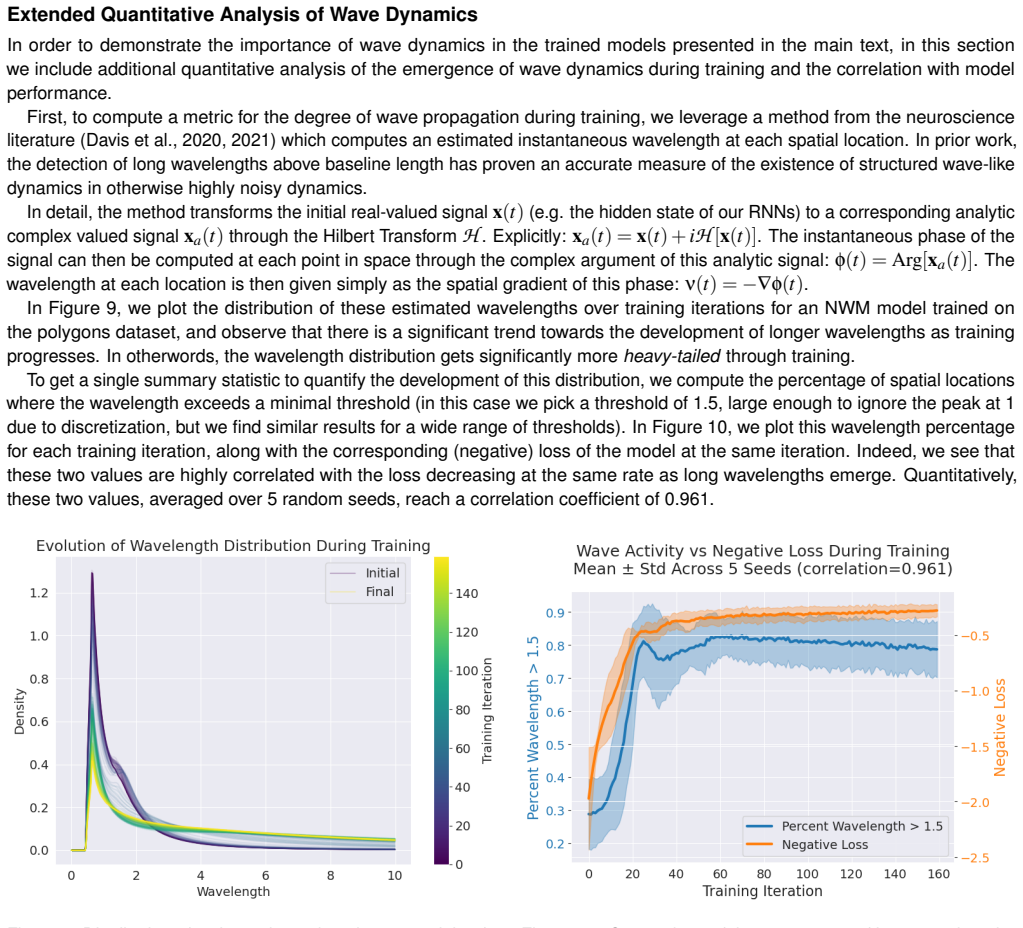
Train the same NWM on Multi-MNIST with the recurrent kernel fixed to a non-wave operator (for example, a random or diffusion-like kernel) and with the input-dependent frequency and damping disabled, keeping the 100 timesteps and the linear readout unchanged. If pixel-wise segmentation accuracy stays at the reported level, the claim that traveling waves expand the receptive field is false; likewise, a training run where loss decreases without any measurable emergence of long wavelengths would contradict the $R^{2}$ = 0.961 correlation.
Extended reading notes
Core claim
The central claim is that traveling waves effectively expand the receptive field of locally connected neurons, enabling long-range encoding and communication of information through time rather than through depth or all-to-all connectivity. The paper demonstrates this by training convolutional recurrent networks whose hidden states follow second-order oscillatory dynamics with input-dependent natural frequencies and damping; the input image sets up 'soft boundaries' that shape how waves propagate, and the resulting time series at each neuron becomes a globally integrated representation. Reading out a learned linear projection of these time series yields pixel-level semantic segmentation on Polygons, Tetrominoes, MNIST, and a new Multi-MNIST dataset. The wave-based model outperforms local feed-forward baselines of comparable size, matches deeper U-Nets, and shows lower variance across seeds; a Conv-LSTM without any wave bias also learns to generate traveling waves, and the emergence of long wavelengths tracks the drop in loss with correlation $R^{2}$ = 0.961.
Load-bearing premise
The load-bearing premise is that the performance gains come from traveling-wave dynamics itself rather than from the extra computation of 100 recurrent steps or from the temporal readout's power to pool information; the paper's direct evidence is a correlation between long-wavelength emergence and loss reduction, with no ablation that removes wave structure while keeping recurrence and readout fixed.
Editorial extensions
If this is right
- Locally constrained recurrent networks with time-series readouts can solve semantic segmentation tasks that require global context, without depth or non-local connections.
- The readout mechanism matters: using only the last hidden state degrades performance, while linear projections of the full time series work best, suggesting that temporal dynamics themselves are the representation.
- Wave dynamics can emerge spontaneously under local recurrence, as the Conv-LSTM learns to propagate waves despite no explicit wave bias.
- Wave-based integration is parameter-efficient and training-stable: the 54K-parameter NWM outperforms U-Nets with 30K and 68K parameters on Multi-MNIST and matches larger U-Nets with lower variance.
- Because the representations span space and frequency, they may be more directly comparable to EEG/MEG measurements than standard deep-network features.
Reading between the lines
- A direct testable extension would hold recurrence depth and readout fixed while randomizing or suppressing the wave structure (for example, freezing the recurrent kernel to a non-wave operator or destroying long-wavelength phase structure); if performance survives, the causal role of traveling waves would be weakened.
- The drum analogy suggests an untested prediction: tasks whose solutions require global shape or boundary information, such as contour completion, inpainting, or scene layout reasoning, should show larger relative gains from wave-based readouts than tasks answerable from local texture.
- If the timeseries readout is the key ingredient, it could be grafted onto other recurrent vision models as a general mechanism for converting temporal dynamics into spatial context, independent of the specific wave equation.
- The finding that a non-wave-biased LSTM still converges to wave-like dynamics hints that traveling waves may be an attractor solution for efficient information transfer under local connectivity; a regularization term that rewards long wavelengths could be tested for faster or more stable convergence in other domains.
Editorial analysis
A structured set of objections, weighed in public.
Referee Report
Summary. The paper proposes that locally connected recurrent networks with wave-like dynamics can integrate global spatial information through time, drawing an analogy to Kac's drum problem. It introduces a Neural Wave Machine (NWM) whose recurrent kernel is initialized to a Laplacian stencil and whose natural frequencies and damping are input-dependent, and it reads out class logits from a linear projection of the hidden-state time series. Experiments on Polygons, Tetrominoes, MNIST, and a new Multi-MNIST dataset compare NWM and Conv-LSTM variants with local CNNs and U-Nets, reporting that the NWM matches or exceeds U-Nets of similar parameter count on Multi-MNIST while using only local connectivity. The appendix validates that the discretized wave equation reproduces theoretical drum frequencies and reports a correlation between the emergence of long wavelengths and decreasing loss.
Significance. If the central claim were established, the paper would offer a biologically motivated alternative to non-local architectures for global-context tasks, with a parameter-efficient recurrent design and a connection to cortical traveling-wave recordings. The study is carefully executed in several respects: the local-receptive-field constraint is enforced and visualized, many random seeds are used (360 models), the code is released, and the U-Net comparisons control for parameter count. However, the paper's headline mechanistic claim—that traveling-wave structure, rather than recurrence plus temporal readout, causes the performance—is not yet supported by the evidence; the missing ablation is central and should be added before publication.
major comments (4)
- [Models, Eq. (9); Appendix 'Extended Quantitative Analysis of Wave Dynamics'] The claim that traveling waves 'effectively expand the receptive field' requires an ablation that removes or randomizes wave structure while keeping recurrence, timesteps, and readout fixed. The only direct evidence offered is the training-time correlation in Figures 9–10 (R²=0.961), but both the wavelength fraction and the loss are monotone over training, so the correlation is weak evidence of causation. A control with a randomly initialized recurrent kernel (or with input-dependent frequencies disabled) would establish that wave-like dynamics, not generic local recurrent mixing on a torus, is responsible for the long-range integration.
- [Models and Table 1] The comparison between NWM and Conv-LSTM conflates wave dynamics with extra sequential computation: NWM is trained for 100 recurrent steps while Conv-LSTM is trained for 20 steps, and the linear time-projection readout is itself a temporal-pooling mechanism. To support the claim that waves specifically help, the paper should include a non-wave recurrent baseline with the same number of timesteps and the same readout, and ideally a wave-suppressed variant of the NWM at matched compute.
- [Metrics, Eq. (21)] The FG-IoU metric is non-standard: it defines a per-pixel 'intersection divided by union' that equals 1 when the predicted label matches and 2 otherwise, then averages over foreground pixels. This is not the standard region-based IoU and can be inflated by confident background predictions; the main quantitative comparisons in Tables 1 and 2 therefore rest on a metric that is difficult to interpret. Please also report standard per-class IoU in the main tables.
- [Results, Table 2, and Limitations] The central Multi-MNIST claim that the model 'outperforms local feed-forward models and rivals non-local U-Net models' lacks a local feed-forward baseline in Table 2, and the parameter-efficiency claim is qualified by the paper's own admission that 'the amount of computation time is significantly higher' for the wave model. Please add a local CNN baseline on Multi-MNIST and state efficiency in terms of wall-clock time or FLOPs, not parameter count alone.
minor comments (4)
- [Motivation, Figure 2] The drum-frequency validation is a numerical consistency check of the discretized wave equation, not of the learned NWM; this distinction should be stated explicitly so that readers do not over-interpret the figure as evidence for the trained model.
- [Models, Eq. (9)] The phrase 'emulate soft boundaries via large differences in natural frequencies' is plausible but not directly verified; Figure 3 is qualitative. A quantitative boundary-reflection analysis would strengthen the link to the drum analogy.
- [Models, Eq. (10)–(15)] There is a typo 'a prioi' for 'a priori' in the sentence introducing the convolutional LSTM.
- [Supplementary Material, experimental details] For reproducibility, please state explicitly how the foreground mask is defined when an image contains no foreground objects, and how FG_count is handled in that case.
Circularity Check
By-construction drum-frequency sanity check is the only near-circular element; central segmentation results are independent external benchmarks.
-
self definitional
[Motivation / Emulation in a Recurrent Neural Network, Eqs. (6)-(8), Fig. 2]
"To simulate the above equation in an RNN, we observe that the wave equation (Equation 1) can be discretized over space and time to yield a set of equations which are very reminiscent of an RNN. [...] The wave-based RNN's results align almost perfectly with theoretical predictions, with minor deviations likely due to numerical integration limitations."
The RNN is explicitly constructed as a Verlet numerical integrator of Eq. (1), with the five-point Laplacian stencil of Eq. (8) and clamped Dirichlet boundaries. The 'theoretical predictions' in Fig. 2 are the Laplacian eigenvalues omega_{m,n}=c*pi/L*sqrt(m^2+n^2) of that same boundary-value problem. Therefore the measured peak frequencies are not an independent output of the model; they are the frequencies of the very equation the model was built to simulate. The match is a numerical consistency check of the discretization, equivalent to its input by construction. This step is not load-bearing for the main segmentation claims, which are validated against external benchmarks and baselines.
full rationale
The core empirical results are not circular: the NWM, Conv-LSTM, CNN, and U-Net models are trained and evaluated on held-out MNIST, Tetrominoes, and Multi-MNIST segmentation data, with external benchmarks and baselines. No fitted parameter is renamed as a prediction in these experiments. The drum-frequency validation in Fig. 2 is the one by-construction element: the RNN is a discretized solver for the wave equation, so its measured modes reproducing the analytical drum eigenvalues is a sanity check rather than an independent theoretical prediction; this is a minor, non-load-bearing issue. The self-citations (Keller & Welling 2023; Keller et al. 2024a,b; Davis et al. 2021; Liboni et al. 2023) provide model naming, related work, and a wavelength-measurement tool, but the central claim does not reduce to them; notably, the Conv-LSTM independently learns wave-like dynamics without the NWM's Laplacian initialization, so the wave mechanism is not forced solely by the cited prior model. No uniqueness theorem is imported from the authors, and the paper's own limitations section cautions against overinterpreting the drum analogy. Overall, the central derivation chain is self-contained against external task performance, so the circularity score is low.
Assumptions & free parameters
free parameters (4)
- Number of recurrent timesteps =
100 for NWM, 20 for LSTM, 500 for polygons
- Integration timestep size =
0.1 for NWM; 0.025 for drum emulation
- Number of recurrent hidden channels =
2 for MNIST and Tetrominoes; 16 for Multi-MNIST
- Wavelength threshold for wave metric =
1.5
assumptions (4)
- standard math The discretized wave equation with the five-point Laplacian stencil and Verlet integration accurately approximates continuum wave dynamics.
- domain assumption A network of locally coupled oscillators reduces to wave dynamics in the continuum limit.
- ad hoc to paper Differences in input-dependent natural frequencies gamma_theta(x) create soft boundaries that reflect and shape waves like a clamped drum boundary.
- domain assumption Hilbert-transform-derived instantaneous wavelength is a valid measure of traveling waves in these recurrent hidden states.
Cite this review
Pith. "Pith review of Traveling Waves Integrate Spatial Information Through Time." pith.science (2026). https://pith.science/paper/OUX3BK2T
@misc{pith2026250206034,
  author       = {Pith},
  title        = {Pith review of: Traveling Waves Integrate Spatial Information Through Time},
  year         = {2026},
  howpublished = {\url{https://pith.science/paper/OUX3BK2T}},
  note         = {Machine review of arXiv:2502.06034}
}
read the original abstract
Traveling waves of neural activity are widely observed in the brain, but their precise computational function remains unclear. One prominent hypothesis is that they enable the transfer and integration of spatial information across neural populations. However, few computational models have explored how traveling waves might be harnessed to perform such integrative processing. Drawing inspiration from the famous "Can one hear the shape of a drum?" problem -- which highlights how normal modes of wave dynamics encode geometric information -- we investigate whether similar principles can be leveraged in artificial neural networks. Specifically, we introduce convolutional recurrent neural networks that learn to produce traveling waves in their hidden states in response to visual stimuli, enabling spatial integration. By then treating these wave-like activation sequences as visual representations themselves, we obtain a powerful representational space that outperforms local feed-forward networks on tasks requiring global spatial context. In particular, we observe that traveling waves effectively expand the receptive field of locally connected neurons, supporting long-range encoding and communication of information. We demonstrate that models equipped with this mechanism solve visual semantic segmentation tasks demanding global integration, significantly outperforming local feed-forward models and rivaling non-local U-Net models with fewer parameters. As a first step toward traveling-wave-based communication and visual representation in artificial networks, our findings suggest wave-dynamics may provide efficiency and training stability benefits, while simultaneously offering a new framework for connecting models to biological recordings of neural activity.
Figures


Figures from the paper (10 more)




Reference graph
Works this paper leans on
-
[1]
adrian1934 APACrefauthors Adrian, E D. \ Matthews, B H C. APACrefauthors \ 1934 . The interpretation of potential waves in the cortex The interpretation of potential waves in the cortex . The Journal of Physiology 81 4 440-471 . APACrefURL https://physoc.onlinelibrary.wiley.com/doi/abs/10.1113/jphysiol.1934.sp003147 APACrefURL APACrefDOI doi:https://doi.o...
-
[2]
pc_waves APACrefauthors Alamia, A. \ VanRullen, R. APACrefauthors \ 2019 10 . Alpha oscillations and traveling waves: Signatures of predictive coding? Alpha oscillations and traveling waves: Signatures of predictive coding? PLOS Biology 17 10 1-26 . APACrefURL https://doi.org/10.1371/journal.pbio.3000487 APACrefURL APACrefDOI doi:10.1371/journal.pbio.3000...
-
[3]
BALKENHOL20244288 APACrefauthors Balkenhol, J. , H \"a ndel, B. , Biswas, S. , Grohmann, J. , v. Kistowski, J. , Prada, J. Dandekar, T. APACrefauthors \ 2024 . Beyond-local neural information processing in neuronal networks Beyond-local neural information processing in neuronal networks . Computational and Structural Biotechnology Journal 23 4288-4305 . A...
-
[4]
info_transfer APACrefauthors Besserve, M. , Lowe, S C. , Logothetis, N K. , Sch \"o lkopf, B. \ Panzeri, S. APACrefauthors \ 2015 09 . Shifts of Gamma Phase across Primary Visual Cortical Sites Reflect Dynamic Stimulus-Modulated Information Transfer Shifts of gamma phase across primary visual cortical sites reflect dynamic stimulus-modulated information t...
-
[5]
direction_waves APACrefauthors Bhattacharya, S. , Brincat, S L. , Lundqvist, M. \ Miller, E K. APACrefauthors \ 2022 01 . Traveling waves in the prefrontal cortex during working memory Traveling waves in the prefrontal cortex during working memory . PLOS Computational Biology 18 1 1-22 . APACrefURL https://doi.org/10.1371/journal.pcbi.1009827 APACrefURL A...
-
[6]
ShaResNet: reducing residual network parameter number by sharing weights
boulch2017sharesnetreducingresidualnetwork APACrefauthors Boulch, A. APACrefauthors \ 2017 . ShaResNet: reducing residual network parameter number by sharing weights. Sharesnet: reducing residual network parameter number by sharing weights. APACrefURL https://arxiv.org/abs/1702.08782 APACrefURL
work page Pith review arXiv 2017
-
[7]
nft APACrefauthors Breakspear, M. APACrefauthors \ 2017 . Dynamic models of large-scale brain activity Dynamic models of large-scale brain activity . Nature Neuroscience 20 3 340--352 . APACrefURL https://doi.org/10.1038/nn.4497 APACrefURL APACrefDOI doi:10.1038/nn.4497 APACrefDOI
doi:10.1038/nn.4497 2017
-
[8]
yves1999 APACrefauthors Bringuier, V. , Chavane, F. , Glaeser, L. \ Fr \'e gnac, Y. APACrefauthors \ 1999 . Horizontal Propagation of Visual Activity in the Synaptic Integration Field of Area 17 Neurons Horizontal propagation of visual activity in the synaptic integration field of area 17 neurons . Science 283 5402 695-699 . APACrefURL https://www.science...
Show all 63 references
-
[9]
\ Helffer, B
Berard2014 APACrefauthors Bérard, P. \ Helffer, B. APACrefauthors \ 2014 . Dirichlet eigenfunctions of the square membrane: Courant’s property, and A. Stern’s and Å. Pleijel’s analyses Dirichlet eigenfunctions of the square membrane: Courant’s property, and a. stern’s and Å. p...
2014
-
[10]
\ Konishi, M
owl_time APACrefauthors Carr, C. \ Konishi, M. APACrefauthors \ 1988 November . Axonal delay lines for time measurement in the owl's brainstem Axonal delay lines for time measurement in the owl's brainstem . Proceedings of the National Academy of Sciences of the United States ...
1988 doi
-
[11]
APACrefauthors \ 1964
cowey1964 APACrefauthors Cowey, A. APACrefauthors \ 1964 . PROJECTION OF THE RETINA ON TO STRIATE AND PRESTRIATE CORTEX IN THE SQUIRREL MONKEY, SAIMIRI SCIUREUS Projection of the retina on to striate and prestriate cortex in the squirrel monkey, saimiri sciureus . Journal of N...
1964 doi
-
[12]
, Benigno, G B
Davis2021 APACrefauthors Davis, Z W. , Benigno, G B. , Fletterman, C. , Desbordes, T. , Steward, C. , Sejnowski, T J. Muller, L. APACrefauthors \ 2021 . Spontaneous traveling waves naturally emerge from horizontal fiber time delays and travel through locally asynchronous-irreg...
2021 doi
-
[13]
, Muller, L
Davis2020 APACrefauthors Davis, Z W. , Muller, L. , Martinez-Trujillo, J. , Sejnowski, T. \ Reynolds, J H. APACrefauthors \ 2020 . Spontaneous travelling cortical waves gate perception in behaving primates Spontaneous travelling cortical waves gate perception in behaving prima...
2020 doi
-
[14]
\ Kaplan, B J
EBERSOLE1981160 APACrefauthors Ebersole, J S. \ Kaplan, B J. APACrefauthors \ 1981 . Intracortical evoked potentials of cats elicited by punctate visual stimuli in receptive field peripheries Intracortical evoked potentials of cats elicited by punctate visual stimuli in recept...
1981
-
[15]
, Carvalho, P
felix APACrefauthors Effenberger, F. , Carvalho, P. , Dubinin, I. \ Singer, W. APACrefauthors \ 2025 . The functional role of oscillatory dynamics in neocortical circuits: A computational perspective The functional role of oscillatory dynamics in neocortical circuits: A comput...
2025 doi
-
[16]
, Rolfe, J
eigen2014understandingdeeparchitecturesusing APACrefauthors Eigen, D. , Rolfe, J. , Fergus, R. \ LeCun, Y. APACrefauthors \ 2014 . Understanding Deep Architectures using a Recursive Convolutional Network. Understanding deep architectures using a recursive convolutional network...
2014 arXiv
-
[17]
, Santelmann, W F
goldman1949 APACrefauthors Goldman, S. , Santelmann, W F. , Vivian, W E. \ Goldman, D J. APACrefauthors \ 1949 . Traveling Waves in the Brain. Traveling waves in the brain. Science 109 2838 524 . APACrefURL https://api.semanticscholar.org/CorpusID:45113030 APACrefURL
1949
-
[18]
\ Van Leeuwen, C
gong2009distributed APACrefauthors Gong, P. \ Van Leeuwen, C. APACrefauthors \ 2009 . Distributed dynamical computation in neural circuits with propagating coherent activity patterns Distributed dynamical computation in neural circuits with propagating coherent activity patter...
2009
-
[19]
\ van Leeuwen, C
wave_compute APACrefauthors Gong, P. \ van Leeuwen, C. APACrefauthors \ 2009 12 . Distributed Dynamical Computation in Neural Circuits with Propagating Coherent Activity Patterns Distributed dynamical computation in neural circuits with propagating coherent activity patterns ....
2009 doi
-
[20]
, Stanić, A
gopalakrishnan_recurrent_2024 APACrefauthors Gopalakrishnan, A. , Stanić, A. , Schmidhuber, J. \ Mozer, M C. APACrefauthors \ 2024 10 . Recurrent Complex - Weighted Autoencoders for Unsupervised Object Discovery . Recurrent Complex - Weighted Autoencoders for Unsupervised Obje...
2024 arXiv
-
[21]
, Webb, D L
Gordon1992 APACrefauthors Gordon, C. , Webb, D L. \ Wolpert, S. APACrefauthors \ 1992 . One cannot hear the shape of a drum One cannot hear the shape of a drum . Bulletin of the American Mathematical Society 27 134--138
1992
-
[22]
, Zhang, X
resnet APACrefauthors He, K. , Zhang, X. , Ren, S. \ Sun, J. APACrefauthors \ 2015 . Deep Residual Learning for Image Recognition. Deep residual learning for image recognition. APACrefURL https://arxiv.org/abs/1512.03385 APACrefURL
2015 arXiv
-
[23]
\ Ermentrout, G B
motionwaves APACrefauthors Heitmann, S. \ Ermentrout, G B. APACrefauthors \ 2020 09 . Direction-selective motion discrimination by traveling waves in visual cortex Direction-selective motion discrimination by traveling waves in visual cortex . PLOS Computational Biology 16 9 1...
2020 doi
-
[24]
\ Schmidhuber, J
lstm APACrefauthors Hochreiter, S. \ Schmidhuber, J. APACrefauthors \ 1997 11 . Long Short-Term Memory Long short-term memory . Neural Comput. 9 8 1735–1780 . APACrefURL https://doi.org/10.1162/neco.1997.9.8.1735 APACrefURL APACrefDOI doi:10.1162/neco.1997.9.8.1735 APACrefDOI
1997 doi
-
[25]
, Williamson, I A
hughes2019wave APACrefauthors Hughes, T W. , Williamson, I A. , Minkov, M. \ Fan, S. APACrefauthors \ 2019 . Wave physics as an analog recurrent neural network Wave physics as an analog recurrent neural network . Science advances 5 12 eaay6946
2019
-
[26]
\ Hoppensteadt, F C
pwc APACrefauthors Izhikevich, E M. \ Hoppensteadt, F C. APACrefauthors \ 2009 . POLYCHRONOUS WAVEFRONT COMPUTATIONS Polychronous wavefront computations . International Journal of Bifurcation and Chaos 19 05 1733-1739 . APACrefURL https://doi.org/10.1142/S0218127409023809 APAC...
2009 doi
-
[27]
, Arpit, D
jastrzębski2018residualconnectionsencourageiterative APACrefauthors Jastrzębski, S. , Arpit, D. , Ballas, N. , Verma, V. , Che, T. \ Bengio, Y. APACrefauthors \ 2018 . Residual Connections Encourage Iterative Inference. Residual connections encourage iterative inference. APACr...
2018 arXiv
-
[28]
APACrefauthors \ 1948
Jeffress1948APT APACrefauthors Jeffress, L A. APACrefauthors \ 1948 . A place theory of sound localization. A place theory of sound localization. Journal of comparative and physiological psychology 41 1 35-9 . APACrefURL https://api.semanticscholar.org/CorpusID:27138083 APACrefURL
1948
-
[29]
, Burgess, C
multiobjectdatasets19 APACrefauthors Kabra, R. , Burgess, C. , Matthey, L. , Kaufman, R L. , Greff, K. , Reynolds, M. \ Lerchner, A. APACrefauthors \ 2019 . Multi-Object Datasets. Multi-object datasets. https://github.com/deepmind/multi-object-datasets/
2019
-
[30]
APACrefauthors \ 1966
kac_can_1966 APACrefauthors Kac, M. APACrefauthors \ 1966 . Can One Hear the Shape of a Drum ? Can One Hear the Shape of a Drum ? The American Mathematical Monthly 73 4 1--23 . APACrefURL [ 2024-11-18 ]https://www.jstor.org/stable/2313748 APACrefURL Publisher: [Taylor & Franci...
1966
-
[31]
, Muller, L
wrnn APACrefauthors Keller, T A. , Muller, L. , Sejnowski, T. \ Welling, M. APACrefauthors \ 2024 2 . Traveling Waves Encode The Recent Past and Enhance Sequence Learning Traveling waves encode the recent past and enhance sequence learning . The Twelfth International Conferenc...
2024
-
[32]
, Muller, L
keller2024spacetimeperspectivedynamicalcomputation APACrefauthors Keller, T A. , Muller, L. , Sejnowski, T J. \ Welling, M. APACrefauthors \ 2024 1 . A Spacetime Perspective on Dynamical Computation in Neural Information Processing Systems. A spacetime perspective on dynamical...
2024
-
[33]
\ Welling, M
nwm APACrefauthors Keller, T A. \ Welling, M. APACrefauthors \ 2023 . Neural Wave Machines: Learning Spatiotemporally Structured Representations with Locally Coupled Oscillatory Recurrent Neural Networks. Neural wave machines: Learning spatiotemporally structured representatio...
2023
- [34]
-
[35]
, Niiyama, K
Kitano_Niiyama_Kasamatsu_Sutter_Norcia_1994 APACrefauthors Kitano, M. , Niiyama, K. , Kasamatsu, T. , Sutter, E E. \ Norcia, A M. APACrefauthors \ 1994 . Retinotopic and nonretinotopic field potentials in cat visual cortex Retinotopic and nonretinotopic field potentials in cat...
1994 doi
-
[36]
APACrefauthors \ 1998
lecun1998mnist APACrefauthors LeCun, Y. APACrefauthors \ 1998 . The MNIST database of handwritten digits The mnist database of handwritten digits . http://yann. lecun. com/exdb/mnist/
1998
-
[37]
\ Poggio, T
liao2020bridginggapsresiduallearning APACrefauthors Liao, Q. \ Poggio, T. APACrefauthors \ 2020 . Bridging the Gaps Between Residual Learning, Recurrent Neural Networks and Visual Cortex. Bridging the gaps between residual learning, recurrent neural networks and visual cortex....
2020 arXiv
-
[38]
, Budzinski, R C
liboni_image_2023 APACrefauthors Liboni, L H B. , Budzinski, R C. , Busch, A N. , Löwe, S. , Keller, T A. , Welling, M. \ Muller, L E. APACrefauthors \ 2023 11 . Image segmentation with traveling waves in an exactly solvable recurrent neural network. Image segmentation with tr...
2023 arXiv
-
[39]
APACrefauthors \ 1949
lilly1949method APACrefauthors Lilly, J C. APACrefauthors \ 1949 . A Method of Recording the Moving Electrical Potential Gradients in the Brain: the 25-Channel Bavatron and Electro-Iconograms A method of recording the moving electrical potential gradients in the brain: the 25-...
1949
-
[40]
, Lippe, P
lowe_rotating_2024 APACrefauthors Löwe, S. , Lippe, P. , Locatello, F. \ Welling, M. APACrefauthors \ 2024 . Rotating features for object discovery Rotating features for object discovery . Advances in Neural Information Processing Systems 36 . APACrefURL [ 2024-11-18 ]https://...
2024
-
[41]
, Lippe, P
lowe_complex-valued_2022 APACrefauthors Löwe, S. , Lippe, P. , Rudolph, M. \ Welling, M. APACrefauthors \ 2022 11 . Complex- Valued Autoencoders for Object Discovery . Complex- Valued Autoencoders for Object Discovery . arXiv . APACrefURL [ 2024-11-18 ]http://arxiv.org/abs/220...
2022 arXiv
-
[42]
APACrefauthors \ 2023
maksymov2023analoguephysicalreservoircomputing APACrefauthors Maksymov, I S. APACrefauthors \ 2023 . Analogue and Physical Reservoir Computing Using Water Waves. Analogue and physical reservoir computing using water waves. APACrefURL https://arxiv.org/abs/2306.09095 APACrefURL
2023 arXiv
-
[43]
\ Ades, H W
mickle1953 APACrefauthors Mickle, W A. \ Ades, H W. APACrefauthors \ 1953 . SPREAD OF EVOKED CORTICAL POTENTIALS Spread of evoked cortical potentials . Journal of Neurophysiology 16 6 608-633 . APACrefURL https://doi.org/10.1152/jn.1953.16.6.608 APACrefURL PMID: 13109547 APACr...
1953 doi
-
[44]
, Löwe, S
miyato_artificial_2024 APACrefauthors Miyato, T. , Löwe, S. , Geiger, A. \ Welling, M. APACrefauthors \ 2024 10 . Artificial Kuramoto Oscillatory Neurons . Artificial Kuramoto Oscillatory Neurons . arXiv . APACrefURL [ 2024-11-18 ]http://arxiv.org/abs/2410.13821 APACrefURL arX...
2024 arXiv
-
[45]
, Chavane, F
Muller2018 APACrefauthors Muller, L. , Chavane, F. , Reynolds, J. \ Sejnowski, T J. APACrefauthors \ 2018 . Cortical travelling waves: mechanisms and computational principles Cortical travelling waves: mechanisms and computational principles . Nature Reviews Neuroscience 19 5 ...
2018 doi
-
[46]
, Piantoni, G
Muller2016 APACrefauthors Muller, L. , Piantoni, G. , Koller, D. , Cash, S S. , Halgren, E. \ Sejnowski, T J. APACrefauthors \ 2016 11 . Rotating waves during human sleep spindles organize global patterns of activity that repeat precisely through the night Rotating waves durin...
2016 doi
-
[47]
, Reynaud, A
Muller2014 APACrefauthors Muller, L. , Reynaud, A. , Chavane, F. \ Destexhe, A. APACrefauthors \ 2014 04 . The stimulus-evoked population response in visual cortex of awake monkey is a propagating wave The stimulus-evoked population response in visual cortex of awake monkey is...
2014 doi
-
[48]
\ Hinton, G E
nair2010rectified APACrefauthors Nair, V. \ Hinton, G E. APACrefauthors \ 2010 . Rectified linear units improve restricted boltzmann machines Rectified linear units improve restricted boltzmann machines . Proceedings of the 27th international conference on machine learning (IC...
2010
-
[49]
, Hubka, P
auditory_waves APACrefauthors Reimer, A. , Hubka, P. , Engel, A K. \ Kral, A. APACrefauthors \ 2010 05 . Fast Propagating Waves within the Rodent Auditory Cortex Fast Propagating Waves within the Rodent Auditory Cortex . Cerebral Cortex 21 1 166-177 . APACrefURL https://doi.or...
2010 doi
-
[50]
, Fischer, P
ronneberger_u-net_2015 APACrefauthors Ronneberger, O. , Fischer, P. \ Brox, T. APACrefauthors \ 2015 05 . U- Net : Convolutional Networks for Biomedical Image Segmentation . U- Net : Convolutional Networks for Biomedical Image Segmentation . arXiv . APACrefURL [ 2025-02-06 ]ht...
-
[51]
, Robbins, K
motor_waves APACrefauthors Rubino, D. , Robbins, K. \ Hatsopoulos, N. APACrefauthors \ 2007 01 . Propagating waves mediate information transfer in the motor cortex Propagating waves mediate information transfer in the motor cortex . Nature neuroscience 9 1549-57 . APACrefDOI d...
2007 doi
-
[52]
\ Mishra, S
cornn APACrefauthors Rusch, T K. \ Mishra, S. APACrefauthors \ 2021 . Coupled Oscillatory Recurrent Neural Network (coRNN): An accurate and (gradient) stable architecture for learning long time dependencies Coupled oscillatory recurrent neural network (cornn): An accurate and ...
2021
-
[53]
\ Rus, D
rusch2025oscillatorystatespacemodels APACrefauthors Rusch, T K. \ Rus, D. APACrefauthors \ 2025 . Oscillatory State-Space Models. Oscillatory state-space models. APACrefURL https://arxiv.org/abs/2410.03943 APACrefURL
2025 arXiv
-
[54]
, Frosst, N
sabour2017dynamic APACrefauthors Sabour, S. , Frosst, N. \ Hinton, G E. APACrefauthors \ 2017 . Dynamic routing between capsules Dynamic routing between capsules . Advances in neural information processing systems 30
2017
-
[55]
, Nauhaus, I
Sato2012 APACrefauthors Sato, T K. , Nauhaus, I. \ Carandini, M. APACrefauthors \ 2012 07 . Traveling Waves in Visual Cortex Traveling waves in visual cortex . Neuron 75 2 218--229 . APACrefURL https://doi.org/10.1016/j.neuron.2012.06.029 APACrefURL APACrefDOI doi:10.1016/j.ne...
2012 doi
-
[56]
APACrefauthors \ 2016 Spring
harvard_lecture_4 APACrefauthors Schwartz, M. APACrefauthors \ 2016 Spring . Harvard Physics 15c Lecture notes, Lecture 4. Harvard physics 15c lecture notes, lecture 4. Harvard University . APACrefURL https://scholar.harvard.edu/files/schwartz/files/lecture4-oscillators-to-wav...
2016
-
[57]
, Gupta, A
schwarzschild2022the APACrefauthors Schwarzschild, A. , Gupta, A. , Ghiasi, A. , Goldblum, M. \ Goldstein, T. APACrefauthors \ 2022 . The Uncanny Similarity of Recurrence and Depth The uncanny similarity of recurrence and depth . International Conference on Learning Representa...
2022
-
[58]
APACrefauthors \ 2007
Singer:2007 APACrefauthors Singer, W. APACrefauthors \ 2007 . B inding by synchrony B inding by synchrony . Scholarpedia 2 12 1657 . revision \#124403 APACrefDOI doi:10.4249/scholarpedia.1657 APACrefDOI
2007 doi
-
[59]
, Gopalakrishnan, A
stanic_contrastive_2024 APACrefauthors Stanić, A. , Gopalakrishnan, A. , Irie, K. \ Schmidhuber, J. APACrefauthors \ 2024 . Contrastive training of complex-valued autoencoders for object discovery Contrastive training of complex-valued autoencoders for object discovery . Advan...
2024
-
[60]
, Shazeer, N
vaswani2023attentionneed APACrefauthors Vaswani, A. , Shazeer, N. , Parmar, N. , Uszkoreit, J. , Jones, L. , Gomez, A N. Polosukhin, I. APACrefauthors \ 2023 . Attention Is All You Need. Attention is all you need. APACrefURL https://arxiv.org/abs/1706.03762 APACrefURL
2023 arXiv
-
[61]
APACrefauthors \ 1999
zelditch1999spectraldeterminationanalyticaxisymmetric APACrefauthors Zelditch, S. APACrefauthors \ 1999 . Spectral determination of analytic axi-symmetric plane domains. Spectral determination of analytic axi-symmetric plane domains. APACrefURL https://arxiv.org/abs/math/99010...
1999 arXiv
-
[62]
, Watrous, A J
Zhang2018 APACrefauthors Zhang, H. , Watrous, A J. , Patel, A. \ Jacobs, J. APACrefauthors \ 2018 06 . Theta and Alpha Oscillations Are Traveling Waves in the Human Neocortex Theta and alpha oscillations are traveling waves in the human neocortex . Neuron 98 6 1269--1281.e4 . ...
2018 doi
-
[63]
write newline
" write newline " cite write " FUNCTION editor.postfix editor num.names #1 > "( )" "( )" if FUNCTION editor.trans.postfix editor num.names #1 > "( )" "( )" if FUNCTION trans.postfix translator num.names #1 > "( )" "( )" if FUNCTION authors.editors.reflist.apa5 'field := 'dot :...
Reviewed August 8, 2026 · model on record in the stance chip above.
Discussion (0). Continue with ORCID to comment.