REVIEW 4 major objections 5 minor 1 cited by
Even-denominator fractional quantum Hall states in the zeroth Landau level of ABA trilayer graphene
T0 review · 4 major / 5 minor · reviewed 2026-08-08 · deepseek-v4-flash
Pith's one-line read Transport experiments show even-denominator fractional quantum Hall states at $\nu=7/2$ and $\nu=5/2$ forming in the $N=0$ Landau level of ABA trilayer graphene, exactly where two symmetry-broken Landau levels cross under a displacement…
desk verdict Plausible observation of 5/2 and 7/2 FQHS in the N=0 Landau level of ABA trilayer graphene, with a body that is honest about the speculative mechanism but an abstract that overstates both the observations and the mechanism. read the letter →
The pith
A machine-rendered reading of the paper's core claim, the machinery that carries it, and where it could break.
The reading
What carries the argument
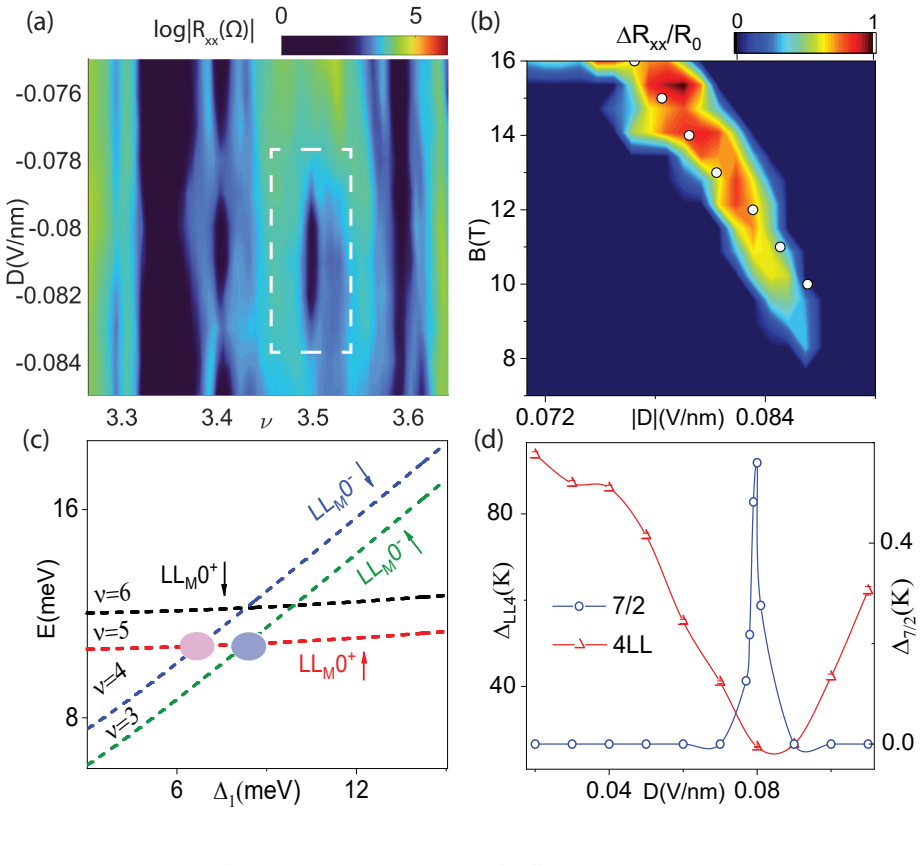
The mechanism is the near-crossing of two $N=0$ Landau levels of the monolayer-like band with different valley/spin isospin indices. As a displacement field lowers one level toward the other, lattice-scale couplings that exist because ABA trilayer graphene lacks inversion symmetry mix the two valleys; the enhanced Landau-level mixing softens the short-range part of the Coulomb repulsion, converting the half-filled level from a gapless composite-fermion Fermi liquid into a paired state. The experimental signature is the coincidence between the calculated crossing loci and the $(B,D)$ window where the even-denominator state and its daughter states are strongest.
What would settle it
Measure the activation gap of the $\nu=7/2$ state over a fine grid of displacement field at fixed high magnetic field and check whether its maximum falls on the calculated crossing point of the two $N=0$ levels; if the gap maximum does not track the crossing locus, or if the state persists where the two levels are well separated, the Landau-level-mixing mechanism is not the cause. In parallel, an equivalent $N=0$ crossing experiment in bilayer graphene—whose valleys remain related by inversion symmetry—that produced an even-denominator state would contradict the claim that inversion-symmetry breaking is essential.
Extended reading notes
Core claim
The paper's central claim is that, in the $N=0$ orbital of the monolayer-like band of ABA trilayer graphene, two symmetry-broken Landau levels with different valley and spin isospin indices can be brought into near-degeneracy by a displacement field, and precisely there the system forms single-component even-denominator fractional quantum Hall states at $\nu=7/2$ and $\nu=5/2$. The states are flanked by the Levin–Halperin daughters at $\nu=7/13$ and $\nu=9/17$ (with additional structure at $\nu=59/17$, $\nu=46/13$, $\nu=58/13$, $\nu=77/17$, and $\nu=43/17$), which identifies the $\nu=7/2$ state as Moore–Read Pfaffian-like and the $\nu=5/2$ state as likely anti-Pfaffian. The measured displacement-field and magnetic-field windows track the calculated crossing locus of the two $N=0$ levels, and the activation gap of $\nu=7/2$ peaks exactly where the single-particle gap between those levels collapses. The paper attributes this behavior to inversion-symmetry breaking in ABA trilayer graphene, which distinguishes the two valleys and generates lattice-scale couplings that enhance Landau-level mixing and renormalize the short-range Coulomb interaction, stabilizing the paired phase over the composite-fermion Fermi liquid (electrons bound to magnetic flux quanta).
Load-bearing premise
The load-bearing premise is that the near-degeneracy of these two particular $N=0$ Landau levels is what creates the paired state; if the displacement field instead acts through screening, disorder, the density profile, or some other level crossing, the microscopic explanation would fail even though the transport observation might stand.
Editorial extensions
If this is right
- Even-denominator fractional quantum Hall physics is not confined to the first excited Landau level: a lowest ($N=0$) Landau level can host it when two symmetry-broken levels are tuned close together.
- The displacement field acts as a continuous switch: $\nu=7/2$ and $\nu=5/2$ and their daughter states appear only in a finite $D$ window that matches the calculated Landau-level crossings.
- The observed daughters at $\nu=7/13$ and $\nu=9/17$ place the parent states in the Pfaffian/anti-Pfaffian universality class, so the system is a candidate host of non-Abelian quasiparticles.
- Increasing the magnetic field strengthens the even-denominator states while suppressing the Jain-sequence composite-fermion states and breaking particle-hole symmetry around half-filling.
Reading between the lines
- A testable extension is an exact-diagonalization study of the two crossing $N=0$ levels with realistic lattice-scale couplings from the tight-binding model, predicting the activation gap as a function of displacement field; the measured $\Delta_{7/2}$ peak gives a direct quantitative target.
- If the proposed mechanism is general, other multilayer or moiré systems that lack inversion symmetry and allow tunable Landau-level crossings should also show even-denominator states at half-filling, for example in rhombohedral or twisted graphene stacks.
- The sharp $D$-window may permit local-gate experiments that switch the same device between a gapless composite-fermion Fermi liquid and a paired non-Abelian state, enabling interferometric probes of anyon braiding.
- Mapping the $B$–$D$ plane in finer detail should reveal where particle-hole symmetry breaks and could locate a topological phase boundary between the Jain sequence and the paired state.
Editorial analysis
A structured set of objections, weighed in public.
Referee Report
Summary. The manuscript reports transport measurements in dual-gated ABA trilayer graphene showing dips in Rxx and Hall plateaus at ν = 7/2 and ν = 5/2, together with daughter states at ν = 7/13 and ν = 9/17, within a finite displacement-field window. The authors argue that these even-denominator fractional quantum Hall states occur in the N = 0 Landau level of the monolayer-like band when two symmetry-broken Landau levels with different isospin indices cross in energy. They present a tight-binding Landau-level calculation, compare the calculated crossing loci with the measured stability regions, and propose that inversion-symmetry breaking in TLG enhances Landau-level mixing, which softens the short-range Coulomb interaction and stabilizes paired composite-fermion states. The abstract additionally claims the observation of ν = 9/2 and several daughter states (59/17, 46/13, 58/13, 77/17, 43/17) that do not appear in the body or the supplied supplementary material.
Significance. If ratified, the observation of even-denominator fractional quantum Hall states in the N = 0 Landau level of a multilayer graphene system would be an important experimental advance, particularly because the displacement field provides in-situ tunability of the putative pairing mechanism. The transport data, including activation-gap measurements, are presented with standard methodology and appear credible for the 7/2 and 5/2 states. However, the paper's central interpretive claim—that Landau-level mixing at isospin crossings is the microscopic origin—is not substantiated by a microscopic calculation, and the body itself labels this scenario a conjecture. The abstract's additional claims (ν = 9/2 and the extra daughter states) are unsupported by the presented evidence. The manuscript also does not establish the 'single-component' character of the states it reports. These issues do not negate the experimental observation, but they require substantial revision before the paper can be accepted.
major comments (4)
- [Abstract, Results] The abstract states that 'robust incompressible states at ν=7/2, 9/2, and 5/2 with their associated Levin–Halperin daughter states: ν=59/17 and 46/13 near 7/2; ν=58/13 and 77/17 near 9/2; and ν=43/17 near 5/2' are observed. The main text and the supplied Supplementary Information contain data only for ν = 7/2 and ν = 5/2, with daughters at ν = 7/13 and ν = 9/17. No evidence for ν = 9/2 or for the fractions 59/17, 46/13, 58/13, 77/17, and 43/17 is presented anywhere in the body or supplementary file. This is a direct inconsistency between the abstract and the manuscript content and must be fixed, either by providing the missing data or by revising the abstract.
- [Discussion, Fig. 2(d), Supp. Note 5] The abstract claims that 'the quantitative correspondence between the calculated crossing loci and the experimentally determined stability regions identifies Landau-level mixing as the microscopic origin.' The body, however, is explicitly more cautious: the Discussion states 'We posit' that lattice-scale couplings enhance LL mixing and that 'Further theoretical studies are essential to verify this proposed scenario.' No microscopic calculation is given showing that mixing between LL0+_M↑ and LL0−_M↓ at the experimental parameters (B = 12 T, Δ1 ≈ 6.7 meV) suppresses the short-range Coulomb repulsion enough to stabilize a paired state over the composite-fermion Fermi liquid. The observed decrease of ΔLL4 with D in Fig. 2(d) is a near-trivial consequence of the two levels approaching each other and does not by itself single out LL mixing as the stabilizer.
- [Results, Fig. 2(b–c), Supp. Note 6] The assignment of each observed state to a specific Landau-level crossing is post hoc. Figure 2(c) shows many LL crossings as functions of Δ1 and B; the authors select the LL0+_M↑–LL0−_M↓ crossing for 7/2 and the LL0+_M↑–LL0−_M↑ crossing for 5/2 because they occur near the experimental stability windows. The claimed 'exact' tracking in Fig. 2(b) is not quantified: no residuals, deviations, or error bars are given, and the conversion Δ1(meV) = 85 D (V/nm) (Supp. Note 3) depends on an unspecified ε_TLG. A quantitative measure of the correspondence and a discussion of why other nearby crossings do not produce even-denominator states are needed.
- [Introduction, Results] The paper claims observation of 'single-component [43] even-denominator FQHSs' at ν = 5/2 and 7/2, but the data do not distinguish a single-component Pfaffian from a two-component Halperin-331 state. The authors themselves state that 'there is a very weak indication of ν = 8/17, but it is not strong enough to conclusively determine if ν = 7/2 is in the Moore-Read Pfaffian or Halperin-331 phase.' In the proposed mechanism, the near-degenerate isospin levels would naturally form a two-component system, so asserting a single-component state requires more evidence than the weak daughter-state signal provides.
minor comments (5)
- [Fig. 1(c) caption] The caption lists D = −0.785 V/nm, which is inconsistent with the value D = −0.079 V/nm quoted in the text for the same data set; this appears to be a typographical error.
- [Abstract] The abstract contains a typographical error: 'e ffect' should be 'effect', and the phrase 'Levin--Halperin' uses a double hyphen rather than an en dash.
- [Supp. Note 3] The conversion factor Δ1(meV) = 85 D (V/nm) is stated without specifying the dielectric constant ε_TLG used; please provide the value or a reference, since the uncertainty in this conversion directly affects the claimed correspondence.
- [Results, first paragraph] The text says the 5/2 data are presented in the Supplementary Information, but the main text does not explicitly refer to the relevant supplementary note (Supp. Note 3); please add a cross-reference for clarity.
- [Supp. Fig. 3 caption] The caption contains corrupted LaTeX text ('log|Rxx/parenleft.capΩ/parenright.cap|') that should be rendered as a proper mathematical expression.
Circularity Check
No circularity: the Landau-level crossing calculation is independent of the transport stability data, and the causal mechanism is explicitly conjectural rather than derived from its inputs.
full rationale
The paper's claimed derivation chain is not circular in the sense of reducing a prediction to its inputs by construction. The Landau spectrum in Fig. 2(c) is computed from a Slonczewski-Weiss-McClure tight-binding model with literature parameters (Supplementary Note 6), and the displacement-field conversion Δ1(meV)=85 D(V/nm) is taken from external work [72]; no parameter is fitted to the measured stability region of the ν=7/2 or ν=5/2 states. The overlay of calculated crossing loci onto the experimental B–D stability map in Fig. 2(b) is therefore a genuine, independent comparison rather than a fitted prediction. Similarly, the observed correlation between the activation gap Δ7/2 and the ν=4 gap ΔLL4 is a measured correlation, not a quantity defined by the model. The proposed microscopic origin—inversion-symmetry breaking enhancing valley-resolved LL mixing—is explicitly presented as a conjecture: the Discussion states "We posit that under the influence of all these lattice terms, the bands with different valleys hybridize" and immediately adds "Further theoretical studies are essential to verify this proposed scenario." That is an unverified hypothesis, not a circular step. The main non-circular weaknesses are that the assignment of which specific crossing pair corresponds to each state is post hoc, the abstract overstates the correlation as "identifies Landau-level mixing as the microscopic origin," and the abstract lists ν=9/2 and daughter fractions (59/17, 46/13, 58/13, 77/17, 43/17) that do not appear in the body, while the body concedes the 8/17 feature is too weak to distinguish Pfaffian from 331. These are correctness and consistency concerns, not circularity, and no quoted reduction of the central claim to its own inputs is present.
Assumptions & free parameters
assumptions (4)
- domain assumption The SWMcC tight-binding model with parameters γ0=3.1 eV, γ1=0.39 eV, γ2=-0.005 eV, γ3=0.275 eV, γ4=0.040 eV, γ5=0.005 eV, δ=0.0108 eV, and Δ2=0.003 eV accurately describes the N=0 Landau levels of ABA TLG at B=12 T.
- domain assumption The displacement field D maps to interlayer potential Δ1 via Δ1(meV) = 85 D (V/nm), with no correction for screening or gate nonlinearity.
- ad hoc to paper A small single-particle gap between two N=0 LLs with different isospin enhances LL mixing enough to suppress short-range Coulomb repulsion and stabilize paired CF states, while the same mixing in BLG does not.
- domain assumption The observed Rxx minima and Gxy plateaus at half-integer fillings are genuine incompressible FQH states rather than artifacts of density inhomogeneity or contact effects.
Cite this review
Pith. "Pith review of Even-denominator fractional quantum Hall states in the zeroth Landau level of ABA trilayer graphene." pith.science (2026). https://pith.science/paper/LLX3COHB
@misc{pith2026250206245,
  author       = {Pith},
  title        = {Pith review of: Even-denominator fractional quantum Hall states in the zeroth Landau level of ABA trilayer graphene},
  year         = {2026},
  howpublished = {\url{https://pith.science/paper/LLX3COHB}},
  note         = {Machine review of arXiv:2502.06245}
}
abstract
Even-denominator fractional quantum Hall states (FQHSs) at half filling are of particular interest because they can host non-Abelian quasiparticles. Here we report the emergence of such states in the zeroth Landau level ($N=0$) of ABA trilayer graphene (TLG), challenging the conventional expectation that they are confined to the first excited Landau level. We observe robust incompressible states at $\nu=7/2$, $9/2$, and $5/2$ with their associated Levin--Halperin daughter states: $\nu=59/17$ and $46/13$ near $7/2$; $\nu=58/13$ and $77/17$ near $9/2$; and $\nu=43/17$ near $5/2$. These states appear exclusively within a finite displacement-field window coincident with crossings between symmetry-broken $N=0$ Landau levels carrying distinct isospin indices. The quantitative correspondence between the calculated crossing loci and the experimentally determined stability regions identifies Landau-level mixing as the microscopic origin. We attribute the stabilization of these even-denominator states to inversion-symmetry breaking in TLG, which enhances valley-resolved Landau-level hybridization and renormalizes short-range Coulomb interactions. Our results expand the landscape of even-denominator FQHSs to multilayer graphene and establish TLG as a tunable platform for realizing non-Abelian anyons.
Figures


Figures from the paper (1 more)

Forward citations
Cited by 1 Pith paper
-
Repulsive-Interaction-Driven Topological Superconductivity in a Landau Level Coupled to an $s$-Wave Superconductor
Repulsive interactions turn a half-filled Rashba-coupled Landau level proximitized by an s-wave superconductor into a topological superconductor.
Reference graph
Works this paper leans on
-
[43]
S. K. Singh, C. Wang, C. T. Tai, C. S. Calhoun, K. A. Villegas Rosales, P. T. Madathil, A. Gupta, K. W. Baldwin, L. N. Pfeiffer, and M. Shayegan, Nature Physics 20, 1247 (2024)
work page 2024
-
[1]
R. B. Laughlin, Phys. Rev. Lett. 50, 1395 (1983)
1983
-
[2]
D. C. Tsui, H. L. Stormer, and A. C. Gossard, Phys. Rev. Lett. 48, 1559 (1982)
1982
-
[3]
and a =2.46 Å. E ffective low energy Hamiltonian can be constructed by expanding the above Hamiltonian near K +/K- points. Low energy Hamiltonian can then be written simply by substitutingγitk→ viπ, where π =ξkx + iky (Supplementary Equation 4a) ℏvi = √ 3 2 aγi (Supplementary Equation 4b) electric field can be taken into account by introducing onsite pote...
-
[4]
Z. Papi ´c and A. C. Balram, Fractional quantum hall e ffect in semiconductor systems (2022), arXiv:2205.03421 [cond-mat.mes-hall]
arXiv 2022
- [5]
-
[6]
B. I. Halperin, Phys. Rev. Lett. 52, 1583 (1984)
work page 1984
-
[7]
Moore and N
G. Moore and N. Read, Nuclear Physics B 360, 362 (1991)
1991
Show all 74 references
-
[8]
D. E. Feldman and B. I. Halperin, Reports on Progress in Physics 84, 076501 (2021)
2021
-
[9]
Bartolomei, M
H. Bartolomei, M. Kumar, R. Bisognin, A. Marguerite, J.-M. Berroir, E. Bocquillon, B. Plaçais, A. Cavanna, Q. Dong, U. Gennser, Y . Jin, and G. Fève, Science 368, 173 (2020), https://www.science.org/doi/pdf/10.1126/science.aaz5601
2020 doi
-
[10]
H. K. Kundu, S. Biswas, N. Ofek, V . Umansky, and M. Heiblum, Nature Physics19, 515 (2023)
2023
-
[11]
Nakamura, S
J. Nakamura, S. Liang, G. C. Gardner, and M. J. Manfra, Nature Physics 16, 931 (2020)
2020
-
[12]
Das Sarma, M
S. Das Sarma, M. Freedman, and C. Nayak, Phys. Rev. Lett. 94, 166802 (2005)
2005
-
[13]
Nayak, S
C. Nayak, S. H. Simon, A. Stern, M. Freedman, and S. Das Sarma, Rev. Mod. Phys. 80, 1083 (2008)
2008
-
[14]
R. L. Willett, K. Shtengel, C. Nayak, L. N. Pfei ffer, Y . J. Chung, M. L. Peabody, K. W. Baldwin, and K. W. West, Phys. Rev. X13, 011028 (2023)
2023
-
[15]
X. Lin, R. Du, and X. Xie, National Science Review 1, 564 (2014), https://academic.oup.com/nsr/article-pdf/1/4/564/31568876/nwu071.pdf
2014
-
[16]
Banerjee, M
M. Banerjee, M. Heiblum, V . Umansky, D. E. Feldman, Y . Oreg, and A. Stern, Nature559, 205 (2018)
2018
-
[17]
Dutta, V
B. Dutta, V . Umansky, M. Banerjee, and M. Heiblum, Science 377, 1198 (2022), https://www.science.org/doi/pdf/10.1126/science.abm6571
2022 doi
-
[18]
Pan, J.-S
W. Pan, J.-S. Xia, V . Shvarts, D. E. Adams, H. L. Stormer, D. C. Tsui, L. N. Pfeiffer, K. W. Baldwin, and K. W. West, Phys. Rev. Lett.83, 3530 (1999)
1999
-
[19]
J. P. Eisenstein, K. B. Cooper, L. N. Pfei ffer, and K. W. West, Phys. Rev. Lett.88, 076801 (2002)
2002
-
[20]
Y . Liu, J. Shabani, D. Kamburov, M. Shayegan, L. N. Pfeiffer, K. W. West, and K. W. Baldwin, Phys. Rev. Lett. 107, 266802 (2011)
2011
-
[21]
Y . W. Suen, L. W. Engel, M. B. Santos, M. Shayegan, and D. C. Tsui, Phys. Rev. Lett.68, 1379 (1992). 21
1992
-
[22]
Willett, J
R. Willett, J. P. Eisenstein, H. L. Störmer, D. C. Tsui, A. C. Gossard, and J. H. English, Phys. Rev. Lett. 59, 1776 (1987)
1987
-
[23]
J. P. Eisenstein, G. S. Boebinger, L. N. Pfei ffer, K. W. West, and S. He, Phys. Rev. Lett. 68, 1383 (1992)
1992
-
[24]
Falson, D
J. Falson, D. Maryenko, B. Friess, D. Zhang, Y . Kozuka, A. Tsukazaki, J. H. Smet, and M. Kawasaki, Nature Physics 11, 347 (2015)
2015
-
[25]
Falson, D
J. Falson, D. Tabrea, D. Zhang, I. Sodemann, Y . Kozuka, A. Tsukazaki, M. Kawasaki, K. von Klitzing, and J. H. Smet, Science Advances 4, eaat8742 (2018), https://www.science.org/doi/pdf/10.1126/sciadv.aat8742
2018 doi
-
[26]
J. I. A. Li, C. Tan, S. Chen, Y . Zeng, T. Taniguchi, K. Watanabe, J. Hone, and C. R. Dean, Science 358, 648 (2017), https://www.science.org/doi/pdf/10.1126/science.aao2521
2017 doi
-
[27]
A. A. Zibrov, C. Kometter, H. Zhou, E. M. Spanton, T. Taniguchi, K. Watanabe, M. P. Zaletel, and A. F. Young, Nature549, 360 (2017)
2017
-
[28]
Y . Kim, A. C. Balram, T. Taniguchi, K. Watanabe, J. K. Jain, and J. H. Smet, Nature Physics 15, 154 (2019)
2019
-
[29]
Huang, H
K. Huang, H. Fu, D. R. Hickey, N. Alem, X. Lin, K. Watanabe, T. Taniguchi, and J. Zhu, Phys. Rev. X 12, 031019 (2022)
2022
-
[30]
A. C. Balram, Phys. Rev. B 105, L121406 (2022)
2022
-
[31]
M. S. Hossain, M. K. Ma, Y . J. Chung, S. K. Singh, A. Gupta, K. W. West, K. W. Baldwin, L. N. Pfeiffer, R. Winkler, and M. Shayegan, Phys. Rev. Lett.130, 126301 (2023)
2023
-
[32]
Assouline, T
A. Assouline, T. Wang, H. Zhou, L. A. Cohen, F. Yang, R. Zhang, T. Taniguchi, K. Watanabe, R. S. K. Mong, M. P. Zaletel, and A. F. Young, Phys. Rev. Lett.132, 046603 (2024)
2024
-
[33]
M. S. Hossain, M. K. Ma, Y . J. Chung, L. N. Pfeiffer, K. W. West, K. W. Baldwin, and M. Shayegan, Phys. Rev. Lett. 121, 256601 (2018)
2018
-
[34]
Shi, E.-M
Q. Shi, E.-M. Shih, M. V . Gustafsson, D. A. Rhodes, B. Kim, K. Watanabe, T. Taniguchi, Z. Papi ´c, J. Hone, and C. R. Dean, Nature Nanotechnology 15, 569 (2020)
2020
-
[35]
Y . Kim, D. S. Lee, S. Jung, V . Skákalová, T. Taniguchi, K. Watanabe, J. S. Kim, and J. H. Smet, Nano Letters 15, 7445 (2015)
2015
-
[36]
J. K. Jain, Annual Review of Condensed Matter Physics 6, 39 (2015)
2015
-
[37]
J. K. Jain, Composite fermions (Cambridge University Press, 2007)
2007
-
[38]
B. I. Halperin, P. A. Lee, and N. Read, Phys. Rev. B 47, 7312 (1993). 22
1993
-
[39]
S. He, S. Das Sarma, and X. C. Xie, Phys. Rev. B 47, 4394 (1993)
1993
-
[40]
Shabani, T
J. Shabani, T. Gokmen, and M. Shayegan, Phys. Rev. Lett. 103, 046805 (2009)
2009
-
[41]
Shabani, T
J. Shabani, T. Gokmen, Y . T. Chiu, and M. Shayegan, Phys. Rev. Lett.103, 256802 (2009)
2009
-
[42]
T. Zhao, W. N. Faugno, S. Pu, A. C. Balram, and J. K. Jain, Phys. Rev. B 103, 155306 (2021)
2021
-
[44]
Sharma, A
A. Sharma, A. C. Balram, and J. K. Jain, Phys. Rev. B 109, 035306 (2024)
2024
-
[45]
M. R. Peterson and C. Nayak, Phys. Rev. B 87, 245129 (2013)
2013
-
[46]
C. Wang, A. Gupta, S. K. Singh, Y . J. Chung, L. N. Pfeiffer, K. W. West, K. W. Baldwin, R. Winkler, and M. Shayegan, Phys. Rev. Lett. 129, 156801 (2022)
2022
-
[47]
T. Zhao, A. C. Balram, and J. K. Jain, Phys. Rev. Lett. 130, 186302 (2023)
2023
-
[48]
Kumar, A
R. Kumar, A. Haug, J. Kim, M. Yutushui, K. Khudiakov, V . Bhardwaj, A. Ilin, K. Watanabe, T. Taniguchi, D. F. Mross, and Y . Ronen, Quarter- and half-filled quantum hall states and their com- peting interactions in bilayer graphene (2024), arXiv:2405.19405 [cond-mat.mes-hall]
2024 arXiv
-
[49]
Kumar, W
A. Kumar, W. Escoffier, J. M. Poumirol, C. Faugeras, D. P. Arovas, M. M. Fogler, F. Guinea, S. Roche, M. Goiran, and B. Raquet, Phys. Rev. Lett. 107, 126806 (2011)
2011
-
[50]
L. C. Campos, T. Taychatanapat, M. Serbyn, K. Surakitbovorn, K. Watanabe, T. Taniguchi, D. A. Abanin, and P. Jarillo-Herrero, Phys. Rev. Lett.117, 066601 (2016)
2016
-
[51]
Koshino and E
M. Koshino and E. McCann, Phys. Rev. B 83, 165443 (2011)
2011
-
[52]
Zollner, M
K. Zollner, M. Gmitra, and J. Fabian, Phys. Rev. B 105, 115126 (2022)
2022
-
[53]
Levin and B
M. Levin and B. I. Halperin, Phys. Rev. B 79, 205301 (2009)
2009
-
[54]
Levin, B
M. Levin, B. I. Halperin, and B. Rosenow, Phys. Rev. Lett. 99, 236806 (2007)
2007
-
[55]
P. T. Zucker and D. E. Feldman, Phys. Rev. Lett. 117, 096802 (2016)
2016
-
[56]
L. Wang, I. Meric, P. Y . Huang, Q. Gao, Y . Gao, H. Tran, T. Taniguchi, K. Watanabe, L. M. Campos, D. A. Muller, J. Guo, P. Kim, J. Hone, K. L. Shepard, and C. R. Dean, Science 342, 614 (2013), https://www.science.org/doi/pdf/10.1126/science.1244358
2013 doi
-
[57]
S. Kaur, T. Chanda, K. R. Amin, D. Sahani, K. Watanabe, T. Taniguchi, U. Ghorai, Y . Gefen, G. J. Sreejith, and A. Bid, Nature Communications 15, 8535 (2024)
2024
-
[58]
Pizzocchero, L
F. Pizzocchero, L. Gammelgaard, B. S. Jessen, J. M. Caridad, L. Wang, J. Hone, P. Bøggild, and T. J. Booth, Nature Communications 7, 11894 (2016). 23
2016
-
[59]
M. K. Jat, P. Tiwari, R. Bajaj, I. Shitut, S. Mandal, K. Watanabe, T. Taniguchi, H. R. Krishnamurthy, M. Jain, and A. Bid, Nature Communications , 2335 (2024)
2024
-
[60]
Yutushui, M
M. Yutushui, M. Hermanns, and D. F. Mross, Phys. Rev. B 110, 165402 (2024)
2024
-
[61]
de Gail, N
R. de Gail, N. Regnault, and M. O. Goerbig, Phys. Rev. B 77, 165310 (2008)
2008
-
[62]
S. H. Simon and A. C. Balram, Phys. Rev. B 111, 045102 (2025)
2025
-
[63]
Serbyn and D
M. Serbyn and D. A. Abanin, Phys. Rev. B 87, 115422 (2013)
2013
-
[64]
A. A. Zibrov, P. Rao, C. Kometter, E. M. Spanton, J. I. A. Li, C. R. Dean, T. Taniguchi, K. Watanabe, M. Serbyn, and A. F. Young, Phys. Rev. Lett.121, 167601 (2018)
2018
-
[65]
Y . Chen, Y . Huang, Q. Li, B. Tong, G. Kuang, C. Xi, K. Watanabe, T. Taniguchi, G. Liu, Z. Zhu, L. Lu, F.-C. Zhang, Y .-H. Wu, and L. Wang, Nature Communications15, 6236 (2024)
2024
-
[66]
Kharitonov, Phys
M. Kharitonov, Phys. Rev. B 85, 155439 (2012)
2012
-
[67]
Alicea and M
J. Alicea and M. P. A. Fisher, Phys. Rev. B 74, 075422 (2006)
2006
-
[68]
A. A. Zibrov, E. M. Spanton, H. Zhou, C. Kometter, T. Taniguchi, K. Watanabe, and A. F. Young, Nature Physics 14, 930 (2018)
2018
-
[69]
B. E. Feldman, A. J. Levin, B. Krauss, D. A. Abanin, B. I. Halperin, J. H. Smet, and A. Yacoby, Phys. Rev. Lett. 111, 076802 (2013)
2013
-
[70]
C. Cong, T. Yu, K. Sato, J. Shang, R. Saito, G. F. Dresselhaus, and M. S. Dresselhaus, ACS Nano 5, 8760 (2011)
2011
-
[71]
T. A. Nguyen, J.-U. Lee, D. Yoon, and H. Cheong, Scientific Reports 4, 4630 (2014)
2014
-
[72]
Tiwari, S
P. Tiwari, S. K. Srivastav, and A. Bid, Phys. Rev. Lett. 126, 096801 (2021)
2021
-
[73]
S. K. Srivastav, A. Udupa, K. Watanabe, T. Taniguchi, D. Sen, and A. Das, Phys. Rev. Lett. 132, 096301 (2024)
2024
-
[74]
D. A. Abanin, B. E. Feldman, A. Yacoby, and B. I. Halperin, Phys. Rev. B 88, 115407 (2013). 24
2013
Reviewed August 8, 2026 · model on record in the stance chip above.
Discussion (0). Continue with ORCID to comment.