REVIEW 5 major objections 6 minor 73 references
Zero-shot Depth Completion via Test-time Alignment with Affine-invariant Depth Prior
T0 review · 5 major / 6 minor · reviewed 2026-08-08 · deepseek-v4-flash
Pith's one-line read Aligning a pre-trained affine-invariant depth diffusion prior with sparse metric measurements at test time yields zero-shot depth completion that generalizes across indoor and outdoor scenes and outperforms test-time adaptation methods by…
desk verdict Solid zero-shot depth completion recipe with broad experiments; the compatibility proof is weak but the empirical results on four domains carry the paper. read the letter →
The pith
A machine-rendered reading of the paper's core claim, the machinery that carries it, and where it could break.
The reading
What carries the argument
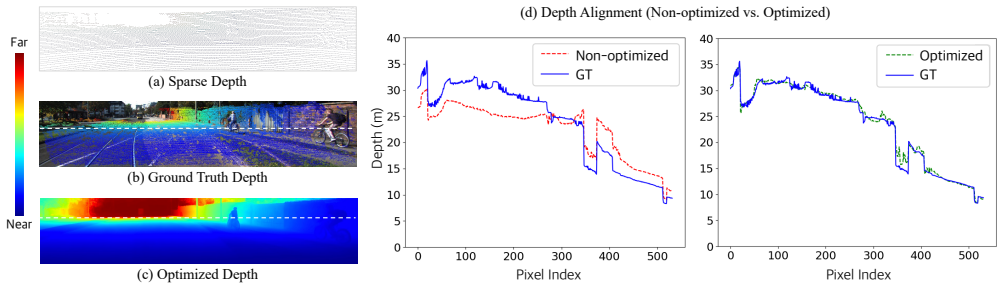
The central object is the reverse diffusion trajectory of a latent diffusion model pre-trained for monocular depth estimation. The key mechanism is test-time alignment: an inner-loop optimization (Eq. 7) over the predicted clean latent $z_0(z_t)$ minimizes an L1 loss against the sparse metric measurements, then re-noises the result to the current timestep via the forward process (Eq. 8) so the trajectory stays on the prior's manifold while respecting hard constraints. This correction step, repeated every few sampling steps, converts an affine-invariant depth prior into a metric depth completion engine, supported by an R-SSIM loss for structure preservation and a superpixel+RANSAC outlier filter for unreliable sensor points.
What would settle it
Run the method on a dataset with physically extreme metric depth ranges (e.g., aerial or satellite scenes with depths from 0.5 m to 5000 m, or a panoramic sensor with non-pinhole projection) where the sparse points are reliable, and compare against high-fidelity ground truth. If the affine-invariant prior's manifold cannot represent these depths, RMSE will degrade sharply and the optimization loop will either diverge or settle on a plausible-looking but wrong structure; a systematic floor in the residual $\|y - A(D(z_0))\|$ after convergence, much larger than sensor noise, would indicate manifold mismatch.
Extended reading notes
Core claim
A pre-trained monocular depth diffusion model operating in the affine-invariant depth space already represents a rich prior over real-world scene geometry, and this prior can be steered at test time to satisfy sparse metric measurements. The paper demonstrates this through an empirical reconstruction experiment showing that normalized metric depth maps lie near the prior's manifold, and through a complete method that aligns the diffusion sampling trajectory with sparse depth as hard constraints. The method achieves strong zero-shot depth completion across NYUv2, SceneNet, Waymo, nuScenes, KITTI, and VOID without any training on the target domain, outperforming test-time adaptation methods and matching or exceeding several few-shot depth-prior approaches.
Load-bearing premise
The load-bearing premise is that the data manifold learned by the pre-trained relative-depth diffusion model is close enough to the normalized metric depth space that the test-time optimization loop can pull the trajectory onto a metric-consistent solution; the paper supports this only with a limited reconstruction experiment on two completion models, not with a formal characterization.
Editorial extensions
If this is right
- Depth completion becomes solvable zero-shot for any RGB plus sparse-depth pair, as long as a strong relative-depth prior is available.
- Affine-invariant depth priors are sufficient for metric depth completion when aligned to sparse metric measurements at test time.
- The proposed prior-based outlier filtering improves reliability, especially for outdoor LiDAR data with see-through points on glass or other reflective surfaces.
- The method is compatible with both a 50-step diffusion model and a 1–2 step flow-matching model, with inference time scaling with base model steps (from about 101 s down to 16 s).
Reading between the lines
- The same test-time alignment principle could extend to other inverse problems where a generative prior is affine-invariant, such as relative surface normals, relative lighting, or intrinsic image decomposition, turning sparse absolute measurements into hard constraints.
- A clear stress test emerges: on scenes whose metric depth distribution falls far outside the prior's training range (extreme distances, non-pinhole projections, unusual sensor noise), the optimization loop should either diverge or settle on a plausible-looking but wrong structure, with the residual $\|y - A(D(z_0))\|$ staying at a floor well above sensor noise.
- The paper's R-SSIM loss suggests that a deeper learned feature-similarity regularizer might replace the hand-tuned structure term, potentially sharpening edges further without adjusting per-dataset weights.
Editorial analysis
A structured set of objections, weighed in public.
Referee Report
Summary. The paper proposes a zero-shot depth completion method that combines a pretrained affine-invariant depth diffusion prior (Marigold or DepthFM) with per-sample test-time optimization. Sparse metric depth measurements are enforced through an optimization loop on the denoised latent z0(zt), followed by a noise-remapping step, together with a superpixel/RANSAC outlier filter and an R-SSIM structural regularizer. Experiments on indoor (NYUv2, SceneNet) and outdoor (Waymo, nuScenes, KITTI, VOID) datasets compare favorably against test-time adaptation baselines and unsupervised methods, and the paper reports up to a 21% average performance improvement over prior state-of-the-art test-time adaptation.
Significance. If the central claim holds, the paper offers a useful training-free recipe for leveraging monocular depth foundation models in metric depth completion across domains, and the test-time alignment idea is interesting beyond the specific depth-completion setting. The paper is unusually broad in its evaluation, includes ablations of the main components, and makes an honest attempt to analyze ground-truth sensitivity and stochasticity of diffusion sampling. However, the significance is conditional on resolving several load-bearing issues, in particular the mismatch between the reported nuScenes benchmark and the supplementary description, the unverified compatibility of the affine-invariant prior with random-noise test-time trajectories, and the finite-optimization approximation of the claimed 'hard constraint'.
major comments (5)
- [Section 3.2, Eqs. (7)-(9)] The 'hard constraint' characterization is not supported by the described procedure. The optimization loop in Eq. (7) is run for a finite number of iterations (200 per Supplementary A.1), and the remapping in Eq. (8) adds Gaussian noise, so the resulting latent no longer satisfies the sparse-depth consistency that Eq. (7) optimizes. Eq. (9) is then an approximate gradient step rather than a projection onto the measurement set. The paper should either report the residual sparse-depth error after the full sampling loop, or rename the mechanism (e.g., 'strong test-time guidance') and justify why the residual is negligible for the downstream claims.
- [Section 3.2 / Eq. (10) and Supplementary Table S2] The central compatibility claim that the affine-invariant depth prior can represent normalized metric depth space is supported only by a reconstruction experiment that starts from a complete depth map, encodes it, adds modest noise, and reverses the diffusion process. This does not test the actual test-time scenario, which begins from pure random noise and relies on sparse guidance to pull the trajectory onto a metric-consistent solution. The supplementary table itself shows severe degradation at timestamp 1000 (RMSE 3.443 to 3.475), the regime closest to the random-noise start. The authors should add a direct test: run the full reverse chain from pure noise with sparse guidance and measure whether the resulting samples preserve metric consistency and lie on the prior manifold, or provide quantitative evidence about the manifold coverage of the optimized latents.
- [Section 4.1 and Supplementary B.1] There is a direct contradiction about which ground-truth definition is used for the nuScenes benchmark. The main text states that Table 1 uses the Huang et al. (2022) PCACC ground truth, while Supplementary B.1 states that Table 1 uses the ProxyTTA ground truth. The reported nuScenes numbers for the proposed method (RMSE 1.561) match the PCACC column in Table S1 (RMSE 1.516) rather than the ProxyTTA column (RMSE 5.876), and on the ProxyTTA ground truth the proposed method is worse than the ProxyTTA baseline (5.876 vs. 5.509). The authors must state exactly which ground truth is used in each table, recompute the '21% average performance improvement' with a consistent benchmark choice, and explain the discrepancy.
- [Algorithm 1, line 8] The outlier-filtering algorithm as written is not reproducible. Line 8 assigns the set of deviating points by |y_hat_i - y_i| > tau, but Omega(y*) is defined as the set of reliable sparse point locations. To filter outliers, the condition should be |y_hat_i - y_i| <= tau, or the definition of Omega(y*) must be changed. This is a load-bearing component of the method and needs to be corrected in the manuscript.
- [Supplementary A.1 and Section 3.4] The method uses several dataset-dependent hyperparameters: lambda_smooth and lambda_rssim are 'adjusted according to the dataset', high-resolution images are optimized at 2x downsampling, the superpixel count is fixed at 200, and the optimization loop uses 200 iterations. For a method whose headline claim is zero-shot generalization, the paper should provide a single default configuration or show that the reported results are stable across a reasonable range of these hyperparameters. Otherwise, the per-dataset tuning itself becomes a contributor to the reported improvements, and the 'zero-shot' claim is weakened.
minor comments (6)
- [Eq. (9)] The notation in Eq. (9) is confusing: the text says the score is rewritten in terms of z0(zt), but the displayed update is for z_hat_t and the gradient is taken with respect to z_t. Please clarify which variable is optimized and how the two-step process in Eqs. (7)-(8) replaces this update.
- [Eq. (10)] Eq. (10) is not a well-defined mathematical statement as written; the left- and right-hand sides appear to involve scores at different arguments with no explicit distributions. Please specify the variables and the sense in which the approximation holds.
- [Algorithm 1, line 7] The input to the RANSAC regressor is written ambiguously as RANSAC Regressor(1_{Omega(y_i)} circle D_r, y_i). Please clarify whether the relative depth map is the input feature and the sparse metric depth is the target, and state how the filtering threshold tau is chosen.
- [Table 2] The inference-time comparison reports only seconds without specifying the GPU model and memory; please add the hardware configuration so the efficiency comparison is interpretable.
- [Section 3.4, Eq. (13)] The R-SSIM loss uses the depth estimated by an off-the-shelf model as d1; please state explicitly which model produces d1 and whether it is the same diffusion prior used for sampling, to rule out a concern that the regularizer is circularly pulling toward the prior's own output.
- [General] There are several typographical and phrasing issues, including 'alignend' in Section 3.2, 'embeded' in Related Work, 'naively' in the Conclusion, and an incomplete sentence in the Fig. 4 caption. A careful proofread is recommended.
Circularity Check
No significant circularity: the central claims are supported by external priors and test-time optimization against sparse measurements, not by fitting the reported benchmarks.
full rationale
I walked the claimed derivation chain. The method takes an external pretrained affine-invariant depth diffusion model (Marigold or DepthFM) as the score prior and, at test time, optimizes z0(zt) to satisfy sparse metric measurements (Eqs. 7-9). The reported gains are measured against external test-time adaptation baselines on held-out domain datasets, and no parameter is fitted to those benchmark numbers. The compatibility claim in Eq. 10 is supported by the reconstruction experiment in Supplementary Table S2, which empirically checks whether normalized metric depth maps can be re-represented by the prior via encoding, noise addition, and reverse sampling. That is a real, if limited, empirical test rather than a definitional identity; the main weakness, that the test degrades at high noise and does not fully cover random-noise trajectories, is an evidence gap rather than circularity. The R-SSIM loss explicitly regularizes the completed depth toward the structure of the prior output, which is a disclosed loss design, not a hidden prediction. The only apparent self-citation (Uni-DVPS for 3D scene understanding motivation) is not load-bearing. Overall, no step reduces to its own input by construction, and no fitted parameter is renamed as a prediction.
Assumptions & free parameters
free parameters (5)
- Lambda_smooth (Eq. 14) =
0.2, adjusted per dataset
- Lambda_rssim (Eq. 14) =
0.3, adjusted per dataset
- Inner optimization iterations (Eq. 7) =
200
- Superpixel segment count N (Algorithm 1) =
200
- Outlier threshold tau (Algorithm 1) =
not reported numerically
assumptions (4)
- standard math Score-based diffusion models provide a valid generative prior and the pretrained Marigold/DepthFM networks can act as the score function for depth.
- domain assumption The normalized metric depth space lies within the support of the affine-invariant depth diffusion prior.
- domain assumption Sparse depth measurements are synchronized with the RGB image and their noise can be handled by the prior-based outlier filtering.
- ad hoc to paper Using the latent decoder D and remapping with noise in Eq. 8 keeps the optimized latent on the correct noise level manifold.
Cite this review
Pith. "Pith review of Zero-shot Depth Completion via Test-time Alignment with Affine-invariant Depth Prior." pith.science (2026). https://pith.science/paper/XM2PTG76
@misc{pith2026250206338,
  author       = {Pith},
  title        = {Pith review of: Zero-shot Depth Completion via Test-time Alignment with Affine-invariant Depth Prior},
  year         = {2026},
  howpublished = {\url{https://pith.science/paper/XM2PTG76}},
  note         = {Machine review of arXiv:2502.06338}
}
read the original abstract
Depth completion, predicting dense depth maps from sparse depth measurements, is an ill-posed problem requiring prior knowledge. Recent methods adopt learning-based approaches to implicitly capture priors, but the priors primarily fit in-domain data and do not generalize well to out-of-domain scenarios. To address this, we propose a zero-shot depth completion method composed of an affine-invariant depth diffusion model and test-time alignment. We use pre-trained depth diffusion models as depth prior knowledge, which implicitly understand how to fill in depth for scenes. Our approach aligns the affine-invariant depth prior with metric-scale sparse measurements, enforcing them as hard constraints via an optimization loop at test-time. Our zero-shot depth completion method demonstrates generalization across various domain datasets, achieving up to a 21\% average performance improvement over the previous state-of-the-art methods while enhancing spatial understanding by sharpening scene details. We demonstrate that aligning a monocular affine-invariant depth prior with sparse metric measurements is a proven strategy to achieve domain-generalizable depth completion without relying on extensive training data. Project page: https://hyoseok1223.github.io/zero-shot-depth-completion/.
Figures


Figures from the paper (5 more)


Reference graph
Works this paper leans on
-
[1]
, " * write output.state after.block = add.period write newline
ENTRY address archivePrefix author booktitle chapter edition editor eid eprint howpublished institution isbn journal key month note number organization pages publisher school series title type volume year label extra.label sort.label short.list INTEGERS output.state before.all mid.sentence after.sentence after.block FUNCTION init.state.consts #0 'before.a...
-
[2]
write newline
" write newline "" before.all 'output.state := FUNCTION n.dashify 't := "" t empty not t #1 #1 substring "-" = t #1 #2 substring "--" = not "--" * t #2 global.max substring 't := t #1 #1 substring "-" = "-" * t #2 global.max substring 't := while if t #1 #1 substring * t #2 global.max substring 't := if while FUNCTION word.in bbl.in capitalize " " * FUNCT...
-
[3]
Achanta, R.; Shaji, A.; Smith, K.; Lucchi, A.; Fua, P.; and Süsstrunk, S. 2012. SLIC Superpixels Compared to State-of-the-Art Superpixel Methods. IEEE Transactions on Pattern Analysis and Machine Intelligence, 34(11): 2274--2282
work page 2012
-
[4]
AMILab. 2024. https://ami.postech.ac.kr/members https://ami.postech.ac.kr/members
work page 2024
-
[5]
Bansal, A.; Chu, H.-M.; Schwarzschild, A.; Sengupta, S.; Goldblum, M.; Geiping, J.; and Goldstein, T. 2024. Universal Guidance for Diffusion Models. In Int. Conf. Learn. Represent
work page 2024
-
[6]
Bartolomei, L.; Poggi, M.; Conti, A.; Tosi, F.; and Mattoccia, S. 2024. Revisiting depth completion from a stereo matching perspective for cross-domain generalization. In International Conference on 3D Vision (3DV), 1360--1370. IEEE
work page 2024
-
[7]
Caesar, H.; Bankiti, V.; Lang, A. H.; Vora, S.; Liong, V. E.; Xu, Q.; Krishnan, A.; Pan, Y.; Baldan, G.; ; and Beijbom, O. 2020. nuscenes: A multi- modal dataset for autonomous driving. In IEEE Conf. Comput. Vis. Pattern Recog
work page 2020
-
[8]
Caron, M.; Touvron, H.; Misra, I.; Jégou, H.; Mairal, J.; Bojanowski, P.; and Joulin, A. 2021. Emerging Properties in Self-Supervised Vision Transformers. In Int. Conf. Comput. Vis
work page 2021
Show all 73 references
-
[9]
Cheng, X.; Wang, P.; and Yang, R. 2018. Learning Depth with Convolutional Spatial Propagation Network. In Eur. Conf. Comput. Vis
2018
-
[10]
Choe, J.; Im, S.; Rameau, F.; Kang, M.; and Kweon, I. S. 2021. Volumefusion: Deep depth fusion for 3d scene reconstruction. In Int. Conf. Comput. Vis., 16086--16095
2021
-
[11]
T.; Klasky, M
Chung, H.; Kim, J.; Mccann, M. T.; Klasky, M. L.; and Ye, J. C. 2023. Diffusion Posterior Sampling for General Noisy Inverse Problems. In Int. Conf. Learn. Represent
2023
-
[12]
Chung, H.; Lee, S.; and Ye, J. C. 2024. Decomposed Diffusion Sampler for Accelerating Large-Scale Inverse Problems. In Int. Conf. Learn. Represent
2024
-
[13]
Chung, H.; Sim, B.; Ryu, D.; and Ye, J. C. 2022. Improving Diffusion Models for Inverse Problems using Manifold Constraints. In Adv. Neural Inform. Process. Syst
2022
-
[14]
Chung, H.; Sim, B.; and Ye, J. C. 2022. Come-closer-diffuse-faster: Accelerating conditional diffusion models for inverse problems through stochastic contraction. In IEEE Conf. Comput. Vis. Pattern Recog., 12413--12422
2022
-
[15]
Conti, A.; Poggi, M.; Aleotti, F.; and Mattoccia, S. 2022. Unsupervised confidence for LiDAR depth maps and applications. In IEEE/RSJ International Conference on Intelligent Robots and Systems
2022
-
[16]
Dhariwal, P.; and Nichol, A. 2021. Diffusion Models Beat GANs on Image Synthesis. In Adv. Neural Inform. Process. Syst
2021
-
[17]
Efron, B. 2011. Tweedie’s Formula and Selection Bias. Journal of the American Statistical Association, 106(496): 1602--1614. PMID: 22505788
2011
-
[18]
Eigen, D.; Puhrsch, C.; and Fergus, R. 2014. Depth map prediction from a single image using a multi-scale deep network. In Adv. Neural Inform. Process. Syst
2014
-
[19]
A.; and Bolles, R
Fischler, M. A.; and Bolles, R. C. 1981. Random sample consensus: a paradigm for model fitting with applications to image analysis and automated cartography. Commun. ACM, 24(6): 381–395
1981
-
[20]
S.; Prestel, U.; Ma, P.; Kotovenko, D.; Grebenkova, O.; Baumann, S
Gui, M.; Fischer, J. S.; Prestel, U.; Ma, P.; Kotovenko, D.; Grebenkova, O.; Baumann, S. A.; Hu, V. T.; and Ommer, B. 2024. DepthFM: Fast Monocular Depth Estimation with Flow Matching. arXiv:2403.13788
2024 arXiv
-
[21]
Harris, C.; Stephens, M.; et al. 1988. A combined corner and edge detector. In Alvey vision conference, volume 15, 10--5244. Citeseer
1988
-
[22]
He, K.; Zhang, X.; Ren, S.; and Sun, J. 2016. Deep residual learning for image recognition. In IEEE Conf. Comput. Vis. Pattern Recog., 770--778
2016
-
[23]
Ho, J.; Jain, A.; and Abbeel, P. 2020. Denoising Diffusion Probabilistic Models. In Adv. Neural Inform. Process. Syst
2020
-
[24]
Ho, J.; and Salimans, T. 2022. Classifier-Free Diffusion Guidance. In NeurIPS 2021 Workshop on Deep Generative Models and Downstream Applications
2022
-
[25]
Hu, M.; Wang, S.; Li, B.; Ning, S.; Fan, L.; and Gong, X. 2021. PENet: Towards Precise and Efficient Image Guided Depth Completion. In IEEE International Conference on Robotics and Automation
2021
-
[26]
Huang, S.; Gojcic, Z.; Huang, J.; and Andreas Wieser, K. S. 2022. Dynamic 3D Scene Analysis by Point Cloud Accumulation. In Eur. Conf. Comput. Vis
2022
-
[27]
Ilg, E.; Cicek, O.; Galesso, S.; Klein, A.; Makansi, O.; Hutter, F.; and Brox, T. 2018. Uncertainty estimates and multi-hypotheses networks for optical flow. In Eur. Conf. Comput. Vis., 652--667
2018
-
[28]
Ji-Yeon, K.; Hyun-Bin, O.; Byung-Ki, K.; Kim, D.; Kwon, Y.; and Oh, T.-H. 2024. Uni-DVPS: Unified Model for Depth-Aware Video Panoptic Segmentation. IEEE Robotics and Automation Letters, 9(7): 6186--6193
2024
-
[29]
V.; Schindler, K.; and Obukhov, A
Jia, Y.; Hoyer, L.; Huang, S.; Wang, T.; Gool, L. V.; Schindler, K.; and Obukhov, A. 2024. DGInStyle: Domain-Generalizable Semantic Segmentation with Image Diffusion Models and Stylized Semantic Control. In European Conference on Computer Vision, ECCV
2024
-
[30]
Kam, J.; Kim, J.; Kim, S.; Park, J.; and Lee, S. 2022. CostDCNet: Cost Volume Based Depth Completion for a Single RGB-D Image. In Eur. Conf. Comput. Vis., 257--274. Springer
2022
-
[31]
C.; and Schindler, K
Ke, B.; Obukhov, A.; Huang, S.; Metzger, N.; Daudt, R. C.; and Schindler, K. 2024. Repurposing Diffusion-Based Image Generators for Monocular Depth Estimation. In IEEE Conf. Comput. Vis. Pattern Recog
2024
-
[32]
Y.; Chung, H.; and Ye, J
Kim, J.; Park, G. Y.; Chung, H.; and Ye, J. C. 2024. Regularization by Texts for Latent Diffusion Inverse Solvers. arXiv:2311.15658
2024 arXiv
-
[33]
Lee, H.-Y.; Tseng, H.-Y.; Lee, H.-Y.; and Yang, M.-H. 2024. Exploiting Diffusion Prior for Generalizable Dense Prediction. In IEEE Conf. Comput. Vis. Pattern Recog
2024
-
[34]
Li, Z.; and Chen, J. 2015. Superpixel segmentation using Linear Spectral Clustering. In IEEE Conf. Comput. Vis. Pattern Recog., 1356--1363
2015
-
[35]
Lin, Y.; Cheng, T.; Zhong, Q.; Zhou, W.; and Yang, H. 2022. Dynamic Spatial Propagation Network for Depth Completion. In AAAI
2022
-
[36]
Lipson, L.; Teed, Z.; and Deng, J. 2021. Raft-stereo: Multilevel recurrent field transforms for stereo matching. In International Conference on 3D Vision (3DV), 218--227. IEEE
2021
-
[37]
D.; Gu, J.; Zhong, G.; Yang, M.-H.; and Kautz, J
Liu, S.; Mello, S. D.; Gu, J.; Zhong, G.; Yang, M.-H.; and Kautz, J. 2017. Learning Affinity via Spatial Propagation Networks. In Adv. Neural Inform. Process. Syst
2017
-
[38]
Liu, S.; Zeng, Z.; Ren, T.; Li, F.; Zhang, H.; Yang, J.; Li, C.; Yang, J.; Su, H.; Zhu, J.; and Zhang, L. 2023. Grounding DINO: Marrying DINO with Grounded Pre-Training for Open-Set Object Detection. arXiv:2303.05499
2023 arXiv
-
[39]
Lopez-Rodriguez, A.; Busam, B.; and Mikolajczyk, K. 2020. Project to Adapt: Domain Adaptation for Depth Completion from Noisy and Sparse Sensor Data. In Asian Conf. Comput. Vis
2020
-
[40]
Lu, K.; Barnes, N.; Anwar, S.; and Zheng, L. 2020. From depth what can you see? Depth completion via auxiliary image reconstruction. In IEEE Conf. Comput. Vis. Pattern Recog., 11306--11315
2020
-
[41]
V.; and Karaman, S
Ma, F.; Cavalheiro, G. V.; and Karaman, S. 2019. Self-supervised Sparse-to-Dense: Self-supervised Depth Completion from LiDAR and Monocular Camera. In IEEE International Conference on Robotics and Automation
2019
-
[42]
Ma, F.; and Karaman, S. 2018. Sparse-to-Dense: Depth Prediction from Sparse Depth Samples and a Single Image. In IEEE International Conference on Robotics and Automation
2018
-
[43]
McCormac, J.; Handa, A.; Leutenegger, S.; and Davison, A. J. 2017. Scenenet rgb-d: 5m photorealistic images of synthetic indoor trajectories with ground truth. In Int. Conf. Comput. Vis
2017
-
[44]
Namekata, K.; Sabour, A.; Fidler, S.; and Kim, S. W. 2024. EmerDiff: Emerging Pixel-level Semantic Knowledge in Diffusion Models. In Int. Conf. Learn. Represent
2024
-
[45]
Park, H.; Gupta, A.; and Wong, A. 2024. Test-Time Adaptation for Depth Completion. In IEEE Conf. Comput. Vis. Pattern Recog
2024
-
[46]
Park, J.; Joo, K.; Hu, Z.; Liu, C.-K.; and Kweon, I. S. 2020. Non-Local Spatial Propagation Network for Depth Completion. In Eur. Conf. Comput. Vis
2020
-
[47]
Park, J.-H.; and Jeon, H.-G. 2024. A Simple yet Universal Framework for Depth Completion. In Adv. Neural Inform. Process. Syst
2024
-
[48]
Park, J.-H.; Jeong, C.; Lee, J.; and Jeon, H.-G. 2024. Depth Prompting for Sensor-Agnostic Depth Estimation. In IEEE Conf. Comput. Vis. Pattern Recog
2024
-
[49]
Qiu, J.; Cui, Z.; Zhang, Y.; Zhang, X.; Liu, S.; Zeng, B.; and Pollefeys, M. 2019. Deeplidar: Deep surface normal guided depth prediction for outdoor scene from sparse lidar data and single color image. In IEEE Conf. Comput. Vis. Pattern Recog., 3313--3322
2019
-
[50]
Ranftl, R.; Lasinger, K.; Hafner, D.; Schindler, K.; and Koltun, V. 2022. Towards Robust Monocular Depth Estimation: Mixing Datasets for Zero-Shot Cross-Dataset Transfer. IEEE Trans. Pattern Anal. Mach. Intell., 44(3)
2022
-
[51]
Rombach, R.; Blattmann, A.; Lorenz, D.; Esser, P.; and Ommer, B. 2022. High-Resolution Image Synthesis with Latent Diffusion Models. In IEEE Conf. Comput. Vis. Pattern Recog
2022
-
[52]
Silberman, N.; Hoiem, D.; Kohli, P.; and Fergus, R. 2012. Indoor segmentation and support inference from rgbd images. In Eur. Conf. Comput. Vis., 746--760. Springer
2012
-
[53]
M.; Zhang, Z.; Hu, X.; Qu, Q.; and Shen, L
Song, B.; Kwon, S. M.; Zhang, Z.; Hu, X.; Qu, Q.; and Shen, L. 2024. Solving Inverse Problems with Latent Diffusion Models via Hard Data Consistency. In Int. Conf. Learn. Represent
2024
-
[54]
Song, J.; Meng, C.; and Ermon, S. 2021. Denoising Diffusion Implicit Models. In Int. Conf. Learn. Represent
2021
-
[55]
Song, Y.; Dhariwal, P.; Chen, M.; and Sutskever, I. 2023. Consistency models. In Int. Conf. Mach. Learn
2023
-
[56]
P.; Kumar, A.; Ermon, S.; and Poole, B
Song, Y.; Sohl-Dickstein, J.; Kingma, D. P.; Kumar, A.; Ermon, S.; and Poole, B. 2021. Score-Based Generative Modeling through Stochastic Differential Equations. In Int. Conf. Learn. Represent
2021
-
[57]
Sun, P.; Kretzschmar, H.; Dotiwalla, X.; Chouard, A.; Patnaik, V.; Tsui, P.; Guo, J.; Zhou, Y.; Chai, Y.; Caine, B.; Vasudevan, V.; Han, W.; Ngiam, J.; Zhao, H.; Timofeev, A.; Ettinger, S.; Krivokon, M.; Gao, A.; Joshi, A.; Zhang, Y.; Shlens, J.; Chen, Z.; and Anguelov, D. 202...
2020
-
[58]
Tang, J.; Tian, F.-P.; Feng, W.; Li, J.; and Tan, P. 2020. Learning guided convolutional network for depth completion. IEEE Transactions on Image Processing, 30: 1116--1129
2020
-
[59]
Uhrig, J.; Schneider, N.; Schneider, L.; Franke, U.; Brox, T.; and Geiger, A. 2017. Sparsity Invariant CNNs. In International Conference on 3D Vision (3DV)
2017
-
[60]
Viereck, U.; Pas, A.; Saenko, K.; and Platt, R. 2017. Learning a visuomotor controller for real world robotic grasping using simulated depth images. In Conference on robot learning, 291--300. PMLR
2017
-
[61]
Wang, D.; Shelhamer, E.; Liu, S.; Olshausen, B.; and Darrell, T. 2021. Tent: Fully Test-Time Adaptation by Entropy Minimization. In Int. Conf. Learn. Represent
2021
-
[62]
Wang, J.; Yue, Z.; Zhou, S.; Chan, K. C. K.; and Loy, C. C. 2023 a . Exploiting Diffusion Prior for Real-World Image Super-Resolution. arXiv:2305.07015
2023 arXiv
-
[63]
Wang, Q.; Fink, O.; Van Gool, L.; and Dai, D. 2022. Continual Test-Time Domain Adaptation. In IEEE Conf. Comput. Vis. Pattern Recog
2022
-
[64]
Wang, Y.; Li, B.; Zhang, G.; Liu, Q.; Gao, T.; and Dai, Y. 2023 b . LRRU: Long-short Range Recurrent Updating Networks for Depth Completion. In Int. Conf. Comput. Vis
2023
-
[65]
Wang, Z.; Bovik, A.; Sheikh, H.; and Simoncelli, E. 2004. Image quality assessment: from error visibility to structural similarity. IEEE Transactions on Image Processing, 13(4): 600--612
2004
-
[66]
Wong, A.; Cicek, S.; and Soatto, S. 2021. Learning Topology From Synthetic Data for Unsupervised Depth Completion. IEEE Robotics and Automation Letters, 6(2): 1495--1502
2021
-
[67]
Wong, A.; Fei, X.; Tsuei, S.; and Soatto, S. 2020. Unsupervised Depth Completion From Visual Inertial Odometry. IEEE Robotics and Automation Letters, 5(2): 1899--1906
2020
-
[68]
Wong, A.; and Soatto, S. 2021. Unsupervised Depth Completion with Calibrated Backprojection Layers. In Int. Conf. Comput. Vis
2021
-
[69]
Yang, L.; Kang, B.; Huang, Z.; Xu, X.; Feng, J.; and Zhao, H. 2024. Depth Anything: Unleashing the Power of Large-Scale Unlabeled Data. In IEEE Conf. Comput. Vis. Pattern Recog
2024
-
[70]
Yang, L.; Zhang, Z.; Song, Y.; Hong, S.; Xu, R.; Zhao, Y.; Zhang, W.; of Methods, C. M. A. C. S.; Applications, B.; and Yang, M.-H. 2023. Diffusion models: A comprehensive survey of methods and applications. ACM Computing Surveys, 56(4): 1--39
2023
-
[71]
Yin, W.; Zhang, C.; Chen, H.; Cai, Z.; Yu, G.; Wang, K.; Chen, X.; and Shen, C. 2023. Metric3D: Towards Zero-shot Metric 3D Prediction from A Single Image. In Int. Conf. Comput. Vis
2023
-
[72]
Zhang, Y.; Guo, X.; Poggi, M.; Zhu, Z.; Huang, G.; and Mattoccia, S. 2023. Completionformer: Depth completion with convolutions and vision transformers. In IEEE Conf. Comput. Vis. Pattern Recog
2023
-
[73]
Zhao, L.; Zheng, W.; Duan, Y.; Zhou, J.; and Lu, J. 2024. SPTR: Structure-Preserving Transformer for Unsupervised Indoor Depth Completion. IEEE Transactions on Circuits and Systems for Video Technology, 34(4): 2439--2452
2024
Reviewed August 8, 2026 · model on record in the stance chip above.
Discussion (0). Continue with ORCID to comment.