REVIEW 4 major objections 5 minor 54 references
Hybrid State-Space and GRU-based Graph Tokenization Mamba for Hyperspectral Image Classification
T0 review · 4 major / 5 minor · reviewed 2026-08-08 · deepseek-v4-flash
Pith's one-line read The paper claims GraphMamba, a hybrid state-space and GRU model with graph-based token prioritization, beats CNN and transformer baselines in hyperspectral image classification while using far fewer parameters.
desk verdict A legitimate but incrementally novel architecture with real parameter efficiency, undermined by internally inconsistent reported results and a training-split selection protocol that invalidates the SOTA claim. read the letter →
The pith
A machine-rendered reading of the paper's core claim, the machinery that carries it, and where it could break.
The reading
What carries the argument
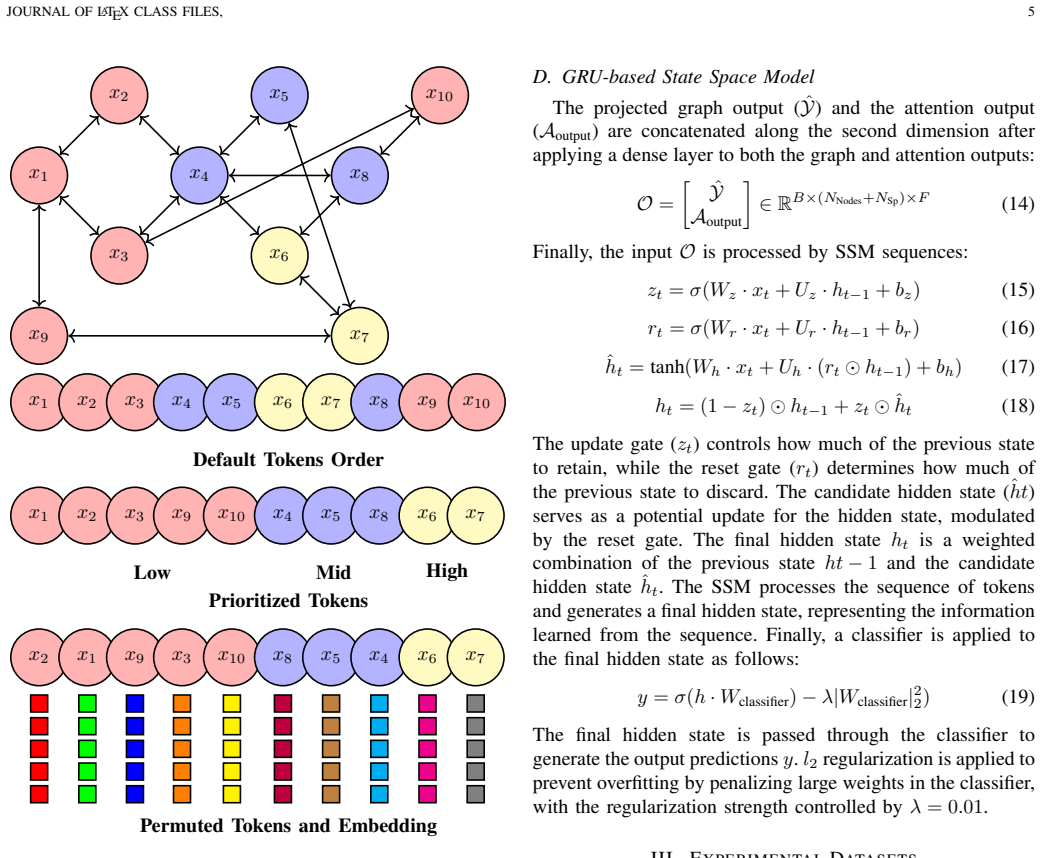
The load-bearing mechanism is graph tokenization with learned prioritization. A dense layer assigns each spectral and spatial token a score; the top $N$ tokens are kept, and their pairwise dot products form an adjacency matrix $A = X_{\text{Pro}}X_{\text{Pro}}^T$ that acts as the graph's edge weights. Multiplying $A$ with the token matrix aggregates information across related tokens, and a dense projection produces the graph output. In parallel, cross-attention between the spatial and spectral token streams computes attention weights $\mathrm{Softmax}(QK^T/\sqrt{d_k})$ and applies them to values. The two outputs are concatenated and passed through a GRU-based state-space layer, whose update gate $z_t$, reset gate $r_t$, and candidate state $\hat{h}_t$ replace purely linear state transitions with nonlinear gated ones.
What would settle it
Re-run the comparison table under identical fixed training splits, patch sizes, and random seeds for all models, tuning each model's hyperparameters on its own validation split; the central claim fails if GraphMamba does not have the fewest parameters and the highest mean accuracy on the majority of the five datasets.
Extended reading notes
Core claim
On its own terms, the paper establishes that a deliberately lightweight architecture can hold or improve classification accuracy on hyperspectral images. The model splits each input patch into spectral tokens (via $1\times1$ convolutions) and spatial tokens (via $3\times3$ convolutions), scores the combined token set with a learned dense layer, and keeps only the top-scoring tokens as nodes of a graph. Edges are defined by the dot-product adjacency matrix $A = X_{\text{Pro}}X_{\text{Pro}}^T$, and the graph output is concatenated with the output of a cross-attention layer that lets spectral and spatial tokens re-weight each other. A GRU-based state-space model then processes the fused sequence, adding nonlinear gated transitions to the usual linear state updates. Across five benchmark datasets, the reported accuracy is the best in the comparison table on at least two datasets, with parameter counts around $1.4\times10^5$, roughly an order of magnitude below several baselines.
Load-bearing premise
The comparison assumes every baseline model was trained and evaluated on the same training-sample splits and patch settings that were selected for GraphMamba, and the paper gives no evidence of that.
Editorial extensions
If this is right
- If the reported parameter counts are correct, GraphMamba is the smallest model in the comparison table on every dataset, which would make it a candidate for deployment on memory-limited platforms such as UAV-based imaging systems.
- If the reported accuracies are taken at face value, the architecture reaches the best overall accuracy in its own comparison on two of the five datasets while remaining competitive on the other three.
- The ablation study ties the gain to the combination of graph tokenization and cross-attention: removing either branch lowers accuracy on every dataset they report.
- The GRU-based state-space layer keeps processing cost linear in the number of tokens, avoiding the quadratic self-attention cost of transformers while still modeling long token sequences.
Reading between the lines
- The comparison table includes CNN and transformer baselines but not the Mamba-based models the paper cites as its closest relatives, so whether GraphMamba also beats other state-space architectures is not tested here.
- The graph-construction step has $O(T^2F)$ cost in the number of tokens $T$, so the practical speed advantage will depend on how aggressively token prioritization shrinks $T$; the paper's wall-clock totals do not separate this component.
- Because the comparative prose quotes accuracy values that differ from the numbers in its own Table III, re-running the comparison under one matched protocol is a prerequisite for treating the claimed margins as quantitative.
Editorial analysis
A structured set of objections, weighed in public.
Referee Report
Summary. The paper proposes GraphMamba, a hybrid hyperspectral image classification architecture that combines spectral-spatial token generation, graph-based token prioritization, cross-attention, and a GRU-based state-space module. The authors evaluate GraphMamba on five HSI datasets (UH, PU, PC, HC, SA) and claim that it outperforms existing CNN and Transformer baselines while using far fewer parameters. The central evidence is Table III and the discussion in Section V, supported by an ablation study in Section IV. The paper also provides a computational complexity analysis and t-SNE visualizations.
Significance. If the empirical claims were reliable, the paper would be a useful contribution to lightweight HSI classification: the architecture is conceptually interesting, the parameter counts in Table III are favorable, and the complexity analysis is a positive feature. However, the paper's central claim is contradicted by its own data. Section V reports accuracy numbers that do not match Table III, Table III shows that GraphMamba is not the best method on several datasets, and the evaluation protocol appears to select per-dataset training splits based on the model's own accuracy curves without evidence that baselines were run under the same splits. These problems affect the main claim rather than peripheral details. The work also lacks code or implementation details for the baselines, further limiting verification. The strengths of the paper cannot compensate for the inconsistency of the reported empirical evidence.
major comments (4)
- [Section V, Table III] The text's numerical claims are contradicted by the paper's own table. Section V states that on PU GraphMamba achieves 99.51% OA and 99.36% Kappa and outperforms all other models, but Table III reports GraphMamba's PU OA as 98.74 and Kappa as 98.33, below HybCNN's 99.18 OA. Similarly, on PC the text reports 99.23% OA while Table III reports 99.49%, with 3DCNN at 99.88 OA; on HC, Table III shows SSViT at 97.46 OA against GraphMamba's 97.36. Since the text and the table cannot both be correct, the core claim that GraphMamba achieves the highest accuracy on most datasets is not supported.
- [Section IV.A, Table III] The comparison protocol is not independent of the model's own performance. Section IV.A states that per-dataset training split percentages (0.5%, 1%, 2%, 5%, 10%, 15%, 20%, 25%) were tested by looking at GraphMamba's accuracy curves in Figure 4, and the 'optimal settings identified from these experiments were subsequently used to evaluate the GraphMamba model in comparison to other methods.' The paper does not report the actual split used for each dataset in Table III, nor does it provide any evidence that the baselines were trained under the same splits. This makes the superiority claim vulnerable to selection bias and prevents independent assessment.
- [Section IV.B, Table II] The ablation text misreports the table it summarizes. Section IV.B says that in the combined graph-and-attention configuration 'the PC dataset reaches an OA of 98.50%, while PU achieves an OA of 99.89%,' but Table II gives PC OA as 99.4924 and PU OA as 98.7422. The reported values are reversed. The same section claims the combined configuration 'consistently outperforms the individual components across all metrics,' but no standard deviations or number of runs are reported, so the consistency claim is not statistically supported.
- [Section II.D, Eqs. (15)-(19)] The method description is not internally consistent. Eqs. (15)-(18) are the standard GRU update equations; no linear state-space transition or selective-scan operation is defined anywhere in the paper, so the claimed 'hybridization of state-space modeling and GRU' is not demonstrated. In addition, Eq. (19) writes y = sigma(h*W) - lambda*||W||^2, which subtracts an L2 penalty from a sigmoid output rather than adding it to a loss function; this is not a valid classifier output as written and makes the architecture description unreliable.
minor comments (5)
- [Section II.A, Eqs. (1)-(2)] Equations (1) and (2) are identical in form apart from the names of the output dimensions; the distinction between the 1x1 spectral convolution and the 3x3 spatial convolution is not expressed in the equations, and the derivation of NSp and NSpc is not specified.
- [Figure 4] The caption says the figure shows overall accuracy 'along with the execution time for each run,' but the plot only shows accuracy as a function of training percentage; no execution-time curve is visible or described.
- [Figures 7-11] Model names are not standardized between the figures and Table III: captions use HCNN, HIN, GCNN, and SST where Table III uses HybCNN, HybIN, GraphCNN, and SSViT. This makes reading the comparison unnecessarily difficult.
- [Table I] The sensor column header is blank and 'AVIRIS' appears to be a typo for 'AVIRIS'; also, the first data column is unlabeled, so the reader cannot tell which column corresponds to which dataset.
- [Section IV.A] The text says the HC dataset reached a peak accuracy of 97.69% with 10% of the data and later says the UH dataset reached 97.69% at 10%; the coincidence of these two numbers is confusing and should be clarified, since Figure 4 appears to show different values for the two datasets.
Circularity Check
No circularity: the accuracy claims are empirical benchmarks, not self-defined outputs.
full rationale
GraphMamba is presented as an empirical architecture paper. There is no claimed first-principles derivation whose output collapses into its input. Each component is defined independently of the reported accuracies: spectral and spatial token generation in Eqs. 1-3, token prioritization and graph adjacency in Eqs. 4-10, cross-attention in Eqs. 11-13, and the GRU-based state transitions in Eqs. 14-18. The reported OA, AA, and kappa values in Table III are measured benchmark results, not fitted parameters or quantities defined in terms of the model outputs. Self-citations appear only in the introduction and related work as background, not as load-bearing evidence for the central empirical claim. The selection of per-dataset training ratios in Section IV.A before the comparative evaluation is a potential evaluation-fairness concern, and the numerical inconsistencies between the Section V text and Table III are correctness risks, but neither constitutes a circular reduction: the claimed superiority is not forced by construction because Table III itself shows GraphMamba losing on several datasets. No equation in the paper defines the target metric equivalently to an input, so there is no self-definitional, fitted-input-as-prediction, or self-citation-chain circularity.
Assumptions & free parameters
free parameters (4)
- regularization strength lambda =
0.01
- training split percentage (per dataset) =
e.g., 10% for HC; varies by dataset
- embedding dimensions =
64 for graph/Mamba, 128 for attention/state-space
- patch size S, number of graph nodes N, number of layers =
not reported
assumptions (3)
- ad hoc to paper Equations 15-18 (the GRU update equations) constitute a state-space model suitable for long-range dependency modeling.
- domain assumption The benchmark datasets are used with standardized, disjoint train/test splits, and the chosen per-dataset training percentage provides a fair comparison.
- domain assumption Overlapping 3D patch extraction does not introduce problematic train/test leakage.
Cite this review
Pith. "Pith review of Hybrid State-Space and GRU-based Graph Tokenization Mamba for Hyperspectral Image Classification." pith.science (2026). https://pith.science/paper/VBWDJLDC
@misc{pith2026250206427,
  author       = {Pith},
  title        = {Pith review of: Hybrid State-Space and GRU-based Graph Tokenization Mamba for Hyperspectral Image Classification},
  year         = {2026},
  howpublished = {\url{https://pith.science/paper/VBWDJLDC}},
  note         = {Machine review of arXiv:2502.06427}
}
read the original abstract
Hyperspectral image (HSI) classification plays a pivotal role in domains such as environmental monitoring, agriculture, and urban planning. However, it faces significant challenges due to the high-dimensional nature of the data and the complex spectral-spatial relationships inherent in HSI. Traditional methods, including conventional machine learning and convolutional neural networks (CNNs), often struggle to effectively capture these intricate spectral-spatial features and global contextual information. Transformer-based models, while powerful in capturing long-range dependencies, often demand substantial computational resources, posing challenges in scenarios where labeled datasets are limited, as is commonly seen in HSI applications. To overcome these challenges, this work proposes GraphMamba, a hybrid model that combines spectral-spatial token generation, graph-based token prioritization, and cross-attention mechanisms. The model introduces a novel hybridization of state-space modeling and Gated Recurrent Units (GRU), capturing both linear and nonlinear spatial-spectral dynamics. GraphMamba enhances the ability to model complex spatial-spectral relationships while maintaining scalability and computational efficiency across diverse HSI datasets. Through comprehensive experiments, we demonstrate that GraphMamba outperforms existing state-of-the-art models, offering a scalable and robust solution for complex HSI classification tasks.
Figures


Figures from the paper (8 more)


Reference graph
Works this paper leans on
-
[1]
Spectralgpt: Spectral remote sensing foun- dation model,
D. Hong, B. Zhang, X. Li, Y . Li, C. Li, J. Yao, N. Yokoya, H. Li, P. Ghamisi, X. Jia et al. , “Spectralgpt: Spectral remote sensing foun- dation model,” IEEE Transactions on Pattern Analysis and Machine Intelligence, 2024
2024
-
[2]
T. Liu, Y . F. Li, H. Liu, Z. Zhang, and S. Liu, “Risir: Rapid infrared spectral imaging restoration model for industrial material detection in intelligent video systems,” IEEE Transactions on Industrial Informatics , pp. 1–1, 2019
work page 2019
-
[3]
Scsnet: Sharpened cosine similarity-based neural network for hyperspectral image classification,
M. Ahmad and M. Mazzara, “Scsnet: Sharpened cosine similarity-based neural network for hyperspectral image classification,” IEEE Geoscience and Remote Sensing Letters , vol. 21, pp. 1–4, 2024
work page 2024
-
[4]
Chapter 5 - hyperspectral imaging applications,
G. P. Sabin, F. L. F. Soares, D. L. D. De Freitas, H. V . de Oliveira Silva, C. de Melo Molinari Ortiz Antunes, E. A. Mohamed, C. A. Teixeira, C. Assis, V . G. K. Cardoso, and M. V olochen, “Chapter 5 - hyperspectral imaging applications,” in Chemometrics, F. A. N. Fernandes, S. Rodrigues, and E. G. A. Filho, Eds. Elsevier, 2024, pp. 91–123. [Online]. Ava...
work page 2024
-
[5]
Semi-active convolutional neural networks for hyperspectral image classification,
J. Yao, X. Cao, D. Hong, X. Wu, D. Meng, J. Chanussot, and Z. Xu, “Semi-active convolutional neural networks for hyperspectral image classification,” IEEE Transactions on Geoscience and Remote Sensing , vol. 60, pp. 1–15, 2022
work page 2022
-
[6]
A. Picon, O. Ghita, P. F. Whelan, and P. M. Iriondo, “Fuzzy spectral and spatial feature integration for classification of nonferrous materials in hyperspectral data,” IEEE Transactions on Industrial Informatics , vol. 5, no. 4, pp. 483–494, 2009. JOURNAL OF LATEX CLASS FILES, 12
work page 2009
-
[7]
Ground truth labeling and samples selection for hyperspectral image classification,
M. Ahmad, “Ground truth labeling and samples selection for hyperspectral image classification,” Optik, vol. 230, p. 166267, 2021. [Online]. Available: https://www.sciencedirect.com/science/article/pii/ S0030402621000103
work page 2021
-
[8]
J. Long, Y . Zhan, Z. Pang, T. Zhou, X. Li, L. Lan, and Y . Peng, “Joint spatial–spectral optimization for the high-magnification fusion of hyper- spectral and multispectral images,” IEEE Transactions on Geoscience and Remote Sensing , vol. 62, pp. 1–19, 2024
work page 2024
Show all 54 references
-
[9]
Dmssn: Distilled mixed spectral–spatial network for hyperspectral salient object detection,
H. Qin, T. Xu, P. Liu, J. Xu, and J. Li, “Dmssn: Distilled mixed spectral–spatial network for hyperspectral salient object detection,”IEEE Transactions on Geoscience and Remote Sensing , vol. 62, pp. 1–18, 2024
2024
-
[10]
Hyperspectral image clas- sification—traditional to deep models: A survey for future prospects,
M. Ahmad, S. Shabbir, S. K. Roy, D. Hong, X. Wu, J. Yao, A. M. Khan, M. Mazzara, S. Distefano, and J. Chanussot, “Hyperspectral image clas- sification—traditional to deep models: A survey for future prospects,” IEEE Journal of Selected Topics in Applied Earth Observations and ...
2022
-
[11]
M. S. Chowdhury, “Comparison of accuracy and reliability of random forest, support vector machine, artificial neural network and maximum likelihood method in land use/cover classification of urban setting,” Environmental Challenges, vol. 14, p. 100800, 2024. [Online]. Availabl...
2024
-
[12]
Convolutional neural networks for multimodal remote sensing data classification,
X. Wu, D. Hong, and J. Chanussot, “Convolutional neural networks for multimodal remote sensing data classification,” IEEE Transactions on Geoscience and Remote Sensing , vol. 60, pp. 1–10, 2021
2021
-
[13]
Deep learning for hyperspectral image classification: A survey,
V . Kumar, R. S. Singh, M. Rambabu, and Y . Dua, “Deep learning for hyperspectral image classification: A survey,” Computer Science Review , vol. 53, p. 100658, 2024. [Online]. Available: https://www.sciencedirect.com/science/article/pii/S157401372400042X
2024
-
[14]
A weakly supervised semantic segmentation framework for medium-resolution forest classi- fication with noisy labels and gf-1 wfv images,
X. Peng, G. He, G. Wang, R. Yin, and J. Wang, “A weakly supervised semantic segmentation framework for medium-resolution forest classi- fication with noisy labels and gf-1 wfv images,” IEEE Transactions on Geoscience and Remote Sensing , pp. 1–1, 2024
2024
-
[15]
A new dimensionality reduction algorithm for hyperspectral image using evolutionary strategy,
J. Yin, Y . Wang, and J. Hu, “A new dimensionality reduction algorithm for hyperspectral image using evolutionary strategy,” IEEE Transactions on Industrial Informatics , vol. 8, no. 4, pp. 935–943, 2012
2012
-
[16]
A systematic review of hyperspectral imaging in precision agriculture: Analysis of its current state and future prospects,
B. G. Ram, P. Oduor, C. Igathinathane, K. Howatt, and X. Sun, “A systematic review of hyperspectral imaging in precision agriculture: Analysis of its current state and future prospects,” Computers and Elec- tronics in Agriculture , vol. 222, p. 109037, 2024. [Online]. Availabl...
2024
-
[17]
Enhanced affinity propagation clustering with a modified extreme learning machine for segmentation and classification of hyperspectral imaging,
V . A. A. Daniel, K. Vijayalakshmi, P. P. Pawar, D. Kumar, A. Bhuvanesh, and A. J. Christilda, “Enhanced affinity propagation clustering with a modified extreme learning machine for segmentation and classification of hyperspectral imaging,” e-Prime - Advances in Electrical Eng...
2024
-
[18]
Multispectral semantic segmen- tation for land cover classification: An overview,
L. Thomas Ramos and A. D. Sappa, “Multispectral semantic segmen- tation for land cover classification: An overview,” IEEE Journal of Selected Topics in Applied Earth Observations and Remote Sensing , vol. 17, pp. 14 295–14 336, 2024
2024
-
[19]
Automatic fruit classification using deep learning for industrial applications,
M. S. Hossain, M. Al-Hammadi, and G. Muhammad, “Automatic fruit classification using deep learning for industrial applications,” IEEE Transactions on Industrial Informatics , vol. 15, no. 2, pp. 1027–1034, 2019
2019
-
[20]
A disjoint samples-based 3d-cnn with active transfer learning for hyperspectral image classification,
M. Ahmad, U. Ghous, D. Hong, A. M. Khan, J. Yao, S. Wang, and J. Chanussot, “A disjoint samples-based 3d-cnn with active transfer learning for hyperspectral image classification,” IEEE Transactions on Geoscience and Remote Sensing , vol. 60, pp. 1–16, 2022
2022
-
[21]
Rustqnet: Multimodal deep learning for quantitative inversion of wheat stripe rust disease index,
J. Deng, D. Hong, C. Li, J. Yao, Z. Yang, Z. Zhang, and J. Chanussot, “Rustqnet: Multimodal deep learning for quantitative inversion of wheat stripe rust disease index,” Computers and Electronics in Agriculture, vol. 225, p. 109245, 2024
2024
-
[22]
High efficient deep feature extraction and classification of spectral-spatial hyperspectral image using cross domain convolutional neural networks,
Y . Guo, H. Cao, J. Bai, and Y . Bai, “High efficient deep feature extraction and classification of spectral-spatial hyperspectral image using cross domain convolutional neural networks,” IEEE Journal of Selected Topics in Applied Earth Observations and Remote Sensing , vol. 1...
2019
-
[23]
Learning disentangled priors for hyperspectral anomaly detection: A coupling model-driven and data-driven paradigm,
C. Li, B. Zhang, D. Hong, X. Jia, A. Plaza, and J. Chanussot, “Learning disentangled priors for hyperspectral anomaly detection: A coupling model-driven and data-driven paradigm,” IEEE Transactions on Neural Networks and Learning Systems , 2024
2024
-
[24]
A fast and compact 3-d cnn for hyperspectral image classification,
M. Ahmad, A. M. Khan, M. Mazzara, S. Distefano, M. Ali, and M. S. Sarfraz, “A fast and compact 3-d cnn for hyperspectral image classification,” IEEE Geoscience and Remote Sensing Letters , vol. 19, pp. 1–5, 2022
2022
-
[25]
Spectral–spatial feature extraction for hsi classification based on supervised hypergraph and sample expanded cnn,
Y . Kong, X. Wang, and Y . Cheng, “Spectral–spatial feature extraction for hsi classification based on supervised hypergraph and sample expanded cnn,” IEEE Journal of Selected Topics in Applied Earth Observations and Remote Sensing , vol. 11, no. 11, pp. 4128–4140, 2018
2018
-
[26]
Local similarity- based spatial–spectral fusion hyperspectral image classification with deep cnn and gabor filtering,
U. A. Bhatti, Z. Yu, J. Chanussot, Z. Zeeshan, L. Yuan, W. Luo, S. A. Nawaz, M. A. Bhatti, Q. U. Ain, and A. Mehmood, “Local similarity- based spatial–spectral fusion hyperspectral image classification with deep cnn and gabor filtering,” IEEE Transactions on Geoscience and Rem...
2022
-
[27]
A comprehensive survey for hyperspectral image classification: The evolution from conventional to transformers,
M. Ahmad, S. Distifano, A. M. Khan, M. Mazzara, C. Li, J. Yao, H. Li, J. Aryal, G. Vivone, and D. Hong, “A comprehensive survey for hyperspectral image classification: The evolution from conventional to transformers,” 2024. [Online]. Available: https: //arxiv.org/abs/2404.14955
2024 arXiv
-
[28]
Review of pixel-level remote sensing image fusion based on deep learning,
Z. Wang, Y . Ma, and Y . Zhang, “Review of pixel-level remote sensing image fusion based on deep learning,” Information Fusion , vol. 90, pp. 36–58, 2023. [Online]. Available: https://www.sciencedirect.com/ science/article/pii/S1566253522001403
2023
-
[29]
Exploring multiscale object-based convolutional neural network (multi-ocnn) for remote sensing image classification at high spatial resolution,
V . S. Martins, A. L. Kaleita, B. K. Gelder, H. L. da Silveira, and C. A. Abe, “Exploring multiscale object-based convolutional neural network (multi-ocnn) for remote sensing image classification at high spatial resolution,” ISPRS Journal of Photogrammetry and Remote Sensing ,...
2020
-
[30]
Uiu-net: U-net in u-net for infrared small object detection,
X. Wu, D. Hong, and J. Chanussot, “Uiu-net: U-net in u-net for infrared small object detection,” IEEE Transactions on Image Processing, vol. 32, pp. 364–376, 2022
2022
-
[31]
Hypersinet: A synergetic interaction network combined with convolution and trans- former for hyperspectral image classification,
Q. Yu, W. Wei, D. Li, Z. Pan, C. Li, and D. Hong, “Hypersinet: A synergetic interaction network combined with convolution and trans- former for hyperspectral image classification,” IEEE Transactions on Geoscience and Remote Sensing , 2024
2024
-
[32]
Waveformer: Spec- tral–spatial wavelet transformer for hyperspectral image classification,
M. Ahmad, U. Ghous, M. Usama, and M. Mazzara, “Waveformer: Spec- tral–spatial wavelet transformer for hyperspectral image classification,” IEEE Geoscience and Remote Sensing Letters , vol. 21, pp. 1–5, 2024
2024
-
[33]
S2mae: A spatial-spectral pretraining foundation model for spectral remote sensing data,
X. Li, D. Hong, and J. Chanussot, “S2mae: A spatial-spectral pretraining foundation model for spectral remote sensing data,” in Proceedings of the IEEE/CVF Conference on Computer Vision and Pattern Recognition , 2024, pp. 24 088–24 097
2024
-
[34]
Casformer: Cascaded transformers for fusion-aware computational hyperspectral imaging,
C. Li, B. Zhang, D. Hong, J. Zhou, G. Vivone, S. Li, and J. Chanus- sot, “Casformer: Cascaded transformers for fusion-aware computational hyperspectral imaging,” Information Fusion , vol. 108, p. 102408, 2024
2024
-
[35]
Spatial–spectral transformer with conditional position encoding for hyperspectral image classification,
M. Ahmad, M. Usama, A. M. Khan, S. Distefano, H. A. Altuwaijri, and M. Mazzara, “Spatial–spectral transformer with conditional position encoding for hyperspectral image classification,” IEEE Geoscience and Remote Sensing Letters , vol. 21, pp. 1–5, 2024
2024
-
[36]
Domain adaptation- aware transformer for hyperspectral object tracking,
Y . Wu, L. Jiao, X. Liu, F. Liu, S. Yang, and L. Li, “Domain adaptation- aware transformer for hyperspectral object tracking,” IEEE Transactions on Circuits and Systems for Video Technology , pp. 1–1, 2024
2024
-
[37]
Spatial pooling transformer network and noise-tolerant learning for noisy hyperspectral image classification,
J. Ma, Y . Zou, X. Tang, X. Zhang, F. Liu, and L. Jiao, “Spatial pooling transformer network and noise-tolerant learning for noisy hyperspectral image classification,” IEEE Transactions on Geoscience and Remote Sensing, vol. 62, pp. 1–19, 2024
2024
-
[38]
Pyramid hierarchical spatial-spectral transformer for hyperspectral image classification,
M. Ahmad, M. H. F. Butt, M. Mazzara, S. Distefano, A. M. Khan, and H. A. Altuwaijri, “Pyramid hierarchical spatial-spectral transformer for hyperspectral image classification,” IEEE Journal of Selected Topics in Applied Earth Observations and Remote Sensing , vol. 17, pp. 17 6...
2024
-
[39]
A survey on graph neural networks and graph transformers in computer vision: A task-oriented perspective,
C. Chen, Y . Wu, Q. Dai, H.-Y . Zhou, M. Xu, S. Yang, X. Han, and Y . Yu, “A survey on graph neural networks and graph transformers in computer vision: A task-oriented perspective,” IEEE Transactions on Pattern Analysis and Machine Intelligence , pp. 1–20, 2024
2024
-
[40]
Gtformer: Graph-based temporal-order-aware transformer for long-term series forecasting,
A. Liang, X. Chai, Y . Sun, and M. Guizani, “Gtformer: Graph-based temporal-order-aware transformer for long-term series forecasting,” IEEE Internet of Things Journal , pp. 1–1, 2024
2024
-
[41]
Mat: Morphological adaptive trans- former for universal morphology policy learning,
B. Li, H. Li, Y . Zhu, and D. Zhao, “Mat: Morphological adaptive trans- former for universal morphology policy learning,” IEEE Transactions on Cognitive and Developmental Systems , vol. 16, no. 4, pp. 1611–1621, 2024
2024
-
[42]
Graph structure learning with automatic search of hyperparameters based on genetic pro- gramming,
P. Wang, M. Lu, W. Yan, D. Yang, and Z. Liu, “Graph structure learning with automatic search of hyperparameters based on genetic pro- gramming,” IEEE Transactions on Emerging Topics in Computational Intelligence, pp. 1–10, 2024
2024
-
[43]
Mambahsi: Spa- tial–spectral mamba for hyperspectral image classification,
Y . Li, Y . Luo, L. Zhang, Z. Wang, and B. Du, “Mambahsi: Spa- tial–spectral mamba for hyperspectral image classification,” IEEE Trans- actions on Geoscience and Remote Sensing , vol. 62, pp. 1–16, 2024
2024
-
[44]
Multi-head spatial-spectral mamba for hyperspectral JOURNAL OF LATEX CLASS FILES, 13 image classification,
M. Ahmad, M. H. F. Butt, M. Usama, H. A. Altuwaijri, M. Mazzara, and S. Distefano, “Multi-head spatial-spectral mamba for hyperspectral JOURNAL OF LATEX CLASS FILES, 13 image classification,” 2024. [Online]. Available: https://arxiv.org/abs/ 2408.01224
2024 arXiv
-
[45]
A local enhanced mamba network for hyperspectral image classification,
C. Wang, J. Huang, M. Lv, H. Du, Y . Wu, and R. Qin, “A local enhanced mamba network for hyperspectral image classification,” International Journal of Applied Earth Observation and Geoinformation , vol. 133, p. 104092, 2024. [Online]. Available: https://www.sciencedirect.com/ ...
2024
-
[46]
State space models meet transformers for hyperspectral image classification,
X. Shi, Y . Zhang, K. Liu, Z. Wen, W. Wang, T. Zhang, and J. Li, “State space models meet transformers for hyperspectral image classification,” Signal Processing, p. 109669, 2024. [Online]. Available: https://www.sciencedirect.com/science/article/pii/S0165168424002895
2024
-
[47]
Spectralmamba: Effi- cient mamba for hyperspectral image classification,
J. Yao, D. Hong, C. Li, and J. Chanussot, “Spectralmamba: Effi- cient mamba for hyperspectral image classification,” arXiv preprint arXiv:2404.08489, 2024
2024 arXiv
-
[48]
Wavemamba: Spatial-spectral wavelet mamba for hyperspectral image classification,
M. Ahmad, M. Usama, M. Mazzara, and S. Distefano, “Wavemamba: Spatial-spectral wavelet mamba for hyperspectral image classification,” IEEE Geoscience and Remote Sensing Letters , vol. 22, pp. 1–5, 2025
2025
-
[49]
Spatial-spectral morphological mamba for hyperspectral image classification,
M. Ahmad, M. H. F. Butt, M. Usama, A. M. Khan, M. Mazzara, S. Distefano, H. A. Altuwaijri, S. K. Roy, J. Chanussot, and D. Hong, “Spatial-spectral morphological mamba for hyperspectral image classification,” 2024. [Online]. Available: https://arxiv.org/abs/ 2408.01372
2024 arXiv
-
[50]
Mamba-in-mamba: Centralized mamba-cross-scan in tokenized mamba model for hyperspectral image classification,
W. Zhou, S. ichiro Kamata, H. Wang, M. S. Wong, and H. C. Hou, “Mamba-in-mamba: Centralized mamba-cross-scan in tokenized mamba model for hyperspectral image classification,” Neurocomputing, vol. 613, p. 128751, 2025. [Online]. Available: https://www.sciencedirect. com/science...
2025
-
[51]
Hypermamba: A spectral- spatial adaptive mamba for hyperspectral image classification,
Q. Liu, J. Yue, Y . Fang, S. Xia, and L. Fang, “Hypermamba: A spectral- spatial adaptive mamba for hyperspectral image classification,” IEEE Transactions on Geoscience and Remote Sensing , pp. 1–1, 2024
2024
-
[52]
Joint classification of hyperspectral and lidar data based on mamba,
D. Liao, Q. Wang, T. Lai, and H. Huang, “Joint classification of hyperspectral and lidar data based on mamba,” IEEE Transactions on Geoscience and Remote Sensing , vol. 62, pp. 1–15, 2024
2024
-
[53]
Spatial–spectral interaction super-resolution cnn–mamba network for fusion of satellite hyperspectral and multispectral image,
G. Zhao, H. Wu, D. Luo, X. Ou, and Y . Zhang, “Spatial–spectral interaction super-resolution cnn–mamba network for fusion of satellite hyperspectral and multispectral image,” IEEE Journal of Selected Topics in Applied Earth Observations and Remote Sensing , vol. 17, pp. 18 489...
2024
-
[54]
Dualmamba: A lightweight spectral-spatial mamba-convolution network for hyperspectral image classification,
J. Sheng, J. Zhou, J. Wang, P. Ye, and J. Fan, “Dualmamba: A lightweight spectral-spatial mamba-convolution network for hyperspectral image classification,” 2024. [Online]. Available: https://arxiv.org/abs/2406.07050
2024 arXiv
Reviewed August 8, 2026 · model on record in the stance chip above.
Discussion (0). Continue with ORCID to comment.