REVIEW 4 major objections 5 minor 157 references
Radial velocity homogeneous analysis of M dwarfs observed with HARPS I. Exoplanet detection and candidates
T0 review · 4 major / 5 minor · reviewed 2026-08-08 · deepseek-v4-flash
Pith's one-line read A homogeneous re-analysis of 200 M dwarfs observed with HARPS recovers most known planets and turns up three new low-mass candidates.
desk verdict Useful homogeneous HARPS M-dwarf catalog, but the three new planet candidates are not yet robust to activity harmonics, and the abstract recovery rate contradicts the body. read the letter →
The pith
A machine-rendered reading of the paper's core claim, the machinery that carries it, and where it could break.
The reading
What carries the argument
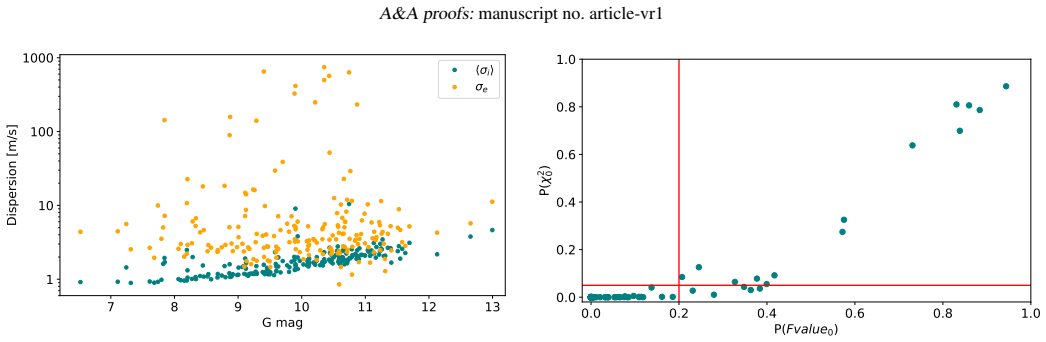
The load-bearing mechanism is the multi-step detection pipeline. RVs are extracted by template matching, then each time series is tested for a dominant long-term pattern (constant, linear, quadratic, or sinusoidal) using reduced chi-squared and F-tests. After subtracting the chosen long-term model, a generalized Lomb-Scargle periodogram identifies the strongest remaining periodic signal, a bootstrap gives its false-alarm probability, and a Keplerian is fitted with a L-BFGS-B minimiser; the process is iterated on residuals until no significant peak remains. Candidate signals are then classified as rotation or planet by comparing their periods to published rotation periods and to periods found in the Ca II, Na D, and Hα chromospheric indices, and the massive companions are re-fitted with the orvara code to combine RV with Hipparcos-Gaia proper motion anomalies.
What would settle it
Re-observe GJ 300, GJ 654, and GJ 739 with additional HARPS (or NIRPS) data and check whether the candidate signals remain at the same period and phase while the chromospheric indices stay flat; a signal that persists after activity modelling, or is corroborated by transits, would confirm the planets, whereas one that shifts in period or amplitude with the activity would reveal a false positive.
Extended reading notes
Core claim
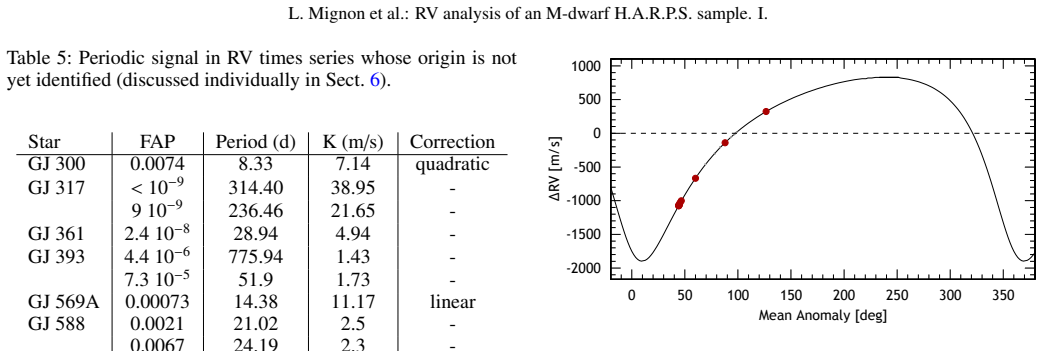
The paper's central claim is that a single, uniform pipeline applied to 200 M dwarfs observed with HARPS between 2003 and 2019 recovers most previously published planetary systems in the sample and uncovers three new low-mass planet candidates: a ~7.3 Earth-mass planet at 8.33 days around GJ 300, a ~5 Earth-mass planet at 15.35 days around GJ 654, and a ~39 Earth-mass planet at about 145 days around GJ 739. The same analysis revises the orbit of the massive planet GJ 9482 b to a period of 3659±4 days and minimum mass 4.58±0.09 Jupiter masses, and, by combining RVs with Hipparcos-Gaia astrometry, constrains the masses and inclinations of four new stellar or brown-dwarf companions around GJ 3307, GJ 4001, GJ 4254, and GJ 9588. Long-term variability is found in 28.5% of the time series; 35 of the remaining periodic signals are attributed to stellar rotation, leaving 22 unexplained signals that await follow-up.
Load-bearing premise
The pipeline removes stellar activity only by subtracting a Keplerian at a published or estimated rotation period or by matching RV periods to chromospheric-index periods; if activity produces a coherent signal at some other period, any of the 22 unexplained signals, including the three planet candidates, could be activity rather than a planet.
Editorial extensions
If this is right
- If the three candidates hold up, they add to the small but growing list of Neptune-to-Earth-mass planets around mid-M dwarfs, directly feeding the occurrence-rate statistics planned in the companion paper.
- The revised GJ 9482 b parameters turn a poorly constrained planet into a well-determined 4.58-Jupiter-mass companion on a 10-year orbit, a useful anchor for the long-period end of the M-dwarf planet mass function.
- The four new companions around GJ 3307, GJ 4001, GJ 4254, and GJ 9588 show that the brown-dwarf-to-star boundary can be probed by combining archival RVs with astrometry; two of them should be resolvable by high-contrast imaging.
- The recovery of known planets by an automatic pipeline with no per-star tuning validates the use of this sample for statistical studies, since the detection completeness can now be quantified.
- The 22 unexplained signals constitute a prioritized list for future RV monitoring, with the planet candidates at the top.
Reading between the lines
- The abstract's '97% of planetary systems' figure is not reproduced by the body's detailed accounting, which reports 31 of 40 systems recovered before exclusions and 88% after excluding five systems observed predominantly with other instruments; readers comparing the two should check which units (planets vs systems) and which exclusion criteria are being counted.
- The three planet candidates are selected mainly by period mismatch with estimated rotation periods; a decisive confirmation should also model activity with a Gaussian process or measure rotation directly, which the paper leaves for future work.
- Because the sample is built from pre-Gaia catalogues and is magnitude-limited, the occurrence-rate analysis announced for the companion paper will need careful incompleteness corrections before its rates can be compared with values from other surveys.
- The four new companions at the brown-dwarf/very-low-mass-star boundary suggest such objects are not rare around M dwarfs; modelling the detection completeness of this sample could yield a mass-ratio distribution for these companions.
Editorial analysis
A structured set of objections, weighed in public.
Referee Report
Summary. The paper presents a homogeneous automated analysis of HARPS radial-velocity time series for 200 nearby M dwarfs, combining long-term trend characterization, GLS periodogram searches, iterative Keplerian fitting, and activity screening based on rotation periods and chromospheric-index periodicities. It reports long-term variability in 57 stars, four new stellar/substellar companions, a revised orbit for GJ 9482 b, recovery of a large fraction of previously published planetary systems, and three new low-mass planetary candidates around GJ 300, GJ 654, and GJ 739. The manuscript is explicitly a survey paper, with the new planets presented as candidates requiring further monitoring.
Significance. If the candidate detections hold, the paper provides a valuable homogeneous catalog for M-dwarf occurrence-rate studies and identifies promising nearby targets for future characterization. Its strengths are the transparent and reproducible automated pipeline, the public release of the RV time series and long-term analysis tables, the careful treatment of the HARPS fiber-change offset, and an honest limitations section. The recovery-rate claim, however, is internally inconsistent with the body of the paper, and the activity discrimination for the strongest new planetary candidate does not yet withstand scrutiny; these issues need to be fixed before the survey results can be used as a reliable statistical foundation.
major comments (4)
- [6.2.1 and Table B.7] The claim that the 8.33 d signal for GJ 300 is not rotation-related ignores the harmonic structure of stellar activity signals. The activity-derived rotation period is 67.3 d, and 67.3/8 = 8.41 d, which is within 1% of the candidate period. Under the paper's own 10% period-matching criterion in Sect. 5.2.2, and given that active M dwarfs commonly produce RV signals at harmonics of the rotation period, the 8.33 d signal is a plausible activity harmonic. This is particularly concerning because the fit uses only 30 points from one season, requires e = 0.64 at an 8 d orbit (in tension with tidal circularization, as the authors themselves note), and an equally good two-planet 2:1 circular solution exists. Before presenting GJ 300 b as the strongest new candidate, the authors should test whether the 8.33 d period appears in the chromospheric activity indicators at the appropriate harmonic, or refit the data with a quasi-periodic activity model.
- [5.2.2, 6.2.7, and 6.2.9] The same harmonic concern applies to the other two new candidates. For GJ 654, the 15.35 d signal lies within about 3% of one quarter of the 63.1 d rotation period, and for GJ 739, the 138.7 d signal lies within about 7% of three times the 49.5 d rotation period. The manuscript applies its 10% matching criterion only to exact rotation periods, not to harmonics, but RV activity signals are known to appear at harmonics of the rotation period. The statement that these signals are unlikely to be rotation signatures is therefore not established by the evidence presented; a quantitative activity false-positive analysis or a GP-based comparison is needed before these can be presented as robust candidates.
- [7.4 versus Abstract] The abstract's claim of recovering 97% of previously published planetary systems is not supported by the body of the paper. Section 7.4 reports 31 of 40 systems (75%) and 51 of 78 planets (65.4%), rising to 88% after excluding five systems detected with additional instruments and to 94% after additionally excluding planets with periods below 1.6 d. The 97% figure in the abstract appears to use a different, undefined denominator. The authors should either state the denominator explicitly or correct the abstract, since the headline recovery rate materially overstates the homogeneous HARPS-only completeness.
- [7.3 and Section 6.2] The paper acknowledges in Sect. 7.3 that subtracting a Keplerian at the rotation period is not an optimal activity correction and may hinder the detection of weak Keplerian signals, but the candidate sections do not quantify how this limitation affects the three new candidates. Because all three candidates rest on period coincidences with rotation periods or their harmonics, the manuscript should provide a concrete estimate of the activity false-positive probability for these signals, for example by injecting and recovering activity-like signals or by comparing with a Gaussian-process model, before the candidates are used as headline results.
minor comments (5)
- [Abstract] There is a typo: 'perdiodic signals' should be 'periodic signals'.
- [6.2.1 and Appendix A.1.1] The number of points used for GJ 300 is inconsistent: Sect. 6.2.1 says 30 measurements, while the caption of Fig. A.2 says 28 nights; please reconcile this.
- [6.2.1] Several figure cross-references are unresolved, including 'Fig. ?? and Fig. ??' and 'presented in Fig. ??'; these should point to the actual appendix figures.
- [6.2.9 and Appendix A.1.7] The caption of Fig. A.8 says 'GJ 654' but the surrounding section and appendix entry are about GJ 739; this appears to be a typo.
- [6.1.2] The orvara-derived inclination and companion mass for GJ 4001 are quoted as 8.6 degrees and 362 M_J without uncertainties; error bars should be provided for these values.
Circularity Check
No circular derivation; the survey's activity cross-checks use independent observables, and the candidate signals are not constructed from the calibrated inputs.
full rationale
The paper is an empirical RV survey: its central claims are Keplerian fits to periodogram peaks in HARPS time series, compared against the NASA Exoplanet Archive. The three new planetary candidates (GJ300, GJ654, GJ739) are residual signals after iterative Keplerian subtraction; they are not quantities defined in terms of the activity calibrations used elsewhere. Rotation-period estimates come from the Astudillo-Defru et al. (2017a) log R'HK relation and from chromospheric-index periodograms, including Mignon et al. (2023); these are independent observables from the RV signals, and applying them to classify 35 signals as activity does not mathematically force the remaining 22 signals. No equation in the paper equates a predicted quantity to a fitted input, and no uniqueness claim is imported from prior work to forbid alternatives. The paper itself flags limitations (Sect. 7.3: the activity correction is not optimal), which is a correctness/robustness concern rather than circularity. One internal inconsistency exists: the abstract claims recovery of 97% of published planetary systems, while Sect. 7.4 states 31 of 40 systems (75%) were recovered; this is a consistency error, not a circular-reasoning step. Overall, the derivation chain is self-contained and does not reduce to its own inputs; the few self-citations are independent evidence and do not raise the circularity score beyond minor.
Assumptions & free parameters
free parameters (3)
- Long-term trend coefficients per star =
e.g., GJ864 slope -52.04 +/- 1.20 m/s/yr (Table B.2)
- RV offset at May 2015 HARPS fibre change for 37 stars =
e.g., GJ9482 -27.10 +/- 15.70 m/s in the sinusoidal model (Table B.3)
- Keplerian parameters for candidate signals =
e.g., GJ300 P=8.347 +/- 0.005 d, K=7.1 +/- 0.8 m/s, e=0.64 +/- 0.07; GJ739 P=145.3 +/- 0.8 d, m sin i=39 +/- 4 Earth…
assumptions (5)
- domain assumption Template matching RV extraction is unbiased and accurate when at least 10 spectra are available per star.
- standard math GLS periodogram false alarm probabilities from 1000 bootstrap permutations correctly calibrate peak significance.
- domain assumption The Delfosse et al. (2000) mass-luminosity relation gives accurate M dwarf masses.
- domain assumption The empirical log R'_HK to rotation period relation of Astudillo-Defru et al. (2017a) is valid for classifying RV signals as rotation.
- domain assumption The HARPS fibre change offset can be modeled as a single additive constant per star.
invented entities (3)
-
GJ300 b (8.33-day planet candidate, about 7.3 Earth masses)
-
GJ654 b (15.35-day planet candidate, about 5 Earth masses)
-
GJ739 b (145.3-day planet candidate, about 39 Earth masses)
Cite this review
Pith. "Pith review of Radial velocity homogeneous analysis of M dwarfs observed with HARPS I. Exoplanet detection and candidates." pith.science (2026). https://pith.science/paper/2IY5BTLV
@misc{pith2026250206513,
  author       = {Pith},
  title        = {Pith review of: Radial velocity homogeneous analysis of M dwarfs observed with HARPS I. Exoplanet detection and candidates},
  year         = {2026},
  howpublished = {\url{https://pith.science/paper/2IY5BTLV}},
  note         = {Machine review of arXiv:2502.06513}
}
read the original abstract
The census of planets around M dwarfs in the solar neighbourhood meets two challenges: detecting the best targets for the future characterisation of planets with ELTs, and studying the statistics of planet occurrence that are crucial to formation scenarios. The radial velocity (RV) method remains the most appropriate for such a census as it is sensitive to the widest ranges of masses and periods. HARPS, mounted on the 3.6 m telescope at La Silla Observatory (ESO, Chile), has been obtaining velocity measurements since 2003, and can therefore be used to analyse a very large and homogeneous dataset. We performed a homogeneous analysis of the RV time series of 200 M dwarfs observed with HARPS from 2003 to 2019 (gathering more than 15000 spectra), with the aim of understanding detectable signals such as stellar and planetary companions and activity signals. The RVs were computed with a template matching method before carrying out the time series analysis. First, we focused on the systematic analysis of the presence of a dominant long-term pattern in the RV time series (linear or quadratic trend and sine function). Then, we analysed higher-frequency perdiodic signals using periodograms of the residual time series and Keplerian function fitting. We found long-term variability in 57 RV time series (28.5%). This led to the revision of the parameters of the massive planet (GJ9482 b), as well as the detection of four substellar and stellar companions (around GJ3307, GJ4001, GJ4254, andGJ9588), for which we characterised inclinations and masses by combining RV and astrometry. The periodic analysis allowed us to recover 97% of the planetary systems already published in this sample, but also to propose three new planetary candidates orbiting GJ300 (7.3Me), GJ654(5Me), and GJ739 (39Me), which require additional measurements before they can be confirmed.
Figures


Figures from the paper (11 more)






Reference graph
Works this paper leans on
-
[1]
, " * write output.state after.block = add.period write newline
ENTRY address archiveprefix author booktitle chapter edition editor howpublished institution eprint journal key month note number organization pages publisher school series title type volume year label extra.label sort.label short.list INTEGERS output.state before.all mid.sentence after.sentence after.block FUNCTION init.state.consts #0 'before.all := #1 ...
-
[2]
write newline
" write newline "" before.all 'output.state := FUNCTION n.dashify 't := "" t empty not t #1 #1 substring "-" = t #1 #2 substring "--" = not "--" * t #2 global.max substring 't := t #1 #1 substring "-" = "-" * t #2 global.max substring 't := while if t #1 #1 substring * t #2 global.max substring 't := if while FUNCTION word.in bbl.in " " * FUNCTION format....
-
[3]
Aigrain , S. & Foreman-Mackey , D. 2022, arXiv e-prints, arXiv:2209.08940
arXiv 2022
-
[4]
M., Astudillo-Defru , N., Bonfils , X., et al
Almenara , J. M., Astudillo-Defru , N., Bonfils , X., et al. 2015, A & A, 581, L7
2015
-
[5]
J., Bauer , F
Amado , P. J., Bauer , F. F., Rodr \' guez L \'o pez , C., et al. 2021, A & A, 650, A188
2021
-
[6]
J., Barnes, J., et al
Anglada-Escud \'e , G., Amado, P. J., Barnes, J., et al. 2016, Nature, 536, 437
2016
-
[7]
2014, Monthly Notices of the Royal Astronomical Society: Letters, 443, L89
Anglada-Escud \'e , G., Arriagada, P., Tuomi, M., et al. 2014, Monthly Notices of the Royal Astronomical Society: Letters, 443, L89
2014
-
[8]
2013, , 556, A126
Anglada-Escud \'e , G., Tuomi , M., Gerlach , E., et al. 2013, , 556, A126
2013
Show all 157 references
-
[9]
J., et al
Artigau , \'E ., Cadieux , C., Cook , N. J., et al. 2022, , 164, 84
2022
-
[10]
2021, , 162, 144
Artigau , \'E ., H \'e brard , G., Cadieux , C., et al. 2021, , 162, 144
2021
-
[11]
2015, A & A, 575, A119
Astudillo-Defru, N., Bonfils, X., Delfosse, X., et al. 2015, A & A, 575, A119
2015
-
[12]
X., et al
Astudillo-Defru , N., Cloutier , R., Wang , S. X., et al. 2020, , 636, A58
2020
-
[13]
2017 a , A & A, 600, A13
Astudillo-Defru, N., Delfosse, X., Bonfils, X., et al. 2017 a , A & A, 600, A13
2017
-
[14]
F., Bonfils, X., et al
Astudillo-Defru, N., Diaz, R. F., Bonfils, X., et al. 2017 b , A & A, 605, L11
2017
-
[15]
2017 c , A & A, 602, A88
Astudillo-Defru, N., Forveille, T., Bonfils, X., et al. 2017 c , A & A, 602, A88
2017
-
[16]
Bailer-Jones , C. A. L., Rybizki , J., Fouesneau , M., Mantelet , G., & Andrae , R. 2018, , 156, 58
2018
-
[17]
P., Tinney, C
Bailey, J., Butler, R. P., Tinney, C. G., et al. 2008, The Astrophysical Journal, 690, 743
2008
-
[18]
Baluev , R. V. 2008, , 385, 1279
2008
-
[19]
2014, , 126, 1134
Beichman , C., Benneke , B., Knutson , H., et al. 2014, , 126, 1134
2014
-
[20]
K., Irwin , J., Charbonneau , D., et al
Berta-Thompson , Z. K., Irwin , J., Charbonneau , D., et al. 2015, , 527, 204
2015
-
[21]
Bidelman , W. P. 1985, , 59, 197
1985
-
[22]
A., Grandjean , A., Messina , S., et al
Biller , B. A., Grandjean , A., Messina , S., et al. 2022, , 658, A145
2022
-
[23]
2018 a , A & A, 618, A142
Bonfils, X., Almenara, J.-M., Cloutier, R., et al. 2018 a , A & A, 618, A142
2018
-
[24]
2018 b , A & A, 613, A25
Bonfils, X., Astudillo-Defru, N., D \' az, R., et al. 2018 b , A & A, 613, A25
2018
-
[25]
L., Correia, A., et al
Bonfils, X., Curto, G. L., Correia, A., et al. 2013 a , A & A, 556, A110
2013
-
[26]
2011, The M-dwarf sample, 1111
Bonfils, X., Delfosse, X., Udry, S., et al. 2011, The M-dwarf sample, 1111
2011
-
[27]
2013 b , A & A, 549, A109
Bonfils, X., Delfosse, X., Udry, S., et al. 2013 b , A & A, 549, A109
2013
-
[28]
2005, A & A, 443, L15
Bonfils, X., Forveille, T., Delfosse, X., et al. 2005, A & A, 443, L15
2005
-
[29]
2007, A & A, 474, 293
Bonfils, X., Mayor, M., Delfosse, X., et al. 2007, A & A, 474, 293
2007
-
[30]
2017, The Messenger, 169, 21
Bouchy , F., Doyon , R., Artigau , \'E ., et al. 2017, The Messenger, 169, 21
2017
-
[31]
2001, A & A, 374, 733
Bouchy , F., Pepe , F., & Queloz , D. 2001, A & A, 374, 733
2001
-
[32]
Brandt , T. D. 2021, , 254, 42
2021
-
[33]
D., Dupuy , T
Brandt , T. D., Dupuy , T. J., Li , Y., et al. 2021, , 162, 186
2021
-
[34]
2021, , 656, A72
Burn , R., Schlecker , M., Mordasini , C., et al. 2021, , 656, A72
2021
-
[35]
P., Johnson, J
Butler, R. P., Johnson, J. A., Marcy, G. W., et al. 2006, Publications of the Astronomical Society of the Pacific, 118, 1685
2006
-
[36]
H., Lu, P., Nocedal, J., & Zhu, C
Byrd, R. H., Lu, P., Nocedal, J., & Zhu, C. 1995, SIAM Journal on scientific computing, 16, 1190
1995
-
[37]
A., Winn, J
Carter, J. A., Winn, J. N., Holman, M. J., et al. 2011, The Astrophysical Journal, 730, 82
2011
-
[38]
2001, , 554, 1274
Chabrier , G. 2001, , 554, 1274
2001
-
[39]
K., Irwin , J., et al
Charbonneau , D., Berta , Z. K., Irwin , J., et al. 2009, , 462, 891
2009
-
[40]
2019, , 629, A27
Coffinet , A., Lovis , C., Dumusque , X., & Pepe , F. 2019, , 629, A27
2019
-
[41]
Collaboration, G. et al. 2018, VizieR Online Data Catalog, 1345
2018
-
[42]
A., Jao, W.-C., et al
Costa, E., M \'e ndez, R. A., Jao, W.-C., et al. 2005, The Astronomical Journal, 130, 337
2005
-
[43]
P., Marcy, G
Cumming, A., Butler, R. P., Marcy, G. W., et al. 2008, Publications of the Astronomical Society of the Pacific, 120, 531
2008
-
[44]
W., & Butler , R
Cumming , A., Marcy , G. W., & Butler , R. P. 1999, , 526, 890
1999
-
[45]
M., Skrutskie , M
Cutri , R. M., Skrutskie , M. F., van Dyk , S., et al. 2003, VizieR Online Data Catalog, II/246
2003
-
[46]
2013, , 553, A8
Delfosse , X., Bonfils , X., Forveille , T., et al. 2013, , 553, A8
2013
-
[47]
L., et al
Delfosse , X., Forveille , T., Beuzit , J. L., et al. 1999, , 344, 897
1999
-
[48]
1998 a , , 338, L67
Delfosse , X., Forveille , T., Mayor , M., et al. 1998 a , , 338, L67
1998
-
[49]
1998 b , , 331, 581
Delfosse , X., Forveille , T., Perrier , C., & Mayor , M. 1998 b , , 331, 581
1998
-
[50]
2000, , 364, 217
Delfosse , X., Forveille , T., S \'e gransan , D., et al. 2000, , 364, 217
2000
-
[51]
B., Hara , N., & S \'e gransan , D
Delisle , J. B., Hara , N., & S \'e gransan , D. 2020, , 635, A83
2020
-
[52]
B., S \'e gransan , D., Buchschacher , N., & Alesina , F
Delisle , J. B., S \'e gransan , D., Buchschacher , N., & Alesina , F. 2016, , 590, A134
2016
-
[53]
F., Delfosse , X., Hobson , M
D \' az , R. F., Delfosse , X., Hobson , M. J., et al. 2019, , 625, A17
2019
-
[54]
A., Montes , D., et al
D \' ez Alonso , E., Caballero , J. A., Montes , D., et al. 2019 a , , 621, A126
2019
-
[55]
A., Montes , D., et al
D \' ez Alonso , E., Caballero , J. A., Montes , D., et al. 2019 b , A & A, 621, A126
2019
-
[56]
A., Irwin, J
Dittmann, J. A., Irwin, J. M., Charbonneau, D., et al. 2017, Nature, 544, 333
2017
-
[57]
2014, in Search for Life Beyond the Solar System
Doyon , R., Lafreni \`e re , D., Albert , L., et al. 2014, in Search for Life Beyond the Solar System. Exoplanets, Biosignatures & Instruments, ed. D. Apai & P. Gabor , 3.6
2014
-
[58]
V., Rodr \' guez , E., et al
Dreizler , S., Jeffers , S. V., Rodr \' guez , E., et al. 2020, , 493, 536
2020
-
[59]
Dressing , C. D. & Charbonneau , D. 2013, , 767, 95
2013
-
[60]
Dressing , C. D. & Charbonneau , D. 2015, , 807, 45
2015
-
[61]
2002, VizieR Online Data Catalog, 2237
Ducati, J. 2002, VizieR Online Data Catalog, 2237
2002
-
[62]
P., Shectman, S
Feng, F., Butler, R. P., Shectman, S. A., et al. 2020, The Astrophysical Journal Supplement Series, 246, 11
2020
-
[63]
T., Zacharias, N., & Jao, W.-C
Finch, C. T., Zacharias, N., & Jao, W.-C. 2018, The Astronomical Journal, 155, 176
2018
-
[64]
L., et al
Forveille, T., Bonfils, X., Curto, G. L., et al. 2011, A & A, 526, A141
2011
-
[65]
2009, A & A, 493, 645
Forveille, T., Bonfils, X., Delfosse, X., et al. 2009, A & A, 493, 645
2009
-
[66]
F., et al
Fouqu \'e , P., Martioli , E., Donati , J. F., et al. 2023, arXiv e-prints, arXiv:2302.03377
2023 arXiv
-
[67]
2018, , 475, 1960
Fouqu \'e , P., Moutou , C., Malo , L., et al. 2018, , 475, 1960
2018
-
[68]
2020, VizieR Online Data Catalog, I/350
Gaia Collaboration . 2020, VizieR Online Data Catalog, I/350
2020
-
[69]
Gaia Collaboration , Brown , A. G. A., Vallenari , A., et al. 2021 a , , 650, C3
2021
-
[70]
L., Sarro , L
Gaia Collaboration , Smart , R. L., Sarro , L. M., et al. 2021 b , , 649, A6
2021
-
[71]
2014, Monthly Notices of the Royal Astronomical Society, 443, 2561
Gaidos, E., Mann, A., L \'e pine, S., et al. 2014, Monthly Notices of the Royal Astronomical Society, 443, 2561
2014
-
[72]
2020, in Bulletin of the American Astronomical Society, Vol
Gillon , M., Meadows , V., Agol , E., et al. 2020, in Bulletin of the American Astronomical Society, Vol. 52, 0208
2020
-
[73]
& Jahrei , H
Gliese , W. & Jahrei , H. 1991, Preliminary Version of the Third Catalogue of Nearby Stars , On: The Astronomical Data Center CD-ROM: Selected Astronomical Catalogs
1991
-
[74]
C., Unger , N., Delisle , J.-B., D \' az , R
Hara , N. C., Unger , N., Delisle , J.-B., D \' az , R. F., & S \'e gransan , D. 2022, , 663, A14
2022
-
[75]
Hawley , S. L. & Pettersen , B. R. 1991, , 378, 725
1991
-
[76]
D., Collier Cameron , A., Queloz , D., et al
Haywood , R. D., Collier Cameron , A., Queloz , D., et al. 2014, , 443, 2517
2014
-
[77]
2016, Monthly Notices of the Royal Astronomical Society, 461, 1465
H \'e brard, \'E ., Donati, J.-F., Delfosse, X., et al. 2016, Monthly Notices of the Royal Astronomical Society, 461, 1465
2016
-
[78]
J., Jao , W.-C., Winters , J
Henry , T. J., Jao , W.-C., Winters , J. G., et al. 2018, , 155, 265
2018
-
[79]
J., Kirkpatrick, J
Henry, T. J., Kirkpatrick, J. D., & Simons, D. A. 1994, The Astronomical Journal, 108, 1437
1994
-
[80]
C., et al
Hojjatpanah , S., Figueira , P., Santos , N. C., et al. 2019, , 629, A80
2019
-
[81]
W., Johnson, J
Howard, A. W., Johnson, J. A., Marcy, G. W., et al. 2010, The Astrophysical Journal, 721, 1467
2010
-
[82]
A., Butler, R
Johnson, J. A., Butler, R. P., Marcy, G. W., et al. 2007, The Astrophysical Journal, 670, 833
2007
-
[83]
2018, A & A, 618, A115
Kaminski, A., Trifonov, T., Caballero, J., et al. 2018, A & A, 618, A115
2018
-
[84]
2019, , 623, A72
Kervella , P., Arenou , F., Mignard , F., & Th \'e venin , F. 2019, , 623, A72
2019
- [85]
-
[86]
2010, Monthly Notices of the Royal Astronomical Society, 403, 1949
Koen, C., Kilkenny, D., Van Wyk, F., & Marang, F. 2010, Monthly Notices of the Royal Astronomical Society, 403, 1949
2010
-
[87]
K., Ramirez , R., Kasting , J
Kopparapu , R. K., Ramirez , R., Kasting , J. F., et al. 2013, , 765, 131
2013
-
[88]
2003, A & A, 403, 1077
Kuerster, M., Endl, M., Rouesnel, F., et al. 2003, A & A, 403, 1077
2003
-
[89]
Landolt, A. U. 1992, The Astronomical Journal, 104, 340
1992
-
[90]
& Shara , M
L \'e pine , S. & Shara , M. M. 2005, , 129, 1483
2005
-
[91]
2020 a , , 642, A121
Lillo-Box , J., Figueira , P., Leleu , A., et al. 2020 a , , 642, A121
2020
-
[92]
A., Santerne , A., et al
Lillo-Box , J., Lopez , T. A., Santerne , A., et al. 2020 b , , 640, A48
2020
-
[93]
2013, , 551, A59
Lo Curto , G., Mayor , M., Benz , W., et al. 2013, , 551, A59
2013
-
[94]
2015, The Messenger, 162, 9
Lo Curto , G., Pepe , F., Avila , G., et al. 2015, The Messenger, 162, 9
2015
-
[95]
Lomb, N. R. 1976, Astrophysics and space science, 39, 447
1976
-
[96]
2008, in Astronomical Society of the Pacific Conference Series, Vol
Lovis , C., Mayor , M., Pepe , F., Queloz , D., & Udry , S. 2008, in Astronomical Society of the Pacific Conference Series, Vol. 398, Extreme Solar Systems, ed. D. Fischer , F. A. Rasio , S. E. Thorsett , & A. Wolszczan , 455
2008
-
[97]
& Pepe , F
Lovis , C. & Pepe , F. 2007, , 468, 1115
2007
-
[98]
2021, , 162, 61
Lubin , J., Robertson , P., Stefansson , G., et al. 2021, , 162, 61
2021
-
[99]
2018, , 620, A171
Luque , R., Nowak , G., Pall \'e , E., et al. 2018, , 620, A171
2018
-
[100]
2019, A & A, 628, A39
Luque, R., Pall \'e , E., Kossakowski, D., et al. 2019, A & A, 628, A39
2019
-
[101]
C., Henry, T
Lurie, J. C., Henry, T. J., Jao, W.-C., et al. 2014, The Astronomical Journal, 148, 91
2014
-
[102]
2020, in Society of Photo-Optical Instrumentation Engineers (SPIE) Conference Series, Vol
Marconi , A., Abreu , M., Adibekyan , V., et al. 2020, in Society of Photo-Optical Instrumentation Engineers (SPIE) Conference Series, Vol. 11447, Society of Photo-Optical Instrumentation Engineers (SPIE) Conference Series, 1144726
2020
-
[103]
W., Butler, R
Marcy, G. W., Butler, R. P., Fischer, D., et al. 2001, The Astrophysical Journal, 556, 296
2001
-
[104]
2003, The Messenger, 114, 20
Mayor , M., Pepe , F., Queloz , D., et al. 2003, The Messenger, 114, 20
2003
-
[105]
A., Astudillo-Defru, N., et al
Ment, K., Dittmann, J. A., Astudillo-Defru, N., et al. 2019, The Astronomical Journal, 157, 32
2019
-
[106]
2023, , 675, A168
Mignon , L., Meunier , N., Delfosse , X., et al. 2023, , 675, A168
2023
-
[107]
2008, Monthly Notices of the Royal Astronomical Society, 390, 567
Morin, J., Donati, J.-F., Petit, P., et al. 2008, Monthly Notices of the Royal Astronomical Society, 390, 567
2008
-
[108]
L., et al
Moutou, C., Mayor, M., Curto, G. L., et al. 2011, A & A, 527, A63
2011
-
[109]
R., Irwin , J., Charbonneau , D., Berta-Thompson , Z
Newton , E. R., Irwin , J., Charbonneau , D., Berta-Thompson , Z. K., & Dittmann , J. A. 2016, , 821, L19
2016
-
[110]
2002, , 388, 632
Pepe , F., Mayor , M., Galland , F., et al. 2002, , 388, 632
2002
-
[111]
2022, , 664, A65
Pinamonti , M., Sozzetti , A., Maldonado , J., et al. 2022, , 664, A65
2022
-
[112]
W., Sivan , J
Queloz , D., Henry , G. W., Sivan , J. P., et al. 2001, , 379, 279
2001
-
[113]
A., Reece , S., & Roberts , S
Rajpaul , V., Aigrain , S., Osborne , M. A., Reece , S., & Roberts , S. 2015, , 452, 2269
2015
-
[114]
N., Hawley , S
Reid , I. N., Hawley , S. L., & Gizis , J. E. 1995, , 110, 1838
1995
-
[115]
2009, , 692, 538
Reiners , A., Basri , G., & Browning , M. 2009, , 692, 538
2009
-
[116]
2021, , 650, A201
Reyl \'e , C., Jardine , K., Fouqu \'e , P., et al. 2021, , 650, A201
2021
-
[117]
E., & Harvin , J
Riaz , B., Gizis , J. E., & Harvin , J. 2006, , 132, 866
2006
-
[118]
2018, , 563, 365
Ribas , I., Tuomi , M., Reiners , A., et al. 2018, , 563, 365
2018
-
[119]
R., Finch , C
Riedel , A. R., Finch , C. T., Henry , T. J., et al. 2014, , 147, 85
2014
-
[120]
J., Lissauer , J
Rivera , E. J., Lissauer , J. J., Butler , R. P., et al. 2005, , 634, 625
2005
-
[121]
& Mahadevan , S
Robertson , P. & Mahadevan , S. 2014, , 793, L24
2014
-
[122]
2014, Science, 345, 440
Robertson , P., Mahadevan , S., Endl , M., & Roy , A. 2014, Science, 345, 440
2014
-
[123]
J., Fulton , B
Rosenthal , L. J., Fulton , B. J., Hirsch , L. A., et al. 2021, , 255, 8
2021
-
[124]
2021, , 653, A114
Sabotta , S., Schlecker , M., Chaturvedi , P., et al. 2021, , 653, A114
2021
-
[125]
2016, A & A, 595, A77
Sahlmann, J., Lazorenko, P., S \'e gransan, D., et al. 2016, A & A, 595, A77
2016
-
[126]
Scargle, J. D. 1982, The Astrophysical Journal, 263, 835
1982
-
[127]
2011, , 743, 109
Schneider , A., Melis , C., Song , I., & Zuckerman , B. 2011, , 743, 109
2011
-
[128]
2011, A & A, 535, A54
Segransan, D., Mayor, M., Udry, S., et al. 2011, A & A, 535, A54
2011
-
[129]
2006, , 644, 1183
Simon , M., Bender , C., & Prato , L. 2006, , 644, 1183
2006
-
[130]
L., et al
Snellen , I., de Kok , R., Birkby , J. L., et al. 2015, , 576, A59
2015
-
[131]
M., Bryden, G., et al
Stauffer, J., Tanner, A. M., Bryden, G., et al. 2010, Publications of the Astronomical Society of the Pacific, 122, 885
2010
-
[132]
Stephenson , C. B. 1986, , 92, 139
1986
-
[133]
I., Rebolo , R., et al
Su \'a rez Mascare \ n o , A., Gonz \'a lez Hern \'a ndez , J. I., Rebolo , R., et al. 2017 a , , 597, A108
2017
-
[134]
Su \'a rez Mascare \ n o , A., Rebolo , R., & Gonz \'a lez Hern \'a ndez , J. I. 2016, , 595, A12
2016
-
[135]
I., & Esposito , M
Su \'a rez Mascare \ n o , A., Rebolo , R., Gonz \'a lez Hern \'a ndez , J. I., & Esposito , M. 2015, , 452, 2745
2015
-
[136]
I., & Esposito , M
Su \'a rez Mascare \ n o , A., Rebolo , R., Gonz \'a lez Hern \'a ndez , J. I., & Esposito , M. 2017 b , , 468, 4772
2017
-
[137]
I., Rodr \' guez-L \'o pez , C., et al
Toledo-Padr \'o n , B., Gonz \'a lez Hern \'a ndez , J. I., Rodr \' guez-L \'o pez , C., et al. 2019, , 488, 5145
2019
-
[138]
I., et al
Toledo-Padr \'o n , B., Su \'a rez Mascare \ n o , A., Gonz \'a lez Hern \'a ndez , J. I., et al. 2021, , 648, A20
2021
-
[139]
2010, The Astronomy and Astrophysics Review, 18, 67
Torres, G., Andersen, J., & Gim \'e nez, A. 2010, The Astronomy and Astrophysics Review, 18, 67
2010
-
[140]
2020, , 636, A74
Trifonov , T., Tal-Or , L., Zechmeister , M., et al. 2020, , 636, A74
2020
-
[141]
R., Barnes, J
Tuomi, M., Jones, H. R., Barnes, J. R., Anglada-Escud \'e , G., & Jenkins, J. S. 2014, Monthly Notices of the Royal Astronomical Society, 441, 1545
2014
-
[142]
2007, A & A, 469, L43
Udry, S., Bonfils, X., Delfosse, X., et al. 2007, A & A, 469, L43
2007
-
[143]
1977, Vistas in Astronomy, 21, 289
van de Kamp , P. 1977, Vistas in Astronomy, 21, 289
1977
-
[144]
2021, , 507, 2154
Van Eylen , V., Astudillo-Defru , N., Bonfils , X., et al. 2021, , 507, 2154
2021
-
[145]
2007, A & A, 474, 653
Van Leeuwen, F. 2007, A & A, 474, 653
2007
-
[146]
J., Boss, A
Weinberger, A. J., Boss, A. P., Keiser, S. A., et al. 2016, The Astronomical Journal, 152, 24
2016
-
[147]
G., Charbonneau , D., Henry , T
Winters , J. G., Charbonneau , D., Henry , T. J., et al. 2021, , 161, 63
2021
-
[148]
G., Henry, T
Winters, J. G., Henry, T. J., Jao, W.-C., et al. 2010, The Astronomical Journal, 141, 21
2010
-
[149]
G., Henry, T
Winters, J. G., Henry, T. J., Lurie, J. C., et al. 2014, The Astronomical Journal, 149, 5
2014
-
[150]
G., Medina , A
Winters , J. G., Medina , A. A., Irwin , J. M., et al. 2019, , 158, 152
2019
-
[151]
G., Sevrinsky, R
Winters, J. G., Sevrinsky, R. A., Jao, W.-C., et al. 2016, The Astronomical Journal, 153, 14
2016
-
[152]
A., Tuomi, M., Butler, R., et al
Wittenmyer, R. A., Tuomi, M., Butler, R., et al. 2014, The Astrophysical Journal, 791, 114
2014
-
[153]
2016, The Astrophysical Journal Letters, 817, L20
Wright, D., Wittenmyer, R., Tinney, C., Bentley, J., & Zhao, J. 2016, The Astrophysical Journal Letters, 817, L20
2016
-
[154]
2013, The Astronomical Journal, 145, 44
Zacharias, N., Finch, C., Girard, T., et al. 2013, The Astronomical Journal, 145, 44
2013
-
[155]
& K \"u rster, M
Zechmeister, M. & K \"u rster, M. 2009, A & A, 496, 577
2009
-
[156]
2009, A & A, 505, 859
Zechmeister, M., K \"u rster, M., & Endl, M. 2009, A & A, 505, 859
2009
-
[157]
H., Lu, P., & Nocedal, J
Zhu, C., Byrd, R. H., Lu, P., & Nocedal, J. 1997, ACM Transactions on Mathematical Software (TOMS), 23, 550
1997
Reviewed August 8, 2026 · model on record in the stance chip above.
Discussion (0). Continue with ORCID to comment.