REVIEW 3 major objections 4 minor 51 references
Hamiltonian formulations of centroid-based clustering
T0 review · 3 major / 4 minor · reviewed 2026-08-08 · deepseek-v4-flash
Pith's one-line read Centroid-based clustering can be written as a spin-Hamiltonian ground-state search, and the combined intracluster/intercluster objective turns out to be equivalent to maximizing the size-weighted squared centroid distance.
desk verdict Clean QUBO trick and a neat combined objective, but the reported Intra* vs weighted MaxCut results contradict their proved equivalence, so the experiments need correction before the empirical claims can be trusted. read the letter →
The pith
A machine-rendered reading of the paper's core claim, the machinery that carries it, and where it could break.
The reading
What carries the argument
The central object is the size-weighted centroid-separation identity, Eq. (12) = Eq. (13): the combined intracluster/intercluster objective equals $-N N_+^2 N_-^2 \|\mu_+-\mu_-\|_2^2$. The machinery that carries the argument is the substitution of the cluster-size variables $N_\pm = \sum_i (1\pm z_i)/2$ and centroid formulas into the distance function $l(\mu,z,s)$, followed by multiplication by $N_+^2 N_-^2$ to clear denominators. For the combined objective, every denominator cancels and all higher-order terms telescope, leaving only quadratic terms $Z_i Z_j$; this is the property that makes the Hamiltonian embeddable on the D-Wave clique sampler, a complete graph of up to 175 logical qubits, without slack variables. The same machinery produces the intra-only quadratic variant and the inter-only variant, which contains higher-order terms and requires slack variables, making it less hardware-friendly.
What would settle it
Take a data set of two compact, well-separated Gaussian clusters plus one distant outlier, and compute the exact ground state of the pairwise Hamiltonian in Eq. (A27) by brute force. If the minimizing assignment puts the outlier alone in one cluster, a near-singleton, while standard k-means assigns it to the nearest cluster, then the claimed equivalence between centroid-based clustering and the size-weighted centroid-separation objective fails on skewed data.
Extended reading notes
Core claim
On the paper's own terms, the discovery is that the combined intracluster/intercluster objective is not just a compromise but collapses exactly: minimizing Eq. (12) is equivalent to minimizing $-N N_+^2 N_-^2 \|\mu_+ - \mu_-\|_2^2$, i.e., maximizing the squared distance between the two cluster centroids weighted by the sizes of both clusters. Because the denominators $N_\pm$ are canceled by multiplying the combined objective by $N_+^2 N_-^2$, the resulting expression is quadratic in the binary cluster-assignment variables and can be written as a pairwise spin Hamiltonian, Eq. (A27), with no higher-order terms. This pairwise form is what makes the combined objective embeddable on D-Wave Advantage's Pegasus topology with zero chain breaks, while the other tested Hamiltonians—intra, intra*, and weighted max-cut—suffered chain breaks that destroyed solution quality. Empirically, the combined Hamiltonian produced Rand Index values higher than or equal to k-means on all four benchmark datasets while keeping comparable Silhouette Scores.
Load-bearing premise
The whole approach rests on the assumption that maximizing the cluster-size-weighted squared distance between the two centroids is a sensible clustering objective on real data, and that the algebraic clearing of denominators in Appendix A.3 preserves exactly which assignments are optimal; the paper tests this on only four small benchmark sets and does not analyze pathological cases such as singleton clusters.
Editorial extensions
If this is right
- The combined objective's ground state is exactly a maximum of the size-weighted squared centroid distance, so tuning this objective means tuning a single interpretable quantity rather than two competing distance sums.
- Because the combined Hamiltonian is purely quadratic, it can be targeted not only by quantum annealing but also by QAOA, VQE, or any quantum ground-state technique that handles Ising models, without extra slack qubits.
- Constraints such as labeling, cardinality, and must-link/cannot-link can be appended as linear or quadratic penalty terms to the same objective, letting users enforce domain knowledge within a single QUBO.
- The hierarchical k-clustering algorithm extends the binary Hamiltonian to $k > 2$ clusters by repeated binary splits, avoiding one-hot encodings and exclusivity penalties.
- The intercluster-only objective requires higher-order terms and slack variables, so among the proposed Hamiltonians the combined form is the one best matched to current annealer hardware.
Reading between the lines
- Not tested in the paper: on skewed data with a distant outlier, the size-weighted centroid-separation objective may favor isolating the outlier as a singleton cluster, because that maximizes $\|\mu_+-\mu_-\|^2$; this would be a failure mode for imbalanced real-world data.
- The zero-chain-break finding may reflect the combined Hamiltonian's simple quadratic connectivity rather than a special property of clustering objectives; comparing it against a random quadratic Hamiltonian on the same graph would separate hardware embedding effects from clustering content.
- The constrained-clustering curves show an initial drop in Rand Index when 10–30 percent of labels are revealed; a systematic sweep of the penalty weight $\lambda_p$ could determine whether that drop is an artifact of penalty calibration rather than a property of the objective.
- A natural next step, consistent with the paper's own future-work list, is to use the centroid-separation value itself as a stopping criterion in the hierarchical splitting algorithm, thereby choosing $k$ from data instead of fixing it in advance.
Editorial analysis
A structured set of objections, weighed in public.
Referee Report
Summary. The manuscript proposes a unified QUBO/Ising Hamiltonian framework for binary centroid-based clustering. It introduces distance functions for intracluster and intercluster objectives, constructs optimization problems for intra-only, inter-only, and combined cases, and derives explicit Pauli--Z Hamiltonians in Appendix A. The combined objective is shown to reduce to maximizing a weighted squared distance between cluster centroids. The authors also add penalty-term constructions for must-link, cannot-link, labeling, and cardinality constraints, and present a recursive algorithm for k-clustering. Experiments use exact enumeration, simulated annealing, and the D-Wave Advantage 6.4 quantum annealer on Iris, Wine, a synthetic overlapping Gaussian dataset, and a 0/1 MNIST subset, with claims of zero chain breaks for the intra-inter combined Hamiltonian.
Significance. The algebraic part of this work is useful: Appendix A provides explicit reductions of centroid-based objectives to Ising Hamiltonians, including the nontrivial simplification of the combined intra-inter objective to a pairwise Hamiltonian, and the derivation appears internally consistent. The constrained-clustering extensions are also valuable because they show how practical requirements can be folded into the same Hamiltonian framework. If the experiments were internally consistent, the zero-chain-break observation on a current quantum annealer would be a genuinely interesting data point for the quantum-annealing clustering community. However, the reported experimental tables contain a direct contradiction with the paper's own algebra, and this undermines the reliability of the empirical pipeline, including the D-Wave results, until it is resolved.
major comments (3)
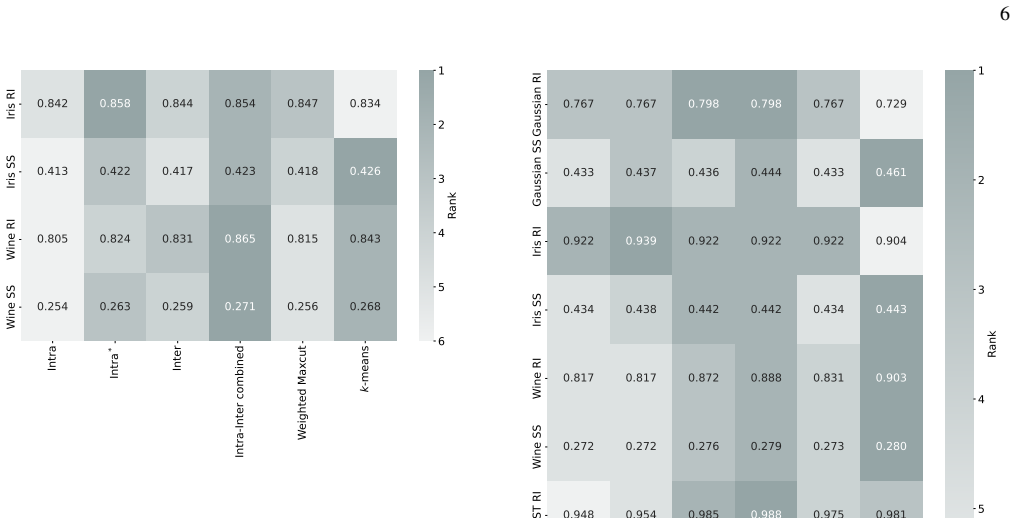
- [Section III and Appendix A.1, vs. Tables II and III] Equation (A16) and the resulting Hamiltonian (A17) show that the objective labeled Intra* is exactly (1/2) sum_{i<j} ||x_i - x_j||^2 z_i z_j. This is a positive scalar multiple of the weighted MaxCut objective defined in Section III with a_ij = ||x_i - x_j||^2. Positive scaling preserves the full set of energy orderings and minimizers, so any optimizer of one objective is an optimizer of the other. Yet Table II reports exact-search Rand Index 0.858 for Intra* versus 0.847 for weighted MaxCut on Iris, with Silhouette Scores 0.422 versus 0.418, and Table III reports simulated-annealing Rand Index 0.939 versus 0.922. These differences are impossible as reported unless the two methods were evaluated on different random subsamples, implemented different objective functions, or used undocumented tie-breaking among degenerate ground states. The authors must reconcile this discrepancy, because the same experimental pipeline produced the central D-Wave claims.
- [Section V and Figures 2-3] The conclusion that 'at least one of our proposed Hamiltonians outperforms the weighted MaxCut' is not supported for Intra*, since Intra* is merely a positively scaled version of weighted MaxCut. Any apparent advantage of Intra* over weighted MaxCut in Figures 2 and 3 must therefore be an artifact of tie-breaking, sampling, or implementation details rather than evidence that centroid information improves clustering. The authors should remove or reinterpret this comparison after correcting the experimental pipeline.
- [Section IV.C, Table IV, and Figure 5] The central quantum-annealing claim is that the Intra-Inter combined Hamiltonian achieves zero chain breaks while Intra, Intra*, and weighted MaxCut produce near-random solutions on the same complete-graph problems. This is surprising because Intra* and weighted MaxCut are mathematically identical problems, and the combined Hamiltonian is also a pairwise Hamiltonian on the same complete graph. The paper does not report the chain strengths used, the embedding parameters returned by the clique sampler, the post-processing rule for broken chains, or the precise sampling protocol. Without these details, the qualitative difference in chain-break behavior cannot be reproduced or assessed; please provide these parameters and, ideally, the raw solver configuration for each Hamiltonian.
minor comments (4)
- [Appendix A.3, Eq. (A23)] Equation (A23) contains a typographical artifact in the factor written as '2N+1N-1'; this should read '2 N_+ N_-'.
- [Appendix B, Table IV] Several rows in Table IV report zero standard deviation for the Intra-Inter combined method; please state explicitly whether these are single-run values or averages over multiple runs, and how many quantum annealing repetitions were used for each entry.
- [Section IV.D] The constrained-clustering experiments depend on the penalty hyperparameter lambda_p, but the paper does not report the values used for Figures 6 and 7. Since the Inter method's variability is attributed to sensitivity to lambda_p, reporting the chosen values is necessary for reproducibility.
- [General] No code or data repository is provided. Given the role of random subsampling, tie-breaking, and hyperparameters in the reported results, a public artifact would materially strengthen the paper's reproducibility.
Circularity Check
No circularity: the Hamiltonian constructions are derived algebraically from explicit clustering objectives and evaluated on external benchmarks; the reported Intra* versus weighted-MaxCut inconsistency is a correctness concern, not a circular derivation.
full rationale
The derivation chain is self-contained. The paper defines the distance function l(mu,z,s) in Eq. (8), constructs intracluster, intercluster, and combined objectives in Eqs. (9)-(12), and then shows in Appendix A that after multiplying by the appropriate powers of N+ and N-, the combined objective reduces algebraically to the weighted centroid-separation expression in Eq. (13). This reduction is a direct expansion of the definitions and is not an assumed conclusion. The Hamiltonians in Eqs. (A12), (A17), and (A27) are obtained by the standard replacement of binary variables with Pauli Z operators, again an explicit mapping rather than a fitted or self-referential step. The performance claims are tested on Iris, Wine, a subset of MNIST, and a synthetic Gaussian dataset, with comparisons to k-means and weighted MaxCut; no parameter of the central unconstrained objectives is fitted to the reported Rand Index or Silhouette Score. There are no load-bearing self-citations and no imported uniqueness theorem; Ref. [35] is only used for a hierarchical k-clustering extension, and Ref. [38] supplies a standard pairwise penalty form. The one notable issue is an internal experimental inconsistency, not circularity: Appendix A.1 shows Intra* (Eq. (A16)) equals 1/2 times the weighted MaxCut objective (Eq. (4)), so exact optimizers of the two problems must return identical assignments, yet Tables II and III report different Rand Indices for them. That inconsistency concerns the experimental pipeline and implementation fidelity, not the logical derivation of the Hamiltonians from their stated objectives. The central result is therefore not circular; the numerical discrepancy should be treated as a reproducibility/correctness risk rather than a circularity finding.
Assumptions & free parameters
free parameters (1)
- lambda_p =
unspecified
assumptions (4)
- standard math QUBO/Ising mapping of combinatorial optimization problems
- domain assumption Squared Euclidean distance is an appropriate similarity measure for clustering
- domain assumption The ground state of the constructed Hamiltonian corresponds to the desired clustering
- domain assumption D-Wave clique sampler can embed complete graphs up to size 175 with no chain breaks for the combined Hamiltonian
Cite this review
Pith. "Pith review of Hamiltonian formulations of centroid-based clustering." pith.science (2026). https://pith.science/paper/D4BOGEL3
@misc{pith2026250206542,
  author       = {Pith},
  title        = {Pith review of: Hamiltonian formulations of centroid-based clustering},
  year         = {2026},
  howpublished = {\url{https://pith.science/paper/D4BOGEL3}},
  note         = {Machine review of arXiv:2502.06542}
}
abstract
Clustering is a fundamental task in data science that aims to group data based on their similarities. However, defining similarity is often ambiguous, making it challenging to determine the most appropriate objective function for a given dataset. Traditional clustering methods, such as the $k$-means algorithm and weighted maximum $k$-cut, focus on specific objectives -- typically relying on average or pairwise characteristics of the data -- leading to performance that is highly data-dependent. Moreover, incorporating practical constraints into clustering objectives is not straightforward, and these problems are known to be NP-hard. In this study, we formulate the clustering problem as a search for the ground state of a Hamiltonian, providing greater flexibility in defining clustering objectives and incorporating constraints. This approach enables the application of various quantum simulation techniques, including both circuit-based quantum computation and quantum annealing, thereby opening a path toward quantum advantage in solving clustering problems. We propose various Hamiltonians to accommodate different clustering objectives, including the ability to combine multiple objectives and incorporate constraints. We evaluate the clustering performance through numerical simulations and implementations on the D-Wave quantum annealer. The results demonstrate the broad applicability of our approach to a variety of clustering problems on current quantum devices. Furthermore, we find that Hamiltonians designed for specific clustering objectives and constraints impose different requirements for qubit connectivity, indicating that certain clustering tasks are better suited to specific quantum hardware. Our experimental results highlight this by identifying the Hamiltonian that optimally utilizes the physical qubits available in the D-Wave System.
Figures


Figures from the paper (5 more)


Reference graph
Works this paper leans on
-
[35]
Distance-based clustering using qubo formula- tions
Nasa Matsumoto, Yohei Hamakawa, Kosuke Tatsumura, and Kazue Kudo. Distance-based clustering using qubo formula- tions. Scientific Reports, 12(1):2669, 2022
work page 2022
-
[1]
Image segmen- tation by clustering
Guy Barrett Coleman and Harry C Andrews. Image segmen- tation by clustering. Proceedings of the IEEE, 67(5):773–785, 1979
work page 1979
-
[2]
Therefore, by optimizing the combined objective function in Eq
(13) This expression reveals that optimizing the combined intra- cluster and intercluster distances is equivalent to maximizing the squared distance between the cluster centroids. Therefore, by optimizing the combined objective function in Eq. (12), we inherently maximize the separation between the centroids of the two clusters. D. Constrained clustering ...
work page 2019
-
[3]
A survey of fuzzy clustering algorithms for pattern recognition
Andrea Baraldi and Palma Blonda. A survey of fuzzy clustering algorithms for pattern recognition. i.IEEE Transactions on Sys- tems, Man, and Cybernetics, Part B (Cybernetics) , 29(6):778– 785, 1999
work page 1999
-
[4]
Anil K Jain, M Narasimha Murty, and Patrick J Flynn. Data clus- tering: a review. ACM Computing Surveys (CSUR), 31(3):264– 323, 1999
work page 1999
-
[5]
Biclustering algorithms for biological data analysis: a survey
Sara C Madeira and Arlindo L Oliveira. Biclustering algorithms for biological data analysis: a survey. IEEE/ACM transac- tions on computational biology and bioinformatics, 1(1):24–45, 2004
work page 2004
-
[6]
Research on customer segmentation model by clustering
Jing Wu and Zheng Lin. Research on customer segmentation model by clustering. In Proceedings of the 7th international conference on Electronic commerce, pages 316–318, 2005
work page 2005
-
[7]
Mark S Handcock, Adrian E Raftery, and Jeremy M Tantrum. Model-based clustering for social networks.Journal of the Royal Statistical Society: Series A (Statistics in Society), 170(2):301– 354, 2007
work page 2007
Show all 51 references
-
[8]
Survey on anomaly de- tection using data mining techniques
Shikha Agrawal and Jitendra Agrawal. Survey on anomaly de- tection using data mining techniques. Procedia Computer Sci- ence, 60:708–713, 2015
2015
-
[9]
A review of clustering techniques and de- velopments
Amit Saxena, Mukesh Prasad, Akshansh Gupta, Neha Bharill, Om Prakash Patel, Aruna Tiwari, Meng Joo Er, Weiping Ding, and Chin-Teng Lin. A review of clustering techniques and de- velopments. Neurocomputing, 267:664–681, 2017
2017
-
[10]
The rcdk and cluster r packages applied to drug candidate selection
Adrian Voicu, Narcis Duteanu, Mirela Voicu, Daliborca Vlad, and Victor Dumitrascu. The rcdk and cluster r packages applied to drug candidate selection. Journal of Cheminformatics, 12:1– 8, 2020
2020
-
[11]
Machine learn- ing in drug discovery: a review
Suresh Dara, Swetha Dhamercherla, Surender Singh Jadav, CH Madhu Babu, and Mohamed Jawed Ahsan. Machine learn- ing in drug discovery: a review. Artificial Intelligence Review, 55(3):1947–1999, 2022
1947
-
[12]
Artificial intelligence in drug discovery and development.Drug Discovery and Evaluation: Safety and Pharmacokinetic Assays, pages 1–38, 2023
Kit-Kay Mak, Yi-Hang Wong, and Mallikarjuna Rao Pichika. Artificial intelligence in drug discovery and development.Drug Discovery and Evaluation: Safety and Pharmacokinetic Assays, pages 1–38, 2023
2023
-
[13]
Data clustering: 50 years beyond k-means
Anil K Jain. Data clustering: 50 years beyond k-means. Pattern Recognition Letters, 31(8):651–666, 2010
2010
-
[14]
A comprehensive survey of clustering algorithms
Dongkuan Xu and Yingjie Tian. A comprehensive survey of clustering algorithms. Annals of Data Science , 2:165–193, 2015
2015
-
[15]
A comprehensive survey of clustering algorithms: State-of-the-art machine learning applications, tax- onomy, challenges, and future research prospects
Absalom E Ezugwu, Abiodun M Ikotun, Olaide O Oyelade, Laith Abualigah, Jeffery O Agushaka, Christopher I Eke, and Andronicus A Akinyelu. A comprehensive survey of clustering algorithms: State-of-the-art machine learning applications, tax- onomy, challenges, and future research...
2022
-
[16]
Ising formulations of many np problems
Andrew Lucas. Ising formulations of many np problems. Fron- tiers in Physics, 2, 2014
2014
-
[17]
Ground state preparation and energy estimation on early fault-tolerant quantum comput- ers via quantum eigenvalue transformation of unitary matrices
Yulong Dong, Lin Lin, and Yu Tong. Ground state preparation and energy estimation on early fault-tolerant quantum comput- ers via quantum eigenvalue transformation of unitary matrices. arXiv preprint arXiv:2204.05955, 2022
2022 arXiv
-
[18]
Preparing ground states of quantum many-body systems on a quantum computer.Physical Review Letters, 102(13):130503, 2009
David Poulin and Pawel Wocjan. Preparing ground states of quantum many-body systems on a quantum computer.Physical Review Letters, 102(13):130503, 2009
2009
-
[19]
Faster ground state preparation and high-precision ground energy estimation with fewer qubits
Yimin Ge, Jordi Tura, and J Ignacio Cirac. Faster ground state preparation and high-precision ground energy estimation with fewer qubits. Journal of Mathematical Physics, 60(2):022202, 2019
2019
-
[20]
Near-optimal ground state preparation
Lin Lin and Yu Tong. Near-optimal ground state preparation. Quantum, 4:372, 2020
2020
-
[21]
Universal quantum algorithmic cool- ing on a quantum computer
P Zeng, J Sun, and X Yuan. Universal quantum algorithmic cool- ing on a quantum computer. arXiv preprint arXiv:2109.15304, 2023
2023 arXiv
-
[22]
Love, Al ´an Aspuru-Guzik, and Jeremy L
Alberto Peruzzo, Jarrod McClean, Peter Shadbolt, Man-Hong Yung, Xiao-Qi Zhou, Peter J. Love, Al ´an Aspuru-Guzik, and Jeremy L. O’Brien. A variational eigenvalue solver on a pho- tonic quantum processor. Nature Communications, 5(1):4213, July 2014
2014
-
[23]
The theory of variational hybrid quantum- classical algorithms
Jarrod R McClean, Jonathan Romero, Ryan Babbush, and Al´an Aspuru-Guzik. The theory of variational hybrid quantum- classical algorithms. New Journal of Physics , 18(2):023023, feb 2016
2016
-
[24]
Cerezo, Andrew Arrasmith, Ryan Babbush, Simon C
M. Cerezo, Andrew Arrasmith, Ryan Babbush, Simon C. Ben- jamin, Suguru Endo, Keisuke Fujii, Jarrod R. McClean, Kosuke Mitarai, Xiao Yuan, Lukasz Cincio, and Patrick J. Coles. Varia- tional quantum algorithms. Nature Reviews Physics, 3(9):625– 644, 2021
2021
-
[25]
A quantum approximate optimization algorithm
Edward Farhi, Jeffrey Goldstone, and Sam Gutmann. A quantum approximate optimization algorithm. arXiv preprint arXiv:1411.4028, 2014
2014 arXiv
-
[26]
Quantum annealing with manufactured spins
Mark W Johnson, Mohammad HS Amin, Suzanne Gildert, Trevor Lanting, Firas Hamze, Neil Dickson, Richard Harris, Andrew J Berkley, Jan Johansson, Paul Bunyk, et al. Quantum annealing with manufactured spins. Nature, 473(7346):194– 198, 2011
2011
-
[27]
Effi- cient combinatorial optimization by quantum-inspired parallel annealing in analogue memristor crossbar
Mingrui Jiang, Keyi Shan, Chengping He, and Can Li. Effi- cient combinatorial optimization by quantum-inspired parallel annealing in analogue memristor crossbar. Nature Communica- tions, 14(1):5927, 2023
2023
-
[28]
Silhouettes: a graphical aid to the interpreta- tion and validation of cluster analysis.Journal of Computational and Applied Mathematics, 20:53–65, 1987
Peter J Rousseeuw. Silhouettes: a graphical aid to the interpreta- tion and validation of cluster analysis.Journal of Computational and Applied Mathematics, 20:53–65, 1987. 11
1987
-
[29]
Objective criteria for the evaluation of clus- tering methods
William M Rand. Objective criteria for the evaluation of clus- tering methods. Journal of the American Statistical association, 66(336):846–850, 1971
1971
-
[30]
Scikit- learn: Machine learning in python
Fabian Pedregosa, Ga ¨el Varoquaux, Alexandre Gramfort, Vin- cent Michel, Bertrand Thirion, Olivier Grisel, Mathieu Blondel, Peter Prettenhofer, Ron Weiss, Vincent Dubourg, et al. Scikit- learn: Machine learning in python. Journal of Machine Learn- ing Research, 12:2825–2830, 2011
2011
-
[31]
QPU-Specific Physical Properties: Ad- vantage System 6.4
D-Wave Systems Inc. QPU-Specific Physical Properties: Ad- vantage System 6.4. Burnaby, BC, Canada, 2024
2024
-
[32]
Ising models for binary clustering via adiabatic quantum computing
Christian Bauckhage, Eduardo Brito, Kostadin Cvejoski, C ´esar Ojeda, Rafet Sifa, and Stefan Wrobel. Ising models for binary clustering via adiabatic quantum computing. In Energy Mini- mization Methods in Computer Vision and Pattern Recognition: 11th International Conference, ...
2017
-
[33]
Balanced k-means cluster- ing on an adiabatic quantum computer
Davis Arthur and Prasanna Date. Balanced k-means cluster- ing on an adiabatic quantum computer. Quantum Information Processing, 20:1–30, 2021
2021
-
[34]
A qubo formulation of the k-medoids prob- lem
Christian Bauckhage, Nico Piatkowski, Rafet Sifa, Dirk Hecker, and Stefan Wrobel. A qubo formulation of the k-medoids prob- lem. In LWDA, pages 54–63, 2019
2019
-
[36]
Quantum annealing for combinatorial clustering
Vaibhaw Kumar, Gideon Bass, Casey Tomlin, and Joseph Dulny. Quantum annealing for combinatorial clustering. Quantum In- formation Processing, 17(2), January 2018
2018
-
[37]
Qubo formulations for training machine learning models
Prasanna Date, Davis Arthur, and Lauren Pusey-Nazzaro. Qubo formulations for training machine learning models. Scientific Reports, 11(1):10029, 2021
2021
-
[38]
Constrained clustering: Current and new trends
Pierre Ganc ¸arski, Thi-Bich-Hanh Dao, Bruno Cr´emilleux, Ger- main Forestier, and Thomas Lampert. Constrained clustering: Current and new trends. A Guided Tour of Artificial Intelligence Research: Volume II: AI Algorithms, pages 447–484, 2020
2020
-
[39]
Flexible constrained spectral clustering
Xiang Wang and Ian Davidson. Flexible constrained spectral clustering. In Proceedings of the 16th ACM SIGKDD inter- national conference on Knowledge discovery and data mining, pages 563–572, 2010
2010
-
[40]
Random search for hyper-parameter optimization
James Bergstra and Yoshua Bengio. Random search for hyper-parameter optimization. J. Mach. Learn. Res. , 13(null):281–305, February 2012
2012
-
[41]
Practi- cal bayesian optimization of machine learning algorithms
Jasper Snoek, Hugo Larochelle, and Ryan P Adams. Practi- cal bayesian optimization of machine learning algorithms. In F. Pereira, C.J. Burges, L. Bottou, and K.Q. Weinberger, editors, Advances in Neural Information Processing Systems, volume 25. Curran Associates, Inc., 2012
2012
-
[42]
King, and Aidan Roy
Tomas Boothby, Andrew D. King, and Aidan Roy. Fast clique minor generation in Chimera qubit connectivity graphs. Quan- tum Information Processing, 15(1):495–508, 2016
2016
-
[43]
Next-generation topology of d-wave quantum processors.arXiv preprint arXiv:2003.00133, 2020
Kelly Boothby, Paul Bunyk, Jack Raymond, and Aidan Roy. Next-generation topology of d-wave quantum processors.arXiv preprint arXiv:2003.00133, 2020
2003 arXiv
-
[44]
Experimental investigation of performance differences between coherent ising machines and a quantum annealer
Ryan Hamerly, Takahiro Inagaki, Peter L McMahon, Davide Venturelli, Alireza Marandi, Tatsuhiro Onodera, Edwin Ng, Carsten Langrock, Kensuke Inaba, Toshimori Honjo, et al. Experimental investigation of performance differences between coherent ising machines and a quantum anneal...
2019
-
[45]
Benchmarking embedded chain breaking in quantum annealing
Erica Grant and Travis S Humble. Benchmarking embedded chain breaking in quantum annealing. Quantum Science and Technology, 7(2):025029, 2022
2022
-
[46]
Benchmarking chain strength: An optimal approach for quantum annealing
Thinh V Le, Manh V Nguyen, Tu N Nguyen, Thang N Dinh, Ivan Djordjevic, and Zhi-Li Zhang. Benchmarking chain strength: An optimal approach for quantum annealing. In 2023 IEEE International Conference on Quantum Computing and Engi- neering (QCE), volume 1, pages 397–406. IEEE, 2023
2023
-
[47]
Comparing three generations of d-wave quan- tum annealers for minor embedded combinatorial optimization problems
Elijah Pelofske. Comparing three generations of d-wave quan- tum annealers for minor embedded combinatorial optimization problems. arXiv preprint arXiv:2301.03009, 2023
2023 arXiv
-
[48]
Quantum annealers chain strengths: A simple heuristic to set them all
Valentin Gilbert and St ´ephane Louise. Quantum annealers chain strengths: A simple heuristic to set them all. In Leonardo Franco, Cl ´elia de Mulatier, Maciej Paszynski, Va- leria V. Krzhizhanovskaya, Jack J. Dongarra, and Peter M. A. Sloot, editors, Computational Science – I...
2024
-
[49]
(A1) and (A2): 𝑑∑︁ 𝑗=1 𝑁∑︁ 𝑖=1 𝑥𝑖 𝑗 2− 𝑁+𝑁2 − 𝑁2 +𝑁2− 𝑁∑︁ 𝑖 𝑥𝑖 𝑗 1+𝑧𝑖 2 !2 − 𝑁2 +𝑁− 𝑁2 +𝑁2− 𝑁∑︁ 𝑖 𝑥𝑖 𝑗 1−𝑧𝑖 2 !2
Intracluster distance To capture the intracluster distance, we combine the following equations Eqs. (A1) and (A2): 𝑑∑︁ 𝑗=1 𝑁∑︁ 𝑖=1 𝑥𝑖 𝑗 2− 𝑁+𝑁2 − 𝑁2 +𝑁2− 𝑁∑︁ 𝑖 𝑥𝑖 𝑗 1+𝑧𝑖 2 !2 − 𝑁2 +𝑁− 𝑁2 +𝑁2− 𝑁∑︁ 𝑖 𝑥𝑖 𝑗 1−𝑧𝑖 2 !2 . (A5) Multiplying by𝑁2 +𝑁2 − to eliminate the deno...
-
[50]
(A3) and Eq
Intercluster distance To capture the intercluster distance, we combine Eq. (A3) and Eq. (A4). After simplifying, we get: 𝑑∑︁ 𝑗=1 − 𝑁∑︁ 𝑖=1 𝑥𝑖2 𝑗+ 2𝑁 𝑁+𝑁− 𝑁∑︁ 𝑖=1 𝑥𝑖 𝑗 1+𝑧𝑖 2 𝑁∑︁ 𝑖=1 𝑥𝑖 𝑗 1−𝑧𝑖 2 − 𝑁+ 𝑁2− 𝑁∑︁ 𝑖=1 1−𝑧𝑖 2 !2 − 𝑁− 𝑁2 + 𝑁∑︁ 𝑖=1 𝑥𝑖 𝑗 1+𝑧𝑖 2 !2 . (A18) Mu...
-
[51]
Combining intra and intercluster distances To capture the intra and intercluster distances, we combine the following equations Eqs. (A1) + (A2) + (A3) + (A4): 𝑑∑︁ 𝑗=1 − 1 𝑁+ 𝑁∑︁ 𝑖=1 𝑥𝑖 𝑗 1+𝑧𝑖 2 !2 − 1 𝑁− 𝑁∑︁ 𝑖=1 𝑥𝑖 𝑗 1−𝑧𝑖 2 !2 + 2𝑁 𝑁+𝑁− 𝑁∑︁ 𝑖=1 𝑥𝑖 𝑗 1+𝑧𝑖 2 ! 𝑁∑︁ 𝑖=1 𝑥𝑖 𝑗 1−𝑧𝑖 ...
Reviewed August 8, 2026 · model on record in the stance chip above.
Discussion (0). Continue with ORCID to comment.