REVIEW 2 major objections 3 minor 1 cited by
Impact of Tracking Resolutions on $\phi$-Meson Spin Alignment Measurement
T0 review · 2 major / 3 minor · reviewed 2026-08-08 · deepseek-v4-flash
Pith's one-line read Tracking resolution shifts phi-meson spin alignment by less than 0.0005, below current measurement errors.
desk verdict Useful toy-MC study of tracking-resolution effects on φ spin alignment with a load-bearing algebraic error in the invariant-mass method that must be corrected before the paper's central claim stands. read the letter →
The pith
A machine-rendered reading of the paper's core claim, the machinery that carries it, and where it could break.
The reading
What carries the argument
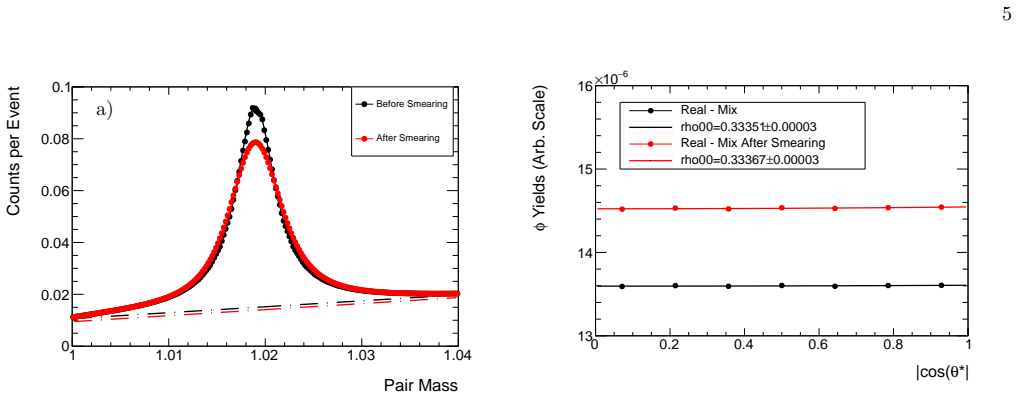
The argument is carried by a parametric resolution model: the standard deviations of the smeared polar angle, azimuthal angle, and transverse momentum are set by Eqs. (3) and (4), which combine a multiple-scattering term falling as $1/(\beta_\perp p_\perp)$ with a constant term from detector granularity. Overlaid on this are the two extraction methods: the yield method fits the $\phi$-meson yield in bins of $|\cos\theta^*|$ to Eq. (1), and the invariant-mass method fits $\langle\cos^2\theta^*\rangle$ versus $m_{\rm inv}$ using the signal-to-background ratio from a mass fit, per Eq. (7). The result that keeps the effect small is a near-cancellation between the distortions caused by polar-angle smearing and azimuthal-angle smearing under equal angular resolutions.
What would settle it
Take the same heavy-ion data set and extract $\rho_{00}$ separately from high-precision primary tracks and from lower-precision global tracks; if the resolution-induced shift is really below 0.0005, the two values should agree within that scale after accounting for statistics, while a visibly larger difference would overturn the conclusion.
Extended reading notes
Core claim
The paper's central claim is that, with resolution parameters typical of a large time-projection-chamber detector, track smearing has only a tiny effect on the extracted $\rho_{00}$: the shift is below 0.0005 for both analysis methods, well within typical experimental uncertainties of about 0.001. The authors reach this by smearing the kaon daughters' polar angle, azimuthal angle, and transverse momentum with Gaussian widths set by a two-term resolution model, then repeating the full $\rho_{00}$ extraction pipeline. Although the smearing visibly distorts the $\phi$-meson mass peak and makes $\langle\cos^2\theta^*\rangle$ versus $m_{\rm inv}$ develop a peak at the $\phi$ mass, with polar- and azimuthal-angle effects pulling in opposite directions, the net bias on $\rho_{00}$ stays small. They conclude that resolution effects do not need to be corrected for at current precision, while cautioning that unequal polar and azimuthal resolutions would likely make the effect larger.
Load-bearing premise
The load-bearing premise is that one simulated operating point — equal polar and azimuthal angular resolutions and an input $\rho_{00}=1/3$ — is representative of the bias for real detectors, whose polar and azimuthal resolutions can differ and whose physical $\rho_{00}$ values deviate from $1/3$ by about a percent.
Editorial extensions
If this is right
- At the precision of current measurements, $\phi$-meson $\rho_{00}$ results do not need a tracking-resolution correction when detector resolutions are comparable to those simulated.
- Both the yield method and the invariant-mass method show similarly small resolution biases, so the choice between them is not dictated by tracking resolutions.
- The smearing-induced distortion of the signal shape away from a pure Breit-Wigner does not translate into a significant bias in $\rho_{00}$ at these resolutions.
- Detectors with unequal polar and azimuthal angular resolutions require their own checks, since the small effect in this study relies partly on the near-cancellation between those two smearing sources.
Reading between the lines
- Running the same toy model with input $\rho_{00}$ values away from $1/3$ — for instance near the measured ~0.34 — would test whether the sub-0.0005 bias persists at the actually observed spin alignment, since only $\rho_{00}=1/3$ is simulated here.
- The same resolution-smearing machinery could be applied to other vector mesons such as $K^{*0}$, whose different mass and decay kinematics would change the boost distortion and therefore the bias estimate.
- If the small-bias result transfers to the measured operating points, it would imply that the sign difference between the $\rho_{00}-1/3$ deviations reported by different experiments is not a tracking-resolution artifact; the explanation would have to lie elsewhere.
Editorial analysis
A structured set of objections, weighed in public.
Referee Report
Summary. The manuscript presents a toy-model Monte Carlo study of how tracking angular and momentum resolutions affect the extraction of the phi-meson spin alignment parameter rho_00. The authors model STAR-like detector resolutions (A_theta = A_phi = 0.0015 GeV/c, B_theta = B_phi = 0.001, B = 0.5 T, L = 1 m), simulate phi -> K+K- decays with input rho_00 = 1/3 and realistic kinematic inputs from data, and compare the conventional yield method with the invariant-mass method. They report that resolution smearing changes the extracted rho_00 by less than 0.0005, well within typical experimental uncertainties, and conclude that tracking resolution is not a major source of bias for either method.
Significance. If correct, the result is a useful negative result for the field: it would justify neglecting tracking-resolution corrections in current phi spin-alignment analyses and would support the proposed invariant-mass method. The paper has clear strengths: externally motivated resolution inputs, realistic kinematic inputs from published data, several extraction variants (Breit-Wigner, Voigt, bin counting), and a self-contained simulation. However, the invariant-mass-method branch contains an algebraic error in the conversion between <cos^2 theta*> and rho_00 that invalidates the quantitative comparison for that method. The 'both methods' conclusion in the abstract and Section IV is therefore not currently supported, although the yield-method results appear internally consistent and support the qualitative conclusion for that method alone.
major comments (2)
- [Eq. (7)] Equation (7) misstates the relation between <cos^2 theta*> and rho_00. From Eq. (1), the normalized decay angular distribution gives <cos^2 theta*> = (1 + 2*rho_00)/5, so rho_00 = (5*<cos^2 theta*> - 1)/2. Equation (7) and the following sentence instead use (5*rho_00 - 1)/2 as the signal <cos^2 theta*>, which is the inverse relation and is not bounded by 1. At the simulated input rho_00 = 1/3 the two expressions coincide, which hides the error at the single operating point tested, but the Jacobian differs by a factor of (5/2)/(2/5) = 25/4 = 6.25. Consequently, any resolution-induced bias delta<cos^2 theta*> in the invariant-mass method is translated into a rho_00 bias approximately 6.25 times larger than reported. For example, the ~0.00009 smeared/unsmeared difference visible for the invariant-mass method in Fig. 6 would become roughly 0.0005-0.0006, comparable to the claimed <0.0005 threshold and no longer unambiguously 'well within' typical uncertainties of ~0.001. The invariant-mass-method results and the abstract/Section IV claim that the effect is small in 'both methods' must be revised after rerunning the analysis with the correct conversion (2*rho_00 + 1)/5.
- [Sections III.B-IV] The numerical support for the central claim is obtained from a single operating point: input rho_00 = 1/3, equal theta and phi angular resolutions, equal B_theta and B_phi, and one centrality/energy setting. This is exactly the point where the erroneous Eq. (7) coincides with the correct relation, so the invariant-mass-method results cannot be safely extrapolated away from rho_00 = 1/3. The paper itself notes in Section III.A that unequal theta/phi resolutions would likely increase the effect. To support the abstract's general statement, the authors should repeat the simulation at physically interesting rho_00 values near the measured deviations (for example 0.32 and 0.34) and with asymmetric angular-resolution parameters; otherwise the conclusion should be explicitly restricted to the tested conditions.
minor comments (3)
- [Figure 6 caption] The x-axis labels 'Fix Gamma', 'Count Bin', 'Gamma Free', 'Voigt', 'Inv M. Manual', and 'Inv M. Voigt' are not self-explanatory; please define each entry in the caption so the reader can map them to the methods described in the text.
- [Section III.C] The statement that the 'manual' (bin-counting) calculation of rho_00 'does not use a signal shape' is imprecise: the background subtraction in that calculation still relies on the Breit-Wigner and linear fits, so the result is shape-dependent through the background model even if the signal shape is not used directly.
- [Section II.A] Equation (3) uses beta_perp in place of beta without a quantitative justification for the |eta| < 1 range used in the simulation; a brief estimate of the error introduced by this approximation would help the reader assess the model's fidelity.
Circularity Check
No circularity: the resolution-effect claim is a forward toy-MC result with external inputs, not a fitted or self-referential prediction.
full rationale
The paper's central claim, that tracking resolution changes the extracted rho_00 by less than 0.0005, is produced by a forward simulation. The track angular and momentum resolutions (Eq. 5) are fixed from STAR TPC material and granularity; kaon and phi kinematics, v2, and yields are taken from published measurements; and the input rho_00 = 1/3 is chosen, not fitted. The extracted rho_00 values before and after smearing are estimator outputs from Eqs. (1) and (7) applied to the simulated data, so they are not equal to the input by construction. The cited STAR data are empirical inputs rather than load-bearing self-citations: the conclusion does not reduce to them, and no uniqueness theorem or ansatz is imported from the authors' prior work. The paper itself flags the limiting assumption of equal theta and phi resolutions (Section III C), which is a scope caveat rather than circularity. A separate algebraic error exists in Eq. (7), where the cos^2(theta*)-rho_00 conversion is inverted; this affects the invariant-mass-method bias estimate and should be corrected, but it is a correctness defect, not a circular derivation.
Assumptions & free parameters
free parameters (2)
- Angular resolution scale A_theta = A_phi =
0.0015 GeV/c
- Constant angular resolution B_theta = B_phi =
0.0010
assumptions (4)
- domain assumption Gaussian smearing of track angles and pT (Eqs. 3-4) faithfully represents the resolution effects on rho_00 measurements.
- domain assumption STAR TPC-like resolution values (A=0.0015 GeV/c, B=0.0010, B-field 0.5 T, L=1 m) are representative of experiments measuring phi rho_00.
- ad hoc to paper The single simulated value rho_00 = 1/3 is sufficient to characterize the resolution bias.
- domain assumption Smearing isolated kaon angles and momenta, without full track reconstruction or pair acceptance effects, captures the experimental resolution impact.
Cite this review
Pith. "Pith review of Impact of Tracking Resolutions on $\phi$-Meson Spin Alignment Measurement." pith.science (2026). https://pith.science/paper/6WQT6CQ4
@misc{pith2026250206576,
  author       = {Pith},
  title        = {Pith review of: Impact of Tracking Resolutions on $\phi$-Meson Spin Alignment Measurement},
  year         = {2026},
  howpublished = {\url{https://pith.science/paper/6WQT6CQ4}},
  note         = {Machine review of arXiv:2502.06576}
}
abstract
Measurements of global spin alignment of vector mesons in relativistic heavy-ion collisions can provide unique insights into spin-orbit interactions and vector meson dynamics in the Quark-Gluon Plasma (QGP) produced in those collisions. The global spin alignment is measured by the $00^{\rm th}$ coefficient of the spin density matrix, $\rho_{00}$, via the polar angle ($\theta^{*}$) of the decay-daughter momentum in the parent rest frame with respect to the direction of the orbital angular momentum of the collision. Such measurements are affected by the angular and momentum resolutions of the reconstructed tracks in the experiment. Such effects are nontrivial because of kinematic complications caused by the boost to the parent rest frame, and could be important given that the global spin alignment signal is weak. In this paper, we investigate the effects of experimental tracking resolutions on measurements of the $\phi$(1020) meson $\rho_{00}$. We study these effects for two methods of $\rho_{00}$ measurements, the conventional method analyzing the $\phi$-meson yield versus $\cos^2 \theta^*$ and the invariant mass ($m_{\rm inv}$) method utilizing $\langle\cos^2\theta^*\rangle$ versus $m_{\rm inv}$. Using typical resolution values from experiments, we find that the effect of track resolution on $\rho_{00}$ is small, well within typical measurement uncertainties.
Figures


Figures from the paper (3 more)


Forward citations
Cited by 1 Pith paper
-
Exploring Data-Driven Corrections for $\phi$-Meson Global Spin Alignment Measurements
A data-driven correction built from combinatorial kaon pairs inside the phi mass window is tested with toy Monte Carlo, showing partial success and clear shortcomings.
Reference graph
Works this paper leans on
-
[1]
Z.-T. Liang and X.-N. Wang, Globally polarized quark- gluon plasma in non-central A+A collisions, Phys. Rev. Lett. 94, 102301 (2005), [Erratum: Phys.Rev.Lett. 96, 039901 (2006)], arXiv:nucl-th/0410079
arXiv 2005
-
[2]
S. A. Voloshin, Polarized secondary particles in unpo- larized high energy hadron-hadron collisions?, (2004), arXiv:nucl-th/0410089. 7
arXiv 2004
- [3]
-
[4]
F. Becattini and M. A. Lisa, Polarization and Vorticity in the Quark–Gluon Plasma, Ann. Rev. Nucl. Part. Sci. 70, 395 (2020), arXiv:2003.03640 [nucl-ex]
arXiv 2020
- [5]
-
[6]
L. Adamczyk et al. (STAR), Global Λ hyperon polariza- tion in nuclear collisions: evidence for the most vortical fluid, Nature 548, 62 (2017), arXiv:1701.06657 [nucl-ex]
arXiv 2017
-
[7]
S. Acharya et al. (ALICE), Evidence of Spin-Orbital Angular Momentum Interactions in Relativistic Heavy- Ion Collisions, Phys. Rev. Lett. 125, 012301 (2020), arXiv:1910.14408 [nucl-ex]
arXiv 2020
-
[8]
M. S. Abdallah et al. (STAR), Pattern of global spin alignment of ϕ and K ∗0 mesons in heavy-ion collisions, Nature 614, 244 (2023), arXiv:2204.02302 [hep-ph]
arXiv 2023
Show all 18 references
-
[9]
Sheng, L
X.-L. Sheng, L. Oliva, Z.-T. Liang, Q. Wang, and X.- N. Wang, Spin Alignment of Vector Mesons in Heavy- Ion Collisions, Phys. Rev. Lett. 131, 042304 (2023), arXiv:2205.15689 [nucl-th]
2023 arXiv
-
[10]
R. L. Workman and Others (Particle Data Group), Review of Particle Physics, PTEP 2022, 083C01 (2022), https://pdg.lbl.gov/2023/reviews/rpp2022-rev-scalar- mesons.pdf, https://pdg.lbl.gov/2023/reviews/rpp2022- rev-non-qqbar-mesons.pdf
2022
-
[11]
B. I. Abelev et al. (STAR), Systematic Measurements of Identified Particle Spectra in pp, d+Au and Au+Au Collisions from STAR, Phys. Rev. C 79, 034909 (2009), arXiv:0808.2041 [nucl-ex]
2009 arXiv
-
[12]
Anderson et al., The STAR time projection cham- ber: A Unique tool for studying high multiplicity events at RHIC, Nucl
M. Anderson et al., The STAR time projection cham- ber: A Unique tool for studying high multiplicity events at RHIC, Nucl. Instrum. Meth. A 499, 659 (2003), arXiv:nucl-ex/0301015
2003 arXiv
-
[13]
K. H. Ackermann et al. (STAR), STAR detector overview, Nucl. Instrum. Meth. A 499, 624 (2003)
2003
-
[14]
B. I. Abelev et al. (STAR), Partonic flow and phi- meson production in Au + Au collisions at √sNN = 200 GeV, Phys. Rev. Lett. 99, 112301 (2007), arXiv:nucl- ex/0703033
2007
-
[15]
Adams et al.(STAR), Azimuthal anisotropy in Au+Au collisions at √sNN = 200 GeV, Phys
J. Adams et al.(STAR), Azimuthal anisotropy in Au+Au collisions at √sNN = 200 GeV, Phys. Rev. C 72, 014904 (2005), arXiv:nucl-ex/0409033
2005 arXiv
-
[16]
B. I. Abelev et al. (STAR), Measurements of phi meson production in relativistic heavy-ion collisions at RHIC, Phys. Rev. C79, 064903 (2009), arXiv:0809.4737 [nucl- ex]
2009 arXiv
-
[17]
Since the purpose of this fit is to obtain the signal-to-noise ratio ofϕ-meson, not the yield vs
One can also subtract the mixed-event background first, and then do a fit with BW and a residual background to obtain the signal-to-noise ratio with the subtracted mixed-event background added back. Since the purpose of this fit is to obtain the signal-to-noise ratio ofϕ-meson...
-
[18]
Mohanty and N
B. Mohanty and N. Xu, Probe the QCD phase dia- gram with phi-mesons in high energy nuclear collisions, J. Phys. G 36, 064022 (2009), arXiv:0901.0313 [nucl-ex]
2009 arXiv
Reviewed August 8, 2026 · model on record in the stance chip above.
Discussion (0). Continue with ORCID to comment.