REVIEW 4 major objections 7 minor 104 references
SAGI: Semantically Aligned and Uncertainty Guided AI Image Inpainting
T0 review · 4 major / 7 minor · reviewed 2026-08-08 · deepseek-v4-flash
Pith's one-line read The paper claims that flagging an inpainted image whenever a vision-language model flips its verdict after the two images are swapped identifies the AI edits humans cannot spot, cutting human accuracy from 74% to 35.2%.
desk verdict A genuinely useful large inpainting-forensics dataset whose headline UGDA mechanism is not yet shown to be about order-reversal uncertainty. read the letter →
The pith
A machine-rendered reading of the paper's core claim, the machinery that carries it, and where it could break.
The reading
What carries the argument
The carrying mechanism is UGDA's two-stage, order-reversed comparison rule, grounded in the assumption that a confident realism assessment should stay stable under semantically invariant perturbations, with input reordering taken as such a perturbation. The first stage is a single-image realism check by the VLM; the second stage compares original $I$ and inpainted $\hat{I}$ in both orders and records each verdict as original, inpainted, or both. If the verdict flips between orders, or consistently names the inpainted image, or names both in both orders, the image is deceiving; all other combinations are non-deceiving. The companion component, SAOR, supplies the prompts that keep generated content inside the distribution of semantically coherent images: an LLM receives the caption $C(I)$ and the object set $O(I)$ and returns an object choice plus an enriched prompt, so that inpainting models operating on the masked region of $I$ start from a semantically aligned target rather than a bare object label.
What would settle it
Run the same original/inpainted pair through the comparison three or more times with shuffled presentation order: if verdict flips occur just as often on obviously bad inpaintings as on plausible ones, the order-reversal signal is noise rather than uncertainty, and the classification collapses. The companion check is a pre-registered human study using a different vision-language model — if the accuracy gap between deceiving and non-deceiving images shrinks toward the 0.4-12.9-point gaps of ordinary quality metrics, the rule is an artifact of the judging model rather than a general property of images.
Extended reading notes
Core claim
The central discovery the paper seeks to establish is that the instability of a vision-language model's preference under input reordering is a usable, model-agnostic proxy for how well an inpainted image would deceive a human eye. With $s_1=\Omega_{\mathrm{vlm}}(I,\hat{I})$ and $s_2=\Omega_{\mathrm{vlm}}(\hat{I},I)$, an inpainted image $\hat{I}$ is classified as deceiving exactly when $(s_1=c_{\hat{I}} \lor s_2=c_{\hat{I}}) \lor (s_1=s_2=c_{\mathrm{both}})$, and non-deceiving otherwise. The authors report that this rule separates images more cleanly than any quality or aesthetic metric they tested: in a 42-participant human study on 1,000 images, accuracy on deceiving images was 35.2% with 12.7 mean IoU, versus 73.7% and 39.9 on non-deceiving images, while Aesthetic Score, QAlign, and CLIP-based quality and aesthetics metrics produced gaps of at most 12.9 points in accuracy and 8.3 in IoU. They further claim that UGDA filtering improves human-alignment for all six vision-language models tested, with GPT-4o strongest, and that the resulting SAGI-D dataset, spanning three source image collections, five inpainting pipelines, eight models, and double-inpainting and object-removal variants, is the largest and most diverse dataset of AI-generated inpaintings to date.
Load-bearing premise
Everything rests on taking a vision-language model's verdict flip when the two images are swapped — or its steady preference for the inpainted one — as a measure of how hard a human would find the image to spot, a link the paper supports with its single 42-participant study rather than an independent argument.
Editorial extensions
If this is right
- Text-guided inpainting becomes a fully automatic loop — prompt sampling plus realism filtering — that can run unattended, which also lowers the effort needed to produce convincing manipulations at scale.
- Conventional quality and aesthetic scores (CLIP, QAlign, aesthetic score) are not usable proxies for perceived realism; generation pipelines that want human-plausible outputs should filter on uncertainty-based signals instead.
- Retraining existing forgery detectors on SAGI-D raises average in-domain localization IoU by 37.4% and out-of-domain IoU by 26.1%, with the best detector reaching over 98% localization AUC in both domains, so the dataset is a working defense resource against AI-inpainting misuse.
- Detectors trained on SAGI-D outperform models trained on the existing TGIF dataset even when evaluated on TGIF's own test images, indicating that the pipeline's coverage generalizes beyond its own data.
- The order-reversal rule is model-agnostic on the VLM side: all six vision-language models tested improved alignment with human realism judgments compared with no filtering.
Reading between the lines
- The order-reversal rule is a general recipe rather than an inpainting-specific one: any task in which a vision-language model ranks a candidate against a reference — whole-image generation, video-frame editing, image-to-image translation — could carry the same uncertainty filter, though the paper tests only still-image inpainting.
- Part of the measured gap between deceiving and non-deceiving images may reflect blind spots shared by the judging VLM and the human participants, not a property of the images themselves; the paper's own VLM ablation (accuracy gaps of 9.5 to 19.7 points across six models) shows the rule holds broadly but with model-dependent strength, which a multi-model, pre-registered human study could quantify.
- Using the uncertainty signal as a reward for iterative refinement — re-inpaint until the comparison flips or stabilizes — instead of a one-shot filter would be a natural extension of the same mechanism that the paper does not explore.
- The deceiving label is a statement about a population of viewers, and the study's 42 participants with 3-5 votes per image set only a lower bound on the effect; deploying the rule in the wild would require calibration on larger and more diverse viewer pools.
Editorial analysis
A structured set of objections, weighed in public.
Referee Report
Summary. The paper proposes SAGI, a model-agnostic pipeline for automated text-guided image inpainting that combines two components: SAOR, which uses an LLM to generate context-aware prompts from image captions and object lists, and UGDA, which uses a VLM to classify inpainted images as 'deceiving' or 'non-deceiving' based on order-reversed realism comparisons. The authors construct SAGI-D, a dataset of 95,839 inpainted images from COCO, RAISE, and OpenImages using five inpainting pipelines, and validate the pipeline through a human study of 42 participants on 1,000 images. They report that human accuracy drops from 74% to 35% after applying their framework, that standard quality/aesthetic metrics fail to separate deceiving from non-deceiving images while UGDA yields a 38.5-point gap, and that retraining four forensic models on SAGI-D improves in-domain IoU by 37.4% and out-of-domain generalization by 26.1% on average.
Significance. The dataset and forensic benchmark results are the strongest contributions: SAGI-D is large, diverse, and publicly released, and the consistent improvements across four forensic detectors, including cross-dataset transfer to TGIF, are credible and useful. The human study provides independent grounding for the claim that UGDA's 'deceiving' label tracks human difficulty, which is not circular. However, the paper's headline claim misstates the baseline, and the central mechanism—order-reversal as aleatoric uncertainty—is not directly validated because the classification rule conflates stable VLM preference for the inpainted image with response instability, and no ablation or specificity control is provided. The QAlign-based dataset construction also creates a circularity in the quality comparison with TGIF. If the authors address these issues, the paper would be a solid contribution.
major comments (4)
- [Abstract; §4.1, Tables 2–3] The abstract and the contribution list state that human ability to distinguish inpainted from real images drops from 74% to 35%, but this is not the comparison the experiments support. Table 3 reports the unfiltered ('w/o UGDA') human accuracy as 54.9% on the 500 inpainted images, while Table 2 reports 73.7% for the non-deceiving subset and 35.2% for the deceiving subset. The abstract's '74% to 35%' therefore misrepresents the measured effect; the correct headline is 54.9% to 35.2%, with 73.7% as the accuracy on the images UGDA flags as non-deceiving. Please revise the abstract, the contributions, and any derivative claims accordingly.
- [§3.2, classification rule; Tables 2 and 14] The UGDA classification rule labels an image as deceiving if (s1 = c_Ihat or s2 = c_Ihat) or (s1 = s2 = c_both). This includes the stable, confident preference s1 = s2 = c_Ihat, which is the opposite of response instability and is not covered by the uncertainty rationale in Section 3.2. The human study validates only the full rule, so the 38.5-point accuracy gap in Table 2 and the corresponding results in Table 14 cannot be attributed to the order-reversal uncertainty mechanism; a single-query 'which image is more realistic?' baseline that flags any answer that is not 'original' might reproduce the gap. Please provide a component ablation of the rule, and a specificity control that isolates order-reversal from stable preference.
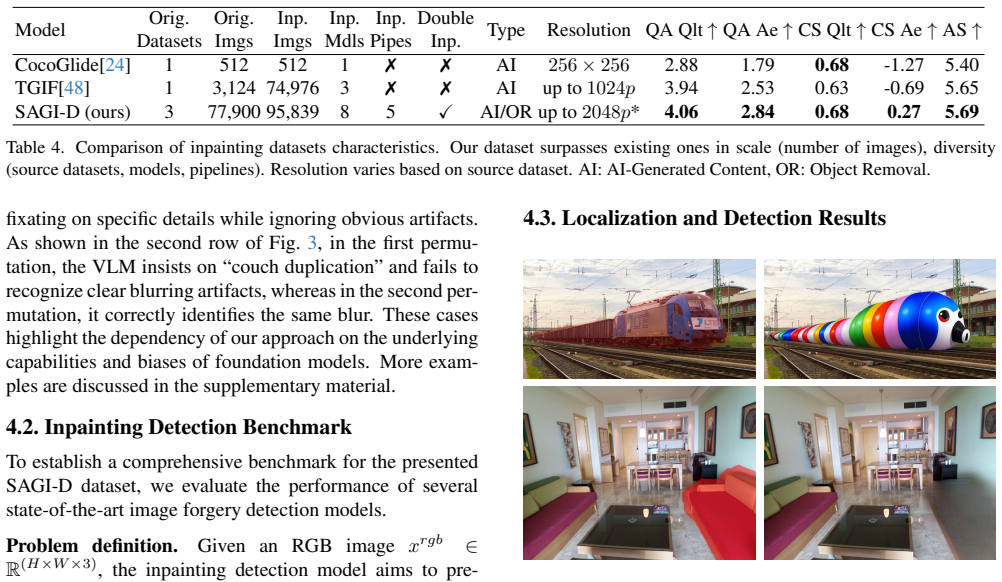
- [§3.3, UGDA configuration; Table 4] The dataset construction selects the highest-scoring images according to QAlign and then Table 4 uses the same QAlign quality and aesthetics metrics to claim that SAGI-D outperforms TGIF. This is a self-selection circularity: the evaluation metric is identical to the filtering criterion. Please report the quality comparison using metrics that were not used in dataset construction, or evaluate on a held-out set that did not undergo QAlign filtering.
- [§3.2, §4.1 UGDA evaluation; Table 14] The main text does not specify how many images fail the first-stage realism check, and Table 14 introduces an 'Intermediate' category (images that passed the first check but not the second) without a definition in Section 3.2. Without the stagewise counts, the reader cannot determine the fraction of inpainted images that are retained as deceiving or how the filtering interacts with the QAlign preselection in §3.3. Please report these counts and define the Intermediate category in the main text.
minor comments (7)
- [§3.2] The sentence 'Variation in responses or consistently choosing the inpainted image indicates uncertainty' is self-contradictory for the stable-preference case; please rephrase to separate the two signals.
- [Table 1] The abbreviations AS, CS Ae, QA Ae, CS Qlt, and QA Qlt are used without expansion in the table or its caption; please define them.
- [References] Reference [48] appears to cite the arXiv ID 2401.56789, which may not exist; please verify the TGIF citation and use the correct identifier.
- [§4.1 human study] The human study report gives only '3-5 independent assessments' per image; please add the number of assessments per image, inter-rater agreement, and confidence intervals for the accuracy and IoU values.
- [Figure 3] The bottom-row 'couch duplication' example shows that order sensitivity can arise from VLM attention biases rather than from the inpainted image's proximity to real-image statistics; please add a sentence connecting this failure mode to the uncertainty interpretation in Section 4.1.
- [Table 4; §3.3] The table lists 77,900 original images while Section 3.3 states 78,684 originals; please reconcile these numbers.
- [§3.3] The phrase 'approximately half of the test inpainted images' is ambiguous; please clarify whether this applies to each dataset split and whether the non-selected images are entirely excluded from SAGI-D.
Circularity Check
Dataset-quality comparison reduces partly to its own selection filter: SAGI-D is filtered by QAlign scores, then QAlign metrics are reported as evidence that SAGI-D outperforms TGIF.
-
self definitional
[Section 3.3 (UGDA configuration) and Section 4.1, Table 4]
"Empirically, we observed that QAlign effectively filters out low-quality images, so we applied UGDA to approximately half of the test inpainted images, selecting those with the highest QAlign scores. ... It outperforms existing datasets in aesthetic and quality metrics, demonstrating superior perceptual alignment and visual fidelity."
SAGI-D is constructed by keeping only the highest-QAlign images, and then Table 4 and the accompanying text report QAlign metrics (QA Qlt, QA Ae) as evidence that SAGI-D surpasses TGIF. The comparison on QAlign is therefore determined by the selection filter, not by the SAOR/UGDA pipeline. This is a self-selection loop: the metric used to choose the dataset is the same metric used to claim its quality advantage over TGIF.
full rationale
The core realism result is not circular: UGDA's deceiving/non-deceiving split is validated against an independent human study (Section 4.1, Tables 2 and 14), and the human accuracy gap (35.2% vs 73.7%) does not reuse the VLM responses that produced the classification. The SAOR prompt comparison (Table 1) is also an independent controlled experiment across models and prompt types. No load-bearing uniqueness theorem or self-citation chain appears: TGIF is treated as an empirical benchmark rather than as a forced premise. The one concrete circular step is the dataset-quality claim: Section 3.3 filters images by QAlign scores, and Section 4.1/Table 4 then cites QAlign metrics as evidence that SAGI-D 'outperforms' TGIF and shows 'superior perceptual alignment.' That particular comparison is an artifact of the selection filter rather than independent evidence for the proposed pipeline. Because the other reported metrics are not the selection criterion and the central human-study result remains independently grounded, the circularity is localized and partial.
Assumptions & free parameters
free parameters (4)
- LLM sampling hyperparameters =
temperature 1.2, top_p 0.8, max_tokens 40
- VLM temperature =
0.1
- QAlign filtering threshold =
top 50% of test inpainted images (approximately half)
- Human participation filter =
participants with at least 20 votes (42 reduced to 34)
assumptions (4)
- domain assumption Pretrained LLMs and VLMs are the best available approximations for the distribution of semantically coherent images aligned with human perception.
- domain assumption Order-reversal disagreement in a pairwise VLM realism ranking is a valid proxy for aleatoric uncertainty, and high uncertainty implies the inpainted image is close to the VLM's learned distribution and hence deceiving.
- domain assumption A small human study (42 participants, 1,000 images) provides reliable ground-truth realism labels.
- domain assumption Quality metrics used for evaluation (CLIP, QAlign, Aesthetic Score) reflect human quality and aesthetics perception.
Cite this review
Pith. "Pith review of SAGI: Semantically Aligned and Uncertainty Guided AI Image Inpainting." pith.science (2026). https://pith.science/paper/R6UYIYFG
@misc{pith2026250206593,
  author       = {Pith},
  title        = {Pith review of: SAGI: Semantically Aligned and Uncertainty Guided AI Image Inpainting},
  year         = {2026},
  howpublished = {\url{https://pith.science/paper/R6UYIYFG}},
  note         = {Machine review of arXiv:2502.06593}
}
read the original abstract
Recent advancements in generative AI have made text-guided image inpainting - adding, removing, or altering image regions using textual prompts - widely accessible. However, generating semantically correct photorealistic imagery, typically requires carefully-crafted prompts and iterative refinement by evaluating the realism of the generated content - tasks commonly performed by humans. To automate the generative process, we propose Semantically Aligned and Uncertainty Guided AI Image Inpainting (SAGI), a model-agnostic pipeline, to sample prompts from a distribution that closely aligns with human perception and to evaluate the generated content and discard instances that deviate from such a distribution, which we approximate using pretrained large language models and vision-language models. By applying this pipeline on multiple state-of-the-art inpainting models, we create the SAGI Dataset (SAGI-D), currently the largest and most diverse dataset of AI-generated inpaintings, comprising over 95k inpainted images and a human-evaluated subset. Our experiments show that semantic alignment significantly improves image quality and aesthetics, while uncertainty guidance effectively identifies realistic manipulations - human ability to distinguish inpainted images from real ones drops from 74% to 35% in terms of accuracy, after applying our pipeline. Moreover, using SAGI-D for training several image forensic approaches increases in-domain detection performance on average by 37.4% and out-of-domain generalization by 26.1% in terms of IoU, also demonstrating its utility in countering malicious exploitation of generative AI. Code and dataset are available at https://mever-team.github.io/SAGI/
Figures


Figures from the paper (7 more)


Reference graph
Works this paper leans on
-
[1]
Gradio: Hassle-free sharing and testing of ml models in the wild, 2019
Abubakar Abid, Ali Abdalla, Ali Abid, Dawood Khan, Ab- dulrahman Alfozan, and James Zou. Gradio: Hassle-free sharing and testing of ml models in the wild, 2019. 15
2019
-
[2]
Mistral small 3.1: Multimodal language model
Mistral AI. Mistral small 3.1: Multimodal language model. https://mistral.ai/news/mistral- small- 3-1, 2025. Model version 2503, 24B parameters, Apache 2.0 license. 6
2025
-
[3]
A sift-based forensic method for copy–move attack detection and transformation recovery
Irene Amerini, Lamberto Ballan, Roberto Caldelli, Alberto Del Bimbo, and Giuseppe Serra. A sift-based forensic method for copy–move attack detection and transformation recovery. IEEE Transactions on Information Forensics and Security, 6(3):1099–1110, 2011. 3
2011
-
[4]
Claude 3.5 sonnet, 2024
Anthropic. Claude 3.5 sonnet, 2024. Large Language Model. 4, 13
2024
-
[5]
Claude 3.7 sonnet, 2025
Anthropic. Claude 3.7 sonnet, 2025. Hybrid reasoning large language model. 6
2025
-
[6]
Qwen2.5-vl techni- cal report, 2025
Shuai Bai, Keqin Chen, Xuejing Liu, Jialin Wang, Wenbin Ge, Sibo Song, Kai Dang, Peng Wang, Shijie Wang, Jun Tang, Humen Zhong, Yuanzhi Zhu, Mingkun Yang, Zhaohai Li, Jianqiang Wan, Pengfei Wang, et al. Qwen2.5-vl techni- cal report, 2025. 6
2025
-
[7]
Synthbuster: Towards detection of diffu- sion model generated images
Quentin Bammey. Synthbuster: Towards detection of diffu- sion model generated images. IEEE Open Journal of Signal Processing, 5:1–9, 2024. 3
2024
-
[8]
From couloring-in to pointillism: revisiting semantic segmentation supervision
Rodrigo Benenson and Vittorio Ferrari. From couloring-in to pointillism: revisiting semantic segmentation supervision. In ArXiv, 2022. 13
2022
Show all 104 references
-
[9]
Bengio and Yann Lecun
Y . Bengio and Yann Lecun. Convolutional networks for im- ages, speech, and time-series, 1997. 2
1997
-
[10]
Bertalmio
M. Bertalmio. Contrast invariant inpainting with a 3rd order, optimal pde. In IEEE International Conference on Image Processing 2005, pages II–778, 2005. 2
2005
-
[11]
Image inpainting
Marcelo Bertalmio, Guillermo Sapiro, Vincent Caselles, and Coloma Ballester. Image inpainting. In Proceedings of the 27th Annual Conference on Computer Graphics and Interactive Techniques, page 417–424, USA, 2000. ACM Press/Addison-Wesley Publishing Co
2000
-
[12]
Bertalmio, A.L
M. Bertalmio, A.L. Bertozzi, and G. Sapiro. Navier-stokes, fluid dynamics, and image and video inpainting. In Pro- ceedings of the 2001 IEEE Computer Society Conference on Computer Vision and Pattern Recognition. CVPR 2001 , pages I–I, 2001. 2
2001
-
[13]
Advances in ai-generated images and videos
Hessen Bougueffa, Mamadou Keita, Wassim Hamidouche, Abdelmalik Taleb-Ahmed, Helena Liz-L ´opez, Alejandro Mart´ın, David Camacho, and Abdenour Hadid. Advances in ai-generated images and videos. International Journal of Interactive Multimedia and Artificial Intelligence, 9(1):1...
2024
-
[14]
Chan and Jianhong Shen
Tony F. Chan and Jianhong Shen. Nontexture inpainting by curvature-driven diffusions. Journal of Visual Communica- tion and Image Representation, 12(4):436–449, 2001. 2
2001
-
[15]
Cloud Yu, and Chih-Chuan Chang
I-Cheng Chang, J. Cloud Yu, and Chih-Chuan Chang. A forgery detection algorithm for exemplar-based inpainting images using multi-region relation. Image and Vision Com- puting, 31(1):57–71, 2013. 2
2013
-
[16]
Ziyi Chang, George Alex Koulieris, and Hubert P. H. Shum. On the design fundamentals of diffusion models: A survey,
-
[17]
Twigma: A dataset of ai- generated images with metadata from twitter, 2023
Yiqun Chen and James Zou. Twigma: A dataset of ai- generated images with metadata from twitter, 2023. 3
2023
-
[18]
An evaluation of pop- ular copy-move forgery detection approaches
Vincent Christlein, Christian Riess, Johannes Jordan, Corinna Riess, and Elli Angelopoulou. An evaluation of pop- ular copy-move forgery detection approaches. IEEE Trans- actions on Information Forensics and Security , 7(6):1841– 1854, 2012. 3
2012
-
[19]
Gemini 2.5: Pushing the frontier with advanced reasoning, multimodality, long context, and next generation agentic capabilities, 2025
Gheorghe Comanici, Eric Bieber, Mike Schaekermann, Ice Pasupat, Noveen Sachdeva, Inderjit Dhillon, Marcel Blis- tein, Ori Ram, Dan Zhang, Evan Rosen, Luke Marris, Sam Petulla, Colin Gaffney, Asaf Aharoni, Nathan Lintz, Tiago Cardal Pais, et al. Gemini 2.5: Pushing the frontier...
2025
-
[20]
Mathematical Methods of Statistics
Harald Cram ´er. Mathematical Methods of Statistics. Prince- ton University Press, Princeton, 1946. Chapter 21, The two- dimensional case, page 282. Table of contents archived at Wayback Machine, 2016-08-16. 18
1946
-
[21]
Criminisi, P
A. Criminisi, P. Perez, and K. Toyama. Region filling and object removal by exemplar-based image inpainting. IEEE Transactions on Image Processing, 13(9):1200–1212, 2004. 2
2004
-
[22]
Raise: a raw images dataset for digital image forensics
Duc-Tien Dang-Nguyen, Cecilia Pasquini, Valentina Conot- ter, and Giulia Boato. Raise: a raw images dataset for digital image forensics. In Proceedings of the 6th ACM Multimedia Systems Conference, page 219–224, New York, NY , USA,
-
[23]
Casia image tam- pering detection evaluation database
Jing Dong, Wei Wang, and Tieniu Tan. Casia image tam- pering detection evaluation database. In 2013 IEEE China Summit and International Conference on Signal and Infor- mation Processing, pages 422–426, 2013. 3
2013
-
[24]
Trufor: Leveraging all-round clues for trustworthy image forgery detection and localiza- tion, 2023
Fabrizio Guillaro, Davide Cozzolino, Avneesh Sud, Nicholas Dufour, and Luisa Verdoliva. Trufor: Leveraging all-round clues for trustworthy image forgery detection and localiza- tion, 2023. 2, 3, 7, 8, 15
2023
-
[25]
Patch-based image inpainting via two-stage low rank approximation
Qiang Guo, Shanshan Gao, Xiaofeng Zhang, Yilong Yin, and Caiming Zhang. Patch-based image inpainting via two-stage low rank approximation. IEEE Transactions on Visualization and Computer Graphics, 24(6):2023–2036, 2018. 2
2023
-
[26]
Clip knows image aesthetics
Simon Hentschel, Konstantin Kobs, and Andreas Hotho. Clip knows image aesthetics. Frontiers in Artificial Intel- ligence, 5, 2022. 6
2022
-
[27]
Oneformer: One transformer to rule universal image segmentation, 2022
Jitesh Jain, Jiachen Li, MangTik Chiu, Ali Hassani, Nikita Orlov, and Humphrey Shi. Oneformer: One transformer to rule universal image segmentation, 2022. 4
2022
-
[28]
Annihilating filter- based low-rank hankel matrix approach for image inpainting
Kyong Hwan Jin and Jong Chul Ye. Annihilating filter- based low-rank hankel matrix approach for image inpainting. IEEE Transactions on Image Processing, 24(11):3498–3511,
-
[29]
Brushnet: A plug-and-play image inpainting model with decomposed dual-branch diffusion, 2024
Xuan Ju, Xian Liu, Xintao Wang, Yuxuan Bian, Ying Shan, and Qiang Xu. Brushnet: A plug-and-play image inpainting model with decomposed dual-branch diffusion, 2024. 5
2024
-
[30]
Brushnet: Plug-and-play image inpainting with user guidance
Xiaodan Ju et al. Brushnet: Plug-and-play image inpainting with user guidance. In Proceedings of the IEEE/CVF Con- ference on Computer Vision and Pattern Recognition, pages 5678–5687, 2024. 5, 13 9
2024
-
[31]
Fusion transformer with object mask guidance for image forgery analysis
Dimitrios Karageorgiou, Giorgos Kordopatis-Zilos, and Symeon Papadopoulos. Fusion transformer with object mask guidance for image forgery analysis. In Proceedings of the IEEE/CVF Conference on Computer Vision and Pattern Recognition, pages 4345–4355, 2024. 2
2024
-
[32]
Diminished reality based on image inpainting considering background geometry
Norihiko Kawai, Tomokazu Sato, and Naokazu Yokoya. Diminished reality based on image inpainting considering background geometry. IEEE Transactions on Visualization and Computer Graphics, 22(3):1236–1247, 2016. 2
2016
-
[33]
Vila: Learning image aesthetics from user comments with vision-language pretraining, 2023
Junjie Ke, Keren Ye, Jiahui Yu, Yonghui Wu, Peyman Mi- lanfar, and Feng Yang. Vila: Learning image aesthetics from user comments with vision-language pretraining, 2023. 3
2023
-
[34]
Semantic segmentation-based image inpainting detection
Nitish Kumar and Toshanlal Meenpal. Semantic segmentation-based image inpainting detection. In In- novations in Electrical and Electronic Engineering , pages 665–677, Singapore, 2021. Springer Singapore. 2
2021
-
[35]
The open images dataset v4: Unified image classification, object detection, and visual relationship detection at scale
Alina Kuznetsova et al. The open images dataset v4: Unified image classification, object detection, and visual relationship detection at scale. International Journal of Computer Vision, 128(7):1956–1981, 2020. 1, 4
1956
-
[36]
Learning jpeg compression ar- tifacts for image manipulation detection and localization.In- ternational Journal of Computer Vision, 130(8):1875–1895,
Myung-Joon Kwon, Seung-Hun Nam, In-Jae Yu, Heung- Kyu Lee, and Changick Kim. Learning jpeg compression ar- tifacts for image manipulation detection and localization.In- ternational Journal of Computer Vision, 130(8):1875–1895,
-
[37]
Localization of deep inpaint- ing using high-pass fully convolutional network
Haodong Li and Jiwu Huang. Localization of deep inpaint- ing using high-pass fully convolutional network. In 2019 IEEE/CVF International Conference on Computer Vision (ICCV), pages 8300–8309, 2019. 2
2019
-
[38]
Blip-2: Bootstrapping language-image pre-training with frozen image encoders and large language models, 2023
Junnan Li, Dongxu Li, Silvio Savarese, and Steven Hoi. Blip-2: Bootstrapping language-image pre-training with frozen image encoders and large language models, 2023. 4
2023
-
[39]
An efficient forgery detection algorithm for object removal by exemplar-based image inpainting.Journal of Visual Com- munication and Image Representation, 30:75–85, 2015
Zaoshan Liang, Gaobo Yang, Xiangling Ding, and Leida Li. An efficient forgery detection algorithm for object removal by exemplar-based image inpainting.Journal of Visual Com- munication and Image Representation, 30:75–85, 2015. 2
2015
-
[40]
Lawrence Zitnick
Tsung-Yi Lin, Michael Maire, Serge Belongie, James Hays, Pietro Perona, Deva Ramanan, Piotr Doll´ar, and C. Lawrence Zitnick. Microsoft coco: Common objects in context. In Computer Vision – ECCV 2014 , pages 740–755, Cham,
2014
-
[41]
Pscc-net: Progressive spatio-channel correlation network for image manipulation detection and localization
Xiaohong Liu, Yaojie Liu, Jun Chen, and Xiaoming Liu. Pscc-net: Progressive spatio-channel correlation network for image manipulation detection and localization. IEEE Trans- actions on Circuits and Systems for Video Technology , 32 (11):7505–7517, 2022. 2, 7, 8, 15
2022
-
[42]
A detection approach using lstm-cnn for object removal caused by exemplar-based image inpainting
Ming Lu and Shaozhang Niu. A detection approach using lstm-cnn for object removal caused by exemplar-based image inpainting. Electronics, 9(5), 2020. 2
2020
-
[43]
Prompting hard or hardly prompting: Prompt inversion for text-to-image diffusion models, 2023
Shweta Mahajan, Tanzila Rahman, Kwang Moo Yi, and Leonid Sigal. Prompting hard or hardly prompting: Prompt inversion for text-to-image diffusion models, 2023. 1
2023
-
[44]
Is it ai or is it me? understanding users’ prompt journey with text-to-image generative ai tools
Atefeh Mahdavi Goloujeh, Anne Sullivan, and Brian Magerko. Is it ai or is it me? understanding users’ prompt journey with text-to-image generative ai tools. In Proceed- ings of the 2024 CHI Conference on Human Factors in Com- puting Systems, New York, NY , USA, 2024. Associati...
2024
-
[45]
Defacto: Image and face manipulation dataset
Ga ¨el MAHFOUDI, Badr TAJINI, Florent RETRAINT, Fr´ed´eric MORAIN-NICOLIER, Jean Luc DUGELAY , and Marc PIC. Defacto: Image and face manipulation dataset. In 2019 27th European Signal Processing Conference (EU- SIPCO), pages 1–5, 2019. 3
2019
-
[46]
Hd-painter: High-resolution prompt-faithful text-guided image inpainting, 2024
Ara Manukyan. Hd-painter: High-resolution prompt-faithful text-guided image inpainting, 2024. 5, 13
2024
-
[47]
Tgif: Text-guided inpainting forgery dataset, 2024
Hannes Mareen, Dimitrios Karageorgiou, Glenn Van Wal- lendael, Peter Lambert, and Symeon Papadopoulos. Tgif: Text-guided inpainting forgery dataset, 2024. 3
2024
-
[48]
Tgif: A text-guided image forgery dataset for deepfake detection
Hugo Mareen et al. Tgif: A text-guided image forgery dataset for deepfake detection. arXiv preprint arXiv:2401.56789, 2024. 7
2024
-
[49]
Improving text- to-image consistency via automatic prompt optimization,
Oscar Ma ˜nas, Pietro Astolfi, Melissa Hall, Candace Ross, Jack Urbanek, Adina Williams, Aishwarya Agrawal, Adri- ana Romero-Soriano, and Michal Drozdzal. Improving text- to-image consistency via automatic prompt optimization,
-
[50]
No-reference image quality assessment in the spa- tial domain
Anish Mittal, Anush Krishna Moorthy, and Alan Conrad Bovik. No-reference image quality assessment in the spa- tial domain. IEEE Transactions on Image Processing , 21 (12):4695–4708, 2012. 3
2012
-
[51]
Ava: A large-scale database for aesthetic visual analysis
Naila Murray, Luca Marchesotti, and Florent Perronnin. Ava: A large-scale database for aesthetic visual analysis. In 2012 IEEE Conference on Computer Vision and Pattern Recognition, pages 2408–2415, 2012. 3
2012
-
[52]
Glide: Towards photorealistic image generation and editing with text-guided diffusion models, 2022
Alex Nichol, Prafulla Dhariwal, Aditya Ramesh, Pranav Shyam, Pamela Mishkin, Bob McGrew, Ilya Sutskever, and Mark Chen. Glide: Towards photorealistic image generation and editing with text-guided diffusion models, 2022. 2
2022
-
[53]
Chatgpt-3.5, 2023
OpenAI. Chatgpt-3.5, 2023. 4, 13
2023
-
[54]
Chatgpt-4, 2023
OpenAI. Chatgpt-4, 2023. 5, 6, 14
2023
-
[55]
The neural basis of image segmentation in the primate brain
A Pasupathy. The neural basis of image segmentation in the primate brain. Neuroscience, 296:101–109, 2015. 3
2015
-
[56]
Deepak Pathak, Philipp Kr ¨ahenb¨uhl, Jeff Donahue, Trevor Darrell, and Alexei A. Efros. Context encoders: Feature learning by inpainting. In 2016 IEEE Conference on Com- puter Vision and Pattern Recognition (CVPR), pages 2536– 2544, 2016. 2
2016
-
[57]
Karl Pearson. X. on the criterion that a given system of devi- ations from the probable in the case of a correlated system of variables is such that it can be reasonably supposed to have arisen from random sampling. The London, Edinburgh, and Dublin Philosophical Magazine and ...
1900
-
[58]
Learning transferable visual models from natural language supervision, 2021
Alec Radford, Jong Wook Kim, Chris Hallacy, Aditya Ramesh, Gabriel Goh, Sandhini Agarwal, Girish Sastry, Amanda Askell, Pamela Mishkin, Jack Clark, Gretchen Krueger, and Ilya Sutskever. Learning transferable visual models from natural language supervision, 2021. 3, 5
2021
-
[59]
Zero-shot text-to-image generation
Aditya Ramesh, Mikhail Pavlov, Gabriel Goh, Scott Gray, Chelsea V oss, Alec Radford, Mark Chen, and Ilya Sutskever. Zero-shot text-to-image generation. InProceedings of the In- ternational Conference on Machine Learning , pages 8821– 8831, 2021. 1 10
2021
-
[60]
Zero-shot text-to-image generation, 2021
Aditya Ramesh, Mikhail Pavlov, Gabriel Goh, Scott Gray, Chelsea V oss, Alec Radford, Mark Chen, and Ilya Sutskever. Zero-shot text-to-image generation, 2021. 2
2021
-
[61]
High-resolution image synthesis with latent diffusion models
Robin Rombach, Andreas Blattmann, Dominik Lorenz, Patrick Esser, and Bj ¨orn Ommer. High-resolution image synthesis with latent diffusion models. In Proceedings of the IEEE/CVF Conference on Computer Vision and Pattern Recognition, pages 10684–10695, 2022. 1
2022
-
[62]
High-resolution image syn- thesis with latent diffusion models, 2022
Robin Rombach, Andreas Blattmann, Dominik Lorenz, Patrick Esser, and Bj¨orn Ommer. High-resolution image syn- thesis with latent diffusion models, 2022. 2, 5, 13
2022
-
[63]
Neu- roprompts: An adaptive framework to optimize prompts for text-to-image generation, 2024
Shachar Rosenman, Vasudev Lal, and Phillip Howard. Neu- roprompts: An adaptive framework to optimize prompts for text-to-image generation, 2024. 3
2024
-
[64]
Photorealistic text-to-image dif- fusion models with deep language understanding
Chitwan Saharia, William Chan, Saurabh Saxena, Lala Li, Jay Whang, Emily Denton, Seyed Kamyar Seyed Ghasemipour, Burcu Karagol Ayan, S Sara Mahdavi, and Raphael Gontijo Lopes. Photorealistic text-to-image dif- fusion models with deep language understanding. arXiv preprint arXi...
2022 arXiv
-
[65]
Laion-5b: An open large-scale dataset for training next generation image-text models, 2022
Christoph Schuhmann, Romain Beaumont, Richard Vencu, Cade Gordon, Ross Wightman, Mehdi Cherti, Theo Coombes, Aarush Katta, Clayton Mullis, Mitchell Worts- man, Patrick Schramowski, Srivatsa Kundurthy, Katherine Crowson, Ludwig Schmidt, Robert Kaczmarczyk, and Jenia Jitsev. Lai...
2022
-
[66]
Very deep convo- lutional networks for large-scale image recognition, 2015
Karen Simonyan and Andrew Zisserman. Very deep convo- lutional networks for large-scale image recognition, 2015. 2
2015
-
[67]
Blindly assess image qual- ity in the wild guided by a self-adaptive hyper network
Shaolin Su, Qingsen Yan, Yu Zhu, Cheng Zhang, Xin Ge, Jinqiu Sun, and Yanning Zhang. Blindly assess image qual- ity in the wild guided by a self-adaptive hyper network. In IEEE/CVF Conference on Computer Vision and Pattern Recognition (CVPR), 2020. 3
2020
-
[68]
Resolution-robust large mask inpainting with fourier convolutions, 2021
Roman Suvorov, Elizaveta Logacheva, Anton Mashikhin, Anastasia Remizova, Arsenii Ashukha, Aleksei Silvestrov, Naejin Kong, Harshith Goka, Kiwoong Park, and Victor Lempitsky. Resolution-robust large mask inpainting with fourier convolutions, 2021. 2, 5
2021
-
[69]
Diffusion models meet image counter-forensics,
Mat ´ıas Tailanian, Marina Gardella, ´Alvaro Pardo, and Pablo Mus´e. Diffusion models meet image counter-forensics,
-
[70]
Nima: Neural image assessment
Hossein Talebi and Peyman Milanfar. Nima: Neural image assessment. IEEE Transactions on Image Processing, 27(8): 3998–4011, 2018. 3
2018
-
[71]
Exploring the impact of ai-generated image tools on professional and non-professional users in the art and design fields, 2024
Yuying Tang, Ningning Zhang, Mariana Ciancia, and Zhi- gang Wang. Exploring the impact of ai-generated image tools on professional and non-professional users in the art and design fields, 2024. 3
2024
-
[72]
Gemma 3 technical report, 2025
Gemma Team, Aishwarya Kamath, Johan Ferret, Shreya Pathak, Nino Vieillard, Ramona Merhej, Sarah Perrin, Ta- tiana Matejovicova, Alexandre Ram ´e, Morgane Rivi `ere, Louis Rouillard, Thomas Mesnard, Geoffrey Cideron, Jean bastien Grill, Sabela Ramos, Edouard Yvinec, et al. Gemm...
2025
-
[73]
What makes an image realistic?, 2024
Lucas Theis. What makes an image realistic?, 2024. 3
2024
-
[74]
Comofod — new database for copy-move forgery detection
Dijana Tralic, Ivan Zupancic, Sonja Grgic, and Mislav Grgic. Comofod — new database for copy-move forgery detection. In Proceedings ELMAR-2013, pages 49–54, 2013. 3
2013
-
[75]
Exploring multi-modal fusion for image manipulation detection and lo- calization, 2023
Konstantinos Triaridis and Vasileios Mezaris. Exploring multi-modal fusion for image manipulation detection and lo- calization, 2023. 2, 7, 8, 15
2023
-
[76]
Gomez, Lukasz Kaiser, and Illia Polosukhin
Ashish Vaswani, Noam Shazeer, Niki Parmar, Jakob Uszko- reit, Llion Jones, Aidan N. Gomez, Lukasz Kaiser, and Illia Polosukhin. Attention is all you need, 2023. 2
2023
-
[77]
Media forensics and deepfakes: An overview
Luisa Verdoliva. Media forensics and deepfakes: An overview. IEEE Journal of Selected Topics in Signal Pro- cessing, 14(5):910–932, 2020. 2
2020
-
[78]
Ex- ploring clip for assessing the look and feel of images
Jianyi Wang, Kelvin CK Chan, and Chen Change Loy. Ex- ploring clip for assessing the look and feel of images. In AAAI, 2023. 3, 6
2023
-
[79]
Bovik, H.R
Zhou Wang, A.C. Bovik, H.R. Sheikh, and E.P. Simoncelli. Image quality assessment: from error visibility to structural similarity. IEEE Transactions on Image Processing , 13(4): 600–612, 2004. 3
2004
-
[80]
Iid-net: Image inpainting de- tection network via neural architecture search and attention
Haiwei Wu and Jiantao Zhou. Iid-net: Image inpainting de- tection network via neural architecture search and attention. IEEE Transactions on Circuits and Systems for Video Tech- nology, 32(3):1172–1185, 2022. 2, 3
2022
-
[81]
Q-align: Teaching lmms for visual scoring via discrete text-defined levels, 2023
Haoning Wu, Zicheng Zhang, Weixia Zhang, Chaofeng Chen, Liang Liao, Chunyi Li, Yixuan Gao, Annan Wang, Erli Zhang, Wenxiu Sun, Qiong Yan, Xiongkuo Min, Guang- tao Zhai, and Weisi Lin. Q-align: Teaching lmms for visual scoring via discrete text-defined levels, 2023. 3, 6
2023
-
[82]
Defakehop: A light-weight high-performance deepfake detector
Pin-Yu Wu, C-C Jay Kuo, et al. Defakehop: A light-weight high-performance deepfake detector. IEEE Transactions on Multimedia, 24:343–353, 2022. 2
2022
-
[83]
Detection of digital doctoring in exemplar-based in- painted images
Qiong Wu, Shao-Jie Sun, Wei Zhu, Guo-Hui Li, and Dan Tu. Detection of digital doctoring in exemplar-based in- painted images. In 2008 International Conference on Ma- chine Learning and Cybernetics, pages 1222–1226, 2008. 2
2008
-
[84]
Loki: A comprehensive syn- thetic data detection benchmark using large multimodal models, 2024
Junyan Ye, Baichuan Zhou, Zilong Huang, Junan Zhang, Tianyi Bai, Hengrui Kang, Jun He, Honglin Lin, Zihao Wang, Tong Wu, Zhizheng Wu, Yiping Chen, Dahua Lin, Conghui He, and Weijia Li. Loki: A comprehensive syn- thetic data detection benchmark using large multimodal models, 2024. 4, 5
2024
-
[85]
Jiahui Yu, Zhe Lin, Jimei Yang, Xiaohui Shen, Xin Lu, and Thomas S. Huang. Generative image inpainting with contex- tual attention, 2018. 2
2018
-
[86]
Inpaint-anything: Seg- ment meets inpaint
Ning Yu, Xiang Zhao, and Bo Chen. Inpaint-anything: Seg- ment meets inpaint. arXiv preprint arXiv:2304.06790, 2023. 5, 13
2023 arXiv
-
[87]
Inpaint anything: Segment anything meets image inpainting, 2023
Tao Yu, Runseng Feng, Ruoyu Feng, Jinming Liu, Xin Jin, Wenjun Zeng, and Zhibo Chen. Inpaint anything: Segment anything meets image inpainting, 2023. 5
2023
-
[88]
Text-to-image diffusion mod- els in generative ai: A survey, 2024
Chenshuang Zhang, Chaoning Zhang, Mengchun Zhang, In So Kweon, and Junmo Kim. Text-to-image diffusion mod- els in generative ai: A survey, 2024. 1
2024
-
[89]
A robust forgery detection algorithm for object removal by exemplar-based image in- painting
Dengyong Zhang, Zaoshan Liang, Gaobo Yang, Qingguo Li, Leida Li, and Xingming Sun. A robust forgery detection algorithm for object removal by exemplar-based image in- painting. Multimedia Tools and Applications, 77(10):11823– 11842, 2018. 2 11
2018
-
[90]
Adding conditional control to text-to-image diffusion models, 2023
Lvmin Zhang, Anyi Rao, and Maneesh Agrawala. Adding conditional control to text-to-image diffusion models, 2023. 5, 13
2023
-
[91]
Efros, Eli Shecht- man, and Oliver Wang
Richard Zhang, Phillip Isola, Alexei A. Efros, Eli Shecht- man, and Oliver Wang. The unreasonable effectiveness of deep features as a perceptual metric, 2018. 15
2018
-
[92]
Blind image quality assessment via vision- language correspondence: A multitask learning perspective
Weixia Zhang, Guangtao Zhai, Ying Wei, Xiaokang Yang, and Kede Ma. Blind image quality assessment via vision- language correspondence: A multitask learning perspective. In IEEE Conference on Computer Vision and Pattern Recog- nition, pages 14071–14081, 2023. 3
2023
-
[93]
Localization of inpainting forgery with feature enhancement network
Yushu Zhang, Zhibin Fu, Shuren Qi, Mingfu Xue, Zhongyun Hua, and Yong Xiang. Localization of inpainting forgery with feature enhancement network. IEEE Transactions on Big Data, 9(3):936–948, 2023. 2
2023
-
[94]
Rich and poor texture contrast: A simple yet effective ap- proach for ai-generated image detection
Nan Zhong, Yiran Xu, Zhenxing Qian, and Xinpeng Zhang. Rich and poor texture contrast: A simple yet effective ap- proach for ai-generated image detection. arXiv preprint arXiv:2311.12397, 2023. 3
2023 arXiv
-
[95]
A deep learning approach to patch-based image in- painting forensics
Xinshan Zhu, Yongjun Qian, Xianfeng Zhao, Biao Sun, and Ya Sun. A deep learning approach to patch-based image in- painting forensics. Signal Processing: Image Communica- tion, 67:90–99, 2018. 2
2018
-
[96]
A transformer–cnn for deep image inpainting forensics
Xinshan Zhu, Junyan Lu, Honghao Ren, Hongquan Wang, and Biao Sun. A transformer–cnn for deep image inpainting forensics. The Visual Computer, 39(10):4721–4735, 2023. 2
2023
-
[97]
A task is worth one word: Learning with task prompts for high-quality versatile image inpainting, 2024
Junhao Zhuang, Yanhong Zeng, Wenran Liu, Chun Yuan, and Kai Chen. A task is worth one word: Learning with task prompts for high-quality versatile image inpainting, 2024. 5, 13 12 SAGI: Semantically Aligned and Uncertainty Guided AI Image Inpainting Supplementary Material
2024
-
[100]
Inpaint the masked area with
Implementation details This section provides additional implementation details of our approach to ensure reproducibility. Code is available on https://github.com/mever-team/SAGI. 6.1. Source of Authentic Images Since RAISE [22] contains RAW images, we processed these images be...
2024
-
[101]
Yes, it is realistic
API endpoint (as of October 2024). We conducted preliminary experiments with various prompt formulations and found that allowing the model to explain its reasoning before providing a verdict led to more reliable assessments. The final implementation uses a two-stage process wi...
2024
-
[102]
Fidelity metrics are most meaningful for FR images, whereas for SP images, where the compared areas are nearly identical, they provide limited insight
Unmasked Area Preservation Fidelity metrics such as Mean Squared Error (MSE), Mean Absolute Error (MAE), Peak Signal-to-Noise Ratio (PSNR), and Learned Perceptual Image Patch Similarity (LPIPS) [91] assess the preservation of the non-inpainted area. Fidelity metrics are most m...
-
[103]
ID” indicates in-domain and “OOD
Localization and Detection Results In this section, we present extended results on localization and detection, studying various cases for forensic models PSCC-Net [41], CAT-Net [36], TruFor [24], and MMFusion (MMFus) [75]. Since mean IoU and detection Accuracy require a thresh...
-
[104]
a juicy orange to add a vibrant pop of color to the composition
Example Outputs Figures 9 and 10 present a qualitative analysis of some cases from our dataset. In Figure 9, we show successful inpaint- ing examples across different models and datasets (COCO, RAISE, and OpenImages), where the models correctly fol- low the prompts while produ...
-
[2014]
1, 4, 13
Springer International Publishing. 1, 4, 13
-
[2015]
1, 4, 13
Association for Computing Machinery. 1, 4, 13
Reviewed August 8, 2026 · model on record in the stance chip above.
Discussion (0). Continue with ORCID to comment.