REVIEW 3 major objections 6 minor 166 references
Shedding light on the star formation rate-halo accretion rate connection and halo quenching mechanism via DECODE, the Discrete statistical sEmi-empiriCal mODEl
T0 review · 3 major / 6 minor · reviewed 2026-08-08 · deepseek-v4-flash
Pith's one-line read A single monotonic star-formation–halo relation plus halo quenching explains galaxy statistics up to $z\sim2$.
desk verdict New abundance-matching-based SFR-HAR framework with a real TNG validation; the high-mass halo-quenching story holds up, but the paper's low-mass quenching claim is input-dependent and should be recast as conditional. read the letter →
The pith
A machine-rendered reading of the paper's core claim, the machinery that carries it, and where it could break.
The reading
What carries the argument
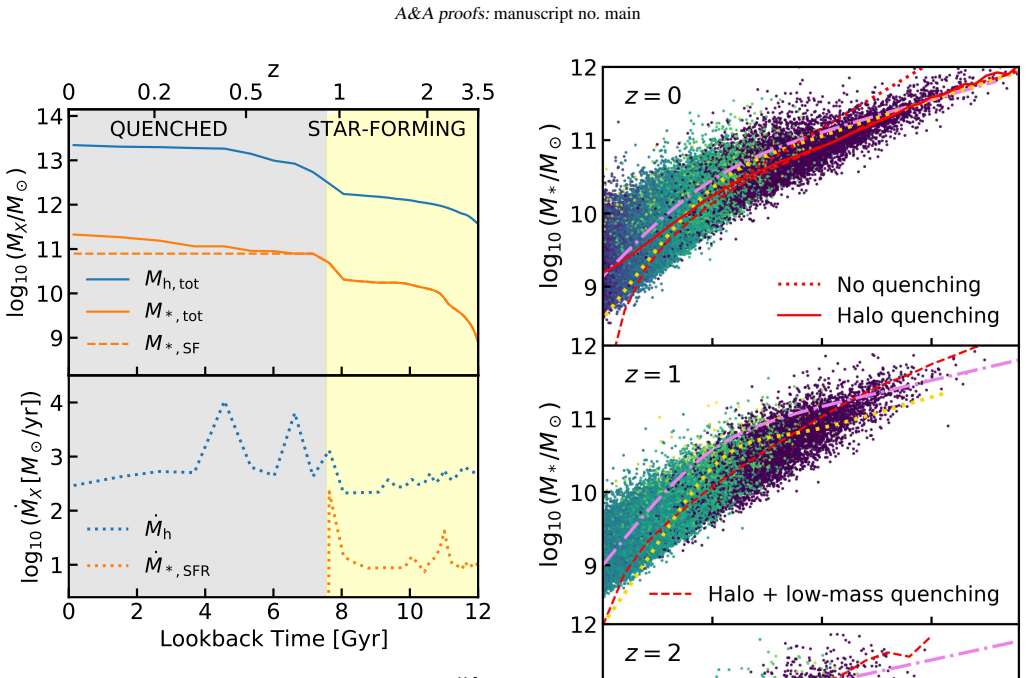
The load-bearing object is the star formation rate–halo accretion rate (SFR–HAR) relation: a monotonic mapping constructed by abundance matching the observed SFR number density with the simulated halo accretion rate number density via a one-equation formalism, with Gaussian scatter in SFR at fixed HAR as the only adjustable parameter. This relation converts dark-matter accretion histories into galaxy star formation histories. The same mapping is validated for self-consistency: feeding a large cosmological hydrodynamical simulation's own SFR and HAR functions into the abundance-matching recipe recovers the simulation's mean SFR–HAR relation at all redshifts studied, and a comparison of co-evolving SFR and HAR tracks shows no appreciable time delay. Quenching enters as a truncation: when the host halo crosses the threshold mass, the assigned SFR is dropped to zero, and the built-up stellar mass thereafter grows only by mergers.
What would settle it
A decisive check would be a direct, per-galaxy measurement of star formation rate and host halo accretion rate at $z\sim1$: if the rank-ordered relation is non-monotonic, bends at high accretion rates, or shows asymmetric scatter well beyond 0.4 dex, the abundance-matching anchor collapses. A cheaper calculation is to re-run the pipeline with an alternative low-mass SFR function census of the kind used in the paper's Appendix A; the paper itself reports that this reverses the low-mass conclusion, so the choice of census decides whether low-mass quenching is actually required.
Extended reading notes
Core claim
The central discovery is that the galaxy–halo connection can be derived, not fitted: rank-order the observed star formation rate function against the halo accretion rate function at each redshift, with a single 0.4 dex scatter, and the resulting relation assigns a star formation rate to every halo in a cosmological merger tree. Stellar mass is then the time integral of that rate, truncated instantaneously when the host halo crosses a quenching threshold near $10^{12}\,M_\odot$ with 0.4 dex of dispersion. This recipe predicts the local and $z\sim1\text{--}2$ stellar mass functions, quenched fractions, and stellar mass–halo mass relations in broad agreement with data, supporting three specific claims: (1) a monotonic star formation rate–halo accretion rate relation is sufficient for the number densities of the bulk of star-forming galaxies; (2) halo quenching alone accounts for the quenched population and for the flat high-mass end of the stellar mass–halo mass relation and the steep bright end of the stellar mass function; and (3) matching the steep low-mass end of the stellar mass–halo mass relation and the flat faint end of the stellar mass function requires an extra quenching process in haloes below roughly $10^{11}\,M_\odot$.
Load-bearing premise
Everything downstream rests on treating the adopted star formation function as a complete census of star-forming galaxies and on removing all haloes above $10^{12}\,M_\odot$ from the abundance matching, so the inferred SFR-HAR relation is calibrated only below the quenching threshold and then extrapolated to every halo's earlier accretion history.
Editorial extensions
If this is right
- If correct, the bulk of the observed galaxy population at $z\lesssim2$ can be predicted from halo accretion histories alone, without a large calibrated set of baryonic feedback parameters.
- The high-mass end of the stellar mass function and the flat high-mass stellar mass–halo mass slope are explained by halo quenching, so the model locates the need for additional feedback mainly in low-mass haloes and at $z\gtrsim2$.
- Because stellar masses are integrals of assigned SFRs, the model produces self-consistent predictions for the stellar mass–halo mass relation and its scatter, including decreasing scatter with halo mass, which can be tested against weak-lensing and dynamical measurements.
- The same pipeline can be rerun with updated empirical SFR censuses from new surveys; Appendix A already shows that alternative inputs reverse the low-mass conclusion, making the low-mass quenching requirement a directly testable data-driven claim.
- The predicted quenched fractions at $z\sim2$ fall below the latest high-redshift data, suggesting the model can be used to single out the redshift range where a second quenching channel becomes necessary.
Reading between the lines
- A natural next test would replace the rank-ordered abundance matching with a direct, per-galaxy measurement of SFR and host halo accretion rate at a few redshifts, to check whether the 0.4 dex symmetric scatter and monotonicity hold outside the simulation used for calibration.
- If low-mass quenching is confirmed, the same machinery could quantify how much of the faint-end slope is produced by supernova-driven outflows versus satellite stripping by rerunning the model with a mass-dependent quenching threshold.
- Since a delayed-quenching variant with 1–2 Gyr exponential decline leaves the outputs essentially unchanged, the model's discriminating power appears to reside in the threshold mass and its scatter rather than the quenching timescale, an interpretation worth testing with more gradual quenching recipes.
- Starting the assembly at higher redshift using early-Universe luminosity functions would test whether the overabundance of high-redshift quenched galaxies seen in recent surveys is a missing second channel for quenching or a problem with the assumed SFR census.
Editorial analysis
A structured set of objections, weighed in public.
Referee Report
Summary. The paper presents DECODE, a semi-empirical model that assigns galaxy star formation rates along dark matter halo accretion histories via an abundance-matched SFR-HAR relation, integrates these SFRs to build stellar masses, and tests a halo-quenching scenario against observed SMFs, quenched fractions, and SMHM relations from z=0 to z~2. The authors validate the monotonic SFR-HAR assumption against TNG100, use the Mancuso et al. (2016) SFR function as the observational input, and conclude that halo quenching alone can reproduce the high-mass galaxy population while additional low-mass quenching is needed to match the steep low-mass end of the SMHM relation and the flat low-mass end of the SMF.
Significance. If the central claims hold, the paper provides a useful, transparent framework with minimal free parameters, and the TNG-based check gives independent support for the monotonic SFR-HAR hypothesis and for the abundance-matching procedure itself. The model's ability to predict quenched fractions and SMHM relations as outputs rather than inputs is a genuine strength, as is the direct integration of SFRs along merger trees. However, the headline low-mass-quenching conclusion is currently tied to one specific input SFR function, and the quenched-fraction comparison depends on a dispersion parameter that is tuned to the data; these caveats reduce the significance of the paper's third conclusion until the robustness is quantified.
major comments (3)
- [Sect. 2.2 and Appendix A] Result 3, that 'additional quenching processes in the least massive haloes are needed,' is not robust to the choice of input SFR function. The abundance matching in Eq. (1) uses Mancuso et al. (2016) as the census of star-forming galaxies, and Sect. 2.2 states that switching to alternative SFR functions yields 'qualitatively similar results.' Appendix A, however, reports that Fujimoto et al. (2023) produces a high excess of low-mass galaxies and lower quenched fractions, while Sargent et al. (2012) predicts 'opposite results.' Since the low-mass excess that motivates the ad hoc 10^11 Msun quenching cut in Sect. 4.2.1 is generated by the SFR-HAR relation derived from this input, the inference is input-dependent. I request a quantitative re-analysis with at least one alternative SFR function, or a clear and quantitative justification for preferring Mancuso et al. (2016), before Result 3 is presented as a general finding. The Conclusions bullet that 'some of the latest current data on the SMF do not require this additional ingredient' should also be reconciled with the abstract's categorical statement of Result 3.
- [Sect. 2.4] The quenched-fraction comparison is not fully independent because the 0.4 dex dispersion around the quenching threshold is explicitly fitted to the data ('we found a value of 0.4 dex to best suit the outputs to the data'). Since the model's claim that halo quenching is 'sufficient' to reproduce the statistics of quenched galaxies is assessed through this comparison, the fitted nature of this parameter should be stated more prominently, and the sensitivity of the high-mass conclusions to sigma_quench should be quantified rather than only described qualitatively as flattening or sharpening the quenched-fraction curves.
- [Sect. 2.2] The abundance matching removes all haloes above Mh,lim = 10^12 Msun from the HAR function, so the SFR-HAR relation at high HAR is not constrained by observations but is effectively imposed by the quenching hypothesis under test. This means the predicted high-mass SMF and quenched fraction partly encode the assumption being tested. I ask the authors to clarify how this truncation affects the claimed agreement at the high-mass end and to state explicitly what part of the high-mass prediction is a test of halo quenching rather than a consequence of the input truncation.
minor comments (6)
- [Eq. (1)] The notation used for the scatter is defined only in the text; please define mu = d log SFR/d log HAR directly after Eq. (1) and clarify how mu is evaluated when the SFR-HAR relation bends at low redshift, as in Fig. 6.
- [Fig. 2] The axis labels in the upper and lower panels of Fig. 2 appear as 'Mh [M yr 1]' and should be typeset as log10(Mh/[M_sun yr^-1]) and log10(SFR/[M_sun yr^-1]) for clarity.
- [Sect. 4.2.1] The phrase 'by including the energy release, for example from strong SN feedback' overstates what is implemented; the model simply shuts down star formation in haloes below 10^11 Msun, and this should be described as an ad hoc test rather than a feedback model.
- [Sect. 5] There is a typo in the sentence 'a strong and instantaneous halo quenching could be not a realist scenario'; this should read 'may not be a realistic scenario.'
- [Sect. 2.3.2] The footnote defining 'surviving' as 'those centrals that have become satellites' is confusing; please clarify whether these are central galaxies that have survived as distinct objects after infall or something else.
- [Sect. 3] The TNG test in Sect. 3 is a self-consistency check of the abundance-matching technique using simulation inputs; the text should state explicitly that this test does not independently validate the observational SFR function or the halo-quenching recipe.
Circularity Check
The quenched-fraction 'prediction' is partly circular because the 0.4 dex dispersion around the quenching threshold is fitted to the data whose match is later presented as an independent test; the low-mass quenching conclusion is input-sensitive rather than forced.
-
fitted input called prediction
[Sect. 2.4 (halo quenching treatment) and Sect. 4.3 (quenched fractions presented as test)]
"Since physically not all galaxies quench when their host halo reaches exactly Mh,lim∼ 1012 M⊙, we included some dispersion around this quenching halo mass, for which we found a value of 0.4 dex to best suit the outputs to the data. By increasing or decreasing this parameter the shape of the quenched fractions as a function of stellar mass would simply flatten or sharpen."
The paper explicitly tunes the dispersion around Mh,lim to the data and states that this parameter directly sets the shape of the quenched-fraction curve. Section 4.3 then calls 'the predicted relative fractions of quenched galaxies as a function of stellar mass or environment' an 'independent and robust test of the quenching mechanism.' The agreement of f_quench(M*) with observations is therefore partly imposed at input time rather than independently predicted. The high-mass SMF and SMHM results remain independent outputs, so the circularity is partial rather than complete.
full rationale
The core abundance-matching pipeline is not circular: the SFR-HAR relation in Eq. (1) is constructed from an observed SFR function (Mancuso et al. 2016) and a simulated HAR function, and the stellar masses are genuine time-integrals of the assigned SFRs. The SMF, SMHM high-mass end, and merger statistics are therefore real predictions with external content. The principal circular step is the quenching dispersion: the 0.4 dex spread around the quenching halo mass is fitted 'to best suit the outputs to the data,' yet the quenched-fraction curve is later showcased as an independent test. Because the paper states that this parameter controls the flattening/sharpening of f_quench(M*), the match of the quenched-fraction shape is partly by construction. The low-mass quenching conclusion (Sect. 4.2.1) is a model-selection inference rather than an equation-level circularity: adding a 10^11 Msun cut and then reporting an improved fit supports sufficiency, not necessity. It is also flagged here as a robustness limitation, since Sect. 2.2 claims alternative SFR functions give 'qualitatively similar results,' while Appendix A reports that Sargent et al. (2012) 'predicts opposite results' for the low-mass behavior. The TNG comparisons are explicitly self-consistency checks and are not load-bearing for the astronomical claims. Overall, the central halo-quenching result has independent content, but one headline prediction reduces partly to a fitted parameter, giving a partial-circularity score of 6.
Assumptions & free parameters
free parameters (3)
- sigma_log10(SFR)|HAR =
0.4 dex
- sigma_quench =
0.4 dex
- Mh,low (low-mass quenching cut) =
10^11 Msun
assumptions (6)
- domain assumption A monotonic, one-to-one SFR-HAR relation exists and is recoverable by the abundance matching formula of Eq. (1) with Gaussian scatter.
- domain assumption The Mancuso et al. (2016) SFR function is a complete census of star-forming galaxies at z<3.
- domain assumption Dark matter halo accretion histories from Tinker et al. (2008) HMF and SatGen/Parkinson et al. (2008) merger trees are accurate.
- domain assumption All haloes above Mh,lim = 10^12 Msun host no star-forming galaxies; such haloes are removed from the HAR function and star formation is truncated at the threshold.
- domain assumption Instantaneous truncation of SFR upon crossing the quenching threshold is a valid representation of quenching.
- ad hoc to paper Satellite galaxies can be initialized from the model's own predicted SMHM relation for centrals.
Cite this review
Pith. "Pith review of Shedding light on the star formation rate-halo accretion rate connection and halo quenching mechanism via DECODE, the Discrete statistical sEmi-empiriCal mODEl." pith.science (2026). https://pith.science/paper/5C3VULP6
@misc{pith2026250206942,
  author       = {Pith},
  title        = {Pith review of: Shedding light on the star formation rate-halo accretion rate connection and halo quenching mechanism via DECODE, the Discrete statistical sEmi-empiriCal mODEl},
  year         = {2026},
  howpublished = {\url{https://pith.science/paper/5C3VULP6}},
  note         = {Machine review of arXiv:2502.06942}
}
read the original abstract
Aims: The relative roles of the physical mechanisms involved in quenching galaxy star formation are still unclear. We tackle this fundamental problem with our cosmological semi-empirical model DECODE (Discrete statistical sEmi-empiriCal mODEl), designed to predict galaxy stellar mass assembly histories, from minimal input assumptions. Methods: Specifically, in this work the star formation history of each galaxy is calculated along its progenitor dark matter halo by assigning at each redshift a star formation rate extracted from a monotonic star formation rate-halo accretion rate (SFR-HAR) relation derived from abundance matching between the (observed) SFR function and the (numerically predicted) HAR function, a relation that is also predicted by the TNG100 simulation. SFRs are integrated across cosmic time to build up the mass of galaxies, which may halt their star formation following input physical quenching recipes. Results: In this work we test the popular halo quenching scenario and we find that: 1) the assumption of a monotonic relation between SFR and HAR allows to reproduce the number densities of the bulk of star-forming galaxies in the local Universe; 2) the halo quenching is sufficient to reproduce the statistics of the quenched galaxies and flat (steep) high-mass end of the SMHM relation (SMF); and 3) to align with the observed steep (flat) low-mass end of the SMHM (SMF) additional quenching processes in the least massive haloes are needed. Conclusions: DECODE is an invaluable tool and will pave the way to investigate the origin of newly observed high-redshift objects from the latest ongoing facilities such as JWST and Euclid.
Figures


Figures from the paper (7 more)




Reference graph
Works this paper leans on
-
[1]
, " * write output.state after.block = add.period write newline
ENTRY address archiveprefix author booktitle chapter edition editor howpublished institution eprint journal key month note number organization pages publisher school series title type volume year label extra.label sort.label short.list INTEGERS output.state before.all mid.sentence after.sentence after.block FUNCTION init.state.consts #0 'before.all := #1 ...
-
[2]
write newline
" write newline "" before.all 'output.state := FUNCTION n.dashify 't := "" t empty not t #1 #1 substring "-" = t #1 #2 substring "--" = not "--" * t #2 global.max substring 't := t #1 #1 substring "-" = "-" * t #2 global.max substring 't := while if t #1 #1 substring * t #2 global.max substring 't := if while FUNCTION word.in bbl.in " " * FUNCTION format....
-
[3]
B., Christensen , C
Akins , H. B., Christensen , C. R., Brooks , A. M., et al. 2021, , 909, 139
2021
-
[4]
2019, , 488, 4916
Allen , M., Behroozi , P., & Ma , C.-P. 2019, , 488, 4916
2019
-
[5]
2012, in Society of Photo-Optical Instrumentation Engineers (SPIE) Conference Series, Vol
Amiaux , J., Scaramella , R., Mellier , Y., et al. 2012, in Society of Photo-Optical Instrumentation Engineers (SPIE) Conference Series, Vol. 8442, Space Telescopes and Instrumentation 2012: Optical, Infrared, and Millimeter Wave, ed. M. C. Clampin , G. G. Fazio , H. A. MacEwen , & J. Oschmann , Jacobus M., 84420Z
2012
-
[6]
2015, , 810, 74
Aversa , R., Lapi , A., de Zotti , G., Shankar , F., & Danese , L. 2015, , 810, 74
2015
-
[7]
M., Nelson , D., & White , S
Ayromlou , M., Kauffmann , G., Yates , R. M., Nelson , D., & White , S. D. M. 2021, , 505, 492
2021
-
[8]
M., Lim , S., D'Eugenio , F., et al
Baker , W. M., Lim , S., D'Eugenio , F., et al. 2024, arXiv e-prints, arXiv:2410.14773
arXiv 2024
Show all 166 references
-
[9]
K., Glazebrook , K., Brinkmann , J., et al
Baldry , I. K., Glazebrook , K., Brinkmann , J., et al. 2004, , 600, 681
2004
-
[10]
H., Hearin , A
Behroozi , P., Wechsler , R. H., Hearin , A. P., & Conroy , C. 2019, , 488, 3143
2019
-
[11]
S., Conroy , C., & Wechsler , R
Behroozi , P. S., Conroy , C., & Wechsler , R. H. 2010, , 717, 379
2010
-
[12]
K., et al
Bernardi , M., Meert , A., Sheth , R. K., et al. 2017, , 467, 2217
2017
-
[13]
& Dekel , A
Birnboim , Y. & Dekel , A. 2003, , 345, 349
2003
-
[14]
R., Hogg , D
Blanton , M. R., Hogg , D. W., Bahcall , N. A., et al. 2003, , 594, 186
2003
-
[15]
Bluck , A. F. L., Conselice , C. J., Ormerod , K., et al. 2024, , 961, 163
2024
-
[16]
2021, , 907, 110
Boco , L., Lapi , A., Chruslinska , M., et al. 2021, , 907, 110
2021
-
[17]
2019, , 881, 157
Boco , L., Lapi , A., Goswami , S., et al. 2019, , 881, 157
2019
-
[18]
2023, arXiv e-prints, arXiv:2307.13036
Boco , L., Lapi , A., Shankar , F., et al. 2023, arXiv e-prints, arXiv:2307.13036
2023 arXiv
-
[19]
J., & Combes , F
Bournaud , F., Jog , C. J., & Combes , F. 2007, , 476, 1179
2007
-
[20]
J., Illingworth , G
Bouwens , R. J., Illingworth , G. D., Franx , M., et al. 2009, , 705, 936
2009
-
[21]
G., Benson , A
Bower , R. G., Benson , A. J., Malbon , R., et al. 2006, , 370, 645
2006
-
[22]
2008, , 383, 93
Boylan-Kolchin , M., Ma , C.-P., & Quataert , E. 2008, , 383, 93
2008
-
[23]
Bravo , M., Robotham , A. S. G., Lagos , C. d. P., et al. 2023, , 522, 4481
2023
-
[24]
B., Governato , F., Ro s kar , R., et al
Brook , C. B., Governato , F., Ro s kar , R., et al. 2011, , 415, 1051
2011
-
[25]
C., McLeod , D
Carnall , A. C., McLeod , D. J., McLure , R. J., et al. 2023, , 520, 3974
2023
-
[26]
Cattaneo , A., Blaizot , J., Devriendt , J. E. G., et al. 2017, , 471, 1401
2017
-
[27]
M., & Guiderdoni , B
Cattaneo , A., Dekel , A., Faber , S. M., & Guiderdoni , B. 2008, , 389, 567
2008
-
[28]
2020, , 497, 279
Cattaneo , A., Koutsouridou , I., Tollet , E., Devriendt , J., & Dubois , Y. 2020, , 497, 279
2020
-
[29]
A., Warnick , K., & Knebe , A
Cattaneo , A., Mamon , G. A., Warnick , K., & Knebe , A. 2011, , 533, A5
2011
-
[30]
2003, , 115, 763
Chabrier , G. 2003, , 115, 763
2003
-
[31]
2014, , 562, A21
Cicone , C., Maiolino , R., Sturm , E., et al. 2014, , 562, A21
2014
-
[32]
L., De Zotti , G., & Danese , L
Cirasuolo , M., Shankar , F., Granato , G. L., De Zotti , G., & Danese , L. 2005, , 629, 816
2005
-
[33]
Clauwens , B., Schaye , J., Franx , M., & Bower , R. G. 2018, , 478, 3994
2018
-
[34]
G., Baugh , C
Cole , S., Lacey , C. G., Baugh , C. M., & Frenk , C. S. 2000, , 319, 168
2000
-
[35]
Cowie , L. L. & Songaila , A. 1977, , 266, 501
1977
-
[36]
L., Songaila , A., Hu , E
Cowie , L. L., Songaila , A., Hu , E. M., & Cohen , J. G. 1996, , 112, 839
1996
-
[37]
J., Springel , V., White , S
Croton , D. J., Springel , V., White , S. D. M., et al. 2006, , 365, 11
2006
-
[38]
J., Stevens , A
Croton , D. J., Stevens , A. R. H., Tonini , C., et al. 2016, , 222, 22
2016
-
[39]
2012, , 539, A31
Cucciati , O., Tresse , L., Ilbert , O., et al. 2012, , 539, A31
2012
-
[40]
M., Valentino , F., et al
Daddi , E., Rich , R. M., Valentino , F., et al. 2022, , 926, L21
2022
-
[41]
2017, , 605, A70
Davidzon , I., Ilbert , O., Laigle , C., et al. 2017, , 605, A70
2017
-
[42]
A., Norris , M
Davison , T. A., Norris , M. A., Pfeffer , J. L., Davies , J. J., & Crain , R. A. 2020, , 497, 81
2020
-
[43]
& Birnboim , Y
Dekel , A. & Birnboim , Y. 2006, , 368, 2
2006
-
[44]
& Birnboim , Y
Dekel , A. & Birnboim , Y. 2008, , 383, 119
2008
-
[45]
C., Birnboim , Y., Mandelker , N., & Li , Z
Dekel , A., Sarkar , K. C., Birnboim , Y., Mandelker , N., & Li , Z. 2023, , 523, 3201
2023
-
[46]
& Silk , J
Dekel , A. & Silk , J. 1986, , 303, 39
1986
-
[47]
2019, , 489, 4135
Dimauro , P., Huertas-Company , M., Daddi , E., et al. 2019, , 489, 4135
2019
-
[48]
2024, , 527, 2139
Dome , T., Tacchella , S., Fialkov , A., et al. 2024, , 527, 2139
2024
-
[49]
T., McLeod , D
Donnan , C. T., McLeod , D. J., Dunlop , J. S., et al. 2023, , 518, 6011
2023
-
[50]
T., McLure , R
Donnan , C. T., McLure , R. J., Dunlop , J. S., et al. 2024, , 533, 3222
2024
-
[51]
D., et al
Donnari , M., Pillepich , A., Joshi , G. D., et al. 2021 a , , 500, 4004
2021
-
[52]
2021 b , , 506, 4760
Donnari , M., Pillepich , A., Nelson , D., et al. 2021 b , , 506, 4760
2021
-
[53]
2020, , 642, A83
Dvornik , A., Hoekstra , H., Kuijken , K., et al. 2020, , 642, A83
2020
-
[54]
2019, , 631, A175
Erfanianfar , G., Finoguenov , A., Furnell , K., et al. 2019, , 631, A175
2019
-
[55]
2024, arXiv e-prints, arXiv:2405.13491
Euclid Collaboration , Mellier , Y., Abdurro'uf , et al. 2024, arXiv e-prints, arXiv:2405.13491
2024
-
[56]
Fabian , A. C. 2012, , 50, 455
2012
-
[57]
J., Faber , S
Fang , J. J., Faber , S. M., Koo , D. C., & Dekel , A. 2013, , 776, 63
2013
-
[58]
& Mayer , L
Feldmann , R. & Mayer , L. 2015, , 446, 1939
2015
-
[59]
2018, , 866, 136
Foltz , R., Wilson , G., Muzzin , A., et al. 2018, , 866, 136
2018
-
[60]
V., Hirschmann , M., et al
Fontanot , F., Macci \`o , A. V., Hirschmann , M., et al. 2015, , 451, 2968
2015
-
[61]
2022, , 516, 3206
Fu , H., Shankar , F., Ayromlou , M., et al. 2022, , 516, 3206
2022
-
[62]
2024, arXiv e-prints, arXiv:2406.07605
Fu , H., Shankar , F., Ayromlou , M., et al. 2024, arXiv e-prints, arXiv:2406.07605
2024 arXiv
-
[63]
2023, arXiv e-prints, arXiv:2303.01658
Fujimoto , S., Kohno , K., Ouchi , M., et al. 2023, arXiv e-prints, arXiv:2303.01658
2023 arXiv
-
[64]
P., Mather , J
Gardner , J. P., Mather , J. C., Clampin , M., et al. 2006, , 123, 485
2006
-
[65]
Gensior , J., Kruijssen , J. M. D., & Keller , B. W. 2020, , 495, 199
2020
-
[66]
2000, , 141, 371
Girardi , L., Bressan , A., Bertelli , G., & Chiosi , C. 2000, , 141, 371
2000
-
[67]
2010, , 463, 203
Governato , F., Brook , C., Mayer , L., et al. 2010, , 463, 203
2010
-
[68]
L., De Zotti , G., Silva , L., Bressan , A., & Danese , L
Granato , G. L., De Zotti , G., Silva , L., Bressan , A., & Danese , L. 2004, , 600, 580
2004
-
[69]
J., Shankar , F., & Conselice , C
Grylls , P. J., Shankar , F., & Conselice , C. J. 2020 a , , 499, 2265
2020
-
[70]
J., Shankar , F., Leja , J., et al
Grylls , P. J., Shankar , F., Leja , J., et al. 2020 b , , 491, 634
2020
-
[71]
Gunn , J. E. & Gott , J. Richard, I. 1972, , 176, 1
1972
-
[72]
2011, , 413, 101
Guo , Q., White , S., Boylan-Kolchin , M., et al. 2011, , 413, 101
2011
-
[73]
& White , S
Guo , Q. & White , S. D. M. 2008, , 384, 2
2008
-
[74]
P., Pereira , M
Haines , C. P., Pereira , M. J., Smith , G. P., et al. 2015, , 806, 101
2015
-
[75]
P., Pereira , M
Haines , C. P., Pereira , M. J., Smith , G. P., et al. 2013, , 775, 126
2013
-
[76]
2023, , 265, 5
Harikane , Y., Ouchi , M., Oguri , M., et al. 2023, , 265, 5
2023
-
[77]
Hatton , S., Devriendt , J. E. G., Ninin , S., et al. 2003, , 343, 75
2003
-
[78]
Henriques , B. M. B., White , S. D. M., Lilly , S. J., et al. 2019, , 485, 3446
2019
-
[79]
F., Croton , D., Bundy , K., et al
Hopkins , P. F., Croton , D., Bundy , K., et al. 2010 a , , 724, 915
2010
-
[80]
F., Somerville , R
Hopkins , P. F., Somerville , R. S., Cox , T. J., et al. 2009, , 397, 802
2009
-
[81]
F., Younger , J
Hopkins , P. F., Younger , J. D., Hayward , C. C., Narayanan , D., & Hernquist , L. 2010 b , , 402, 1693
2010
-
[82]
2020, , 492, 3685
Huang , S., Leauthaud , A., Hearin , A., et al. 2020, , 492, 3685
2020
-
[83]
2021, , 502, 621
Jiang , F., Dekel , A., Freundlich , J., et al. 2021, , 502, 621
2021
-
[84]
D., Pillepich , A., Nelson , D., et al
Joshi , G. D., Pillepich , A., Nelson , D., et al. 2021, , 508, 1652
2021
-
[85]
2017, , 464, 4977
Katsianis , A., Tescari , E., Blanc , G., & Sargent , M. 2017, , 464, 4977
2017
-
[86]
H., & Dav \'e , R
Kere s , D., Katz , N., Weinberg , D. H., & Dav \'e , R. 2005, , 363, 2
2005
-
[87]
& Cattaneo , A
Koutsouridou , I. & Cattaneo , A. 2022, , 516, 4194
2022
-
[88]
N., Cen , R., Ostriker , J
Lackner , C. N., Cen , R., Ostriker , J. P., & Joung , M. R. 2012, , 425, 641
2012
-
[89]
Lagos , C. D. P., Bravo , M., Tobar , R., et al. 2023, arXiv e-prints, arXiv:2309.02310
2023 arXiv
-
[90]
2017, , 847, 13
Lapi , A., Mancuso , C., Bressan , A., & Danese , L. 2017, , 847, 13
2017
-
[91]
2018 a , , 857, 22
Lapi , A., Pantoni , L., Zanisi , L., et al. 2018 a , , 857, 22
2018
-
[92]
2018 b , , 859, 2
Lapi , A., Salucci , P., & Danese , L. 2018 b , , 859, 2
2018
-
[93]
Larson , R. B. 1974, , 169, 229
1974
-
[94]
B., Tinsley , B
Larson , R. B., Tinsley , B. M., & Caldwell , C. N. 1980, , 237, 692
1980
-
[95]
& Yi , S
Lee , J. & Yi , S. K. 2013, , 766, 38
2013
-
[96]
Leitner , S. N. & Kravtsov , A. V. 2011, , 734, 48
2011
-
[97]
S., Johnson , B
Leja , J., Speagle , J. S., Johnson , B. D., et al. 2020, , 893, 111
2020
-
[98]
2016, , 832, 29
Lian , J., Yan , R., Zhang , K., & Kong , X. 2016, , 832, 29
2016
-
[99]
Liepold , E. R. & Ma , C.-P. 2024, arXiv e-prints, arXiv:2407.14595
2024 arXiv
-
[100]
2014, , 782, 33
Lin , L., Jian , H.-Y., Foucaud , S., et al. 2014, , 782, 33
2014
-
[101]
2023, , 959, 5
Lyu , C., Peng , Y., Jing , Y., et al. 2023, , 959, 5
2023
-
[102]
& Dickinson , M
Madau , P. & Dickinson , M. 2014, , 52, 415
2014
-
[103]
2024, , 688, A55
Magnelli , B., Adscheid , S., Wang , T.-M., et al. 2024, , 688, A55
2024
-
[104]
2019, , 881, 74
Man , Z.-Y., Peng , Y.-J., Shi , J.-J., et al. 2019, , 881, 74
2019
-
[105]
2016, , 823, 128
Mancuso , C., Lapi , A., Shi , J., et al. 2016, , 823, 128
2016
-
[106]
2018, , 480, 5113
Marinacci , F., Vogelsberger , M., Pakmor , R., et al. 2018, , 480, 5113
2018
-
[107]
2009, , 707, 250
Martig , M., Bournaud , F., Teyssier , R., & Dekel , A. 2009, , 707, 250
2009
-
[108]
2018, , 475, 3700
Mart \' n-Navarro , I., Vazdekis , A., Falc \'o n-Barroso , J., et al. 2018, , 475, 3700
2018
-
[109]
A., et al
Matthee , J., Schaye , J., Crain , R. A., et al. 2017, , 465, 2381
2017
-
[110]
F., et al
McCavana , T., Micic , M., Lewis , G. F., et al. 2012, , 424, 361
2012
-
[111]
A., Grand , R
Monachesi , A., G \'o mez , F. A., Grand , R. J. J., et al. 2019, , 485, 2589
2019
-
[112]
P., Naab , T., & White , S
Moster , B. P., Naab , T., & White , S. D. M. 2018, , 477, 1822
2018
-
[113]
2013, , 777, 18
Muzzin , A., Marchesini , D., Stefanon , M., et al. 2013, , 777, 18
2013
-
[114]
P., Pillepich , A., Springel , V., et al
Naiman , J. P., Pillepich , A., Springel , V., et al. 2018, , 477, 1206
2018
-
[115]
2022, , 39, e002
Nanayakkara , T., Esdaile , J., Glazebrook , K., et al. 2022, , 39, e002
2022
-
[116]
2019, Computational Astrophysics and Cosmology, 6, 2
Nelson , D., Springel , V., Pillepich , A., et al. 2019, Computational Astrophysics and Cosmology, 6, 2
2019
-
[117]
P., Naab , T., Johansson , P
Oser , L., Ostriker , J. P., Naab , T., Johansson , P. H., & Burkert , A. 2010, , 725, 2312
2010
-
[118]
A., Tinker , J
Oyarz \'u n , G. A., Tinker , J. L., Bundy , K., Xhakaj , E., & Wyithe , J. S. B. 2024, arXiv e-prints, arXiv:2409.03004
2024 arXiv
-
[119]
2008, , 383, 557
Parkinson , H., Cole , S., & Helly , J. 2008, , 383, 557
2008
-
[120]
J., Kova c , K., et al
Peng , Y.-j., Lilly , S. J., Kova c , K., et al. 2010, , 721, 193
2010
-
[121]
J., Renzini , A., & Carollo , M
Peng , Y.-j., Lilly , S. J., Renzini , A., & Carollo , M. 2012, , 757, 4
2012
-
[122]
2004, , 612, 168
Pietrinferni , A., Cassisi , S., Salaris , M., & Castelli , F. 2004, , 612, 168
2004
-
[123]
2018 a , , 475, 648
Pillepich , A., Nelson , D., Hernquist , L., et al. 2018 a , , 475, 648
2018
-
[124]
2018 b , , 473, 4077
Pillepich , A., Springel , V., Nelson , D., et al. 2018 b , , 473, 4077
2018
-
[125]
2014, , 444, 237
Pillepich , A., Vogelsberger , M., Deason , A., et al. 2014, , 444, 237
2014
-
[126]
M., Bluck , A
Piotrowska , J. M., Bluck , A. F. L., Maiolino , R., & Peng , Y. 2022, , 512, 1052
2022
-
[127]
2020, , 641, A6
Planck Collaboration , Aghanim , N., Akrami , Y., et al. 2020, , 641, A6
2020
-
[128]
2017, , 465, 547
Pontzen , A., Tremmel , M., Roth , N., et al. 2017, , 465, 547
2017
-
[129]
2019, , 626, A56
Posti , L., Fraternali , F., & Marasco , A. 2019, , 626, A56
2019
-
[130]
C., Bower , R
Qu , Y., Helly , J. C., Bower , R. G., et al. 2017, , 464, 1659
2017
-
[131]
Reeves , A. M. M., Hudson , M. J., & Oman , K. A. 2023, , 522, 1779
2023
-
[132]
1975, Memoires of the Societe Royale des Sciences de Liege, 8, 369
Reimers , D. 1975, Memoires of the Societe Royale des Sciences de Liege, 8, 369
1975
-
[133]
& Fusi Pecci , F
Renzini , A. & Fusi Pecci , F. 1988, , 26, 199
1988
-
[134]
2015, , 449, 49
Rodriguez-Gomez , V., Genel , S., Vogelsberger , M., et al. 2015, , 449, 49
2015
-
[135]
V., et al
Rodriguez-Gomez , V., Pillepich , A., Sales , L. V., et al. 2016, , 458, 2371
2016
-
[136]
T., B \'e thermin , M., Daddi , E., & Elbaz , D
Sargent , M. T., B \'e thermin , M., Daddi , E., & Elbaz , D. 2012, , 747, L31
2012
-
[137]
M., & Edmondson , E
Schawinski , K., Dowlin , N., Thomas , D., Urry , C. M., & Edmondson , E. 2010, , 714, L108
2010
-
[138]
2006, , 643, 14
Shankar , F., Lapi , A., Salucci , P., De Zotti , G., & Danese , L. 2006, , 643, 14
2006
-
[139]
2013, , 428, 109
Shankar , F., Marulli , F., Bernardi , M., et al. 2013, , 428, 109
2013
-
[140]
2014, , 439, 3189
Shankar , F., Mei , S., Huertas-Company , M., et al. 2014, , 439, 3189
2014
-
[141]
& Rees , M
Silk , J. & Rees , M. J. 1998, , 331, L1
1998
-
[142]
B., Jin , S., Magdis , G
Sillassen , N. B., Jin , S., Magdis , G. E., et al. 2024, , 690, A55
2024
-
[143]
S., Hopkins , P
Somerville , R. S., Hopkins , P. F., Cox , T. J., Robertson , B. E., & Hernquist , L. 2008, , 391, 481
2008
-
[144]
2010, , 401, 791
Springel , V. 2010, , 401, 791
2010
-
[145]
& Hernquist , L
Springel , V. & Hernquist , L. 2003, , 339, 289
2003
-
[146]
2018, , 475, 676
Springel , V., Pakmor , R., Pillepich , A., et al. 2018, , 475, 676
2018
-
[147]
Springel , V., White , S. D. M., Tormen , G., & Kauffmann , G. 2001, , 328, 726
2001
-
[148]
F., Bryan , G
Su , K.-Y., Hopkins , P. F., Bryan , G. L., et al. 2021, , 507, 175
2021
-
[149]
M., et al
Tacchella , S., Conroy , C., Faber , S. M., et al. 2022, , 926, 134
2022
-
[150]
2010, , 404, 1775
Thomas , D., Maraston , C., Schawinski , K., Sarzi , M., & Silk , J. 2010, , 404, 1775
2010
-
[151]
V., Klypin , A., et al
Tinker , J., Kravtsov , A. V., Klypin , A., et al. 2008, , 688, 709
2008
-
[152]
Valentino , F., Brammer , G., Gould , K. M. L., et al. 2023, , 947, 20
2023
-
[153]
G., et al
van der Wel , A., Franx , M., van Dokkum , P. G., et al. 2014, , 788, 28
2014
-
[154]
2016, , 459, 3251
van Uitert , E., Cacciato , M., Hoekstra , H., et al. 2016, , 459, 3251
2016
-
[155]
2024, arXiv e-prints, arXiv:2408.00824
Vani , A., Ayromlou , M., Kauffmann , G., & Springel , V. 2024, arXiv e-prints, arXiv:2408.00824
2024 arXiv
-
[156]
R., Davidzon , I., Toft , S., et al
Weaver , J. R., Davidzon , I., Toft , S., et al. 2023, , 677, A184
2023
-
[157]
J., et al
Weibel , A., de Graaff , A., Setton , D. J., et al. 2024, arXiv e-prints, arXiv:2409.03829
2024 arXiv
-
[158]
2017, , 465, 3291
Weinberger , R., Springel , V., Hernquist , L., et al. 2017, , 465, 3291
2017
-
[159]
F., et al
Wellons , S., Faucher-Gigu \`e re , C.-A., Hopkins , P. F., et al. 2023, , 520, 5394
2023
-
[160]
R., Tinker , J
Wetzel , A. R., Tinker , J. L., & Conroy , C. 2012, , 424, 232
2012
-
[161]
R., Tinker , J
Wetzel , A. R., Tinker , J. L., Conroy , C., & van den Bosch , F. C. 2013, , 432, 336
2013
-
[162]
M., van der Wel , A., et al
Wuyts , S., F \"o rster Schreiber , N. M., van der Wel , A., et al. 2011, , 742, 96
2011
-
[163]
2020, , 492, 1671
Zanisi , L., Shankar , F., Lapi , A., et al. 2020, , 492, 1671
2020
-
[164]
@esa (Ref
\@ifclassloaded agu2001 natbib The agu2001 class already includes natbib coding, so you should not add it explicitly Type <Return> for now, but then later remove the command natbib from the document \@ifclassloaded aguplus natbib The aguplus class already includes natbib codin...
-
[165]
@stdbsttrue NAT@ctr \@lbibitem[ NAT@ctr ] \@lbibitem[#1]#2 \@extra@b@citeb \@ifundefined br@#2\@extra@b@citeb \@namedef br@#2 \@nameuse br@#2\@extra@b@citeb \@ifundefined b@#2\@extra@b@citeb @num @parse #2 [ @natanchorstart #2\@extra@b@citeb \@biblabel @num @natanchorend] @ifc...
-
[166]
@open @close @open @close and [1] URL: #1 \@ifundefined chapter * \@mkboth \@ifundefined NAT@sectionbib * \@mkboth * \@mkboth\@gobbletwo \@ifclassloaded amsart * \@ifclassloaded amsbook * \@ifundefined bib@heading @heading NAT@ctr thebibliography [1] @ \@biblabel NAT@ctr \@bib...
Reviewed August 8, 2026 · model on record in the stance chip above.
Discussion (0). Continue with ORCID to comment.