REVIEW 4 major objections 6 minor 84 references
CreAgent: Towards Long-Term Evaluation of Recommender System under Platform-Creator Information Asymmetry
T0 review · 4 major / 6 minor · reviewed 2026-08-08 · deepseek-v4-flash
Pith's one-line read Modeling creators as information-poor agents makes recommender simulations match real platform behavior.
desk verdict Good engineering and a real problem, but the validation can't yet separate what CreAgent learns from what was seeded. read the letter →
The pith
A machine-rendered reading of the paper's core claim, the machinery that carries it, and where it could break.
The reading
What carries the argument
The load-bearing mechanism is the belief module plus the two-speed creation loop. Each CreAgent holds a skill belief, the share of its own past uploads per genre, and an audience belief, the average feedback utility per genre computed only from items it created; updating these from the platform's per-item feedback log enforces exactly the information asymmetry of interest. At creation time a slow-thinking chain-of-thought step turns the most recent item's utility, the two beliefs, and the creator's profile into an EXPLORE or EXPLOIT decision, and a fast-thinking step generates title, genre, tags, and description from retrieved creation memory. Proximal Policy Optimization then tunes the agent against the simulated platform's feedback as the reward, so the agent learns to read its limited feedback the way a real creator would.
What would settle it
A direct test is to feed each trained CreAgent only the feedback its real counterpart had received up to a given date, then compare the agent's next upload genre and timing against the creator's actual next upload on a held-out slice of the dataset; if the agent is not more accurate than always exploiting the current most profitable genre, the belief and fast-slow machinery is not doing the claimed work. A second check is to rerun the long-term evaluations with user agents calibrated to real logged clicks; if the fairness and diversity conclusions reverse, the user-agent bias is the active ingredient.
Extended reading notes
Core claim
The paper's central discovery is that modeling the creator's information asymmetry directly, giving the agent feedback only on its own items as real platform policies do, is what makes a recommender-system simulation resemble a real content ecosystem. CreAgent maintains two beliefs from that limited feedback, a skill belief over genres it has created and an audience belief over the utility each genre has returned, and a slow-thinking LLM reads those beliefs together with the most recent item's utility to choose between exploiting the current genre and exploring a new one, while a fast-thinking LLM writes the actual item. The paper reports that this agent reproduces the creator-side distribution of a crawled video-platform dataset better than previous simulation baselines: a Jensen-Shannon divergence of 0.1667 for creation preference and 0.3014 for diversity, against best baseline values of 0.2537 and 0.6284. It also reproduces two behavioral-economics signatures of real creators: accumulated reward is higher under full than partial information, matching bounded rationality, and agents become more exploratory after low rewards and more exploitative after high rewards, matching prospect theory.
Load-bearing premise
The load-bearing premise is that the simulated users click, skip, and leave the platform the way real users do; if their feedback is biased, the creator's beliefs, the training signal, and every downstream fairness or diversity conclusion inherit that bias.
Editorial extensions
If this is right
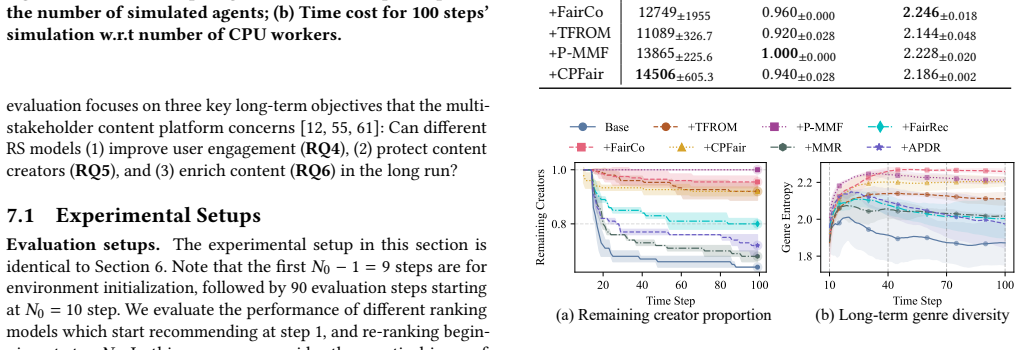
- Fairness- and diversity-aware re-ranking can improve long-term user engagement rather than hurting it; in the reported simulations some fairness-aware models increased total clicks by up to 28.5% over the base model.
- Creator retention depends strongly on the recommender: several fairness-aware models kept all creators active through 100 steps, while the base model lost more than 20% of its creators.
- Click-optimizing models can create filter bubbles: the base model delivered lower content genre diversity than simpler baselines, and fairness-aware re-ranking consistently raised diversity over time.
- Ignoring information asymmetry biases evaluation: CreAgent under full preference information earned higher cumulative reward than under partial information, showing that omitted asymmetry makes simulated creators look more rational than real ones.
- The simulation is cheap enough to be practical for long-term evaluation: time per simulation step stayed under 15 minutes with 1,000 agents.
Reading between the lines
- Editorial inference: The credibility validation compares aggregate genre distributions, so it does not yet establish that the belief and fast-slow machinery is what drives alignment; a per-creator, time-ordered forecast test would isolate the mechanism.
- Editorial inference: Because the reinforcement-learning reward is the utility of the creator's own items, the agent will be systematically blind to genres it never tries; this is realistic but means the simulator may understate how quickly real creators discover a shift in platform-wide taste.
- Editorial inference: The reported accuracy and recall of the user agents, around 63% and 74% at best, plus their tendency to hallucinate positive clicks, imply that the fairness and diversity conclusions should be re-run after calibrating user agents against logged real interactions.
- Editorial inference: The asymmetry modeled here is one of many; the same agent architecture could be extended to hidden platform policies, revenue-sharing terms, or other creators' performance, with the belief update modified accordingly.
Editorial analysis
A structured set of objections, weighed in public.
Referee Report
Summary. The paper proposes CreAgent, an LLM-based simulation agent for content creators in recommender-system evaluation, combining a game-theoretic belief module, fast-and-slow thinking, and PPO fine-tuning. The authors collect a YouTube dataset, build a simulated platform with modified RecAgent user agents, compare CreAgent's genre distribution, diversity, and activity against CFD, LBR, and SimuLine using Jensen-Shannon divergence, and use the simulator to compare ranking, fairness, and diversity models. The headline claim is that CreAgent aligns well with real-world platform and creator behavior and thereby improves the reliability of long-term RS evaluation.
Significance. If validated, the work would fill a real gap: most RS simulators either omit creators or model them without information asymmetry. The open-sourced code and dataset, the extensible platform design, and the behavioral-economics checks (bounded rationality, prospect theory) are useful starting points and should be credited. However, the central credibility claim is not yet established. The alignment experiments are computed over initialization steps using the same dataset that seeds profiles, memories, and beliefs, and the user agents that drive the creator feedback loop show limited fidelity. The long-term evaluation conclusions in Section 7 therefore rest on assumptions that still need direct validation.
major comments (4)
- [§6.2.1 and Table 1] The preference and diversity alignment is computed over "the first 10 environment initialization steps" (§6.2.1), but §4.1–4.3 initialize the creator profile, creation memory, and the skill and audience beliefs (Eqs. (3)–(4)) from the same YouTube dataset used as the target distribution in Figure 3(a) and Table 1. A creator that mostly replays its initialization memory would reproduce the target genre distribution even if the belief-update and PPO components contributed nothing. The ablation in Table 1 is consistent with this concern: removing audience belief or skill belief raises the preference JS divergence only to 0.2671 and 0.2928, still comparable to or better than the baselines (0.2537–0.3175), so much of the alignment may come from the initialization channel rather than from the simulated strategic loop. Please add a time-split holdout validation (e.g., initialize beliefs and memory from an early window of creator history and test alignment on later, unseen creations) or a control that replays the initialization distribution without the belief-based decision process.
- [§6 and §7] The central claim concerns long-term reliability, but no longitudinal ground-truth validation is provided. RQ1 compares aggregate genre, diversity, and activity distributions over the initialization period, and RQ2 checks prospect-theory patterns; the claimed practical value in Section 7 (e.g., P-MMF retaining 100% of creators in Table 3) requires that CreAgent's temporal creation trajectories respond to changing recommender policies the way real creators do. The paper does not compare simulated creator trajectories against held-out real creator sequences under policy changes. Please add a longitudinal validation, for example predicting next-item genres or creator retention on a time-based holdout of the YouTube dataset, or using an external dataset that records creator-visible feedback and subsequent uploads.
- [Appendix C and §5 (User agents)] The creator feedback loop in Eqs. (1)–(2) and the PPO reward in §4.5 depend entirely on the user agent's clicks. Table 6 reports at most 0.630 accuracy and 0.740 recall, and the text explicitly acknowledges that the agents tend to hallucinate positive clicks, identifying some negative items as positive. With a positive-click bias, the feedback signal z_i(n) is systematically inflated, so the creator beliefs (Eq. (4)), PPO rewards (Eq. (7)), and the Section 7 conclusions about fairness- and diversity-aware models are built on biased signals. Please calibrate the user agent against held-out user behavior in the simulation setting, or provide a sensitivity analysis bounding the effect of click bias on the Section 7 metrics.
- [§7.2–7.4, Tables 2–3] The long-term algorithm comparisons report means and standard deviations but no significance tests. Several differences that drive the conclusions are small relative to the reported variation (e.g., MMR reduces engagement by 2.03% and TFROM by 1.77% versus the base model, with standard deviations of 114.6 and 326.7 against a base of 11289±1353). Without paired significance tests or effect sizes, the claims that diversity/fairness models "do not significantly harm" user engagement and that CPFair increases engagement by 28.50% are not statistically supported. Please add appropriate significance tests or present the results as descriptive only.
minor comments (6)
- [§6.4] The heading "Computaional Costs" should be "Computational Costs".
- [§6.2.1 vs §7.1] Section 6.2.1 says alignment is computed during "the first 10 environment initialization steps," while Section 7.1 says the first N0-1 = 9 steps are initialization; please reconcile this inconsistency.
- [§5 and Appendices] Appendix C is referenced in §5 as "please see Appendix" without a letter; give the correct cross-reference, and cite Appendix B if it is intended to be part of the main evaluation.
- [Global] The manuscript still contains placeholder text ("Conference acronym 'XX", "Make sure to enter the correct conference title", and unfilled reference page fields) that should be cleaned before publication.
- [Figure 6] Figure 6 has stray label text ("SimuLine") overlapping the plot; the figure should be regenerated for clarity.
- [§8] The limitations paragraph mentions randomness and multimodality but not the validation issues raised above (initialization circularity and user-agent click bias); adding these would give readers a more complete picture of the current evidence.
Circularity Check
RQ1's headline alignment evidence is partly self-referential: the genre and activity distributions compared in Table 1 and Figures 3(a,c) are measured over the first 10 initialization steps, while the same YouTube dataset was used to initialize creation activity and skill/audience beliefs, so the match largely re-emits the initialization rather than validating CreAgent's decision process.
-
self definitional
[Section 4.1 (Creation activity) and Section 6.2.3 (Creation Activity Alignment)]
"We use the collected dataset I0_c to initialize the inherent activity level p_a_c for each creator c. ... After getting p_a_c of each creator, the creation probability for each creator at each step is p_a_c/η. [Section 6.2.3:] we plot the individual-level distribution of creator activity ... the deep blue dashed line represents the average creation count per month for 643 creators in the YouTube dataset ... while the light blue area represents the corresponding CreAgent's total creation times under 100 steps' simulation. ..."
The simulated creation count is generated by a per-step creation probability p_a_c/η where p_a_c is literally the average number of items per day taken from the same real-world dataset. Comparing the resulting 100-step creation-count distribution to the real creators' creation-count distribution is therefore comparing a dataset-derived rate with itself (up to sampling noise). The activity alignment that the paper reports as credibility evidence is built into the initialization by definition, not produced by the belief or fast-slow-thinking modules.
-
fitted input called prediction
[Section 4.3 (Skill/Audience belief initialization), Section 6.2.1 (Creation Preference Alignment) and Table 1]
"we initialize the skill belief Bskill_c(1) using the pre-collected dataset I0_c. ... we initialize the audience belief Baud_c(1) using the real-world creator's history items I0_c. [Section 6.2.1:] we plot the creation genre distribution of the YouTube dataset ... and our simulation ... the proportion of creation times all CreAgents created in each genre during the first 10 environment initialization steps. ... We find that both audience belief and skill belief have a significant impact on preference alignment, as they contain information about real creators."
Bskill_c,g is defined as the genre share of the creator's own creation memory, and at step 1 that memory is the real YouTube history; the slow-thinker prompt is given Bskill_c as the creator's familiarity and is instructed to choose known genres when exploiting. Thus the aggregate genre distribution of creations in the first 10 initialization steps is directly conditioned on the very YouTube genre distribution used as the ground-truth target in Table 1. The reported JS divergence therefore measures how faithfully the LLM re-emits its initialization, not whether the hypothesized information-asymmetry belief mechanism reproduces real creator behavior. The authors' own ablation concedes that the beliefs carry the alignment signal.
full rationale
The two load-bearing RQ1 validations (preference and activity alignment) compare simulated quantities to the same real-world YouTube distribution that was used to initialize those quantities: creation activity is set to the real per-creator creation rate, and skill/audience beliefs are initialized from the real creation history and then fed into the creation prompt. Because the preference metric is computed over the first 10 environment-initialization steps, before the feedback loop has had much chance to transform the beliefs, the low JS divergences in Table 1 are substantially inherited from initialization rather than earned by the PPO fine-tuning or fast-slow thinking. The paper itself states that removing the beliefs changes preference divergence only modestly and that the beliefs 'contain information about real creators,' which confirms the mechanism. This is not speculation about intent: the equations and experimental description exhibit the reduction. The remaining RQ2 checks (bounded rationality and prospect-theory-consistent explore/exploit patterns) are self-contained behavioral-economics tests that do not reduce to the initialization, and the Section 7 long-term comparisons are downstream applications rather than validation of realism; hence the circularity is partial rather than total. No load-bearing self-citation or imported uniqueness theorem appears.
Assumptions & free parameters
free parameters (5)
- beta (exposure weight in creator utility)
- lambda (PPO reward scaling)
- N_r, N_u, M (PPO replay and update hyperparameters)
- creator retention threshold =
5 consecutive creations without clicks
- timeliness threshold eta (20 steps) =
20 steps
assumptions (5)
- domain assumption Creators observe only feedback on their own items (P_c = {I_c, E_i, Y_i | i in I_c})
- domain assumption Creators behave according to bounded rationality and prospect theory
- domain assumption User comments indicate user preference for items
- ad hoc to paper The utility function in Eq. (2) captures how creators perceive success
- ad hoc to paper LLM-generated text with profile, memory, and beliefs approximates real creator reasoning
invented entities (2)
-
skill belief Bskill_c,g
-
audience belief Baud_c,g
Cite this review
Pith. "Pith review of CreAgent: Towards Long-Term Evaluation of Recommender System under Platform-Creator Information Asymmetry." pith.science (2026). https://pith.science/paper/HJNX5RVT
@misc{pith2026250207307,
  author       = {Pith},
  title        = {Pith review of: CreAgent: Towards Long-Term Evaluation of Recommender System under Platform-Creator Information Asymmetry},
  year         = {2026},
  howpublished = {\url{https://pith.science/paper/HJNX5RVT}},
  note         = {Machine review of arXiv:2502.07307}
}
read the original abstract
Ensuring the long-term sustainability of recommender systems (RS) emerges as a crucial issue. Traditional offline evaluation methods for RS typically focus on immediate user feedback, such as clicks, but they often neglect the long-term impact of content creators. On real-world content platforms, creators can strategically produce and upload new items based on user feedback and preference trends. While previous studies have attempted to model creator behavior, they often overlook the role of information asymmetry. This asymmetry arises because creators primarily have access to feedback on the items they produce, while platforms possess data on the entire spectrum of user feedback. Current RS simulators, however, fail to account for this asymmetry, leading to inaccurate long-term evaluations. To address this gap, we propose CreAgent, a Large Language Model (LLM)-empowered creator simulation agent. By incorporating game theory's belief mechanism and the fast-and-slow thinking framework, CreAgent effectively simulates creator behavior under conditions of information asymmetry. Additionally, we enhance CreAgent's simulation ability by fine-tuning it using Proximal Policy Optimization (PPO). Our credibility validation experiments show that CreAgent aligns well with the behaviors between real-world platform and creator, thus improving the reliability of long-term RS evaluations. Moreover, through the simulation of RS involving CreAgents, we can explore how fairness- and diversity-aware RS algorithms contribute to better long-term performance for various stakeholders. CreAgent and the simulation platform are publicly available at https://github.com/shawnye2000/CreAgent.
Figures


Figures from the paper (6 more)



Reference graph
Works this paper leans on
-
[1]
Himan Abdollahpouri and Robin Burke. 2019. Multi-stakeholder recommendation and its connection to multi-sided fairness. arXiv preprint arXiv:1907.13158 (2019)
arXiv 2019
-
[2]
Amit Kumar Bardhan and Saad Ashraf. 2022. More buyers or more sellers: on marketing resource allocation strategies of competing two-sided platforms. Electronic Commerce Research (2022), 1–30
2022
-
[3]
Omer Ben-Porat and Moshe Tennenholtz. 2018. A game-theoretic approach to recommendation systems with strategic content providers. Advances in Neural Information Processing Systems 31 (2018)
2018
-
[4]
Hemant K Bhargava. 2022. The creator economy: Managing ecosystem supply, revenue sharing, and platform design. Management Science 68, 7 (2022), 5233– 5251
2022
-
[5]
Xiang Bi and Cunchen Tang. 2020. Research on the motives affecting the behavior of short video’s creators. Ieee Access 8 (2020), 188415–188428
2020
-
[6]
Robin D Burke, Himan Abdollahpouri, Bamshad Mobasher, and Trinadh Gupta
-
[7]
Jaime Carbonell and Jade Goldstein. 1998. The use of MMR, diversity-based reranking for reordering documents and producing summaries. In Proceedings of the 21st annual international ACM SIGIR conference on Research and development in information retrieval. 335–336
1998
-
[8]
Jiawei Chen, Hande Dong, Xiang Wang, Fuli Feng, Meng Wang, and Xiangnan He. 2023. Bias and debias in recommender system: A survey and future directions. ACM Transactions on Information Systems 41, 3 (2023), 1–39
2023
Show all 84 references
-
[9]
Minmin Chen, Yuyan Wang, Can Xu, Ya Le, Mohit Sharma, Lee Richardson, Su- Lin Wu, and Ed Chi. 2021. Values of user exploration in recommender systems. In Proceedings of the 15th ACM Conference on Recommender Systems . 85–95
2021
-
[10]
John Conlisk. 1996. Why bounded rationality? Journal of economic literature 34, 2 (1996), 669–700
1996
-
[11]
Yujuan Ding, Yunshan Ma, Wenqi Fan, Yige Yao, Tat-Seng Chua, and Qing Li
-
[12]
Pejman Ebrahimi, Datis Khajeheian, Maryam Soleimani, Abbas Gholampour, and Maria Fekete-Farkas. 2023. User engagement in social network platforms: what key strategic factors determine online consumer purchase behaviour? Economic Research-Ekonomska Istraživanja 36, 1 (2023), 2106264
2023
-
[13]
Lana El Sanyoura and Ashton Anderson. 2022. Quantifying the creator econ- omy: A large-scale analysis of patreon. In Proceedings of the International AAAI Conference on Web and Social Media , Vol. 16. 829–840
2022
-
[14]
Adrienne Felt and David Evans. 2008. Privacy protection for social networking platforms. Citeseer
2008
-
[15]
Joseph L Gastwirth. 1972. The estimation of the Lorenz curve and Gini index. The review of economics and statistics (1972), 306–316
1972
-
[16]
Henning Hohnhold, Deirdre O’Brien, and Diane Tang. 2015. Focusing on the long- term: It’s good for users and business. In Proceedings of the 21th ACM SIGKDD International Conference on Knowledge Discovery and Data Mining . 1849–1858
2015
-
[17]
Clark Leonard Hull. 1943. Principles of behavior: an introduction to behavior theory. (1943)
1943
-
[18]
Eugene Ie, Chih-wei Hsu, Martin Mladenov, Vihan Jain, Sanmit Narvekar, Jing Wang, Rui Wu, and Craig Boutilier. 2019. Recsim: A configurable simulation platform for recommender systems. arXiv preprint arXiv:1909.04847 (2019)
2019 arXiv
-
[19]
Dietmar Jannach and Christine Bauer. 2020. Escaping the McNamara fallacy: Towards more impactful recommender systems research. Ai Magazine 41, 4 (2020), 79–95
2020
-
[20]
Dietmar Jannach, Markus Zanker, Mouzhi Ge, and Marian Gröning. 2012. Rec- ommender systems in computer science and information systems–a landscape of research. In E-Commerce and Web Technologies: 13th International Conference, EC-Web 2012, Vienna, Austria, September 4-5, 2012....
2012
-
[21]
Kalervo Järvelin and Jaana Kekäläinen. 2002. Cumulated gain-based evaluation of IR techniques. ACM Transactions on Information Systems (TOIS) 20, 4 (2002), 422–446
2002
-
[22]
Daniel Kahneman. 2011. Thinking, fast and slow. Farrar, Straus and Giroux (2011)
2011
-
[24]
Daniel Kahneman and Amos Tversky. 2013. Prospect theory: An analysis of decision under risk. In Handbook of the fundamentals of financial decision making: Part I. World Scientific, 99–127
2013
-
[25]
Ron Kohavi and Roger Longbotham. 2015. Online controlled experiments and A/B tests. Encyclopedia of machine learning and data mining (2015), 1–11
2015
-
[26]
Yehuda Koren, Robert Bell, and Chris Volinsky. 2009. Matrix factorization tech- niques for recommender systems. Computer 42, 8 (2009), 30–37
2009
-
[27]
Matevž Kunaver and Tomaž Požrl. 2017. Diversity in recommender systems–A survey. Knowledge-based systems 123 (2017), 154–162
2017
-
[28]
Patricia G Lange. 2007. Publicly private and privately public: Social networking on YouTube. Journal of computer-mediated communication 13, 1 (2007), 361–380
2007
-
[29]
Fengqi Liang, Baigong Zheng, Liqin Zhao, Guorui Zhou, Qian Wang, and Yanan Niu. 2024. Ensure Timeliness and Accuracy: A Novel Sliding Window Data Stream Paradigm for Live Streaming Recommendation. arXiv preprint arXiv:2402.14399 (2024)
2024 arXiv
-
[30]
Bill Yuchen Lin, Yicheng Fu, Karina Yang, Faeze Brahman, Shiyu Huang, Chandra Bhagavatula, Prithviraj Ammanabrolu, Yejin Choi, and Xiang Ren. 2024. Swift- sage: A generative agent with fast and slow thinking for complex interactive tasks. Advances in Neural Information Process...
2024
-
[31]
Tao Lin, Kun Jin, Andrew Estornell, Xiaoying Zhang, Yiling Chen, and Yang Liu. 2024. User-Creator Feature Dynamics in Recommender Systems with Dual Influence. arXiv preprint arXiv:2407.14094 (2024)
2024 arXiv
-
[32]
María Luisa Menéndez, JA Pardo, L Pardo, and MC Pardo. 1997. The jensen- shannon divergence. Journal of the Franklin Institute 334, 2 (1997), 307–318
1997
-
[33]
Martin Mladenov, Elliot Creager, Omer Ben-Porat, Kevin Swersky, Richard Zemel, and Craig Boutilier. 2020. Optimizing long-term social welfare in recommender systems: A constrained matching approach. In International Conference on Ma- chine Learning. PMLR, 6987–6998
2020
-
[34]
Martin Mladenov, Chih-Wei Hsu, Vihan Jain, Eugene Ie, Christopher Colby, Nicolas Mayoraz, Hubert Pham, Dustin Tran, Ivan Vendrov, and Craig Boutilier
-
[35]
Marco Morik, Ashudeep Singh, Jessica Hong, and Thorsten Joachims. 2020. Con- trolling fairness and bias in dynamic learning-to-rank. In Proceedings of the 43rd international ACM SIGIR conference on research and development in information retrieval. 429–438
2020
-
[36]
Sendhil Mullainathan and Richard H Thaler. 2000. Behavioral economics
2000
-
[37]
Mohammadmehdi Naghiaei, Hossein A Rahmani, and Yashar Deldjoo. 2022. Cpfair: Personalized consumer and producer fairness re-ranking for recommender systems. In Proceedings of the 45th International ACM SIGIR Conference on Research and Development in Information Retrieval . 770–779
2022
-
[38]
Tien T Nguyen, Pik-Mai Hui, F Maxwell Harper, Loren Terveen, and Joseph A Konstan. 2014. Exploring the filter bubble: the effect of using recommender systems on content diversity. In Proceedings of the 23rd international conference on World wide web. 677–686
2014
-
[39]
Long Ouyang, Jeffrey Wu, Xu Jiang, Diogo Almeida, Carroll Wainwright, Pamela Mishkin, Chong Zhang, Sandhini Agarwal, Katarina Slama, Alex Ray, et al. 2022. Training language models to follow instructions with human feedback. Advances in neural information processing systems 35...
2022
-
[40]
Gourab K Patro, Arpita Biswas, Niloy Ganguly, Krishna P Gummadi, and Abhijnan Chakraborty. 2020. Fairrec: Two-sided fairness for personalized recommendations in two-sided platforms. In Proceedings of the web conference 2020 . 1194–1204
2020
-
[41]
Siddharth Prasad, Martin Mladenov, and Craig Boutilier. 2023. Content prompting: Modeling content provider dynamics to improve user welfare in recommender ecosystems. arXiv preprint arXiv:2309.00940 (2023)
2023 arXiv
-
[42]
Steffen Rendle, Christoph Freudenthaler, Zeno Gantner, and Lars Schmidt-Thieme
-
[43]
Yuta Saito, Himan Abdollahpouri, Jesse Anderton, Ben Carterette, and Mounia Lalmas. 2024. Long-term Off-Policy Evaluation and Learning. In Proceedings of the ACM on Web Conference 2024 . 3432–3443
2024
-
[44]
John Schulman, Filip Wolski, Prafulla Dhariwal, Alec Radford, and Oleg Klimov
-
[45]
Reinhard Selten. 1990. Bounded rationality.Journal of Institutional and Theoretical Economics (JITE)/Zeitschrift für die gesamte Staatswissenschaft 146, 4 (1990), 649– 658
1990
-
[46]
Chenglei Shen, Xiao Zhang, Wei Wei, and Jun Xu. 2023. HyperBandit: Contextual Bandit with Hypernewtork for Time-Varying User Preferences in Streaming Recommendation. In Proceedings of the 32nd ACM International Conference on Information and Knowledge Management . 2239–2248
2023
-
[47]
Jing-Cheng Shi, Yang Yu, Qing Da, Shi-Yong Chen, and An-Xiang Zeng. 2019. Virtual-taobao: Virtualizing real-world online retail environment for reinforce- ment learning. In Proceedings of the AAAI Conference on Artificial Intelligence , Vol. 33. 4902–4909
2019
-
[48]
Sonya Yan Song and Steven S Wildman. 2012. Evolution of strategy and commer- cial relationships for social media platforms: The case of YouTube. In Handbook of Social Media Management: Value Chain and Business Models in Changing Media Markets. Springer, 619–632
2012
-
[49]
Laura Stein. 2013. Policy and participation on social media: The cases of YouTube, Facebook, and Wikipedia. Communication, Culture & Critique 6, 3 (2013), 353– 371
2013
-
[50]
Aixin Sun. 2023. Take a fresh look at recommender systems from an evaluation standpoint. In Proceedings of the 46th International ACM SIGIR Conference on Research and Development in Information Retrieval . 2629–2638
2023
-
[51]
Özge Sürer, Robin Burke, and Edward C Malthouse. 2018. Multistakeholder recom- mendation with provider constraints. In Proceedings of the 12th ACM Conference on Recommender Systems. 54–62. CreAgent: Towards Long-Term Evaluation of Recommender System under Platform-Creator Info...
2018
-
[52]
Alex Tamkin, Miles Brundage, Jack Clark, and Deep Ganguli. 2021. Understanding the capabilities, limitations, and societal impact of large language models. arXiv preprint arXiv:2102.02503 (2021)
2021 arXiv
-
[53]
Choon Hui Teo, Houssam Nassif, Daniel Hill, Sriram Srinivasan, Mitchell Good- man, Vijai Mohan, and SVN Vishwanathan. 2016. Adaptive, personalized diversity for visual discovery. In Proceedings of the 10th ACM conference on recommender systems. 35–38
2016
-
[54]
Hugo Touvron, Thibaut Lavril, Gautier Izacard, Xavier Martinet, Marie-Anne Lachaux, Timothée Lacroix, Baptiste Rozière, Naman Goyal, Eric Hambro, Faisal Azhar, et al. 2023. Llama: Open and efficient foundation language models. arXiv preprint arXiv:2302.13971 (2023)
2023 arXiv
-
[55]
Lei Wang, Jingsen Zhang, Hao Yang, Zhiyuan Chen, Jiakai Tang, Zeyu Zhang, Xu Chen, Yankai Lin, Ruihua Song, Wayne Xin Zhao, et al. 2023. User behavior sim- ulation with large language model based agents. arXiv preprint arXiv:2306.02552 (2023)
2023 arXiv
-
[56]
Yifan Wang, Weizhi Ma, Min Zhang, Yiqun Liu, and Shaoping Ma. 2023. A survey on the fairness of recommender systems. ACM Transactions on Information Systems 41, 3 (2023), 1–43
2023
-
[57]
Stanisław Węglarczyk. 2018. Kernel density estimation and its application. In ITM web of conferences , Vol. 23. EDP Sciences, 00037
2018
-
[58]
Jason Wei, Xuezhi Wang, Dale Schuurmans, Maarten Bosma, Fei Xia, Ed Chi, Quoc V Le, Denny Zhou, et al. 2022. Chain-of-thought prompting elicits reasoning in large language models. Advances in neural information processing systems 35 (2022), 24824–24837
2022
-
[59]
Cort J Willmott and Kenji Matsuura. 2005. Advantages of the mean absolute error (MAE) over the root mean square error (RMSE) in assessing average model performance. Climate research 30, 1 (2005), 79–82
2005
-
[60]
Yao Wu, Jian Cao, Guandong Xu, and Yudong Tan. 2021. Tfrom: A two-sided fairness-aware recommendation model for both customers and providers. In Proceedings of the 44th International ACM SIGIR Conference on Research and Development in Information Retrieval . 1013–1022
2021
-
[61]
Chen Xu, Sirui Chen, Jun Xu, Weiran Shen, Xiao Zhang, Gang Wang, and Zhenhua Dong. 2023. P-MMF: Provider Max-min Fairness Re-ranking in Recommender System. In Proceedings of the ACM Web Conference 2023 . 3701–3711
2023
-
[62]
Chen Xu, Xiaopeng Ye, Wenjie Wang, Liang Pang, Jun Xu, and Tat-Seng Chua
-
[63]
Renzhe Xu, Haotian Wang, Xingxuan Zhang, Bo Li, and Peng Cui. 2024. PPA- Game: Characterizing and Learning Competitive Dynamics Among Online Con- tent Creators. arXiv preprint arXiv:2403.15524 (2024)
2024
-
[64]
Fan Yao, Chuanhao Li, Denis Nekipelov, Hongning Wang, and Haifeng Xu. 2023. How Bad is Top-𝐾 Recommendation under Competing Content Creators?. In International Conference on Machine Learning . PMLR, 39674–39701
2023
-
[65]
Fan Yao, Yiming Liao, Mingzhe Wu, Chuanhao Li, Yan Zhu, James Yang, Jingzhou Liu, Qifan Wang, Haifeng Xu, and Hongning Wang. 2024. User welfare optimiza- tion in recommender systems with competing content creators. In Proceedings of the 30th ACM SIGKDD Conference on Knowledge ...
2024
-
[66]
Fan Yao, Yiming Liao, Mingzhe Wu, Chuanhao Li, Yan Zhu, James Yang, Qifan Wang, Haifeng Xu, and Hongning Wang. 2024. User Welfare Optimization in Recommender Systems with Competing Content Creators. arXiv preprint arXiv:2404.18319 (2024)
2024 arXiv
-
[67]
Wenlin Yao, Haitao Mi, and Dong Yu. 2024. HDFlow: Enhancing LLM Complex Problem-Solving with Hybrid Thinking and Dynamic Workflows. arXiv preprint arXiv:2409.17433 (2024)
2024 arXiv
-
[68]
arXiv preprint arXiv:2404.17826 (2024)
A Taxation Perspective for Fair Re-ranking. arXiv preprint arXiv:2404.17826 (2024)
2024 arXiv
-
[69]
Eva Zangerle and Christine Bauer. 2022. Evaluating recommender systems: survey and framework. Comput. Surveys 55, 8 (2022), 1–38
2022
-
[70]
Ruohan Zhan, Konstantina Christakopoulou, Ya Le, Jayden Ooi, Martin Mladenov, Alex Beutel, Craig Boutilier, Ed Chi, and Minmin Chen. 2021. Towards content provider aware recommender systems: A simulation study on the interplay between user and provider utilities. In Proceeding...
2021
-
[71]
An Zhang, Yuxin Chen, Leheng Sheng, Xiang Wang, and Tat-Seng Chua. 2024. On generative agents in recommendation. In Proceedings of the 47th International ACM SIGIR Conference on Research and Development in Information Retrieval . 1807–1817
2024
-
[72]
Fuguo Zhang, Qihua Liu, and An Zeng. 2017. Timeliness in recommender systems. Expert Systems with Applications 85 (2017), 270–278
2017
-
[73]
Guangping Zhang, Dongsheng Li, Hansu Gu, Tun Lu, Li Shang, and Ning Gu
-
[74]
Xiaopeng Ye, Chen Xu, Jun Xu, Xuyang Xie, Gang Wang, and Zhenhua Dong
-
[75]
arXiv preprint arXiv:2405.16120 (2024)
Guaranteeing Accuracy and Fairness under Fluctuating User Traffic: A Bankruptcy-Inspired Re-ranking Approach. arXiv preprint arXiv:2405.16120 (2024)
2024 arXiv
-
[76]
Lixin Zou, Long Xia, Zhuoye Ding, Jiaxing Song, Weidong Liu, and Dawei Yin
-
[82]
Xiaoqing Zhang, Xiuying Chen, Yuhan Liu, Jianzhou Wang, Zhenxing Hu, and Rui Yan. 2024. A large-scale time-aware agents simulation for influencer selection in digital advertising campaigns. arXiv preprint arXiv:2411.01143 (2024)
2024 arXiv
-
[83]
Guorui Zhou, Xiaoqiang Zhu, Chenru Song, Ying Fan, Han Zhu, Xiao Ma, Yanghui Yan, Junqi Jin, Han Li, and Kun Gai. 2018. Deep interest network for click-through rate prediction. In Proceedings of the 24th ACM SIGKDD international conference on knowledge discovery & data mining ...
2018
-
[2012]
arXiv preprint arXiv:1205.2618 (2012)
BPR: Bayesian personalized ranking from implicit feedback. arXiv preprint arXiv:1205.2618 (2012)
2012 arXiv
-
[2016]
UMAP (Extended Proceedings) 750 (2016)
Towards multi-stakeholder utility evaluation of recommender systems. UMAP (Extended Proceedings) 750 (2016)
2016
-
[2017]
arXiv preprint arXiv:1707.06347 (2017)
Proximal policy optimization algorithms. arXiv preprint arXiv:1707.06347 (2017)
2017 arXiv
-
[2019]
In Proceedings of the 25th ACM SIGKDD international conference on knowledge discovery & data mining
Reinforcement learning to optimize long-term user engagement in recom- mender systems. In Proceedings of the 25th ACM SIGKDD international conference on knowledge discovery & data mining . 2810–2818
-
[2021]
arXiv preprint arXiv:2103.08057 (2021)
Recsim ng: Toward principled uncertainty modeling for recommender ecosystems. arXiv preprint arXiv:2103.08057 (2021)
2021 arXiv
-
[2023]
arXiv preprint arXiv:2305.14103 (2023)
Simulating news recommendation ecosystem for fun and profit. arXiv preprint arXiv:2305.14103 (2023)
2023 arXiv
-
[2024]
In Companion Proceedings of the ACM on Web Conference 2024
Fashionregen: Llm-empowered fashion report generation. In Companion Proceedings of the ACM on Web Conference 2024 . 991–994
2024
Reviewed August 8, 2026 · model on record in the stance chip above.
Discussion (0). Continue with ORCID to comment.