pith. machine review for the scientific record. sign in

cs.IR

Information Retrieval

Covers indexing, dictionaries, retrieval, content and analysis. Roughly includes material in ACM Subject Classes H.3.0, H.3.1, H.3.2, H.3.3, and H.3.4.

0
cs.IR 2026-05-13 2 theorems

Prototype-guided retrieval improves EHR clinical predictions

EHR-RAGp: Retrieval-Augmented Prototype-Guided Foundation Model for Electronic Health Records

The module selects task-relevant history chunks and outperforms fixed-window baselines while boosting other foundation models.

Figure from the paper full image
abstract click to expand
Electronic Health Records (EHR) contain rich longitudinal patient information and are widely used in predictive modeling applications. However, effectively leveraging historical data remains challenging due to long trajectories, heterogeneous events, temporal irregularity, and the varying relevance of past clinical context. Existing approaches often rely on fixed windows or uniform aggregation, which can obscure clinically important signals. In this work, we introduce EHR-RAGp, a retrieval-augmented foundation model that dynamically integrates the most relevant patient history across diverse clinical event types. We propose a prototype-guided retrieval module that acts as an alignment mechanism and estimates the relevance of retrieved historical chunks with respect to a given prediction task, guiding the model towards the most informative context. Across multiple clinical prediction tasks, EHR-RAGp consistently outperforms state-of-the-art EHR foundation models and transformer-based baselines. Furthermore, integrating EHR-RAGp with existing clinical foundation models yields substantial performance gains. Overall, EHR-RAGp provides a scalable and efficient framework for leveraging long-range clinical context to improve downstream performance.
0
0
cs.IR 2026-05-13 Recognition

BatchBench framework equalizes autoscaling policy tests

BatchBench: Toward a Workload-Aware Benchmark for Autoscaling Policies in Big Data Batch Processing -- A Proposed Framework

Shared workload classes, statistical validation, and five-axis metrics let rule-based, learned, and LLM policies compete directly.

abstract click to expand
Autoscaling has become a baseline expectation for cloud-native big data processing, and the design space has expanded beyond rule-based heuristics to include learned controllers and, most recently, large language model (LLM) agents. Yet despite a growing body of work spanning these paradigms, the community lacks a shared benchmark for comparing them. Existing evaluations rely on synthetic TPC-style queries, vendor blog posts with proprietary baselines, or narrow trace replays. Each new policy reports favorable numbers against a different baseline, on a different workload, with a different cost model, making cross-paper comparison effectively impossible. This is a position paper. We propose BatchBench, an open benchmarking framework designed to place rule-based, learned, and agentic autoscaling policies on equal experimental footing. The contribution is the design of the framework, not empirical results. We contribute: (1) a workload taxonomy of six batch processing classes synthesized from published autoscaling benchmarks and publicly released cluster traces; (2) the design of a parameterized workload generator with a validation methodology based on two-sample Kolmogorov-Smirnov and earth-mover distance; (3) a five-axis evaluation harness specification covering cost, SLA attainment, scaling responsiveness, scaling thrash, and decision interpretability, with first-class accounting for LLM inference cost; and (4) a standardized agent interface that lets LLM-based and reinforcement-learning autoscalers be evaluated alongside rule-based controllers with a single API. We discuss the expected evaluation surface, identify open research questions the framework is designed to answer, and outline a roadmap for the empirical paper that will follow. BatchBench's reference implementation is in active development and will be released as open source.
0
0
cs.IR 2026-05-13 Recognition

Crowdsourcing validates LLM ontology mappings at scale

Unlocking Crowdsourcing for Ontology Matching Validation

Three mechanisms let non-experts check the extra mappings found by automatic systems without adding errors.

Figure from the paper full image
abstract click to expand
Recent advances in large language models (LLMs) pose new challenges for ontology matching (OM). While OM systems built on LLMs have shown remarkable capabilities in discovering more mappings, traditional OM validation that relies on domain experts has become overwhelming. In this study, we explore the use of crowdsourcing for OM validation and introduce a novel crowdsourcing system. We propose three domain-specific mechanisms, namely differential trustworthiness, coherence pre-filling, and time-dependent beliefs, to ensure the quality of crowdsourcing for OM validation. We demonstrate that our crowdsourcing system can be integrated with state-of-the-art OM systems to enable human-in-the-loop validation. Two real-world use cases illustrate the effectiveness of our crowdsourcing system.
0
0
cs.IR 2026-05-13 Recognition

Health record trajectories improve image-based disease forecasts

From Trajectories to Phenotypes: Disease Progression as Structural Priors for Multi-organ Imaging Representation Learning

Trajectory priors raise AUC and reduce onset prediction errors across 159 diseases, most for rare ones.

Figure from the paper full image
abstract click to expand
Imaging-derived phenotypes (IDPs) summarize multi-organ physiology but provide only static snapshots of diseases that evolve over time. In contrast, longitudinal electronic health records encode disease trajectories through temporal dependencies among past diagnosis events and comorbidity structure. We hypothesize that IDPs and disease trajectories contain partially shared disease-relevant structure. We propose a trajectory-aware distillation framework that transfers structural knowledge from a generative disease trajectory Transformer into an organ-wise IDP encoder. A population-scale trajectory model trained on longitudinal diagnosis sequences produces subject-level embeddings that supervise IDP representation learning via geometry-preserving alignment. During downstream prediction, trajectory and imaging representations can also be fused via cross-attention. Across 159 diseases in the UK Biobank cohort, trajectory-aware pretraining consistently improves both discrimination (AUC) and time-to-onset prediction (MAE), with the largest gains for low-prevalence diseases. Similarity relationships in IDP embedding space also align with those in trajectory space, providing supportive evidence for partially aligned representation geometry. These results suggest that population-scale generative disease models can serve as structural priors for data-limited imaging modalities, improving robustness under realistic cohort constraints.
0
0
cs.IR 2026-05-13 2 theorems

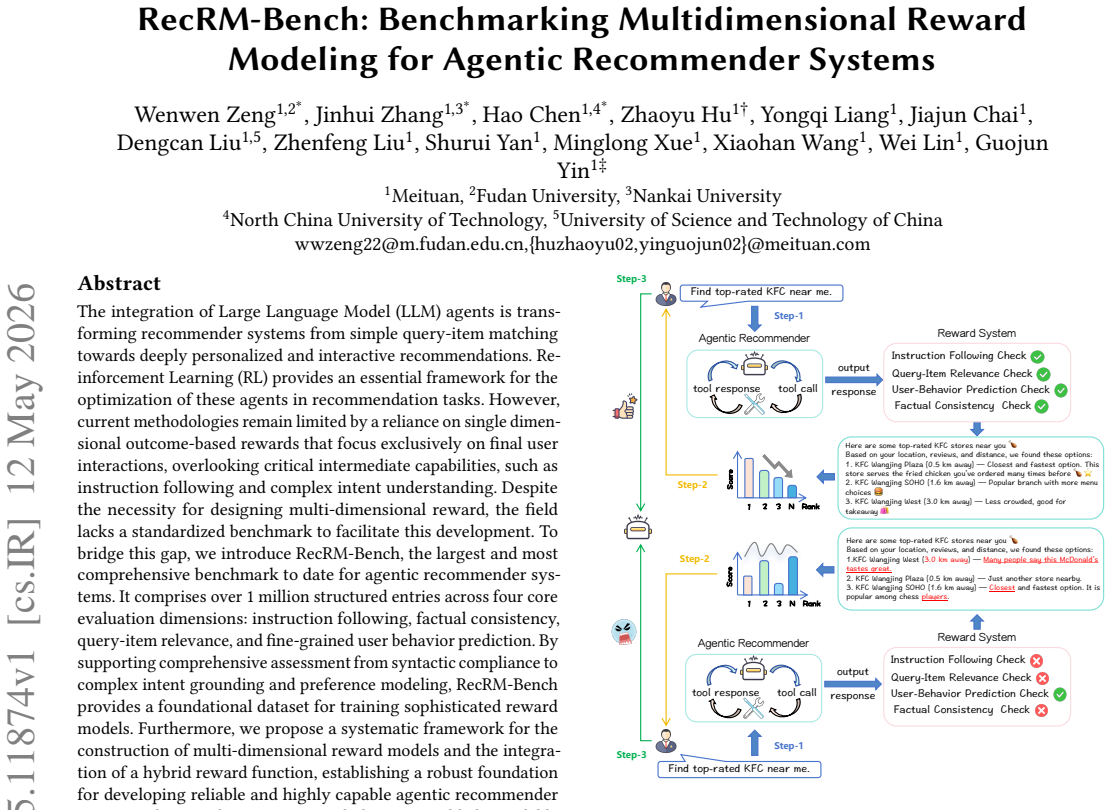
Benchmark with 1M entries tests multi-dimensional rewards for recommender agents

RecRM-Bench: Benchmarking Multidimensional Reward Modeling for Agentic Recommender Systems

It evaluates instruction following, factual consistency, relevance and behavior prediction to guide hybrid reward design.

Figure from the paper full image
abstract click to expand
The integration of Large Language Model (LLM) agents is transforming recommender systems from simple query-item matching towards deeply personalized and interactive recommendations. Reinforcement Learning (RL) provides an essential framework for the optimization of these agents in recommendation tasks. However, current methodologies remain limited by a reliance on single dimensional outcome-based rewards that focus exclusively on final user interactions, overlooking critical intermediate capabilities, such as instruction following and complex intent understanding. Despite the necessity for designing multi-dimensional reward, the field lacks a standardized benchmark to facilitate this development. To bridge this gap, we introduce RecRM-Bench, the largest and most comprehensive benchmark to date for agentic recommender systems. It comprises over 1 million structured entries across four core evaluation dimensions: instruction following, factual consistency, query-item relevance, and fine-grained user behavior prediction. By supporting comprehensive assessment from syntactic compliance to complex intent grounding and preference modeling, RecRM-Bench provides a foundational dataset for training sophisticated reward models. Furthermore, we propose a systematic framework for the construction of multi-dimensional reward models and the integration of a hybrid reward function, establishing a robust foundation for developing reliable and highly capable agentic recommender systems. The complete RecRM-Bench dataset is publicly available at https://huggingface.co/datasets/wwzeng/RecRM-Bench.
0
0
cs.IR 2026-05-13 1 theorem

ZipRerank matches top multimodal rerankers at 10x lower latency

Very Efficient Listwise Multimodal Reranking for Long Documents

Early query-image interaction plus single-pass scoring lets listwise reranking run on long documents without autoregressive delays.

Figure from the paper full image
abstract click to expand
Listwise reranking is a key yet computationally expensive component in vision-centric retrieval and multimodal retrieval-augmented generation (M-RAG) over long documents. While recent VLM-based rerankers achieve strong accuracy, their practicality is often limited by long visual-token sequences and multi-step autoregressive decoding. We propose ZipRerank, a highly efficient listwise multimodal reranker that directly addresses both bottlenecks. It reduces input length via a lightweight query-image early interaction mechanism and eliminates autoregressive decoding by scoring all candidates in a single forward pass. To enable effective learning, ZipRerank adopts a two-stage training strategy: (i) listwise pretraining on large-scale text data rendered as images, and (ii) multimodal finetuning with VLM-teacher-distilled soft-ranking supervision. Extensive experiments on the MMDocIR benchmark show that ZipRerank matches or surpasses state-of-the-art multimodal rerankers while reducing LLM inference latency by up to an order of magnitude, making it well-suited for latency-sensitive real-world systems. The code is available at https://github.com/dukesun99/ZipRerank.
0
0
cs.IR 2026-05-13 2 theorems

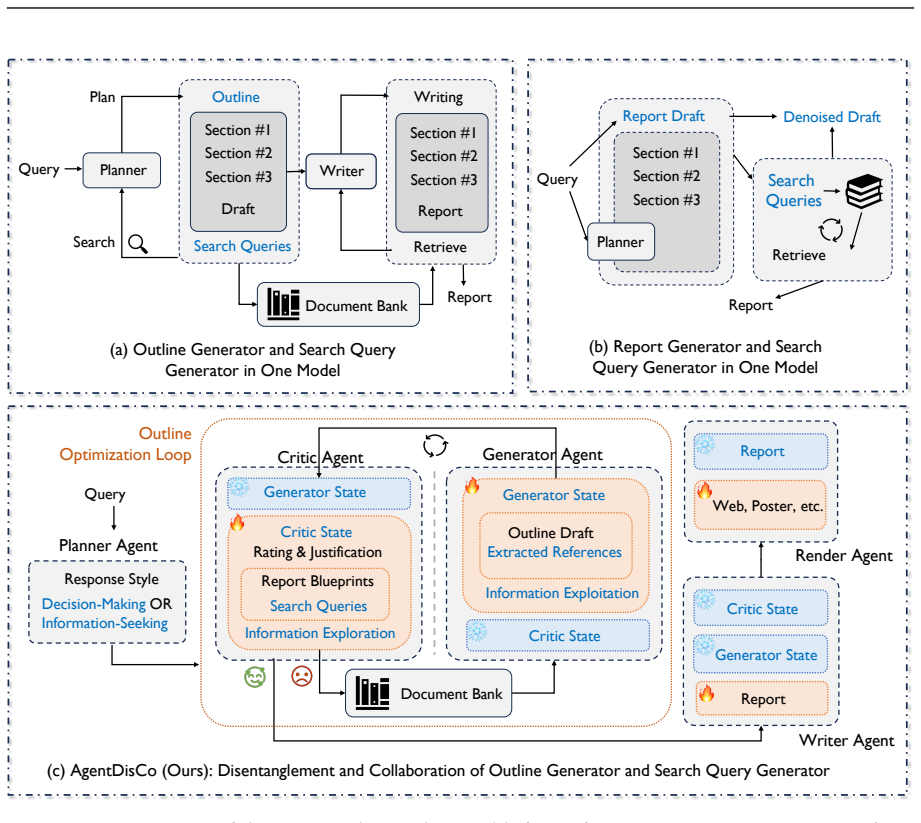
Critic and generator agents iteratively refine research outlines

AgentDisCo: Towards Disentanglement and Collaboration in Open-ended Deep Research Agents

An adversarial loop between evaluation and retrieval builds stronger outlines before report writing, with automatic strategy discovery.

Figure from the paper full image
abstract click to expand
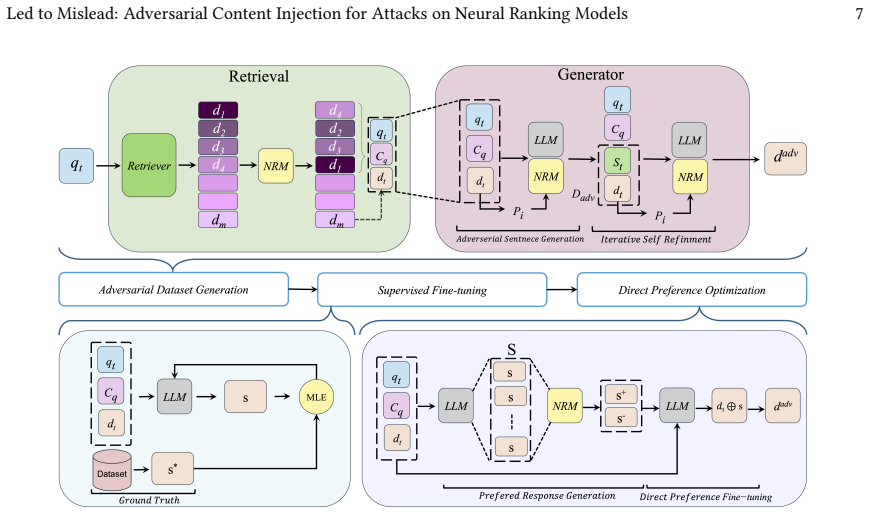
In this paper, we present AgentDisCo, a novel Disentangled and Collaborative agentic architecture that formulates deep research as an adversarial optimization problem between information exploration and exploitation. Unlike existing approaches that conflate these two processes into a single module, AgentDisCo employs a critic agent to evaluate generated outlines and refine search queries, and a generator agent to retrieve updated results and revise outlines accordingly. The iteratively refined outline is then passed to a downstream report writer that synthesizes a comprehensive research report. The overall workflow supports both handcrafted and automatically discovered design strategies via a meta-optimization harness, in which the generator agent is repurposed as a scoring agent to evaluate critic outputs and generate quality signals. Powerful code-generation agents (e.g., Claude-Code, Codex) systematically explore agent configurations and construct a policy bank, a structured repository of reusable design strategies, enabling the framework to self-refine without extensive human intervention. We evaluate AgentDisCo on three established deep research benchmarks (DeepResearchBench, DeepConsult, DeepResearchGym) using Gemini-2.5-Pro, achieving performance comparable to or surpassing leading closed-source systems. Observing that existing benchmarks inadequately reflect real-world user needs, we introduce GALA (General AI Life Assistants), a benchmark that mines latent research interests from users' historical browsing behavior. We further develop a rendering agent that converts research reports into visually rich poster presentations, and demonstrate an end-to-end product, AutoResearch Your Interest, which delivers personalized deep research recommendations derived from individual browsing histories.
0
0
cs.IR 2026-05-13 2 theorems

Dual-context views with quality weights boost sequential recs

Quality-Aware Collaborative Multi-Positive Contrastive Learning for Sequential Recommendation

Learnable augmentations from same-target and similar sequences receive adaptive weights from augmentation confidence to reduce semantic

Figure from the paper full image
abstract click to expand
The effectiveness of contrastive learning in sequential recommendation hinges on the construction of contrastive views, which ideally should be both semantically consistent and diverse. However, most existing CL-based methods rely on heuristic augmentations that are prone to removing crucial items or disrupting transition patterns, leading to semantic drift. While a few studies have explored learnable augmentations to improve view quality, they often suffer from limited diversity and still necessitate heuristic aids. Furthermore, the quality differences across views are rarely modeled explicitly and adaptively, aggravating the false-positive issue. To address these issues, we propose Quality-aware Collaborative Multi-Positive Contrastive Learning for sequential recommendation. First, we introduce a learnable collaborative sequence augmentation module that generates two augmented views under two complementary collaborative contexts, one based on same-target sequences and the other on similar sequences, thereby enhancing view diversity while preserving intent consistency.Second, we design a quality-aware mechanism, tightly integrated into the model representations, which estimates each view' s quality from the confidence of its augmentation operations and assigns adaptive weights to ensure that high-confidence views contribute more supervision while low-confidence ones contribute less.Extensive experiments on three real-world datasets demonstrate that QCMP-CL outperforms state-of-the-art CL-based sequential recommendation baselines.
0
0
cs.IR 2026-05-13 1 theorem

Staged mining and activity grouping boost LLM recommendations

HSUGA: LLM-Enhanced Recommendation with Hierarchical Semantic Understanding and Group-Aware Alignment

HSU splits long histories into constrained preference edits while GAA strengthens guidance for users with sparse data.

Figure from the paper full image
abstract click to expand
Large language model (LLM)-enhanced sequential recommendation typically aims to improve two core components: user semantic embedding extraction and utilization. Despite promising results, existing methods still have two limitations: 1) In the extraction stage, most methods directly input long interaction sequence fragments into LLM for preference summarization. However, excessively long sequences increase inference difficulty, making it challenging to reliably infer accurate user embeddings. 2) In the utilization stage, most methods employ the same semantic embedding utilization strategy for all users, neglecting the differences caused by user activity levels, leading to suboptimal performance. To address these issues, we propose HSUGA, which introduces a simple yet effective plugin for each of the two core components: Hierarchical Semantic Understanding (HSU) and Group-Aware Alignment (GAA). HSU performs a staged two-phase preference mining and models preference evolution through constrained editing operations, thereby improving the reliability of user semantic extraction. GAA adjusts the intensity of semantic utilization based on user activity levels, providing weaker alignment for active users and stronger guidance for users with sparse historical data. Finally, extensive experiments on three benchmark datasets demonstrate the effectiveness and compatibility of HSUGA.
0
0
cs.IR 2026-05-13 2 theorems

Planner picks slow reasoning only when it improves recommendations

TwiSTAR:Think Fast, Think Slow, Then Act,Generative Recommendation with Adaptive Reasoning

TwiSTAR trains a decision maker to invoke fast retrieval, ranking, or slow commonsense reasoning per user sequence, cutting latency while提高g

Figure from the paper full image
abstract click to expand
Generative recommendation with Semantic IDs (SIDs) has emerged as a promising paradigm, yet existing methods apply a fixed inference strategy, either fast direct generation or slow chain-of-thought reasoning, uniformly across all user histories. This approach creates a trade-off: fast recommendation model produces suboptimal accuracy on hard samples, while always invoking slow reasoning incurs prohibitive latency and wastes computation on easy cases. To address this, we propose Think Fast, Think Slow, Then Act, a framework that learns to adaptively allocate reasoning effort per user sequence. Our system equips an LLM with three complementary tools: a fast SID-based retriever, a lightweight candidate ranker, and a slow reasoning model that generates explicit rationales before recommending. Crucially, we inject collaborative commonsense into the slow model by transforming item-to-item knowledge into natural language explanations. A planner, trained through supervised warm-up followed by agentic reinforcement learning, dynamically decides which tool to invoke. Experiments on three datasets demonstrate that our method outperforms strong baselines, achieving consistent accuracy gains while reducing inference latency compared to uniform slow reasoning.
0
0
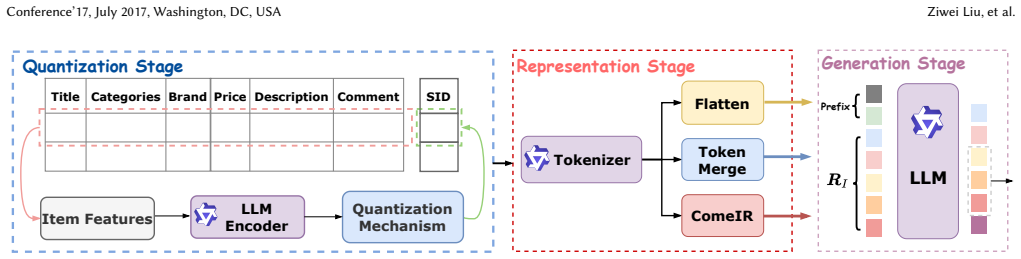
cs.IR 2026-05-13 1 theorem

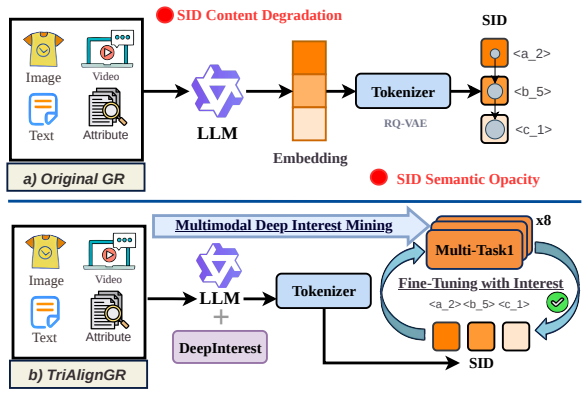
Conditional memory fixes SID representation conflicts in generative recommendation

Conditional Memory Enhanced Item Representation for Generative Recommendation

ComeIR rebuilds item inputs from token embeddings while restoring token-level detail for accurate autoregressive decoding.

Figure from the paper full image
abstract click to expand
Generative recommendation (GR) has emerged as a promising paradigm that predicts target items by autoregressively generating their semantic identifiers (SID). Most GR methods follow a quantization-representation-generation pipeline, first assigning each item a SID, then constructing input representations from SID-token embeddings, and finally predicting the target SID through autoregressive generation. Existing item-level representation constructions mainly take two forms: directly merging SID-token embeddings into a compact vector, or enriching item-level representations with external inputs through additional networks. However, these item-level constructors still expose two practical challenges: direct merging may amplify the information loss caused by quantization and ID collision while obscuring SID code relations, whereas external-input-based methods can strengthen item semantics but cannot reliably preserve the SID-structured evidence required for token-level generation. These limitations make representation construction an underexplored bottleneck, leading to two severe problems, \ie{} the Identity-Structure Preservation Conflict and Input-Output Granularity Mismatch. To this end, we propose ComeIR, a Conditional Memory enhanced Item Representation framework that reconstructs SID-token embeddings into item-aware inputs and restores the token granularity during SID decoding. Specifically, MM-guided token scoring adaptively estimates the contribution of each code within the SID, dual-level Engram memory captures intra-item code composition and inter-item transition patterns, and a memory-restoring prediction head reuses the memories during SID decoding. Extensive experiments demonstrate the effectiveness and flexibility of ComeIR, and further reveal scalable gains from enlarging conditional memory.
0
0
cs.IR 2026-05-13 Recognition

Codebooks quantize signals to boost multi-market CTR privately

FedMM: Federated Collaborative Signal Quantization for Multi-Market CTR Prediction

Global and local layers capture shared and specific patterns for better predictions without sharing raw data.

Figure from the paper full image
abstract click to expand
Online platforms such as Amazon and Netflix serve users across multiple countries and regions, underscoring the importance of multi-market recommendation (MMR). Most MMR methods adopt a pre-training and fine-tuning paradigm, in which a unified model is first trained on centralized, global data and subsequently adapted to specific markets. However, this approach ignores the privacy of market data. While traditional federated learning preserves privacy, it typically aims to obtain a global model by aggregating model parameters and does not account for significant market heterogeneity. Additionally, because ID spaces are disjoint across markets, embedding-based aggregation strategies become ineffective. To overcome these challenges, we propose a federated collaborative signal quantization (FedMM) method for multi-market click-through rate (CTR) prediction. Our core idea leverages a discrete codebook mechanism to achieve privacy-preserving transmission and align disjoint ID spaces. We further employ a hierarchical codebook structure to capture cross-market shared patterns and market-specific characteristics. Specifically, we deploy a residual quantized variational autoencoder (RQ-VAE) with a dual-layer codebook mechanism for each market to quantize collaborative embeddings. The first layer utilizes a global federated codebook, updated via aggregation to capture universally shared collaborative patterns, while the second layer maintains a local codebook to learn market-specific semantics. Finally, the learned discrete codes, which integrate both general and specific collaborative signals, are incorporated into downstream CTR models to enhance prediction accuracy across all markets. Extensive experiments on benchmark datasets demonstrate that FedMM significantly improves recommendation performance with privacy guarantees.
0
0
cs.IR 2026-05-12 Recognition

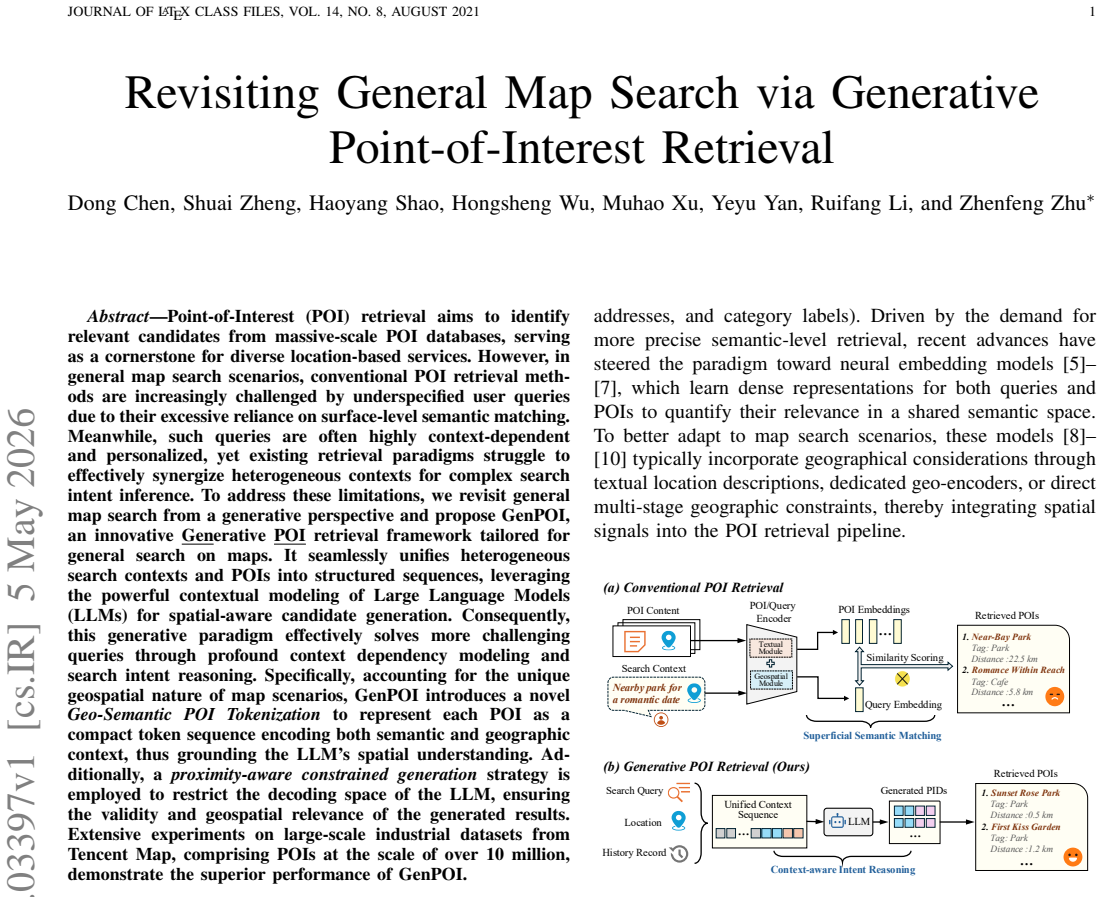
18% of web searches concern places

Much of Geospatial Web Search Is Beyond Traditional GIS

Costs and prices alone drive 15% of geospatial queries, showing most place questions exceed traditional map and GIS capabilities.

abstract click to expand
Web search queries concern place far more often than existing labelling schemes suggest, yet the landscape of geospatial web search queries - what people ask of place, and how often - remains poorly characterised at scale. We apply dense sentence embeddings, a lightweight SetFit classifier, and density-based clustering to the full MS MARCO corpus of 1.01 million real Bing queries without prior filtering for toponyms or spatial keywords, identifying 181,827 geospatial queries (18.0%), nearly threefold the 6.17% labelled as Location in the original annotations. The resulting taxonomy of 88 query categories reveals that geospatial web search is dominated by transactional and practical lookups: costs and prices alone account for 15.3% of geospatial queries, nearly twice the size of the entire physical geography theme. Much of this activity - costs, opening hours, contact details, weather, travel recommendations - falls outside the scope traditional GIS systems and knowledge graphs are built to serve. The categories vary substantially in the kind of answer they admit, from deterministic lookups answerable from spatial databases or knowledge graphs to evaluative or temporally volatile queries that require generative or real-time systems. We discuss implications for hybrid retrieval architectures and for benchmarks of geographic reasoning in large language models. We openly release the labelled dataset, classifier, and taxonomy.
0
0
cs.IR 2026-05-12 Recognition

Structured belief store beats vector search for LLM memory

Beyond Similarity Search: Tenure and the Case for Structured Belief State in LLM Memory

In one person's or team's technical context, alias-weighted exact matching delivers perfect precision while embeddings reach only 0.12.

Figure from the paper full image
abstract click to expand
Why do we need another AI to help the AI? We argue you don't. Stateless LLM sessions impose re-orientation costs on iterative, session-heavy workflows. Prior work addresses cross-session memory through retrieval-augmented approaches: store history, embed it, retrieve by semantic similarity. Cross-session memory is a state management problem, not a search problem. Similarity search fails for named entity resolution within bounded vocabulary contexts because beliefs about a shared technical domain are semantically proximate by construction. A single user is the simplest bounded vocabulary context; engineering teams converge on the same property through shared codebases and terminology. We present Tenure, a local-first proxy that maintains a typed belief store with epistemic status, versioned supersession, and scope isolation, injecting curated context into every LLM session through precision-first retrieval. Hard scope isolation provides a structural guarantee: the right beliefs surface, and only within the boundaries the user has authorized. Tenure's typed schema converts extracted facts into imperative instructions via a why it matters field, making injected beliefs directly actionable rather than raw material for the model to re-derive. A controlled evaluation on 72 retrieval cases demonstrates the gap. Cosine similarity over dense embeddings achieves mean precision of 0.12. Alias-weighted BM25 maintains mean precision of 1.0, passing 72/72 cases versus 8/72 for cosine similarity on the same corpus. Hybrid retrieval typically solves vocabulary mismatch between disparate authors; Tenure eliminates this structurally: query and belief authors are the same person, and an alias enrichment flywheel continuously indexes their specific vocabulary. Under multi-turn topic drift this worsens: the vector backend produces drift scores of 0.43--0.50 on noise-critical turns where BM25 maintains 0.
0
0
cs.IR 2026-05-12 Recognition

LLM-assisted benchmark tests retrieval across four scholarly categories

MIRA: An LLM-Assisted Benchmark for Multi-Category Integrated Retrieval

Real user queries from a social science platform receive automated labels for publications, data, variables and instruments in one framework

Figure from the paper full image
abstract click to expand
Users increasingly expect modern search systems to offer a unified interface that seamlessly retrieves information from diverse data sources and formats. However, current information retrieval (IR) evaluation benchmarks have not kept pace with this development, primarily due to the lack of test collections that represent the diversity of contemporary search domains. We address this critical gap with MIRA, a novel benchmark based on a large-scale social science search platform. MIRA is designed for category-aware ranking across heterogeneous categories - Publications, Research Data, Variables, and Instruments & Tools - within a single, unified evaluation framework. The proposed collection is distinctive in several ways: (1) it is built upon real user queries, providing a more realistic basis for evaluation; (2) it covers scholarly items from four distinct categories, enabling multi-faceted evaluation; and (3) it leverages a Large Language Model to generate topic descriptions and narratives, as well as for relevance assessment with respect to these topics, substantially reducing the labor and cost of test collection generation. We release this resource to benefit the community by providing a foundational testbed for the research on multi-faceted, category-aware, integrated, or cross-category information retrieval.
0
0
cs.IR 2026-05-12 2 theorems

Adaptive weights inside GNN message passing cut popularity bias

Debiasing Message Passing to Mitigate Popularity Bias in GNN-based Collaborative Filtering

Embedding-aware interaction scores and higher-order neighborhood scaling surface more diverse items in collaborative filtering.

Figure from the paper full image
abstract click to expand
Collaborative filtering (CF) models based on graph neural networks (GNNs) achieve strong performance in recommender systems by propagating user-item signals over interaction graphs. However, they are highly susceptible to popularity bias, since skewed interaction distributions and repeated message passing across high-order neighborhoods amplify the influence of popular items while suppressing long-tail ones. Existing debiasing approaches, including re-weighting objectives, regularization, causal methods, and post-processing, are less effective in GNN-based settings because they do not directly counteract bias propagated through the aggregation process, and recent in-aggregation weighting methods often rely on static heuristics or unstable embedding estimates. We propose Debiasing Popularity Amplification in Aggregation (DPAA), a popularity debiasing framework for GNN-based CF that integrates adaptive, embedding-aware interaction weighting and layer-wise weighting directly into message passing. DPAA assigns interaction-level weights from a representation-aware popularity signal, stabilized by a smooth transition from pre-trained to evolving model embeddings during training. It further introduces a layer-wise weighting that amplifies higher-order neighborhoods, surfacing long-range interactions with diverse and underexposed items. Experiments on real-world and semi-synthetic datasets show that DPAA outperforms state-of-the-art popularity-bias correction methods for GNN-based CF.
0
0
cs.IR 2026-05-12 1 theorem

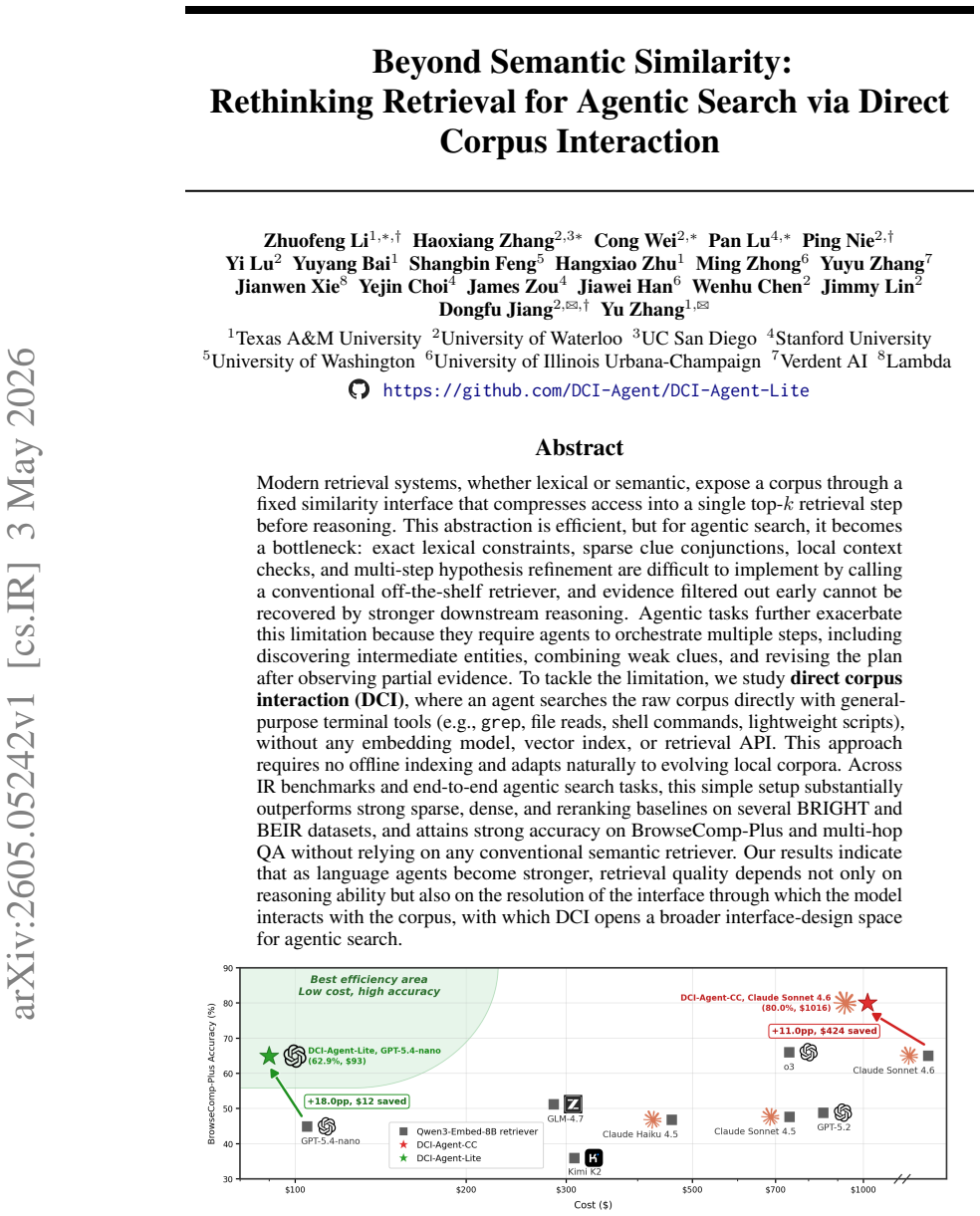
BM25 lexical search hits 83% accuracy in LLM research agents

Rethinking Agentic Search with Pi-Serini: Is Lexical Retrieval Sufficient?

Tuned BM25 with frontier LLMs beats released dense-retriever agents on BrowseComp-Plus.

Figure from the paper full image
abstract click to expand
Does a lexical retriever suffice as large language models (LLMs) become more capable in an agentic loop? This question naturally arises when building deep research systems. We revisit it by pairing BM25 with frontier LLMs that have better reasoning and tool-use abilities. To support researchers asking the same question, we introduce Pi-Serini, a search agent equipped with three tools for retrieving, browsing, and reading documents. Our results show that, on BrowseComp-Plus, a well-configured lexical retriever with sufficient retrieval depth can support effective deep research when paired with more capable LLMs. Specifically, Pi-Serini with gpt-5.5 achieves 83.1% answer accuracy and 94.7% surfaced evidence recall, outperforming released search agents that use dense retrievers. Controlled ablations further show that BM25 tuning improves answer accuracy by 18.0% and surfaced evidence recall by 11.1% over the default BM25 setting, while increasing retrieval depth further improves surfaced evidence recall by 25.3% over the shallow-retrieval setting. Source code is available at https://github.com/justram/pi-serini.
0
0
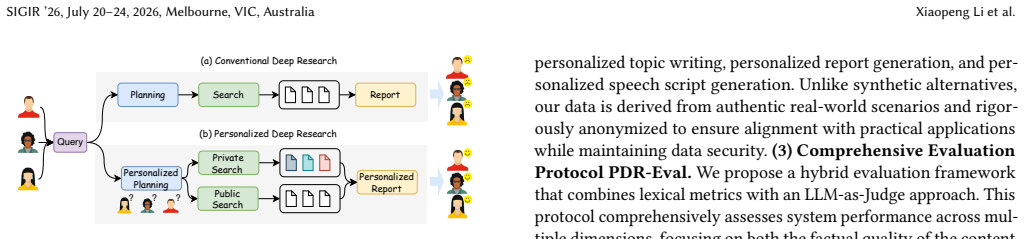
cs.IR 2026-05-12 Recognition

User context inside the loop lifts LLM research report relevance

Personalized Deep Research: A User-Centric Framework, Dataset, and Hybrid Evaluation for Knowledge Discovery

PDR adapts query depth, retrieval, and synthesis to individual expertise, beating generic baselines on a new task dataset.

Figure from the paper full image
abstract click to expand
Deep Research agents driven by LLMs have automated the scholarly discovery pipeline, from planning and query formulation to iterative web exploration. Yet they remain constrained by a static, ``one-size-fits-all'' retrieval paradigm. Current systems fail to adaptively adjust the depth and breadth of exploration based on the user's existing expertise or latent interests, frequently resulting in reports that are either redundant for experts or overly dense for novices. To address this, we introduce Personalized Deep Research (PDR), a framework that integrates dynamic user context into the core retrieval-reasoning loop. Rather than treating personalization as a post-hoc formatting step, PDR unifies user profile modeling with iterative query development, dual-stage (private/public) retrieval, and context-aware synthesis. This allows the system to autonomously align research sub-goals with user intent and optimize the stopping criteria for evidence collection. To facilitate benchmarking, we release the PDR Dataset, covering four realistic user tasks, and propose a hybrid evaluation framework combining lexical metrics with LLM-based judgments to assess factual accuracy and personalization alignment. Experimental results against commercial baselines demonstrate that PDR significantly improves retrieval utility and report relevance, effectively bridging the gap between generic information retrieval and personalized knowledge acquisition. The resource is available to the public at https://github.com/Applied-Machine-Learning-Lab/SIGIR2026_PDR.
0
0
cs.IR 2026-05-12 Recognition

Iterative denoising unifies list reranking

UniRank: Unified List-wise Reranking via Confidence-Ordered Denoising

UniRank fills the most confident slot each step to capture dependencies without error propagation or slot independence

Figure from the paper full image
abstract click to expand
List-wise reranking arranges a request-specific pool of candidate items into an ordered slate that maximizes user satisfaction. Existing generative rerankers fall into two paradigms: Autoregressive (AR) rerankers construct the slate left to right and capture inter-item dependencies in the exposure list, but they suffer from error propagation because early mistakes affect subsequent slots. Non-autoregressive (NAR) rerankers predict all slots in parallel and avoid error propagation, but they weaken inter-item interaction modeling under a slot independence assumption. This raises a central question: is there a unified architecture that combines the strengths of both paradigms and delivers stronger reranking performance? We answer this question with UniRank, a unified list-wise reranking framework whose inference time variants recover AR and NAR rerankers as special cases. UniRank integrates bidirectional slate modeling into an iterative denoising process and fills the most confident slot at each step. To instantiate this framework for reranking, we introduce the Task Grounded Diffusion Interface (TGD), which performs denoising at the item level and restricts prediction to the request-specific candidate pool. TGD aggregates each item's semantic tokens into a single item embedding and scores each slot directly against the candidate pool. Experiments on Amazon Books, MovieLens-1M, and an industrial short video dataset show that UniRank consistently outperforms state-of-the-art baselines. Online A/B tests on a real-world industrial platform further validate its effectiveness, yielding significant improvements of +0.159% in user average app-time and +1.016% in share-rate.
0
0
cs.IR 2026-05-12 3 theorems

LLM agents model group leadership to lift recommendation accuracy

AgentGR: Semantic-aware Agentic Group Decision-Making Simulator for Group Recommendation

By simulating topic recognition, influence, and dialogue instead of averaging preferences, the simulator beats baselines on real datasets.

Figure from the paper full image
abstract click to expand
Group Recommendation (GR) aims to suggest items to a group of users, which has become a critical component of modern social platforms. Existing GR methods focus on aggregating individual user preferences with advanced neural networks to infer group preferences. Despite effectiveness, they essentially treat group preference learning as a simple preference aggregation process, failing to capture the complex dynamics of real-world group decision-making. To address these limitations, we propose AgentGR, a novel Semantic-aware Agentic Group Decision-Making Simulator for Group Recommendations, inspired by the semantic reasoning and human behavior simulation capabilities of LLM-driven agents. It aims to jointly capture collaborative-semantic user preferences for member-role-playing and simulate dynamic group interactions to reflect real-world group decision-making processes, thereby boosting recommendation performance. Specifically, to capture collaborative-semantic user preferences, we introduce a semantic meta-path guided chain-of-preference reasoning mechanism that integrates high-order collaborative filtering signals and textual semantics to improve user preference profiles. To model the complex dynamics of group decision-making, we first recognize group topic and leadership to explicitly model the influencing factors within the group decision processes. Building on these, we simulate group-level decision dynamics via two multi-agent simulation strategies for recommendations: a static workflow-based strategy for efficiency and a dynamic dialogue-based strategy for precision. Extensive experiments on two real-world datasets show that AgentGR significantly outperforms state-of-the-art baselines in both recommendation accuracy and group decision simulation, highlighting its potential for real-world GR applications.
0
0
cs.IR 2026-05-12 Recognition

LLM recommenders gain from anchoring ratings as numeric tokens

Every Preference Has Its Strength: Injecting Ordinal Semantics into LLM-Based Recommenders

Treating each preference level as a distinct token preserves strength information that binary approaches discard.

Figure from the paper full image
abstract click to expand
Recent work has shown that large language models (LLMs) can enhance recommender systems by integrating collaborative filtering (CF) signals through hybrid prompting. However, most existing CF-LLM frameworks collapse explicit ratings into implicit or positive-only feedback, discarding the ordinal structure that conveys fine-grained preference strength. As a result, these models struggle to exploit graded semantics and nuanced preference distinctions. We propose Ordinal Semantic Anchoring (OSA), a hybrid CF-LLM framework that explicitly incorporates preference strength by modeling interaction-level user feedback. OSA represents ordinal preference levels as numeric textual tokens and uses their token embeddings as semantic anchors to align user-item interaction representations in the LLM latent space. Through strength-aware alignment across ordinal levels, OSA preserves preference semantics when integrating collaborative signals with LLMs. Experiments on multiple real-world datasets demonstrate that OSA consistently outperforms existing baselines, particularly in pairwise preference evaluation, highlighting its effectiveness in modeling fine-grained user preferences over prior CF-LLM methods.
0
0
cs.IR 2026-05-12 2 theorems

Latent reasoning halves steps while lifting generative recommendation accuracy

LASAR: Latent Adaptive Semantic Aligned Reasoning for Generative Recommendation

Aligning hidden states to CoT anchors and learning per-sample depth cuts computation by about 20x with only marginal added latency.

Figure from the paper full image
abstract click to expand
Large Language Models (LLMs) have demonstrated powerful reasoning capabilities through Chain-of-Thought (CoT) in various tasks, yet the inefficiency of token-by-token generation hinders real-world deployment in latency-sensitive recommender systems. Latent reasoning has emerged as an effective paradigm in LLMs, performing multi-step inference in a continuous hidden-state space to achieve stronger reasoning at lower cost. However, this paradigm remains underexplored in mainstream generative recommendation. Adapting it reveals three unique challenges: (1) the gap between prior-less Semantic ID (SID) symbols and continuous latent reasoning - SIDs lack pre-trained semantics, hindering joint optimization; (2) representation drift due to a lack of reasoning chain supervision; and (3) the suboptimality of applying a globally fixed reasoning depth. To address these, we propose LASAR (Latent Adaptive Semantic Aligned Reasoning), an SFT-then-RL framework. First, we bridge this gap via two-stage training: Stage 1 grounds SID semantics before Stage 2 introduces latent reasoning, ensuring efficient convergence. Second, we mitigate representation drift through explicit CoT semantic alignment. Step-wise bidirectional KL divergence constrains the latent reasoning trajectory using hidden-state anchors extracted from CoT text, while a Policy Head predicts per-sample reasoning depth. Third, during the GRPO-based RL phase, terminal-only KL alignment accommodates variable-length reasoning, and REINFORCE optimizes the Policy Head to dynamically allocate steps. This nearly halves the average latent step count while simultaneously improving recommendation quality. Experiments on three real-world datasets demonstrate that LASAR outperforms all baselines. It adds marginal inference latency and is roughly 20 times faster than generating explicit CoT text.
0
0
cs.IR 2026-05-12 2 theorems

NumColBERT injects numeracy into ColBERT without pipeline overhaul

NumColBERT: Non-Intrusive Numeracy Injection for Late-Interaction Retrieval Models

Gating mechanism and contrastive objective let numerical conditions integrate into standard MaxSim scoring for simpler deployment.

Figure from the paper full image
abstract click to expand
This study addresses the challenge of improving dense retrieval performance for queries containing numerical conditions, such as ``companies with more than one billion dollars in R&D expenditure.'' Although recent research has shown that standard models struggle with numeric information in domains such as finance, e-commerce, and medicine, existing solutions typically decompose queries into textual and numerical components and score them separately. These approaches modify late-interaction retrieval models such as ColBERT and introduce challenges in deployment, latency, and maintainability. To overcome these limitations, we propose NumColBERT, an inference-time non-intrusive method that enhances numerically conditioned retrieval while preserving the original late-interaction mechanism. Because NumColBERT retains the standard ColBERT indexing and MaxSim scoring pipeline, existing optimizations and ecosystem components can be reused directly, facilitating practical deployment. NumColBERT introduces a Numerical Gating Mechanism and a Numerical Contrastive Learning objective to enable numerical conditions to contribute more effectively within standard ColBERT scoring. The gating mechanism amplifies tokens carrying critical numerical constraints while suppressing context-neutral numerical mentions, and the contrastive objective shapes the embedding space to reflect numerical magnitudes, units, and conditions. Experimental results show that NumColBERT substantially outperforms standard fine-tuning baselines and achieves accuracy comparable to or better than prior approaches relying on separate textual and numerical scoring. These findings demonstrate the feasibility of numerically conditioned retrieval with a non-intrusive inference pipeline and present a maintainable solution for real-world deployment.
0
0
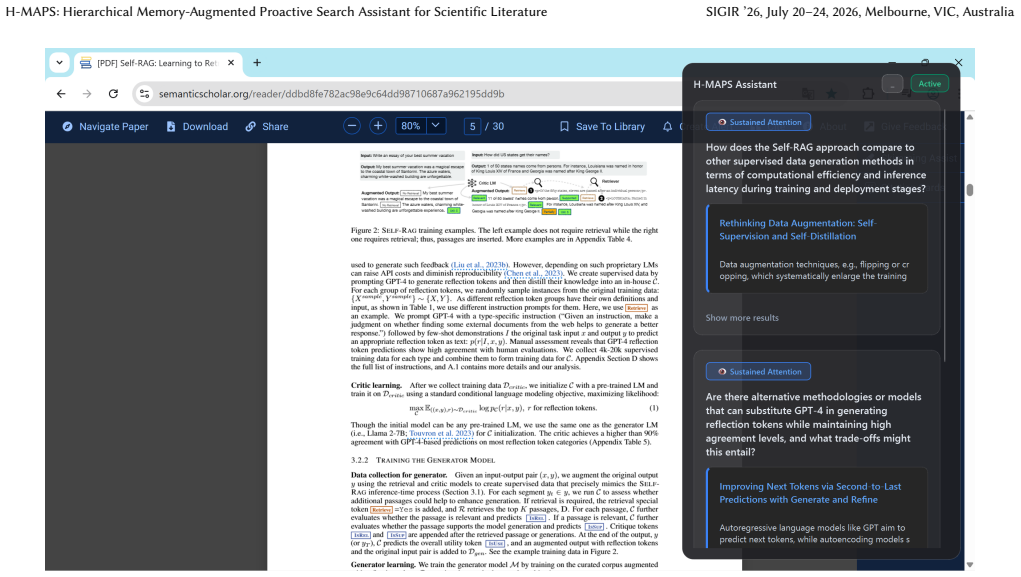
cs.IR 2026-05-12 2 theorems

Three-layer memory turns reading scrolls into tailored paper questions

H-MAPS: Hierarchical Memory-Augmented Proactive Search Assistant for Scientific Literature

H-MAPS infers expertise from dwell time and scrolling then retrieves relevant papers locally without sending data elsewhere.

Figure from the paper full image
abstract click to expand
Scientific reading is an active process that frequently requires consulting external resources, but manual keyword searching interrupts the reading flow and imposes a high cognitive load. Existing proactive information retrieval systems often suffer from context ambiguity, as they rely solely on on-screen text and ignore the reader's specific background and intent. In this demonstration, we present H-MAPS (Hierarchical Memory-Augmented Proactive Search Assistant), a proactive literature exploration assistant that resolves this ambiguity by leveraging a three-layered hierarchical memory. Triggered by implicit reading behaviors, H-MAPS articulates the user's latent information needs into explicit natural language questions and performs neural retrieval entirely on the local device to ensure privacy. We demonstrate H-MAPS using a scenario where two researchers, specializing in NLP and HCI, read the same paper. In response, the system generates profile-specific questions and retrieves distinct literature tailored to each user.
0
0
cs.IR 2026-05-12 2 theorems

CCD-aware scheduling lifts vector search throughput 3.7x

CCD-Level and Load-Aware Thread Orchestration for In-Memory Vector ANNS on Multi-Core CPUs

By aligning tasks with chiplet caches and request locality, it reduces misses and stalls on live production workloads.

Figure from the paper full image
abstract click to expand
Vector approximate nearest neighbor search (ANNS) underpins search engines, recommendation systems, and advertising services. Recent advances in ANNS indexes make CPU a cost-effective choice for serving million-scale, in-memory vector search, yet per-core throughput remains constrained by memory access latency of vector reading and the compute intensity of distance evaluations in production deployments. With the growing scale of the business and advances in hardware, modern CCD-based multi-core CPUs have been widely deployed for high throughput in our services. However, we find that simply increasing core counts does not yield optimal performance scaling. To improve the efficiency of more cores from the CCD-based architecture, we analyze the distributions of real-world requests in our production environments. We observe high access locality in vector search in our online services and low cache utilization, resulting from overlooking the multi-chiplet nature of CCD based CPUs. Hence, we propose a workload- and hardware-aware thread orchestration framework at CCD-level that (i) provides a uniform interface for both inter-query parallel HNSW search and intra-query parallel IVF search, (ii) achieves cache-friendly and workload-adaptive mapping of task dispatching, and (iii) employs CCD-aware task stealing to address load imbalance. Applied to real production workloads from search, recommendation, and advertising services of Xiaohongshu (RedNote), our approach delivers up to 3.7x higher throughput and 30-90% reductions in P50 and P999 latency. In detail, compared with the original framework, the cache-miss ratio decreases by 6-30%, and the total CPU stall is reduced by 20-80%.
0
0
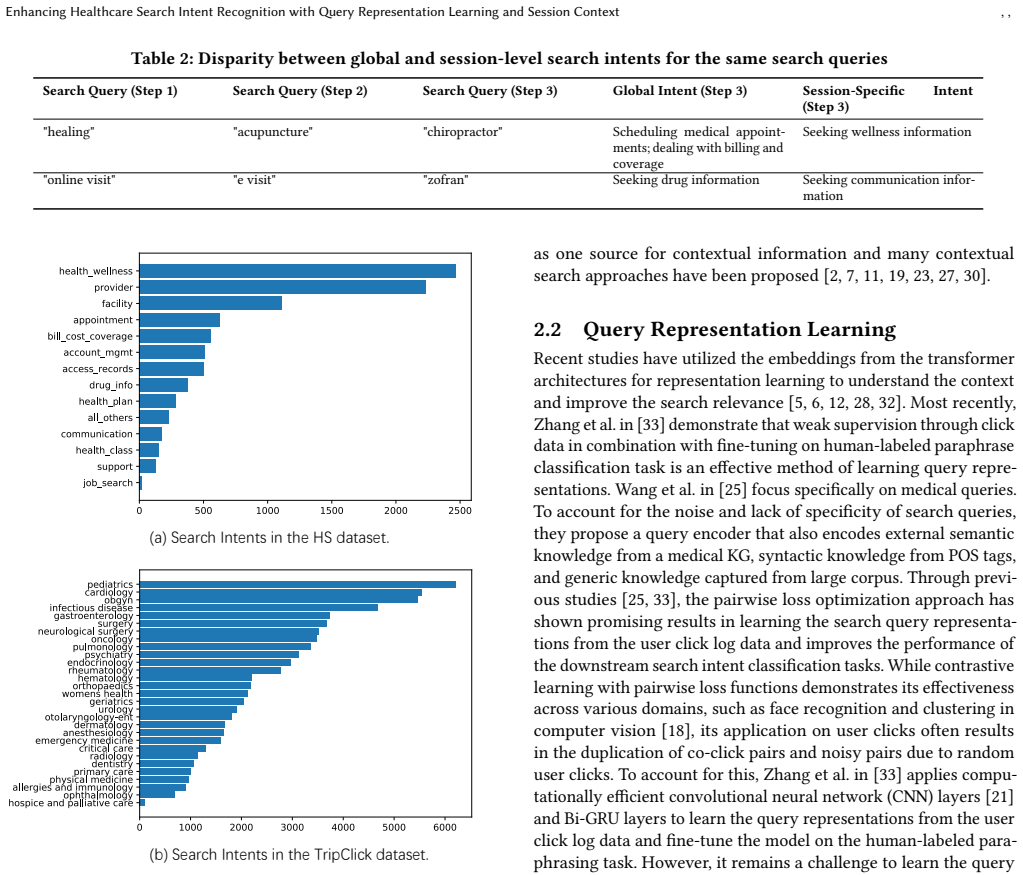
cs.IR 2026-05-12 2 theorems

Query clustering and novel loss improve health intent accuracy

Enhancing Healthcare Search Intent Recognition with Query Representation Learning and Session Context

Aggregating similar queries and handling multiple intents with session context raises classification performance on real search datasets.

Figure from the paper full image
abstract click to expand
Classifying the intent behind healthcare search queries is crucial for improving the delivery of online healthcare information. The intricate nature of medical search queries, coupled with the limited availability of high-quality labeled data, presents substantial challenges for developing efficient classification models. Previous studies have exploited user interaction data, such as user clicks from search logs and employed pairwise loss functions to model co-click behavior for query representation learning. However, many health queries could have multiple intents, resulting in ambiguous or divergent click behavior. Furthermore, learning the single most popular intent of queries as inferred from global statistics based on the aggregate behavior of different users could potentially lead to disparity and performance drop when classifying the query intent within specific search sessions. To address these limitations, our work improves the query representation learning by aggregating similar queries via clustering, and introducing a novel loss function designed to capture the multifaceted nature of health search queries, resulting in a more scalable and accurate learning procedure. Furthermore, we quantify the ambiguity of health queries and the misalignment between global search intents and those discerned from individual sessions, by introducing the concordance rate (CR) score, and demonstrate a simple and effective method for incorporating our learned query representation into contextual, session-based search intent classification. Our extensive experimental results and analysis on two real-world search log datasets, i.e., a Health Search (HS) dataset and the publicly available TripClick dataset, demonstrate that our approach not only improves the intrinsic clustering metrics for query representation learning but also enhances accuracy for subsequent search intent classification tasks.
0
0
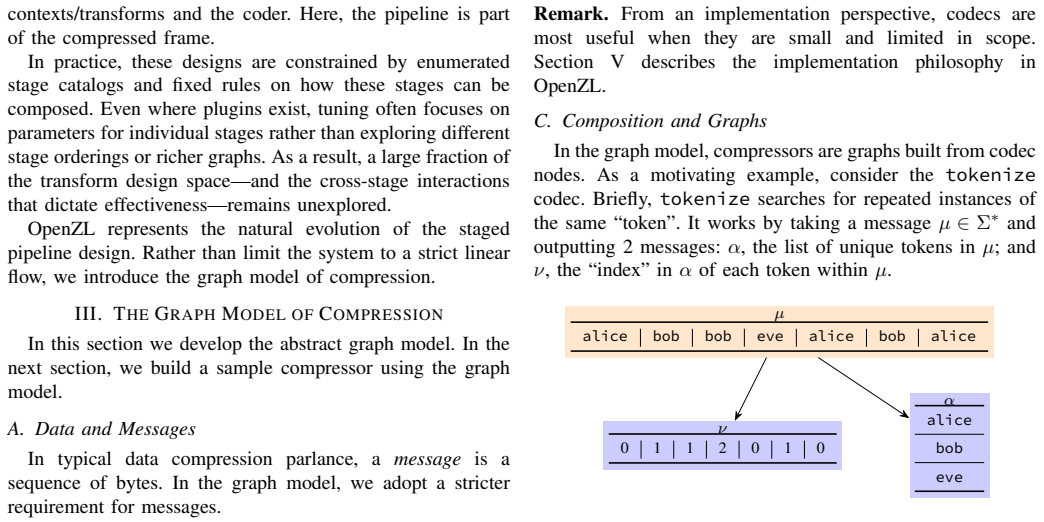
cs.IR 2026-05-12 2 theorems

Graph of codecs compresses data smaller and faster

OpenZL: Using Graphs to Compress Smaller and Faster

Modular DAGs let developers build domain-specific compressors in days that beat generic tools and rival slow machine-learning methods.

Figure from the paper full image
abstract click to expand
In the last few decades, research techniques have improved lossless compression ratios by significantly increasing processing time. However, these techniques have not gained popularity in industry because production systems require high throughput and low resource utilization. Instead, real world improvements in compression are increasingly realized by building application-specific compressors which can exploit knowledge about the structure and semantics of the data being compressed. Application-specific compressor systems outperform even the best generic compressors, but these techniques have severe drawbacks -- they are inherently limited in applicability, are hard to develop, and are difficult to maintain and deploy. In this work, we show that these challenges can be overcome with a new compression strategy. We propose the "graph model" of compression, a new theoretical framework for representing compression as a directed acyclic graph of modular codecs. OpenZL implements this framework and compresses data into a self-describing wire format, any configuration of which can be decompressed by a universal decoder. OpenZL's design enables rapid development of application-specific compressors with minimal code. Experimental results demonstrate that OpenZL achieves superior compression ratios and speeds compared to state-of-the-art general-purpose compressors on a variety of real-world datasets. Compared to ratio-focused deep-learning compressors, OpenZL is competitive on ratio while being many orders of magnitude faster. Internal deployments at Meta have also shown consistent improvements in size and/or speed, with development timelines reduced from months to days. OpenZL thus represents a significant advance in practical, scalable, and maintainable data compression for modern data-intensive applications.
0
0
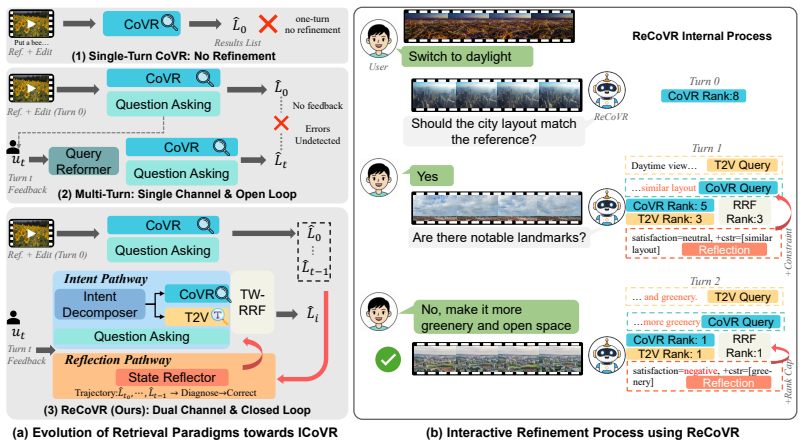
cs.IR 2026-05-12 2 theorems

ReCoVR reaches 74% recall after one interactive video round

ReCoVR: Closing the Loop in Interactive Composed Video Retrieval

A reflection pathway monitors retrieval history to detect drifts and correct errors, outperforming single-channel baselines across turns.

Figure from the paper full image
abstract click to expand
Composed video retrieval (CoVR) searches for target videos using a reference video and a modification text, but existing methods are restricted to a single interaction round and cannot support the progressive nature of real-world visual search. To bridge this gap, we first formalize interactive composed video retrieval, a multi-turn extension of CoVR, where users progressively refine their search intent through natural-language feedback across turns. Adapting existing interactive retrieval methods to this setting reveals two structural weaknesses: reliance on a single retrieval channel and an open-loop retrieval design that consumes user feedback but does not diagnose whether its own retrieval trajectory is drifting or stagnating. To address these limitations, we propose ReCoVR (Reflexive Composed Video Retrieval), a dual-pathway architecture built on reflexive perception, where the system treats its retrieval history as diagnostic evidence alongside user feedback. Specifically, an Intent Pathway routes heterogeneous feedback to complementary retrieval channels, while a Reflection Pathway performs trajectory-level reflection to monitor result evolution and correct retrieval errors across turns. Experiments on multiple benchmarks show that ReCoVR consistently outperforms interactive baselines, notably achieving 74.30% R@1 after just one interactive round on the WebVid-CoVR-Test dataset.
0
0
cs.IR 2026-05-12 Recognition

Hybrid system recommends coherent outfits from fashion catalogs

Loom: Hybrid Retrieval-Scoring Outfit Recommendation with Semantic Material Compatibility and Occasion-Aware Embedding Priors

Embedding retrieval finds candidates while scoring with material heaviness and occasion affinity improves coherence over random choices.

Figure from the paper full image
abstract click to expand
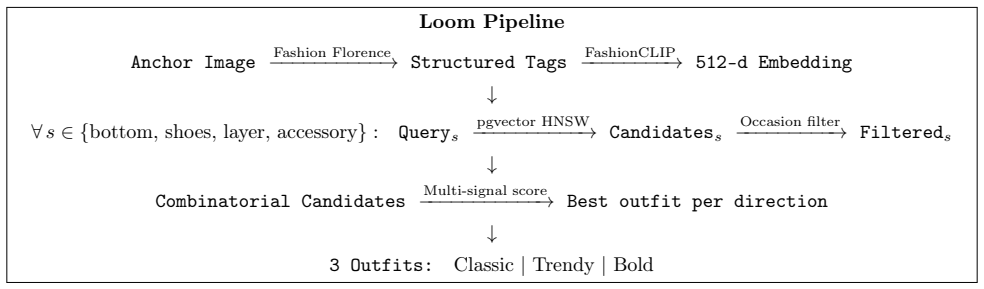
We present Loom, an outfit recommendation system that combines neural embedding retrieval with structured domain scoring to generate complete, coherent outfits from fashion catalogs. Given an anchor clothing item, Loom retrieves complementary pieces via slot-constrained approximate nearest neighbor search over FashionCLIP embeddings, then scores candidate outfits using a multi-objective function that integrates six signals: embedding similarity, color harmony, formality consistency, occasion coherence, style direction, and within-outfit diversity. We introduce two techniques that address limitations of purely learned or purely rule-based approaches: (1) semantic material weight, which uses CLIP embedding geometry to infer garment heaviness for layer compatibility without hand-coded material taxonomies; and (2) vibe/anti-vibe occasion priors, which embed prose descriptions of occasion contexts as anchor vectors in CLIP space and score items by differential affinity. Ablation experiments on a catalog of 620 items show that each component contributes measurably to outfit quality: the full system achieves a mean outfit score of 0.179 with a 9.3% hard violation rate, compared to 0.054 score and 16.0% violations for a category-constrained random baseline, a 3.3x improvement in score and 42% reduction in violations. Direction reranking is the single indispensable component: removing it drops score to 0.052, essentially equal to random. The system generates three stylistically distinct outfits in under 5 seconds on commodity hardware.
0
0
cs.IR 2026-05-11 Recognition

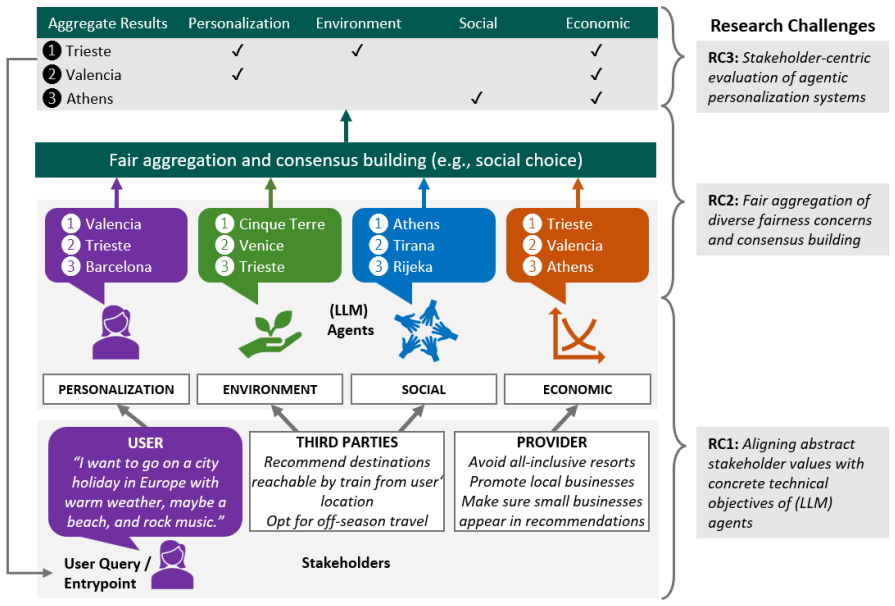
LLM agents let users beat platform personalization with their own data

LLM Agents Enable User-Governed Personalization Beyond Platform Boundaries

Users combine exports across services via off-the-shelf agents to exceed single-platform baselines in proof-of-concept tests.

Figure from the paper full image
abstract click to expand
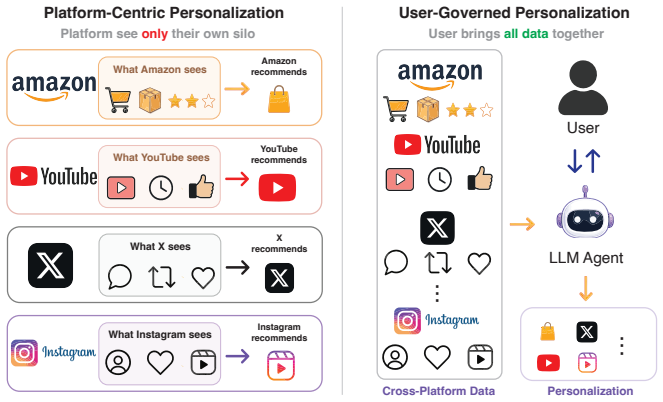
Personalization today is fundamentally platform-centric: services build user representations from the behavioral fragments they observe. Yet no platform can construct a complete picture of the user, as competitive incentives, legal constraints, user privacy concerns, and epistemic limits create persistent data barriers. This paper argues for a shift from platform-centric personalization to user-governed personalization, where only the user can integrate fragmented contexts across platforms and the offline world. The key asymmetry lies in data access: only users can aggregate their own cross-platform and offline information. Large language model (LLM) agents make such integration practically feasible for the first time by enabling reasoning over heterogeneous personal data and transforming users' cross-context information into actionable personalization capabilities. We provide proof-of-concept evidence that users equipped with cross-platform data exports and an off-the-shelf LLM agent can outperform single-platform personalization baselines. We conclude by outlining a research agenda for building scalable user-governed personalization systems.
0
0
cs.IR 2026-05-11 2 theorems

MM-LLM captions lift recsys AUC by 0.35% at industrial scale

A General Framework for Multimodal LLM-Based Multimedia Understanding in Large-Scale Recommendation Systems

Tripartite pipeline converts LLaMA2 descriptions into tokenized features that improve offline AUC and online metrics while respecting strict

Figure from the paper full image
abstract click to expand
Conventional recommendation systems frequently fail to fully exploit the high-dimensional semantic signals inherent in multimedia content, thereby limiting the fidelity of user preference modeling. While Multimodal Large Language Models (MM-LLMs) offer robust mechanisms for interpreting such complex data, their integration into latency-constrained, industrial-scale architectures remains a significant challenge. To address this, we propose a generalized framework for MM-LLM-driven multimedia understanding. Our methodology employs a tripartite architecture encompassing content interpretation, representation extraction, and systematic pipeline integration, instantiated via a LLaMA2-based model that generates descriptive captions subsequently ingested as tokenized categorical features. Empirical evaluation demonstrates the efficacy of this approach, yielding a $0.35\%$ increase in offline AUC and a $0.02\%$ improvement in online metrics at scale, substantiating the practical viability of leveraging MM-LLMs to enhance large-scale recommendation performance.
0
0
cs.IR 2026-05-11 Recognition

Open platform runs LLM personas in four IR scenario types

OpenIIR: An Open Simulation Platform for Information Retrieval Research

Researchers declare parameters once then re-execute panel, social-media, feed and evolutionary studies to compare structured outputs side by

Figure from the paper full image
abstract click to expand
OpenIIR runs hundreds of LLM-driven personas as parameterised, reproducible IR research experiments. Researchers configure agents across four kinds of multi-agent study (deliberative panels, social platforms, curated recommender feeds, and evolutionary co-evolution between content producers and credibility detectors) under many priors, rounds, and constraints. Persona budgets, retrieval policies, ranker choices, intervention timings, and mutation rates are declared up front, and the same study can be re-run under different settings to compare outcomes side by side. Every run produces structured outputs (argument graphs, exposure logs, fitness traces, transcripts) that a downstream evaluator can consume directly, and a new study is a 200--400 line plug-in over a shared core (agent runtime, world-model store, retrieval primitives, claim extractor, persona ontology). The contributions are: (i) the shared core; (ii) a type interface for pluggable scenarios; (iii) four released types with reference runs (Panel, Social-Media, Curated-Feed, Multi-Generational); and (iv) six modular extensions sketched against open IR research questions.
0
0
cs.IR 2026-05-11 1 theorem

Reddit music chats become 190k Deezer-grounded dialogues

Reddit2Deezer: A Scalable Dataset for Real-World Grounded Conversational Music Recommendation

Authentic conversations paired with audio and metadata access address the scale-versus-realism tradeoff in conversational music recs.

Figure from the paper full image
abstract click to expand
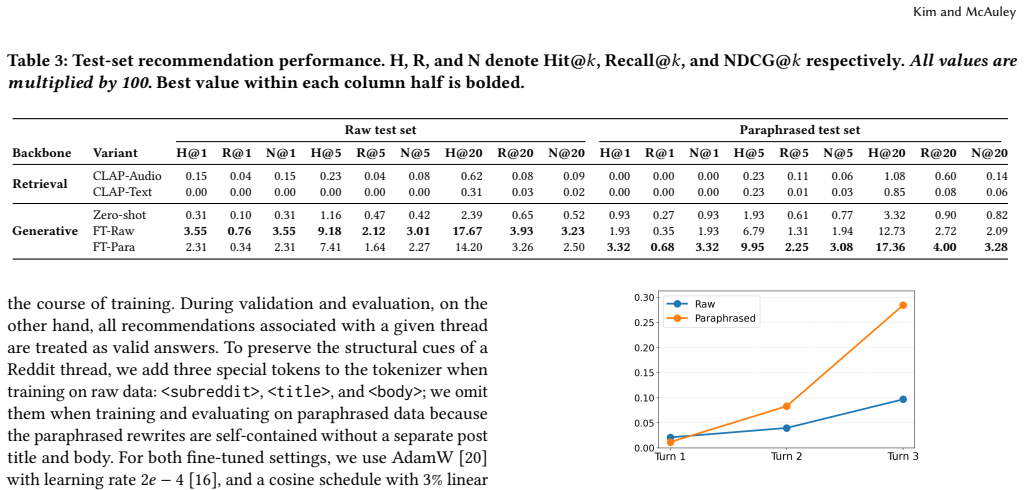
Conversational music recommendation (CMR) research currently faces a tradeoff between authentic dialogue corpora that are limited in scale and synthesized corpora that scale up but whose conversations are artificially constructed rather than naturally observed. In this paper, we introduce Reddit2Deezer, a reality-grounded CMR resource derived from 190k unique {thread, leaf-comment} pairs. We release the resource in two versions: a raw version that preserves authenticity, and a paraphrased version that maximizes long-term reproducibility. Each musical entity is linked to a Deezer identifier, which provides straightforward access to audio previews and rich metadata (e.g., genre tags, popularity, BPM), opening the door to future research on content-grounded conversational recommendation. A human validation confirms the quality of the dialogues, item grounding, and paraphrases. The dataset is available at https://huggingface.co/datasets/McAuley-Lab/Reddit2Deezer.
0
0
cs.IR 2026-05-11 Recognition

LLM framework summarizes user histories into personas

UserGPT Technical Report

Simulation engine and curriculum training let models predict tags and generate summaries while cutting record size by up to 98 percent.

abstract click to expand
Personalized user understanding from large-scale digital traces remains a fundamental challenge. Traditional user profiling methods rely on discriminative models and manual feature engineering to predict discrete attributes, often producing fragmented and logically inconsistent profiles that generalize poorly to long-tail behaviors. In this work, we study a generative paradigm in which large language models (LLMs) summarize long and noisy behavioral histories into coherent narratives that capture nuanced user evolution. Our experiments show that even strong LLMs remain limited in complex and implicit personalization reasoning. We propose UserGPT, a framework for improving LLM-based persona understanding through both attribute generation and summary generation. To address the scarcity of real-world behavioral data, we develop a User Behavior Simulation Engine that produces realistic and complex user trajectories. We further introduce a Data-Centric Semantization module that transforms heterogeneous behavioral logs into structured and semantically coherent inputs, reducing noise and sparsity. On top of this pipeline, we design a curriculum-driven post-training strategy that combines multi-stage Supervised Fine-Tuning (SFT) with Dual-Filter Group Relative Policy Optimization (DF-GRPO) to strengthen reasoning over long behavioral histories. We also construct HPR-Bench, a benchmark for holistic persona reasoning derived from simulated data. On HPR-Bench, UserGPT achieves an Avg@10 score of 0.7325 on tag prediction and an $Acc_{Ex}$ score of 0.7528 on summary generation, while compressing behavioral records by up to 97.9% with critical information preserved. These results demonstrate the effectiveness of UserGPT for holistic persona reasoning and personalized user-agent interaction.
0
0
cs.IR 2026-05-11 Recognition

Multi-level contrastive learning improves knowledge graph recommendations

Multi-Level Graph Attention Network Contrastive Learning for Knowledge-Aware Recommendation

Distilling multi-view graphs and comparing features at three levels yields better user and item models despite data sparsity.

abstract click to expand
In recent years, the use of edge information provided by knowledge graphs together with the advantages of higher-order connectivity in graph neural networks for recommendation systems has become an important research direction. However, existing approaches are often limited by sparse labels, insufficient graph structure learning, and noisy entities in the knowledge graph, which reduce recommendation accuracy. To address these limitations, we propose a multi-view graph contrastive learning framework. The proposed method enhances user representations through multi-view knowledge graph distillation, enabling more accurate modeling of user preferences over entities and relations. The network aggregates neighborhood entity information to construct informative item representations. Furthermore, we design a multi-level self-supervised contrastive learning module that performs comparisons across three perspectives: Inter-Level, Intra-Level, and Interaction-Level. This design improves the model's ability to generalize across intra-class samples while increasing discrimination between inter-class samples, thereby enabling more effective multi-dimensional feature modeling. We conduct extensive experiments on three public datasets using both baseline and ablation settings. Experimental results demonstrate that the proposed framework consistently outperforms existing state-of-the-art methods. Ablation studies further verify the effectiveness of each module in the proposed model.
0
0
cs.IR 2026-05-11 Recognition

Exclusion distances raise filtered ANNS speed 1.3-5x

FAVOR: Efficient Filter-Agnostic Vector ANNS Based on Selectivity-Aware Exclusion Distances

FAVOR reshapes distances inside HNSW graphs and routes by estimated selectivity to keep high recall for any filter condition.

Figure from the paper full image
abstract click to expand
Modern retrieval systems increasingly require integrating approximate nearest neighbor search (ANNS) with complex attribute filtering to handle hybrid queries in applications such as recommendation systems and retrieval-augmented generation (RAG). While HNSW-based inline-filtering methods show promise, existing approaches struggle to deliver high throughput under low-selectivity scenarios while balancing search efficiency, filtering generality, and index connectivity. To address these challenges, we propose FAVOR, an efficient filter-agnostic vector ANNS that supports arbitrary filtering conditions while maintaining stable performance across varying selectivity levels. FAVOR introduces three novel features: (1) an integrated architecture that unifies selectivity estimation and filtered ANNS execution, providing a cohesive solution for hybrid vector-attribute queries; (2) a HNSW-based inline-filtering algorithm that introduces an exclusion distance mechanism to dynamically reshape the vector distance distribution, pushing non-target vectors away from the query while promoting valid candidates toward the query, thus improving search efficiency without compromising generality or graph connectivity; and (3) a selectivity-driven search selector that estimates query selectivity and dynamically routes queries between a pre-filtering brute-force algorithm for low-selectivity cases and an optimized HNSW-based search algorithm for other scenarios, ensuring consistent performance. Extensive experiments on real-world datasets demonstrate that FAVOR achieves a 1.3-5$\times$ higher QPS at $Recall@10 = 95\%$ compared to state-of-the-art methods for arbitrary filtering conditions, while maintaining competitive performance even against tailored solutions in some filtering conditions.
0
0
cs.IR 2026-05-11 Recognition

Benchmark reveals three competency gaps in tourism recommenders

TRACE: Tourism Recommendation with Accountable Citation Evidence

LLM zero-shot leads recall and recovery but cites sparsely; retrievers ground well but score low on accuracy; synthesis fails to adapt.

Figure from the paper full image
abstract click to expand
Tourism is a high-stakes setting for conversational recommender systems (CRS): a plausible-sounding suggestion can waste real money and trip time once a traveler acts on it. Existing CRS benchmarks primarily evaluate systems with a single Recall@k score over entity mentions, and tourism-specific resources add spatial or knowledge-graph context, yet none of them couple multi-turn recommendation with verbatim review-span evidence and rejection recovery. This leaves an evaluation gap for tourism recommendation that is simultaneously trustworthy, verifiable, and adaptive: recommend the right point of interest (POI) for multi-aspect preferences (such as cuisine, price, atmosphere, walking distance), justify each suggestion with verifiable evidence from prior visitors so the traveler can act without trial and error, and recover when the first recommendation is rejected mid-dialogue. We introduce TRACE, where each item is a multi-turn tourism recommendation dialogue with review-span citations and explicit rejection turns: 10,000 dialogues over 2,400 Yelp POIs and 34,208 reviews across eight U.S. cities, paired with 14 retrieval, planning, and LLM baselines, along with 25 metrics organized under Accuracy, Grounding, and Recovery. Across these baselines, TRACE reveals the Three-Competency Gap: LLM Zero-Shot leads in closed-set Recall@1 and rejection recovery but cites less densely than retrievers; non-LLM retrievers achieve surface-verbatim grounding but with low accuracy; Multi-Review Synthesis fails at recovery. The Grounding Score agrees with human citation precision (Spearman rho=+0.80, p<10^-20), and paired t-tests reproduce the per-baseline ranking (p<0.01 on the dominant contrasts). TRACE reframes accountable tourism recommendation as a joint target (right POI, verifiable evidence, adaptive repair) rather than a single-axis leaderboard.
0
0
cs.IR 2026-05-11 2 theorems

Hyperlinks as metadata improve RAG quality and efficiency

LARAG: Link-Aware Retrieval Strategy for RAG Systems in Hyperlinked Technical Documentation

LARAG encodes existing links to retrieve relevant chunks implicitly, achieving top BERTScore with fewer tokens on technical docs.

Figure from the paper full image
abstract click to expand
Retrieval-Augmented Generation (RAG) enhances the factual grounding of Large Language Models by conditioning their outputs on external documents. However, standard embedding-based retrievers treat naturally structured corpora, such as technical manuals, as flat collections of passages, thereby overlooking the hyperlink topology that users rely on when navigating such content. We introduce LARAG (Link-Aware RAG): a lightweight, link-aware retrieval strategy that leverages the author-defined hyperlink structure already present in HTML documentation, encoding hyperlink relations as metadata in the chunk representations and exploiting them to perform a form of graph-like retrieval of locally relevant content. In a benchmark of twenty expert-designed queries over Rulex Platform technical documentation and four prompting strategies, LARAG consistently improves answer quality, achieving the highest BERTScore F1, while retrieving fewer chunks and generating fewer tokens than a baseline RAG architecture used for comparison. These results show that directly leveraging the existing hyperlink topology of technical documentation, even without explicit graph construction or inference, enables an implicit form of graph-like retrieval that yields a more faithful and efficient RAG pipeline, providing better grounding at lower cost.
0
0
cs.IR 2026-05-11 Recognition

Skills as reusable procedures scale LLM agents

A Comprehensive Survey on Agent Skills: Taxonomy, Techniques, and Applications

By treating skills as operational layers separate from reasoning, agents become more reliable and easier to maintain for complex tasks.

Figure from the paper full image
abstract click to expand
Large language model (LLM)-based agents that reason, plan, and act through tools, memory, and structured interaction are emerging as a promising paradigm for automating complex workflows. Recent systems such as OpenClaw and Claude Code exemplify a broader shift from passive response generation to action-oriented task execution. Yet as agents move toward open-ended, real-world deployment, relying on from-scratch reasoning and low-level tool calls for every task become increasingly inefficient, error-prone, and hard to maintain. This survey examines this challenge through the lens of \emph{agent skills}, which we define as reusable procedural artifacts that coordinate tools, memory, and runtime context under task-specific constraints. Under this view, agents and skills play complementary roles: agents handle high-level reasoning and planning, while skills form the operational layer that enables reliable, reusable, and composable execution. Skills are therefore central to the scalability, robustness, and maintainability of modern agent systems. We organize the literature around four stages of the agent skill lifecycle -- representation, acquisition, retrieval, and evolution -- and review representative methods, ecosystem resources, and application settings across each stage. We conclude by discussing open challenges in quality control, interoperability, safe updating, and long-term capability management. All related resources, including research papers, open-source data, and projects, are collected for the community in \textcolor{blue}{https://github.com/JayLZhou/Awesome-Agent-Skills}.
0
0
cs.IR 2026-05-11 2 theorems

Dual channels separate semantics from behavior to lift sparse recommendations

DCGL: Dual-Channel Graph Learning with Large Language Models for Knowledge-Aware Recommendation

DCGL decouples LLM knowledge from user IDs, adds contrastive alignment, and fuses by interaction frequency to beat prior methods on sparse,

Figure from the paper full image
abstract click to expand
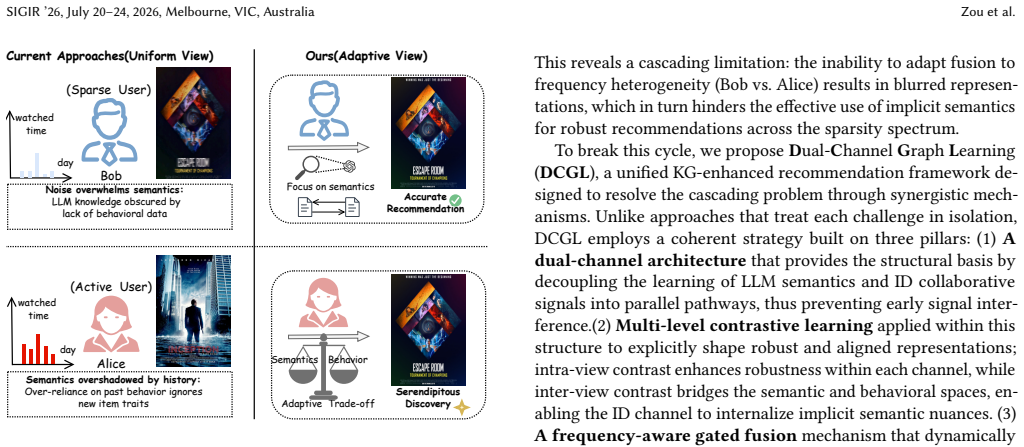
Knowledge Graphs (KGs) have proven highly effective for recommendation systems by capturing latent item relationships, while recent integration of Large Language Models (LLMs) has further enhanced semantic understanding and addressed knowledge sparsity issues. Nevertheless, current KG-and-LLM-based methods still face three main limitations: 1) inadequate modeling of implicit semantic relationships beyond explicit KG links; 2) suboptimal single-channel fusion of ID and LLM embeddings, which often leads to signal interference and blurred representations; and 3) insufficient consideration of user-item interaction frequency variations in recommendation strategies. To address these challenges, we propose the Dual-Channel Graph Learning (DCGL) framework, featuring three key innovations: 1) a dual-channel architecture that structurally decouples rich semantic information from user behavioral patterns, preventing early interference; 2) a multi-level contrastive learning mechanism that enhances robustness against KG noise through intra-view contrasts and bridges semantic gaps between channels via inter-view alignment; and 3) a dynamic fusion mechanism that adaptively balances semantic generalization and behavioral specificity based on interaction frequency, resolving the cascading limitation. Extensive experiments on four real-world datasets show that DCGL consistently outperforms state-of-the-art methods, yielding substantial improvements in sparse scenarios while maintaining precision for active users. Our code is available at https://github.com/XinchiZou/DCGL.
0
0
cs.IR 2026-05-11 2 theorems

PRISM models interacting preference and relevance in e-commerce search

PRISM: Refracting the Entangled User Behavior Space for E-Commerce Search

Treating the signals as linked cuts confounding and misalignment for better behavior prediction on benchmarks.

Figure from the paper full image
abstract click to expand
E-commerce search systems rely on modeling user behavior to estimate item relevance and user preference, which are typically assumed to be stable and independently learnable signals. However, in practice, user interactions are jointly shaped by exposure mechanisms, feedback loops, and semantic matching, leading to entangled and dynamically drifting behavioral signals. As a result, both preference estimation and relevance modeling suffer from confounding effects and semantic misalignment, which limits the robustness of downstream ranking models. To address this issue, we propose PRISM, a Preference-Relevance Interaction Semantic Modeling framework for e-commerce search behavior prediction. PRISM explicitly models the interaction between user preference and item relevance rather than treating them as independent components. Specifically, it introduces a preference rectification module to iteratively refine user preference under relevance-aware constraints, improving robustness against behavioral confounding. To ensure semantic consistency, we further incorporate a large language model (LLM)-driven semantic anchoring mechanism that leverages positive and negative prototypes to calibrate relevance representations. Finally, a preference-conditioned evidence routing module adaptively aggregates multi-source behavioral signals, enabling context-aware and preference-aligned relevance estimation. Extensive experiments on two public e-commerce benchmarks demonstrate that PRISM consistently outperforms strong baselines, validating the effectiveness of explicitly modeling preference-relevance interaction for robust and semantically grounded search behavior modeling.
0
0
cs.IR 2026-05-11 Recognition

Multilingual retrievers split between semantic strength and language match

MLAIRE: Multilingual Language-Aware Information Retrieval Evaluation Protocal

MLAIRE protocol uses parallel passages to measure how often models return correct content in the query language versus other languages.

Figure from the paper full image
abstract click to expand
Multilingual Information Retrieval is increasingly important in real-world search settings, where users issue queries over mixed-language corpora. Existing evaluations mainly reward language-agnostic semantic relevance, treating relevant passages equally regardless of language. Yet retrieval utility also depends on the language of the retrieved passages: users may prefer results they can read and verify in the query language, and query--passage language mismatch can complicate downstream grounding and answer verification in Retrieval-Augmented Generation systems. To evaluate this language-aware dimension, we introduce MLAIRE, a Multilingual Language-Aware Information Retrieval Evaluation protocol that disentangles cross-lingual semantic retrieval from query-language preference. MLAIRE constructs controlled pools with parallel passages across languages, enabling measurement of semantic retrieval accuracy and query-language preference when equivalent translations are available. We propose language-aware metrics, including Language Preference Rate (LPR) and Lang-nDCG, together with a 4-way decomposition separating semantic and query-language preference failures. Evaluating 31 dense, sparse, and late-interaction retrievers, we show that standard metrics obscure distinct behaviors: semantically strong retrievers may return correct content in a non-query language, while retrievers with stronger query-language preference may retrieve less semantically relevant passages.
0
0
cs.IR 2026-05-11 Recognition

Parallel tokens in diffusion LMs top BEIR-7 retrieval scores

DiffRetriever: Parallel Representative Tokens for Retrieval with Diffusion Language Models

Appending masked positions lets diffusion models decode multiple representatives in one pass, beating autoregressive multi-token and single-

Figure from the paper full image
abstract click to expand
PromptReps showed that an autoregressive language model can be used directly as a retriever by prompting it to generate dense and sparse representations of a query or passage. Extending this to multiple representatives is inefficient for autoregressive models, since tokens must be generated sequentially, and prior multi-token variants did not reliably improve over single-token decoding. We show that the bottleneck is sequential generation, not the multi-token idea itself. DiffRetriever is a representative-token retriever for diffusion language models: it appends K masked positions to the prompt and reads all K in a single bidirectional forward pass. Across in-domain and out-of-domain evaluation, multi-token DiffRetriever substantially improves over single-token on every diffusion backbone we test, while autoregressive multi-token is flat or negative and pays a latency cost that scales with K where diffusion does not. After supervised fine-tuning, DiffRetriever on Dream is the strongest BEIR-7 retriever in our comparison, ahead of PromptReps, the encoder-style DiffEmbed baseline on the same diffusion backbones, and the contrastively fine-tuned single-vector RepLLaMA. A per-query oracle on the frozen base model exceeds contrastive fine-tuning at the same fixed budget, pointing to adaptive budget selection as future work. Code is available at https://github.com/ielab/diffretriever.
0
0
cs.IR 2026-05-11 Recognition

Embeddings match sub-fields but miss agendas 80 percent of the time

Topic Is Not Agenda: A Citation-Community Audit of Text Embeddings

Citation-graph audit of 3.58M papers finds top-10 neighbors share the query agenda only 15-21 percent of the time, while simple citation rer

Figure from the paper full image
abstract click to expand
Vector search and retrieval-augmented generation (RAG) rest on the assumption that cosine similarity between text embeddings reflects conceptual relatedness. We measure where this assumption breaks. We build an augmented citation graph over 3.58M scientific papers and partition it via Leiden CPM at two granularities: sub-field (L1) and research-agenda (L2, hierarchical inside each L1). Four state-of-the-art embeddings (Gemini, Qwen3-8B, Qwen3-0.6B, SPECTER2) clear the L1 bar reasonably (45-52% top-10 same-rate) but stop working at L2: only 15-21% of top-10 neighbors share the query's research agenda. In absolute terms, 8 of every 10 retrieved papers are off-agenda. The failure is universal across eight scientific domains and all four models; SPECTER2, despite its citation-based contrastive training, is the weakest. As a diagnostic probe, we test whether the same augmented graph also functions as a retrieval signal: a deliberately simple citation-count rerank reaches 57.7% top-1 L2 on top of LLM-expanded Boolean retrieval and 59.6% on top of plain BM25, on 80 curated agenda queries -- about 9 points above the best cosine retriever (Gemini, 50.6%) and 20 points above BM25 alone (39.3%). The probe isolates a slice of the agenda-matching signal the graph carries but the embeddings miss, connecting recent theoretical limits on single-vector retrieval to a concrete failure mode of scientific RAG.
0
0
cs.IR 2026-05-11 Recognition

LLMs learn to fetch memories dynamically for better recommendations

RRCM: Ranking-Driven Retrieval over Collaborative and Meta Memories for LLM Recommendation

Ranking-driven optimization of retrieval over collaborative and meta memories improves top-k quality without fixed rules.

Figure from the paper full image
abstract click to expand
Large Language Models (LLMs) have emerged as a promising paradigm for next-generation recommender systems, offering strong semantic understanding and natural-language reasoning abilities. Despite recent progress, current LLM-based recommenders still face key challenges in constructing decision-relevant contexts from heterogeneous evidence. First, existing methods often rely on fixed context construction strategies: collaborative behavioral evidence and item-side metadata are typically incorporated through predefined prompts, static retrieval pipelines, or handcrafted injection mechanisms, making it difficult to determine what information is truly beneficial for each instance. Second, heterogeneous evidence introduces a severe context-efficiency bottleneck. Rich metadata and collaborative interaction records can quickly overwhelm the context window, while aggressive compression or heuristic filtering may discard fine-grained evidence critical for accurate recommendation. To address these challenges, we propose RRCM, a ranking-driven retrieval-and-reasoning framework over collaborative and metadata memories for LLM-based agentic recommendation. RRCM starts from a lightweight user-history context and learns whether to recommend directly, retrieve collaborative evidence, retrieve item metadata, or interleave both through reasoning. Both memories are represented in natural language and accessed through a unified retrieval interface, enabling flexible evidence acquisition without handcrafted CF injection or fixed retrieval rules. We optimize this memory-reading policy with an outcome-only ranking reward, instantiated using group relative policy optimization, so that retrieval decisions are directly driven by final top-k recommendation quality. Extensive experiments show that RRCM significantly outperforms traditional baselines and diverse LLM-based recommendation approaches.
0
0
cs.IR 2026-05-11 Recognition

Simple graph heuristic beats trained recommenders on benchmarks

An Embarrassingly Simple Graph Heuristic Reveals Shortcut-Solvable Benchmarks for Sequential Recommendation

Reveals shortcut structures in popular datasets that let local retrieval succeed without sequence modeling or training

Figure from the paper full image
abstract click to expand
Sequential recommendation has increasingly shifted toward generative recommenders that combine sequential patterns with semantic item information. Yet these methods are often evaluated on a small set of widely used benchmarks, raising a key question: do these benchmarks actually require the advanced modeling capabilities that modern generative recommenders claim to provide? We conduct a benchmark audit with an intentionally simple graph heuristic. Starting from only the last one or two interacted items, it retrieves candidates from a few-hop item-transition graph and ranks them by item-feature similarity. Despite using no sequence encoder, generative objective, or training, this heuristic matches or outperforms many modern baselines, with relative NDCG@10 improvements of 38.10% and 44.18% over the best competing baseline on Amazon Review Sports and CDs. We show that this behavior reflects shortcut solvability rather than an artifact of one heuristic. We identify three shortcut structures that can make next-item prediction easier than expected: low-branching local transitions, feature-smooth transitions, and limited dependence on long user histories. These shortcuts need not appear together; even one or two strong signals can make simple local retrieval highly competitive, while weakening them makes the benefits of more sophisticated models clearer. Across 14 datasets, model rankings vary substantially with dataset properties, yet the heuristic remains competitive on 10 of them. Our findings suggest that strong performance on standard benchmarks does not always demonstrate advanced sequential, semantic, or generative modeling ability. We call for more careful dataset selection and dataset-level diagnostic analysis when using benchmarks to support claims about new recommendation models.
0
0
cs.IR 2026-05-08 2 theorems

RL aligns LLM text profiles with embeddings for recommendations

Bridging Textual Profiles and Latent User Embeddings for Personalization

BLUE generates interpretable profiles that outperform baselines in zero-shot and cross-domain recommendation tasks on review datasets.

abstract click to expand
Personalized systems rely on user representations to connect behavioral history with downstream recommendation applications. Existing methods typically employ either supervised latent user embeddings, which are effective for retrieval but difficult to interpret, or textual user profiles, which are interpretable but challenging to optimize for downstream utility due to lack of direct supervision. To bridge this gap, we present BLUE, a reinforcement learning framework that unifies these two forms of user representation by aligning language-based user profiles with embedding-based recommendation objectives. Given a user interaction history, BLUE leverages a profiler Large Language Model (LLM) to generate textual profiles, while an embedding model provides reward signals. This encourages the resulting textual representations to move closer to positive items and farther from negative ones in the embedding space. We further introduce a text-space supervision signal based on next-item prediction, ensuring the learned profiles remain both semantically meaningful and highly effective for downstream retrieval. Experiments on Amazon Reviews 2023 and Google Local Reviews in zero-shot sequential recommendation settings demonstrate that BLUE consistently outperforms strong baselines under both frozen and trainable embedding conditions. Notably, BLUE achieves clear gains in cross-domain transfer, highlighting the strong generalization ability of the learned user profiles. Furthermore, these generated profiles provide superior personalized context for question answering compared to raw user histories or alternative profile optimization methods. Overall, these results show that BLUE provides an effective way to unify interpretable textual profiling with discriminative latent embeddings for personalization.
0
0
cs.IR 2026-05-08

Single lexical query outperforms multi-round retrieval agents

Superintelligent Retrieval Agent: The Next Frontier of Information Retrieval

LLM-guided predictions and document-frequency filters compress exploratory search into one efficient step that beats iterative baselines.

abstract click to expand
Retrieval-augmented agents are increasingly the interface to large organizational knowledge bases, yet most still treat retrieval as a black box: they issue exploratory queries, inspect returned snippets, and iteratively reformulate until useful evidence emerges. This approach resembles how a newcomer searches an unfamiliar database rather than how an expert navigates it with strong priors about terminology and likely evidence, and results in unnecessary retrieval rounds, increased latency, and poor recall. We introduce \textit{SuperIntelligent Retrieval Agent} (SIRA), which defines \emph{superintelligence} in retrieval as the ability to compress multi-round exploratory search into a single corpus-discriminative retrieval action. SIRA does not merely ask what terms are relevant to the query; it asks which terms are likely to separate the desired evidence from corpus-level confusers. On the corpus side, an LLM enriches each document offline with missing search vocabulary; on the query side, it predicts evidence vocabulary omitted by the query; and document-frequency statistics as a tool call to filter proposed terms that are absent, overly common, or unlikely to create retrieval margin. The final retrieval step is a single weighted BM25 call combining the original query with the validated expansion. Across ten BEIR benchmarks and downstream question-answering tasks, SIRA achieves the significantly superior performance outperforming dense retrievers and state-of-the-art multi-round agentic baselines, demonstrating that one well-formed lexical query, guided by LLM cognition and lightweight corpus statistics, can exceed substantially more expensive multi-round search while remaining interpretable, training-free, and efficient.
0
0
cs.IR 2026-05-08

Pruning trims deep recommenders while raising accuracy

Light-FMP: Lightweight Feature and Model Pruning for Enhanced Deep Recommender Systems

Light-FMP pretrains a mask on small data to drop features and weights, then retrains to beat prior methods on speed and quality.

Figure from the paper full image
abstract click to expand
Deep recommender systems (DRS) often face challenges in balancing computational efficiency and model accuracy, especially when handling high-dimensional input features. Existing methods either focus on improving accuracy while neglecting training efficiency or prioritize efficiency at the cost of suboptimal accuracy across tasks. We propose Light-FMP: Lightweight Feature and Model Pruning for Enhanced DRS, a lightweight framework that addresses the challenges through three key phases: \textit{pretraining}, \textit{pruning}, and \textit{continued training}. Using a hard concrete distribution, a masking layer is efficiently pretrained on a small data subset to identify important features. The model and features are then pruned, and training continues on the remaining dataset with domain-adapted parameters. Experiments on benchmark datasets from real-world recommender systems demonstrate that Light-FMP outperforms existing methods in both efficiency and accuracy while maintaining scalability and robustness.
0
0
cs.IR 2026-05-08

Semantic ID trees block simple preferences in generative recommenders

Expressiveness Limits of Autoregressive Semantic ID Generation in Generative Recommendation

Autoregressive token sequences force similar probabilities on nearby items, so GR models miss distinctions that ordinary collaborative Ρ„ΠΈΠ»ΡŒΡ‚

Figure from the paper full image
abstract click to expand
Generative recommendation (GR) models generate items by autoregressively producing a sequence of discrete tokens that jointly index the target item. However, this autoregressive generation process also induces a structured decoding space whose impact on model expressiveness remains underexplored. Specifically, token-by-token generation can be viewed as traversing a decoding tree induced by semantic ID tokens, where leaf nodes correspond to candidate items. We observe that the item probabilities produced by GR models are strongly correlated with this tree structure: items that are close in the tree tend to receive similar probabilities for any given user, making it difficult to distinguish among them based on user-specific preferences. We further show theoretically that such structural correlations prevent GR models from representing even simple patterns that can be well captured by conventional collaborative filtering models. To mitigate this issue, we propose Latte, a simple modification that injects a latent token before each semantic ID, reshaping the decoding space from a single tree into multiple latent-token-conditioned trees. This design creates multiple paths with varying tree distances between items, relaxing tree-induced probability coupling and yielding an average of 3.45% relative improvement on NDCG@10. Our code is available at https://github.com/hyp1231/Latte.
0
0
cs.IR 2026-05-08

Retrievers miss most documents that match latent patterns

OBLIQ-Bench: Exposing Overlooked Bottlenecks in Modern Retrievers with Latent and Implicit Queries

OBLIQ-Bench shows that even advanced pipelines fail to surface implicit-query matches while LLMs can verify them once found.

Figure from the paper full image
abstract click to expand
Retrieval benchmarks are increasingly saturating, but we argue that efficient search is far from a solved problem. We identify a class of queries we call oblique, which seek documents that instantiate a latent pattern, like finding all tweets that express an implicit stance, chat logs that demonstrate a particular failure mode, or transcripts that match an abstract scenario. We study three mechanisms through which obliqueness may arise and introduce OBLIQ-Bench, a suite of five oblique search problems over real long-tail corpora. OBLIQ-Bench exposes an overlooked asymmetry between retrieval and verification, where reasoning LLMs reliably recognize latent relevance whenever relevant documents are surfaced, but even sophisticated retrieval pipelines fail to surface most relevant documents in the first place. We hope that OBLIQ-Bench will drive research into retrieval architectures that efficiently capture latent patterns and implicit signals in large corpora.
0
0
cs.IR 2026-05-08

Agents automate e-commerce search relevance fixes

A Case-Driven Multi-Agent Framework for E-Commerce Search Relevance

A framework with Annotator, Optimizer, and User Agents handles bad-case identification to resolution, with human tests showing improved

Figure from the paper full image
abstract click to expand
Relevance is a foundation of user experience in e-commerce search. We view relevance optimization as a closed-loop ecosystem involving multiple human roles: users who provide feedback, product managers who define standards, annotators who label data, algorithm engineers who optimize models, and evaluators who assess performance. Because improving relevance in practice means systematically resolving user-perceived bad cases, we ask a system-level question: can this ecosystem be reimagined by replacing its human roles with autonomous agents? To answer this question, we propose a case-driven multi-agent framework that automates the pipeline from bad-case identification to resolution. The framework instantiates an Annotator Agent for multi-turn annotation, an Optimizer Agent for autonomous bad-case analysis and resolution, and a User Agent that identifies bad cases through conversational interaction, together forming an autonomous and continually evolving system. To make the framework practical in production, we further adopt a harness-engineering paradigm and build a unified retrieval-and-ranking relevance model for efficient training, an instruction-following relevance model for real-time case resolution, Global Memory to reduce information asymmetry across agents, a Deep Search Agent to target underestimation failures, and an agent-based chatbot for human--agent collaboration. Extensive human evaluation shows that the framework performs relevance-related tasks effectively, improves annotation accuracy, and enables more timely and generalizable bad-case resolution, indicating a practical paradigm for industrial search relevance optimization.
0
0
cs.IR 2026-05-08

Active queries lift conversation starter penetration by 0.54%

Bridging Passive and Active: Enhancing Conversation Starter Recommendation via Active Expression Modeling

Adversarial alignment and semantic discretization let free-form user inputs escape echo chambers in LLM-driven recommendations.

Figure from the paper full image
abstract click to expand
Large Language Model (LLM)-driven conversational search is shifting information retrieval from reactive keyword matching to proactive, open-ended dialogues. In this context, Conversation Starters are widely deployed to provide personalized query recommendations that help users initiate dialogues. Conventionally, recommending these starters relies on a closed "exposure-click" loop. Yet, this feedback loop mechanism traps the system in an echo chamber where, compounded by data sparsity, it fails to capture the dynamic nature of conversational search intents shaped by the open world. As a result, the system skews towards popular but generic suggestions.In this work, we uncover an untapped paradigm shift to shatter this harmful feedback loop: harnessing user "free will" through active user expressions. Unlike traditional recommendations, conversational search empowers users to bypass menus entirely through manually typed queries. The open-world intents in active queries hold the key to breaking this loop. However, incorporating them is non-trivial: (1) there exists an inherent distribution shift between active queries and formulated starters. (2) Furthermore, the "non-ID-able" nature of open text renders traditional item-based popularity statistics ineffective for large-scale industrial streaming training. To this end, we propose Passive-Active Bridge (PA-Bridge), a novel framework that employs an adversarial distribution aligner to bridge the distributional gap between passively recommended starters and active expressions. Moreover, we introduce a semantic discretizer to enable the deployment of popularity debiasing algorithms. Online A/B tests on our platform, demonstrate that PA-Bridge significantly boosts the Feature Penetration Rate by 0.54% and User Active Days
0
0
cs.IR 2026-05-08

Value signals folded into generative ad tokens raise hit rate 37%

Unified Value Alignment for Generative Recommendation in Industrial Advertising

A single decoder trained with eCPM-aware RL and value-guided beam search delivers 1.5% GMV lift in production A/B tests.

Figure from the paper full image
abstract click to expand
Generative Recommendation (GR) reformulates recommendation as a next-token generation problem and has shown promise in industrial applications. However, extending GR to industrial advertising is non-trivial because the system must optimize not only user interest but also commercial value. Existing GR pipelines remain largely semantics-centric, making it difficult to align value signals across tokenization, decoding, and online serving. To address this issue, we propose UniVA, a Unified Value Alignment framework for advertising recommendation. We first introduce a Commercial SID tokenizer that injects value-related attributes into SID construction, yielding value-discriminative item representations. We then develop a Generation-as-Ranking SID Decoder jointly optimized by supervised learning and eCPM-aware reinforcement learning, which fuses value scores into next-item SID generation to perform generation and ranking in one decoding process. Finally, we design a value-guided personalized beam search that reuses generation-as-ranking logits as online value guidance and applies a personalized trie tree to constrain decoding to request-valid SID paths. Experiments on the Tencent WeChat Channels advertising platform show that UniVA achieves a 37.04\% improvement in offline Hit Rate@100 over the baseline and a 1.5\% GMV lift in online A/B tests.
0
0
cs.IR 2026-05-08

Rebuilding rare location transitions lifts next-POI accuracy

Beyond Long Tail POIs: Transition-Centered Generalization for Human Mobility Prediction

RECAP reconstructs unseen source-destination pairs from graph paths and user history, delivering the biggest gains exactly where prior data-

Figure from the paper full image
abstract click to expand
Human mobility prediction forecasts a user's next Point of Interest (POI) from historical trajectories, supporting applications from recommendation to urban planning. Recent studies have recognized the problem with long-tail POIs in human mobility prediction, which are POIs with few visit records, making new visits to such POIs difficult to predict. Our analysis shows that many predictions fail even for visits to popular POIs. The underlying cause is often transition-level sparsity: the corresponding source-destination transition appears rarely, or never appears, in the training set. We therefore argue that a core bottleneck in human mobility prediction lies in transition-level long-tail generalization. We formulate this problem as compositional generalization and propose a tRansition rEconstruction framework for Compositional generAlization in next-POI prediction (RECAP). RECAP reconstructs long-tail transitions from two generalizable signals: multi-hop transitivity in the global transition graph and revisit evidence from a user's historical trajectory. It further uses warm-transition holdout training to discourage memorization of frequent transitions and encourage generalization from transferable signals. Experiments on multiple real-world datasets show that RECAP consistently improves prediction accuracy, with clear gains on tail transitions.
0
0
cs.IR 2026-05-08

Router and transmitter modules transfer knowledge to lift CVR prediction

Effective Knowledge Transfer for Multi-Task Recommendation Models

The design pools signals from related user tasks and adapts them per conversion objective, yielding a 3.93 percent eCPM gain in production.

Figure from the paper full image
abstract click to expand
The conversion rate (CVR) is a crucial metric for evaluating the effectiveness of platforms, as it quantifies the alignment of content with audience preferences. However, the limited nature of customers' conversion actions presents a significant challenge for training ranking models effectively. In this paper, we propose an Effective Knowledge Transfer method for Multi-task Recommendation Models (EKTM). This method enables the ranking model to learn from diverse user behaviors, thereby enhancing performance through the transfer of knowledge across distinct yet related tasks. Each specific CVR task can directly benefit from the insights provided by other tasks. To achieve this, we first introduce a router module that integrates and disseminates knowledge across tasks. Subsequently, each CVR task is equipped with a transmitter module that facilitates the transformation of knowledge from the router. Additionally, we propose an enhanced module to ensure that the transferred knowledge benefit the original task learning. Extensive experiments on several benchmark datasets demonstrate that our proposed method outperforms existing state-of-the-art approaches. Online A/B testing on a commercial platform has validated the effectiveness of the EKTM algorithm in large-scale industrial settings, resulting in a 3.93% uplift in effective Cost Per Mille (eCPM). The algorithm has since been fully deployed across two of the platform's main-traffic scenarios.
0
0
cs.IR 2026-05-07

Burn-down diffusion models interest decay for better CF recommendations

Interests Burn-down Diffusion Process for Personalized Collaborative Filtering

The tailored process and its reverse generate personalized outputs that align more closely with subtle user behaviors than Gaussian-based扩散.

Figure from the paper full image
abstract click to expand
Generative methods have gained widespread attention in Collaborative Filtering (CF) tasks for their ability to produce high-quality personalized samples aligned with users' interests. Among them, diffusion generative models have raised increasing attention in recommendation field. Despite that the pioneering efforts have applied the conventional diffusion process to model diffusive user interests, the incongruity between the Gaussian noise and the subtle nature of user's personalized interaction behavior has led to sub-optimal results. To this end, we introduce a specifically-tailored diffusion scheme for interaction systems, namely the interests burn-down process. The interests burn-down process delineates the decay of user interests towards candidate items, complemented by its reverse burn-up process that yields personalized recommendation for users. The inherent burn-down nature of this process adeptly models the diffusive user interests, aligning seamlessly with the requirements of CF tasks. We present a novel recommendation method StageCF to illustrate the superiority of this newly proposed diffusion process. Experimental results have demonstrated the effectiveness of StageCF against existing generative and diffusion-based baseline methods. Furthermore, comprehensive studies validate the functionality of interests burn-down process, shedding light on its capacity to generate personalized interactions.
0
0
cs.IR 2026-05-07

Capsule routing yields better semantic IDs for recommendation

CapsID: Soft-Routed Variable-Length Semantic IDs for Generative Recommendation

Soft multi-capsule assignments produce variable-length IDs that lift recall 9.6 percent over hard quantization baselines at half the latency

Figure from the paper full image
abstract click to expand
Generative recommendation maps each item to a sequence of Semantic IDs (SIDs) and recasts retrieval as autoregressive token generation. In this paradigm the main bottleneck is the tokenizer rather than the Transformer: residual vector quantization with a hard nearest-neighbor assignment at every layer collapses multi-faceted item semantics at cluster boundaries and propagates early errors to later SID positions. A common workaround is to append a dense vector or attribute prefix to the SID, but this dual-representation design inflates inference cost and gives up the simplicity of a generative interface. We address the bottleneck at the tokenizer itself. CAPSID replaces hard residual quantization with capsule routing: at each layer an item probabilistically routes to several semantic capsules, the residual is updated by the routed reconstruction rather than by a single winning code, and the SID terminates once the active capsule's confidence is high enough. On top of CAPSID, SEMANTICBPE composes adjacent SID tokens into reusable subwords by combining their co-occurrence with their embedding compatibility. On Amazon Beauty, Sports, Toys, and a 35M-item proprietary industrial catalog, CAPSID+SEMANTICBPE improves Recall at 10 by 9.6% on average over ReSID, the strongest single-representation baseline, and matches or exceeds a COBRA-style sparse-dense system on every public benchmark while running at 51% of its inference latency. Ablations show that soft routing, iterative agreement, and confidence-driven length each contribute independently, and the gains are largest on tail items where boundary semantics dominate.
0
0
cs.IR 2026-05-07

Enriched SERP dataset labels every element with boxes and types

AllSERP: Exhaustive Per-Element Enrichment of the Versatile AdSERP Dataset

AllSERP adds pixel-accurate annotations to organic results and widgets, covering 91.7% of clicks across 2,776 trials.

Figure from the paper full image
abstract click to expand
We release AllSERP, a typed AOI and per-element behavioral enrichment of the AdSERP commercial-intent SERP corpus [4]. AdSERP ships 2,776 trials of full-page screenshots, captured SERP HTML, 150 Hz Gazepoint eye tracking, evtrack mouse telemetry, scroll, and pupil signals against real Google SERPs collected before AI Overviews -- but its bounding boxes cover only ad surfaces (15.5 % of attributable clicks). AllSERP adds pixel-accurate organic and widget bboxes via screenshot-anchored CV, semantic types across thirteen element types via an HTML parser, an inter-result gap-fill flavor (typed_gapfill), and X+Y click attribution that reaches 91.7 % of the corpus while flagging the rest at trial level. The Phase C ad-vs-non-ad partition is internally consistent with the shipped ad rectangles (0 disagreements across 38,250 classifications). We ship the pipeline, per-trial JSONs, a corpus CSV, and a browser-based replay viewer; everything is reproducible from the AdSERP Zenodo volume. The release enables per-element click, fixation, regression, and above-fold analyses that the shipped ads-vs-organic split could not resolve.
0
0
cs.IR 2026-05-07

Crowd aggregation stabilizes deepfake authenticity but not type ID

Beyond Seeing Is Believing: On Crowdsourced Detection of Audiovisual Deepfakes

960 judgments across 96 videos show aggregation helps basic screening yet leaves modality attribution noisy and incomplete.

Figure from the paper full image
abstract click to expand
Deepfakes are increasingly realistic and easy to produce, raising concerns about the reliability of human judgments in misinformation settings. We study audiovisual deepfake detection by measuring how consistently crowd workers distinguish authentic from manipulated videos and, when they flag a video as manipulated, how accurately they identify the manipulation type (audio-only, video-only, or audio-video) and how consistently they report manipulation timestamps. We run two matched crowdsourcing studies on Prolific using AV-Deepfake1M and the Trusted Media Challenge (TMC) dataset. We sample 48 videos per dataset (96 total) and collect 960 judgments (10 per video). Results show that crowd workers rarely misclassify authentic videos as manipulated, but they miss many manipulations, and agreement remains limited across videos. Aggregating multiple judgments per video stabilizes the authenticity signal, but it cannot recover manipulations that most workers consistently miss. Manipulation type identification is substantially noisier than authenticity detection even when workers detect a manipulation, with joint audio-video cases being particularly hard to recognize. Overall, these findings suggest that crowdsourcing can provide a scalable screening signal for audiovisual authenticity, while reliable modality attribution remains an open challenge.
0
0
cs.IR 2026-05-07

On-device LLM lifts Taobao recommendation accuracy

RecGPT-Mobile: On-Device Large Language Models for User Intent Understanding in Taobao Feed Recommendation

Lightweight model processes user actions locally to match fast-shifting shopping intent without cloud delays.

Figure from the paper full image
abstract click to expand
Predicting a user's next search query from recent interaction behaviors is a critical problem in modern e-commerce systems, particularly in scenarios where user intent evolves rapidly. Large Language Models (LLMs) offer strong semantic reasoning capabilities and have recently been adopted to enhance training data construction for next-query prediction. However, due to resource constraints on mobile devices, existing applications are deployed on cloud servers, resulting in high inference costs. In this paper, we propose RecGPT-Mobile, a framework that designs a lightweight LLM-based intent understanding agent to improve recommendation quality in mobile e-commerce scenarios. By deploying LLMs directly on mobile devices, our approach can capture evolving interests of users more quickly and adjust the recommendation results in real time. Extensive offline analyses and online experiments demonstrate that our method significantly improves the accuracy of recommendation results, laying a practical path for LLM deployment in production-scale recommendation systems on mobile devices, as well as a scalable solution for integrating LLMs into real-world next-query prediction systems.
0
0
cs.IR 2026-05-07

Hierarchical convolutions outperform attention on user sequences

Rethinking Convolutional Networks for Attribute-Aware Sequential Recommendation

ConvRec builds compact sequence representations with linear cost and beats state-of-the-art models on four real datasets.

Figure from the paper full image
abstract click to expand
Attribute-aware sequential recommendation entails predicting the next item a user will interact with based on a chronologically ordered history of past interactions, enriched with item attributes. Existing methods typically leverage self-attention mechanisms to aggregate the entire sequence into a unified representation used for next-item prediction. While effective, these models often suffer from high computational complexity and memory consumption, limiting their ability to process long user histories. This constraint restricts the model's capacity to fully capture long-term user preferences. In some scenarios, modeling item interactions purely through attention may also not be the most effective approach to extract sequential patterns. In this work, we propose ConvRec, an alternative method with linear computational and memory complexity that employs convolutional layers in a hierarchical, down-scaled fashion to generate compact, yet expressive sequence representations. To further enhance the model's ability to capture diverse sequential patterns, each layer aggregates the neighboring items gradually to reach a comprehensive sequence representation. Extensive experiments on four real-world datasets demonstrate that our approach outperforms state-of-the-art sequential recommendation models, highlighting the potential of convolution-based architectures for efficient and effective sequence modeling in recommendation systems. Our implementation code and datasets are available here https://github.com/ismll-research/ConvRec.
0
0
cs.IR 2026-05-07

Bayesian updates break static bound for LLM recommendation alignment

Beyond Static Best-of-N: Bayesian List-wise Alignment for LLM-based Recommendation

BLADE fuses historical priors with current rollouts to keep list-wise training signals informative as the model improves.

Figure from the paper full image
abstract click to expand
Large Language Models have revolutionized recommender systems (LLM4Rec) by leveraging their generative capabilities to model complex user preferences. However, existing LLM4Rec methods primarily rely on token-level objectives, making it difficult to optimize list-level and non-differentiable metrics (e.g., NDCG, fairness) that define actual recommendation quality. While Best-of-N (BoN) directly optimizes these metrics during inference, its high computational cost hinders real-world deployment. To address this, BoN Alignment aims to distill the search capability into the model itself, yet current approaches suffer from two critical limitations: (1) Indiscriminate Supervision, where the static reference fails to distinguish the relative quality of candidates exceeding its empirical range, leading to a loss of ranking guidance; and (2) Gradient Decay, where the effective supervision signal rapidly diminishes as the evolving policy improves, resulting in inefficient optimization. To overcome these challenges, we propose BLADE (Bayesian List-wise Alignment via Dynamic Estimation). Unlike static approaches, BLADE introduces a Bayesian framework that continuously updates the target distribution by fusing historical priors with dynamic evidence from the model's current rollouts. This mechanism constructs a self-evolving target that adapts to the model's growing capabilities, ensuring the training signal remains informative throughout the learning process. Extensive experiments on three real-world datasets demonstrate that BLADE significantly outperforms state-of-the-art baselines. Crucially, it breaks the static performance upper bound, achieving sustained gains in both ranking accuracy (Recall, NDCG) and complex list-wise metrics (Fairness, Diversity). The code is available via https://github.com/RegionCh/BLADE.
0
0
cs.IR 2026-05-07

Career vault lifts ATS scores 7.8 points for matching roles

Career-Aware Resume Tailoring via Multi-Source Retrieval-Augmented Generation with Provenance Tracking: A Case Study

Pilot shows longitudinal retrieval improves tailoring when experience overlaps but lowers scores when it does not.

abstract click to expand
AI-assisted resume tailoring systems commonly operate on a single uploaded resume, which limits their ability to recover relevant experience omitted from the current draft and makes it difficult for users to distinguish grounded edits from model-generated suggestions. This paper presents Resume Tailor, an agentic resume-tailoring system that maintains a longitudinal career vault in a vector database and uses multi-source retrieval-augmented generation (RAG) to assemble job-specific resume content from historical resumes and structured career records. The system is implemented as a 12-node LangGraph pipeline with typed state management, hybrid semantic-lexical confidence scoring, provenance-aware fallback generation, anti-hallucination guardrails, and a conditional review loop. We report a pilot evaluation on nine job descriptions (JDs) across software engineering, data analytics, and business analysis roles using a single candidate's career history. For six JDs where the candidate held at least one prior role in the same occupational category, enabling the career vault improved Applicant Tracking System (ATS)-style fit scores by an average of 7.8 points. For two JDs requiring domain-specific expertise absent from the vault, scores decreased by an average of 8.0 points. One partially overlapping role showed a modest gain of 2 points. These results suggest that longitudinal retrieval can improve resume tailoring when relevant prior experience exists, while also highlighting the need for confidence-gated retrieval when domain overlap is weak.
0
0
cs.IR 2026-05-06

New benchmark tests RAG on 500,000 enterprise documents

EnterpriseRAG-Bench: A RAG Benchmark for Company Internal Knowledge

500 questions across Slack, email and other tools measure retrieval and reasoning over realistic company-internal records.

Figure from the paper full image
abstract click to expand
Retrieval-Augmented Generation (RAG) has become the standard approach for grounding large language models in information that was not available during training. While existing datasets and benchmarks focus on web or other public sources, there is still no widely adopted dataset that realistically reflects the nature of company-internal knowledge. Meanwhile, startups, enterprises, and researchers are increasingly developing AI Agents designed to operate over exactly this kind of proprietary data. To close this gap, we release a synthetic enterprise corpus, its generation framework, and a leaderboard. We present EnterpriseRAG-Bench, a dataset consisting of approximately 500,000 documents spanning nine enterprise source types (Slack, Gmail, Linear, Google Drive, HubSpot, Fireflies, GitHub, Jira, and Confluence) and 500 questions across ten categories that test distinct retrieval and reasoning capabilities. The corpus is generated with cross-document coherence (grounded in shared projects, people, and initiatives) and augmented with realistic noise such as misfiled documents, near-duplicates, and conflicting information. The question set ranges from simple single-document lookups to multi-document reasoning, constrained retrieval, conflict resolution, and recognizing when information is absent. The generation framework lets teams generate variants tailored to their own industry, scale, and source mix. The dataset, code, evaluation harness, and leaderboard are available at https://github.com/onyx-dot-app/EnterpriseRAG-Bench.
0
0
cs.IR 2026-05-06

Mixed training lifts average scores on Brazilian legal retrieval

Domain-Adaptive Dense Retrieval for Brazilian Legal Search

Legal data plus SQuAD-pt raises NDCG@10, MRR@10 and MAP@10 while preserving specialized strength

abstract click to expand
Brazilian legal retrieval is heterogeneous, covering case law, legislation, and question-based search. This makes training dense retrievers a trade-off between stronger domain specialization and broader robustness across retrieval types of search. In this paper, we explore this trade-off using three training setups based on Qwen3-Embedding-4B: a base model with no fine-tuning, a version trained only on legal data, and a mixed setup that combines legal data with SQuAD-pt supervised dataset. We evaluate these models on five legal datasets from the JU\'A leaderboard, along with Quati dataset as an extra Portuguese retrieval benchmark to test out-of-domain generalization. The legal-only model performs best on the most specialized legal tasks. The mixed setup keeps strong performance on legal data while offering a better overall balance, improving average NDCG@10 from 0.414 to 0.447, MRR@10 from 0.586 to 0.595, and MAP@10 from 0.270 to 0.308 across all six datasets. The biggest improvement appears on Quati, where the mixed model clearly outperforms the legal-only one. Overall, the results show that legal-only and mixed training lead to different strengths: the first is better for specialization, while the second is more robust across different types of search, especially question-based ones. Both adapted models are available on Hugging Face
0
0
cs.IR 2026-05-06

Aspect-aware GNN beats baselines on math paper recommendations

Aspect-Aware Content-Based Recommendations for Mathematical Research Papers

Conditioning on specific relevance aspects plus text, citations, and authors captures conceptual links that standard methods miss.

Figure from the paper full image
abstract click to expand
Content-based research paper recommendation (CbRPR) has seen advances in computer science and biomedicine, but remains unexplored for mathematics, where paper relatedness is more conceptual than explicit textual or citation-based similarity. Mathematics papers may be connected through shared proof techniques, logical implications, or natural generalizations, yet exhibit minimal textual or citation overlap, rendering existing CbRPR ineffective. To address this gap, we first conduct an expert-driven study characterizing mathematical recommendations, revealing that relevance is inherently \textit{aspect}-driven. Grounded in this insight, we introduce GoldRiM (small, expert-annotated) and SilverRiM (large, automatically derived), the first datasets for \textit{aspect}-aware CbRPR in mathematics. Recognizing that LLM embeddings of mathematical content alone yield suboptimal representation, we propose AchGNN, an \textit{aspect}-conditioned heterogeneous GNN that jointly models textual semantics, citation structure, and author lineage. Across GoldRiM and SilverRiM, AchGNN consistently outperforms prior \textit{aspect}-based CbRPR methods, achieving substantial gains across all evaluated \textit{aspects}. We conduct ablation studies to analyze the contributions of individual \textit{aspect} supervision, authorship lineage, and graph-structural signals to AchGNN's performance. To assess domain generality, we further evaluate AchGNN on the \textit{Papers with Code} dataset of machine learning publications, demonstrating that our \textit{aspect}-aware approach effectively transfers beyond mathematics. We deploy our system on the MaRDI platform to help mathematicians with recommendations and release datasets and code publicly for reproducibility.
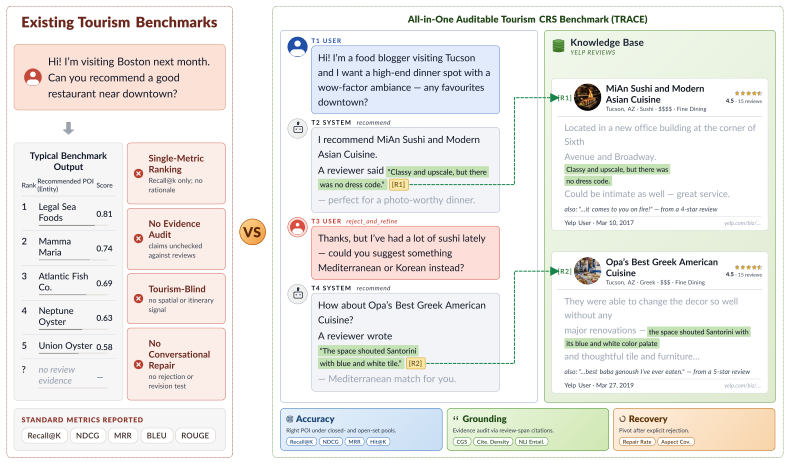
0
0
cs.IR 2026-05-06 2 theorems

Decision module cuts over-acceptance in recommender simulators

Decision-aware User Simulation Agent for Evaluating Conversational Recommender Systems

By separating utility calculation from overload-aware commitment, the added component lowers acceptance rates as options increase and aligns

Figure from the paper full image
abstract click to expand
Conversational recommender systems (CRS) increasingly rely on user simulators for automated evaluation of sales agents. A key requirement for such simulators is the ability to model human decision-making. However, most existing simulation frameworks do not explicitly model the internal decision process, and LLM-based simulators often exhibit unrealistically strong information-processing capabilities, rarely exhibit the hesitation or decision deferral commonly observed in real consumer behavior, resulting in overly high acceptance probabilities. To address this limitation, we propose Hesitator, a theory-grounded user simulation framework that explicitly models human decision-making under choice overload. The framework introduces a modular Decision Module that separates utility-based item selection from overload-aware commitment decisions. Experiments across multiple user simulation frameworks, domains, sales modes, and LLM backbones show that integrating our module consistently mitigates unrealistic behaviors under increasing overload conditions. Furthermore, Hesitator reproduces established behavioral patterns from psychological economics, demonstrating its ability to model human decision behavior.
0
0
cs.IR 2026-05-06 3 theorems

Multimodal alignment embeds visual semantics into semantic IDs

TriAlignGR: Triangular Multitask Alignment with Multimodal Deep Interest Mining for Generative Recommendation

Cross-modal encoding plus eight-task training reduces content degradation and opacity in generative recommenders.

Figure from the paper full image
abstract click to expand
We introduce TriAlignGR, a unified multitask-multimodal framework for generative recommendation that establishes two-stage multimodal semantic propagation: (i) encoding visual semantics directly into SIDs via multimodal embeddings, and (ii) enabling the model to decode these semantics through visual description tasks. Existing Semantic ID (SID) pipelines suffer from two fundamental but underexplored problems: \textbf{SID Content Degradation (SCD)}, where cascaded encoding and residual quantization discard critical multimodal and interest-level semantics; and \textbf{SID Semantic Opacity (SSO)}, where models autoregressively generate SID sequences without truly comprehending their underlying meaning, leading to hallucination and poor generalization. Prior work addresses at most text-SID alignment, leaving visual semantics and latent user interests entirely unexploited. TriAlignGR resolves both problems through three tightly integrated components: (1)~\textbf{Cross-Modal Semantic Alignment (CMSA)} integrates visual content into SID construction through both VLM-generated textual descriptions and a multimodal embedding model that directly encodes image features alongside text, ensuring that SIDs inherently carry multimodal semantics; (2)~\textbf{Multimodal Deep Interest Mining (MDIM)} leverages LLM Chain-of-Thought reasoning to extract latent user intents (\eg ``productivity-focused lifestyle'' from noise-canceling headphones) beyond surface attributes, enriching SID semantics before discretization; and (3)~\textbf{Triangular Multitask (TMT)} jointly trains on eight complementary generation tasks under a single autoregressive loss -- including two novel visual-semantic tasks (VisDesc$\to$SID, VisDesc$\to$Title) that map VLM-generated image descriptions to SIDs and titles, completing the SID-Text-Image triangle -- without requiring task-specific towers or complex loss weighting.
0
0
cs.IR 2026-05-06

GenPOI generates map POIs from context via LLM token sequences

Revisiting General Map Search via Generative Point-of-Interest Retrieval

By encoding points of interest with semantic and geographic tokens and constraining output to nearby valid results, the method improves on-v

Figure from the paper full image
abstract click to expand
Point-of-Interest (POI) retrieval aims to identify relevant candidates from massive-scale POI databases, serving as a cornerstone for diverse location-based services. However, in general map search scenarios, conventional POI retrieval methods are increasingly challenged by underspecified user queries due to their excessive reliance on surface-level semantic matching. Meanwhile, such queries are often highly context-dependent and personalized, yet existing retrieval paradigms struggle to effectively synergize heterogeneous contexts for complex search intent inference. To address these limitations, we revisit general map search from a generative perspective and propose GenPOI, an innovative Generative POI retrieval framework tailored for general search on maps. It seamlessly unifies heterogeneous search contexts and POIs into structured sequences, leveraging the powerful contextual modeling of Large Language Models (LLMs) for spatial-aware candidate generation. Consequently, this generative paradigm effectively solves more challenging queries through profound context dependency modeling and search intent reasoning. Specifically, accounting for the unique geospatial nature of map scenarios, GenPOI introduces a novel Geo-Semantic POI Tokenization to represent each POI as a compact token sequence encoding both semantic and geographic context, thus grounding the LLM's spatial understanding. Additionally, a proximity-aware constrained generation strategy is employed to restrict the decoding space of the LLM, ensuring the validity and geospatial relevance of the generated results. Extensive experiments on large-scale industrial datasets from Tencent Map, comprising POIs at the scale of over 10 million, demonstrate the superior performance of GenPOI.
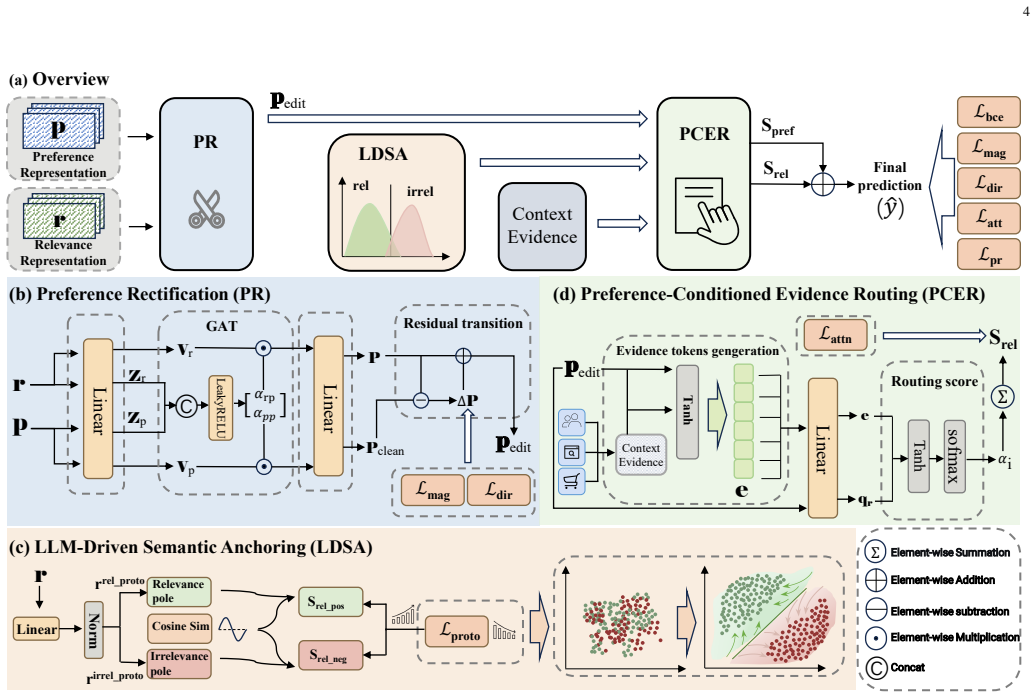
0
0
cs.IR 2026-05-06

Thinking traces as RAG corpus raise math and code scores

RAG over Thinking Traces Can Improve Reasoning Tasks

Retrieve-then-generate with problem-solving trajectories beats web retrieval and no-RAG baselines on AIME, LiveCodeBench, and GPQA.

Figure from the paper full image
abstract click to expand
Retrieval-augmented generation (RAG) has proven effective for knowledge-intensive tasks, but is widely believed to offer limited benefit for reasoning-intensive problems such as math and code generation. We challenge this assumption by showing that the limitation lies not in RAG itself, but in the choice of corpus. Instead of retrieving documents, we propose retrieving thinking traces, i.e., intermediate thinking trajectories generated during problem solving attempts. We show that thinking traces are already a strong retrieval source, and further introduce T3, an offline method that transforms them into structured, retrieval-friendly representations, to improve usability. Using these traces as a corpus, a simple retrieve-then-generate pipeline consistently improves reasoning performance across strong models and benchmarks such as AIME 2025--2026, LiveCodeBench, and GPQA-Diamond, outperforming both non-RAG baselines and retrieval over standard web corpora. For instance, on AIME, RAG with traces generated by Gemini-2-thinking achieves relative gains of +56.3%, +8.6%, and +7.6% for Gemini-2.5-Flash, GPT-OSS-120B, and GPT-5, respectively, even though these are more recent models. Interestingly, RAG on T3 also incurs little or no extra inference cost, and can even reduce inference cost by up to $15%$. Overall, our results suggest that thinking traces are an effective retrieval corpus for reasoning tasks, and transforming them into structured, compact, or diagnostic representations unlocks even stronger gains. Code available at https://github.com/Narabzad/t3.
0
0
cs.IR 2026-05-06

Unified PostgreSQL layer cuts RAG latency up to 92%

Beyond Similarity Search: A Unified Data Layer for Production RAG Systems

One database holding vectors and metadata together removes staleness, cross-tenant leaks, and complex query code that split systems create.

Figure from the paper full image
abstract click to expand
Retrieval-Augmented Generation (RAG) systems have become the standard architecture for grounding large language models in organizational knowledge. Yet production deployments consistently expose a gap between clean prototype performance and real-world reliability. This paper identifies three root causes of that gap: data staleness, tenant data leakage, and query composition explosion. All three trace back to the conventional split-system data layer. We propose and evaluate a unified data layer built on PostgreSQL with native vector search (pgvector) and HNSW indexing. Controlled benchmarks on 50,000 documents show 92% latency reduction for date-filtered queries, 74% for tenant-scoped queries, zero synchronization inconsistency, and complete elimination of cross-tenant data leakage with 93% less synchronization code. We additionally discuss a recommended hybrid tier architecture
1 0
0
cs.IR 2026-05-05 2 theorems

Two-stage filter catches unfaithful RAG answers up to 77 percent of cases

Towards Dependable Retrieval-Augmented Generation Using Factual Confidence Prediction

Conformal prediction keeps reliable context chunks and an attention classifier measures consistency to support more dependable AI use.

Figure from the paper full image
abstract click to expand
Incorporating specific knowledge into large language models via retrieval-augmented generation (RAG) is a widespread technique that fuels many of today's industry AI applications. A fundamental problem is to assess if the context retrieved by some similarity search provides indeed supporting facts, or instead misguides the generator with irrelevant information. It is critical to associate meaningful confidence measures about the factuality of the retrieval process with the generated answers. We present a new, two-staged approach to predict fact faithfulness of the output of retrieval-augmented generations. First, we employ conformal prediction to select only those retrieved chunks who have a high chance to come from the correct source. This approach in itself can improve answer quality by up to 6% in some of the studied datasets, however, the associated statistical guarantees do not hold generally, since the assumption of sample exchangeability depends on the retriever setup. We present diagnostic metrics to assess whether a setup is suitable. Second, we quantify confidence in the consistency of a generated final answer with a given retrieved context, using an attention-based factuality classifier. This approach can detect inconsistent answers with a chance of up to 77%. Our work helps to establish a novel type of certified RAG systems for a broad range of natural language industry applications.
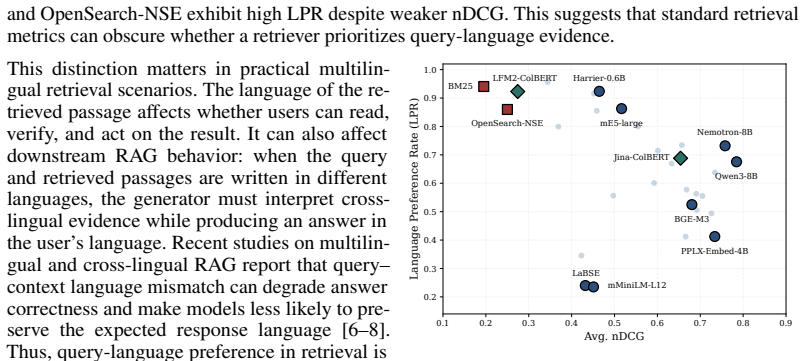
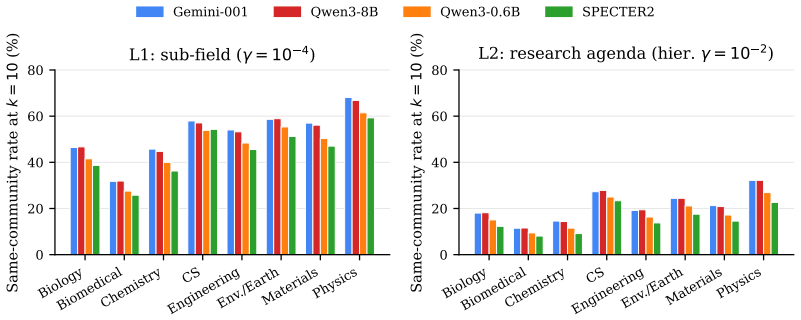
0
0
cs.IR 2026-05-05 2 theorems

Framework aligns agents for fair multistakeholder personalization

Fair Agents: Balancing Multistakeholder Alignment in Multi-Agent Personalization Systems

Objective mapping plus social-choice aggregation and stakeholder evaluations balance competing goals in multi-agent systems.

Figure from the paper full image
abstract click to expand
LLM agents are increasingly used for personalization due to their ability to communicate directly with users in natural language, integrate external knowledge bases, and negotiate with other (possibly human) agents. Especially in multistakeholder AI systems with multiple distinct objectives, LLM agents are used to independently optimize for each stakeholder's goals. Here, stakeholder alignment is essential to identify and map these goals to provide LLM agents with quantifiable objectives. Plus, the way in which the outputs of the LLM agents are aggregated is fundamental to ensuring fair outcomes for all agents and, therefore, stakeholders. In this work, we identify open research challenges and propose a conceptual framework for designing fair multi-agent multistakeholder personalization systems that balance competing stakeholder objectives. Our framework integrates (i) methods to align stakeholder objectives and LLM agents, (ii) aggregation strategies, e.g., based on social choice theory, to form fair collective decisions, and (iii) stakeholder-centric evaluation procedures for both individual and collective agent behavior. We showcase our framework through a tourism use case and discuss possible applications in other domains, such as education and healthcare. Finally, we discuss domain-specific fairness tensions and review datasets for evaluating multistakeholder fairness and multi-agent personalization systems.
0
0
cs.IR 2026-05-05 3 theorems

ODE behavior modeling plus LLM counterfactuals lifts cross-domain recs

Bridging Behavior and Semantics for Time-aware Cross-Domain Sequential Recommendation

Continuous-time preference evolution and time-sensitive semantics reduce negative transfer when data spans multiple domains.

Figure from the paper full image
abstract click to expand
Cross-domain sequential recommendation (CDSR) alleviates interaction sparsity by jointly modeling user behaviors across multiple domains. While current studies have made some progresses, they still neglect two issues that severely impact recommendation performance: (i) ignoring domain-specific interaction frequencies and interest decay rates at identical time intervals; (ii) treating semantic preferences as time-invariant during cross-domain transfer. To address these, we propose a novel framework that bridges Behavior and Semantics for Time-aware Cross-Domain Sequential Recommendation (BST-CDSR). Specifically, we design a behavioral preference evolution module that decouples long-term interests and short-term intentions, and models continuous-time preference via a neural ordinary differential equation (ODE) with event-driven updates. Additionally, to capture time-aware semantic preferences, we introduce a temporal counterfactual-enhanced semantic generator that discretizes temporal interval tokens and leverages large language models (LLMs) to extract robust temporal semantics, where counterfactual perturbations enhance the time sensitivity of semantic preferences. Furthermore, we propose a time-preference guided domain transfer module to adaptively control transfer weights and mitigate negative transfer. Extensive experiments on real-world datasets demonstrate that BST-CDSR consistently outperforms baselines.
0
0
cs.IR 2026-05-04 1 theorem

Direct text tools beat semantic retrievers for agents

Beyond Semantic Similarity: Rethinking Retrieval for Agentic Search via Direct Corpus Interaction

Agents using grep and file reads on raw corpora outperform sparse and dense baselines on IR benchmarks and agentic QA without embeddings.

Figure from the paper full image
abstract click to expand
Modern retrieval systems, whether lexical or semantic, expose a corpus through a fixed similarity interface that compresses access into a single top-k retrieval step before reasoning. This abstraction is efficient, but for agentic search, it becomes a bottleneck: exact lexical constraints, sparse clue conjunctions, local context checks, and multi-step hypothesis refinement are difficult to implement by calling a conventional off-the-shelf retriever, and evidence filtered out early cannot be recovered by stronger downstream reasoning. Agentic tasks further exacerbate this limitation because they require agents to orchestrate multiple steps, including discovering intermediate entities, combining weak clues, and revising the plan after observing partial evidence. To tackle the limitation, we study direct corpus interaction (DCI), where an agent searches the raw corpus directly with general-purpose terminal tools (e.g., grep, file reads, shell commands, lightweight scripts), without any embedding model, vector index, or retrieval API. This approach requires no offline indexing and adapts naturally to evolving local corpora. Across IR benchmarks and end-to-end agentic search tasks, this simple setup substantially outperforms strong sparse, dense, and reranking baselines on several BRIGHT and BEIR datasets, and attains strong accuracy on BrowseComp-Plus and multi-hop QA without relying on any conventional semantic retriever. Our results indicate that as language agents become stronger, retrieval quality depends not only on reasoning ability but also on the resolution of the interface through which the model interacts with the corpus, with which DCI opens a broader interface-design space for agentic search.
0
0
cs.IR 2026-05-04

Target-aware frequency filtering isolates true user interests from noise

FEDIN: Frequency-Enhanced Deep Interest Network for Click-Through Rate Prediction

Lower spectral entropy marks relevant periodic signals in attention scores, lifting CTR prediction over time-domain baselines on public data

Figure from the paper full image
abstract click to expand
Sequential recommendation models often struggle to capture latent periodic patterns in user interests, primarily due to the noise inherent in time-domain behavioral data. While frequency-domain analysis offers a global perspective to address this, existing approaches typically treat user sequences in isolation, overlooking the crucial context of the target item. In this work, we present a novel empirical observation: user attention scores exhibit distinct spectral entropy distributions when conditioned on positive versus negative target items. Specifically, true user interests manifest as highly concentrated spectral patterns with lower entropy in the frequency domain, whereas irrelevant behaviors appear as high-entropy noise. Leveraging this insight, we propose the Frequency-Enhanced Deep Interest Network (FEDIN). FEDIN introduces a frequency-domain branch that utilizes a target-aware spectrum filtering mechanism to isolate these periodic interest signals. Extensive experiments on three public datasets demonstrate that FEDIN consistently outperforms state-of-the-art sequential recommendation baselines, demonstrating superior robustness against noise. We have released our code at: https://github.com/otokoneko/FEDIN.
0
0
cs.IR 2026-05-04

Hybrid RAG reaches perfect grounding accuracy on 200 biomedical claims

A Hybrid Retrieval and Reranking Framework for Evidence-Grounded Retrieval-Augmented Generation

Pilot study with 25 queries shows all extracted claims supported by reranked evidence chunks from healthcare documents.

abstract click to expand
Retrieval-augmented generation (RAG) improves large language model reliability by grounding generated responses in external evidence. However, RAG performance depends on the relevance of retrieved passages, the quality of evidence ranking, and the ability to verify whether generated claims are supported by source documents. This study presents a hybrid retrieval and reranking framework for citation-aware RAG in biomedical and healthcare-related document question answering. The framework uses Amazon Bedrock Knowledge Bases for document ingestion, parsing, chunking, embedding generation, and evidence retrieval. Source PDF documents are stored in Amazon S3, embedded using Amazon Titan Text Embeddings V2, and indexed with Amazon OpenSearch Serverless. Hybrid retrieval first retrieves candidate evidence chunks, and Cohere reranking then prioritizes the most relevant passages before answer generation. The answer-generation stage uses top-ranked evidence chunks to produce controlled, evidence-grounded responses, while a separate judge model evaluates each generated factual claim against the retrieved evidence. The framework was evaluated using 25 biomedical NLP and healthcare transformer queries as a pilot-scale proof-of-concept study. Across the evaluation set, the system retrieved and reranked 500 evidence chunks and generated answers from top-ranked evidence. Claim-level grounding evaluation extracted 200 factual claims, all of which were judged to be supported by retrieved evidence, resulting in 100.0% grounding accuracy. The results suggest that hybrid retrieval, reranking, conservative prompting, and claim-level evaluation can support reliable evidence-grounded RAG responses when sufficient source evidence is available.
0
0
cs.IR 2026-05-04

LLM framework tricks neural rankers to promote target documents

Led to Mislead: Adversarial Content Injection for Attacks on Neural Ranking Models

CRAFT generates fluent adversarial text that beats prior attacks and transfers to cross-encoder, embedding, and LLM rankers on MS MARCO and

Figure from the paper full image
abstract click to expand
Neural Ranking Models (NRMs) are central to modern information retrieval but remain highly vulnerable to adversarial manipulation. Existing attacks often rely on heuristics or surrogate models, limiting effectiveness and transferability. We propose CRAFT, a supervised framework for black-box adversarial rank attacks powered by large language models (LLMs). CRAFT operates in three stages: adversarial dataset generation via retrieval-augmented generation and self-refinement, supervised fine-tuning on curated adversarial examples, and preference-guided optimization to align generations with rank-promotion objectives. Extensive experiments on the MS MARCO passage dataset, TREC Deep Learning 2019, and TREC Deep Learning 2020 benchmarks show that CRAFT significantly outperforms state-of-the-art baselines, achieving higher promotion rates and rank boosts while preserving fluency and semantic fidelity. Moreover, CRAFT transfers effectively across diverse ranking architectures, including cross-encoder, embedding-based, and LLM-based rankers, underscoring vulnerabilities in real-world retrieval systems. This work provides a principled framework for studying adversarial threats in NRMs, underscores the risks of generative AI in rank manipulation, and provides a foundation for developing more robust retrieval systems. To support reproducibility, we publicly release our source code, trained models, and prompt templates.
0
0
cs.IR 2026-05-04

Hybrid KG-LLM service retrieves skills at 0.94 nDCG under 200 ms

KG-First, LLM-Fallback: A Hybrid Microservice for Grounded Skill Search and Explanation

Unifies ESCO, ROME and O*NET into one traceable graph so educators receive fast, grounded answers without expensive re-ranking.

Figure from the paper full image
abstract click to expand
Authoritative competency frameworks such as ESCO, ROME, and O*NET are essential for aligning education with labor market needs, yet their technical complexity and structural heterogeneity hinder practical adoption by educators. This paper introduces SkillGraph-Service, an interoperable microservice designed to bridge this gap by unifying these resources into a provenance-preserving Knowledge Graph (KG). Adopting a KG-first, LLM-fallback architecture, the system combines symbolic rigor with sub-symbolic flexibility. It implements a lightweight hybrid retrieval engine (fusing SQLite FTS5 and HNSW vector search) to handle the vocabulary mismatch in educator queries, and utilizes Large Language Models (LLMs) strictly for constrained ranking and audience-aware explanation. Empirical evaluation on a multilingual dataset reveals that the proposed hybrid strategy achieves superior retrieval effectiveness (nDCG@5>0.94) with sub-200 ms latency, rendering computationally expensive cross-encoder re-ranking may be unnecessary for this domain. Furthermore, an analysis of generated explanations highlights a trade-off between fluency and faithfulness: while JSON-constrained LLMs ensure high citation precision, deterministic templates remain the most reliable method for maximizing evidence coverage. The resulting architecture offers a practical, scalable, and auditable solution for integrating complex skill data into digital learning ecosystems.
0

browse all of cs.IR β†’ full archive Β· search Β· sub-categories