REVIEW 3 major objections 5 minor 66 references
MoENAS: Mixture-of-Expert based Neural Architecture Search for jointly Accurate, Fair, and Robust Edge Deep Neural Networks
T0 review · 3 major / 5 minor · reviewed 2026-08-08 · deepseek-v4-flash
Pith's one-line read By varying the number of experts per layer, MoENAS claims to produce edge DNNs that improve accuracy, fairness, robustness, and generalization simultaneously.
desk verdict A sensible MoE-based NAS idea whose headline fairness numbers are mathematically inconsistent with the paper's own equation — fixable, but not acceptable as stated. read the letter →
The pith
A machine-rendered reading of the paper's core claim, the machinery that carries it, and where it could break.
The reading
What carries the argument
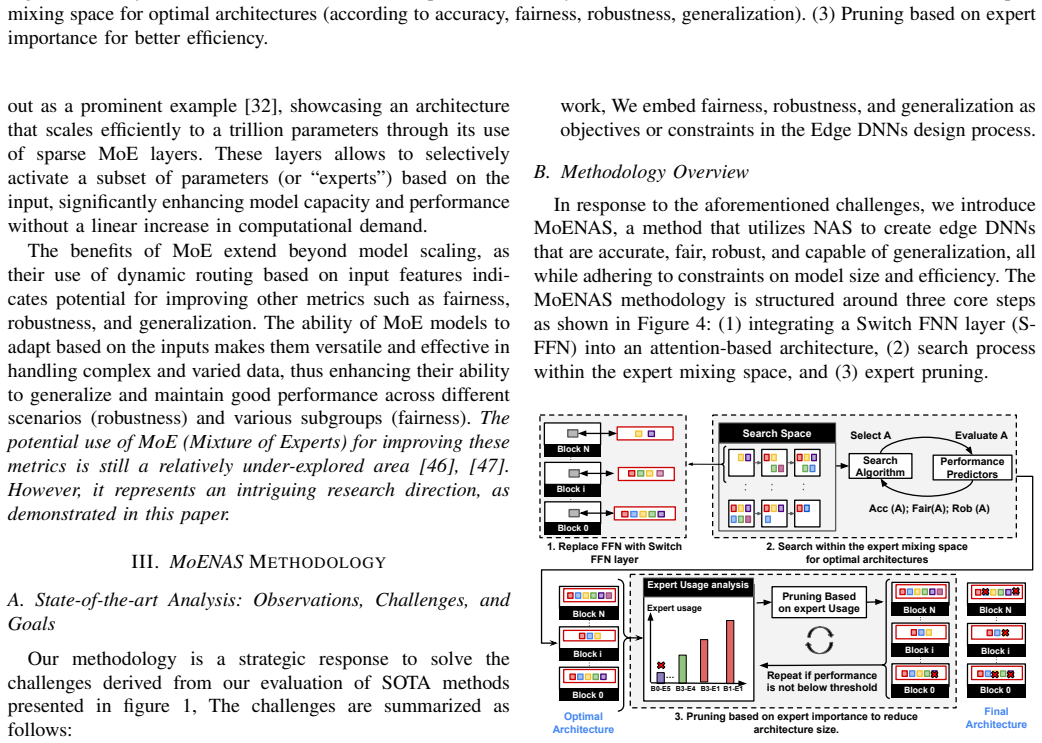
The load-bearing object is the Switch FFN (S-FFN) layer: an attention block's static feed-forward network is replaced with a router plus a set of expert FFNs, so each feature token is sent to one expert chosen dynamically. The search space is the vector of expert counts across the nine switched layers ($8^{9}$ ≈ 1.3×$10^{8}$ candidates), and the search is driven by a population-based Bayesian optimizer with XGBoost surrogate models that predict the four objectives from this vector. Expert pruning closes the loop: after training, the least-used experts are removed iteratively, with their tokens redirected to the next-best expert, until performance drops below a threshold. The router's input-dependent selection is what the paper credits for letting a single model adapt across skin tones and lighting conditions.
What would settle it
Recompute the Table I fairness scores using Eq. (1)–(2) exactly: with beta = 0.2 and SPD the sum over 10 skin-tone groups of |Acc_Gi - Acc_minority|, the resulting Fairness = (beta - SPD)/beta is at most 100% when SPD = 0 and drops rapidly with any realistic disparity, so it cannot yield the 93.13% reported for MoENAS-S. If the published formula is the metric, the reported fairness improvements cannot be reproduced; if a corrected formula or a different group aggregation was used, reporting it would settle whether the claim is real.
Extended reading notes
Core claim
MoENAS's central claim is that the number of experts per switch layer is a searchable architectural axis that controls accuracy, fairness, robustness, and generalization jointly. Starting from MobileViTv2, the method converts each FFN into a switch FFN with a router, encodes an architecture as a 9-vector of expert counts (1 to 8 per layer), and searches this space with a Bayesian-optimization loop whose surrogate predictors estimate test accuracy, skin fairness, robustness to light, and overfitting. The reported result is a family of models—MoENAS-S, XS, and XXS—that sit on the Pareto front against fourteen state-of-the-art edge DNNs: MoENAS-S reaches 90.33% test accuracy, 93.13% skin fairness, and 0.21% overfitting at 2.71M parameters. Expert pruning then removes least-used experts to shrink size by up to 26% with modest metric loss. The claim is architecture-level: fairness disparities and robustness gaps that appear baked into existing edge models can be reduced by changing the routing structure, not just the data.
Load-bearing premise
The whole fairness result stands or falls on the skin-fairness metric being computed the way the paper says it is; as printed, that formula does not produce the reported fairness scores, so an unspecified normalization or group split is doing load-bearing work.
Editorial extensions
If this is right
- Edge DNN designers can treat fairness and robustness as first-class NAS objectives without a large model-size penalty: MoENAS's gains come with a +0.4M parameter increase over the state-of-the-art average.
- The same S-FFN search axis could be ported to other attention-based backbones, since the method only changes the FFN layer and the per-layer expert counts.
- Expert pruning gives a practical compression path: up to 26% size reduction while keeping accuracy and fairness above state-of-the-art levels, so MoE-based edge models need not stay large.
- If MoENAS's routing patterns hold, fairness is partly a routing property: images from the same skin-tone group follow similar expert paths, meaning group-conditional routing could be a target for further bias mitigation.
- MoENAS establishes new Pareto-front points for edge DNNs on accuracy, fairness, robustness, and overfitting, which raises the bar for future hardware-aware NAS methods.
Reading between the lines
- A direct test of the routing hypothesis is to replace the router in MoENAS-S with a fixed per-layer expert selection and check whether the skin-tone gap widens; the paper reports routing patterns but does not run this counterfactual.
- The 0.21% overfitting figure likely reflects that COCO and FACET are both person-centric natural-image benchmarks; the generalization advantage may shrink on genuinely out-of-distribution test sets, which MoENAS does not evaluate.
- Because the fairness objective's printed formula cannot reproduce the reported scores, the quantitative fairness claim is only as strong as the unstated normalization used during search; reporting that normalization would let others replicate the search.
- If the fairness gains come from expert specialization rather than extra parameters, then the same search axis applied to a smaller base model might yield fair edge DNNs below 2M parameters, an extension the paper leaves open.
Editorial analysis
A structured set of objections, weighed in public.
Referee Report
Summary. The paper introduces MoENAS, a hardware-aware neural architecture search method that replaces the feed-forward layers of MobileViTv2 with Switch mixture-of-experts layers, searches over per-layer expert counts using Bayesian optimization with surrogate predictors, and prunes low-usage experts to reduce model size. The authors evaluate the discovered models on person classification using COCO for training/validation and FACET for testing, reporting accuracy, skin-tone fairness, robustness to lighting, overfitting, and model size against 14 SOTA edge DNNs. The headline claims are simultaneous improvements in accuracy (4.02%), fairness (skin-tone disparity reduction from 14.09% to 5.60%), robustness (3.80%), and generalization (overfitting of 0.21%) at comparable model size.
Significance. The problem addressed by the paper, jointly optimizing fairness, robustness, and generalization during edge DNN design, is timely and practically important. The empirical scope is a strength: the authors compare against 14 SOTA edge DNNs, use the FACET benchmark, train 127 models, and include ablations for expert pruning and expert-usage patterns. The proposed MoE-based search space is a plausible mechanism for improving robustness and generalization through input-adaptive routing. If the fairness metric and data-split issues are resolved, MoENAS could be a useful contribution to fairness-aware NAS for edge models. However, the current numerical support for the central fairness claim is invalid as presented, and the evaluation protocol needs clarification before the results can be relied upon.
major comments (3)
- [Section III.C, Eqs. (1)-(2); Table I] As printed, the fairness formula Fairness = (β − SPD)/β with β = 0.2 and SPD the sum of 10 absolute group differences cannot produce the values in Table I. For MoENAS-S, the table reports 95.59% accuracy for the lightest skin tone and 90.62% for the darkest, so SPD is at least 0.0497 and the maximum possible fairness score is (0.2 − 0.0497)/0.2 = 75.15%; the table reports 93.13%. The same violation appears for MobileNetV2, whose reported 79.51% exceeds the upper bound of 44.9% implied by its 11.02 percentage-point range. The authors must specify the exact formula actually implemented, including any normalization by N or conversion to percentage units, and recompute every Fairness entry in Table I and Figure 8. The direct lightest-to-darkest accuracy gap is a valid and useful summary, but the Eq. (1)-(2) fairness scores are not supported as stated.
- [Section III.B.2 and Section IV.A] The search procedure explicitly optimizes "Skin Fairness" and "Robustness to Light," but both metrics are defined using the FACET test set, and the manuscript does not state whether a held-out split of FACET was reserved for final evaluation. If the same FACET labels were used both to guide architecture selection and to produce the final test numbers, the reported fairness and robustness improvements are selection-biased. The authors should clarify the exact split used for the search objectives versus the final evaluation, and if no separate split was used, they should re-run the evaluation on a properly held-out subset.
- [Section IV.B and Table I] The baseline training protocol is asymmetric and underspecified. For each SOTA model, five training schemes are tried and the one with the highest test accuracy on FACET is selected, whereas the MoENAS models are trained with a single scheme chosen for MobileViTv2. Selecting baselines by test accuracy can inflate their reported performance, and the comparison is therefore not a controlled test of architecture quality. The scheme-selection criterion should be based on validation data, or a single fixed training scheme should be used for all models, and the chosen scheme for each model should be reported.
minor comments (5)
- [Table I] The table header is confusing: "Fairness" appears twice, and the boundaries between the Robustness, Overfitting, and Model-size columns are unclear. Reformatting the header with explicit column labels would make the table much easier to read.
- [Section IV.D.1] The text states that MoENAS-XXS has a robustness of 87.34%, but Table I lists 90.32% under the most natural column ordering. One of these values is inconsistent and should be corrected.
- [Section III.C] The bullet on Validation and Test Accuracy cites FACET as reference [30], which is the COCO paper; FACET is reference [31]. This citation error should be fixed.
- [Section V.C] The quantum-head ablation does not specify what the quantum component is, how it is trained, or what simulator or hardware is used, so the reader cannot verify the claim that MoENAS-S + Q surpasses SOTA models. Either provide the missing implementation details or remove the section.
- [Section III.C] The "overfitting" metric, defined as validation accuracy on COCO minus test accuracy on FACET, is really a cross-domain generalization gap rather than classical overfitting. Clarifying this terminology would prevent misinterpretation.
Circularity Check
No load-bearing circularity: MoENAS is an empirical NAS pipeline whose final results are measured, not surrogate predictions; only minor self-citations appear in related work.
full rationale
The claimed derivation chain is an empirical search-and-evaluate pipeline, not a mathematical derivation. The Bayesian-optimization search uses XGBoost surrogates trained on 127 evaluated architectures to select expert-count vectors, and the final MoENAS models are trained and measured, so Table I reports measured outcomes rather than surrogate outputs. Optimizing objectives (accuracy, fairness, robustness, overfitting) and then evaluating the same objective types is standard objective alignment, not circularity: no equation reduces to its own input, and no fitted parameter is renamed as a prediction. The only in-house citations ([5], [15], [16]) appear in related-work lists for pruning and HW-NAS background; none is load-bearing for the MoENAS mechanism or its evaluation. The fairness metric as printed is mathematically inconsistent with Table I (Eq. (2) forces SPD to be at least the lightest-to-darkest accuracy gap, which caps Eq. (1) below several reported fairness scores), and there is ambiguity about whether FACET test labels entered the search; these are serious correctness and validity concerns, but they are not instances of 'prediction equals input by construction' and do not constitute circularity under the taxonomy. Hence the low non-circularity score, with the caveat that the headline fairness claim remains formally unsupported as printed.
Assumptions & free parameters
free parameters (2)
- beta in fairness formula =
0.2
- expert-count search range =
1 to 8 experts per layer
assumptions (4)
- domain assumption Skin-tone accuracy parity on FACET is the correct fairness measure for edge classifiers
- ad hoc to paper Replacing FFN layers with Switch FFN layers in MobileViTv2 is sufficient to capture fairness and robustness improvements
- domain assumption Trained MoE models pruned after training retain or improve performance relative to training smaller models from scratch
- domain assumption Pretrained ImageNet initialization transfers to the COCO person-classification task
Cite this review
Pith. "Pith review of MoENAS: Mixture-of-Expert based Neural Architecture Search for jointly Accurate, Fair, and Robust Edge Deep Neural Networks." pith.science (2026). https://pith.science/paper/WOD64SAE
@misc{pith2026250207422,
  author       = {Pith},
  title        = {Pith review of: MoENAS: Mixture-of-Expert based Neural Architecture Search for jointly Accurate, Fair, and Robust Edge Deep Neural Networks},
  year         = {2026},
  howpublished = {\url{https://pith.science/paper/WOD64SAE}},
  note         = {Machine review of arXiv:2502.07422}
}
read the original abstract
There has been a surge in optimizing edge Deep Neural Networks (DNNs) for accuracy and efficiency using traditional optimization techniques such as pruning, and more recently, employing automatic design methodologies. However, the focus of these design techniques has often overlooked critical metrics such as fairness, robustness, and generalization. As a result, when evaluating SOTA edge DNNs' performance in image classification using the FACET dataset, we found that they exhibit significant accuracy disparities (14.09%) across 10 different skin tones, alongside issues of non-robustness and poor generalizability. In response to these observations, we introduce Mixture-of-Experts-based Neural Architecture Search (MoENAS), an automatic design technique that navigates through a space of mixture of experts to discover accurate, fair, robust, and general edge DNNs. MoENAS improves the accuracy by 4.02% compared to SOTA edge DNNs and reduces the skin tone accuracy disparities from 14.09% to 5.60%, while enhancing robustness by 3.80% and minimizing overfitting to 0.21%, all while keeping model size close to state-of-the-art models average size (+0.4M). With these improvements, MoENAS establishes a new benchmark for edge DNN design, paving the way for the development of more inclusive and robust edge DNNs.
Figures


Figures from the paper (7 more)


Reference graph
Works this paper leans on
-
[1]
Intelligent health care: Applications of deep learning in computational medicine,
S. Yang, F. Zhu, X. Ling, Q. Liu, and P. Zhao, “Intelligent health care: Applications of deep learning in computational medicine,” Frontiers in Genetics, 2021
work page 2021
-
[2]
A survey on deep learning for cybersecurity: Progress, challenges, and opportunities,
M. Macas, C. Wu, and W. Fuertes, “A survey on deep learning for cybersecurity: Progress, challenges, and opportunities,” Computer Networks, 2022
work page 2022
-
[3]
A survey of deep learning techniques for autonomous driving,
S. Grigorescu, B. Trasnea, T. Cocias, and G. Macesanu, “A survey of deep learning techniques for autonomous driving,” Journal of Field Robotics, 2020
work page 2020
-
[4]
Edge artificial intelligence for internet of things devices: Open challenges,
V . Alvear-Puertas, P. D. Rosero-Montalvo, V . F ´elix-L´opez, and D. H. Peluffo-Ord´o˜nez, “Edge artificial intelligence for internet of things devices: Open challenges,” DITTET, 2023
work page 2023
-
[5]
Prunet: Class- blind pruning method for deep neural networks,
A. Marchisio, M. A. Hanif, M. Martina, and M. Shafique, “Prunet: Class- blind pruning method for deep neural networks,” in IJCNN, 2018
work page 2018
-
[6]
Methods for pruning deep neural networks,
S. Vadera and S. Ameen, “Methods for pruning deep neural networks,” 2021
work page 2021
-
[7]
A cross-layer approach towards de- veloping efficient embedded deep learning systems,
M. A. Hanif and M. Shafique, “A cross-layer approach towards de- veloping efficient embedded deep learning systems,” Microprocess. Microsystems, 2022
work page 2022
-
[8]
Quantization of deep neural networks for accurate edge computing,
W. Chen et al., “Quantization of deep neural networks for accurate edge computing,” JETC, 2021
work page 2021
Show all 66 references
-
[9]
Head network distillation: Splitting distilled deep neural networks for resource-constrained edge computing systems,
Y . Matsubara et al., “Head network distillation: Splitting distilled deep neural networks for resource-constrained edge computing systems,” IEEE Access, 2020
2020
-
[10]
A comprehensive survey on hardware-aware neural architecture search,
H. Benmeziane et al. , “A comprehensive survey on hardware-aware neural architecture search,” arXiv preprint arXiv:2101.09336 , 2021
2021 arXiv
-
[11]
Fast hardware-aware neural architecture search,
L. L. Zhang et al., “Fast hardware-aware neural architecture search,” in CVPR Workshops, 2020
2020
-
[12]
Automl: A survey of the state-of-the-art,
X. He, K. Zhao, and X. Chu, “Automl: A survey of the state-of-the-art,” Knowledge-Based Systems, 2021
2021
-
[13]
Neural architecture search: A survey,
T. Elsken, J. H. Metzen, and F. Hutter, “Neural architecture search: A survey,” JMLR, 2019
2019
-
[14]
A survey on neural architecture search,
M. Wistuba, A. Rawat, and T. Pedapati, “A survey on neural architecture search,” arXiv preprint arXiv:1905.01392 , 2019
1905 arXiv
-
[15]
Nascaps: A framework for neural architecture search to optimize the accuracy and hardware efficiency of convolutional capsule networks,
A. Marchisio et al. , “Nascaps: A framework for neural architecture search to optimize the accuracy and hardware efficiency of convolutional capsule networks,” in ICCAD, 2020
2020
-
[16]
Bionetexplorer: Architecture-space exploration of biosignal processing deep neural networks for wearables,
B. S. Prabakaran et al., “Bionetexplorer: Architecture-space exploration of biosignal processing deep neural networks for wearables,” IEEE IoT, 2021
2021
-
[17]
Kaisa, Nonlinear Multiobjective Optimization
M. Kaisa, Nonlinear Multiobjective Optimization . International Series in Operations Research & Management Science, Kluwer Academic Publishers, 1999
1999
-
[18]
The larger the fairer? small neural networks can achieve fairness for edge devices,
Y . Sheng et al., “The larger the fairer? small neural networks can achieve fairness for edge devices,” in DAC, 2022
2022
-
[19]
A systematic review of robustness in deep learning for computer vision: Mind the gap?,
N. Drenkow, N. Sani, I. Shpitser, and M. Unberath, “A systematic review of robustness in deep learning for computer vision: Mind the gap?,” arXiv preprint arXiv:2112.00639 , 2021
2021 arXiv
-
[20]
Robust re-identification by multiple views knowledge distillation,
A. Porrello, L. Bergamini, and S. Calderara, “Robust re-identification by multiple views knowledge distillation,” in ECCV, 2020
2020
-
[21]
Domain generalization: A survey,
K. Zhou et al., “Domain generalization: A survey,” TPAMI, 2022
2022
-
[22]
Deep learning-enabled medical computer vision,
A. Esteva et al., “Deep learning-enabled medical computer vision,” NPJ digital medicine, 2021
2021
-
[23]
A survey on bias and fairness in machine learning,
N. Mehrabi et al., “A survey on bias and fairness in machine learning,” ACM computing surveys (CSUR) , 2021
2021
-
[24]
Do imagenet classifiers generalize to imagenet?,
B. Recht, R. Roelofs, L. Schmidt, and V . Shankar, “Do imagenet classifiers generalize to imagenet?,” in ICML, 2019
2019
-
[25]
The robust- ness limits of sota vision models to natural variation,
M. Ibrahim, Q. Garrido, A. Morcos, and D. Bouchacourt, “The robust- ness limits of sota vision models to natural variation,”arXiv:2210.13604, 2022
2022 arXiv
-
[26]
Fair ai: Challenges and opportunities,
S. Feuerriegel, M. Dolata, and G. Schwabe, “Fair ai: Challenges and opportunities,” Business & information systems engineering , 2020
2020
-
[27]
Fairness by explica- bility and adversarial shap learning,
J. M. Hickey, P. G. Di Stefano, and V . Vasileiou, “Fairness by explica- bility and adversarial shap learning,” in ECML PKDD, 2021
2021
-
[28]
Social-minded measures of data quality: fairness, diversity, and lack of bias,
E. Pitoura, “Social-minded measures of data quality: fairness, diversity, and lack of bias,” JDIQ, 2020
2020
-
[29]
Fairness for deep learning predic- tions using bias parity score based loss function regularization,
B. Jain, M. Huber, and R. Elmasri, “Fairness for deep learning predic- tions using bias parity score based loss function regularization,” IJAIT, 2024
2024
-
[30]
Microsoft coco: Common objects in context,
T.-Y . Lin et al., “Microsoft coco: Common objects in context,” in ECCV, 2014
2014
-
[31]
Facet: Fairness in computer vision evaluation benchmark,
L. Gustafson et al. , “Facet: Fairness in computer vision evaluation benchmark,” in ICCV, 2023
2023
-
[32]
Switch transformers: Scaling to trillion parameter models with simple and efficient sparsity,
W. Fedus, B. Zoph, and N. Shazeer, “Switch transformers: Scaling to trillion parameter models with simple and efficient sparsity,” JMLR, 2022
2022
-
[33]
Fairness perceptions of artificial intelligence: A review and path forward,
D. Narayanan et al. , “Fairness perceptions of artificial intelligence: A review and path forward,” JHCI, 2024
2024
-
[34]
Assessing generalisability of deep learning-based polyp detection and segmentation methods through a computer vision chal- lenge,
S. Ali et al. , “Assessing generalisability of deep learning-based polyp detection and segmentation methods through a computer vision chal- lenge,” Scientific Reports, 2024
2024
-
[35]
Understanding deep learning (still) requires rethinking generalization,
C. o. Zhang, “Understanding deep learning (still) requires rethinking generalization,” Communications of the ACM , 2021
2021
-
[36]
Fair data generation and ma- chine learning through generative adversarial networks,
X. Wu, D. Xu, S. Yuan, and L. Zhang, “Fair data generation and ma- chine learning through generative adversarial networks,” in Generative Adversarial Learning: Architectures and Applications , Springer, 2022
2022
-
[37]
Data preprocessing to mitigate bias: A maximum entropy based approach,
L. E. Celis, V . Keswani, and N. Vishnoi, “Data preprocessing to mitigate bias: A maximum entropy based approach,” in ICML, 2020
2020
-
[38]
Ditto: Fair and robust federated learning through personalization,
T. Li, S. Hu, A. Beirami, and V . Smith, “Ditto: Fair and robust federated learning through personalization,” in ICML, 2021
2021
-
[39]
Fairness in deep learning: A survey on vision and language research,
O. Parraga et al. , “Fairness in deep learning: A survey on vision and language research,” ACM Computing Surveys , 2023
2023
-
[40]
A comprehensive review of yolo architectures in computer vision: From yolov1 to yolov8 and yolo-nas,
J. Terven, D.-M. C ´ordova-Esparza, and J.-A. Romero-Gonz ´alez, “A comprehensive review of yolo architectures in computer vision: From yolov1 to yolov8 and yolo-nas,” Machine Learning and Knowledge Extraction, 2023
2023
-
[41]
Mobilenetv3,
B. Koonce and B. Koonce, “Mobilenetv3,” Convolutional Neural Net- works with Swift for Tensorflow: Image Recognition and Dataset Cate- gorization, 2021
2021
-
[42]
Mobilevit: light-weight, general- purpose, and mobile-friendly vision transformer,
S. Mehta and M. Rastegari, “Mobilevit: light-weight, general- purpose, and mobile-friendly vision transformer,” arXiv preprint arXiv:2110.02178, 2021
2021 arXiv
-
[43]
Ensemble learning techniques and its efficiency in machine learning: A survey,
T. N. Rincy and R. Gupta, “Ensemble learning techniques and its efficiency in machine learning: A survey,” in IDEA, 2020
2020
-
[44]
Glam: Efficient scaling of language models with mixture- of-experts,
N. Du et al., “Glam: Efficient scaling of language models with mixture- of-experts,” in ICML, 2022
2022
-
[45]
Scaling vision with sparse mixture of experts,
C. Riquelme et al. , “Scaling vision with sparse mixture of experts,” NeurIPS, 2021
2021
-
[46]
Synergy-of-experts: Collaborate to improve adversarial robustness,
S. Cui et al. , “Synergy-of-experts: Collaborate to improve adversarial robustness,” NeurIPS, 2022
2022
-
[47]
Balanced product of calibrated experts for long-tailed recognition,
E. S. Aimar et al., “Balanced product of calibrated experts for long-tailed recognition,” in CVPR, 2023
2023
-
[48]
Attention is all you need,
A. Vaswani et al., “Attention is all you need,” NeurIPS, 2017
2017
-
[49]
Transformers in vision: A survey,
S. Khan et al. , “Transformers in vision: A survey,” ACM computing surveys (CSUR), 2022
2022
-
[50]
Bananas: Bayesian optimiza- tion with neural architectures for neural architecture search,
C. White, W. Neiswanger, and Y . Savani, “Bananas: Bayesian optimiza- tion with neural architectures for neural architecture search,” in AAAI, 2021
2021
-
[51]
Scalability of the bayesian optimization algorithm,
M. Pelikan, K. Sastry, and D. E. Goldberg, “Scalability of the bayesian optimization algorithm,” IJAR, 2002
2002
-
[52]
Task-specific expert pruning for sparse mixture-of- experts,
T. Chen et al. , “Task-specific expert pruning for sparse mixture-of- experts,” arXiv:2206.00277, 2022
2022 arXiv
-
[53]
Timm top 20 fastest models
H. Face, “Timm top 20 fastest models.” https:// huggingface.co/collections/timm/timm-top-20-fastest-models- 655d84afb5da99edaf3a51c3, 2021
2021
-
[54]
Efficientvit: Lightweight multi-scale attention for high- resolution dense prediction,
H. Cai et al. , “Efficientvit: Lightweight multi-scale attention for high- resolution dense prediction,” in ICCV, 2023
2023
-
[55]
Repghost: a hardware-efficient ghost module via re- parameterization,
C. Chen et al. , “Repghost: a hardware-efficient ghost module via re- parameterization,” arXiv:2211.06088, 2022
2022 arXiv
-
[56]
Pp-lcnet: A lightweight cpu convolutional neural net- work,
C. Cui et al. , “Pp-lcnet: A lightweight cpu convolutional neural net- work,” arXiv preprint arXiv:2109.15099 , 2021
2021 arXiv
-
[57]
Separable self-attention for mobile vision transformers,
S. Mehta and M. Rastegari, “Separable self-attention for mobile vision transformers,” arXiv:2206.02680, 2022
2022 arXiv
-
[58]
Mobilenetv2: Inverted residuals and linear bottle- necks,
M. Sandler et al. , “Mobilenetv2: Inverted residuals and linear bottle- necks,” in CVPR, 2018
2018
-
[59]
Deep residual learning for image recognition,
K. He, X. Zhang, S. Ren, and J. Sun, “Deep residual learning for image recognition,” in CVPR, 2016
2016
-
[60]
Mnasnet: Platform-aware neural architecture search for mobile,
M. Tan et al., “Mnasnet: Platform-aware neural architecture search for mobile,” in CVPR, 2019
2019
-
[61]
Searching for mobilenetv3,
A. Howard et al., “Searching for mobilenetv3,” ICCV, 2019
2019
-
[62]
Model rubik’s cube: Twisting resolution, depth and width for tinynets,
K. Han et al., “Model rubik’s cube: Twisting resolution, depth and width for tinynets,” NeurIPS, 2020
2020
-
[63]
Proxylessnas: Direct neural architecture search on target task and hardware,
H. Cai, L. Zhu, and S. Han, “Proxylessnas: Direct neural architecture search on target task and hardware,” arXiv:1812.00332, 2018
2018 arXiv
-
[64]
Imagenet: A large-scale hierarchical image database,
J. o. Deng, “Imagenet: A large-scale hierarchical image database,” in CVPR, 2009
2009
-
[65]
Efficientnet: Rethinking model scaling for convo- lutional neural networks,
M. Tan and Q. Le, “Efficientnet: Rethinking model scaling for convo- lutional neural networks,” in ICML, 2019
2019
-
[66]
Architectural vision for quantum computing in the edge-cloud continuum,
A. Furutanpey et al. , “Architectural vision for quantum computing in the edge-cloud continuum,” arXiv preprint arXiv:2305.05238 , 2023
2023 arXiv
Reviewed August 8, 2026 · model on record in the stance chip above.
Discussion (0). Continue with ORCID to comment.