REVIEW 1 major objections 4 minor 22 references
The amplitude decay of a harmonic oscillator damped simultaneously by weak linear and nonlinear damping forces
T0 review · 1 major / 4 minor · reviewed 2026-08-08 · deepseek-v4-flash
Pith's one-line read This paper claims that a harmonic oscillator damped simultaneously by sliding friction, viscous damping, and quadratic drag has its amplitude decay governed by one envelope equation, with closed-form solutions valid whenever the total…
desk verdict A genuinely new and clean derivation of the combined-damping envelope, but Eq. (19) is invalid as printed and must be fixed before the paper can be trusted. read the letter →
The pith
A machine-rendered reading of the paper's core claim, the machinery that carries it, and where it could break.
The reading
What carries the argument
The machinery is a slowly varying envelope ansatz: the solution is written $x(t)=A_0 f(t)\cos(\omega_0 t+\varphi_0)$ with $|df/dt|\ll\omega_0$, so the velocity is approximated by $-\omega_0 A_0 f(t)\sin(\omega_0 t+\varphi_0)$ and the phase and frequency remain those of the undamped oscillator. Substituting this ansatz into the energy balance $dE/dt=F_d v$, averaging the factors $|\sin|$, $\sin^2$, and $|\sin|^3$ over half periods with average values $2/\pi$, $1/2$, and $4/(3\pi)$, and separating variables in the resulting equation produces the envelope $f(t)$. The coefficients $c_0=2\mu g/(\pi\omega_0 A_0)$, $c_1=b/(2m)$, and $c_2=4D\omega_0 A_0/(3\pi m)$ encode the three damping mechanisms, and the sign of $C=4c_2c_0-c_1^2$ selects which elementary function solves the equation.
What would settle it
A decisive check is to record $x(t)$ for a block-spring or pendulum with total damping near $0.2\omega_0$ and compare turning-point and zero-crossing times with equation (24): the approximation predicts crossings at the undamped instants, so a growing time lag in zero crossings, or a halt offset larger than $\pm\mu m g/k$, would directly falsify the envelope description.
Extended reading notes
Core claim
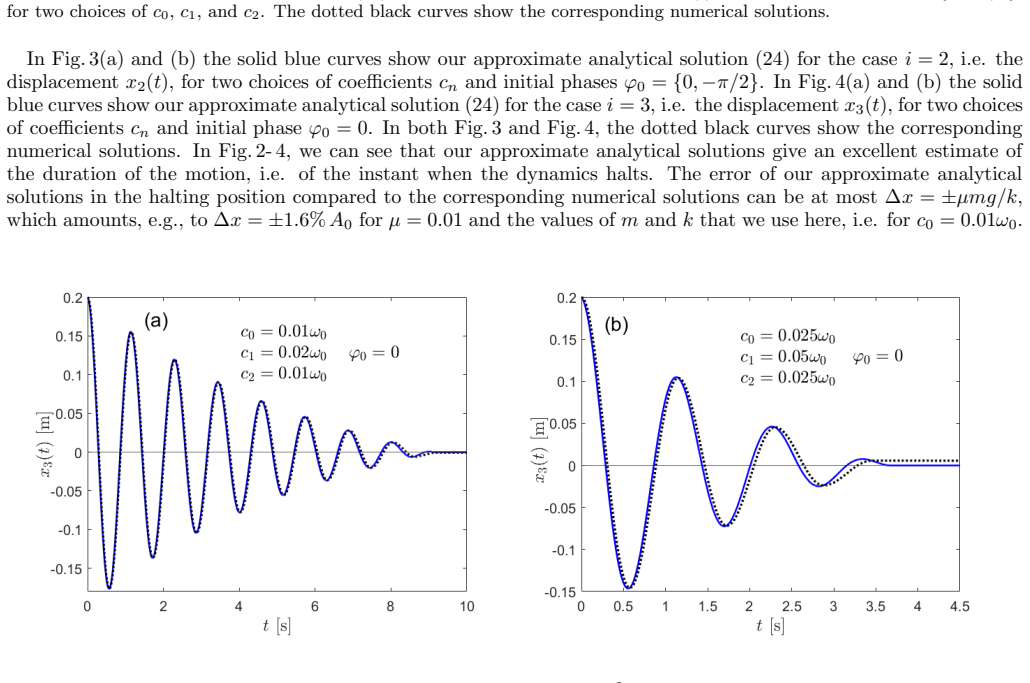
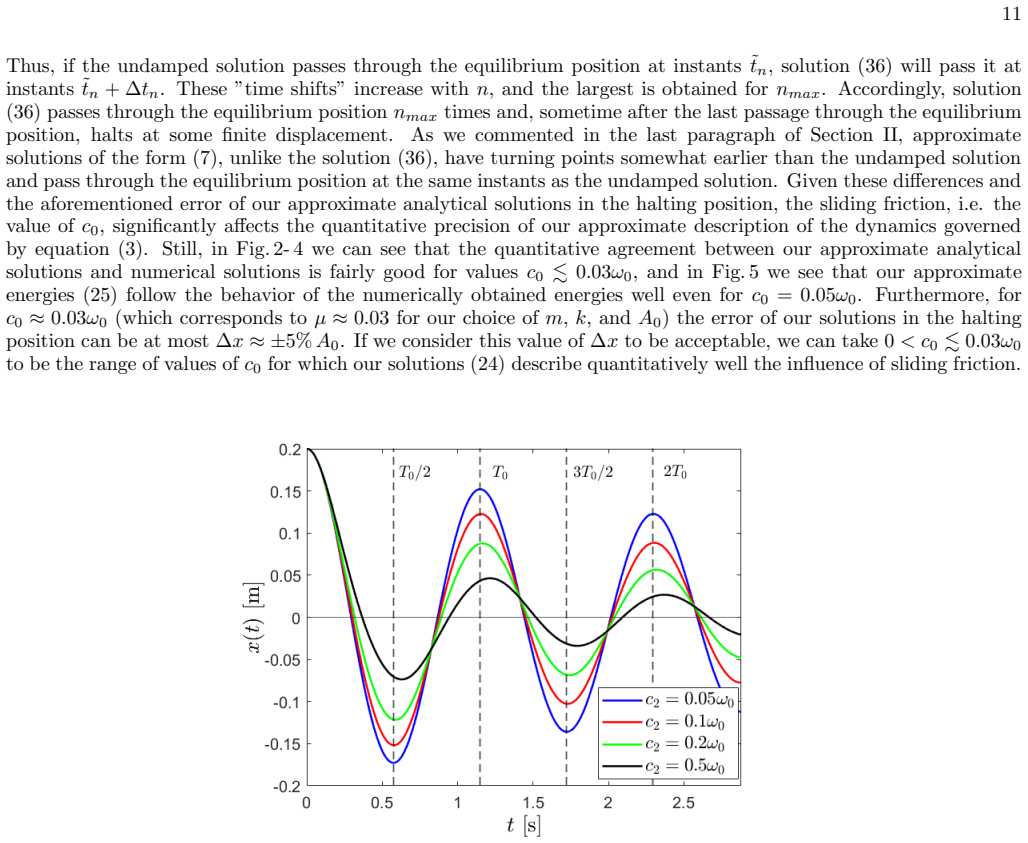
The central claim is that for a damped block-spring oscillator with total damping force $F_d=-\operatorname{sgn}(v)\mu m g-bv-Dv|v|$, weakly damped motion is accurately approximated by $x_i(t)=A_0 f_i(t)\theta_i(t)\cos(\omega_0 t+\varphi_0)$, with the envelope $f_i$ obtained from the separable equation $df/dt=-(c_2f^2+c_1f+c_0)$ and with $\theta_i$ truncating the solution at the stopping time $\tau_i$ where $f_i=0$. Depending on the sign of $C=4c_2c_0-c_1^2$, the envelope is a tangent, a hyperbolic tangent, or a rational function, with all three cases given in closed form. The same construction yields closed formulas for the two-force cases, including sliding friction combined with quadratic damping, which the authors report not finding elsewhere in the literature. Comparisons with numerical solutions show close agreement in the regime $c_0+c_1+c_2\ll\omega_0$, with suggested working limits $c_0\lesssim 0.03\omega_0$, $c_1\lesssim 0.1\omega_0$, and $c_2\lesssim 0.1\omega_0$.
Load-bearing premise
The load-bearing premise is that the damped motion keeps the undamped frequency and initial phase while the amplitude shrinks slowly, so the velocity can be written as if the phase never shifts; if damping is strong enough to shift the phase or frequency appreciably, the closed-form envelope formulas lose quantitative accuracy.
Editorial extensions
If this is right
- For any weak combination of the three forces, envelope, energy, and stopping time are available in closed elementary form, so a laboratory can test the stopping-time formulas $\tau_i$ without numerical integration.
- The presence of sliding friction makes the approximate motion halt in finite time at the equilibrium position, with worst-case halt-position error at most $\pm\mu m g/k$.
- Without sliding friction, the linear-plus-quadratic case decays asymptotically and never halts, showing that constant friction qualitatively changes the long-time behavior.
- The same derivation covers all pairwise combinations, so one energy-averaging step unifies textbook treatments of Coulomb, viscous, and quadratic damping.
- The predicted duration of free oscillations becomes a measurable quantity whose dependence on $\mu$, $b$, $D$, and initial amplitude can be checked by students.
Reading between the lines
- Editorial extension: since $c_2$ grows with the initial amplitude $A_0$ while $c_0$ shrinks with it, changing only the initial displacement can move one physical system across the $C>0$, $C<0$, and $C=0$ branches, offering a clean experimental test of all three solution forms.
- Editorial extension: the same half-period averaging of powers of $|\sin|$ would produce envelope equations for damping forces proportional to $|v|^p$ for other powers $p$, hinting at a unified family of closed-form decay laws beyond the three forces treated here.
- Editorial extension: the authors observe that viscous damping can shift the initial phase more than the frequency; an improved ansatz with damping-adjusted amplitude and phase is the natural next step, and would likely extend accuracy near the upper bound $c_1\approx0.1\omega_0$.
Editorial analysis
A structured set of objections, weighed in public.
Referee Report
Summary. The paper derives approximate closed-form expressions for the amplitude envelope, energy, and stopping time of a harmonic oscillator subject to the simultaneous action of Coulomb (constant) friction, linear viscous damping, and quadratic (velocity-squared) damping. Starting from the energy dissipation rate dE/dt = F_d v and the slowly-varying amplitude ansatz x(t)=A0 f(t) cos(ω0t+φ0), the authors average the dissipation over half periods and obtain the Riccati equation df/dt = -(c2 f^2 + c1 f + c0) with coefficients given in Eq. (15). They solve this equation in closed form for the three cases of the discriminant C = 4c2c0 - c1^2, provide the corresponding stopping times, treat the two-force limits, and present comparisons with numerical solutions of Eq. (3). The central claim is that Eqs. (24) provide an excellent description of the dynamics when c0 + c1 + c2 ≪ ω0.
Significance. The work is valuable for undergraduate teaching and for engineering approximations: the derivation uses only elementary calculus, and the final formulas are explicit and simple to evaluate. It generalizes the single-force treatment of Ref. [11] to the simultaneous action of all three damping mechanisms, including the finite stopping time due to Coulomb friction. However, the printed solution for the C<0 case, Eq. (19), is not a well-defined real-valued elementary function, so the manuscript in its current form is not self-contained and the central claim cannot be verified directly from the text.
major comments (1)
- [Section III, Eq. (19)] For C < 0 with c0,c1,c2 > 0, the quantity (2c2+c1)/√(-C) always exceeds 1, because (2c2+c1)^2 - (-C) = 4c2(c0+c1+c2) > 0. Consequently, the real arctanh in Eq. (19) is undefined, and the printed formula for f2(t) cannot be evaluated as an elementary real-valued expression. The correct solution in this regime is f2(t) = (1/(2c2))[√(-C) coth( (√(-C)/2) t + arctanh( √(-C)/(2c2+c1) ) ) - c1], which is needed to reproduce Figs. 3 and 6(c)-(d) and the energy and stopping-time expressions built on it. This is a load-bearing defect in the closed-form solution and must be corrected.
minor comments (4)
- [Section V, Figs. 7-8] The claimed validity ranges c0 ≲ 0.03ω0, c1 ≲ 0.1ω0, and c2 ≲ 0.1ω0 are inferred from visual inspection of the numerical solutions; adding a quantitative error measure, such as the maximum relative deviation of the envelope or the phase over the oscillating interval, would make the 'excellent description' claim more objective and reproducible.
- [Section III, Eqs. (20) and (23)] The expression for f3(t) should be typeset so that the denominator is clearly (√c2 t + 1/(√c2+√c0))^{-1}; the current rendering '√c2 t + 1/√c2 + √c0' is ambiguous and could be misread as 1/√c2 + √c0. The same clarification is needed for τ3 in Eq. (23).
- [Section II, Eq. (13)] The averaging step is described as averaging over time intervals ΔT/2; it would help to state explicitly that this assumes f(t) changes negligibly over a half-period, since the slowly-varying assumption is otherwise stated only in terms of |df/dt| ≪ ω0.
- [Section II, numerical methods] The numerical comparisons use Matlab's ode45, but the solver tolerances and output grid are not reported; specifying these would improve reproducibility of the figures.
Circularity Check
No significant circularity: the envelope equation is derived from explicit energy-balance averaging and validated against independent numerics; self-citation is only contextual.
full rationale
The central derivation is self-contained. The paper starts from the exact damping force (1) and the exact energy dissipation rate (6), adopts the explicitly stated weak-damping ansatz (7)-(9), averages the trigonometric factors over half-periods in Eqs. (12)-(13), and obtains the first-order envelope ODE (14) with coefficients (15). Equations (18)-(23) are direct separation-of-variables solutions of that ODE, and the displacement and energy expressions (24)-(25) follow by construction. No parameter is fitted to the numerical solutions; the numerical comparisons in Figs. 2-6 and 8 are external checks against the original equation of motion (3). The only self-citation with any role in the argument is [21], used in Section V to set c1 ≲ 0.1ω0 as the upper validity limit for the viscous part; this same value is also exercised directly in Fig. 8, so the self-citation is not load-bearing for the central claim. The method deliberately follows the earlier approach of [11], but the derivation is restated fully in Section II rather than smuggled in by citation. A separate non-circularity issue is that Eq. (19), as printed, uses a real arctanh with argument larger than 1 when C<0, which is a branch/typographical defect that should be corrected for reproducibility; this does not affect the circularity verdict. Score 2 reflects the presence of a minor, non-load-bearing self-citation, not a circular derivation.
Assumptions & free parameters
assumptions (5)
- domain assumption The damped motion is well approximated by x(t) = A0 f(t) cos(ω0t + φ0) with |df/dt| << ω0, so velocity can be approximated without the df/dt term.
- standard math Energy dissipation rate equals the power of the damping force, and the envelope energy is E = mω0^2 A0^2 f^2/2.
- standard math Trigonometric averages over half a period: ⟨|sin|⟩ = 2/π, ⟨sin²⟩ = 1/2, ⟨|sin|³⟩ = 4/(3π).
- standard math The Riccati equation (14) is solved by separation of variables, with three cases depending on the sign of C = 4c2c0 - c1^2.
- domain assumption Dynamic and static friction coefficients are taken to be equal.
Cite this review
Pith. "Pith review of The amplitude decay of a harmonic oscillator damped simultaneously by weak linear and nonlinear damping forces." pith.science (2026). https://pith.science/paper/IP6JWVSX
@misc{pith2026250207458,
  author       = {Pith},
  title        = {Pith review of: The amplitude decay of a harmonic oscillator damped simultaneously by weak linear and nonlinear damping forces},
  year         = {2026},
  howpublished = {\url{https://pith.science/paper/IP6JWVSX}},
  note         = {Machine review of arXiv:2502.07458}
}
read the original abstract
We derive approximate expressions for the amplitude decay of harmonic oscillations weakly damped by the simultaneous action of three different damping forces: force of constant magnitude, force linear in velocity, and force quadratic in velocity. Our derivation is based on a basic understanding of the undamped harmonic oscillator and the connection between the energy dissipation rate and the power of the total damping force. By comparing our approximate analytical solutions with the corresponding numerical solutions, we find that our solutions excellently describe the dynamics of the oscillator in the regime of weak damping by combinations of these three forces for an experimentally relevant range of corresponding damping constants. The physical concepts and mathematical techniques we employ are suitable for undergraduate physics teaching.
Figures


Figures from the paper (5 more)



Reference graph
Works this paper leans on
-
[11]
X. Wang, C. Schmitt, and M. Payne. Oscillations with three damping effects. European Journal of Physics, 23(2):155–164, jan 2002
work page 2002
-
[21]
K. Lelas and R. Pezer. Modeling the amplitude and energy decay of a weakly damped harmonic oscillator using the energy dissipation rate and a simple trick. European Journal of Physics , 46(1):015004, dec 2024
work page 2024
- [1]
-
[2]
David Halliday, Robert Resnick, and Jearl Walker. Fundamentals of Physics . John Wiley & Sons, 2013
work page 2013
-
[3]
Hugh D. Young and Roger A. Freedman. University Physics with Modern Physics . Pearson, 2020
work page 2020
- [4]
-
[5]
I. R. Lapidus. Motion of a harmonic oscillator with sliding friction. American Journal of Physics , 38(11):1360–1361, nov 1970. 14
work page 1970
-
[6]
A. Marchewka, David. S. Abbott, and R. J. BeichnerKamela. Oscillator damped by a constant-magnitude friction force. American Journal of Physics , 72(4):477–483, apr 2004
work page 2004
Show all 22 references
-
[7]
Anastasios Adamopoulosa and N
A. Anastasios Adamopoulosa and N. Adamopoulos. Constant and quadratic damping of free oscillations: easy solutions. International Journal of Mathematical Education in Science and Technology , 53(11):3151–3161, jan 2022
2022
-
[8]
M. Kamela. An oscillating system with sliding friction. The Physics Teacher, 45(2):110–113, feb 2007
2007
-
[9]
B. R. Jr. Smith. The quadratically damped oscillator: A case study of a non-linear equation of motion. American Journal of Physics , 80(9), sep 2012
2012
-
[10]
C. E. Mungan and T. C. Lipscombe. Oscillations of a quadratically damped pendulum. European Journal of Physics , 34(5):1243–1253, jul 2013
2013
-
[12]
P. T. Squire. Pendulum damping. American Journal of Physics , 54(11):984–991, nov 1986
1986
-
[13]
P. H. Markho. On free vibrations with combined viscous and coulomb damping.Journal of Dynamic Systems, Measurement, and Control, 102(4):283–286, dec 1980
1980
-
[14]
Ricchiuto and A
A. Ricchiuto and A. Tozzi. Motion of a harmonic oscillator with sliding and viscous friction. American Journal of Physics , 50(2):176–179, feb 1982
1982
-
[15]
P. F. Hinrichsen and C. I. Larnder. Combined viscous and dry friction damping of oscillatory motion. American Journal of Physics , 86(8):577–584, aug 2018
2018
-
[16]
R. A. Nelson and M. G. Olsson. The pendulum—rich physics from a simple system. American Journal of Physics , 54(2):112–121, feb 1986
1986
-
[17]
M. E. Bacon and D. D. Nguyen. Real-world damping of a physical pendulum. European Journal of Physics, 26(4):651–655, may 2005
2005
-
[18]
M. V. Vitorino, A. Vieira, and M. S. Rodrigues. Effect of sliding friction in harmonic oscillators. Scientific Reports, 7:3726, jun 2017
2017
-
[19]
J. A. Rizcallah. Revisiting the coulomb-damped harmonic oscillator. European Journal of Physics , 40(5), aug 2019
2019
-
[20]
Damped harmonic oscillator revisited: The fastest route to equilibrium
Karlo Lelas, Nikola Poljak, and Dario Juki´ c. Damped harmonic oscillator revisited: The fastest route to equilibrium. American Journal of Physics , 91(10):767–775, 10 2023
2023
-
[22]
B. K. Karthik, R. B. Shreesha, V. Shrikanth, and A. K. Gaonkar. Prediction of energy dissipation by analytical solution to combined viscous and coulomb damping. Journal of Sound and Vibration , 573:118216, 2024
2024
Reviewed August 8, 2026 · model on record in the stance chip above.
Discussion (0). Continue with ORCID to comment.