Stable levitation needs damping—but only within a bounded range
A six-degree-of-freedom model and experiments map the window of rotation speed and damping that keeps the magnet aloft.

Classical Physics
Newtonian and relativistic dynamics; many particle systems; planetary motions; chaos in classical dynamics. Maxwell's equations and dynamics of charged systems and electromagnetic forces in materials. Vibrating systems such as membranes and cantilevers; optomechanics. Classical waves, including acoustics and elasticity; physics of music and musical instruments. Classical thermodynamics and heat flow problems.
sort pith recommended most recent
A six-degree-of-freedom model and experiments map the window of rotation speed and damping that keeps the magnet aloft.
The second WKB field component's phase rises with distance inside the layer, recasting where reflection occurs.
· “Generation of a reflected wave in an inhomogeneous medium”
In a 1D elastoplastic bar, it finds the smallest additive fix keeping dissipation non-negative at every instant.
· “Solving the Dissipation Inequality not as a constitutive restriction”

The impulse from turning off the field is set by the vector potential, so the source matters.

The angular-momentum parameter covers all conic paths; add flight time and one orbit remains.
· “Connect the dots ... finding all possible orbits between two points”
Any second-order equation of motion gets an explicit doubled Hamiltonian whose physical slice reproduces the original dissipative dynamics.

In a gapped three-band system, eigenmode exchange follows fixed braid words; acoustic cavities show it.
· “Topological Braiding of Bloch Eigenmodes Protected by Non-Abelian Quaternion Invariants”
A passive track converts the carriage's harmonic motion into hoisting, cutting energy from 482 to 248 J per lift.
· “Energetically efficient, mediated mechanical system for precise control of hoisting operations”

Simulations predict declination residuals above the 30-microarcsec threshold in up to 60% of realizations at apocenter.
· “Impact of a granular mass distribution on the orbit of S2 in the Galactic center”

The distorted Hamiltonian a symplectic method samples changes with coordinates; a careful choice can raise the observed order.
· “On the coordinate system-dependence of the accuracy of symplectic numerical methods”

Closed-form amplitudes and stopping times match numerics when total damping stays well below the natural frequency.

Friction from d'Alembert's principle gives a redshift that grows with density and distance squared.

If local conservation of charge holds in 3D space, the field equations must take Maxwellian form, and Newtonian physics fails.
· “On the "Universality" of the Form of Maxwell's Equations”
Resonance changes each beam's push, so particles of different sizes drift apart and can be collected separately.
· “Acoustic angular sorting of resonant subwavelength particles”

New writings unify compatibility, momentum, and differentiated material laws for anisotropic wave equations.
· “Alternative writings of classical elastodynamics equations as a first order symmetric system”
Mapping any bounded motion onto a Kepler ellipse yields a conserved vector and a dynamical symmetry group.
· “About the Keplerization of motion in any central force field”
Admitting imperfect material laws, a dual-to-primal mapping yields entropy production as an equality with minimal excess fields.
· “The Second Law as a constraint and admitting the approximate nature of constitutive assumptions”
A neural surrogate replaces slow per-atom FDTD solves, enabling a 1-mm metalens to be optimized in about four minutes.
· “On-demand Quick Metasurface Design with Neighborhood Attention Transformer”
Eisenhart-lift geometry rewrites Ermakov, oscillator, and Morse systems as a free particle.
Onset pressure climbs 4 percent at typical embouchure; the pressure at which sound stops falls 40 percent.
· “Oscillation threshold of a Raman clarinet with localized nonlinear losses at the open end”

A Wigner-function input lets one neural network tune spectrum and duration of supercontinuum light on demand.
· “Engineering spectro-temporal light states with physics-embedded deep learning”

At deformed contact points friction does more work than at the center of mass—the surplus heats the material.

Slow starts swing low and range grows linearly with speed; fast starts approach the 45-degree projectile limit.
· “Theoretical analysis of the maximum range of a projectile released from a pendulum”

In one dipole-conserving Hamiltonian, a homogeneous expanding ball and an arrow of time emerge from random data.
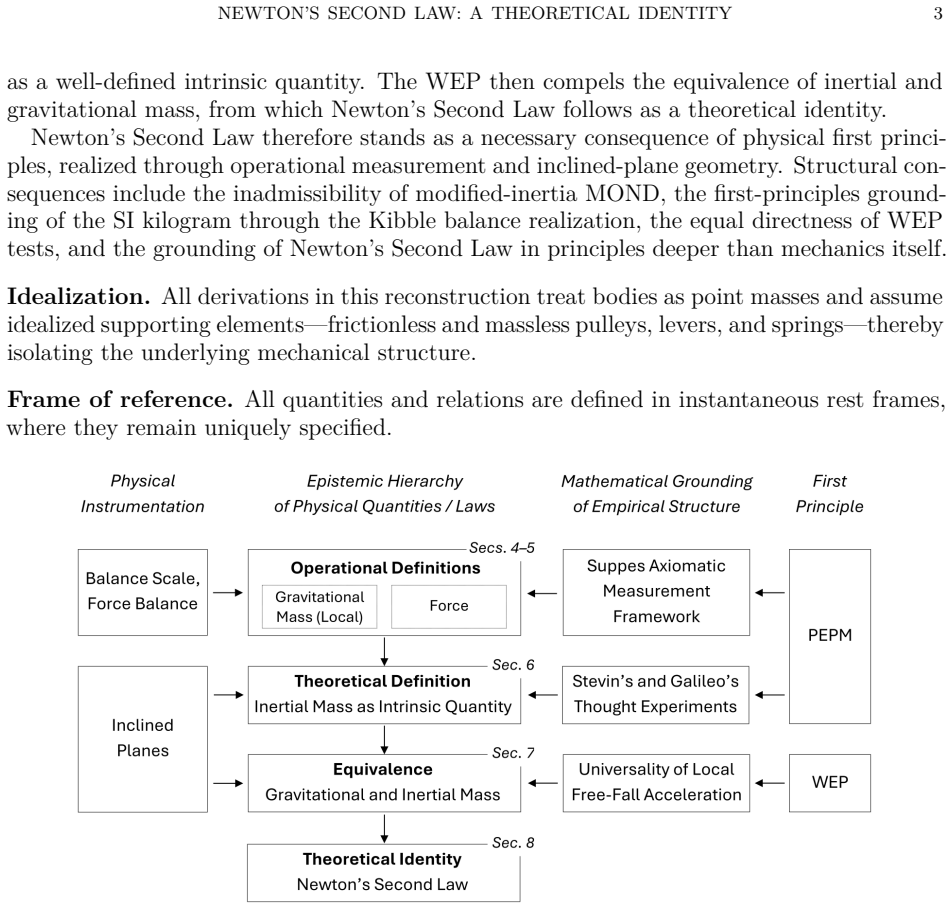
A new derivation gets F=ma out of two physical principles, making it an identity between measured quantities.
A second Hamiltonian, compatible Poisson brackets, and a Lax pair all appear on that locus; closed orbits alone mislead.
· “Integrable curl-force Hamiltonians: bi-Hamiltonian structure, separability, and periodic orbits”
Two-family fabrics miss mixed second derivatives; a third oblique direction closes the gap.
· “On the synthesis of complete two-dimensional second-gradient continua: Tri-pantographic fabrics”
A single energy functional decides emission vs. cleavage; fracture resistance stays elastic in the dissipationless limit.

Linear elastic rod theory links a knot's handedness to the shape it takes when pulled tight.
Encoding separate streams on the x, y, and z components of particle velocity, one vector sensor recovers them in real time.
· “High-Capacity and Real-Time Acoustic Communication by Multiplexing Velocity”
The effect vanishes when both bodies have equal moments of inertia, and vertical spring placement restores a fixed center.
· “On the edge of complexity: The simplest not simple coupled mechanical system”
Experiments and simulations show the ray count and rotation are set by flow rate and diffusivity ratio.
· “Radially Locked Sun-Ray Patterns in Autocatalytic Reaction-Diffusion-Advection Systems”
Configurational entropy's finite-size gap is a surface-to-volume effect linking geometry to plastic crystals and colloids

Koch-snowflake pins trap shear waves where circular arrays fail; response saturates by the third iteration.
· “Scattering of Antiplane Shear Waves by Fractals in Strain Gradient Elasticity”

A single relative-entropy split reveals that hot-cooling and symmetry-restoration anomalies are the same physics.
· “A resource theoretical unification of Mpemba effects: classical and quantum”

Rocks' curved strength envelope is the stress-space image of the linear Drucker-Prager criterion.

With rolling masses at (√1729−1)/36 of the other masses, the natural frequency is exactly √(k/m), not just close.

Raising two penalty coefficients turns a defect-rich continuum model first into Timoshenko, then Euler-Bernoulli.
· “A New Framework for Unidimensional Structures Based on Generalised Continua”
A 3D flume model validated to within ±15 percent shows which settings favour dewatering.
· “Numerical investigation on solids settling in a non-Newtonian slurry inside a horizontal flume”

A phase-locked feedback loop locks the system onto the one state that maximizes efficiency, beating parity-time-symmetric designs.
· “Clock Pulling Enables Maximum-Efficiency Wireless Power Transfer”

Using measured roughness and finite-element pressures, predicted leak rates fall inside the measured range.
· “Leakage at interfaces: a comprehensive study based on Persson contact mechanics theory”

The first-order four-wave correction keeps mode occupations accurate up to b = 200 in NSE, MMT, and FPUT-beta models.
· “The equilibrium distribution function for strongly nonlinear systems”

Real-valued angular indices create a continuum of singular-but-finite field modes, testable in conical cavities.
· “Full Vectorial Maxwell Equations with Continuous Angular Indices”
A direct Coulomb-gauge calculation gives a nonzero vector potential where the Yang-Nevels equation predicts zero.
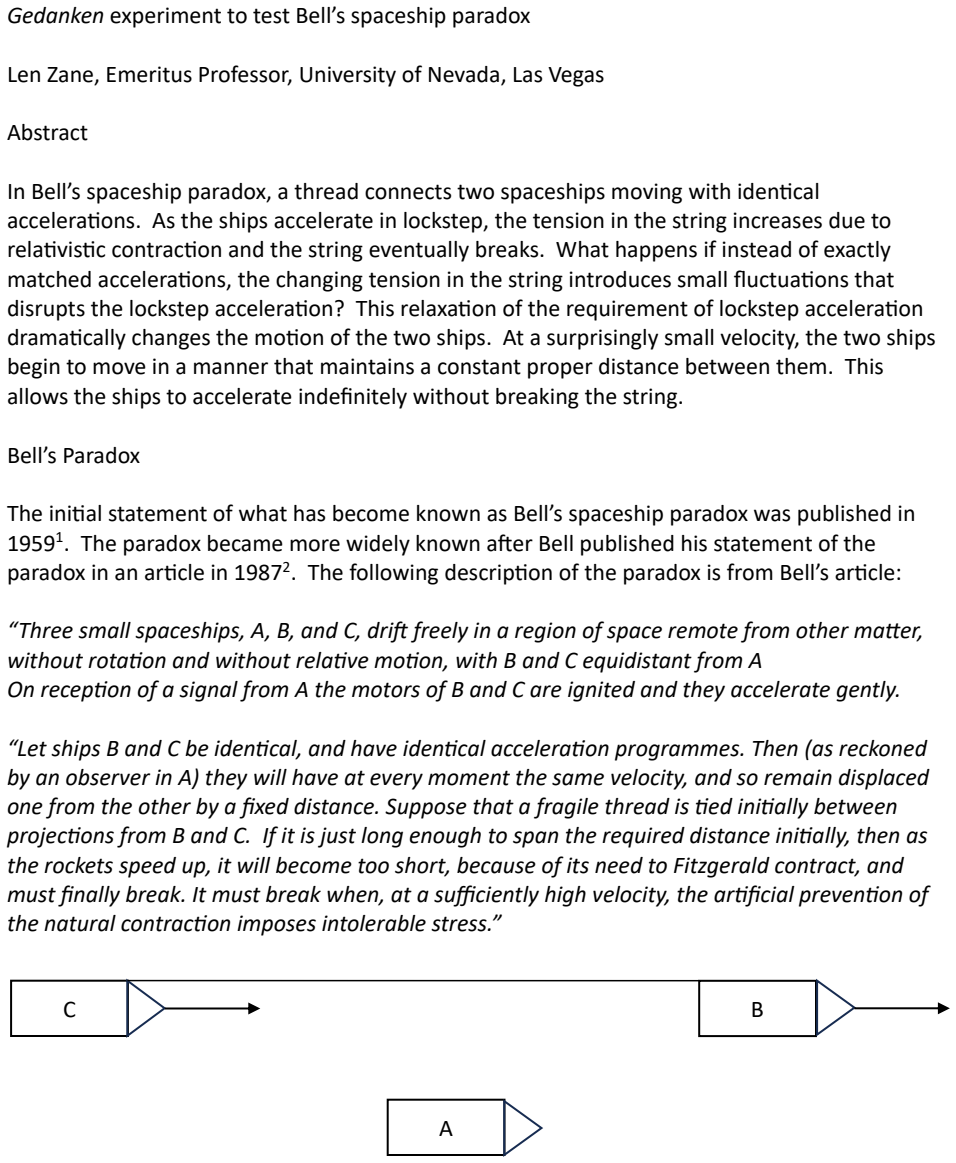
At 80,000 m/s the thread's tension self-corrects and proper distance stays fixed forever.
A complete derivation of 3D car-crash impact shows Virtual CRASH behaves like PC-Crash, not as its manual claims.
· “Three-Dimensional Rigid-Body Impact Mechanics for Automobile Collisions”

Static, temporal, moving, and dispersive metasurface interfaces all reduce to special cases of a single spacetime formula.
· “Electromagnetic Boundary Conditions for Space--time Interfaces”

Treating gauge potentials as 1-forms removes ad hoc symmetrization and fuses canonical and Hilbert tensors.
6-wave resonances balance only opposing mode pairs, then freeze; nonlinear broadening finishes thermalization.

Slow temperature sweeps then obey T^(1−µ) dψ/dT, with µ set by material disorder statistics.
· “Microscopic Origins of Conformable Dynamics: From Disorder to Deformation”
A pressure imbalance between close pebbles offers a non-sticky route past the usual growth barriers.

A retarded part plus a gradient correction built from the scalar potential; fields still propagate at light speed
· “Direct, analytic solution for the electromagnetic vector potential in any gauge”
Mapping spins to canonical coordinates reveals ensemble refocusing as a collapse of stability-matrix elements.
· “The robustness of composite pulses elucidated by classical mechanics: Stability around the globe”

A proposed action with fluid equations as constraints would derive these waves and feed the Navier-Stokes problem.
One force balance yields the rule of 2, the mirror rule, and a magnetic stand-in for the guiding wire.
Migrating planets should feel the non-axisymmetric disc, both directly and indirectly; the disc itself should not.
· “On inertial forces (indirect terms) in problems with a central body”

The book's worth rests on solutions students can follow and answers that check out.
Disks pack hexagonally and bars align nematically, yet both give the same smooth force rise when compressed.
· “Static and dynamic ordering of magnetic repelling particles under confinement: disks vs bars”
A capstan-based model with a massed string matches video-tracked fall distances across mass ratios.
· “Modelling the non-linear dynamics of the looping pendulum”

Small changes in hole size, chimney, or bore length convert directly into cents per millimeter of intonation error.

A missing flux term fixes the least-action test and recovers the standard canonical momentum and energy levels.
· “On the action for a charged particle moving in a magnetic field”

Ideal, soft, and rigid couplings solved explicitly; a weak-interface recipe estimates hidden damage from top-face measurements.

Elastic-joint robot controllers need torque rates; this spatial recursion delivers them in linear time.

Closed forms give the full trajectory and a launch-angle-independent period for teardrop-heart orbits.

A proof shows odd petals need cos(nθ), even petals cos(2nθ), and no intermediate harmonics.

Četaev-based and vakonomic kinematics agree only when the constraint's Lagrangian derivatives fall in the right span.
· “On the transpositional relation for nonholonomic systems”
Repeated rebounds dominate; contact time tracks the slowest cable mode, not stiffness.
· “Impacts between multibody systems and deformable structures”
Induced plate charges change the transit time; exact psi-function potential shows by how much.
· “On the motion of a point charge in a plate capacitor considering influence effects”

Narrow sheets shear and tilt; wide sheets fracture via anchored dislocations that open into cracks.
· “Defect-free and defective adaptations of crystalline sheets to stretching deformation”

Exact formula unifies uniform, edge-concentrated, and intermediate profiles; only the elliptic integral K remains.
· “Modeling the Electrostatic Potential of Disks with Arbitrary Radial Charge Profiles”

A coordinate-free Lie-derivative proof recovers the 2+1 and 1+1 dimensional sectors of 4D vacuum electrodynamics.
· “Electromagnetism: an intrinsic approach to Hadamard's method of descent”
Read Boltzmann's own 1898 argument that entropy curves fluctuate, and a new formula for how bias multiplies humps.
· “A commented translation of Boltzmann's work, "Ueber die sogenannte H-Curve."”

45° slant inverse Compton scattering matches head-on geometry for high-degree-of-polarization gamma rays.

New closed-form solution shows where stress peaks sit in ring-test specimens as hole size and load width vary.
· “Stress distribution in elastic disks with a hole under uniaxial compression”

Fields are computed from charges on the past light cone and transformed to the moving observer's rest frame.
· “Seeing through the light cone: Visualizing electromagnetic fields in special relativity”

A fixed grating can move, split, and merge polarization singularities just by rotating a uniaxial crystal's axis.
The disk's equations match the diffusionless Lorenz model, uniting chaos, periodic orbits, and steady spin.
· “The Upward-Driven Disk, a Steadily Forced Chaotic Pendulum”

Rheology plus dilatancy yields existence, uniqueness, and positive pressure via energy dissipation.
Per-post resonances violate the cavity boundary conditions; whole-block even/odd modes restore standard filter synthesis.

A 0.01 K change over 100 km of fiber should shift phase by about 3190 radians; the paper shows why.
· “Elastically induced phase-shift and birefringence in optical fibers”
