REVIEW 3 major objections 5 minor 113 references
HarmonyCut: Supporting Creative Chinese Paper-cutting Design with Form and Connotation Harmony
T0 review · 3 major / 5 minor · reviewed 2026-08-08 · deepseek-v4-flash
Pith's one-line read The paper claims that a structured design space, not a bigger model, is what lets generative AI keep Chinese paper-cutting's form and cultural meaning aligned.
desk verdict Solid HCI system paper with a real design-space contribution, but the 'form-connotation alignment' claim outruns what the study measures. read the letter →
The pith
A machine-rendered reading of the paper's core claim, the machinery that carries it, and where it could break.
The reading
What carries the argument
The load-bearing object is the paper-cutting design space: four ideation factors (Function, Subject Matter, Style, and Method of Expression) together with a Pattern taxonomy that divides patterns into Unit Patterns (geometric, semantic, and sawtooth) and Composite Patterns (primary and decorative). The taxonomy converts a rough intent into factor-structured idea descriptions, grounds the LLM's explanations in annotated domain knowledge, and supplies the retrieved works, segmented contours, and unit patterns that users assemble on an interactive mood board. The semiotic pairing of a pattern's form (signifier) with its meaning (signified) is the mechanism the system claims to preserve, and it is what distinguishes HarmonyCut from unstructured text-to-image generation.
What would settle it
Have several independent paper-cutting experts code a stratified sample of paper-cuttings using the published taxonomy and measure inter-coder agreement; if agreement is low or a substantial share of works cannot be classified into the four factors and the pattern categories, the design space is not comprehensive and the recommendations built on it would systematically mislead users.
Extended reading notes
Core claim
The central claim is that the alignment of form and connotation in paper-cutting can be engineered into a generative-AI design tool by making the craft's hidden knowledge explicit. The authors identify four core factors that structure ideation — Function, Subject Matter, Style, and Method of Expression — and define Pattern as the key element, a semiotic unit with both a shape (signifier) and a cultural meaning (signified). HarmonyCut operationalizes this design space: the LLM suggests factor-relevant content with interpretations, a fine-tuned retrieval model finds related existing works, a text-to-image model offers new compositions, and segmentation plus unit-pattern extraction let users edit and combine what they want rather than accepting end-to-end outputs. The comparative evidence is that the same underlying generative models, wrapped in this structure, produced more diverse exploration, more controllable editing, and stronger expressiveness in the user study, and that expert inheritors recognized the cultural meaning of the suggested content.
Load-bearing premise
The design space was built by a single coder annotating 140 paper-cuttings, with disagreements settled by discussion among the same five experts who helped shape it, so its completeness across the full regional and historical range of Chinese paper-cutting is assumed rather than measured.
Editorial extensions
If this is right
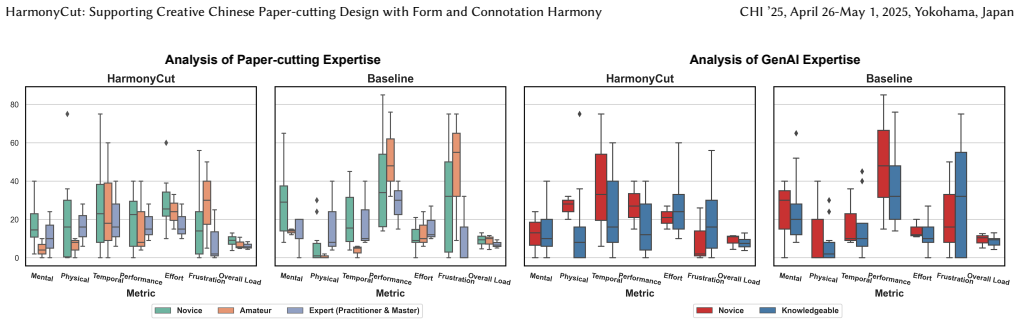
- HarmonyCut users reported significantly lower mental workload during ideation than baseline users (p=0.026), even though the tool asks them to choose factors and inspect references.
- Exploration and editing flexibility improved sharply (p=0.0029 and p<0.001), and overall Creativity Support Index rose from 52.79 to 73.25 (p=0.0013).
- The editable mood-board workflow lets users segment contours, extract unit patterns, and rearrange SVG elements, directly addressing the black-box limitation of end-to-end generation.
- Paper-cutting inheritors with 20-40 years of experience said the factor-guided suggestions did not constrain their creativity and that the interpretations would help the public learn regional traditions.
- Novices used the retrieved references partly as models for imitation, which the experts treat as a legitimate early stage in learning the craft.
Reading between the lines
- Implicit in the results is a transferable recipe: for any craft with a dense symbolic vocabulary, the hard step is curating and structuring knowledge, not improving the generator; the same factor-plus-pattern template could apply to embroidery, shadow puppetry, or batik.
- A fairer validation of the design space would have independent coders, not the five experts who helped build the taxonomy, apply the codebook to fresh paper-cuttings; the paper reports no inter-rater reliability, so comprehensiveness remains the central open question.
- Because retrieval is limited to 701 monochrome works, the exploration space is narrow by construction; expanding the annotated corpus with regional, contemporary, and multicolored work would likely raise both retrieval relevance and the quality of the LLM's cultural explanations.
Editorial analysis
A structured set of objections, weighed in public.
Referee Report
Summary. The paper proposes HarmonyCut, a generative-AI-based creativity support tool for Chinese paper-cutting design. The authors first conduct a formative study (N=7) and a content analysis of 140 paper-cutting images to derive a design workflow (ideation and composition) and a design space comprising four ideation factors (Function, Subject Matter, Style, Method of Expression) and a pattern taxonomy (Unit and Composite Patterns). The system then operationalizes this design space through factor-oriented LLM guidance, CLIP-based retrieval and DALL-E-3 generation of references, SAM-based contour segmentation, and an editable SVG mood board. The evaluation is a within-subjects user study (N=16) comparing HarmonyCut against a generic ChatGPT/DALL-E-3 baseline, plus interviews with three paper-cutting inheritors. The reported results show significant improvements on exploration, editing flexibility, expressiveness, and overall CSI, and a mixed pattern on NASA-TLX. The paper claims that these studies demonstrated that the system maintains alignment between visual form and cultural connotation.
Significance. If its central claim were fully supported, HarmonyCut would be a valuable contribution to HCI and cultural-heritage computing: it integrates domain knowledge with generative models in a structured, editable pipeline, and it addresses a real problem—the risk that generic GenAI produces culturally inappropriate or homogenized outputs for traditional crafts. The paper also provides a useful methodological template: a formative study grounded in interviews with practitioners, a content-derived taxonomy, and a comparison against a generic-GenAI baseline. The strengths include the two-stage workflow grounded in expert input, the within-subjects counterbalanced design, the inclusion of participants with diverse levels of paper-cutting and GenAI expertise, and an expert evaluation with recognized inheritors. The dataset and fine-tuned models, while modest in scale, are described concretely and could support follow-up work. However, the evaluation does not directly measure the headline construct of form-connotation alignment, and the taxonomy's generalizability rests on a small single-coder sample; both issues need to be addressed or the claims appropriately softened.
major comments (3)
- [§7, Table 4] The abstract and §9 state that the studies "demonstrated" that HarmonyCut maintains alignment between form and cultural connotation, but no dependent variable in the reported evaluation measures this construct. The design-goal questionnaire (§7.2) asks about idea generation, broad exploration, and editing flexibility; the NASA-TLX measures workload; and the CSI measures perceived creativity support. None of these instruments assesses whether the users' final paper-cutting designs were culturally correct or whether the form-connotation pairings were appropriate. The only cultural evidence is the qualitative expert interview (§7.3.1), which is based on prompted discussion with three inheritors and includes no systematic scoring, no blind comparison of HarmonyCut outputs against baseline outputs, and no inter-rater reliability. A system could obtain identical scores on all reported measures while consistently recommending culturally inappropriate subject-pattern combinations. To support the central claim, the authors should either add a direct outcome measure (e.g., expert artifact ratings on form-connotation correctness, blind to condition) or revise the abstract, §1, and §9 to claim only that the system supports users' perceived ideation, exploration, and editing without claiming demonstrated alignment.
- [§4.2–§4.3, Appendix B] The design-space taxonomy—the four ideation factors and the 25-unit/42-composite pattern taxonomy—is derived from content analysis of only 140 annotated paper-cuttings, with all instance-level coding performed by the first author and reliability handled through majority vote in a single expert-guided discussion rather than through independent coding with inter-rater reliability statistics. The taxonomy is then used as the domain knowledge base that drives the LLM guidance, the CLIP retrieval fine-tuning, and the pattern classification (§6), so any incompleteness or regional bias in the 140-image sample would systematically propagate into the recommendations and generation. The paper's own limitation discussion (§7.3.5, §8.3) acknowledges that the dataset is the bottleneck, but the main text still calls the design space "relatively comprehensive" without reporting reliability or sampling justification. The authors should either report inter-rater reliability for the coding of both the ideation factors and the patterns, or explicitly frame the taxonomy as a preliminary, region-limited design space with correspondingly restricted claims.
- [§7.3, Table 4] Several of the significant differences reported as evidence for the system's value can be explained by generic interface affordances rather than by cultural knowledge. For example, the large Editing difference (p=0.00003) is expected because the baseline tool has no direct editing capability at all, and the Exploration difference (p=0.0029) is plausibly driven by the added retrieval and mood-board functions rather than by connotation-aware guidance. Meanwhile, the Ideation measure itself is non-significant (p=0.472). The paper should therefore temper the conclusion that the results validate the cultural-knowledge design space, and should explicitly discuss the alternative explanation that the user-facing benefits come mostly from the editing and reference-exploration interface rather than from the cultural taxonomy.
minor comments (5)
- [§8.1] There is a typo in "controllabliltiy" that should be corrected.
- [Figure 1] The labels "CBA" in the overlap of the two workflow stages are unclear; please spell out the stage names in the figure or the caption.
- [§6.2.1] The retrieval evaluation reports recall@1/5/10 but not a comparison against the unfine-tuned Chinese CLIP model; such a comparison would help the reader assess the value added by fine-tuning on the 140-image dataset.
- [§6.2.2] The segmentation step relies on the user clicking objects and backgrounds with two labels; the paper does not report how many participants encountered segmentation failures or how often manual repair was needed, which would be relevant to the reported higher physical load and effort.
- [§7.3.4] The NASA-TLX Performance measure is treated as if higher scores mean better performance, but in the standard TLX, lower scores on this subscale indicate better perceived performance. The direction should be clarified, since the reported means suggest HarmonyCut users felt they performed better, which is consistent with the qualitative data, but the current wording is ambiguous.
Circularity Check
No significant circularity: the taxonomy, system, and evaluation are not linked by construction.
full rationale
The paper's derivation chain is empirical rather than formal: the design space is induced from a content analysis of 140 annotated paper-cuttings with iterative expert discussion (Section 4), the tool is built on that design space and on fine-tuned CLIP/ViT models evaluated on held-out data (Section 6.2), and the evaluation uses standard user-study instruments plus qualitative expert interviews (Section 7). No predicted quantity is defined in terms of the data it is supposed to explain, and no fitted parameter is renamed as a prediction. The retrieval and pattern-recognition metrics (recall@1, precision, F1) are reported on validation splits of the same annotated dataset; this limits generalizability but is not circular. The self-citations (Wan and Lu 2023; Wan et al. 2024) appear only as related work on GenAI mood boards and are not load-bearing for the central claim. The main concerns are construct-validity issues, not circularity: the quantitative questionnaires measure perceived support, workload, and creativity support rather than cultural correctness of the final designs, and the evaluation tables list E1 (30, master 21 years, Central China, Bilibili) and E2 (59, master 40+ years, Northeast, Douyin), demographics identical to formative-study participants P1 and P5 who helped build the taxonomy, so the expert endorsement of cultural alignment is not fully independent. These weaknesses affect whether the evaluation demonstrates the abstract's alignment claim, but they do not make the derivation equivalent to its inputs.
Assumptions & free parameters
free parameters (2)
- Number of retrieved references (K) =
20
- CLIP fine-tuning epochs =
30
assumptions (3)
- domain assumption The 140 sampled paper-cuttings are representative of the full diversity of Chinese paper-cutting.
- domain assumption Expert-guided consensus coding yields a valid taxonomy without quantified inter-rater reliability.
- domain assumption Self-reported ratings and interviews are adequate evidence for creative support and cultural alignment.
Cite this review
Pith. "Pith review of HarmonyCut: Supporting Creative Chinese Paper-cutting Design with Form and Connotation Harmony." pith.science (2026). https://pith.science/paper/WDOUGMOA
@misc{pith2026250207628,
  author       = {Pith},
  title        = {Pith review of: HarmonyCut: Supporting Creative Chinese Paper-cutting Design with Form and Connotation Harmony},
  year         = {2026},
  howpublished = {\url{https://pith.science/paper/WDOUGMOA}},
  note         = {Machine review of arXiv:2502.07628}
}
read the original abstract
Chinese paper-cutting, an Intangible Cultural Heritage (ICH), faces challenges from the erosion of traditional culture due to the prevalence of realism alongside limited public access to cultural elements. While generative AI can enhance paper-cutting design with its extensive knowledge base and efficient production capabilities, it often struggles to align content with cultural meaning due to users' and models' lack of comprehensive paper-cutting knowledge. To address these issues, we conducted a formative study (N=7) to identify the workflow and design space, including four core factors (Function, Subject Matter, Style, and Method of Expression) and a key element (Pattern). We then developed HarmonyCut, a generative AI-based tool that translates abstract intentions into creative and structured ideas. This tool facilitates the exploration of suggested related content (knowledge, works, and patterns), enabling users to select, combine, and adjust elements for creative paper-cutting design. A user study (N=16) and an expert evaluation (N=3) demonstrated that HarmonyCut effectively provided relevant knowledge, aiding the ideation of diverse paper-cutting designs and maintaining design quality within the design space to ensure alignment between form and cultural connotation.
Figures


Figures from the paper (9 more)







Reference graph
Works this paper leans on
-
[1]
Janice Affleck and Thomas Kvan. 2008. A Virtual Community as the Context for Discursive Interpretation: A Role in Cultural Heritage Engagement.International Journal of Heritage Studies 14, 3 (2008), 268–280
2008
-
[2]
Open AI. 2023. Introducing ChatGPT. https://openai.com/blog/chatgpt
2023
-
[3]
Zhang Aili. 2021. Exploration of the Practical Teaching of the Artistic Thinking of Paper-cutting and the Basic Course of Formation. Higher Education and Oriental Studies 1, 4 (2021)
2021
-
[4]
Barrett R Anderson, Jash Hemant Shah, and Max Kreminski. 2024. Homog- enization Effects of Large Language Models on Human Creative Ideation. In Proceedings of the 16th Conference on Creativity & Cognition (Chicago, IL, USA) (C&C ’24). ACM, 413–425. https://doi.org/10.1145/3635636.3656204
arXiv 2024
-
[5]
Hanxia Bai. 2003. On the Stylistic Characteristics and Causes of Chinese Folk Paper Cutting Art. Ph. D. Dissertation. China Central Academy of Fine Arts
2003
-
[6]
Federico Bianchi, Pratyusha Kalluri, Esin Durmus, Faisal Ladhak, Myra Cheng, Debora Nozza, Tatsunori Hashimoto, Dan Jurafsky, James Zou, and Aylin Caliskan. 2023. Easily Accessible Text-to-Image Generation Amplifies Demo- graphic Stereotypes at Large Scale. In Proceedings of the 2023 ACM Conference on Fairness, Accountability, and Transparency (Chicago, I...
-
[7]
Tom Brown, Benjamin Mann, Nick Ryder, Melanie Subbiah, Jared D Kaplan, Prafulla Dhariwal, Arvind Neelakantan, Pranav Shyam, Girish Sastry, Amanda Askell, Sandhini Agarwal, Ariel Herbert-Voss, Gretchen Krueger, Tom Henighan, Rewon Child, Aditya Ramesh, Daniel Ziegler, Jeffrey Wu, Clemens Winter, Chris Hesse, Mark Chen, Eric Sigler, Mateusz Litwin, Scott Gr...
2020
-
[8]
Qianqian Cao. 2023. The Historical Evolution and Modern Innovative Expres- sions of Paper-cutting Art. China Paper Newsletters 12 (2023), 81–82
2023
Show all 113 references
-
[9]
Youyun Cao. 2009. Explaining the Art of Chinese Paper-cutting from the Angle of Semiotics. Master’s thesis. Jiangnan University
2009
-
[10]
Tracy Diane Cassidy. 2008. Mood boards: Current practice in learning and teaching strategies and students’ understanding of the process. International journal of fashion design 1, 1 (2008), 43–54
2008
-
[11]
Eva Cetinic and James She. 2022. Understanding and Creating Art with AI: Review and Outlook. ACM Transactions on Multimedia Computing, Com- munications, and Applications 18, 2, Article 66 (feb 2022), 22 pages. https: //doi.org/10.1145/3475799
2022 doi
-
[12]
Dar-Yen Chen, Ayan Kumar Bhunia, Subhadeep Koley, Aneeshan Sain, Pinaki Nath Chowdhury, and Yi-Zhe Song. 2024. Democaricature: Democratis- ing caricature generation with a rough sketch. In Proceedings of the IEEE/CVF Conference on Computer Vision and Pattern Recognition (CVPR)...
2024
-
[14]
Erin Cherry and Celine Latulipe. 2014. Quantifying the Creativity Support of Digital Tools through the Creativity Support Index. ACM Transaction Computer- Human Interaction 21, 4, Article 21 (Jun 2014), 25 pages. https://doi.org/10.1145/ 2617588
2014
-
[15]
DaEun Choi, Sumin Hong, Jeongeon Park, John Joon Young Chung, and Juho Kim. 2024. CreativeConnect: Supporting Reference Recombination for Graphic Design Ideation with Generative AI. In Proceedings of the 2024 CHI Conference on Human Factors in Computing Systems (Honolulu, HI, ...
2024
-
[16]
Jiwoo Chung, Sangeek Hyun, and Jae-Pil Heo. 2024. Style Injection in Diffusion: A Training-free Approach for Adapting Large-scale Diffusion Models for Style Transfer. In Proceedings of the IEEE/CVF Conference on Computer Vision and Pattern Recognition (CVPR). IEEE, 8795–8805
2024
-
[17]
John Joon Young Chung and Eytan Adar. 2023. Artinter: AI-powered Boundary Objects for Commissioning Visual Arts. InProceedings of the 2023 ACM Designing Interactive Systems Conference (Pittsburgh, PA, USA) (DIS ’23). ACM, 1997–2018. https://doi.org/10.1145/3563657.3595961
2023
-
[18]
John Joon Young Chung and Eytan Adar. 2023. PromptPaint: Steering Text-to- Image Generation Through Paint Medium-like Interactions. In Proceedings of the 36th Annual ACM Symposium on User Interface Software and Technology (San Francisco, CA, USA) (UIST ’23). ACM, Article 6, 17...
2023
-
[19]
Jiaxi Cui, Munan Ning, Zongjian Li, Bohua Chen, Yang Yan, Hao Li, Bin Ling, Yonghong Tian, and Li Yuan. 2024. Chatlaw: A Multi-Agent Collaborative Legal Assistant with Knowledge Graph Enhanced Mixture-of-Experts Large Language Model. arXiv:2306.16092 [cs.CL]
2024 arXiv
-
[20]
Xiaoqing Cui. 2016. Study on the Functional Evolution of Chinese Paper-cutting . Master’s thesis. China Central Academy of Fine Arts
2016
-
[21]
Ferdinand de Saussure; Roy Harris. 1998. Course in General Linguistics . Open Court
1998
-
[22]
Alexey Dosovitskiy, Lucas Beyer, Alexander Kolesnikov, Dirk Weissenborn, Xiaohua Zhai, Thomas Unterthiner, Mostafa Dehghani, Matthias Minderer, Georg Heigold, Sylvain Gelly, Jakob Uszkoreit, and Neil Houlsby. 2021. An Image is Worth 16x16 Words: Transformers for Image Recognit...
2021
-
[23]
Ondřej Dušek, Jekaterina Novikova, and Verena Rieser. 2020. Evaluating the State-of-the-art of End-to-end Natural Language Generation: The E2E NLG Challenge. Computer Speech & Language 59 (2020), 123–156
2020
-
[24]
Claudia Eckert and Martin Stacey. 2000. Sources of inspiration: a language of design. Design studies 21, 5 (2000), 523–538. HarmonyCut: Supporting Creative Chinese Paper-cutting Design with Form and Connotation Harmony CHI ’25, April 26-May 1, 2025, Yokohama, Japan
2000
-
[25]
KA Ericsson, R Th KRAMPE, and C TESCH-RÖMER. 1994. The Role of Deliberate Practice in Expert Performance. Psychological Review (1994), 363–406
1994
-
[27]
Chuanglin Fang, Haimeng Liu, Kui Luo, and Xiaohua Yu. 2017. Comprehensive Regionalization of Human Geography in China. ACTA GEOGRAPHICA SINICA 72, 2 (2017)
2017
-
[28]
Jane Fulton Suri and Matthew Marsh. 2000. Scenario Building as an Ergonomics Method in Consumer Product Design. Applied Ergonomics 31, 2 (2000), 151–157. https://doi.org/10.1016/S0003-6870(99)00035-6
2000 doi
-
[29]
Manuel B. Garcia. 2024. The Paradox of Artificial Creativity: Challenges and Opportunities of Generative AI Artistry. Creativity Research Journal 0, 0 (2024), 1–14. https://doi.org/10.1080/10400419.2024.2354622
2024
-
[30]
Howard Gardner. 1993. Creating Minds: An Anatomy of Creativity Seen through the Lives of Freud, Einstein, Picasso, Stravinsky, Eliot, Graham, and Gandhi. (1993)
1993
-
[31]
Steve Garner and Deana McDonagh-Philp. 2001. Problem Interpretation and Resolution via Visual Stimuli: the Use of ‘Mood Boards’ in Design Education. Journal of Art & Design Education 20, 1 (2001), 57–64
2001
-
[32]
Team GLM, Aohan Zeng, Bin Xu, Bowen Wang, Chenhui Zhang, Da Yin, Diego Rojas, Guanyu Feng, Hanlin Zhao, Hanyu Lai, Hao Yu, Hongning Wang, Jiadai Sun, Jiajie Zhang, Jiale Cheng, Jiayi Gui, Jie Tang, Jing Zhang, Juanzi Li, Lei Zhao, Lindong Wu, Lucen Zhong, Mingdao Liu, Minlie H...
2024 arXiv
-
[33]
Gabriela Goldschmidt. 2011. Avoiding design fixation: transformation and abstraction in mapping from source to target. The Journal of Creative Behavior 45, 2 (2011), 92–100
2011
-
[34]
Ian Goodfellow, Jean Pouget-Abadie, Mehdi Mirza, Bing Xu, David Warde-Farley, Sherjil Ozair, Aaron Courville, and Yoshua Bengio. 2020. Generative adversarial networks. Commun. ACM 63, 11 (2020), 139–144
2020
-
[35]
Sandra G Hart. 2006. NASA-task Load Index (NASA-TLX); 20 Years Later. In Proceedings of the Human Factors and Ergonomics Society Annual Meeting, Vol. 50. Sage publications Sage CA: Los Angeles, CA, 904–908
2006
-
[36]
Yihan Hou, Manling Yang, Hao Cui, Lei Wang, Jie Xu, and Wei Zeng. 2024. C2Ideas: Supporting Creative Interior Color Design Ideation with a Large Lan- guage Model. In Proceedings of the 2024 CHI Conference on Human Factors in Computing Systems (Honolulu, HI, USA) (CHI ’24). ACM...
2024
-
[37]
Wenwen Hu. 2017. The Design and Implementation of Chinese Paper-cutting Generation Method based on its Artistic Characteristics . Master’s thesis. Zhejiang University of Technology
2017
-
[38]
Xinrui Hu, Qing Zhang, Xueyu Zhao, and Yan Zhang. 2021. Chinese Traditional Pattern. Huazhong University of Science & Technology Press, Wuhan, Hubei, China
2021
-
[39]
Qingsui Huang. 2021. The Chinese Classic Pattern Book . People’s Posts and Telecommunications Publishing House, Beijing, China
2021
-
[40]
Yonglin Huang and Guoxin Tan. 2012. Research on the Digital Preservation and Development of Chinese Intangible Cultural Heritage. Journal of Central China Normal University (Humanities and Social Sciences Edition) 51, 2 (2012), 49–55
2012
-
[41]
Vladimir Hubka and W Ernst Eder. 1992. Engineering design. Z{ü}rich: Heurista (1992)
1992
-
[42]
David G Jansson and Steven M Smith. 1991. Design Fixation. Design Studies 12, 1 (1991), 3–11
1991
-
[43]
Diederik P Kingma and Max Welling. 2022. Auto-Encoding Variational Bayes. arXiv:1312.6114 [stat.ML]
2022 arXiv
-
[44]
Berg, Wan-Yen Lo, Piotr Dollár, and Ross Girshick
Alexander Kirillov, Eric Mintun, Nikhila Ravi, Hanzi Mao, Chloe Rolland, Laura Gustafson, Tete Xiao, Spencer Whitehead, Alexander C. Berg, Wan-Yen Lo, Piotr Dollár, and Ross Girshick. 2023. Segment Anything. In 2023 IEEE/CVF International Conference on Computer Vision (ICCV) ....
2023
-
[45]
Janin Koch, Andrés Lucero, Lena Hegemann, and Antti Oulasvirta. 2019. May AI? Design Ideation with Cooperative Contextual Bandits. In Proceedings of the 2019 CHI Conference on Human Factors in Computing Systems (Glasgow, Scotland Uk) (CHI ’19). ACM, 1–12. https://doi.org/10.11...
2019
-
[46]
Janin Koch, Nicolas Taffin, Andrés Lucero, and Wendy E. Mackay. 2020. Seman- ticCollage: Enriching Digital Mood Board Design with Semantic Labels. In Pro- ceedings of the 2020 ACM Designing Interactive Systems Conference (Eindhoven, Netherlands) (DIS ’20). ACM, 407–418. https:...
2020
-
[47]
Christian Kraft. 2012. User Experience Innovation: User-centered Design that Works. Springer
2012
-
[48]
Hongjun Li. 1998. Monochromatic Paper-cutting Production. People’s Fine Arts Publishing House, Beijing, China
1998
-
[49]
Hubiao Li, Xiaogang Hou, Tingting Wang, and Haiying Zhao. 2020. An Unified Generation Scheme of Traditional Patterns Based on Rule Learning. Journal of Zhejiang University (Science Edition) 47, 6 (2020), 669–680
2020
-
[50]
Junlei Li. 2023. Protection and Inheritance of Paper Cutting Art in the Digital Age. China Paper Newsletters 6 (2023), 97–98
2023
-
[51]
Junnan Li, Dongxu Li, Caiming Xiong, and Steven Hoi. 2022. BLIP: Bootstrap- ping Language-Image Pre-training for Unified Vision-Language Understanding and Generation. In Proceedings of the 39th International Conference on Machine Learning (Proceedings of Machine Learning Resea...
2022
-
[52]
Na Li. 2011. Chinese Traditional Pattern and Modern Art Decorative Design . Baihua Literature and Art Publishing House, Beijing, China
2011
-
[53]
Huie Liang and Jiaojiao Liu. 2011. Symbolic Patterns of Folkloric Paper-cutting. Hundred Schools in Arts 27, A01 (2011), 165–168
2011
-
[54]
Ximing Lin. 1974. How to Perform Paper-cutting . Shanghai People Publishing House
1974
-
[55]
Enmao Liu, Lijuan Liu, Junwu Wang, Qiming Jin, Cheng Yao, and Fangtian Ying
-
[56]
Lijuan Liu, Yang Chen, Pinhao Wang, Yizhou Liu, Caowei Zhang, Xuan Li, Cheng Yao, and Fangtian Ying. 2018. Papercut: Digital Fabrication and Design for Paper Cutting. In Extended Abstracts of the 2018 CHI Conference on Human Factors in Computing Systems (Montreal QC, Canada) (...
2018
-
[57]
Tao Liu. 2009. Research and Implementation of Innovative Paper-cutting Pat- tern Design Based on Evolutionary Computation Technology . Master’s thesis. Shandong Normal University
2009
-
[58]
Vivian Liu, Han Qiao, and Lydia Chilton. 2022. Opal: Multimodal Image Gener- ation for News Illustration. In Proceedings of the 35th Annual ACM Symposium on User Interface Software and Technology (Bend, OR, USA) (UIST ’22). ACM, Article 73, 17 pages. https://doi.org/10.1145/35...
2022
-
[59]
Yuxuan Lu, Bingsheng Yao, Shao Zhang, Yun Wang, Peng Zhang, Tun Lu, Toby Jia-Jun Li, and Dakuo Wang. 2023. Human Still Wins over LLM: An Empirical Study of Active Learning on Domain-Specific Annotation Tasks. arXiv:2311.09825 [cs.CL]
2023 arXiv
-
[60]
Liping Ma. 2010. Study of Folk Paper-cutting Culture Among Chinese Ethnic Minorities. Ph. D. Dissertation. Minzu University of China
2010
-
[61]
Gaura Mancacaritadipura. 2009. Building Public Awareness, Particularly among the Youth, Regarding ICH Safeguarding. In International conference on the safe- guarding of intangible cultural heritage: How to apply information and networking, 3–4 November 2009, Seoul . 69–82
2009
-
[62]
Meng Meng, Mingtian Zhao, and Song-Chun Zhu. 2010. Artistic Paper-cut of Human Portraits. In Proceedings of the 18th ACM International Conference on Multimedia (Firenze, Italy) (MM ’10). ACM, 931–934. https://doi.org/10.1145/ 1873951.1874116
2010
-
[63]
Uwe Messer. 2024. Co-creating Art with Generative Artificial Intelligence: Implications for Artworks and Artists. Computers in Human Behavior: Artificial Humans 2, 1 (2024), 100056. https://doi.org/10.1016/j.chbah.2024.100056
2024
-
[64]
Michael Muller, Lydia B Chilton, Anna Kantosalo, Charles Patrick Martin, and Greg Walsh. 2022. GenAICHI: Generative AI and HCI. In Extended Abstracts of the 2022 CHI Conference on Human Factors in Computing Systems (New Orleans, LA, USA) (CHI EA ’22) . ACM, Article 110, 7 page...
2022
-
[65]
Amin Heyrani Nobari, Muhammad Fathy Rashad, and Faez Ahmed. 2021. Cre- ativeGAN: Editing Generative Adversarial Networks for Creative Design Syn- thesis. arXiv:2103.06242 [cs.LG]
2021 arXiv
-
[66]
Takeshi Okada and Kentaro Ishibashi. 2017. Imitation, Inspiration, and Creation: Cognitive Process of Creative Drawing by Copying Others’ Artworks.Cognitive Science 41, 7 (2017), 1804–1837
2017
-
[67]
Xiaohan Peng, Janin Koch, and Wendy E. Mackay. 2024. DesignPrompt: Using Multimodal Interaction for Design Exploration with Generative AI. In Proceed- ings of the 2024 ACM Designing Interactive Systems Conference (Copenhagen, Denmark) (DIS ’24). ACM, 804–818. https://doi.org/1...
2024
-
[68]
Xiaoguang Qiao. 2011. Living Paper Culture: The Tradition of Chinese Paper Cutting as a World Intangible Cultural Heritage. Heilongjiang People’s Publishing House, Harbin, Heilongjiang, China
2011
-
[69]
Alec Radford, Jong Wook Kim, Chris Hallacy, Aditya Ramesh, Gabriel Goh, Sandhini Agarwal, Girish Sastry, Amanda Askell, Pamela Mishkin, Jack Clark, Gretchen Krueger, and Ilya Sutskever. 2021. Learning Transferable Visual Models From Natural Language Supervision. In Proceedings...
2021
-
[70]
Alec Radford, Karthik Narasimhan, Tim Salimans, Ilya Sutskever, et al. 2018. Improving Language Understanding by Generative Pre-training. (2018)
2018
-
[71]
Alec Radford, Jeff Wu, Rewon Child, David Luan, Dario Amodei, and Ilya Sutskever. 2019. Language Models are Unsupervised Multitask Learners. (2019)
2019
-
[72]
Mohi Reza, Nathan M Laundry, Ilya Musabirov, Peter Dushniku, Zhi Yuan “Michael” Yu, Kashish Mittal, Tovi Grossman, Michael Liut, Anastasia Kuzminykh, and Joseph Jay Williams. 2024. ABScribe: Rapid Exploration & Or- ganization of Multiple Writing Variations in Human-AI Co-Writi...
2024
-
[73]
Upkar Varshney Robert C Nickerson and Jan Muntermann. 2013. A Method for Taxonomy Development and Its Application in Information Systems. European Journal of Information Systems 22, 3 (2013), 336–359. https://doi.org/10.1057/ ejis.2012.26
2013
-
[74]
Robin Rombach, Andreas Blattmann, Dominik Lorenz, Patrick Esser, and Björn Ommer. 2022. High-Resolution Image Synthesis With Latent Diffusion Mod- els. In Proceedings of the IEEE/CVF Conference on Computer Vision and Pattern Recognition (CVPR). IEEE, New Orleans, LA, USA, 10684–10695
2022
-
[75]
Pamela Samuelson. 2023. Generative AI Meets Copyright. Science 381, 6654 (2023), 158–161
2023
-
[76]
Ben Shneiderman. 2000. Creating creativity: user interfaces for supporting innovation. ACM Transaction Computer-Human Interaction 7, 1 (mar 2000), 114–138. https://doi.org/10.1145/344949.345077
2000
-
[77]
Dong Shu. 2023. Cross-cultural Communication and Cognition of Traditional Handicraft Paper-cutting in Art Anthropology Education. Arts Educa 37 (2023)
2023
-
[78]
Linlin Shui, Jianxiang Cao, Weiguo Lin, and Minyong Shi. 2008. Design of a Paper Cutting System Based on Image Boundary Recognition. Advances in Computer Graphics in China (2008)
2008
-
[80]
Ben Swanson, Kory Mathewson, Ben Pietrzak, Sherol Chen, and Monica Di- nalescu. 2021. Story Centaur: Large Language Model Few Shot Learning as a Creative Writing Tool. In Proceedings of the 16th Conference of the Euro- pean Chapter of the Association for Computational Linguist...
2021 doi
-
[81]
Zibing Tian, Shusheng Wu, and Qing Tian. 2003. History of Chinese Patterns . Higher Education Press, Beijing, China
2003
-
[82]
Maryam Tohidi, William Buxton, Ronald Baecker, and Abigail Sellen. 2006. Getting the right design and the design right. In Proceedings of the 2006 CHI Conference on Human Factors in Computing Systems (Montréal, Québec, Canada) (CHI ’06). ACM, 1243–1252. https://doi.org/10.1145...
2006
-
[83]
UNESCO. 2009. UNESCO Intangible Cultural Heritage Lists. https://ich.unesco. org/en/RL/chinese-paper-cut-00219
2009
-
[84]
Qian Wan, Xin Feng, Yining Bei, Zhiqi Gao, and Zhicong Lu. 2024. Metamor- pheus: Interactive, Affective, and Creative Dream Narration Through Metaphor- ical Visual Storytelling. In Proceedings of the 2024 CHI Conference on Human Factors in Computing Systems (Honolulu, HI, USA)...
2024
-
[85]
Qian Wan and Zhicong Lu. 2023. GANCollage: A GAN-Driven Digital Mood Board to Facilitate Ideation in Creativity Support. In Proceedings of the 2023 ACM Designing Interactive Systems Conference (Pittsburgh, PA, USA) (DIS ’23). ACM, 136–146. https://doi.org/10.1145/3563657.3596072
2023
-
[86]
Guisheng Wang. 2021. Cultural Interpretation of Paper Cutting Folklore . Peking University Publishing House
2021
-
[87]
2009.Traditional Folk Paper Cutting Patterns
Guangpu Wang and Wei Xu. 2009.Traditional Folk Paper Cutting Patterns. Gansu People’s Fine Arts Publishing House, Lanzhou, Gansu, China
2009
-
[88]
Liping Wang, Jiawei Li, Lifan Zhao, Zhizhuo Kou, Xiaohan Wang, Xinyi Zhu, Hao Wang, Yanyan Shen, and Lei Chen. 2023. Methods for Acquiring and Incor- porating Knowledge into Stock Price Prediction: A Survey. arXiv:2308.04947 [q- fin.ST]
2023 arXiv
-
[89]
Ruoyao Wang. 2021. Development and Preservation of Paper-cutting Art in the Yellow River Basin from the Perspective of Intangible Cultural Heritage. China Paper Newsletters 05 (2021), 74–75
2021
-
[90]
Cheng, Alwena Lin, Yu Chen, and Mike Y
Shun-Yu Wang, Wei-Chung Su, Serena Chen, Ching-Yi Tsai, Marta Misztal, Katherine M. Cheng, Alwena Lin, Yu Chen, and Mike Y. Chen. 2024. Room- Dreaming: Generative-AI Approach to Facilitating Iterative, Preliminary Interior Design Exploration. In Proceedings of the 2024 CHI Con...
2024
-
[91]
Wenjing Wang. 2018. On the Issues of Transmission and Inheritance in Folk Paper-cutting Art. Popular Literature and Art 21 (2018), 2
2018
-
[92]
Zhijie Wang, Yuheng Huang, Da Song, Lei Ma, and Tianyi Zhang. 2024. PromptCharm: Text-to-Image Generation through Multi-modal Prompting and Refinement. In Proceedings of the 2024 CHI Conference on Human Factors in Computing Systems (Honolulu, HI, USA) (CHI ’24). ACM, Article 1...
2024
-
[93]
Weisberg
Robert W. Weisberg. 1999. Creativity and Knowledge: A Challenge to Theories. Handbook of Creativity (1999), 226–250
1999
-
[94]
Shishi Xiao, Liangwei Wang, Xiaojuan Ma, and Wei Zeng. 2024. TypeDance: Creating Semantic Typographic Logos from Image through Personalized Gen- eration. In Proceedings of the 2024 CHI Conference on Human Factors in Com- puting Systems (Honolulu, HI, USA) (CHI ’24) . ACM, Arti...
2024
-
[95]
Haoran Xu, Shuyao Chen, and Zhang Ying. 2023. Magical Brush: A Symbol- Based Modern Chinese Painting System for Novices. In Proceedings of the 2023 CHI Conference on Human Factors in Computing Systems (Hamburg, Germany) (CHI ’23). ACM, Article 131, 14 pages. https://doi.org/10...
2023
-
[96]
Jie Xu and Craig S Kaplan. 2008. Artistic thresholding. In Proceedings of the 6th International Symposium on Non-photorealistic Animation and Rendering. 39–47
2008
-
[97]
Jie Xu, Craig S Kaplan, and Xiaofeng Mi. 2007. Computer-generated papercutting. In 15th Pacific Conference on Computer Graphics and Applications (PG’07) . IEEE, 343–350
2007
-
[98]
Xu Xu. 2024. A Fuzzy Control Algorithm based on Artificial Intelligence for the Fusion of Traditional Chinese Painting and AI Painting. Scientific Reports 14, 1 (2024), 17846. https://doi.org/10.1038/s41598-024-68375-x
2024 doi
-
[99]
Chuan Yan, John Joon Young Chung, Yoon Kiheon, Yotam Gingold, Eytan Adar, and Sungsoo Ray Hong. 2022. FlatMagic: Improving Flat Colorization through AI-driven Design for Digital Comic Professionals. In Proceedings of the 2022 CHI Conference on Human Factors in Computing System...
2022
-
[100]
An Yang, Junshu Pan, Junyang Lin, Rui Men, Yichang Zhang, Jingren Zhou, and Chang Zhou. 2023. Chinese Clip: Contrastive Vision-Language Pretraining in Chinese. arXiv:2211.01335 [cs.CV]
2023 arXiv
-
[101]
Zhihao Yao, Shiqing Lyu, Yao Lu, Qirui Sun, Hanxuan Li, Xuezhu Wang, Guan- hong Liu, and Haipeng Mi. 2024. ShadowMaker: Sketch-Based Creation Tool for Digital Shadow Puppetry. In Extended Abstracts of the 2024 CHI Conference on Human Factors in Computing Systems (Honolulu, HI,...
2024
-
[102]
Ann Yuan, Andy Coenen, Emily Reif, and Daphne Ippolito. 2022. Wordcraft: Story Writing With Large Language Models. In Proceedings of the 27th Interna- tional Conference on Intelligent User Interfaces (Helsinki, Finland) (IUI ’22). ACM, 841–852. https://doi.org/10.1145/3490099.3511105
2022
-
[103]
Di Zhang. 2021. Discussion on the Inheritance and Design of Paper-cutting Art from the Perspective of Intangible Cultural Heritage Protection. China Paper Newsletters 10 (2021), 77–78
2021
-
[104]
Fenggao Zhang. 1982. On Paper-cutting Creation. Shanxi People’s Publishing House, Taiyuan, Shanxi, China
1982
-
[105]
Fenggao Zhang. 2000. Paper-cutting Arts in China and Abroad . Liaoning Art Press, Shenyang, Liaoning, China
2000
-
[106]
Qiqi Zhang. 2018. Study of Sawtooth Patterns in Chinese Paper-cutting Art . Master’s thesis. Shanghai University
2018
-
[107]
Xianquan Zhang, Fangyuan Qin, and Guoxiang Li. 2009. Paper Cut-Out Patterns Recognition Based on Geometrical Features. In 2009 International Conference on Information Engineering and Computer Science . IEEE, 1–4
2009
-
[108]
Xianquan Zhang, Jinhui Yu, Linglin Jiang, and Lina Liu. 2006. Computer Paper Cut-out System Based on Decorative Pattern. Computer Engineering 32, 11 (2006), 248–250
2006
-
[109]
Xianquan Zhang, Jinhui Yu, Linglin Jiang, and Xiaomei Tao. 2005. Computer Assisted Generation of Paper Cut-out Images. Journal of Computer-aided Design & Computer Graphics 17, 6 (2005), 1378–1382
2005
-
[110]
Yuxin Zhang, Weiming Dong, Fan Tang, Nisha Huang, Haibin Huang, Chongyang Ma, Tong-Yee Lee, Oliver Deussen, and Changsheng Xu. 2023. ProSpect: Prompt Spectrum for Attribute-Aware Personalization of Diffusion Models. ACM Transactions on Graphics (TOG) 42, 6 (2023), 244:1–244:14
2023
-
[111]
Yuxin Zhang, Nisha Huang, Fan Tang, Haibin Huang, Chongyang Ma, Weiming Dong, and Changsheng Xu. 2023. Inversion-Based Style Transfer With Diffusion Models. In Proceedings of the IEEE/CVF Conference on Computer Vision and Pattern Recognition (CVPR). IEEE, 10146–10156
2023
-
[112]
Linlin Zhao. 2023. Paper Cutting and Culture (Illustrated Chinese Traditional Paper Cutting). Posts and Telecom Publishing House
2023
-
[113]
Mi Zhou, Vibhanshu Abhishek, Timothy Derdenger, Jaymo Kim, and Kannan Srinivasan. 2024. Bias in Generative AI. arXiv:2403.02726 [econ.GN]
2024 arXiv
-
[114]
Tongyu Zhou, Connie Liu, Joshua Kong Yang, and Jeff Huang. 2023. filtered.ink: Creating Dynamic Illustrations with SVG Filters. In Proceedings of the 2023 CHI Conference on Human Factors in Computing Systems (Hamburg, Germany) (CHI ’23). ACM, Article 129, 15 pages. https://doi...
2023
-
[115]
flora and fauna
Kai Zhuge, Lianfu Guo, and Tao Ding. 1998. Chinese Pattern Dictionary. Tianjin Education Publishing House, Tianjin, China. HarmonyCut: Supporting Creative Chinese Paper-cutting Design with Form and Connotation Harmony CHI ’25, April 26-May 1, 2025, Yokohama, Japan A Formative ...
1998
-
[2020]
In 2020 15th IEEE Conference on Industrial Electronics and Applications (ICIEA)
Int-Papercut: An Intelligent Pattern Generation with Papercut Style Based on Convolutional Neural Network. In 2020 15th IEEE Conference on Industrial Electronics and Applications (ICIEA). 59–67. https://doi.org/10.1109/ICIEA48937. 2020.9248173
2020
Reviewed August 8, 2026 · model on record in the stance chip above.
Discussion (0). Continue with ORCID to comment.